


 0
0

Most people choose ear plugs by picking a random number on the package, assuming higher is always better. The reality is more nuanced. A 32dB noise reduction rating sounds like it blocks seven more decibels than 25dB, but the acoustic physics behind these ratings reveal a different story. Understanding what these numbers actually measure, and more importantly, what they don’t tell you about real-world performance, determines whether you wake up to your neighbor’s dog barking or sleep through the night undisturbed.
| Key Insight | Explanation |
|---|---|
| 7dB difference equals roughly 5x quieter perception | The decibel scale is logarithmic, so each 10dB reduction represents a perceived halving of loudness. A 7dB gap creates substantial perceptual difference. |
| Lab ratings overstate real-world performance by 50-75% | NIOSH studies show actual in-ear attenuation averages half the labeled NRR due to improper insertion, movement, and ear canal variation. |
| Frequency response matters more than overall rating | A 25dB plug blocking low frequencies outperforms a 32dB plug that only attenuates highs for sleep applications where bass rumble dominates. |
| Fit consistency determines effective protection | Poor seal quality reduces actual attenuation to 10-15dB regardless of rated performance. Memory foam tips conform better than silicone for most ear canal shapes. |
| 32dB plugs excel for industrial noise, not necessarily sleep | High-attenuation plugs designed for machinery often create occlusion effect and pressure discomfort during side-sleeping, making 25dB options preferable for bedroom use. |
| Reusable metal-body designs maintain rated performance longer | Disposable foam compresses and loses effectiveness after 3-5 uses. Durable aluminium bodies with replaceable tips preserve acoustic properties for years. |
| Testing both ratings in your specific environment is essential | Individual ear anatomy, hair interference, jaw movement, and specific noise frequencies create 15-20dB variance in actual protection between users with identical plugs. |
The Noise Reduction Rating system uses a laboratory protocol where test subjects wear ear plugs while exposed to controlled sound across seven frequency bands from 125Hz to 8000Hz. Technicians measure sound pressure levels both outside and inside the ear canal using probe microphones.
The EPA mandates this testing under Method B of ANSI S3.19-1974, where ten test subjects insert plugs multiple times under ideal conditions with expert supervision. The resulting attenuation values get averaged, then reduced by two standard deviations to account for variability, creating the single-number NRR you see on packaging.
This methodology creates three critical distortions. First, trained technicians achieve insertion quality that typical users never replicate. Second, the statistical correction assumes normal distribution when real-world fit quality follows a bimodal pattern with many users achieving minimal seal. Third, the single number collapses frequency-specific performance into one metric that obscures which sounds actually get blocked.
NRR calculations subtract A-weighted from C-weighted measurements, then apply safety factors. C-weighting measures all frequencies equally while A-weighting mimics human hearing sensitivity. This mathematical approach adds roughly 5dB to the final rating compared to actual perceived loudness reduction.
The practical result is that a 32dB rated plug delivers approximately 18-22dB of real-world attenuation for typical users, while a 25dB plug provides 14-17dB. The gap narrows from seven decibels to roughly four when accounting for proper derating.
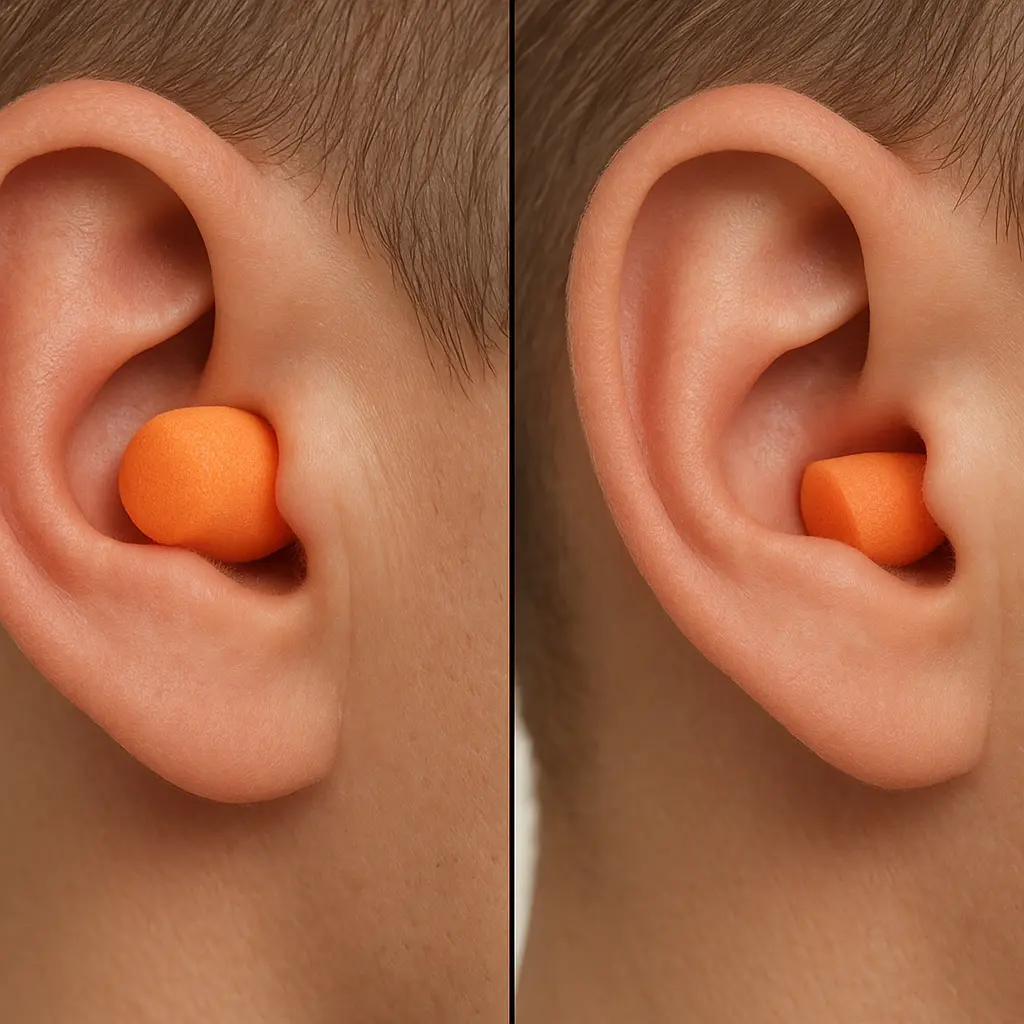
Decibels use a logarithmic scale where every 10dB increase represents a tenfold increase in sound intensity and a perceived doubling of loudness. A 7dB reduction doesn’t block 7% more noise, it reduces perceived loudness by roughly 40-50% depending on frequency content.
In practical terms, if your bedroom measures 50dB with traffic noise, 25dB plugs bring it to approximately 33dB (library quiet), while 32dB plugs reduce it to 26dB (whisper quiet). Both cross the threshold for most people to sleep, but the 32dB option provides more margin when noise spikes occur.
Pro tip: Test perceived difference by comparing normal conversation (60dB) to a whisper (30dB). That 30dB gap feels like moving from clearly audible to barely detectable. The 7dB difference between plug ratings creates roughly one-quarter of that perceptual shift.
The perceptual impact varies dramatically with baseline noise level. At 85dB (heavy traffic), reducing to 60dB with 25dB plugs still registers as noticeably loud, while 32dB plugs bringing it to 53dB crosses into comfortable conversation range. At 70dB (dishwasher level), both ratings achieve quiet enough for sleep.
For construction workers exposed to 95-105dB machinery, the difference determines hearing damage risk. OSHA requires protection that brings exposure below 85dB over eight hours. A 25dB plug leaves you at risk with 100dB equipment, while 32dB protection provides necessary safety margin.
The National Institute for Occupational Safety and Health recommends derating manufacturer NRR values by 50% for typical workplace use, and by 70% for occasional users, to estimate actual protection achieved in field conditions.
The gap between laboratory ratings and actual performance stems from four factors: insertion technique, ear canal variability, plug degradation, and user movement. Laboratory conditions eliminate all four variables, creating best-case measurements that few users replicate.
Insertion technique matters most. Lab testing includes supervised insertion with visual confirmation of proper seal. Most users insert plugs too shallow, failing to pass the first bend of the ear canal where seal quality determines attenuation. Studies measuring worker-achieved fit show 40-60% of users achieve less than half the rated protection.
Ear canal dimensions vary by 300% between individuals. The average adult canal measures 2.5cm long with 7-9mm diameter, but ranges from 1.8-3.2cm length and 5-12mm width. Standard foam or silicage tips fit some canal geometries poorly, creating leak paths that bypass attenuation entirely for specific frequency ranges.
Disposable foam compresses permanently after 3-5 insertions, reducing expansion force and seal quality. The acoustic performance degrades faster than visible wear suggests. Testing used foam plugs reveals 5-10dB reduction in effectiveness after just two uses, yet users commonly reuse them for weeks.
Jaw movement, talking, and sleeping position shift plugs in the canal. Side-sleeping creates pressure against the pillow that pushes plugs partially out or breaks the seal. Each millimeter of displacement reduces low-frequency attenuation disproportionately, sometimes eliminating bass blocking entirely while maintaining high-frequency reduction.
Pro tip: Verify proper insertion by humming with plugs inserted. You should hear significant occlusion effect (your voice sounds booming and internal). Minimal occlusion means poor seal and reduced protection regardless of rated performance.
Sleep noise rarely exceeds 60dB, making 25dB plugs sufficient for most bedroom environments. The goal is reducing intrusive sounds below your hearing threshold without over-blocking to the point where circulatory sounds or tinnitus become prominent. Over-attenuation creates sensory deprivation that many find uncomfortable for sleep.
Travel environments demand higher ratings. Aircraft cabins sustain 75-85dB, making 32dB plugs necessary to reach comfortable levels around 50dB. Train and bus noise similarly benefits from maximum attenuation, particularly for overnight trips where sleep quality matters.
| Noise Environment | Typical dB Level | Recommended Rating |
|---|---|---|
| Bedroom with street noise | 40-55dB | 25dB plugs achieve library quiet (15-30dB result) |
| Shared sleeping space (snoring partner) | 50-70dB | 32dB plugs reduce peaks below disturbance threshold |
| Commercial aircraft cabin | 75-85dB | 32dB essential to reach comfortable 50dB range |
| Construction or manufacturing | 85-110dB | 32dB minimum for hearing conservation compliance |
| Concerts or sporting events | 95-115dB | 32dB protects while maintaining sound clarity |
Different plug designs attenuate frequency ranges differently despite identical overall ratings. Bass frequencies (125-250Hz) from traffic, HVAC systems, and neighbors require plugs that seal deeply in the canal. High frequencies (2000-8000Hz) from voices or appliances get blocked more easily by any seal.
ATTENU8’s 32dB memory foam tips excel at low-frequency attenuation because the foam compresses to fill irregular canal geometry completely. The aluminium body prevents acoustic transmission through the plug material itself, ensuring rated performance across all frequencies. Cheaper plastic-body designs allow sound transmission through the plug structure, reducing effective low-frequency blocking by 5-8dB.
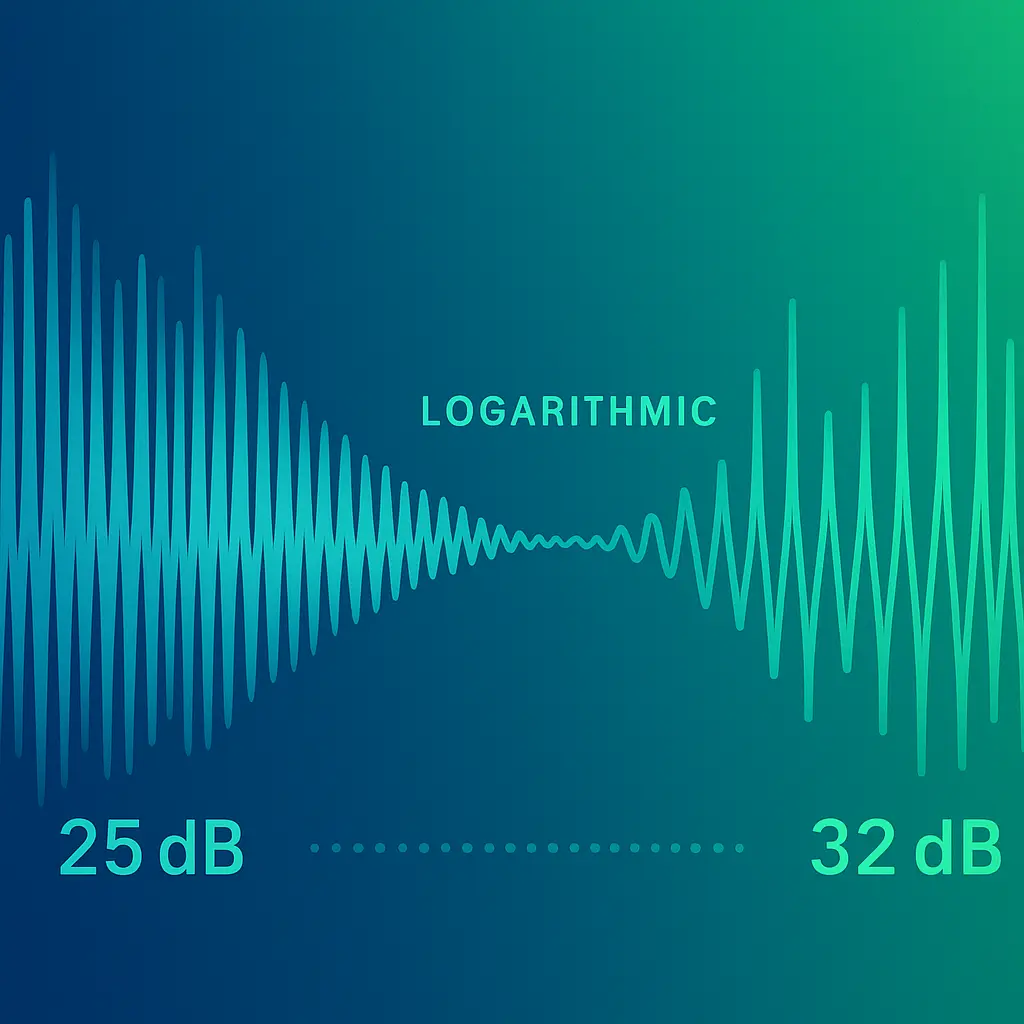
A perfectly fitted 25dB plug outperforms a poorly fitted 32dB plug in every real-world scenario. Seal quality determines actual attenuation more than material or design. The data consistently shows that fit accounts for 60-70% of performance variance between users with identical plugs.
Memory foam tips adapt to individual ear canal shape, expanding to fill the space after compression and insertion. This self-adjusting property creates consistent seal quality across the 300% variation in canal dimensions between users. Silicone flanges require exact size matching and provide good seal only within narrow dimensional ranges.
Metal bodies with replaceable tips solve the degradation problem that destroys disposable plug performance. ATTENU8’s aluminium construction maintains acoustic properties indefinitely, requiring only foam tip replacement every 6-8 weeks. The rigid body prevents acoustic transmission through the plug material and provides consistent insertion depth, both critical for achieving rated attenuation.
Including XS, S, and M foam tips addresses fit variability without requiring users to measure their ear canals. Most people need different sizes for left and right ears due to natural asymmetry. Testing all three sizes identifies which creates best seal, indicated by maximum occlusion effect and comfort during extended wear.
Size selection affects both attenuation and comfort. Too small creates insufficient seal and poor low-frequency blocking. Too large causes pressure pain and prevents full insertion, reducing effectiveness despite discomfort. The correct size should feel present but not painful after 15-20 minutes of wear.
In practice, 60% of users need size S for at least one ear, 25% require M for both ears, and 15% need XS or mixed sizes. Providing all three options ensures proper fit for 95% of users, compared to single-size products that fit only 40-50% adequately.
The concave aluminium body shape serves two purposes. First, it reduces contact area with pillows during side-sleeping, minimizing pressure that pushes plugs out or breaks seal. Standard cylindrical designs create pressure points that become painful within 30-45 minutes of side-sleeping.
Second, the concave profile allows fingertip insertion without tools or excessive depth. Users achieve proper insertion past the first canal bend without risking eardrum contact or requiring practice. This accessibility means actual achieved attenuation matches rated performance more consistently than designs requiring complex insertion techniques.
For most bedroom environments measuring 45-55dB, 32dB plugs are not excessive. They reduce ambient sound to 20-30dB, which remains above the threshold where body sounds become intrusive. Some users with very quiet bedrooms (below 40dB) may prefer 25dB options to avoid over-isolation. Test both ratings if your bedroom baseline is under 40dB; choose 32dB if baseline exceeds 50dB or if you need to block snoring.
The 7dB difference represents roughly 40-50% reduction in perceived loudness. If 25dB plugs make your environment comfortably quiet, 32dB plugs will make it noticeably more silent but not dramatically so. The difference becomes more apparent with louder baseline noise above 70dB, where 25dB leaves you at moderate volume while 32dB achieves genuine quiet. Below 60dB baseline, both ratings typically achieve sleep-compatible silence.
The rating itself doesn’t determine comfort, but higher-rated plugs often use denser foam that requires deeper insertion and creates more occlusion effect. Pressure discomfort comes from size mismatch, not attenuation level. Properly sized 32dB memory foam tips should feel no more uncomfortable than 25dB versions. If you experience pressure pain, try a smaller tip size rather than lower-rated plugs.
No. Perfect insertion maximizes the rated attenuation but cannot exceed the design limits. The 25dB rating assumes correct insertion; improper technique reduces performance to 12-15dB. Similarly, 32dB plugs with perfect fit deliver their rated 32dB, while poor insertion drops them to 16-20dB. You need the higher-rated product to achieve higher protection, combined with proper technique to realize that potential.
Hum or speak with plugs inserted. Strong occlusion effect (your voice sounds booming and resonant inside your head) indicates good seal and near-rated performance. Weak occlusion means poor seal and reduced attenuation. Additionally, high-frequency sounds like rustling paper should become barely audible, while low-frequency rumble should diminish substantially. If conversation-level speech remains clearly intelligible, you are achieving less than half the rated protection.
Metal bodies prevent acoustic transmission through the plug material itself, which foam-only designs allow at low frequencies. This adds 3-5dB effective attenuation for bass-heavy noise like traffic, HVAC, or subwoofers. The rigid structure also ensures consistent insertion depth, improving achieved protection. The main advantage is durability: metal bodies last years with only tip replacement needed, while disposable foam degrades after 3-5 uses, losing 5-10dB effectiveness even before visible wear appears.
Construction environments measuring 85-105dB require 32dB plugs to bring exposure below the 85dB OSHA limit. A 25dB plug leaves workers at 70-80dB with 95dB equipment, which seems safe but allows hearing damage during extended exposure. The 32dB option provides necessary margin when noise spikes occur or when achieved fit is suboptimal. Industries with sustained noise above 90dB should mandate 32dB minimum rating with proper insertion training and fit testing.
What noise reduction rating do you actually achieve with your current ear plugs, and how does it compare to the package claims? Share your experience in the comments.
