


 0
0

If you sleep on your side, you already know the problem. You press your ear into the pillow, and whatever ear plug you’re wearing turns into a pressure point that wakes you up faster than the noise you were trying to block. Standard foam ear plugs were designed for upright use in loud workplaces, not for hours of lateral skull pressure against a mattress. The result is discomfort, poor seal, and a restless night. Finding genuine ear plugs for side sleepers requires understanding exactly why conventional designs fail this specific use case.
| Key Insight | Explanation |
|---|---|
| Ear plug protrusion causes pillow pain | Standard foam ear plugs extend 10-15mm beyond the ear canal, creating painful leverage when your head presses into a pillow. |
| Low-profile body design is non-negotiable | Ear plugs with a slim, flush-fitting body significantly reduce the pressure point that disrupts side sleeper comfort. |
| Memory foam tips outperform standard foam for sleep | Memory foam conforms to your ear canal shape and maintains a seal even as jaw movement or head repositioning occurs during sleep. |
| Tip size directly controls comfort and seal quality | Using the wrong tip size causes either canal pressure or sound leakage. Multiple size options (XS, S, M) are essential for a proper fit. |
| Reusable metal bodies reduce nightly waste and cost | Single-use foam ear plugs degrade quickly. A durable metal-bodied ear plug with replaceable tips lasts far longer and maintains consistent performance. |
| 32dB noise reduction blocks the most disruptive sleep sounds | Snoring typically registers at 50-80dB. A 32dB reduction brings that into a manageable range that does not trigger full arousal from sleep. |
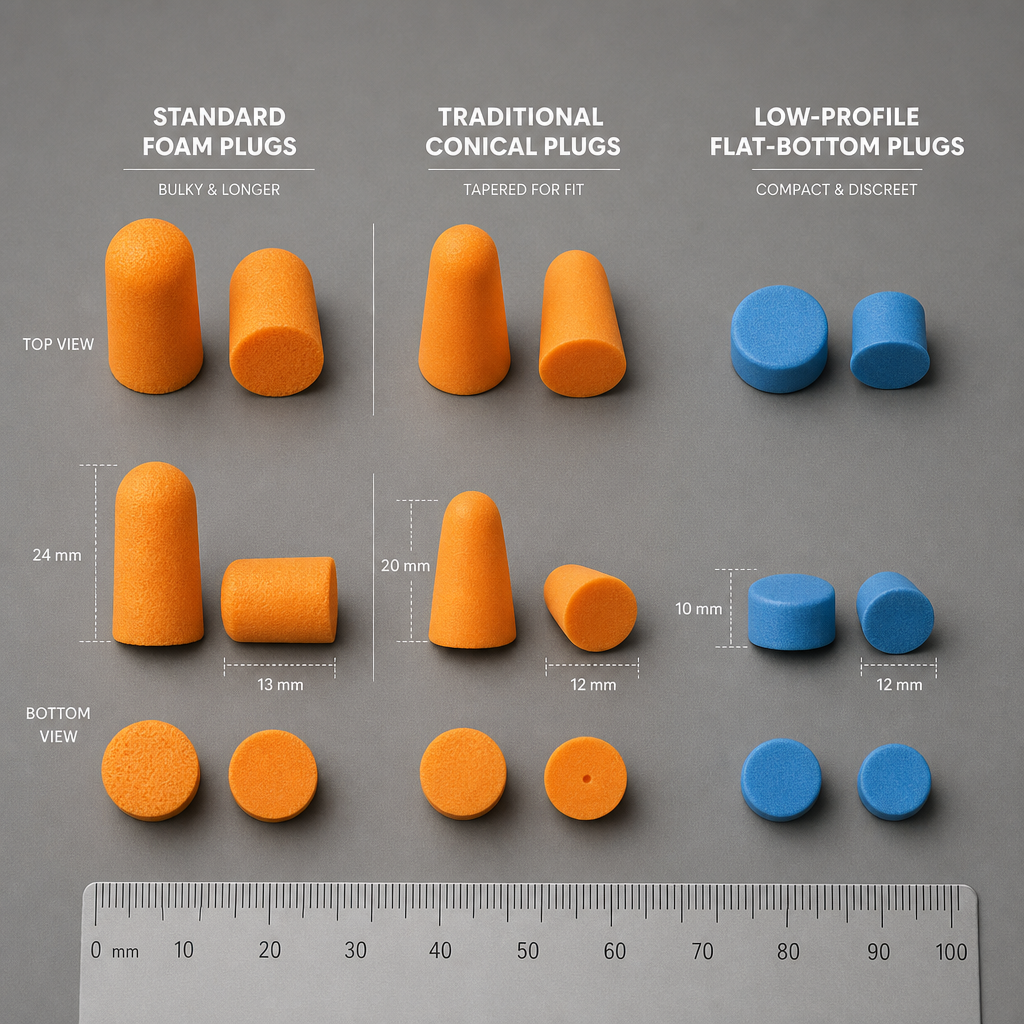
| Flat-bottom tip geometry is the overlooked variable | A tip that is flatter at its outermost edge sits flush against the pillow rather than twisting or creating a fulcrum that dislodges the plug. |
The overwhelming majority of ear plugs on the market are engineered for occupational hearing protection. Construction workers, factory staff, and airline ground crew use them while standing or seated upright. The design brief for those products does not include surviving six to eight hours of lateral compression between a human skull and a memory foam pillow.
Standard rolled foam ear plugs protrude significantly from the ear canal once expanded. That protrusion acts as a fulcrum. When you lie on your side, the pillow pushes against the protruding end, levering the plug deeper into the canal or simply ejecting it entirely. Neither outcome is useful. The pressure also builds at the outer ear, which is rich in cartilage and nerve endings, causing the dull ache that wakes side sleepers in the early hours.
A common mistake is assuming that softer foam solves the problem. Softer foam compresses more easily under pillow pressure, which means the plug loses its seal. You end up with an ear plug that neither blocks sound nor stays comfortable. The material choice matters, but the shape and profile matter more.
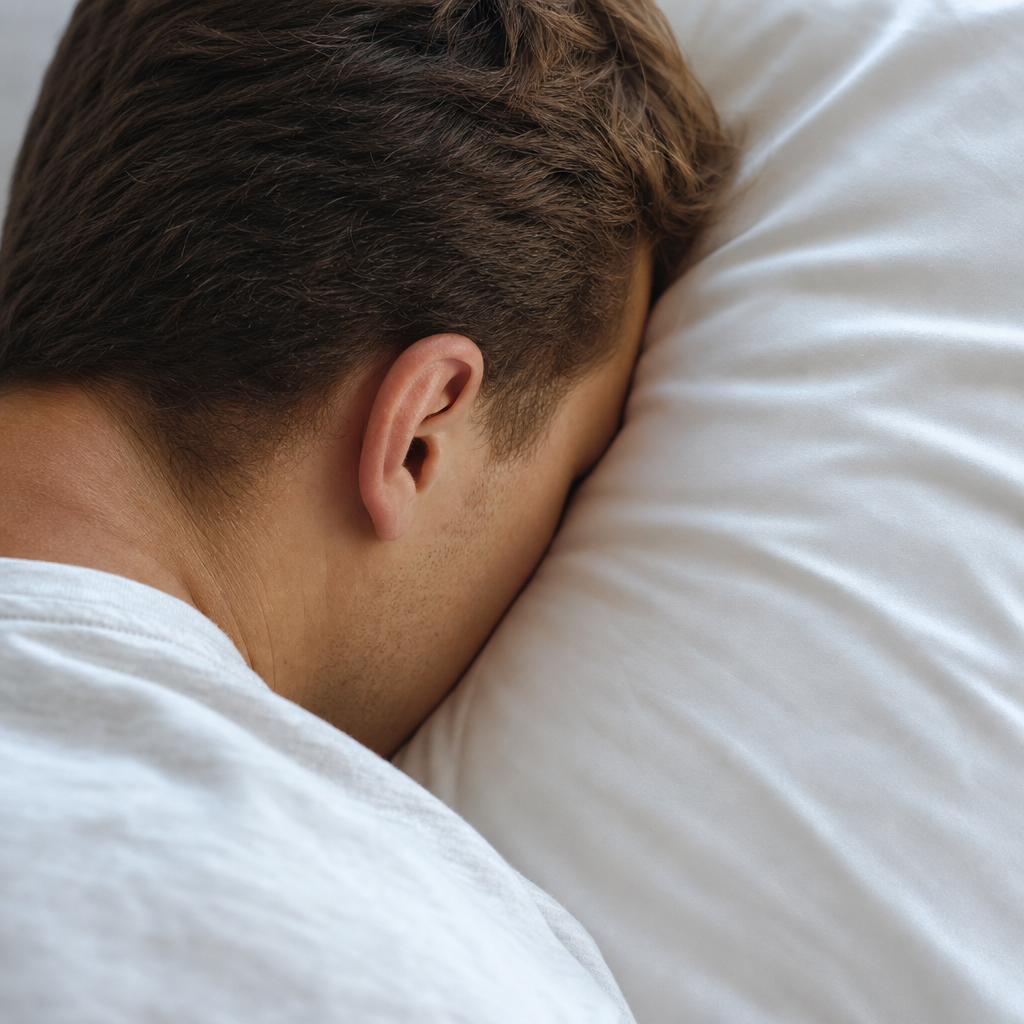
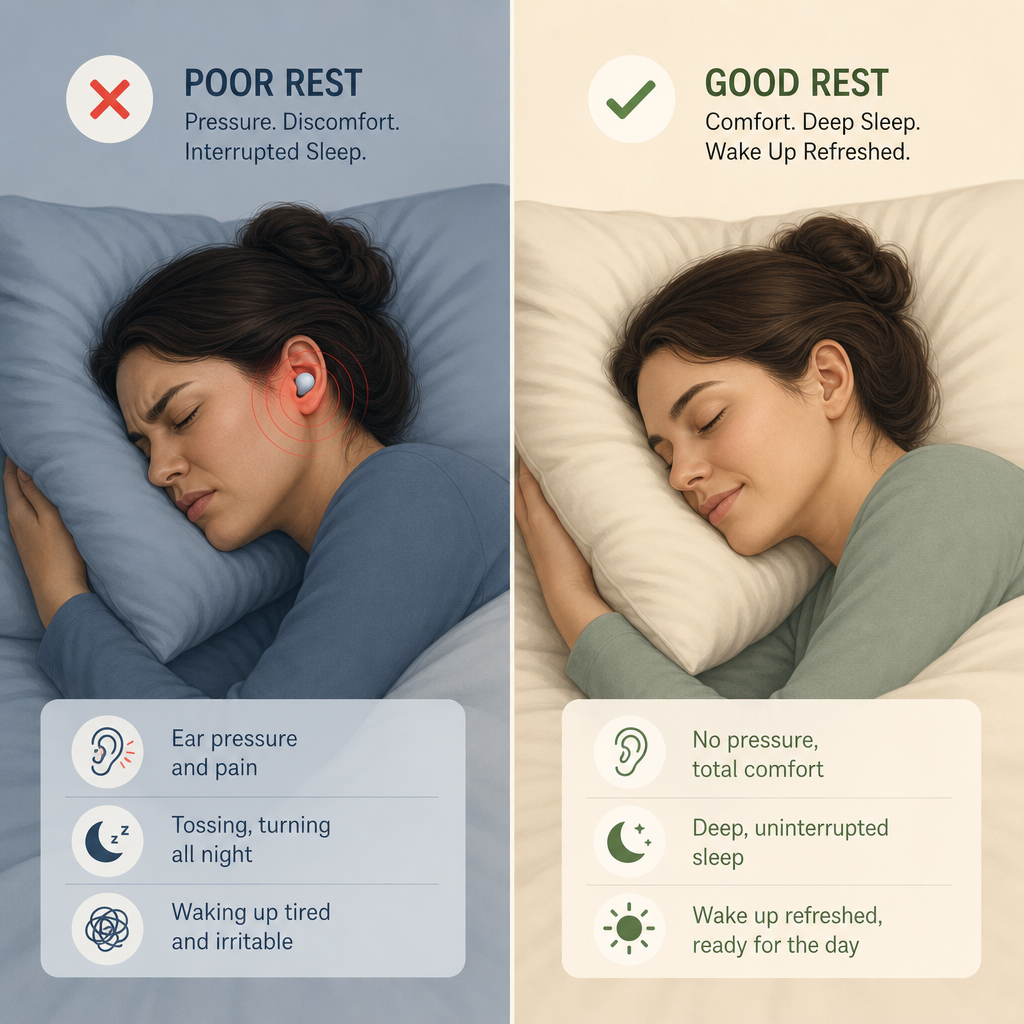
When you lie on your side, the external ear (the pinna) folds slightly inward and the surrounding tissue compresses. Any object protruding from the ear canal is now sandwiched between a rigid skull and a yielding but still resistant pillow surface. The force is not enormous, but it is sustained and directional. Over an hour, that sustained force translates into discomfort significant enough to cause micro-arousals from sleep, even if you do not fully wake up.
According to research published through the National Institutes of Health, noise-related sleep disturbance is associated with increased cardiovascular stress responses even when the sleeper does not consciously wake. The implication is that poor-fitting ear plugs that allow sound to leak through are not just annoying. They are physiologically disruptive. Getting the fit right is not a luxury preference. It is a functional requirement.
The external ear canal is not a straight tube. It runs at an angle, and that angle shifts subtly when jaw muscles relax during sleep and when your head tilts laterally onto a pillow. An ear plug that fits well when inserted upright may lose its seal as you drift into sleep and the canal geometry changes. This is why rigid, one-size-fits-all tips consistently underperform for side sleepers. A tip material that adapts to these micro-changes, the way quality memory foam does, maintains an acoustic seal across the postural shifts of a full night’s sleep.
Even sleepers who manage the initial discomfort often find their ear plugs on the pillow or in the sheets by morning. This happens because pillow movement creates repeated small forces against the protruding plug body. Over dozens of positional shifts throughout the night, those forces accumulate and work the plug loose. A low-profile plug with minimal external protrusion simply has less surface area for the pillow to act against, which is why profile height is one of the most important specifications to check when selecting ear plugs specifically for side sleeping.
Comfort during side sleeping comes from three independent but interacting factors: profile height, tip material, and tip size fit. Get all three right and the ear plug becomes essentially unnoticeable. Get any one of them wrong and you are back to the 3am removal.
Profile height refers to how far the ear plug extends beyond the entrance of the ear canal. Products with a protruding stem, a large handle, or a thick outer flange all create surface area that the pillow can push against. The best ear plugs for lying down have a body that sits as close to flush with the ear opening as possible, or at minimum keeps its lowest possible external profile.
Tip material determines both the initial seal and how well that seal survives movement. Standard PU foam is cheap but compresses under sustained lateral pressure, losing acoustic performance. Memory foam is denser and slower to rebound, which means it holds its shape against the canal wall more effectively even when head pressure shifts. Silicone flanged tips solve the protrusion problem reasonably well but often create a harsher surface contact point that irritates the outer canal during extended wear.
Pro tip: Before buying any ear plug marketed for sleep, check the listed insertion depth and protrusion measurement. If the manufacturer does not publish this, treat it as a red flag. Any product genuinely designed for side sleepers will consider this specification fundamental.
The phrase flat bottom ear plug tips refers to a tip geometry where the outermost face of the plug, the part visible when the plug is inserted, presents a relatively flat rather than convex or tapered surface. This matters specifically for side sleepers because a flat or minimally rounded surface distributes pillow contact force evenly rather than concentrating it at a single point.
A convex or rounded tip end acts like a ball against the pillow. Force is concentrated at the centre point of that curve, which then transmits directly into the canal. A flatter profile spreads that same force across a wider area and reduces the peak pressure at any single point. The reduction in peak pressure is what eliminates the focal ache that wakes side sleepers.
A concave outer surface on the ear plug body, as used in ATTENU8’s aluminium shell, takes the flat-bottom principle further. A concave form actually recesses the central surface away from the pillow contact point, so even under lateral compression the deepest part of the plug exterior is not in direct contact with the pillow material. The contact points become the rim of the concave form, which are closer to the outer ear and further from the canal entrance. This distributes pressure around the periphery rather than driving it axially into the ear canal.
In practice, users report a meaningful difference in overnight comfort when switching from convex-tipped plugs to concave or flat-profile designs. The ear simply stops hurting. That is not a minor quality-of-life detail. For someone who has been tolerating discomfort or abandoning ear plugs altogether, it is the reason they can finally use hearing protection consistently enough to actually improve their sleep.
Not all ear plug categories perform equally for side sleepers. The table below compares the three main options a noise-sensitive sleeper or professional is likely to consider, judged specifically on side-sleeping performance rather than general hearing protection adequacy.
| Ear Plug Type | Side Sleeping Suitability | Key Limitation |
|---|---|---|
| Standard disposable foam (cylindrical roll-down) | Poor. High protrusion, loses seal under pillow pressure, difficult to size correctly. | Protrudes 12-15mm from canal, creates direct leverage point against pillow. Must be discarded frequently, adding ongoing cost and waste. |
| Silicone flanged reusable (triple-flange or mushroom tip) | Moderate. Lower profile than foam cylinders but flanges can create pressure hotspots at the outer canal rim. | Rigid flange material does not conform to canal geometry changes during sleep. Fit is highly sensitive to canal shape; poor fit means sound leakage or discomfort. |
| Metal-bodied with memory foam tips (e.g. ATTENU8) | Best for side sleeping. Concave low-profile aluminium body minimises pillow contact. Memory foam tips adapt to canal geometry shifts during sleep. | Higher upfront cost than disposable foam. Tips require replacement every 6-8 weeks. Must be matched to correct tip size (XS, S, M) for optimal fit. |
“Sleep quality has a larger effect on wellbeing than income or marital status. Disrupted sleep is not a minor inconvenience. It is a measurable health risk.” — Matthew Walker, neuroscientist and author of research on sleep and human performance, via University of California Berkeley.
The data consistently shows that acoustic seal quality directly determines how much noise actually reaches the cochlea, regardless of what the packaging NRR claims. A 32dB-rated plug that loses its seal because of pillow pressure is functionally providing far less than 32dB of attenuation. Choosing the right type for your sleep position is not optional if you want the rated performance to actually apply to your situation.
ATTENU8 approached the ear plug design problem from a fundamentally different starting point than most manufacturers. Rather than adapting an occupational hearing protection device for consumer sleep use, the product centres on the physical realities of extended wear in a lying-down position. The aluminium body is machined with a concave profile that keeps the outer surface of the plug from creating the single-point pressure contact that characterises conventional designs.
The metal body is also substantially thinner and lower-profile than a standard foam cylinder at maximum expansion. When inserted correctly with the right tip size, the outermost point of the ATTENU8 plug sits significantly closer to flush with the ear canal entrance than a rolled foam plug does. That reduction in protrusion is the primary reason side sleepers report being able to wear them through the night without the 3am removal.
The inclusion of XS, S, and M memory foam tips is not just a marketing gesture toward inclusivity. Ear canal dimensions vary significantly between individuals. A plug tip that is too large creates painful canal wall pressure. One that is too small cannot maintain an acoustic seal, particularly as the canal geometry shifts during the postural changes of sleep. The ability to match the tip size to actual anatomy means the seal quality is consistent from insertion through to morning.
Memory foam as a tip material also has a specific advantage for the side sleeper context. Its slow rebound rate means that when the tip is compressed by pillow pressure, it does not immediately spring back and eject itself. It holds its compressed form temporarily, then gradually re-expands as pressure is released. This dynamic is the opposite of what happens with standard PU foam, which rebounds aggressively and can work itself out of position throughout the night.
Pro tip: When testing ear plug size for side sleeping, try inserting the plug while lying on your side rather than standing in front of a mirror. The canal orientation changes in that position, and a tip that feels correct upright may be too large or too small when you are horizontal. Assess the fit where it actually needs to perform.
Single-use foam ear plugs seem inexpensive per unit, but a light sleeper or a shift worker using two ear plugs per night spends considerably more annually than the cost of a premium reusable pair. The more significant cost is the repeated failure. Every night spent discarding a dislodged ear plug at 2am, or tolerating discomfort rather than getting consistent noise reduction, is a night of degraded sleep. ATTENU8’s model of replacing only the foam tips every six to eight weeks retains the structural integrity of the metal body while keeping the acoustic seal consistently fresh.
The Noise Reduction Rating (NRR) printed on ear plug packaging is measured in a laboratory under controlled conditions with correctly fitted plugs. Real-world attenuation is typically lower, because most people do not achieve the laboratory-standard insertion depth and seal. The US EPA and OSHA both note that the real-world effective noise reduction is often estimated at approximately half the stated NRR for practical use purposes.
Even accounting for that real-world adjustment, a 32dB-rated plug delivering an effective 16dB of attenuation makes a meaningful difference. A partner snoring at 65dB becomes effectively 49dB, which sits below the threshold at which most people experience full cortical arousal from sleep. The math is simple and the outcome is measurable. More consistent attenuation across the night, maintained by a plug that stays in place, translates directly to more slow-wave and REM sleep stages.
Road traffic at 50 metres registers at approximately 60-65dB. A partner’s snoring can reach 80dB at close range. Urban ambient noise through a closed window sits around 40-50dB. A 32dB-rated ear plug, even at its real-world effective performance, reduces all of these sources to levels that either fall below or approach the roughly 30-35dB ambient threshold associated with undisturbed sleep in adults. That is the target range. It is achievable, but only if the plug maintains its seal throughout the night, which circles back to the fit and profile requirements discussed above.
Products like those from Flare Audio or Loop Ear Plugs position themselves partly around acoustic filtering, preserving some sound frequencies while attenuating others. That is useful for musicians or for people who need situational awareness. For a side sleeper whose sole objective is uninterrupted sleep in a noisy environment, maximum broadband attenuation with a stable overnight fit is the correct specification. Acoustic filtering is a feature that is largely irrelevant at 2am when a truck accelerates past your bedroom window.
Yes, but only with the right design. Low-profile, concave-bodied ear plugs with correctly sized memory foam tips are specifically suited to surviving the pillow pressure and postural shifts of a full night’s sleep. Standard cylindrical foam plugs are not designed for this use case and regularly migrate out of position during the night.
Start with the medium tip and assess the fit lying on your side rather than standing upright. If the plug feels uncomfortable or creates pressure inside the canal, move down to small. If you notice sound leaking through or the plug sits loosely, move up. The correct tip size should feel snug but not painful, and the plug should require gentle effort to remove, not fall out freely.
Memory foam tips used nightly typically require replacement every six to eight weeks. The foam gradually loses its rebound elasticity and its surface accumulates oils and debris from the ear canal that reduce hygiene and acoustic seal quality. Replacing only the tips on a metal-bodied plug is significantly more economical and sustainable than discarding and replacing an entire plug unit.
In practice, no. The aluminium body of a product like ATTENU8 is compact enough that its weight is negligible compared to the forces already acting on the plug from pillow contact. The rigidity of the metal body actually helps maintain the plug’s geometry under pressure, whereas soft foam bodies can deform under sustained lateral compression and lose their shape and seal.
Sleep-specific ear plugs prioritise maximum broadband noise attenuation, low profile for lying down, and sustained overnight comfort. Concert ear plugs prioritise acoustic filtering to preserve music clarity at reduced volume. Travel ear plugs are often optimised for pressure equalisation and ambient noise reduction during flights. These are genuinely different engineering goals. A product optimised for concerts will underperform for a side sleeper who needs 8 hours of maximum attenuation in a horizontal position.
For most cases, yes, particularly if the seal is maintained consistently. Snoring typically ranges from 50dB to 80dB depending on severity. A 32dB rated plug delivering real-world effective attenuation reduces even loud snoring to levels that approach or fall below the threshold for sleep disruption in most adults. For very loud snoring above 80dB, ear plugs alone may be insufficient and should be combined with positional adjustments or other interventions.
The aluminium body can be wiped with a damp cloth or a mild isopropyl alcohol solution. The memory foam tips should not be submerged in water as this degrades the foam structure. Wipe the tips gently with a dry or slightly damp cloth. Given that tips are replaced every six to eight weeks anyway, deep cleaning of the tips is less critical than cleaning the metal body itself.
Have you tried switching from standard foam ear plugs to a low-profile reusable option for side sleeping? Share what worked, or what did not, in the comments below.

