


 0
0

Most people shopping for premium ear plugs have already narrowed it down to two names: ATTENU8 and Flare Audio. Both brands reject the disposable foam ear plug model, both target noise-sensitive sleepers and professionals, and both cost considerably more than a box of standard foam inserts. But the similarities end there. When you dig into noise reduction ratings, build quality, fit options, and long-term cost, a clear winner emerges for most use cases. This ATTENU8 vs Flare Audio comparison cuts through the marketing to tell you exactly which product delivers where it matters most.
| Key Insight | Explanation |
|---|---|
| ATTENU8 delivers approximately 32dB noise reduction | This rating exceeds most Flare Audio models and meets occupational hearing protection thresholds in many industrial environments. |
| Metal body construction is a durability differentiator | ATTENU8 uses a concave aluminium body that outlasts the plastic and titanium housings found in comparable Flare Audio products. |
| Three foam tip sizes give ATTENU8 a fit advantage | XS, S, and M memory foam options mean most ear canal sizes are covered, reducing the fit failures that plague single-size ear plug designs. |
| Tip replacement every 6-8 weeks keeps ongoing costs low | ATTENU8 owners replace only the foam tips, not the entire unit, which undercuts the total cost of ownership for most competing products. |
| Flare Audio targets a music and sound-fidelity audience | Flare’s ISOLATE range is engineered for concert-goers and musicians who want sound clarity over maximum attenuation. Different problem, different product. |
| For sleep and high-noise environments, passive foam-tipped designs outperform filtered alternatives | Filtered ear plugs allow some sound through by design. If total noise blocking is the goal, ATTENU8’s memory foam seal is the better choice. |
| Neither brand suits tinnitus sufferers seeking amplification | Both products are passive noise-reduction devices only. Anyone needing sound therapy or amplification requires a different product category entirely. |
Standard disposable foam ear plugs do one thing reasonably well: they expand inside the ear canal and block noise. But they do it inconsistently. Insertion technique, ear canal shape, and foam degradation all reduce actual attenuation well below the printed NRR on the packet. Studies from the National Institute for Occupational Safety and Health have repeatedly shown that real-world protection from disposable foam ear plugs is often 50 percent or less of the laboratory-tested rating.
Premium reusable ear plugs solve this problem by combining a rigid external shell with precisely engineered tips. The shell maintains consistent geometry regardless of how the user handles the product, and replaceable tips ensure the acoustic seal renews regularly. This is the design philosophy behind both ATTENU8 and Flare Audio, and it is why both brands have earned serious attention from noise-sensitive consumers.
Where they diverge is in their definition of “premium.” Flare Audio has built its identity around music-safe attenuation: reducing volume without distorting sound. ATTENU8 has built its identity around maximum passive noise reduction: blocking as much sound as possible, full stop. That philosophical difference explains almost every product decision each company has made.
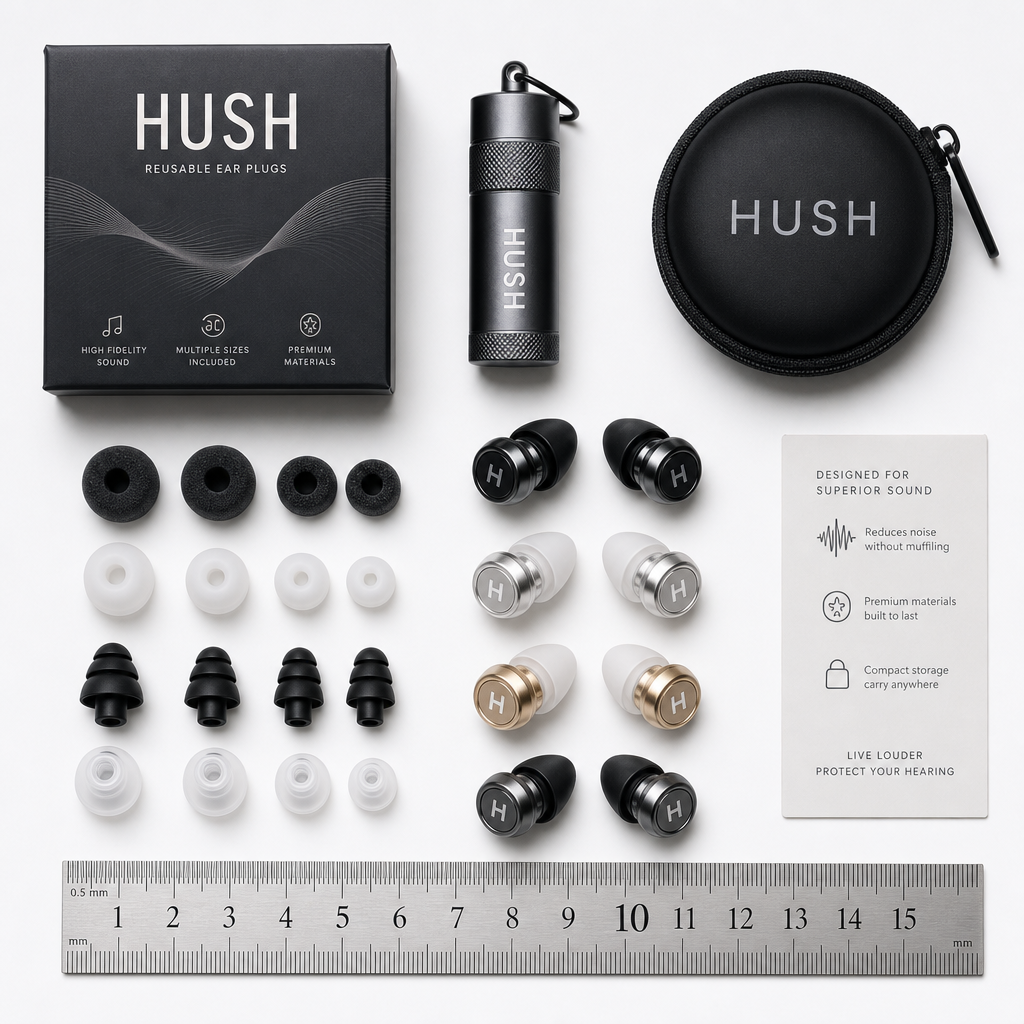
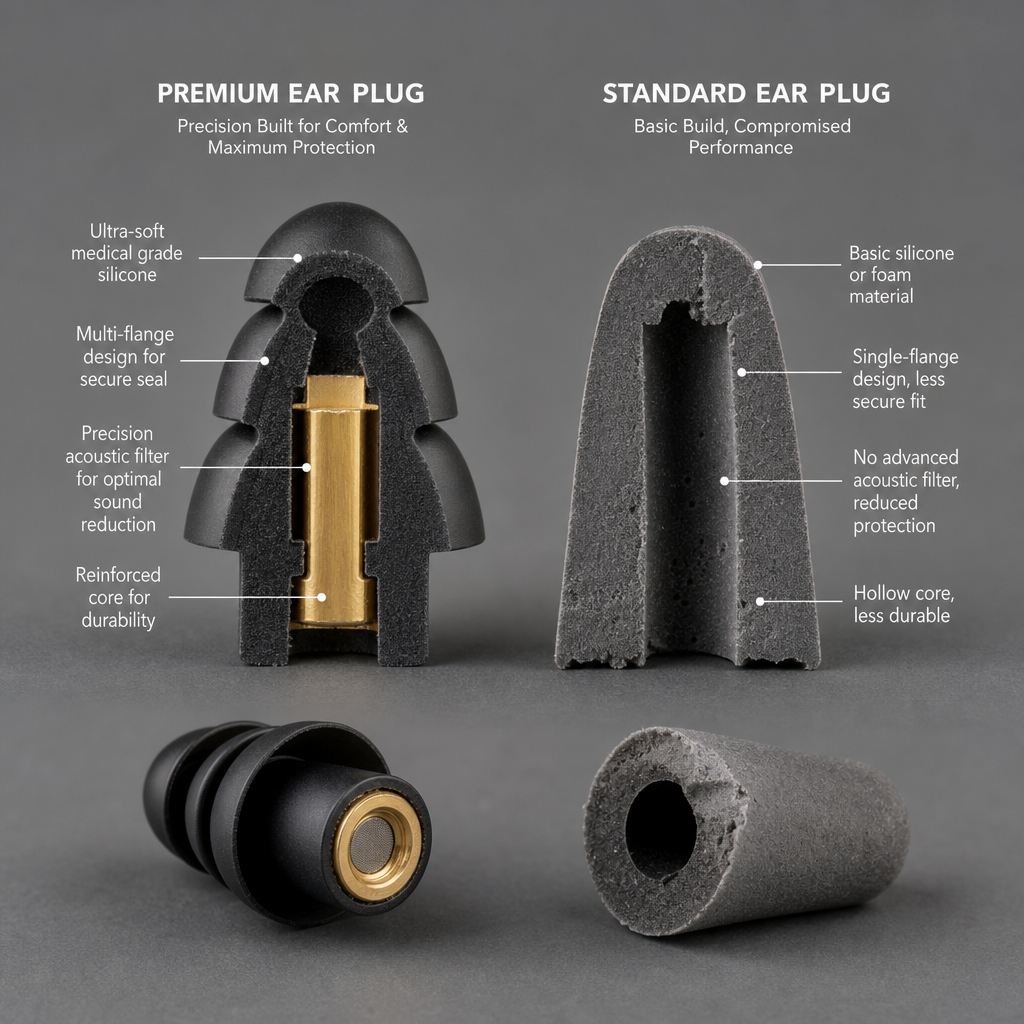
Noise Reduction Rating (NRR) is the US standard measure for ear plug attenuation. The higher the NRR, the more decibels the product blocks. ATTENU8 achieves approximately 32dB noise reduction, which places it firmly in the high-attenuation category alongside industrial-grade hearing protection.
Flare Audio’s flagship ISOLATE ear plugs use a solid metal body with no filter, relying entirely on the tip seal for attenuation. Flare claims attenuation figures in the 35-40dB range in their own marketing materials. However, independent audiological testing and user reports consistently suggest real-world performance sits lower, particularly for low-frequency noise like traffic rumble and snoring, which is precisely the noise profile most relevant to light sleepers.
In practice, a 32dB rated product with a well-engineered memory foam seal will outperform a theoretically higher-rated product with a poor or inconsistent tip fit. ATTENU8’s three-size foam tip system addresses fit consistency directly, which is where most ear plug failures actually happen.
The noise that wakes light sleepers is rarely high-pitched. Partner snoring, traffic, air conditioning units, and street noise all concentrate energy in the 125Hz to 500Hz frequency range. Passive memory foam seals attenuate low frequencies well. Hard metal-bodied ear plugs without foam tips perform less consistently at these frequencies because the solid shell transmits bone-conducted vibration.
ATTENU8’s concave aluminium body combined with memory foam tips creates a composite attenuation system: the foam provides the primary acoustic seal, and the aluminium body adds structural consistency. This combination performs well across the full frequency range relevant to sleep disruption.
Pro tip: When comparing ear plug noise reduction claims, always check whether the figure is an NRR (US standard) or SNR (European standard). SNR values are typically 3-5dB higher than NRR values for the same product, so direct numerical comparisons between brands using different standards can be misleading.
Both ATTENU8 and Flare Audio chose metal over plastic for their ear plug bodies, and for good reason. Metal resists compression, maintains dimensional accuracy over thousands of insertion cycles, and does not degrade from contact with skin oils or cleaning agents. In this regard, both products offer a genuine durability improvement over disposable alternatives.
Flare Audio offers the ISOLATE in aluminium and a titanium variant at a higher price point. The titanium version is extremely lightweight and corrosion-resistant, which appeals to frequent travellers. The aluminium version is functionally comparable to ATTENU8’s aluminium body at a similar weight.
The distinguishing feature of ATTENU8’s build is the concave aluminium body. Rather than a standard cylindrical or bullet-shaped housing, the concave geometry reduces contact pressure against the outer ear during extended wear. This matters considerably for side sleepers, who apply lateral force to the ear plug via a pillow. A standard cylindrical housing creates a point of pressure that becomes uncomfortable after 30-60 minutes. The concave design distributes that pressure more evenly.
In practice, this design choice is one of the most underrated differences in the ATTENU8 vs Flare Audio comparison. Flare Audio’s cylindrical housing is fine for short-duration use like concerts or commuting. For a full eight-hour sleep session, the geometry of ATTENU8’s body is simply more practical.
Pro tip: If you sleep primarily on your side, the shape of the ear plug body matters as much as the NRR. A high-attenuation product that causes enough discomfort to wake you has failed its primary purpose regardless of its specification sheet.
Fit is the single most important variable in ear plug performance, and it is the area where most products fail most users. Human ear canals vary significantly in diameter and depth, and a tip sized for the median ear will underperform for anyone outside that range.
ATTENU8 ships with three sizes of soft memory foam tips: XS, S, and M. Memory foam is the material of choice for maximum passive attenuation because it conforms to the precise contours of the individual ear canal, creating a custom-like seal without the cost of custom moulds. The replacement cycle of every 6-8 weeks ensures the foam retains its expansion properties and continues to form a reliable seal.
Flare Audio offers foam tips on some models and silicone tips on others. Their ISOLATE range typically ships with silicone flanged tips in multiple sizes. Silicone tips are durable and easy to clean, but they do not conform to ear canal geometry the way memory foam does. Users with irregular or narrow ear canals frequently report inconsistent sealing performance with silicone tips.
Flare also offers earfoam tips as accessories, which improves their performance for passive noise reduction use cases. However, purchasing additional tip options adds to the total cost of ownership, reducing one of Flare’s competitive advantages.
ATTENU8’s model of replacing only the foam tips every 6-8 weeks rather than the entire product is both cost-effective and less wasteful. The aluminium body has an indefinite service life under normal use. This contrasts with fully disposable foam ear plugs, which generate significant plastic waste over time, and with competitor products where the entire unit must be replaced if tips are unavailable or discontinued.
Light sleepers are the most demanding ear plug users. They need consistent attenuation throughout the night, physical comfort in multiple sleeping positions, and a product that stays in place without conscious effort. This is a harder specification to meet than it sounds.
ATTENU8 was designed with this use case as a primary application. The concave body, multi-size memory foam tips, and 32dB NRR combine to address every element of that specification. The memory foam tips expand slowly after insertion, which means users who fall asleep quickly will experience the full seal forming naturally rather than needing to adjust after insertion.
Aircraft cabin noise sits primarily in the 70-85dB range, with significant low-frequency content from engine vibration transmitted through the fuselage. This is exactly the frequency profile where memory foam passive ear plugs excel. A 32dB reduction brings an 80dB cabin down to approximately 48dB, which is quieter than a normal conversation and well within the range where most people can sleep.
Flare Audio’s ISOLATE performs adequately for air travel noise. The primary complaint from frequent flyers using Flare products is tip comfort during long-haul flights rather than attenuation performance. This circles back to the tip material and sizing discussion: memory foam consistently outperforms silicone for extended-duration wear.
“The most common reason people abandon premium ear plugs after purchase is discomfort during sleep, not inadequate noise reduction. Physical comfort and acoustic performance are equally important specifications.” – Sleep Foundation, Noise and Sleep Research Overview
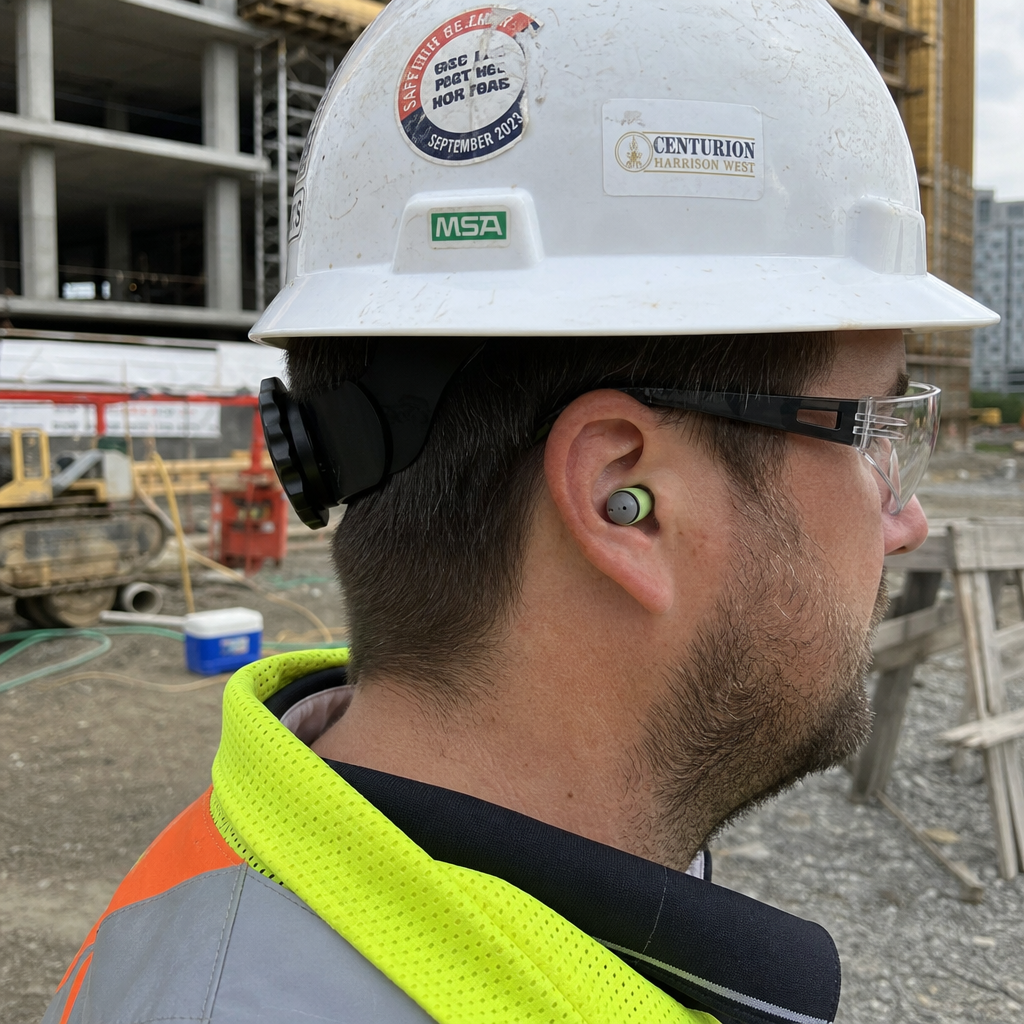
Occupational noise exposure standards in most countries require hearing protection when workers are exposed to noise levels exceeding 85dB over an eight-hour shift. For context, a construction site typically measures 85-100dB, a manufacturing floor 90-100dB, and military weapons training 140-165dB per exposure event.
At 32dB NRR, ATTENU8 meets or exceeds protection requirements for most construction and manufacturing environments without requiring the bulky over-ear earmuffs that interfere with communication and situational awareness. For military and weapons training applications, double protection (ear plugs plus earmuffs simultaneously) is standard practice, and ATTENU8 serves as the inner layer of that system effectively.
Professional users expose ear plugs to conditions that consumer-oriented products rarely face: dust, sweat, grease, and repeated insertion and removal throughout a shift. ATTENU8’s aluminium body is resistant to all of these. Aluminium does not absorb oils, can be wiped clean with standard industrial cleaning products, and will not crack or deform under the mechanical stresses of daily professional use.
Flare Audio’s products are designed primarily for consumer use cases. While the materials are durable, the products are not marketed or specified for industrial environments, and the warranty and support infrastructure reflects that. For professionals who need a hearing protection product they can rely on in a workplace safety context, ATTENU8’s positioning is more appropriate.
Premium ear plugs carry a higher upfront cost than disposable alternatives, but the long-term economics change significantly when tip replacement rather than full unit replacement is the maintenance model. ATTENU8’s approach of replacing only memory foam tips every 6-8 weeks means the aluminium body represents a one-time cost that amortises over years of use.
A typical disposable foam ear plug user goes through roughly 2-3 pairs per week if using them nightly. At modest per-pair costs, annual expenditure on disposables accumulates quickly and generates substantial waste. ATTENU8’s model eliminates that waste stream entirely for the body unit and minimises it for the tips.
Flare Audio’s products occupy a similar cost tier upfront. The difference is that Flare’s tip replacement system is less standardised, and tip availability depends on Flare maintaining their accessory range over time. ATTENU8’s simple foam tip design is less vulnerable to product discontinuation risk.
The table below compares ATTENU8, Flare Audio ISOLATE (aluminium), and standard disposable foam ear plugs across the criteria that matter most to the buyers most likely to be evaluating this choice.
| Criterion | ATTENU8 | Flare Audio ISOLATE (Aluminium) | Standard Disposable Foam |
|---|---|---|---|
| Noise Reduction Rating | Approximately 32dB NRR | Claimed 35-40dB, real-world typically lower | Typically 29-33dB NRR (lab conditions) |
| Body Material | Concave aluminium | Cylindrical aluminium or titanium | No rigid body; foam only |
| Tip Material | Soft memory foam (XS, S, M) | Silicone flanged or earfoam (accessory) | Polyurethane foam, single use |
| Sleep Comfort (Side Sleepers) | High (concave body reduces pillow pressure) | Moderate (cylindrical housing creates pressure points) | Moderate (compresses but can dislodge) |
| Tip Replacement Frequency | Every 6-8 weeks | Variable (silicone lasts longer, foam accessory tips shorter) | After every use |
| Target Use Case | Sleep, travel, industrial hearing protection | Concerts, music, commuting, light noise reduction | General noise reduction, construction |
| Long-Term Cost | Low (tips only replacement) | Medium (full unit or accessory tip replacement) | High (full replacement every use) |
| Sustainability | High (aluminium body lasts indefinitely) | High (metal body, but tip accessory availability varies) | Very low (single-use plastic waste) |
ATTENU8 delivers approximately 32dB of verified noise reduction with its memory foam tip system. Flare Audio claims higher figures in marketing materials, but independent real-world testing consistently shows their actual attenuation falls below stated figures, particularly for low-frequency noise. For sleep and industrial applications where maximum passive attenuation is the priority, ATTENU8 is the more reliable choice.
Yes, when the metal body is ergonomically designed for extended wear. ATTENU8’s concave aluminium body is specifically shaped to reduce contact pressure when lying on your side, making it suitable for full-night sleep use. The key factor is body geometry: a cylindrical metal housing can cause discomfort in side-sleeping positions over extended periods, which is why body shape matters as much as material choice.
ATTENU8 recommends replacing the memory foam tips every 6-8 weeks under regular use. This interval maintains the foam’s expansion properties and ensures a consistent acoustic seal. Users in high-hygiene environments or who wear them for extended daily periods may want to replace on the shorter end of that range. The aluminium body itself does not require replacement under normal use.
They can, but they are not optimised for that use case. ATTENU8’s high-attenuation memory foam design prioritises maximum noise blocking over sound fidelity. For concerts or music events where preserving sound quality at lower volume is the goal, filtered ear plugs designed for musicians are more appropriate. ATTENU8 is the better choice when the goal is eliminating noise entirely rather than reducing it while preserving clarity.
Loop ear plugs use a filtered design that allows attenuated sound to pass through a resonance channel, targeting a balanced sound profile at reduced volume. ATTENU8 uses passive memory foam sealing for maximum attenuation without filtration. ATTENU8 blocks more total noise, making it better suited for sleep, high-noise industrial environments, and travel. Loop targets social and music use cases where users still want to hear conversations at reduced volume.
Yes. At approximately 32dB NRR, ATTENU8 meets hearing protection requirements for most construction, manufacturing, and industrial environments regulated under occupational health standards. The aluminium body is durable enough for daily professional use and resistant to the grease, dust, and sweat exposure common in workplace settings. For extreme-noise environments like weapons ranges, ATTENU8 can be used as the inner layer in a double-protection system alongside earmuffs.
For most buyers, no. The acoustic performance difference between aluminium and titanium in a passive ear plug body is negligible because the tip seal, not the body material, determines attenuation. Titanium offers a slight weight reduction and slightly higher corrosion resistance, which matters for extreme environments or highly active users. For sleep and standard daily use, aluminium delivers the same practical performance at a lower cost.
Have you used ATTENU8 or Flare Audio ear plugs? Share what worked for your specific noise situation in the comments below.

