


 0
0

The average commercial aircraft cabin registers between 85 and 105 decibels during cruise altitude. That is louder than a lawnmower and well above the threshold where sustained exposure causes fatigue and sleep disruption. If you have ever landed after an overnight flight feeling worse than when you boarded, cabin noise is almost certainly a major culprit. Choosing the right ear plugs for flying is not a minor comfort upgrade. It is the single most effective intervention for getting genuine sleep on a plane, and most travellers are still doing it wrong.
Aircraft cabin noise is not just loud, it is relentless. The constant low-frequency roar of jet engines creates a broadband noise profile that occupies nearly every frequency the human ear is sensitive to. Unlike a single loud event, this sustained exposure keeps your nervous system in a low-level alert state, suppressing the deep sleep stages that actually restore your body.
Research published by the National Institutes of Health confirms that sleep in environments above 55 decibels shows measurable reductions in slow-wave and REM sleep. At 85 to 100 decibels, meaningful sleep becomes nearly impossible without active noise management.
Add in crying infants, announcements, and the person next to you watching a film without headphones, and the acoustic environment of a plane is genuinely hostile to rest. The good news is that reducing perceived noise by even 20 to 30 decibels is enough to shift your sleep architecture back toward something useful.
| Key Insight | Explanation |
|---|---|
| 32dB NRR is the benchmark for flight sleep | Ear plugs rated at 32dB noise reduction cut cabin noise to levels where meaningful sleep is physiologically possible for most people. |
| Foam tip size is more important than brand | A correctly sized soft memory foam tip seals the ear canal completely. An oversized or undersized tip leaks noise and causes discomfort that wakes you mid-flight. |
| Reusable metal-bodied ear plugs outlast the trip | Disposable foam plugs degrade after one or two uses. A durable aluminium-bodied ear plug with replaceable foam tips maintains consistent performance across hundreds of flights. |
| Insertion technique determines actual noise reduction | Even a 32dB-rated ear plug delivers far less protection if inserted incorrectly. Compress, insert, and hold until foam expands fully in the canal. |
| Ear plugs outperform noise-cancelling headphones for sleep | Headphones require battery power, create pressure on the ears during long wear, and are impractical when lying against a seat or pillow. Ear plugs have none of these limitations. |
| Replace foam tips, not the whole ear plug | Premium reusable ear plugs only require foam tip replacements every 6 to 8 weeks. This reduces both cost and plastic waste compared to single-use alternatives. |
| Pre-flight insertion beats reactive use | Inserting ear plugs before takeoff prevents the loudest noise exposure and signals your body that sleep conditions are being established, supporting faster sleep onset. |
When you see a noise reduction rating on a product, that number is measured in controlled laboratory conditions. In practice, real-world attenuation is typically 50 to 70 percent of the stated NRR figure, depending on fit. This means a 32dB rated ear plug delivers approximately 16 to 22dB of actual noise reduction in everyday use. That is still enough to bring a 95dB aircraft cabin down to roughly 73 to 79dB, which is within a range where sleep becomes achievable.
Products rated below 25dB NRR are unlikely to provide sufficient attenuation for in-flight sleep. They may be adequate for muffling voices or softening ambient office noise, but the low-frequency engine drone requires meaningful physical sound blocking, which only a well-fitted, high-rated ear plug delivers.
The ear canal is not a uniform tube. It curves, varies in diameter between individuals, and shifts shape when you move your jaw. Soft memory foam tips conform to this geometry in a way that rigid silicone flanged tips cannot. They create a seal rather than just a plug, which is why foam consistently outperforms silicone for raw decibel reduction in travel contexts.
ATTENU8 ear plugs come with three tip sizes, XS, S, and M, which matters because most competing products offer a single size and expect everyone to make it work. The XS tip alone opens up genuine hearing protection to a substantial portion of the population with smaller ear canals, including many women and younger adults, who are routinely underserved by standard one-size-fits-all products.
Pro tip: Before your next flight, test all three foam tip sizes at home. Insert each one, wait two minutes for full expansion, and tap the ear plug body gently. The size that produces the deepest, most resonant blocking sensation is your correct fit. Use that size exclusively for travel.
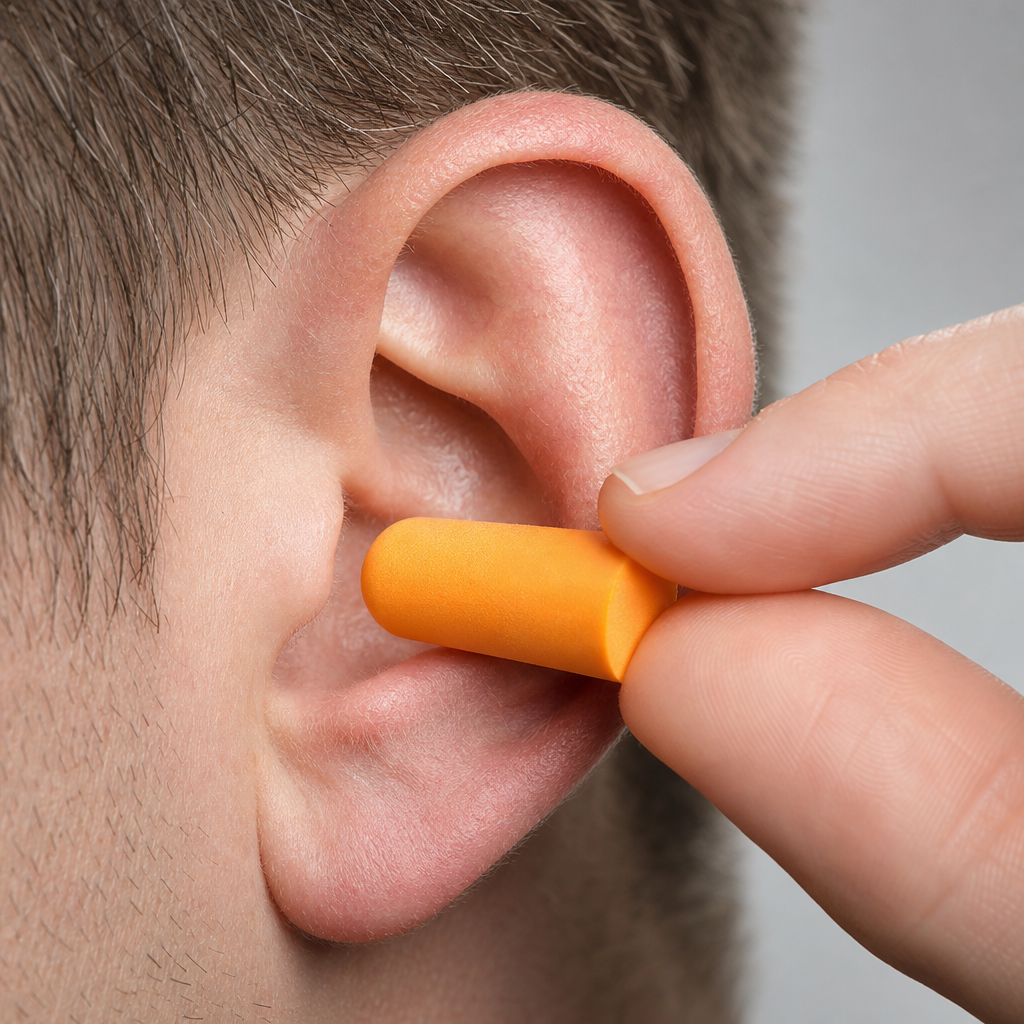
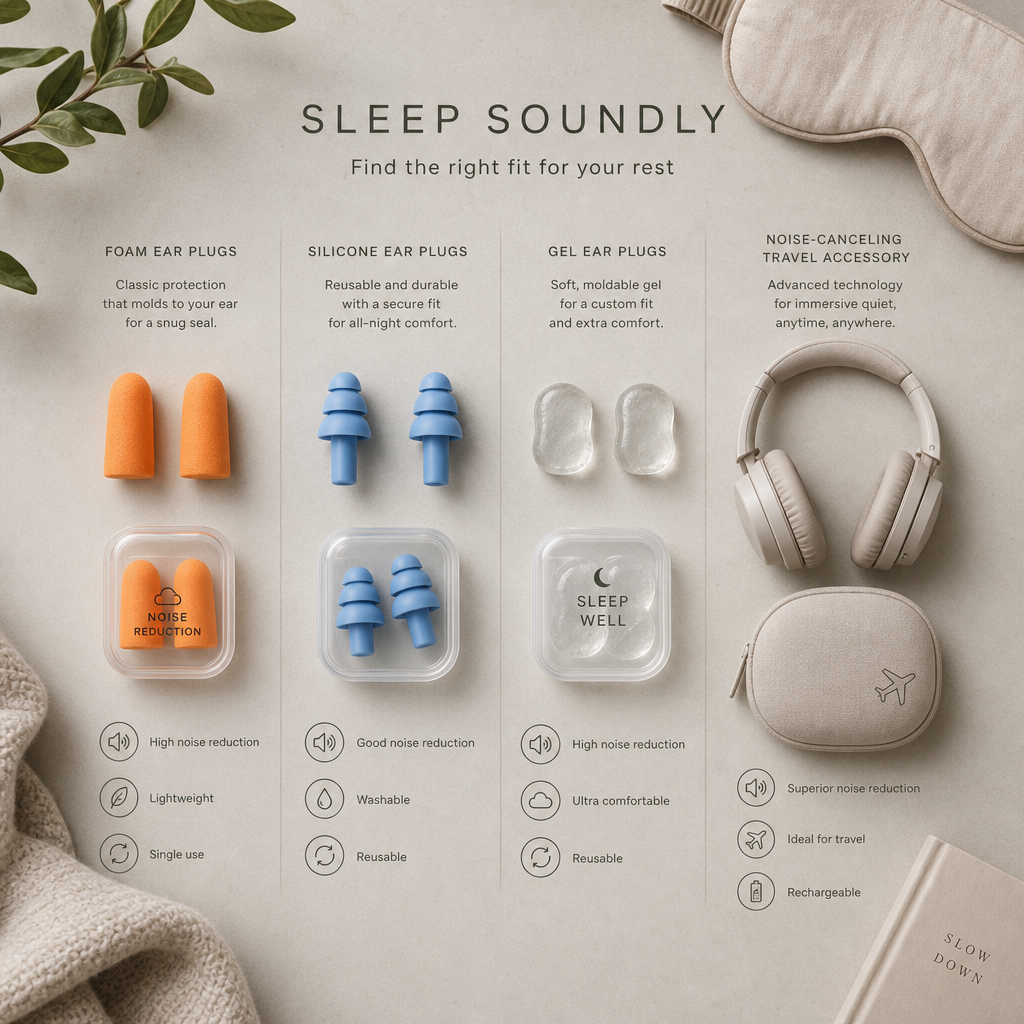
The standard argument for disposable foam ear plugs is convenience. You grab a pair at the airport pharmacy, use them, and throw them away. The argument against is performance, reliability, and the complete absence of any hygiene logic on long-haul routes where you might wear them for ten or twelve hours.
A disposable foam ear plug that has been compressed, expanded, and worn for several hours begins to lose its recovery speed. The foam does not spring back as firmly, which degrades the seal. By the second use, most budget foam plugs are already operating well below their stated NRR. This is not a minor degradation. In practice, a second-use disposable plug rated at 33dB may be delivering closer to 18 to 22dB, which is a significant drop in a high-noise environment.
A premium reusable ear plug with an aluminium body separates the structural element from the consumable element. The body, which handles insertion, shape retention, and durability, lasts indefinitely. The foam tips, which do the acoustic work, are replaced every 6 to 8 weeks under normal use. You are never flying with degraded foam because you control the replacement cycle.
This is the model ATTENU8 is built on. The concave aluminium body gives you a consistent grip point for clean insertion and removal, which also matters when you wake up disoriented at 2am over the Pacific and need to take them out without fumbling. The body does not bend, does not absorb earwax at the structural level, and does not end up compressed at the bottom of your carry-on bag looking like something you found on the floor.
“The primary failure mode for ear plugs in travel settings is not the product specification, it is the degraded condition of the product at the moment of use. Reusable designs with replaceable tips solve this problem structurally.” – Sleep science commentary on hearing protection for travellers, cited in occupational health literature.
Ear plugs for flying are the foundation, but they work best as part of a deliberate system. Noise reduction alone will not guarantee sleep if light, posture, and temperature are working against you. The goal is to reduce the total number of sensory inputs that can trigger a micro-awakening.
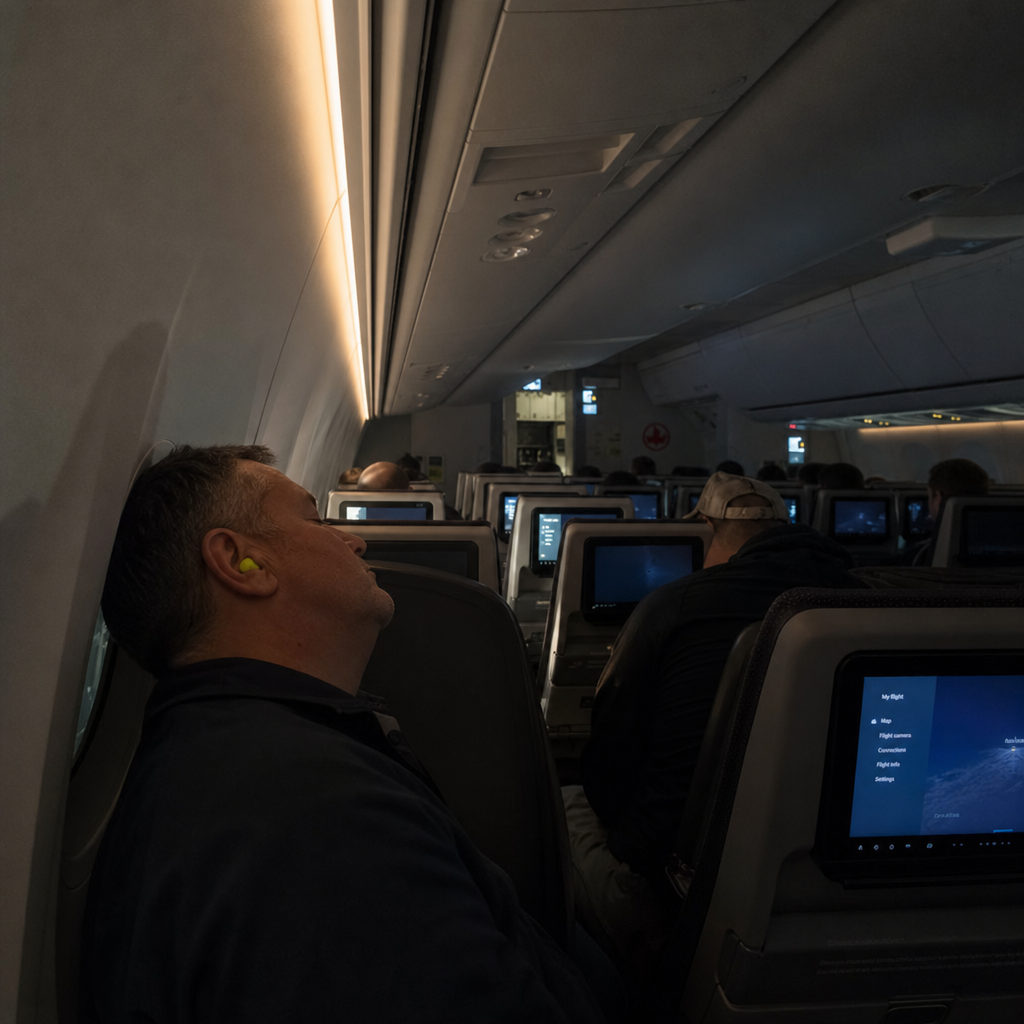
Window seats beat middle and aisle seats for sleep on almost every metric. You have a wall to lean against, you control the blind, and you are not disturbed by neighbouring passengers getting up. On long-haul flights, booking a window seat specifically for sleep is worth a modest fare difference or a portion of your frequent flyer points.
A travel pillow that supports the neck in a neutral position prevents the head-drop that jolts you awake. The U-shaped neck pillow is not optimal for window seat sleepers. A wrap-around or full-chin-support pillow keeps your head stable against the cabin wall, especially when turbulence hits.
An eye mask blocks the galley lights, overhead reading lights, and the screen glow from neighbouring passengers. Combined with ear plugs rated at 32dB, an eye mask addresses the two dominant sensory channels that prevent sleep. Temperature regulation is handled by dressing in layers and requesting a blanket immediately after boarding rather than waiting until you are already cold and alert.
Avoid alcohol as a sleep aid. It shortens time-to-sleep onset but fragments sleep architecture, particularly in the second half of the flight. You may fall asleep faster but wake up multiple times and land feeling more fatigued. Hydration with water is the better pre-sleep protocol on a plane.
Pro tip: Insert your ATTENU8 ear plugs before takeoff, not after the aircraft reaches cruise altitude. The engine run-up and climb phase are the loudest parts of the flight. Blocking this noise from the outset also signals your body that the environment is being prepared for sleep, which supports faster sleep onset once the cabin dims.
A common mistake is treating ear plug insertion as a casual action. Most people roll the foam tip between two fingers, push it into the ear canal about halfway, and let go. The result is an ear plug that sits at the canal entrance rather than within it, blocking maybe 10 to 15dB instead of the rated 32dB.
The correct technique for memory foam ear plugs involves three steps. First, compress the foam tip completely between your thumb and forefinger for 10 to 15 seconds. Second, reach over your head with the opposite hand to gently pull the top of your ear upward, which straightens and opens the ear canal. Third, insert the compressed foam tip and hold it firmly in place for 30 to 45 seconds while it expands to fill the canal fully.
If you feel significant discomfort or pressure pain within ten minutes of insertion, the tip is too large. Switch to the next size down. If you can hear speech clearly through the ear plug without raising your voice, the tip is too small or not fully inserted. Correct fit should feel like a firm, even pressure with no sharp edges or localised soreness.
The three-size system in ATTENU8 ear plugs, XS, S, and M, exists precisely because ear canals do not conform to a single standard. Most travellers have never actually tested all three sizes back to back. The size that works is often not the one you would guess. XS and S are correct for a larger proportion of the adult population than manufacturers typically acknowledge, because the M tip shipped with most single-size products is oversized for a significant percentage of users.
There are three dominant approaches to noise management on flights: passive ear plugs, active noise-cancelling headphones, and electronic noise-masking earbuds. Each has a legitimate use case, but they are not equally effective for sleep.
| Approach | Noise Reduction for Sleep | Practical Limitations for Long-Haul Travel |
|---|---|---|
| Premium Reusable Ear Plugs (e.g. ATTENU8, 32dB NRR) | High. Passive attenuation of 16 to 22dB real-world, broadband frequency coverage including engine drone. No battery required. | Minimal. Correct tip size needed for full seal. No electronic components to fail. |
| Active Noise-Cancelling Headphones (e.g. over-ear ANC models) | Moderate to high for low-frequency engine noise. Less effective for mid and high frequencies like speech and announcements. | Significant. Battery dies on very long flights. Physically uncomfortable when lying against seat or pillow. Cannot be worn flat. Not suitable for side-sleeping. |
| Standard Disposable Foam Ear Plugs | Moderate initially. Degrades rapidly with use. Real-world performance often below 20dB by second use. | Inconsistent. No size options. Hygiene concerns on multi-day travel. Contributes to plastic waste across frequent travel. |
The data consistently shows that passive ear plugs outperform ANC headphones for sleep-specific use cases because they require no power, create no ear pressure from electronics, and remain functional when you are lying against a seat headrest. Noise-cancelling headphones excel for listening use during waking hours. They are genuinely poor sleep tools for anyone who moves during sleep or travels in anything less than business class with fully flat seating.
For noise reduction travel purposes, the correct framing is: use premium reusable ear plugs as your primary sleep tool, and use ANC headphones for awake entertainment. These are complementary products, not competing ones.
Yes. Ear plugs do not seal the ear canal completely in the way that would prevent pressure equalisation. The Eustachian tube, which connects the middle ear to the throat, handles cabin pressure changes independently of the outer ear canal. Foam ear plugs sit in the outer canal only and do not interfere with this mechanism. If you experience ear pain during descent, it is Eustachian tube dysfunction, not a product issue. Swallowing, yawning, or chewing gum are the correct responses.
A minimum of 32dB NRR is the practical benchmark for flight sleep. Aircraft cabins at cruise altitude typically reach 85 to 100dB. Applying the real-world reduction factor of 50 percent to a 32dB rated product gives approximately 16dB of actual attenuation, which brings most cabin environments into the 70 to 80dB range where sleep is physiologically achievable for the majority of people. Products rated below 25dB NRR are insufficient for this specific environment.
Loop and Flare Audio products are primarily designed around wearable aesthetics and mild social noise filtering, with noise reduction ratings typically in the 18 to 27dB range. ATTENU8 targets the maximum noise reduction use case with a 32dB NRR, a durable aluminium body built for repeated travel use, and a three-size foam tip system that addresses fit across a wider range of ear canal geometries. For light social filtering, lower-rated products are adequate. For genuine sleep on a noisy commercial flight, the 32dB specification is the relevant threshold.
Under typical travel use, foam tips should be replaced every 6 to 8 weeks. This accounts for normal foam compression fatigue, accumulation of earwax that degrades the foam surface, and gradual loss of the expansion speed that creates a proper canal seal. Replacing only the foam tips, rather than the entire ear plug, keeps ongoing costs low and ensures the product consistently delivers its rated noise reduction. ATTENU8 is specifically designed around this replacement model.
At 32dB NRR, flight safety announcements made over a cabin PA system at standard aircraft volume will still be audible, though softer. Cabin crew speaking directly to you at normal volume may require you to briefly remove one ear plug. This is a deliberate trade-off for sleep. If you are concerned about missing specific announcements, inform the cabin crew before sleep that you are wearing hearing protection and ask to be notified directly. Most airlines are accommodating of this request.
For commercial air travel, ear plugs are decisively better than ear muffs for sleep purposes. Ear muffs with equivalent attenuation ratings are physically large, incompatible with airline seating headrests and neck pillows, and generate significant heat during multi-hour wear. They are appropriate for short-duration industrial environments where hearing protection is the only priority. On a ten-hour overnight flight where comfort, portability, and sustained wearability are equally important, in-ear foam plugs with a high NRR rating are the correct tool.
If you have a travel ear plug strategy that works particularly well for you, or a flight route where noise has been a persistent problem, share your experience in the comments. Real-world context from frequent travellers is genuinely useful here.
We would love your feedback and any insights you would share with others. What perspective would you add?

