


 0
0

Most people asking whether metal ear plugs are safe are doing so because they have already tried cheap foam disposables and found them frustrating, uncomfortable, or simply not durable enough to rely on. The short answer is yes, aluminium ear plugs are safe when designed correctly, and in many ways they are safer and more hygienic than the single-use foam plugs most people default to. But there are genuine questions worth answering: Does metal conduct sound differently? Can a rigid body damage the ear canal? And what makes one metal-bodied design safer than another? This article addresses all of it directly.
The safety concern most people have centres on the idea of placing a rigid metal object inside the ear canal. This is a reasonable concern, and it deserves a direct answer rather than reassurance without explanation.
A well-designed aluminium ear plug never places the metal body in direct contact with the ear canal. The metal shell sits at the ear canal entrance or just inside the outer rim, while a soft memory foam tip, sized to the individual ear, creates the acoustic seal. The metal does not press against the delicate skin of the ear canal at any point during normal use.
The key word is “well-designed.” A concave aluminium body with correctly sized foam tips distributes any light pressure evenly and prevents the rigid material from bearing directly on tissue. This is the same principle used in professional in-ear monitors worn by touring musicians for hours at a time.
| Key Insight | Explanation |
|---|---|
| Metal does not touch the ear canal | Soft memory foam tips create the seal; the aluminium body sits at the entrance, not inside the canal wall. |
| Aluminium is non-toxic and hypoallergenic for most people | Anodised or finished aluminium does not leach chemicals into skin and is far safer long-term than cheap PVC foam compounds. |
| 32dB noise reduction is clinically meaningful | The U.S. Occupational Safety and Health Administration (OSHA) requires hearing protection in environments above 85dB. A 32dB NRR rating comfortably covers most industrial and sleep-disruption scenarios. |
| Foam tip replacement every 6-8 weeks maintains hygiene | Old foam degrades and harbours bacteria. Replacing tips on a schedule means the seal quality and sanitary standard remain high without replacing the entire plug. |
| Fit matters more than material for safety | An ill-fitting ear plug of any material, foam or metal, can cause pressure injuries or an incomplete seal. Three tip sizes (XS, S, M) are the minimum range needed to accommodate real ear anatomy variation. |
| Metal ear plugs reduce long-term waste | A durable aluminium body that only requires foam tip replacements generates a fraction of the plastic waste of single-use disposable plugs used daily for sleep or shift work. |
| Not all metal ear plugs are equal | Cheap metal-cased plugs with hard tips or poor ergonomic shaping can be uncomfortable and potentially harmful. Body shape, tip softness, and size range are the differentiating factors. |
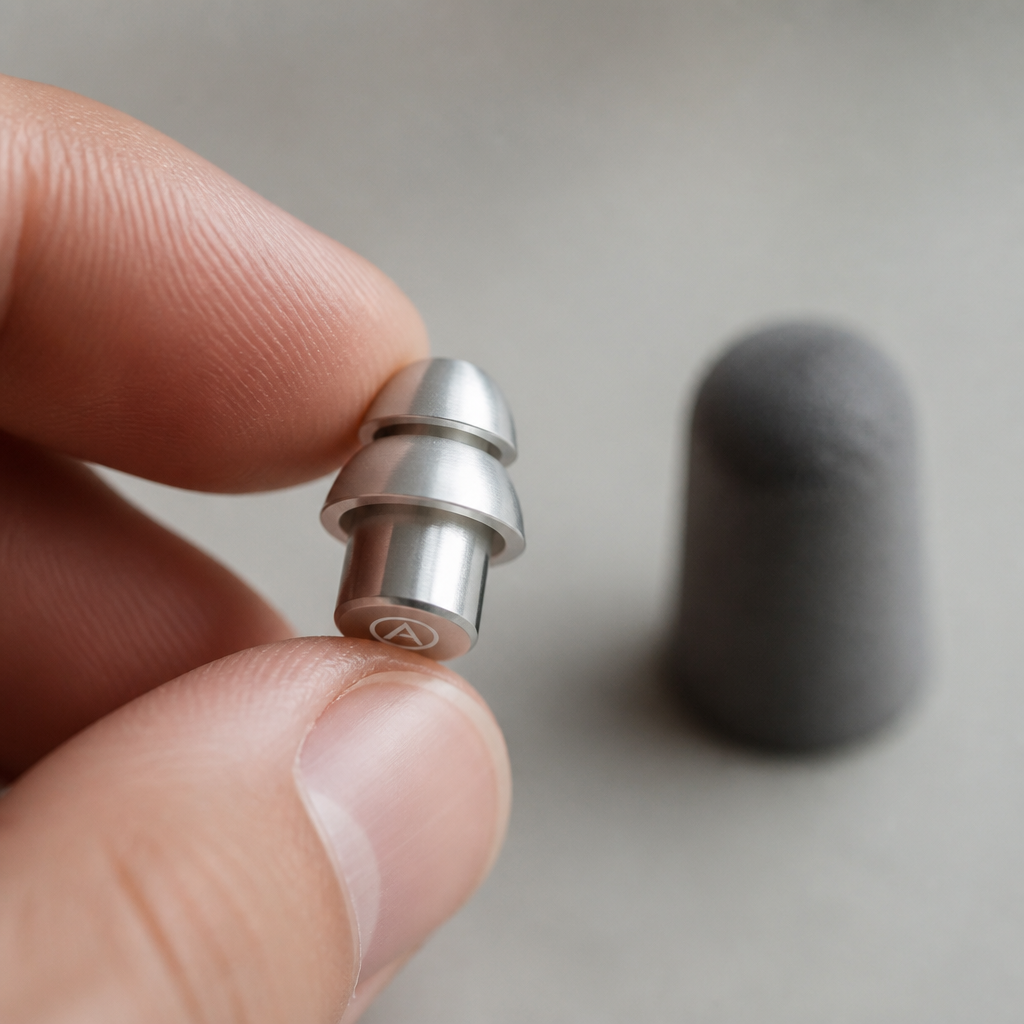
Understanding the mechanics makes the safety question easier to answer. An aluminium ear plug like those made by ATTENU8 uses a two-part system: a rigid outer body that gives the plug its shape and durability, and a replaceable memory foam tip that does all the acoustic and physical work inside the ear.
The aluminium body is a structural housing. It maintains consistent geometry across thousands of insertions, meaning the plug never compresses, deforms, or loses its shape the way a disposable foam plug does after a single night. The concave design also helps with grip during insertion and removal, which reduces the chance of fumbling the plug too deep into the canal.
Aluminium is used specifically because it is lightweight, corrosion-resistant, and does not react with sweat, cerumen (earwax), or skin oils over time. A stainless steel body would work structurally but would add unnecessary weight. Plastic bodies, used by competitors like Loop and Flare Audio, are lighter but more prone to cracking, UV degradation, and static buildup in dusty industrial environments.
The foam tip is the component doing the real acoustic work. It compresses on insertion, then slowly expands to conform to the specific geometry of the ear canal, creating an airtight seal. This is what produces the noise reduction rating. The metal body holds the tip at the correct insertion angle and depth, preventing over-insertion, which is one of the most common causes of ear canal abrasion with traditional foam plugs.
Pro tip: Always match the foam tip size to your ear before your first full night of use. Insert the plug with the smallest tip that still gives a full seal. Using an oversized tip creates outward pressure that causes soreness over several hours, regardless of whether the body is metal or plastic.
A common misconception is that the metal body of an ear plug amplifies or conducts sound differently than a plastic or foam body. This idea comes from the general knowledge that metal conducts vibration well. In practice, this concern does not apply to how these plugs function.
Sound transmission in ear plugs is governed almost entirely by the acoustic seal at the ear canal, not by the shell material. The foam tip, when properly seated, is the barrier. The rigid aluminium body sits outside this seal and has no meaningful acoustic contact with the ear canal wall. The metal body is acoustically irrelevant to noise reduction performance.
The Noise Reduction Rating (NRR) is measured under ANSI S3.19 standards and represents the decibel reduction achievable under controlled conditions with proper fit. A 32dB NRR is at the high end for commercially available ear plugs. For context, the U.S. National Institute for Occupational Safety and Health (NIOSH) recommends applying a 50% derating to NRR ratings in real-world conditions, which would place real-world performance at approximately 16dB of reduction. That is still enough to bring a 100dB construction site environment down to 84dB, just below OSHA’s 85dB action threshold.
For sleep, a 32dB NRR brings a 65dB urban bedroom noise floor (street traffic, an aircon unit) down to approximately 33-35dB, which is within the range most people find comfortable for sleep. This is a practical, meaningful difference, not a marketing figure.
“Noise-induced hearing loss is entirely preventable. The challenge is not the technology, it is consistent, comfortable use. A plug that hurts will not be worn.” – Dr. Richard Neitzel, Associate Professor of Environmental Health Sciences, University of Michigan School of Public Health, speaking on occupational hearing protection compliance.
This is precisely where metal-bodied plugs justify their design. Consistent geometry and correctly sized foam tips mean the plug fits the same way every single insertion. Disposable foam plugs require the user to roll, compress, and hold the plug in place for 30 seconds while it expands. In practice, many people skip steps or under-insert, cutting their effective NRR significantly.
Hygiene is one of the strongest arguments for metal-bodied ear plugs over disposable foam alternatives. This is an area that most buyers do not think about until they have already been using ear plugs daily for several months.
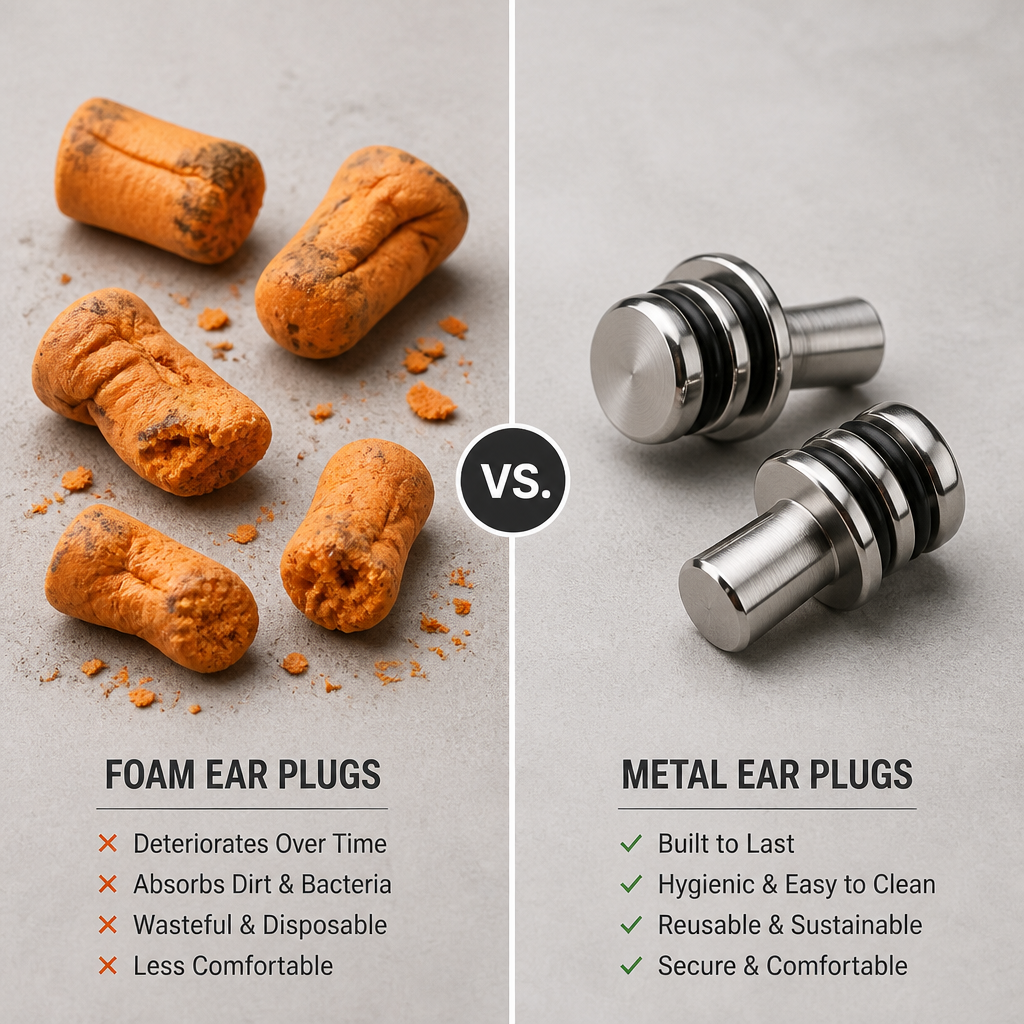
Disposable foam ear plugs are typically made from polyurethane or PVC foam. These materials are porous at a microscopic level. After a single use in a warm ear canal, the foam has absorbed moisture, cerumen, and skin cells. Most people reuse them anyway, particularly for sleep, because buying new plugs every night is impractical. The result is a degraded foam plug carrying bacterial load pressed against the thin skin of the ear canal for 7-8 hours.
A 2018 study cited in occupational health literature noted that reused foam ear plugs from industrial workers showed measurable contamination with skin flora bacteria, including Staphylococcus epidermidis, after just two uses. This is not a trivial hygiene concern for people sleeping with plugs every night.
The ATTENU8 model separates the durable component (the aluminium body) from the consumable hygiene component (the foam tip). Replacing foam tips every 6-8 weeks means the user always has a fresh, uncompressed, uncontaminated sealing surface without discarding a perfectly functional aluminium housing.
The aluminium body itself can be wiped clean with an alcohol swab in seconds. Aluminium does not absorb moisture or oils and does not support bacterial biofilm formation the way foam does. This is a meaningful long-term advantage for anyone using ear plugs daily.
Pro tip: Keep a dated label or calendar reminder when you install fresh foam tips. Foam that has been in daily use for more than 8 weeks loses a measurable amount of elasticity, which reduces its ability to fully seal the ear canal and lowers your effective noise reduction, even if the tip still looks intact.

It helps to see how metal-bodied ear plugs measure against the alternatives across the specific dimensions that matter to daily users and hearing protection professionals.
| Feature | ATTENU8 Aluminium Ear Plugs | Loop / Flare (Plastic-Bodied Reusable) | Standard Disposable Foam |
|---|---|---|---|
| Body Material | Anodised aluminium | ABS or polycarbonate plastic | Polyurethane or PVC foam |
| Noise Reduction Rating | Approximately 32dB NRR | Varies: 18-27dB depending on model | 28-33dB NRR (when correctly inserted) |
| Durability | Body lasts indefinitely; tips replaced every 6-8 weeks | Body lasts 12-24 months; tips replaced periodically | Single use or 2-3 uses maximum |
| Hygiene Profile | Non-porous metal body; fresh foam tips on schedule | Plastic body can harbour oils; tip hygiene varies | Porous foam absorbs contamination immediately |
| Fit Consistency | Rigid body maintains geometry; 3 tip sizes (XS, S, M) | Consistent shape; fewer tip size options on some models | Inconsistent; depends on user rolling technique each time |
| Comfort Over 8 Hours | High when correctly sized; memory foam conforms to canal | Moderate; silicone tips can create pressure over time | Variable; degraded foam creates pressure points |
| Environmental Impact | Low ongoing waste; only foam tips discarded | Low; full unit rarely replaced | High; each pair is single-use plastic waste |
A responsible assessment of any ear protection device includes honest acknowledgement of risks. Metal-bodied ear plugs are safe in normal use, but there are specific scenarios and user errors that can create problems.
Using a foam tip that is too large for the ear canal creates sustained outward pressure against the ear canal wall. Over several hours of sleep, this can cause soreness, minor abrasion, or in extreme cases, temporary canal irritation. This risk exists with any ear plug type but is worth mentioning because the rigid aluminium body means the plug does not compress the way a full-foam plug would under accidental pressure.
The solution is straightforward: use the correct tip size. ATTENU8 provides XS, S, and M tips specifically to cover the realistic range of adult ear canal dimensions. Start with the smallest size that still provides a full seal.
Anyone with a perforated eardrum, active ear infection, or chronic ear canal inflammation should consult a medical professional before using any ear plug, including aluminium-bodied models. Ear plugs of any material are contraindicated during active infection because they trap moisture and create an environment that worsens infection.
People with nickel sensitivity should note that most aluminium alloys used in consumer products, including anodised aluminium, do not contain significant nickel. However, if a person has broad metal sensitivity or dermatographic urticaria, a patch test is worth doing before extended use.
This is a genuine practical consideration for side sleepers. Pressing the side of the head into a pillow while wearing any ear plug creates lateral force on the plug. With a foam plug, this force is absorbed by the foam. With a metal-bodied plug, the rigid housing transmits some of this force to the outer ear.
In practice, most side sleepers find this manageable because the concave body design reduces the profile that contacts the pillow. Using a contoured memory foam pillow with an ear cutout eliminates this concern entirely and is a worthwhile investment for anyone using ear plugs for sleep long-term.
Metal-bodied ear plugs are not universally the right choice for every person in every situation. But they are the right choice for a specific and large group of users, and it is worth being direct about who that is.
Daily sleep users benefit most. The hygiene advantage of replaceable tips, combined with consistent geometry that delivers the same fit every night without any rolling or preparation technique, makes aluminium ear plugs significantly better than disposable foam for this use case. A person using ear plugs every night for a year will go through approximately 365 pairs of disposable foam plugs. With ATTENU8, they replace foam tips six to seven times.
Industrial and occupational hearing protection users also benefit substantially. In noisy environments where plugs are inserted and removed multiple times across a shift, the durability of the aluminium body means the plug never degrades mid-shift the way a reused foam plug does. The 32dB NRR provides sufficient attenuation for most construction, manufacturing, and event environments when correctly fitted.
Frequent travellers dealing with aircraft cabin noise or hotel environments are a strong fit. The metal body is compact, easy to clean, and does not deform in a bag or pocket the way foam plugs do. They survive checked luggage, TSA screening, and the kind of incidental compression that destroys a foam plug’s acoustic integrity before it is even used.
People who have tried plastic-bodied reusable plugs like Loop or Flare Audio and found them uncomfortable or insufficiently attenuating will often find that the higher NRR of a 32dB metal-bodied plug with true memory foam tips addresses both issues. The acoustic performance gap between 18-20dB plastic plugs and a 32dB memory foam-tipped aluminium plug is not subtle in a noisy environment.
No. Aluminium ear plugs do not generate sound or vibration, and a correctly designed metal-bodied plug keeps the rigid aluminium body outside the ear canal entirely. The foam tip handles all contact with canal tissue. The risk of hearing damage from wearing ear plugs comes from improper insertion technique or ignoring existing ear conditions, not from the body material being metal.
Yes, with appropriate sizing and sleeping position awareness. Side sleepers should use a pillow that accommodates the plug body without pushing it hard against the outer ear. Correctly sized foam tips ensure no excessive outward pressure is placed on the ear canal wall during the night. Thousands of daily sleep users wear metal-bodied ear plugs without incident when they use the right tip size.
Aluminium-bodied ear plugs with memory foam tips generally outperform plastic-bodied alternatives on NRR. Products like Loop Quiet and Flare Audio’s range typically deliver 18 to 27dB of noise reduction. A metal-bodied plug with a proper memory foam seal, such as ATTENU8’s design, achieves approximately 32dB NRR. That difference is meaningful in any environment above 85dB and is noticeable even for sleep use in urban environments.
Aluminium, particularly anodised aluminium, is non-reactive in contact with skin. It does not leach compounds at body temperature, does not corrode with moisture exposure, and is not absorbed transdermally. It is widely used in medical device housings, hearing aid components, and surgical instruments. The relevant safety consideration is the shape and softness of the tip rather than the chemistry of the metal body.
Every 6 to 8 weeks with daily use. Foam degrades with repeated compression and moisture exposure. Tips that have been used daily for longer than 8 weeks lose elasticity and no longer expand fully to fill the ear canal geometry, which reduces your effective noise reduction even if the NRR on the packaging remains the same. Replacing tips on schedule is the single most important maintenance step for maintaining both hygiene and acoustic performance.
Most metal allergies are nickel allergies, and aluminium does not contain nickel. Anodised aluminium also has an oxidised surface layer that acts as a barrier between the base metal and skin. Genuine aluminium hypersensitivity is extremely rare. However, if you have a diagnosed broad-spectrum metal allergy or have had reactions to aluminium-containing products, check with a dermatologist before prolonged use.
Yes, and in several ways they outperform disposable foam in occupational settings. The rigid body survives being placed in a pocket, on a toolbox, or in a dirty work environment without deforming or collecting debris in a way that affects performance. The 32dB NRR meets OSHA hearing protection requirements for most industrial noise exposures. Replaceable foam tips mean the plug can be maintained at full performance throughout a long working day without replacing the entire unit.
Have you switched from disposable foam to metal-bodied ear plugs? Share what difference you noticed in comfort or noise reduction after the first week of use.

