


 0
0

A 2023 study from University College London found that ambient noise above 65 decibels reduces reading comprehension scores by up to 30%. If you study in a dorm, café, or shared apartment, you are almost certainly working above that threshold without realising it. Using ear plugs for studying is not a workaround for people who cannot concentrate. It is a evidence-backed method to protect your cognitive performance during the hours that matter most. This article explains exactly why noise wrecks focus, which ear plug options genuinely work for students, and how to make the habit stick.
| Key Insight | Explanation |
|---|---|
| 32dB reduction is the practical target for serious study sessions | At 32dB attenuation, common dorm or café noise is reduced to a whisper-level background, preventing the attention splits that drain working memory. |
| Fit determines performance more than brand | An ear plug rated 32dB that sits loosely in your canal delivers far less real-world protection. Multiple tip sizes are not a luxury, they are essential for accurate fit. |
| Foam tips wear out every 6-8 weeks under regular use | Compressed or dirty foam loses its seal and drops your effective NRR significantly. Replacing tips rather than the whole ear plug saves money and maintains performance. |
| Disposable foam plugs are a false economy for students | Students who study 4-5 hours daily go through hundreds of disposable pairs per semester. A reusable metal-bodied pair with replaceable tips is dramatically cheaper over a term. |
| Ear plug comfort directly affects how long you study | Hard plastic or poorly shaped plugs cause pressure pain after 45-60 minutes. Memory foam tips on a shaped aluminium body distribute pressure evenly, making 3-4 hour sessions tolerable. |
| Consistency in ear plug use builds a focus trigger | When you pair ear plug insertion with the start of a study session every day, your brain begins to associate the act with deep focus. This is a conditioned cue, not just noise reduction. |
| Blocking noise is not the same as blocking all sound | You want attenuation, not total silence. At 32dB reduction, you remain aware of fire alarms and urgent calls while eliminating distracting conversation and traffic noise. |
The core problem is not volume. It is unpredictability. Research published by the Journal of the Acoustical Society of America shows that irregular, speech-like noise is far more cognitively disruptive than steady background hum because your brain cannot habituate to it. Every unexpected word fragment pulls your attention toward identifying whether it is relevant to you.
This phenomenon is called the irrelevant speech effect. Even when you think you are tuning out a conversation in the background, your phonological processing system is still partially engaged with it. The result is reduced capacity in working memory, which is precisely the cognitive resource you need for reading, problem-solving, and memorisation.
In practice, students often misattribute poor session quality to tiredness or motivation when the actual cause is a noisy environment chipping away at their working memory capacity for hours. Fixing the environment fixes the output. Ear plugs that genuinely block noise while studying address the root problem directly.
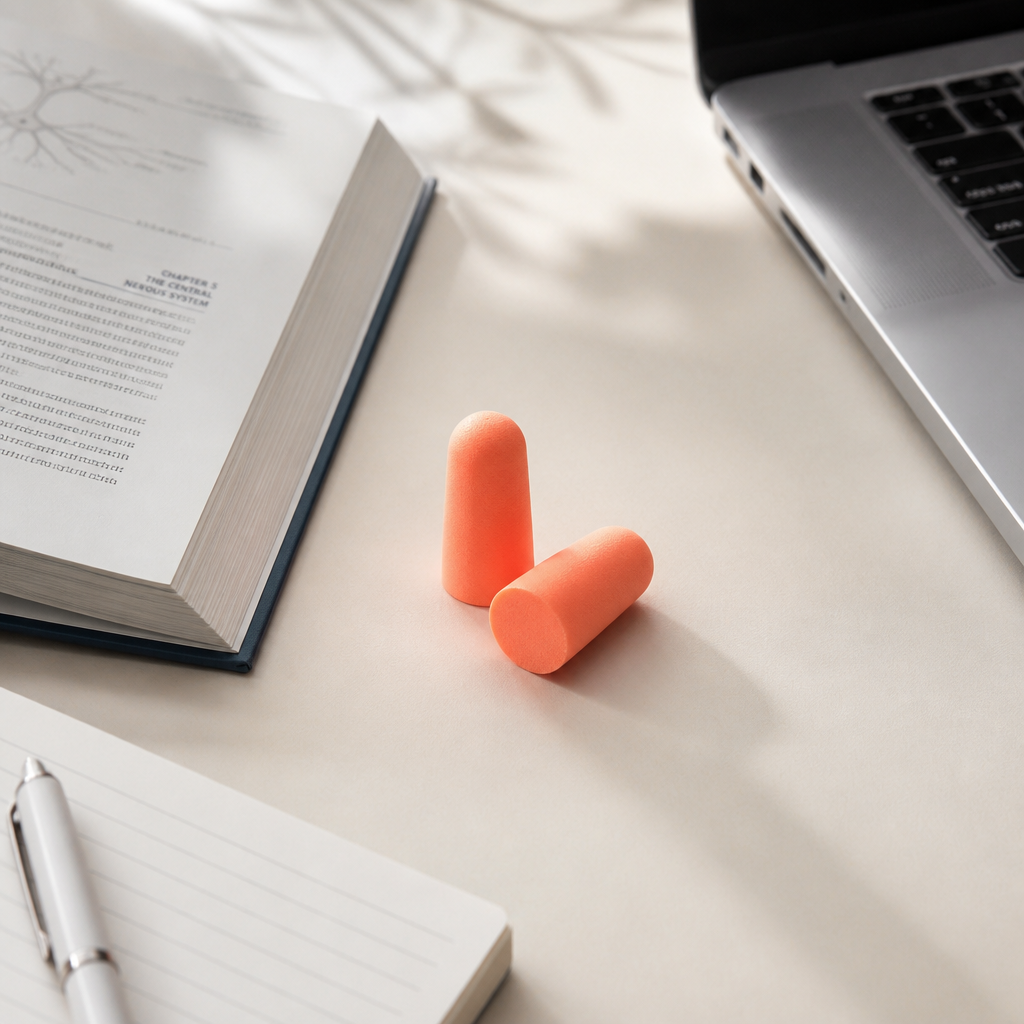
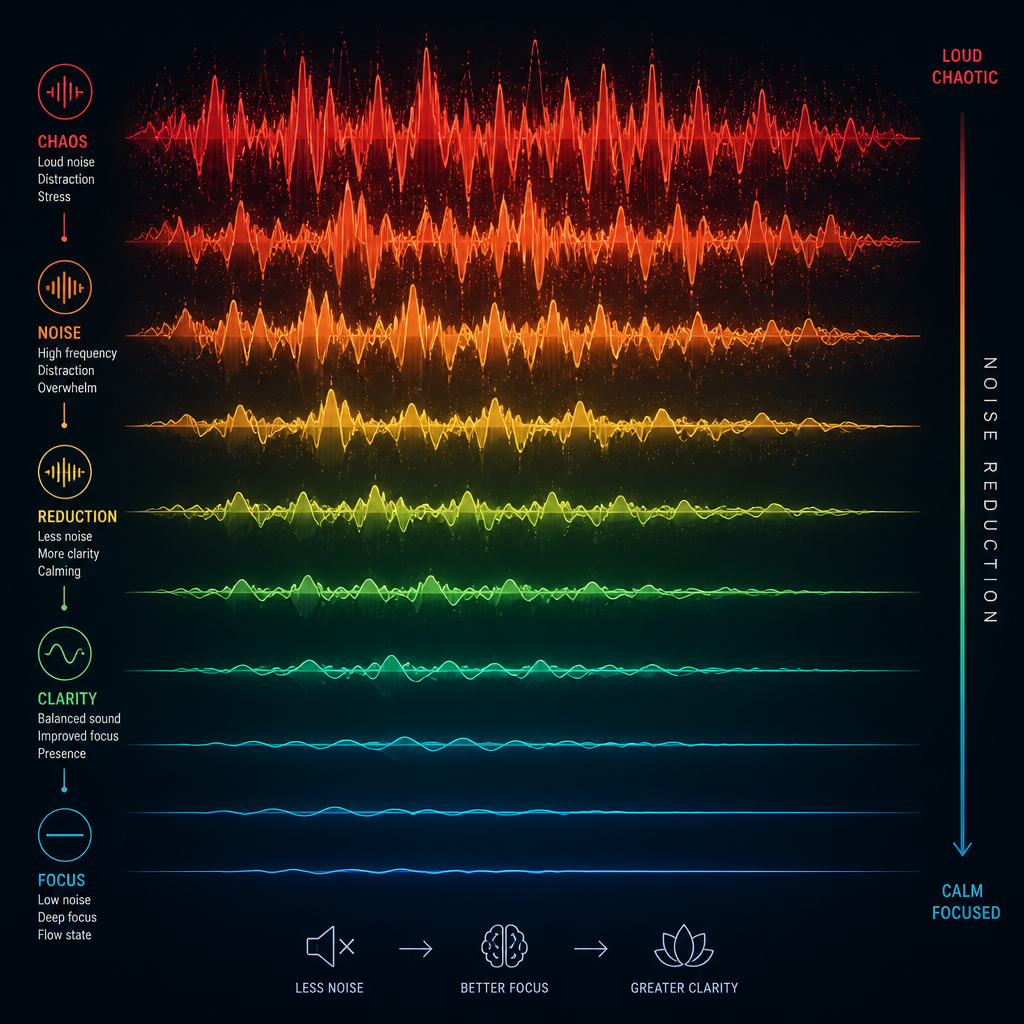
“Noise is the most underestimated study killer. Students spend money on apps, planners, and supplements but ignore the single environmental change that has the most immediate cognitive impact.” – Dr. Nick Perham, Cardiff Metropolitan University researcher on noise and cognition
The data consistently shows that even moderate noise levels around 55-65 decibels, which is a normal office or café environment, impair performance on tasks requiring reading comprehension and serial recall. Libraries are quieter than that, but shared student accommodation is almost never quieter than 60dB during waking hours.
The Noise Reduction Rating (NRR) printed on ear plug packaging is a laboratory measurement of attenuation in decibels. A product rated NRR 32 means it reduced test-booth noise by 32dB under controlled insertion by trained participants. Real-world performance is lower because most people do not insert ear plugs as precisely as a lab technician does.
A common mistake is assuming that a higher NRR automatically means better studying. Beyond roughly 30-35dB of attenuation, you start to feel uncomfortably isolated, and the pressure sensation in the canal becomes distracting in itself. The sweet spot for study sessions is 28-32dB reduction, which eliminates conversational and traffic noise without making you feel sealed in a vacuum.
ATTENU8 ear plugs are rated at approximately 32dB NRR. That sits at the top of the productive study range. The concave aluminium body also helps by acting as a stable outer shell that keeps the memory foam tip positioned correctly in the canal, so the real-world attenuation stays close to the rated figure rather than dropping off due to poor seal.
Memory foam tips must fully expand against the canal wall to create the acoustic seal that delivers rated performance. A tip that is too small leaves gaps. A tip that is too large creates pressure that causes pain and makes you remove the plug early, defeating the entire exercise.
ATTENU8 includes three tip sizes per pair, XS, S, and M, specifically because canal size varies significantly between individuals and even between a person’s left and right ear. Taking two minutes to test which size gives you a snug, painless fit is the single most effective thing you can do to maximise your real-world noise reduction.
Pro tip: Insert the tip, reach your hand over your head to gently pull your ear upward and backward, then press the tip in slightly and release. This straightens the ear canal and allows the foam to expand into a full seal. Most students skip this step and wonder why their ear plugs feel ineffective.
Students have three realistic categories to choose from: disposable foam plugs, reusable silicone or rubber plugs, and premium metal-bodied reusable plugs with replaceable foam tips. Each has a distinct profile of performance, cost, and practicality over an academic term.
The cheapest entry point. Soft polyurethane foam, rolled down and inserted to expand in the canal. NRR ratings typically fall between 29-33dB on paper. The problem is that these plugs degrade fast. After 2-3 uses, compressed foam loses significant recovery speed, and the tip picks up enough skin oil and debris to compromise the seal. Students who study daily burn through these quickly and generate significant waste.
They also lack any structural body to keep them correctly positioned. If you fall asleep at your desk studying, a disposable foam plug often migrates further into the canal than intended, which is both uncomfortable and sometimes difficult to remove without tweezers.
Better durability, washable, and available in multiple sizes. Brands like Loop and Flare Audio sit in this category and market themselves heavily toward lifestyle users. The NRR ratings are typically lower, often in the 18-27dB range, which is sufficient for mild café noise but noticeably insufficient in louder dorm environments or open-plan study spaces with multiple conversations happening.
These plugs work well for commuting or light focus work. For serious multi-hour study sessions where you need reliable, consistent attenuation, the lower NRR is a real limitation rather than an acceptable trade-off.
This is where ATTENU8 sits. The aluminium body serves a structural purpose: it maintains the correct depth and angle of the tip without requiring you to constantly re-insert. The memory foam tip does the acoustic sealing work, and when it wears out every 6-8 weeks, you replace only the tips rather than the entire plug. At 32dB NRR, performance is consistent across the life of the product because the aluminium body never degrades.
The durability case is straightforward. A student who studies four hours daily for a 13-week semester goes through roughly 26 sets of disposable ear plugs at minimum. A single pair of ATTENU8 plugs with one or two tip replacements covers the same period at a fraction of the cost and with more consistent performance.

The table below compares the three main ear plug categories on the factors that matter most for students who use them regularly across an academic term.
| Feature | Disposable Foam (e.g., 3M Classic) | Reusable Silicone (e.g., Loop, Flare) | Premium Metal-Bodied (ATTENU8) |
|---|---|---|---|
| Typical NRR | 29-33dB (drops after 2-3 uses) | 18-27dB | 32dB (consistent over product life) |
| Comfort over 3+ hours | Low. Foam migrates and creates pressure. | Moderate. Silicone can cause canal fatigue. | High. Concave body distributes pressure evenly with memory foam tips. |
| Cost per semester | High. Constant repurchasing of packs. | Medium. One pair lasts but NRR compromises study performance. | Low. One pair plus tip replacements every 6-8 weeks. |
| Fit customisation | One size. Poor fit is common. | Some models offer S/M/L. | XS, S, M memory foam tips included per pair. |
| Hygiene | Not designed for reuse. Single use only. | Washable silicone body. | Replaceable foam tips. Aluminium body is wipe-clean. |
| Best for | Occasional one-off use. | Commuting, mild noise environments. | Daily study sessions, high-noise environments, sleep, travel. |
The comparison is not close for students who study daily in genuinely noisy environments. Lower-NRR lifestyle plugs serve a different use case. The question for best ear plugs for focus students is not which product looks the most stylish. It is which product delivers consistent 30dB-plus attenuation without causing discomfort that cuts sessions short.
Correct insertion technique is underrated. Most students who report that ear plugs do not work for them are inserting them incorrectly and getting 10-15dB of actual attenuation from a product rated at 32dB. That gap is the difference between usable quiet and mildly reduced noise.
Roll the memory foam tip between your thumb and forefinger to compress it down to roughly half its diameter. Reach over your head with the opposite hand and pull your ear upward and back to straighten the canal. Insert the compressed tip fully into the canal entrance, not just partway. Hold it in place with your fingertip for 20-30 seconds while the foam slowly expands against the canal wall. When the foam has fully expanded, you should notice an immediate muffling of ambient sound. If you do not, the tip size is likely too small for your canal and you should try the next size up.
For ATTENU8 plugs specifically, the aluminium body sits just outside the canal entrance once correctly inserted. Do not try to push the body itself into the canal. The body is designed to stay external while the foam tip creates the seal internally.
Even well-fitted ear plugs cause mild pressure fatigue after 90-120 minutes. A common mistake is powering through the discomfort until you need to remove them entirely. A better approach is to remove them for 5 minutes during natural study breaks, which ATTENU8 recommends as standard practice anyway. This also allows the foam tips to re-expand to full volume, maintaining seal quality when you reinsert.
Pro tip: Keep your ATTENU8 plugs in the carry case and place the case visibly on your desk as a physical cue. When the case is open and the plugs are in, your study session is active. When you close the case, the session is over. This simple ritual reinforces the conditioned focus response over time.
Ear plugs work best as part of a deliberate environmental design rather than a reactive measure you grab only when noise gets unbearable. Students who reduce distractions while studying most effectively treat noise control as a pre-session step, not an interruption response.
A practical routine looks like this: before you open a book or laptop, insert your ear plugs, position your study materials, and silence your phone. This sequence takes under two minutes and signals to your nervous system that focused work is beginning. The ear plug insertion step carries particular weight because it is physical and irreversible in the moment. Unlike silencing a phone, which you can undo in seconds, inserted ear plugs require a deliberate removal action. That small friction keeps you in the session.
Ear plugs handle the variable, unpredictable noise that your brain cannot habituate to. If you also face a low, steady background hum from HVAC systems or distant traffic, that type of noise actually becomes less disruptive once the irregular conversational sounds are blocked. You do not need to add white noise machines or extra equipment in most study environments. Blocking the irregular speech-like noise with 32dB ear plugs is usually sufficient to create a workable study environment.
The one exception is if you share a thin-walled room with someone who is gaming with speakers or watching content at high volume. In those cases, ear plugs reduce the noise substantially but may not eliminate it entirely. The solution there is a combination of ear plugs and a direct conversation about study hours, not more complex audio equipment.
Memory foam tip degradation is gradual, which means you rarely notice the drop in performance. The foam compresses and re-expands slightly less fully with each use. After 6-8 weeks of daily use, a tip that originally expanded to full volume is now expanding to perhaps 80-85% of that. The NRR drop is measurable but not obvious. Setting a calendar reminder to replace your ATTENU8 tips every six weeks ensures you are always operating at rated performance.
This is genuinely different from how competitors approach the product. With Loop or Flare silicone plugs, the body and sealing mechanism are the same component, so degradation of the seal means degradation of the product. With ATTENU8, the durable aluminium body remains fully functional indefinitely. Only the consumable foam tip component needs periodic replacement, which takes ten seconds and costs a fraction of replacing the full product.
The effect is real and measurable. Research from the Acoustical Society of America and studies at Loughborough University consistently show that ear plugs providing 28dB or more of attenuation in genuinely noisy environments improve performance on tasks requiring working memory and reading comprehension. The mechanism is straightforward: blocking the irregular speech-like noise that activates your phonological loop frees up cognitive capacity for the task at hand. It is not a placebo; it is environmental engineering.
No. A 32dB NRR ear plug reduces ambient sound but does not create a sealed chamber. Fire alarms are typically rated at 65-75dB at the source and are legally required to reach 75dB at the pillow level in residential buildings. At 32dB attenuation, a 75dB alarm still reaches you at 43dB, which is clearly audible. You will hear fire alarms, loud knocks on doors, and any sound above roughly 40-50dB in the room. Normal conversational noise at 55-65dB gets reduced to a quiet murmur, which is exactly the intended effect.
Start with the medium tip, which fits most adult ear canals. Insert it correctly using the roll-and-hold technique. If you feel significant pressure or discomfort within the first few minutes, try the small tip. If the plug feels loose or falls out easily, try the medium again with closer attention to insertion depth. A correctly sized and inserted tip creates a clear but painless muffling sensation immediately on insertion. The XS size is specifically useful for individuals with narrower canals, which is more common than most people realise, and having the option avoids the degraded performance that comes from using an oversized tip.
Every 6-8 weeks under daily use is the practical guideline for memory foam tips. Visible signs of degradation include yellowing or browning from skin contact, a flattened appearance where the foam no longer fully recovers its shape within 30 seconds of compression, and a noticeably reduced acoustic seal feeling on insertion. Do not wait for all three signs. If you have been using the same tips for more than eight weeks daily, replace them proactively. The cost is minimal compared to the performance drop from degraded foam.
Yes, and most students find note-taking with ear plugs in is no different from without them. The only scenario where ear plugs interfere with note-taking is if you are transcribing spoken audio from a lecturer or recording. In that case, you are introducing the irrelevant speech effect deliberately, so ear plugs are counterproductive. For silent reading, problem sets, memorisation, and written assignments, ear plugs have no downside and a measurable upside in noisy environments.
When maintained properly, yes. Disposable foam plugs accumulate ear canal debris and skin oil from the first use but are often reused several times anyway. A reusable aluminium-bodied plug with replaceable memory foam tips combines a wipe-clean body with consumable tip components that can be replaced before they accumulate enough contamination to become a hygiene concern. The key is adhering to the replacement schedule and wiping the aluminium body with a dry cloth periodically. This is objectively more hygienic than reusing week-old disposable foam plugs, which many students do to extend a pack.
If you use ear plugs regularly for studying, we would like to hear what has worked for you and what has not. Share your experience in the comments below.

