


 0
0

Most people who struggle to sleep blame their mattress, their stress levels, or their phone. The real culprit is usually noise. Research suggests that sounds as low as 30 decibels can disrupt rest, and nocturnal noise exposure has been linked to serious long-term health effects including cardiovascular stress, even when it does not fully wake you. If you care about sleep environment noise reduction, patching one weak spot in your bedroom is not enough. Sound finds every gap, every hard surface, and every room in the house that bleeds into your sleeping space. This room-by-room checklist covers everything from windows and doors to floors and hallways, so you can build a genuinely quiet bedroom rather than just masking the problem.
The brain does not switch off its auditory processing during sleep. It continues monitoring the acoustic environment throughout the night, and sudden or unpredictable sounds trigger arousal responses, whether or not those arousals reach full consciousness. The problem is not just being jolted awake by a passing truck. It is the dozens of micro-arousals per night that fragment your sleep architecture, prevent you from reaching deep slow-wave sleep, and leave you feeling unrested despite eight hours in bed.
Research published in the Noise and Health journal found that noise events induce arousals at relatively low exposure levels, independent of the noise source, whether that source is road traffic, neighbors, or other environmental sounds. Separate research cited by the WHO suggests that traffic-related noise alone causes significant loss of healthy life years across entire populations. These are not edge-case outcomes for people living next to airports. They apply to anyone sleeping in a normally noisy urban or suburban home.
The practical implication is clear: your bedroom noise level matters more than most sleep advice acknowledges. Fixing it is not a luxury project. It is a foundational health measure.
| Key Insight | Explanation |
|---|---|
| Sounds from 30 dB upward can disrupt sleep architecture | You do not need to fully wake for noise to damage sleep quality. Micro-arousals accumulate through the night and reduce restorative deep sleep stages. |
| Windows and doors are the primary noise entry points | Even well-insulated walls lose their effectiveness if window frames have gaps or if hollow-core doors allow sound to pass freely. Address these first. |
| Hard surfaces amplify and reflect sound inside the room | Bare floors, bare walls, and minimal soft furnishings allow sound to bounce and build. Rugs, heavy curtains, and upholstered furniture absorb these reflections. |
| White and pink noise machines work best at 50-60 dB | Background noise at this level masks disruptive sound spikes without introducing its own volume-related harm. Going above 85 dB creates new risks. |
| Noise masking and noise blocking serve different problems | Blocking reduces sound entering the room. Masking reduces your perception of sounds that remain. Most effective sleep environments use both strategies together. |
| Reusable ear plugs with high NRR ratings provide portable, personal noise reduction | Quality ear plugs rated around 32 dB NRR offer consistent protection regardless of what is happening in the room, making them effective for travel and unpredictable environments. |
| Noise from adjacent rooms matters as much as noise from outside | HVAC units, kitchen appliances, televisions in living areas, and bathroom pipes all transmit noise into bedrooms through walls, floors, and ceilings. |
Start with the room itself before moving outward. The bedroom has six surfaces, and treating all six matters if you want genuine quiet bedroom results rather than marginal improvements.
Hard flooring transmits impact noise directly. Footsteps from upstairs, vibration from appliances, and even street-level impacts travel up through structural elements and radiate into the room. A thick area rug with dense underlayment under the bed reduces floor-borne noise absorption and breaks the transmission path. If you have downstairs neighbors or a timber floor, this single addition makes a noticeable difference.
Ceilings are often overlooked. If a neighbor, flatmate, or family member occupies the room above yours, sound travels through the ceiling plane at surprising volume. A false ceiling with insulation, or even heavy wall art and acoustic panels mounted overhead, can interrupt that path. Most renters cannot modify the ceiling structure, but adding mass elsewhere in the room still helps.
Shared walls with adjacent rooms or neighboring units are a common noise path. The fastest low-cost approach is placing heavy, dense furniture directly against the shared wall. A full bookcase packed with books provides genuine acoustic mass. Upholstered headboards, thick fabric wall hangings, and acoustic panels all absorb reflected sound inside the room and reduce transmission through the wall surface.
A common mistake is treating soundproofing as a single wall problem. In practice, sound enters a room from every surface simultaneously. Treating only the wall that faces the street while leaving bare floors and no curtains leaves you with a room that still reflects and amplifies whatever does enter.
Pro tip: Before spending money on acoustic panels, walk around your bedroom barefoot and listen to where sound feels loudest. Hard corners where two walls meet a bare floor are echo focal points. Placing rugs and soft furniture near those corners gives you the highest acoustic return for the lowest cost.
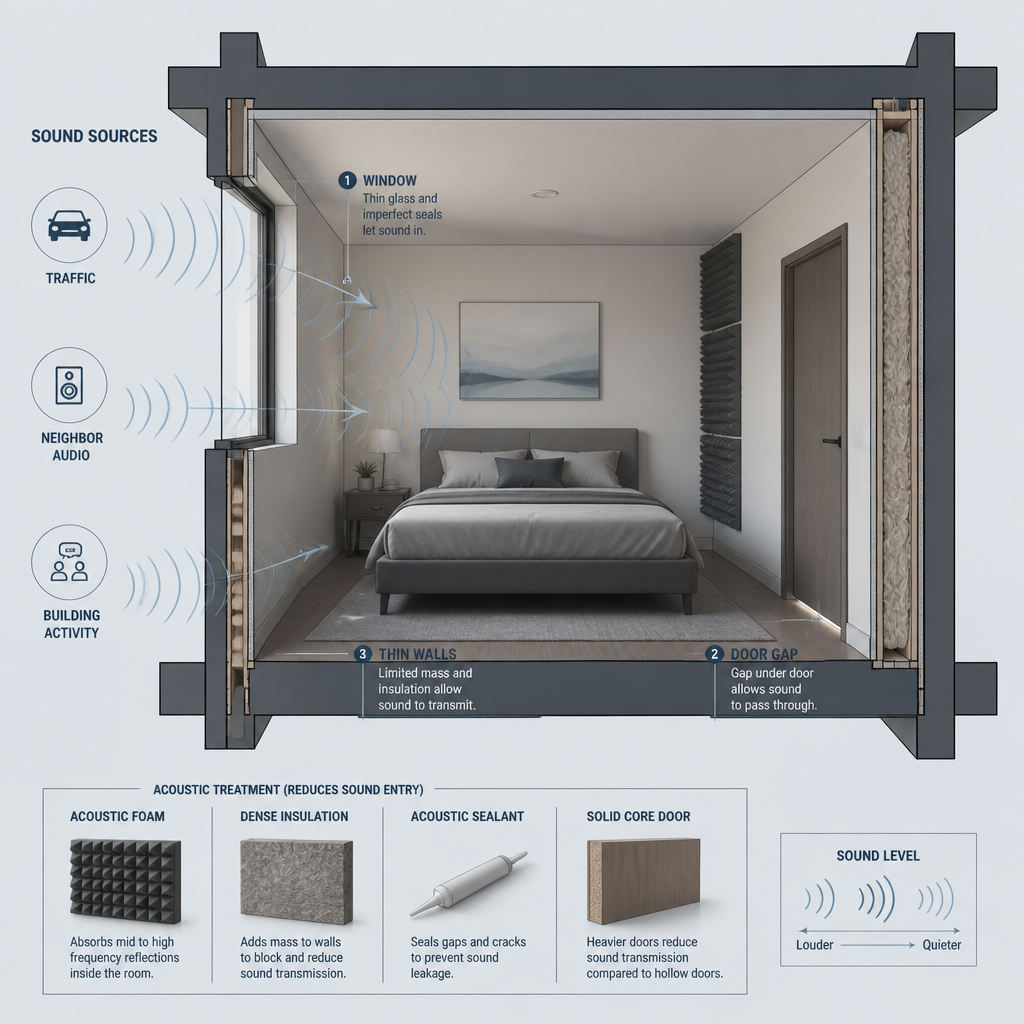
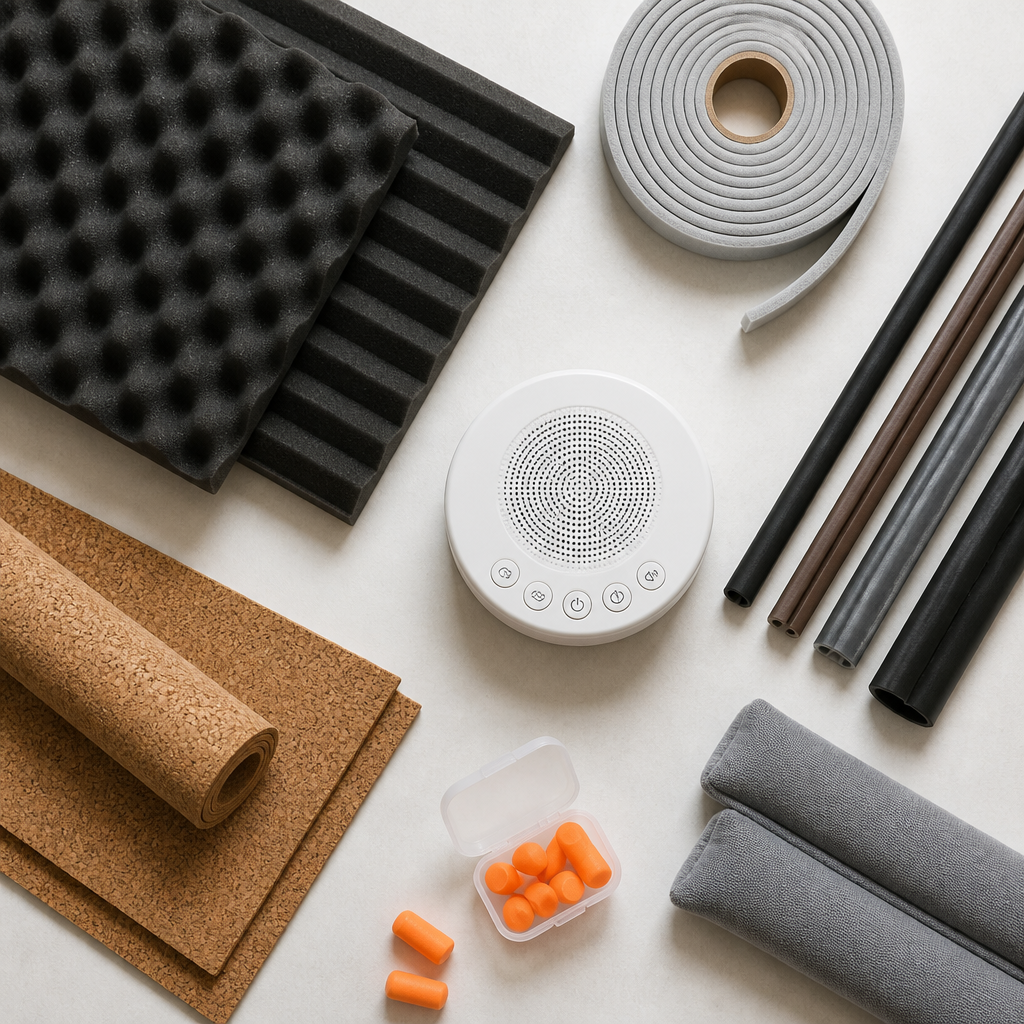
If you want to know how to reduce bedroom noise at its source, windows and doors are almost always the answer. A thick concrete wall might have a Sound Transmission Class (STC) rating above 50. A single-pane window sits around STC 26-28. A hollow-core door rarely exceeds STC 20. Every hour you spend treating walls without addressing windows and doors produces diminishing returns.
The fastest improvement is acoustic caulk around the window frame. Gaps between the frame and the surrounding wall, even small ones, allow disproportionate sound transmission. Sealing them costs very little and takes under an hour.
Heavy, dense curtains hung from ceiling to floor provide meaningful noise reduction at modest cost. Pleated curtains offer more acoustic mass than flat-hung versions. Dedicated soundproofing curtains with an STC rating of 20 or higher add a further layer. These do not match the performance of sealed window inserts, but they work without any structural modification.
For serious treatment, window inserts sit inside the existing frame and create an air gap that dramatically increases the STC rating. These are particularly effective for double-glazing a single-pane window without replacing the entire unit.
Bedroom doors are almost universally the weakest acoustic barrier in the room. Hollow-core doors, which are standard in most homes, offer almost no sound resistance. Upgrading to a solid-core door is the single highest-impact structural change you can make to a bedroom’s acoustic performance.
Where a solid-core door is not possible, the gap between the door bottom and the floor is the priority fix. A door sweep eliminates the gap that allows sound to pass freely beneath the door. Weather stripping around the door perimeter seals the remaining edges. These two additions alone transform a standard door from acoustically transparent to meaningfully resistant.
Pro tip: Check your door gap with a torch at night. If you can see light under the door from the hallway, noise is moving through that gap just as freely. A door sweep costs very little and takes minutes to install.
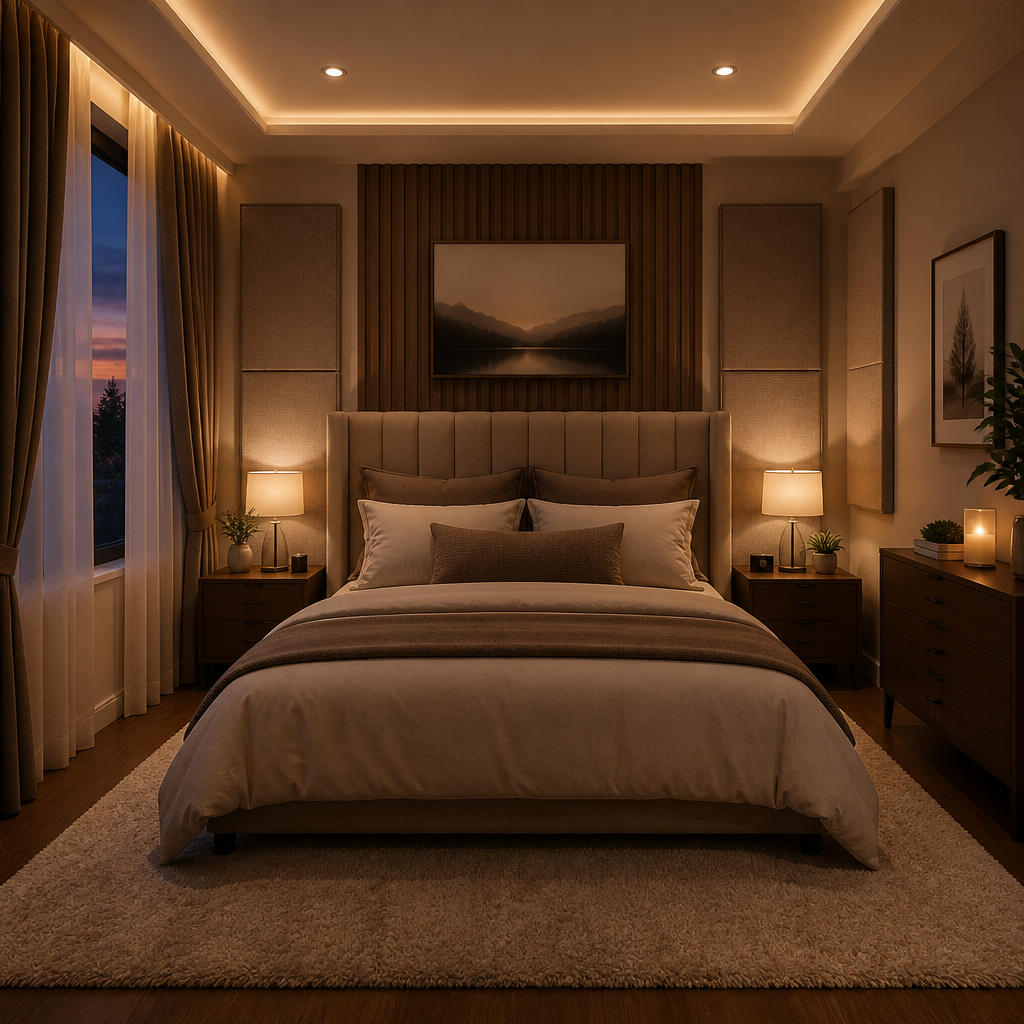
A significant portion of the noise disrupting your sleep does not come from outside the building. It comes from inside it. The television in the living room, the refrigerator compressor, the bathroom exhaust fan, a partner moving around the kitchen late at night: all of these transmit through walls, floors, and open doorways into the bedroom.
The most effective approach is removing the noise before it travels. Scheduling appliance use, switching off ice makers at night if the kitchen is adjacent to the bedroom, and placing anti-vibration pads under washing machines and dryers eliminates sound before it becomes a bedroom problem.
In hallways, a dense rug runner on hard floors absorbs the impact sound of footsteps that would otherwise travel into adjacent rooms. This is one of the least expensive and most consistently effective changes in a shared household.
HVAC systems are a frequently underestimated source of sleep disruption. Forced-air systems can transmit duct-borne sound directly into bedrooms through vent openings. Duct insulation and acoustic baffles at the vent opening reduce this without affecting air circulation. Pipe noise from plumbing is harder to treat but relocating the bed away from the wall shared with bathrooms or utility rooms solves most practical cases without renovation.
The bedroom door and the adjacent living space noise level together determine your baseline sleep environment more than any single acoustic product. Fix the noise at its source and at the boundary before reaching for masking solutions.
These two strategies are complementary, not interchangeable. Noise blocking physically reduces the amount of sound that reaches your ears. Noise masking adds a consistent background sound that reduces your brain’s sensitivity to the remaining noise spikes. Both have a role in a complete sleep environment, and understanding which problem each solves prevents wasted effort.
If your room has identifiable structural gaps, single-pane windows, hollow-core doors, or bare hard surfaces, blocking is the priority. Adding a white noise machine to a room with a 1cm gap under the door is like running a dehumidifier in a room with an open window. The machine will work to some degree, but the underlying problem remains unaddressed.
Once you have treated the main structural noise paths, a white or pink noise machine set at roughly 50 to 60 decibels provides a consistent acoustic baseline that reduces the perceptual contrast of any remaining sounds. Research on white and pink noise for sleep suggests this approach reduces how disruptive residual noise feels. Pink noise, which has more energy in the lower frequencies than white noise, suits people who find white noise too harsh or hiss-heavy.
Fans, air purifiers, and dedicated sound machines all serve this purpose. The specific sound source matters less than consistency. Avoid tracks that loop or vary, since changing sounds draw the brain’s attention rather than masking it.
| Approach | Best For | Practical Limitations |
|---|---|---|
| Structural soundproofing (solid-core doors, window inserts, acoustic caulk, wall mass) | Permanently reducing the amount of external noise entering the room. High return on investment in owned properties. | Requires time, investment, and sometimes permission from landlords. Does not eliminate all noise. |
| Soft furnishing absorption (heavy curtains, thick rugs, upholstered furniture, acoustic panels) | Reducing internal reverberation and absorbing noise that has already entered the room. Renter-friendly and low cost. | Reduces reflection rather than transmission. Will not block substantial external noise on its own. |
| Noise masking (white noise machines, pink noise, fan) | Reducing the perceptual impact of sounds that cannot be eliminated. Good for unpredictable noise patterns like traffic, snoring partners, and building sounds. | Does not reduce actual decibel levels. Requires correct volume setting to be safe and effective. Some people find sustained background sound disruptive rather than helpful. |
| Personal ear protection (reusable premium ear plugs with memory foam tips) | Individual noise reduction regardless of room treatment status. Essential for travel, shared accommodation, and situations where room treatment is not possible. | Requires correct fit for effective seal. Disposable foam ear plugs require constant replacement. Reusable options with replaceable tips offer much better long-term value. |
Even a well-treated bedroom has limits. Shared accommodation, hotel rooms, partner snoring, shift work with daytime sleeping, and travel all create noise environments you cannot structurally modify. This is where personal ear protection becomes essential rather than a last resort.
The problem with standard disposable foam ear plugs is not their noise reduction performance. It is the experience of wearing them. Cheap foam compresses unevenly, creating pressure points that wake light sleepers. They fall out during sleep. They require daily replacement, adding cost and waste. And they do nothing to address fit variations between individuals.
This is exactly what ATTENU8 was designed to address. The metal-bodied construction and concave aluminium shell hold their shape against the ear without creating the pressure problems typical of solid foam plugs. Three included sizes of soft memory foam tips (XS, S, and M) allow a proper acoustic seal regardless of ear canal variation, which is the single most important factor in actual noise reduction performance. An NRR of approximately 32 dB means meaningful attenuation of the sound sources most likely to disrupt sleep: traffic, voices, construction, and snoring.
The foam tips require replacement every six to eight weeks rather than after every use. In practice, this means a pair of ATTENU8 ear plugs costs a fraction of a year’s supply of disposable foam alternatives while delivering consistent, reliable fit every night. For side sleepers, the low-profile design and soft memory foam tips mean the plugs do not create discomfort against a pillow, which is the common failure point for harder ear plug designs.
If you are also addressing noise in professional environments, the same 32 dB NRR that makes ATTENU8 effective for sleep makes them suitable for use on construction sites, in manufacturing settings, and during air travel, where standard disposables are often worn incorrectly and deliver far less protection than their rated NRR would suggest.
Research and health guidance consistently point to below 30 decibels as the target for a sleeping environment. Urban residential areas typically measure 45 to 55 dB at night, which means most city dwellers are sleeping in rooms well above the recommended threshold without active noise reduction measures in place.
Yes, but within realistic limits. Dense, heavy curtains hung from ceiling to floor can reduce incoming noise by a few decibels and reduce internal reverberation meaningfully. They are not a substitute for sealed window frames or double-glazed glass, but as a renter-friendly first step, they deliver real improvement, particularly for mid-to-high frequency sounds like voices and traffic.
White noise used consistently at 50 to 60 decibels is considered safe for most adults. The risk arises when sound machines are set too loud. Levels above 85 decibels sustained through the night can cause auditory stress. Set your machine to the lowest volume that effectively masks the noise you are trying to block, not to the highest volume you can tolerate.
Reusable ear plugs with properly fitting memory foam tips typically outperform disposable foam plugs in practice because they allow a more precise fit. Disposable foam requires correct insertion technique to achieve its rated NRR, and most people do not insert them fully enough. A well-designed reusable plug with size-matched tips creates a reliable seal every night without the technique variability. They are also significantly cheaper over any period longer than a few weeks.
Treat it at the source first wherever possible. Turning off appliances, reducing household noise after a certain hour, and sealing internal door gaps all reduce the sound load on your bedroom before it reaches the boundary. Then treat the bedroom boundary itself with doors, windows, and curtains. Masking and personal ear protection address whatever remains. This order of operations produces the best results for the least cost.
Yes, significantly. A full bookcase against a shared wall adds acoustic mass that reduces transmission through that surface. A bed positioned away from the wall shared with a noisy bathroom or hallway reduces the perceived volume of pipe and footstep noise. Heavy furniture on hard floors also reduces the transmission of impact noise through the floor plane. These are not marginal effects. In rooms without soft furnishings, sound bounces and builds. Adding mass and soft surfaces changes the acoustic character of the room noticeably.
Substantially, yes. Thick area rugs, floor-to-ceiling curtains, furniture placement against shared walls, door sweeps (removable), acoustic panels mounted with adhesive strips, and personal ear protection all provide meaningful noise reduction without any structural modification. A renter who addresses all of these simultaneously will experience a very different acoustic environment from one who treats the bedroom as fixed. The combination of soft furnishings plus personal ear protection covers most practical scenarios without requiring landlord permission.
Have you already made changes to your sleep environment for better noise reduction? Share what worked (or what did not) in the comments below.

