


 0
0

Most people grab a pack of foam ear plugs at the pharmacy without thinking twice. They are cheap, widely available, and rated up to 33dB of noise reduction on the label. But if you have ever rolled one up, shoved it into your ear canal, and still heard every word your partner said, you already know that the rating on the packet does not tell the whole story. The debate around foam ear plugs vs metal ear plugs is not just about which one blocks more sound on a lab chart. It is about which material actually delivers quiet when you need it, night after night, shift after shift.
| Key Insight | Explanation |
|---|---|
| Lab NRR ratings overstate real-world performance | A foam plug rated 33dB NRR typically delivers only 20-25dB of actual noise reduction due to fit variance and improper insertion technique. |
| Foam degrades fast | Disposable foam plugs lose their resilience after a handful of uses, meaning the seal that worked on day one is noticeably weaker by day five. |
| Wax plugs prioritize comfort, not maximum attenuation | Wax sits at the ear canal entrance rather than inside it, making it gentler for side sleepers but less effective at blocking high-decibel noise. |
| Metal bodies create consistent geometry every use | A rigid aluminium shell does not compress, deform, or change shape over time, so the fit and seal remain predictable use after use. |
| Memory foam tips on metal bodies combine the best properties | Soft replaceable tips conform to your ear canal while the metal body holds position, delivering both comfort and a reliable acoustic seal. |
| Tip replacement beats full replacement | With metal-bodied plugs like ATTENU8, only the foam tips need replacing every 6-8 weeks, cutting long-term cost and waste significantly. |
| Sizing access matters more than most buyers realize | Ear canals vary widely. Products offering XS, S, and M tip sizes dramatically outperform one-size solutions when it comes to achieving an actual acoustic seal. |
Noise reduction is a physics problem. Sound travels as pressure waves, and an ear plug’s job is to interrupt those waves before they reach your eardrum. The material an ear plug is made from determines how well it absorbs, reflects, or simply blocks those waves, and how reliably it maintains the seal that makes any of that possible.
There are two broad mechanisms at play. The first is acoustic mass: denser materials are harder for sound waves to move through, so they transmit less energy. The second is seal integrity: even the most acoustically dense material fails completely if there is a gap between the plug and your ear canal wall. This is why insertion technique and fit geometry matter as much as the raw material.
Where foam, wax, and metal-bodied designs diverge is in how consistently each one can maintain that seal across repeated uses, across different ear canal shapes, and across a full night of sleep or a long work shift. Material choice is not cosmetic. It is the engineering decision that determines whether your ear plug actually works.
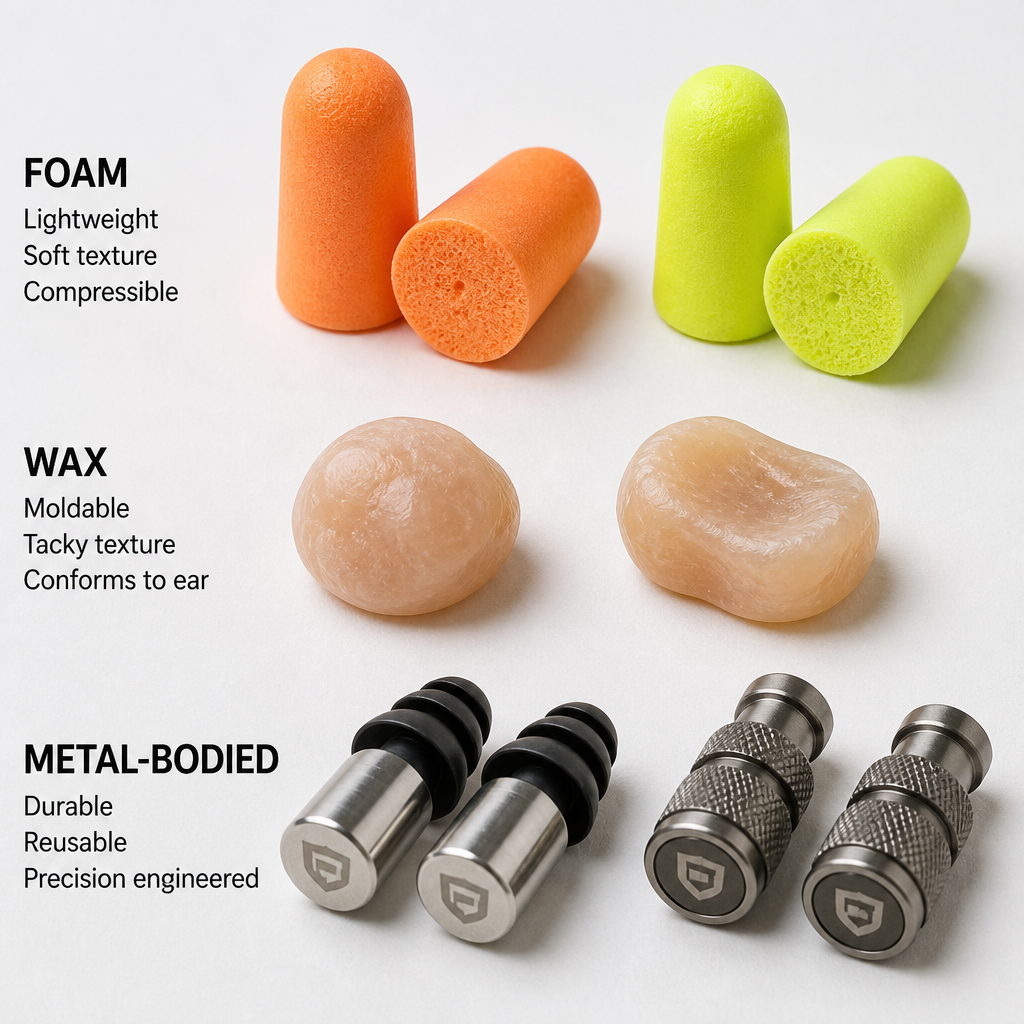

Foam ear plugs are made from polyurethane or similar compressible material. You roll them thin, insert them into the ear canal, and the foam slowly expands to fill the space and create a seal. At their best, they are effective. The problem is that “at their best” is a condition that is surprisingly hard to achieve and even harder to maintain.
Proper foam plug insertion requires rolling the plug tight, reaching over your head to straighten your ear canal, inserting the plug deeply, and holding it in place for a full 20-30 seconds while it expands. In practice, most users skip at least one of these steps. The result is a plug that sits too shallow, seals poorly, and delivers a fraction of its rated attenuation.
Research consistently shows that real-world noise reduction from foam plugs runs at roughly 50-75% of the rated NRR value, meaning a 33dB plug may only deliver 20-25dB in actual use. That gap is not a minor rounding error. At 25dB instead of 33dB, a noise source that should be inaudible is still clearly present.
Disposable foam plugs are designed for single or very limited use. The open-cell foam absorbs ear canal oils, moisture, and debris with every insertion. After a few uses, the foam loses the elasticity that creates the expanding seal. The plug that worked reasonably well on Monday is measurably worse by Friday. Most users keep using it anyway, because buying more feels wasteful, and the degradation is gradual enough not to be obviously noticed.
Pro tip: If you are using foam plugs and they feel noticeably easier to insert than they did the first time, that is the foam telling you it has lost its expansion properties. Replace them immediately rather than accepting progressively worse noise blocking.
For professionals in loud environments, such as construction or manufacturing, degraded foam plugs are not just uncomfortable but a genuine hearing protection gap. The rated attenuation that appeared on your employer’s hazard assessment paperwork is not what you are actually getting.
Wax ear plugs take a fundamentally different approach. Rather than inserting into the ear canal, they are shaped by hand and pressed over the canal opening, conforming to the outer ear structure. This makes them genuinely more comfortable for many users, particularly side sleepers who find a deep-insertion plug digs into the ear when their head meets the pillow.
For light noise reduction during sleep, wax is a reasonable choice. The soft, pliable material creates no pressure points inside the canal, and it is forgiving of ear shape variation because it moulds to whatever surface it contacts. Swimmers also use wax plugs because they create a surface-level seal that keeps water out without requiring a deep fit.
The ceiling on wax performance is, however, meaningful. Because the plug sits at the entrance rather than inside the canal, it cannot achieve the same acoustic seal depth as a correctly inserted foam or fitted tip plug. In genuinely loud environments, such as a flight, a snoring partner, or any industrial setting, wax plugs tend to underwhelm.
Wax plugs are also hygiene-challenged for frequent use. They pick up skin oils, hair, and debris with every application, and they do not clean well. Most manufacturers recommend single or very limited use. For daily sleepers or frequent travellers, this creates a running cost and waste problem that most people underestimate when they first buy a tin of wax plugs.
The best ear plug material is not the one with the highest number on the packet. It is the one that maintains its seal reliably under the conditions you actually face, every single time you use it.
Metal-bodied ear plugs represent a different engineering philosophy. Instead of a material that both forms the structure and creates the seal, metal-bodied designs split those two jobs between the rigid body and the replaceable tip. The body holds its geometry precisely, and the soft tip, typically memory foam or silicone, does the acoustic sealing work against the ear canal wall.
A foam plug’s shape changes every time you use it. Compression, moisture, and heat all alter how the foam sits in your ear. A machined aluminium body has the same shape on day one as it does on day five hundred. This means the depth of insertion, the angle, and the position of the sealing tip relative to the ear canal are consistent. Consistency is the enemy of noise leakage.
ATTENU8’s aluminium-bodied ear plugs use a concave body design that positions the memory foam tips correctly in the ear canal without requiring the user to master a specific technique. The fit is repeatable, which matters whether you are inserting them at 6 a.m. before a construction shift or at 11 p.m. when you are half asleep.
The memory foam tips on metal-bodied plugs function similarly to the tips on premium in-ear headphones. They conform to the individual contours of the ear canal, creating a contact seal that holds even as you shift position. Because ATTENU8 offers three tip sizes (XS, S, and M), users can match the tip to their actual canal diameter rather than accepting a compromise fit.
In practice, getting the tip size right makes a larger difference than most people expect. An undersized tip cannot create full contact around the canal wall. An oversized tip creates pressure that causes discomfort before the sleep benefit is realised. Having three size options to test is not a minor convenience but the mechanism by which a reliable seal is achieved for a wide range of users.
Pro tip: When testing tip sizes for the first time, start with the medium. Insert, listen for ambient noise, then swap down to small if you feel pressure or up to medium-large if noise is still audible around the edges. The right size should feel present but not pushing.
The most common objection to metal-bodied ear plugs is upfront cost. It is a fair objection measured at the point of purchase and misleading measured over six months of use. Foam plugs purchased in bulk look cheap per unit, but a daily user burns through them constantly. Metal-bodied plugs like ATTENU8 require only foam tip replacements every 6-8 weeks. The aluminium body lasts years. Across a full year of nightly use, the per-use cost of a premium reusable easily undercuts the cost of disposables, with less waste and better performance.
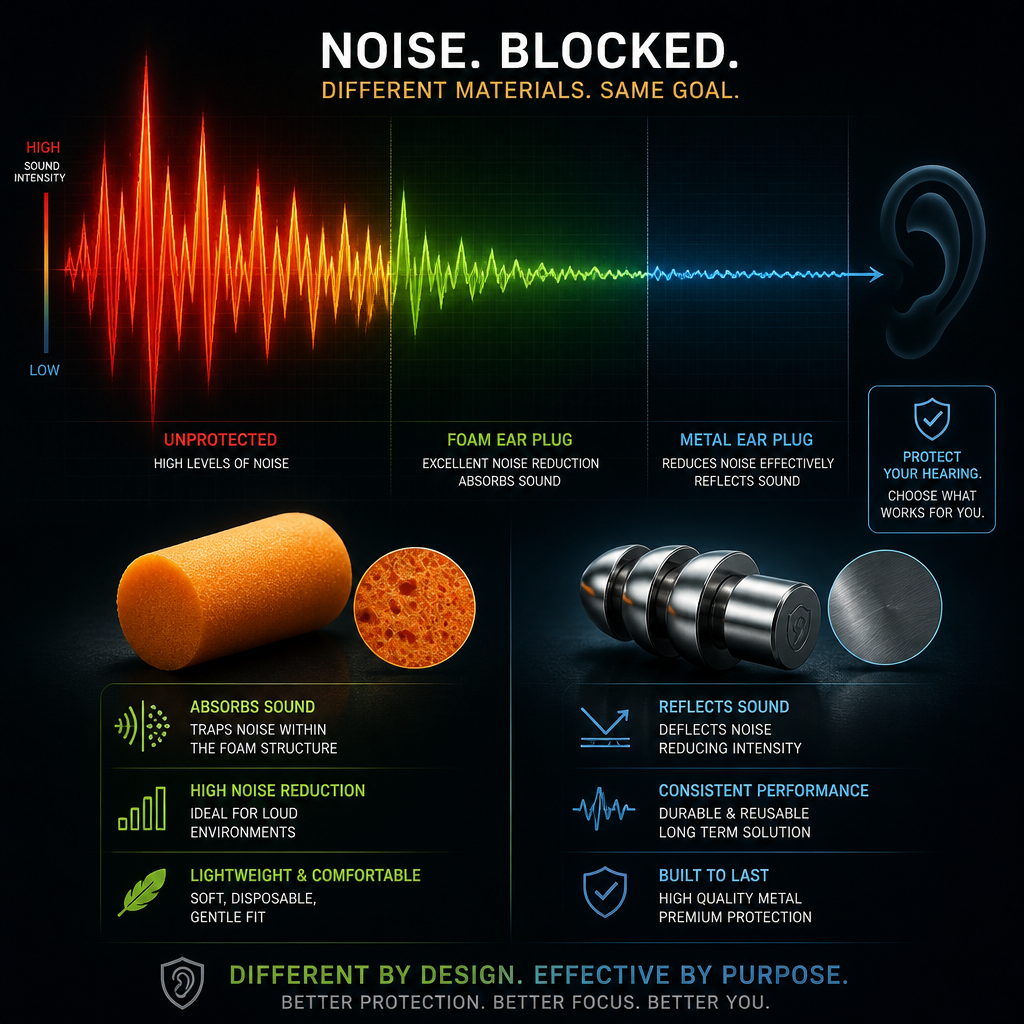
The table below compares all three main ear plug material types across the factors that actually determine whether a plug works for daily use. The comparison is honest about trade-offs because no single material is perfect for every use case.
| Factor | Disposable Foam | Wax | Metal-Bodied with Memory Foam Tips (e.g. ATTENU8) |
|---|---|---|---|
| Noise Reduction Potential | High when correctly inserted (up to ~33dB NRR), but real-world attenuation typically 20-25dB | Moderate. Sits at canal entrance, not inside it. Lower ceiling on attenuation | High and consistent. ATTENU8 delivers approximately 32dB through a repeatable, geometry-controlled fit |
| Comfort for Side Sleepers | Poor to moderate. Foam can press into ear canal when lying on a pillow | Good. No deep canal intrusion, low profile against outer ear | Good. Low-profile concave body reduces contact pressure against the pillow |
| Consistency of Fit | Variable. Depends heavily on insertion technique. Degrades with each use | Moderate. Hand-moulded fit varies each time and with temperature | High. Rigid body ensures the same positioning every insertion |
| Durability | Single to a few uses. Foam loses elasticity rapidly | Single to very limited use. Picks up debris and loses shape | Body lasts years. Tips replaced every 6-8 weeks |
| Hygiene | Moderate. Open-cell foam absorbs oils and moisture | Poor for repeat use. Difficult to clean effectively | Good. Aluminium body can be wiped clean. Tips are replaced regularly |
| Long-Term Cost | Appears low per unit, but high for daily users replacing frequently | Similar to foam for daily users due to limited reusability | Higher upfront, significantly lower over months and years of use |
| Environmental Impact | High waste. Hundreds of single-use plugs per year for a daily user | Moderate waste. Less plastic, but still frequent replacement | Low waste. Only small foam tips replaced periodically |
Matching material to use case is where the abstract comparison becomes practical advice. The right answer changes depending on what you are trying to block, for how long, and how often.
Light sleepers who need consistent quiet every night are the worst served by disposable foam. The degradation problem hits them hardest because they are using plugs every single night. Wax is a reasonable short-term option for side sleepers but cannot keep pace with the noise level of a snoring partner or urban ambient sound. A metal-bodied plug with correctly sized memory foam tips, worn nightly, delivers both the attenuation level and the consistent geometry that makes quiet reliable rather than hit-or-miss.
In loud industrial or construction environments, the stakes are higher than inconvenience. Degraded or poorly fitted foam plugs create a real hearing risk over time. Metal-bodied reusable plugs are cleaned and inspected rather than discarded, which means the user actually maintains their equipment. The tip replacement cycle also forces a hygiene and performance check every 6-8 weeks, creating a natural audit that disposable users never perform.
Travel use favours portability and convenience. Foam plugs win on throwaway convenience for occasional travellers. But for frequent flyers or regular commuters, the metal body of an ATTENU8 plug fits in a carry case, survives bag pressure without being crushed, and performs the same whether it is your third flight this week or your first in a month. Foam plugs crammed into a bag pocket arrive damaged and compromised.
A common mistake is buying wax or foam plugs for travel because they feel like the “easy” option, then abandoning ear protection entirely after the plugs fail to block aircraft cabin noise and cause discomfort on a long-haul flight. A product that actually works consistently gets used consistently.
Metal-bodied ear plugs do not block noise through the metal itself. The attenuation comes from the memory foam tips creating a seal inside the ear canal. What the metal body adds is consistent geometry, meaning the tip is positioned correctly and at the right depth every time you insert the plug. In practice, this consistency means you get close to the rated attenuation more reliably than with disposable foam, where insertion technique and foam degradation frequently undercut the rated NRR figure.
Wax ear plugs are generally considered safe for occasional use. For nightly use, the main concerns are hygiene and build-up. Wax that is not replaced regularly can carry bacteria and accumulate debris. There is also a small risk of wax residue remaining in the ear canal if the plug is not removed carefully. For daily sleep use, a properly fitted reusable ear plug with replaceable tips is the more hygienic and reliable long-term option.
NRR stands for Noise Reduction Rating, and it is measured under controlled laboratory conditions. The number on the packet represents best-case performance with perfect insertion. In real-world conditions, most users achieve 50-75% of the stated NRR, according to audiological research on actual user performance. This means a plug rated at 33dB NRR may realistically deliver 20-25dB of protection in everyday use. The NRR is useful for comparing products relative to each other, but do not treat it as an absolute guarantee of what you will experience.
Start with the medium size if you have no reference point. Insert the plug and pay attention to two things: whether you feel pressure or discomfort inside the canal, and whether ambient noise is still clearly audible around the edges of the plug. Discomfort with good noise reduction suggests you could try the small. Comfortable fit but poor noise reduction suggests trying the medium or checking your insertion depth. ATTENU8 includes XS, S, and M tips precisely because ear canal diameter varies enough between individuals that a single size genuinely cannot work well for everyone.
For daily users, foam tips on metal-bodied ear plugs typically need replacement every 6-8 weeks. The foam gradually loses its elastic memory and picks up oils from the ear canal, reducing both comfort and sealing performance. The aluminium body itself does not need replacement. This replacement cycle is significantly less frequent than the effective lifespan of a single foam disposable plug, and it means the most expensive component, the precision-machined body, is a long-term investment rather than a recurring cost.
Yes. Side sleeping is a common concern with ear plugs because a deep-insertion plug can press painfully into the ear when the head is on a pillow. Metal-bodied designs with a low-profile concave body, such as ATTENU8, are designed with this in mind. The shape reduces the amount of material protruding from the ear, which lowers pillow contact pressure. Pairing this with the correct tip size (not oversized, which would push the body outward) makes side sleeping with effective ear protection practical rather than uncomfortable.
If you have tried foam, wax, or metal-bodied ear plugs and found one that genuinely changed your sleep or protected your hearing in a loud environment, share your experience in the comments below. The specific details of what worked and what did not are exactly what other readers need to make a better decision than the packet label alone will give them.
We would love your feedback and any insights you would share with others. What perspective would you add?

