


 0
0

Most people dramatically underestimate how loud their surroundings are. The lawnmower you run barefoot behind on a Saturday morning, the commuter train carriage you sit in for 45 minutes, the restaurant where you have to lean in and raise your voice just to hold a conversation: these are not edge-case industrial hazards. They are the exact decibel levels everyday sounds reach that put hearing at real risk. Understanding where common noises sit on the decibel scale is not trivia. It is the single most actionable piece of information you can have if you want to protect your hearing over a lifetime, sleep more deeply, or simply stop waking up with a persistent ring in your ears.
| Key Insight | Explanation |
|---|---|
| 85 dB is the recognised damage threshold | Prolonged exposure to sounds at or above 85 dBA can cause permanent hearing damage. This level corresponds to heavy traffic heard from inside a car. |
| Every 3 dB doubles the acoustic energy | The decibel scale is logarithmic. 88 dB is twice as intense as 85 dB, which means safe exposure time halves with every 3 dB increase. |
| 120 dB causes immediate damage | Sounds above 120 dB, such as a live rock concert front row or a nearby firework, can cause instant hearing injury with zero recovery time. |
| Normal conversation sits at roughly 60 dB | This is the baseline safe level. The gap between a conversation and a construction site (95 dB+) is far greater than the numbers suggest due to logarithmic scaling. |
| Noise-induced hearing loss is permanent | Cochlear hair cells do not regenerate in humans. Damage accumulates silently over years before most people notice any problem. |
| The “raise your voice” test is a useful field check | If you have to shout to be heard by someone an arm’s length away, the ambient noise is likely above 85 dB and you should be wearing protection. |
| Sleep quality degrades well below the damage threshold | Even sounds around 40 to 55 dB, such as a partner snoring or light traffic, are enough to interrupt sleep architecture and reduce restorative rest. |
A decibel (dB) is the unit used to measure sound intensity. The scale compares any given sound to the quietest sound a healthy human ear can detect, which is set at 0 dB. What catches almost everyone off guard is that the scale is logarithmic, not linear. This means a 10 dB increase does not represent a sound that is 10 units louder. It represents a sound that is roughly 10 times more intense in terms of acoustic energy.
In practice, this means the difference between 85 dB and 95 dB is not “a bit louder.” It is ten times more acoustic energy hitting your cochlea every second. The gap between 85 dB and 105 dB is one hundred times the energy. Most people have no intuition for this, which is exactly why they routinely underestimate noise risk from common sources like power tools, sports venues, and nighttime traffic.
The A-weighted scale (dBA) is the version most commonly used in health and safety standards because it accounts for how the human ear is actually sensitive to different frequencies, giving more weight to mid-range frequencies that matter most for speech and less weight to very low or very high frequencies. When regulatory agencies quote safe limits, they almost always mean dBA.
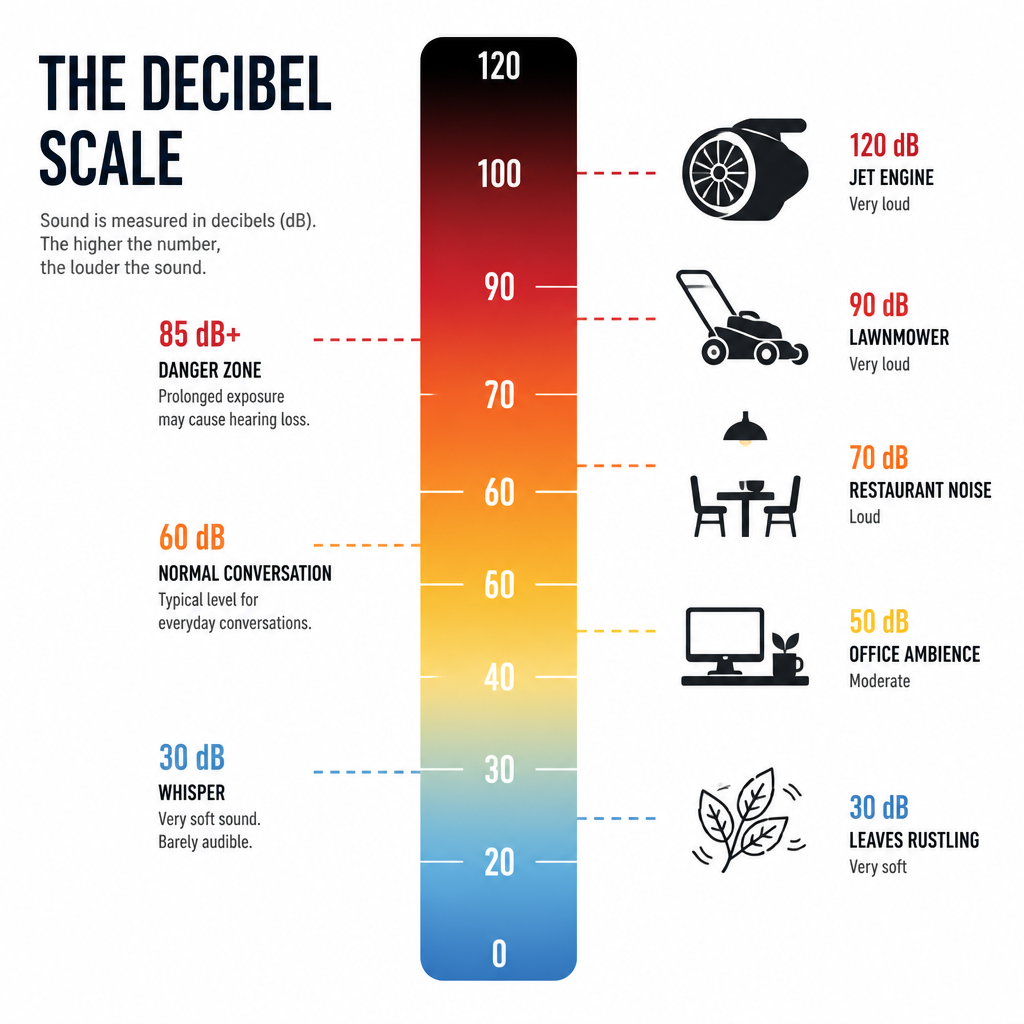
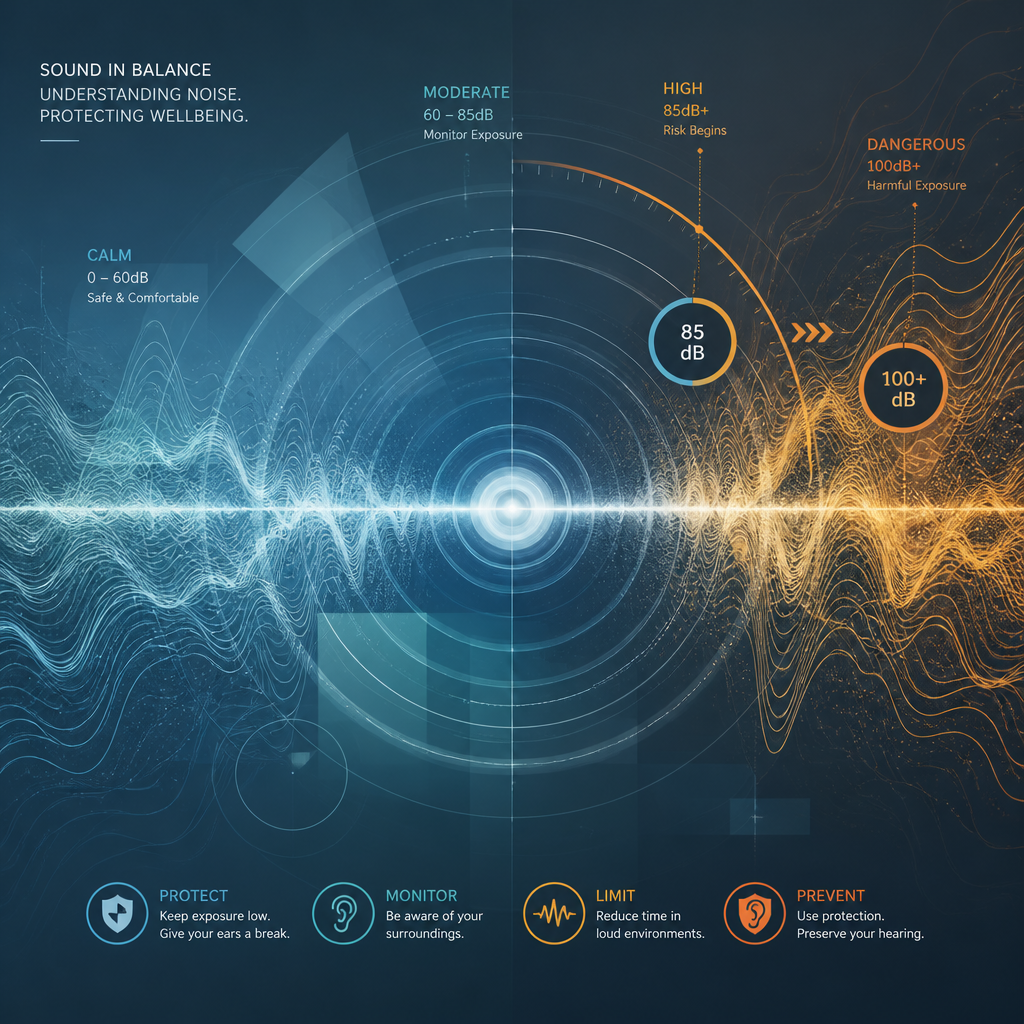
The following reference ranges come directly from publicly available data published by health and safety organisations. Use this as your baseline map of the sonic landscape you move through every day.
At the low end of the scale you have the threshold of human hearing (0 dB), a quiet library or bedroom at night (around 20 to 30 dB), and a soft whisper at close range (approximately 15 to 20 dB). These levels cause no hearing risk whatsoever, even with indefinite exposure. They can, however, still disrupt light sleepers when they break the silence of an otherwise quiet room.
This is the range where most safe daily activity occurs. A normal conversation between two people registers around 60 dB. A quiet office might sit around 50 dB. A vacuum cleaner or hair dryer typically reaches 70 to 75 dB. Sounds at or below 70 dBA are generally considered safe for your hearing regardless of duration, according to the Hearing Health Foundation. That said, even moderate noise at the higher end of this range becomes fatiguing over extended periods and degrades sleep quality well before it causes permanent hearing loss.
This is where most people get complacent. A busy restaurant, a noisy open-plan office, or heavy road traffic heard from inside a car all fall into this bracket. These levels will not destroy your hearing in a single session, but they sit close enough to the damage threshold that prolonged, repeated daily exposure over years absolutely accumulates. Both the EPA and the WHO recommend keeping environmental noise below 70 dBA over 24 hours to prevent noise-induced hearing loss (NIHL) in the long term.
A motorcycle engine, a chainsaw, a power drill, a sporting event crowd, and a nightclub all sit in this band. This is where time-dose relationships become critical. At 88 dB, safe exposure halves compared to 85 dB. At 91 dB, it halves again. The damage is cumulative and largely invisible until it is too late to reverse. Snoring, for reference, can reach anywhere from 50 dB to over 100 dB depending on the individual and their position, which puts severe snoring solidly in the danger zone for anyone sleeping in the same room night after night.
A jet engine at takeoff, a gunshot at close range, or fireworks nearby all exceed 120 to 140 dB. At these levels, immediate physical damage to the ear is possible, including rupture of the eardrum and destruction of the tiny hair cells (stereocilia) in the cochlea. There is no safe exposure duration for sustained sound at this level.
Noise-induced hearing loss (NIHL) is sensorineural damage: it affects the hair cells in the inner ear that translate vibration into electrical signals your brain reads as sound. Once these cells are gone, they are gone permanently. The human cochlea does not regenerate them. This is not a worst-case scenario reserved for industrial workers. Approximately 23 million Americans aged 20 and older are estimated to have noise-induced hearing loss, and the WHO has identified over 1.1 billion teenagers and young adults globally at risk due to unsafe use of personal audio devices and exposure to damaging sound levels at entertainment venues.
Damage follows two distinct patterns. The first is acute: a single extremely loud event, like a gunshot or explosion, causes instant injury. The second is chronic and far more common: repeated moderate overexposure that accumulates silently across years. The audiological signature is a characteristic dip in hearing sensitivity around 4,000 Hz, known as the “4 kHz notch,” which shows up on hearing tests before most people have noticed any change in their everyday hearing ability.
There is one partial reprieve: a temporary threshold shift (TTS). After a loud concert or a long shift in a noisy environment, sounds may seem muffled or distant. This temporary dulling can recover within hours to days if exposure stops and the noise dose was not catastrophic. The danger is treating TTS as proof that no harm was done. Repeated TTS events compound over time and contribute directly to permanent loss.
The clearest warning sign is not the ringing itself, it is the fact that most people notice the ringing only when the noise stops. By the time tinnitus becomes a regular companion, some permanent damage has almost certainly already occurred.
The 85 dBA figure is not arbitrary. NIOSH (the U.S. National Institute for Occupational Safety and Health) established it as the recommended exposure limit (REL) for an 8-hour workday, with the exchange rate being a key concept: every 3 dB increase in sound level halves the safe exposure duration. This is the more protective standard. OSHA sets its permissible exposure limit (PEL) at 90 dBA with a 5 dB exchange rate, which most occupational health professionals consider less safe. When these numbers translate to real time limits, the picture becomes stark.
| Noise Level (dBA) | NIOSH Maximum Daily Exposure | Common Source at This Level |
|---|---|---|
| 85 dBA | 8 hours | Heavy traffic (inside car), power lawnmower |
| 88 dBA | 4 hours | Hand drill, busy kitchen environment |
| 91 dBA | 2 hours | Motorcycle engine, angle grinder nearby |
| 94 dBA | 1 hour | Tractor, construction site general noise |
| 97 dBA | 30 minutes | Power saw, pneumatic drill |
| 100 dBA | 15 minutes | Jackhammer, nightclub/concert speakers |
| 110+ dBA | Under 2 minutes | Live rock concert (front row), chainsaw |
The practical implication is direct: a construction worker who operates a pneumatic drill for a full shift without hearing protection is not “maybe” at risk. They are receiving a dangerous overdose of acoustic energy every single day. The same applies to the person who attends three live music events per month without ear protection, or the shift worker who sleeps next to a partner who snores loudly.
Pro tip: Use the arm’s-length voice test as your quick field check. If you have to raise your voice significantly to be heard by someone standing roughly one metre away, the ambient noise around you is almost certainly above 85 dB and hearing protection is warranted.
We would love your feedback and any insights you would share with others. What perspective would you add?
The predictable hazards, chainsaws, jet engines, shooting ranges, get all the attention. The sources that actually accumulate damage in most people’s hearing are far more mundane. Here are the ones consistently underestimated.
A busy urban street sits comfortably at 80 to 85 dB. Underground trains and subway carriages regularly reach 90 to 95 dB. Commuters who use personal audio devices to drown out transit noise are often dialling their headphones up to 85 to 100 dB to compete, stacking one damaging source on top of another. The commute that feels like downtime is, acoustically, closer to a light industrial environment.
Busy restaurant environments commonly reach 80 to 90 dB during peak service, driven by hard surfaces, background music, and the collective noise of many conversations trying to compete with each other. A nightclub or bar with amplified music is routinely above 100 dB. Neither environment typically prompts anyone to reach for ear protection, which is precisely what makes them dangerous in aggregate.
Snoring is one of the most overlooked noise hazards for a non-snoring partner. Loud snoring can range from 50 dB to over 100 dB depending on the individual, with severe sleep-apnea-related snoring reaching levels comparable to a chainsaw or rock concert at close range. A person sleeping next to a loud snorer several nights per week is accumulating meaningful noise exposure during the very hours supposedly dedicated to recovery. This is one of the strongest practical cases for wearing ear protection during sleep.
The maximum output of typical consumer earbuds and over-ear headphones exceeds 100 dB at high volume settings. Half of 12 to 35-year-olds in high-income countries expose their ears to unsafe levels from personal audio devices, according to WHO data. The insidious element is that listening volume creeps upward gradually, especially in noisy environments, and the listener rarely perceives the danger because the experience feels pleasant rather than painful.
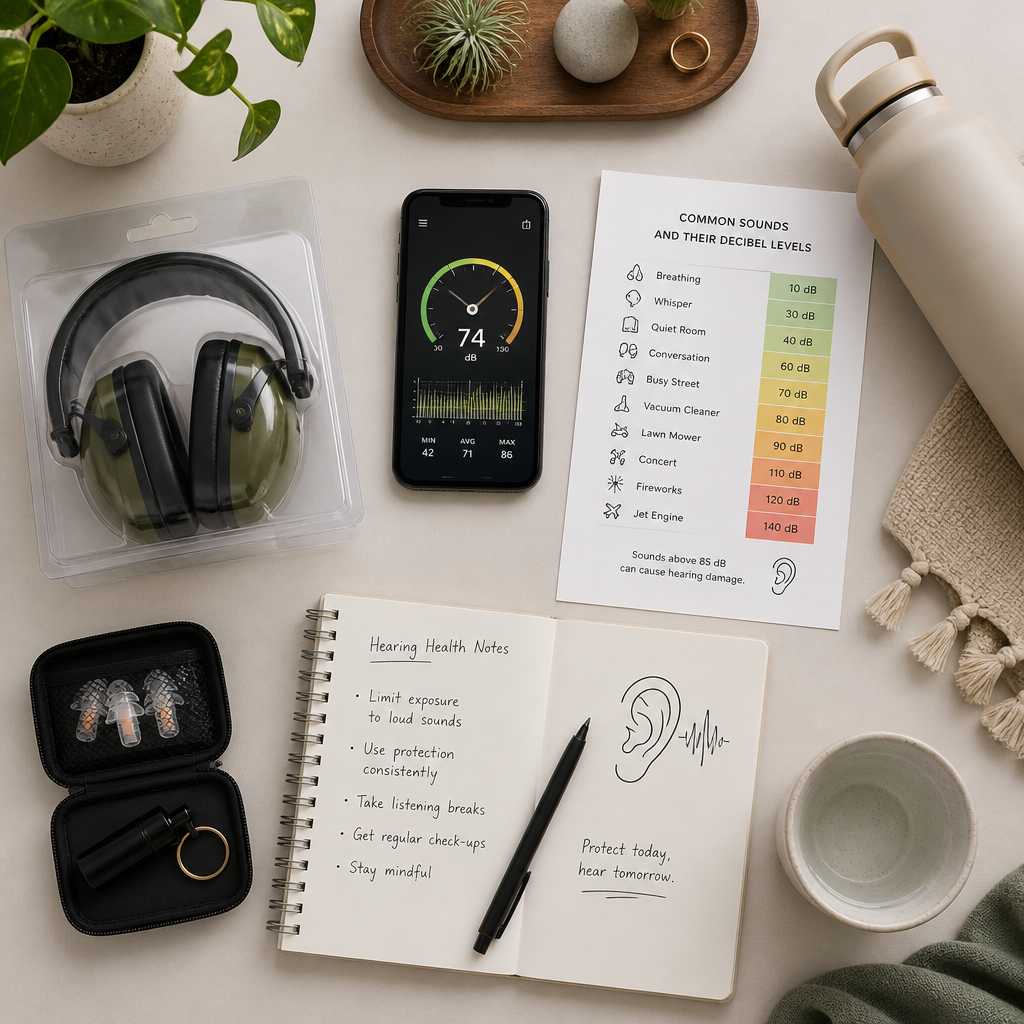
Given that most cochlear damage is permanent, the only rational approach is prevention. The good news is that consistent, properly fitted hearing protection is highly effective. The bad news is that “properly fitted” is doing a lot of work in that sentence.
Every hearing protector carries a Noise Reduction Rating (NRR) measured in decibels. A product rated NRR 32 dB is rated to reduce sound intensity by up to 32 dB under ideal test conditions. In real-world use, both OSHA and NIOSH recommend derating: dividing the NRR by roughly half to account for imperfect fit and insertion. A 32 dB NRR earplug therefore delivers a realistic field attenuation of approximately 15 to 16 dB in average real-world use. This still makes a 100 dB environment feel like 84 to 85 dB, which is right at the safe threshold.
The fit issue is exactly why the material and design of an earplug matters enormously. A poorly inserted disposable foam plug rolls loosely in the ear canal and may deliver almost no meaningful attenuation. A correctly fitted memory foam tip seated fully in the canal delivers its rated performance reliably. ATTENU8’s approach of providing three memory foam tip sizes (XS, S, M) within a metal-bodied earplug addresses precisely this problem: if the tip fits your ear canal correctly, you get consistent attenuation every time rather than the lottery of a one-size-fits-all foam roll-down.
Certain environments make the decision simple: any construction or industrial site where you are operating or standing near power tools; concerts or live music events; shooting ranges; and riding or working near motorcycles, heavy equipment, or aircraft. These are above-85 dB environments where the only sensible default is protection in, not protection in your pocket.
Sleep is a situation most people never consider until they have already been losing it for years. If your bedroom noise level during the night regularly exceeds 40 to 55 dB from traffic, urban noise, or a partner snoring, the case for sleeping with ear protection is straightforward. You are not being precious about quiet. You are removing a genuine physiological stressor from the hours your brain needs most for memory consolidation and cellular repair.
Pro tip: If you wear earplugs for sleep, the single most important variable is comfort during the night. A hard, bulky earplug that forces you to adjust your head position or that falls out when you roll over delivers almost zero benefit. Soft memory foam tips on a low-profile, well-weighted body, the design logic behind ATTENU8’s aluminium-bodied earplugs, solve this problem in a way that disposable foam cylinders simply cannot.
Single-use foam earplugs work adequately for occasional use. For anyone who wears protection daily, whether for sleep, commuting, or work, the calculus shifts. Disposable foam rolls deteriorate quickly and must be replaced per use to maintain their NRR. A reusable earplug with replaceable memory foam tips (which typically last 6 to 8 weeks before needing replacement) delivers more consistent protection, produces far less waste, and is more economical over a 12-month period. The metal body of a premium reusable earplug also makes it easier to insert and remove cleanly, which matters when you are doing it twice every day.
Not all hearing protection is suited for the same use cases. Here is a direct comparison of the three most common approaches for people dealing with everyday noise exposure in sleep, travel, and occupational settings.
| Protection Type | Typical NRR / Attenuation | Best For / Key Limitation |
|---|---|---|
| Single-use disposable foam plugs | 25 to 33 dB NRR (real-world: ~12 to 16 dB) | Good for occasional industrial use. Degrades with each use, inconsistent fit, not suitable for daily sleep use over the long term. |
| Reusable metal-bodied earplugs with memory foam tips (e.g., ATTENU8) | Up to 32 dB NRR, consistent fit across uses | Ideal for daily sleep, travel, and noise-sensitive work. Three tip sizes ensure correct canal fit. Tips replaced every 6 to 8 weeks, not the whole unit. |
| Silicone filter earplugs (e.g., Loop, Flare Audio) | Typically 18 to 27 dB attenuation depending on model | Good for social settings where some sound awareness is needed. Lower NRR makes them less suitable for high-noise industrial environments or heavy snoring situations. |
Hearing damage from noise exposure begins with prolonged exposure to sounds at or above 85 dBA. This is the level recognised by NIOSH as the recommended maximum for an 8-hour workday. Sounds above 120 dBA can cause immediate, irreversible damage regardless of how brief the exposure is. Crucially, because the decibel scale is logarithmic, even small numerical increases above 85 dB dramatically reduce the safe exposure time.
A normal conversation between two people sitting close together registers around 60 dB. That places it safely below the 85 dBA threshold by 25 decibels, which, given the logarithmic scale, means dangerous noise levels carry roughly 300 times more acoustic energy per unit of time than ordinary conversation. Heavy road traffic or a lawnmower is typically around 85 to 90 dB, and a nightclub or live concert regularly exceeds 100 to 110 dB.
Loud snoring can reach 50 to over 100 dB, and extreme cases have been recorded above 110 dB. Sustained exposure to a partner snoring at 80 to 90 dB every night represents meaningful cumulative noise exposure during sleep hours. While acute hearing damage from a single night is unlikely, the chronic exposure across years is a genuine concern, and sleep quality disruption is an immediate, nightly consequence that affects health independently of hearing loss.
A 32 dB NRR earplug is rated to block up to 32 dB of sound under ideal laboratory conditions. In real-world use, accounting for fit variation, the effective attenuation is typically around 15 to 16 dB. This still means a 100 dB environment, such as a nightclub or a loud industrial machine, would be reduced to roughly 84 to 85 dB at the ear, which sits right at the threshold of safe exposure. For sleep applications involving snoring or urban noise, 32 dB NRR earplugs are among the most effective passive options available.
Yes, wearing well-fitted, clean earplugs every night is safe for the vast majority of people. The main practical risks are using dirty or degraded tips (which can cause irritation), using plugs that fit so tightly they create pressure discomfort, or using a plug so large it sits uncomfortably against the ear canal wall during side-sleeping. Reusable earplugs with correctly sized, regularly replaced soft memory foam tips avoid all of these issues. The benefit of consistent noise reduction during sleep, both for sleep quality and long-term hearing health in noisy environments, outweighs any marginal inconvenience.
Yes, the same acoustic physics apply regardless of whether the sound source is industrial machinery or personal headphones. The cochlea does not distinguish between a pleasant source and an unpleasant one. WHO data indicates that roughly half of 12 to 35-year-olds in high-income countries regularly listen to personal audio devices at unsafe levels. A practical safe ceiling is keeping listening volume below 60 percent of maximum output and limiting continuous listening sessions, particularly in environments where you are tempted to compete with background noise by turning the volume up further.
If you regularly deal with noise at home, on the commute, or at work, we would like to hear which specific environments you find hardest to protect yourself from and what solutions you have found to actually work day-to-day.

