


 0
0

If you wake up more than once a night but can’t pinpoint why, noise is the most likely culprit you’re underestimating. Research consistently shows that sounds as low as 30 decibels can pull you out of restorative sleep stages, and most urban bedrooms sit well above that threshold. The question of whether ear plugs improve sleep isn’t really a debate anymore. Multiple randomized controlled trials confirm they work. What matters now is understanding exactly how they work, which types deliver genuine noise reduction for better sleep, and what separates a pair that stays comfortable all night from one you’ll pull out at 2am.
| Key Insight | Explanation |
|---|---|
| Noise below 40dB can still disrupt sleep | The WHO’s nighttime noise threshold sits around 40dB. Sounds below this level still cause measurable arousals in light sleepers, meaning even a “quiet” room may be too loud. |
| Ear plugs protect REM sleep specifically | A polysomnographic study found that earplugs improved REM sleep time and reduced arousals in noisy environments, protecting the sleep stage most responsible for memory consolidation and mood regulation. |
| Earplugs outperform pink noise machines for noise cancellation | A seven-night laboratory study published in SLEEP found earplugs mitigated nearly all effects of environmental noise on sleep architecture, performing better than pink noise across most conditions. |
| Fit is more important than the NRR number | A plug rated 32dB that seals properly outperforms a 33dB plug that shifts during the night. Multiple tip sizes, like XS, S, and M memory foam options, are what make a consistent seal possible. |
| Disposable foam plugs accumulate significant annual cost | Used nightly, single-use foam plugs become a recurring expense. Reusable plugs with replaceable tips eliminate the waste and lower the long-term cost substantially. |
| Non-pharmacological sleep aids have no dependency risk | Multiple ICU studies categorize earplugs as a “nonpharmacologic sleep-promoting adjunct,” meaning they improve sleep without the tolerance or withdrawal risks associated with sleep medication. |
| Side sleepers need a low-profile design | Protruding ear plugs create pressure against a pillow that wakes side sleepers. A low-profile, metal-bodied design with a concave form reduces this significantly. |
The evidence base for ear plugs and sleep quality is more robust than most people realize. Studies don’t just rely on self-reported sleepiness scales. Several use polysomnography, the gold standard for measuring sleep, recording actual brain activity to track which sleep stages a person enters and how often they’re disrupted.
A randomized controlled trial published in Critical Care found that earplugs and an eye mask improved REM sleep time and reduced arousals in ICU patients, a population exposed to some of the most relentless nighttime noise imaginable. The same study noted these tools failed to significantly improve total sleep time or N3 deep sleep in that extreme environment, which is an honest finding worth acknowledging. But for the kind of moderate noise a light sleeper faces at home, the protective effect is substantially stronger.
The most directly relevant laboratory study for everyday sleepers appeared in the journal SLEEP. Twenty-five healthy adults underwent seven nights of polysomnographic monitoring under different noise conditions. Environmental noise reduced N3 deep sleep, and earplugs mitigated nearly all of those effects. They only started to fall short at the highest noise level tested, 65 dBA, which exceeds what most bedrooms ever reach. For typical urban or suburban noise, the protection was comprehensive.
Earplugs are more effective than pink noise in mitigating the effects of nighttime environmental noise on sleep architecture, preserving both REM sleep and deep sleep stages across most real-world noise levels.
Separately, a 2021 study published on PubMed concluded that earplugs and eye masks are effective in improving sleep quality in patients undergoing frequent nighttime assessments, and the authors specifically noted this strengthens the evidence for non-pharmacological sleep-promoting approaches. The consistency across multiple independent research teams and settings is what makes this a reliable finding rather than a one-off result.
To understand why ear plugs help, you need to understand what noise actually does to sleep architecture. Sleep isn’t a single state. It cycles through light sleep (N1, N2), deep slow-wave sleep (N3), and REM sleep roughly every 90 minutes. Each stage serves a different biological purpose, and different noise types attack different stages.
Even if a noise doesn’t fully wake you, it can cause a microarousal, a brief shift to a lighter sleep stage that you won’t remember in the morning. A night with 20 microarousals feels like poor sleep even if you technically stayed in bed for eight hours. This is exactly the mechanism behind why light sleepers feel exhausted despite apparently sleeping through the night.
REM sleep, which governs emotional processing, creativity, and memory consolidation, is disproportionately affected by intermittent noise like traffic surges, distant sirens, or a partner’s snoring. Research shows that even moderate environmental noise at peak levels of 45 to 65 dBA reduces N3 deep sleep. The cascade effect means that if you’re knocked out of N3, you cycle back through lighter stages before reaching REM again, compressing your total REM time by morning.
Pro tip: If you wake up feeling foggy or emotionally flat despite a full night’s sleep, disrupted REM is often the cause. Blocking noise with a well-fitting pair of ear plugs is the simplest first step before exploring other interventions.
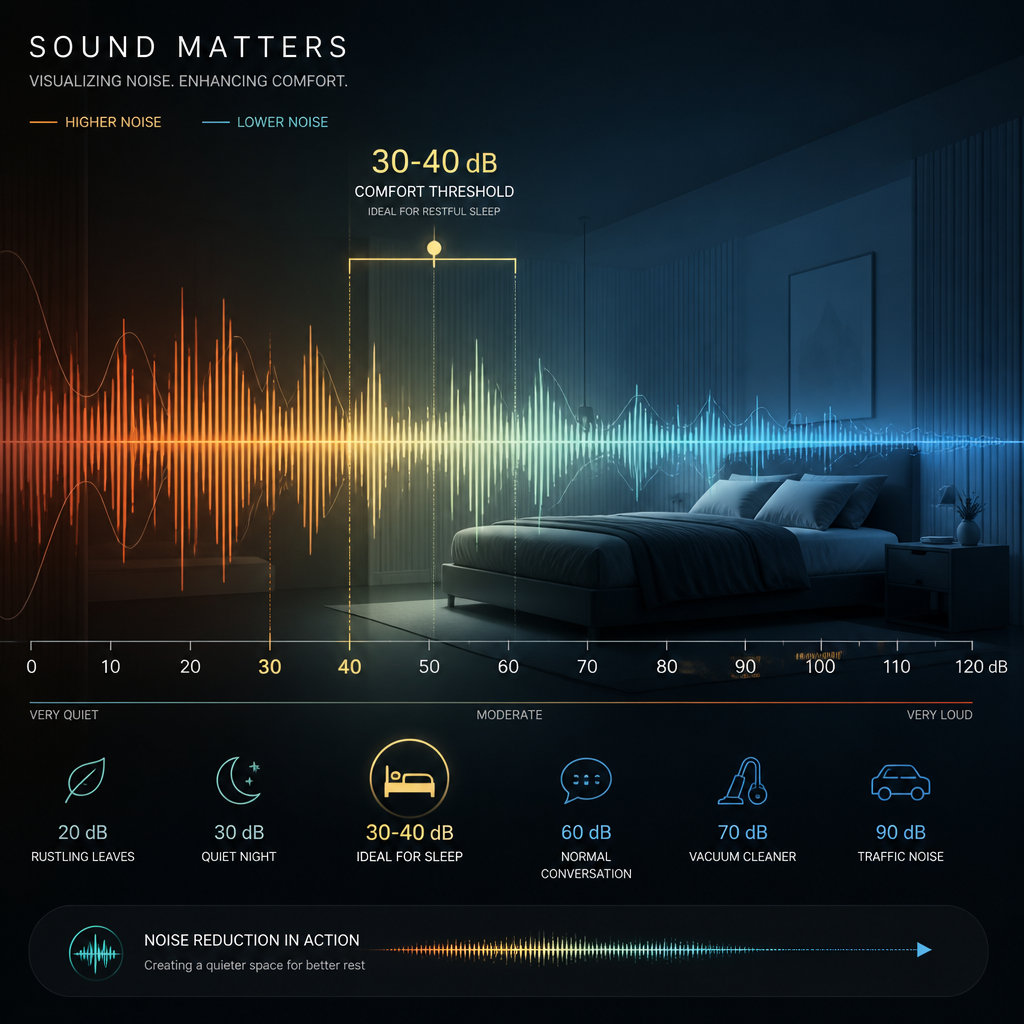
Most people assume they need genuinely loud noise to disrupt sleep. The research says otherwise. Sounds as low as 30 decibels have been shown to affect rest, and the WHO placed its nighttime noise threshold at around 40dB for building facades. A ticking clock, a distant TV, light street traffic: these are all capable of causing measurable sleep disruption in noise-sensitive individuals, and none of them would register as “loud” during waking hours.
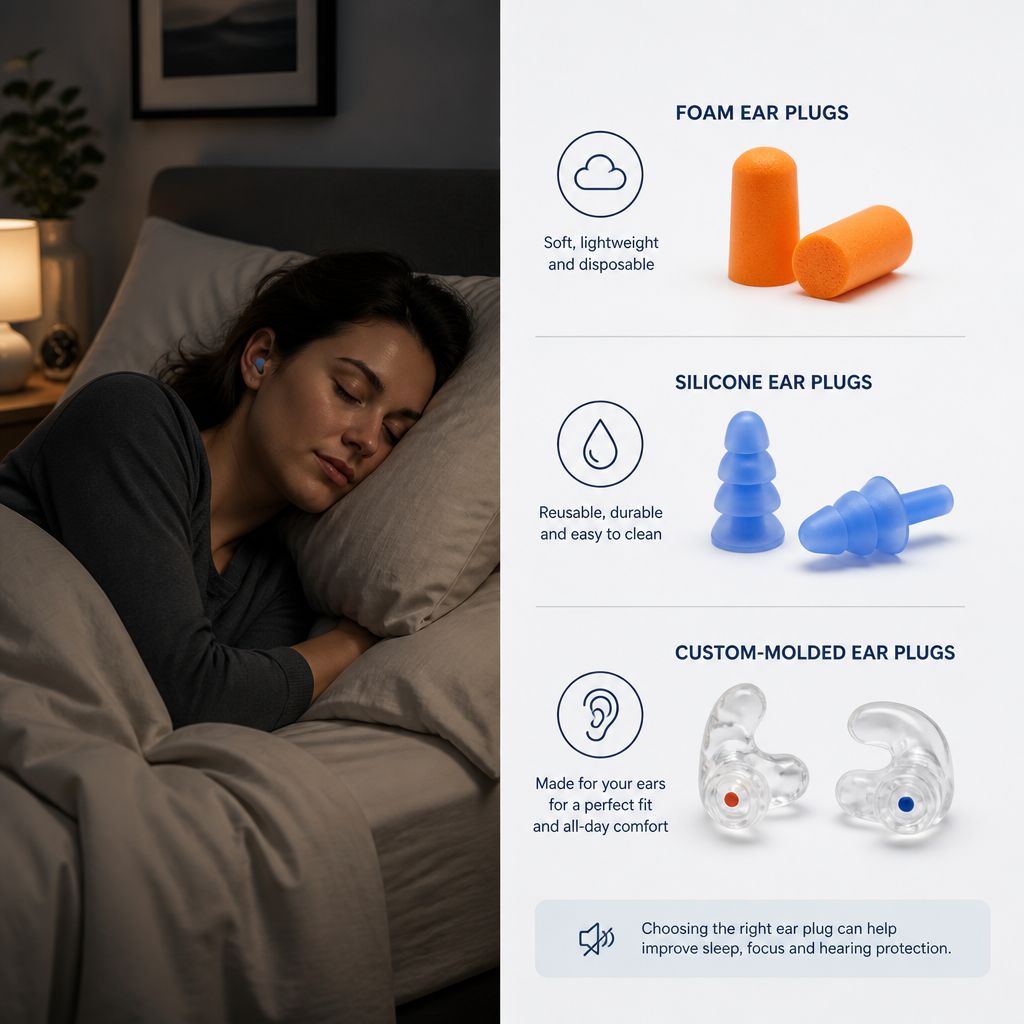
Not all ear plugs deliver the same experience during sleep. The type of material, the form factor, and whether the plug requires a hard insertion process all affect comfort over an eight-hour period. Below is a direct comparison of the three main approaches.
| Type | Noise Reduction | Sleep Comfort |
|---|---|---|
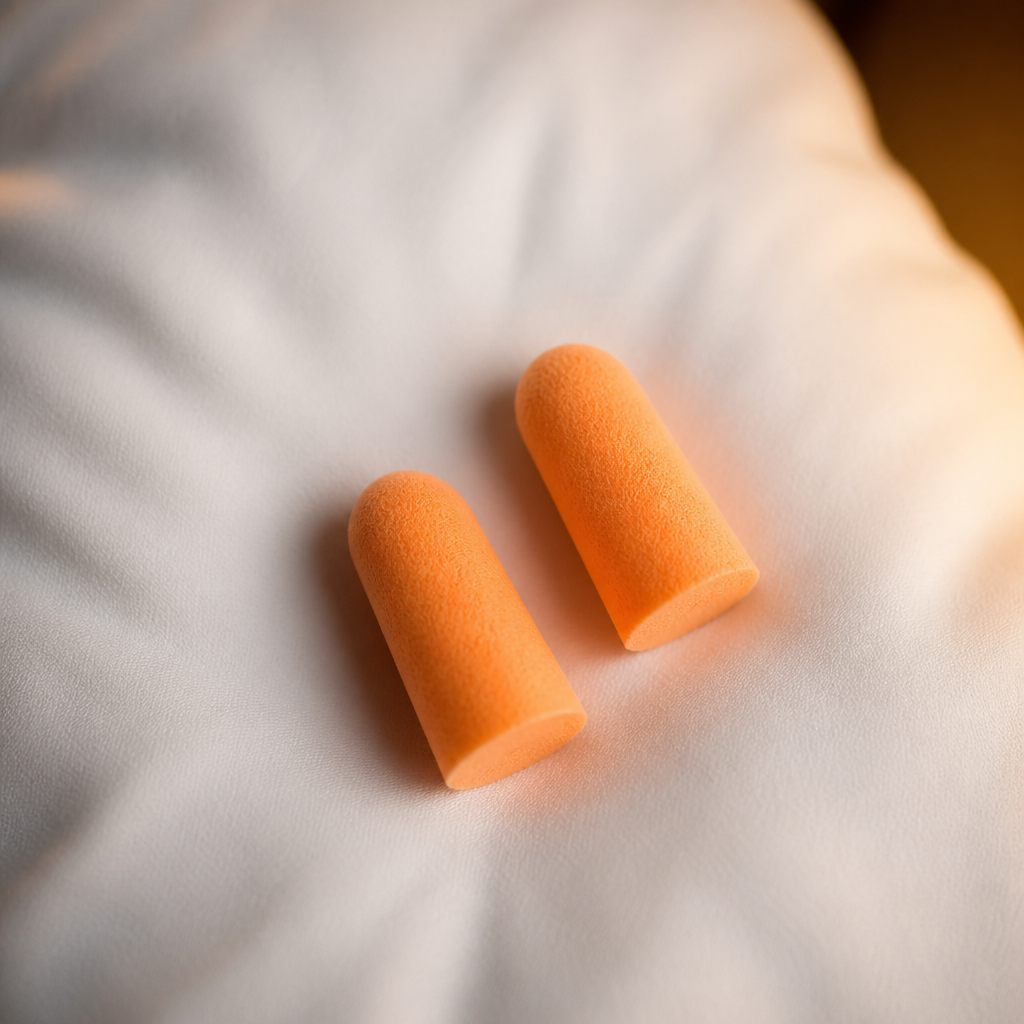
| Disposable foam (single-use) | High NRR on paper, but fit varies each insertion and plugs expand unevenly, reducing real-world attenuation | Can cause ear canal pressure and soreness after a few hours. No tip-size options mean poor fit for narrower or larger canals |
| Reusable metal-bodied with memory foam tips (e.g., ATTENU8) | Consistent 32dB attenuation with a stable seal due to firm body and sized foam tips (XS, S, M) | Low-profile concave design reduces pillow pressure. Memory foam tips conform to the ear canal shape and stay put through the night |
| Acoustic filter plugs (e.g., Loop, Flare) | Lower attenuation, typically designed to preserve sound quality rather than maximize noise reduction. Better suited for concerts than sleep | Comfortable for short durations. Less suited for extended wear due to rigid body and higher insertion depth requirements |
The design priorities are fundamentally different between sleep-focused ear plugs and acoustic/concert plugs. If you’re buying ear plugs primarily for sleep, maximum noise reduction and all-night comfort matter far more than preserved audio fidelity. A product designed to let you hear music clearly at a concert is solving the wrong problem for a light sleeper in a noisy bedroom.
Numbers on packaging can feel abstract. Here’s what 32dB attenuation translates to in practice. Heavy urban traffic outside a closed window typically registers at around 65 to 70dB inside a bedroom. A snoring partner produces roughly 50 to 60dB. With 32dB of noise reduction, that traffic comes down to the 33 to 38dB range, sitting comfortably below the critical 40dB threshold where sleep disruption becomes consistent.
For snoring, 32dB reduction takes a 55dB snore to approximately 23dB, roughly the level of a whisper in a quiet library. The difference in sleep continuity is significant. A noise level that was triggering arousals every 20 minutes becomes inaudible enough to sleep through.
The NRR (Noise Reduction Rating) printed on a product is tested under laboratory conditions with a perfect seal. In real use, a single-use foam plug that isn’t compressed and inserted correctly, or that shifts when you roll over, can lose half its rated attenuation or more. This is why fit consistency is the most important variable for real-world sleep protection.
A firm, machined aluminium body holds its shape precisely. Combined with correctly sized memory foam tips, it creates a repeatable seal every night without the rolling and insertion technique that single-use foam requires. For a light sleeper who inserts ear plugs at 10pm and wakes at 6am, that plug needs to perform consistently for eight hours across multiple sleep positions. Disposable foam rarely achieves this.
Pro tip: If you’ve tried foam earplugs before and found they fall out or become uncomfortable overnight, the issue is almost certainly fit rather than your ears being “unusual.” Try a size down on memory foam tips. Most people with smaller-diameter ear canals end up needing XS or S rather than the default medium size.
The environmental and financial case for reusable ear plugs is straightforward, but the practical performance case is equally strong and less often discussed. Disposable foam plugs, used every night, represent a recurring purchase cycle with no improvement in product quality over time. You’re replacing the same product repeatedly rather than investing in one that improves with the right fit.
Reusable ear plugs with replaceable foam tips change this equation. The structural component, the metal body that houses the tips and maintains the shape, doesn’t wear out on the timescale of the foam tips. Replacing only the tips every six to eight weeks means the core fit and performance remain consistent, and the cost per night drops substantially over a year of use. Beyond cost, the waste reduction is measurable: a single reusable pair replaces hundreds of disposable foam plugs annually.
A common objection to reusable ear plugs is hygiene. This is a legitimate concern with cheaper, hard-to-clean designs. It isn’t a problem with a smooth metal body that can be wiped clean and tips that are scheduled for regular replacement anyway. The aluminium surface doesn’t harbor bacteria the way porous materials do, and the replaceable tip model means the surface that actually contacts your ear canal is refreshed every six to eight weeks regardless.
For regular use, wipe the metal body with a damp cloth after each use. Store them in a case rather than loose in a drawer. Replace the memory foam tips on schedule rather than waiting until they’ve visibly degraded. These three habits cover the full hygiene requirement for long-term safe use.
The research on ear plugs and sleep quality was largely conducted on ICU patients because that’s where sleep disruption is most severe and most measurable. But the mechanisms identified, noise-triggered arousals, REM sleep compression, and accumulated sleep debt, apply directly to everyday situations that many people dismiss as “just normal life.”
Some people cycle through lighter sleep stages more frequently or have a lower arousal threshold. For these individuals, noise at levels that a heavier sleeper wouldn’t notice can cause repeated arousals across a single night. Ear plugs for sleep quality research consistently identifies this group as having the strongest measurable benefit from noise reduction, precisely because there’s more disruption to eliminate.
City bedrooms, apartments near busy roads, and hotel rooms during travel all present noise environments that exceed the sleep-disruption threshold. Traffic noise, HVAC systems, neighboring rooms, and early-morning deliveries all create intermittent noise events. These are exactly the conditions where a consistent 32dB seal changes the subjective experience of sleep from fragmented to continuous.
Snoring is one of the most common and most under-addressed causes of poor sleep for people who don’t snore themselves. The noise profile of snoring is irregular, which makes it more disruptive than consistent background noise because the brain cannot habituate to it. Ear plugs that maintain a seal through the night, including during position changes, address this directly without requiring any change in behavior from the snoring partner.
For people who work in loud environments, construction, manufacturing, or other industries with sustained noise exposure, the priority shifts from comfort alone to genuine hearing protection combined with overnight recovery. A product that delivers 32dB attenuation at night, with a durable metal body designed for long-term use, bridges the gap between occupational hearing protection and daily sleep support.
You can explore ATTENU8’s full range of premium reusable ear plugs designed specifically for this kind of extended, all-day and all-night use.
Both. Blocking sound is the mechanism, and improved sleep quality is the measurable outcome. Multiple randomized controlled trials using polysomnography, objective brain-wave monitoring, have shown that ear plugs reduce nighttime arousals and protect REM sleep in participants exposed to environmental noise. The subjective experience of sleeping better reflects a real change in sleep architecture, not just a perception of quietness.
Yes, with appropriate hygiene practices. The main risks associated with regular ear plug use are earwax impaction if the plugs push wax deeper into the canal, and ear canal irritation from poorly fitting or unclean plugs. Using a metal-bodied plug with replaceable memory foam tips and cleaning the body regularly eliminates most of these risks. Many sleep specialists recommend ear plugs as a first-line, non-pharmacological sleep intervention precisely because they are safe for nightly use.
The goal is to bring your sleeping environment below approximately 30 to 40dB, the range where sleep disruption becomes consistent. If your bedroom sits at around 60 to 70dB due to traffic or a snoring partner, you need roughly 25 to 35dB of effective attenuation. A well-fitted 32dB plug achieves this for most real-world noise environments. At extreme noise levels above 65dBA, even high-NRR plugs begin to show limitations, which is why a proper seal matters more than chasing the highest rated number.
Yes, and this is one of the clearest use cases the research supports. Snoring produces irregular, intermittent noise that the brain cannot tune out the way it can with consistent background sound. This irregularity makes it particularly effective at triggering arousals. A well-sealed ear plug with 32dB of attenuation brings most snoring below the arousal-triggering threshold, allowing you to cycle through sleep stages normally. The key is a seal that holds through position changes, which is where memory foam tips sized correctly to your ear canal outperform one-size-fits-all foam plugs.
Concert or acoustic ear plugs, such as those marketed by brands like Loop or Flare Audio, are engineered to preserve sound fidelity while reducing volume. This is the opposite requirement from sleep. For sleep, you want maximum attenuation across all frequencies, with no concern for audio clarity. Concert plugs typically deliver lower attenuation and are optimized for short-duration wear. Sleep plugs need to be comfortable over eight or more hours, remain in place during movement, and provide the highest practical noise reduction rather than a flat frequency response.
Most people adapt within three to five nights. The first night or two may feel slightly unusual due to the increased awareness of your own breathing and heartbeat that comes with effective noise blocking. This fades quickly. The adjustment period is shorter with a correctly fitted plug because discomfort is the main reason people abandon them early. Starting with the smallest tip size that creates a good seal, rather than defaulting to the largest, tends to make the adaptation faster and more comfortable.
Have you found that ear plugs have changed how you sleep, or do you have questions about fit and noise reduction that weren’t covered here? Share your experience in the comments below.

