


 0
0

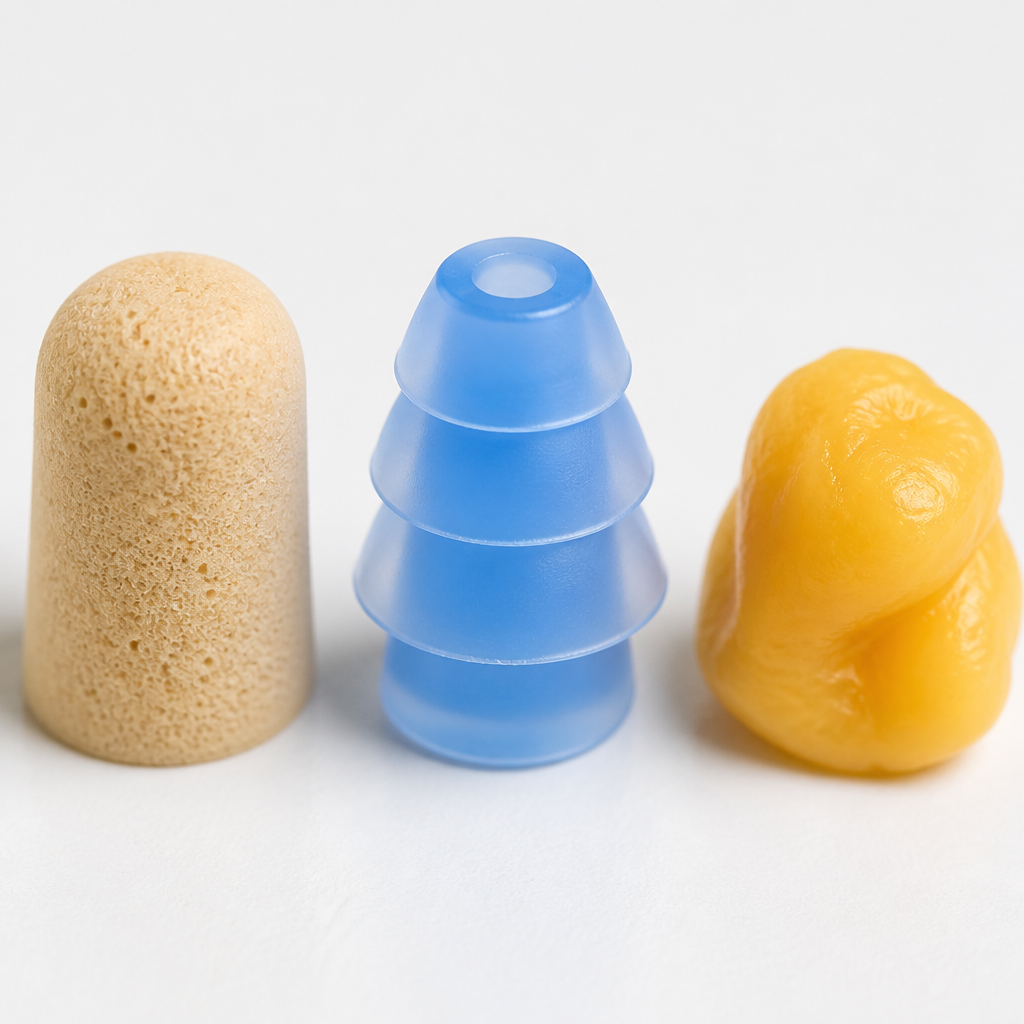
Most people reach for whatever ear plugs are cheapest at the pharmacy and wonder why they wake up at 3am to their neighbour’s music or a snoring partner. The material of the ear plug tip is almost never discussed on the packaging, yet it is the single factor that determines whether you get a real acoustic seal or an expensive placebo. Memory foam ear plug tips are not the default choice simply because they are traditional. They are the default choice because no other material reliably conforms to the irregular geometry of a human ear canal. Silicone flanges and wax putty both have real-world limitations that become obvious the moment you actually try to sleep on your side for eight hours or stand on a noisy construction site for an entire shift.
| Key Insight | Explanation |
|---|---|
| Memory foam expands to fill the ear canal | Unlike silicone flanges, memory foam conforms to the individual contours of each ear canal after insertion, producing a custom-like acoustic seal without custom-moulded tooling. |
| Silicone creates pressure points during side sleeping | Flanged silicone tips are rigid enough to transmit pillow pressure directly into the ear canal. Most side sleepers report discomfort after 3-4 hours, compared to 6-8 hours with memory foam. |
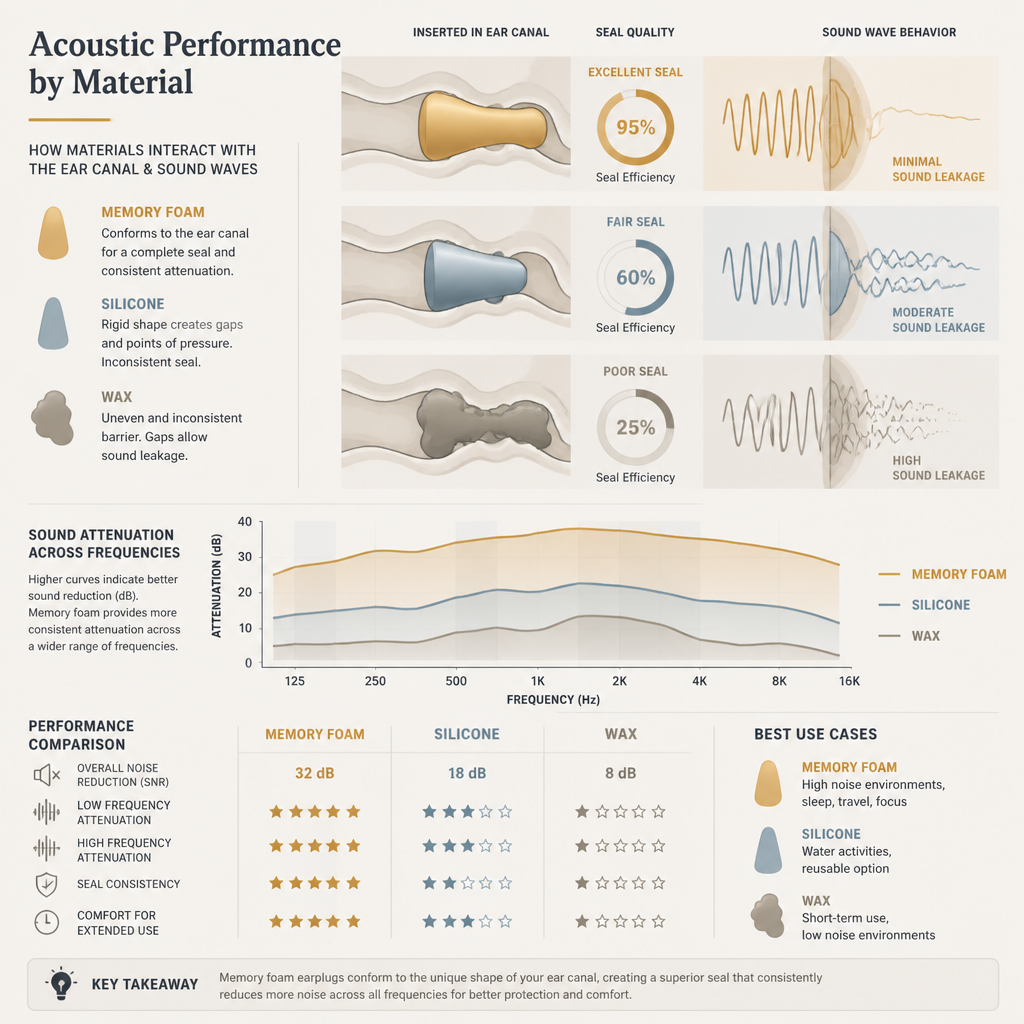
| Wax plugs have significantly lower noise reduction ratings | Wax and moldable silicone putty seal at the entrance of the ear canal rather than inside it, which produces lower NRR figures and leaves low-frequency noise like traffic and snoring poorly attenuated. |
| Foam tip size matters as much as material | A correct-size memory foam tip that fully expands inside the canal outperforms an oversized silicone flange that creates a partial seal at the wrong point. Multiple tip sizes are not a marketing add-on. They are an acoustic requirement. |
| Memory foam softness reduces cumulative ear fatigue | Memory foam is considerably softer than silicone, which matters over long wear periods such as overnight sleep or a full work shift. Harder materials build up pressure-related discomfort that foam does not. |
| Foam tips degrade and require replacement; the ear plug body does not | With a reusable metal-bodied design like ATTENU8, only the foam tips are replaced every 6-8 weeks. The aluminium body is permanent. This is more cost-effective and less wasteful than discarding entire ear plugs. |
| Real-world NRR is always lower than lab-rated NRR | Lab NRR figures assume perfect insertion. With memory foam and a correct insertion technique, real-world attenuation is closer to the rated value than with any other tip material because the seal is more consistent. |
The ear canal is not a uniform tube. It bends, narrows, and widens in ways that differ from person to person and even between your left and right ear. A rigid tip material that relies on a fixed shape, such as a flanged silicone tip, can only seal properly when its geometry happens to match the canal geometry closely enough. That match is inconsistent across a population of users.
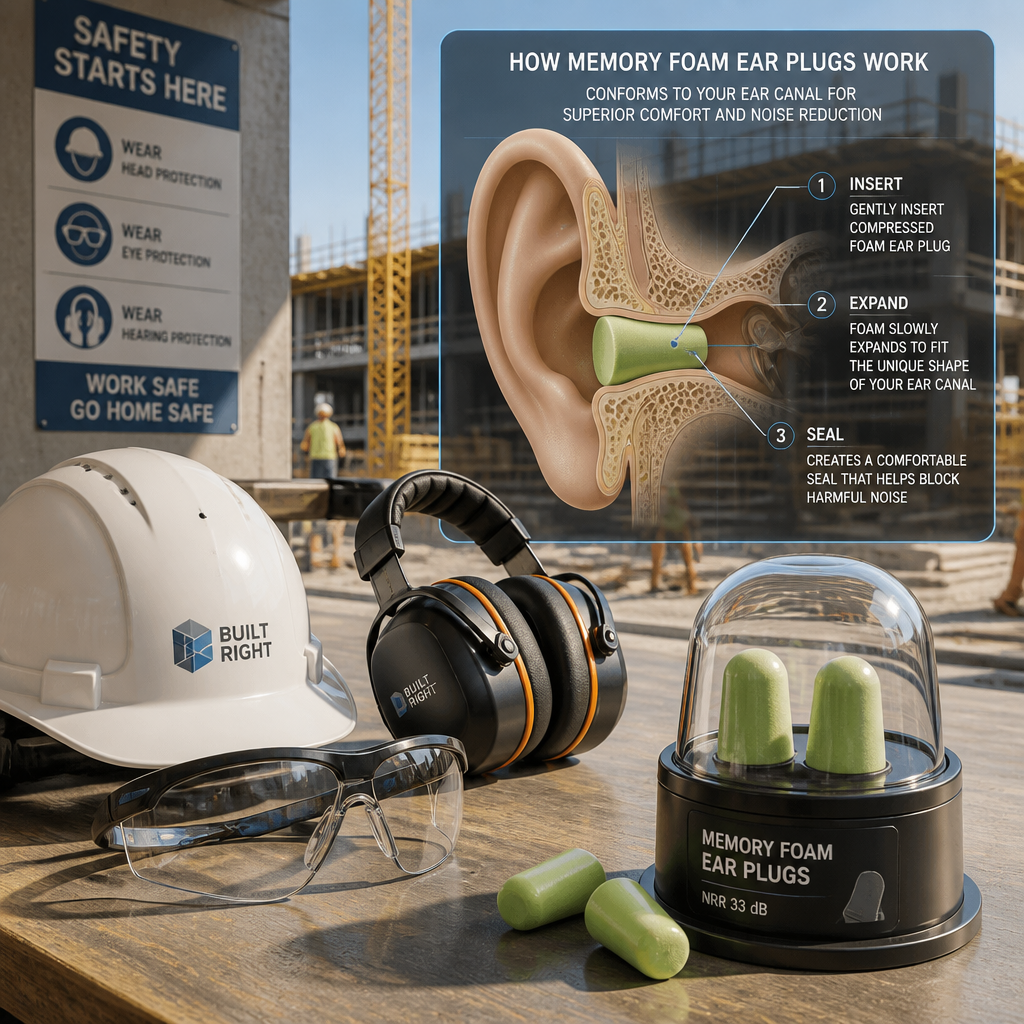
Memory foam works through a different mechanism entirely. You compress the tip between your fingers, insert it while compressed, and the foam then slowly expands against the canal walls. This expansion-based seal conforms to the precise contours of the individual ear canal, filling small gaps that any fixed-shape tip would leave open. Those gaps are where noise enters. Closing them is the entire job of an ear plug tip.
The expansion also creates a distributed, low-pressure contact across the full circumference of the canal rather than concentrated pressure at a few contact points. This is why memory foam tips are more comfortable during extended wear. The pressure is spread over a larger surface area at lower intensity per square millimetre, rather than a silicone flange pressing firmly at two or three discrete points.
Pro tip: After inserting a memory foam tip, press gently on your tragus (the small flap of cartilage at the front of your ear opening) and speak aloud. If your voice sounds hollow and enclosed rather than open and external, the foam has fully expanded and the seal is complete. If you still hear your voice externally, the tip needs to be reinserted deeper.
The slow expansion rate of quality memory foam also gives you time to position the plug correctly before the foam locks in place. Cheaper foam tips expand too fast, locking in before you can adjust the depth. This is why foam formulation quality varies considerably between products, and why the tip material specification matters even within the category of foam.
Silicone ear plug tips are durable and easy to clean. Those are real advantages. The problem is that a clean, durable tip that does not seal properly provides no meaningful hearing protection. Durability is only a virtue if the underlying performance justifies repeated use.
Flanged silicone tips can provide a seal, but the fit is less consistent depending on ear shape and tip size. Because silicone does not expand to match the shape of the ear, tips that feel secure at first insertion can loosen as you move, talk, or shift position during sleep. Memory foam maintains its expanded seal even as the ear canal shifts slightly with jaw movement or head rotation.
This inconsistency has a direct acoustic consequence. Every time a silicone tip loses partial contact with the canal wall, low-frequency noise bleeds through the gap. Low-frequency sounds, specifically traffic rumble, bass from music, and snoring, are exactly the noise profile that most light sleepers and noise-sensitive individuals are trying to block.
Silicone’s firmness becomes a genuine problem during side sleeping. When your ear presses against a pillow, the ear plug body transmits pressure directly into the ear canal through the rigid silicone tip. Most side sleepers report discomfort after 3-4 hours with flanged silicone, compared to 6-8 hours with memory foam. For anyone trying to get a full night of sleep, that difference is decisive.
This is not a minor comfort issue. Discomfort during sleep causes micro-arousals even when they do not fully wake you, reducing sleep quality even if you technically stayed asleep. An ear plug that causes you to remove it at 2am has not protected your sleep.
The goal of an ear plug tip is not to be close to the right shape. It is to become the right shape. Only expanding foam reliably achieves that in a population with varying ear canal geometry.
Wax ear plugs have one genuine advantage: they sit at the entrance of the ear canal rather than inside it, which means they create no inward pressure on the canal walls. For people who find any in-canal insertion uncomfortable, wax is more tolerable. That is where the list of advantages ends.
Wax and moldable silicone putty seal at the canal entrance rather than inside the canal, which produces lower NRR figures and leaves low-frequency noise poorly attenuated. This matters enormously when the noise you are trying to block is a snoring partner or low-frequency traffic rumble, both of which require substantial attenuation in the 125-500Hz frequency range. Surface seals at the canal entrance do not produce that attenuation.
Wax also deforms inconsistently. The material softens with body heat, which can cause it to lose its moulded shape over the course of a night. A tip that has shifted position at 4am is not providing the same protection it provided at 11pm. Memory foam maintains its expanded shape once set, and does not flow or deform under body heat.
Wax is a reasonable short-term option for light, occasional noise. It is not a serious solution for consistent high-attenuation hearing protection, whether for sleep, professional noise environments, or travel.
Pro tip: If you have been relying on wax ear plugs for sleep and they are not working well enough, the issue is almost certainly not the brand. It is the fundamental limitation of a surface seal. Switching to a well-fitted memory foam tip with proper insertion depth will produce a noticeably different result the first night you use it correctly.
The table below compares the three main ear plug tip materials across the factors that matter most to people using ear plugs for sleep, travel, or occupational hearing protection.
| Factor | Memory Foam | Flanged Silicone | Wax / Moldable Putty |
|---|---|---|---|
| Seal mechanism | Expands to fill full canal contour | Fixed flanges press against canal wall | Surface seal at canal entrance |
| Noise reduction consistency | High, consistent across ear shapes | Moderate, varies with ear canal geometry | Low to moderate, limited by depth of seal |
| Comfort for side sleeping | Excellent (6-8 hours) | Poor (pressure after 3-4 hours) | Good (no inward pressure) |
| Low-frequency attenuation | Strong | Moderate | Weak |
| Reusability | 6-8 weeks per tip (with metal body) | Long-term with cleaning | Short-term, degrades quickly |
| Cleanability | Limited (porous material) | Easy (non-porous, washable) | Single-use or very short-term |
| Fit adjustment | Self-adjusts via expansion | Requires correct size selection | Manually moldable at insertion |
Sleep is where material choice produces the most obvious real-world difference. The conditions of sleep, specifically lying still for 6-8 hours, changing position multiple times, pressing one ear against a pillow, and tolerating the plug at low consciousness levels, expose every weakness of silicone and wax that is less apparent during brief daytime use.
Selecting the right ear plug for sleep is not just about grabbing the highest NRR number. Comfort in a side-lying position, material softness, and whether the plug stays sealed as you move all matter more than raw decibel reduction numbers. A plug rated at a high NRR that causes you to pull it out at 2am provides zero protection for the rest of the night.
High-quality memory foam for ear plug tips is engineered to be noticeably softer than standard foam. It compresses with less force and expands slowly, so there is minimal rebound pushing against the ear canal wall when you are lying on your side. This slow, low-pressure expansion is what makes memory foam tolerable for hours rather than minutes.
In practice, a foam tip that expands too aggressively creates the same pressure problem as a firm silicone flange. Foam quality varies, and not all foam ear plugs use the same formulation. The tips on ATTENU8 ear plugs are specifically soft memory foam, designed to maintain a seal without creating the hard pressure points that wake side sleepers before their alarm does.
Ear canals are not standardised. Offering a single foam tip size and expecting it to work for every user is acoustically unrealistic. A tip that is too small will not expand to fill the canal. A tip that is too large will not insert deeply enough for a proper seal. ATTENU8 ships with three sizes of soft memory foam tips (XS, S, and M) precisely because the correct size is an acoustic requirement, not a preference. Finding the right size on the first night eliminates the guesswork that causes most new users to abandon ear plugs prematurely.
Construction workers, manufacturing personnel, and military operators face a different set of requirements than light sleepers. Hearing protection must remain effective over long shifts, withstand physical activity, and maintain its seal even when the wearer is sweating or moving frequently. Memory foam handles all of these conditions better than the alternatives.
For professionals who wear ear protection for hours at a stretch, the memory foam tip material reduces the cumulative pressure discomfort that builds over a shift with harder silicone or rigid stem designs. An ear plug that feels fine at 8am and becomes painful by noon is a liability, not protection. Workers will remove it, defeating its purpose entirely.
The ATTENU8 design addresses the professional context specifically. The aluminium body serves as an insertion handle and anchoring structure, while the replaceable memory foam tip creates the acoustic seal. A disposable foam plug in a tool belt pocket degrades before it is even inserted. An aluminium-bodied plug in a carry case does not. The combination of a durable body with a high-performance foam tip produces hearing protection that holds up to the demands of an actual work environment rather than just a lab test.
For noise environments requiring approximately 32dB reduction, which covers most construction and manufacturing settings, this design is genuinely viable. The foam tip provides the seal; the metal body provides the consistency of insertion and the longevity that disposables cannot offer.
One legitimate criticism of memory foam ear plug tips is that they degrade over time. Foam compresses and expands repeatedly with use, gradually losing elasticity and its ability to form a complete seal. This is a real limitation, and dismissing it would be dishonest.
The ATTENU8 approach addresses this limitation directly rather than ignoring it. The aluminium body is permanent and does not wear out. Only the memory foam tips are replaced, at a recommended interval of every 6-8 weeks. This means you replace the component that actually degrades while keeping the component that does not. The alternative, buying new disposable foam ear plugs every few weeks, replaces the entire product including the parts that were still functional.
This also has a comparison advantage over the memory foam vs silicone debate. Silicone tips last longer without requiring replacement, which is a genuine advantage. But the relevant question is not which tip lasts longer in isolation. It is which tip provides better acoustic performance per dollar and per unit of user effort. Memory foam tips that are replaced on schedule maintain their performance. Silicone tips that last longer but provide a less consistent seal may technically outlast the foam, but they also underperform on every night that the fit is not right.
A common mistake is to assume that because silicone is more durable, it is the better long-term investment. Durability only has value when the product is performing its function. An ear plug tip that lasts two years but provides inconsistent noise reduction is not a better investment than one replaced every 6-8 weeks that seals correctly every time.
Yes, for most users and most use cases. Memory foam expands to conform to the individual shape of each ear canal, creating a more consistent acoustic seal than fixed-shape silicone flanges. Silicone can provide a good seal when the tip size happens to match the canal geometry closely, but this consistency is lower across a general population. For sleep, construction noise, and traffic, memory foam’s expanding seal outperforms silicone flanges in practice.
Memory foam ear plug tips maintain their expansion properties for approximately 6-8 weeks of regular use before the foam begins to lose elasticity and the seal becomes less consistent. On a reusable design like ATTENU8, only the tips are replaced at this interval. The metal body is permanent. You can tell a tip needs replacing when it no longer feels like it fully expands against the canal wall, or when noise that was previously blocked starts to come through at familiar volume levels.
Wax ear plugs sit at the entrance of the ear canal rather than inside it, which means there is no inward pressure on the canal walls. This makes them more comfortable for people sensitive to in-canal insertion. The trade-off is that a surface seal at the canal entrance cannot achieve the same attenuation as a deep in-canal seal. Low-frequency noise in particular, including snoring and traffic, requires substantial attenuation in frequency ranges that a surface seal does not reliably cover.
Memory foam is the best ear plug tip material for side sleepers. Silicone flanges are firm enough to create pressure points when your ear presses against a pillow, and most side sleepers report discomfort after a few hours. Memory foam compresses under pillow pressure without creating hard pressure points, which is why memory foam ear plug users can comfortably wear them for a full night. Wax sits outside the canal and avoids in-canal pressure, but provides significantly less noise reduction than in-canal foam.
It matters more with disposables, not less. Disposable foam ear plugs use a basic open-cell foam that degrades quickly and loses its seal after a single use. Silicone disposables are rare. The comparison becomes most relevant when you move to reusable ear plugs, where you are choosing a tip material that will be your daily noise protection for weeks at a time. With a reusable system using replaceable memory foam tips, you get the acoustic advantages of foam combined with the economic and environmental advantages of a durable body.
Yes. Ear canal geometry varies considerably between individuals, and even between a person’s left and right ear. A tip that is too small will not expand to fully contact the canal walls. A tip that is too large will not insert to the correct depth. Both produce a partial seal rather than a full one, reducing real-world noise attenuation substantially. ATTENU8 includes XS, S, and M tip sizes specifically because correct sizing is an acoustic requirement. Try all three sizes and confirm the seal using the tragus-press check described earlier in this article.
Have you switched from silicone or wax to memory foam ear plug tips, and noticed a difference in how much noise actually gets through? Share what you experienced below, because real-world comparisons from different environments are useful to others making the same decision.

