


 0
0

Roughly 22 million workers in the United States are exposed to potentially damaging noise levels on the job every single year, and that figure does not even count the millions more who damage their hearing at concerts, sporting events, or through daily headphone use. The unsettling truth about noise-induced hearing loss prevention is that the window to act is always right now, not after you notice the first signs of damage. Once the sensory hair cells in your inner ear are gone, they do not grow back. This guide breaks down exactly what NIHL is, what causes it, and the concrete steps you can take today to protect the hearing you still have.
| Key Insight | Explanation |
|---|---|
| NIHL is 100% preventable and 100% permanent | Damaged inner-ear hair cells do not regenerate. Prevention is the only cure. |
| The 85 dB threshold is the safety ceiling | Habitual exposure above 85 dB will cause gradual hearing loss in a significant number of individuals. At 88 dB, safe daily exposure drops to four hours. |
| Noise damage is cumulative | Each loud exposure adds to a lifetime total. A concert tonight compounds the factory floor from this morning. |
| Tinnitus is an early warning sign | Ringing or buzzing in the ears after noise exposure means hair cells were stressed. Repeated episodes lead to permanent tinnitus and hearing loss. |
| Fit matters more than NRR number alone | A high-rated earplug worn incorrectly provides almost no real-world attenuation. Consistent, well-fitted protection beats any single-use foam plug. |
| Reusable earplugs reduce the barrier to daily protection | When your hearing protection is always in your pocket or bag, you actually use it. Disposable plugs get left behind. |
| Both impulse and continuous noise cause NIHL | A single explosion can cause immediate damage; steady noise at high levels causes the same injury more slowly over time. |
Noise-induced hearing loss (NIHL) is hearing damage caused by exposure to loud sounds, whether that is a single intense event like an explosion or years of steady occupational noise. It can affect people of all ages, and it can arrive quickly or accumulate so gradually that many people only notice it when the damage is already significant.
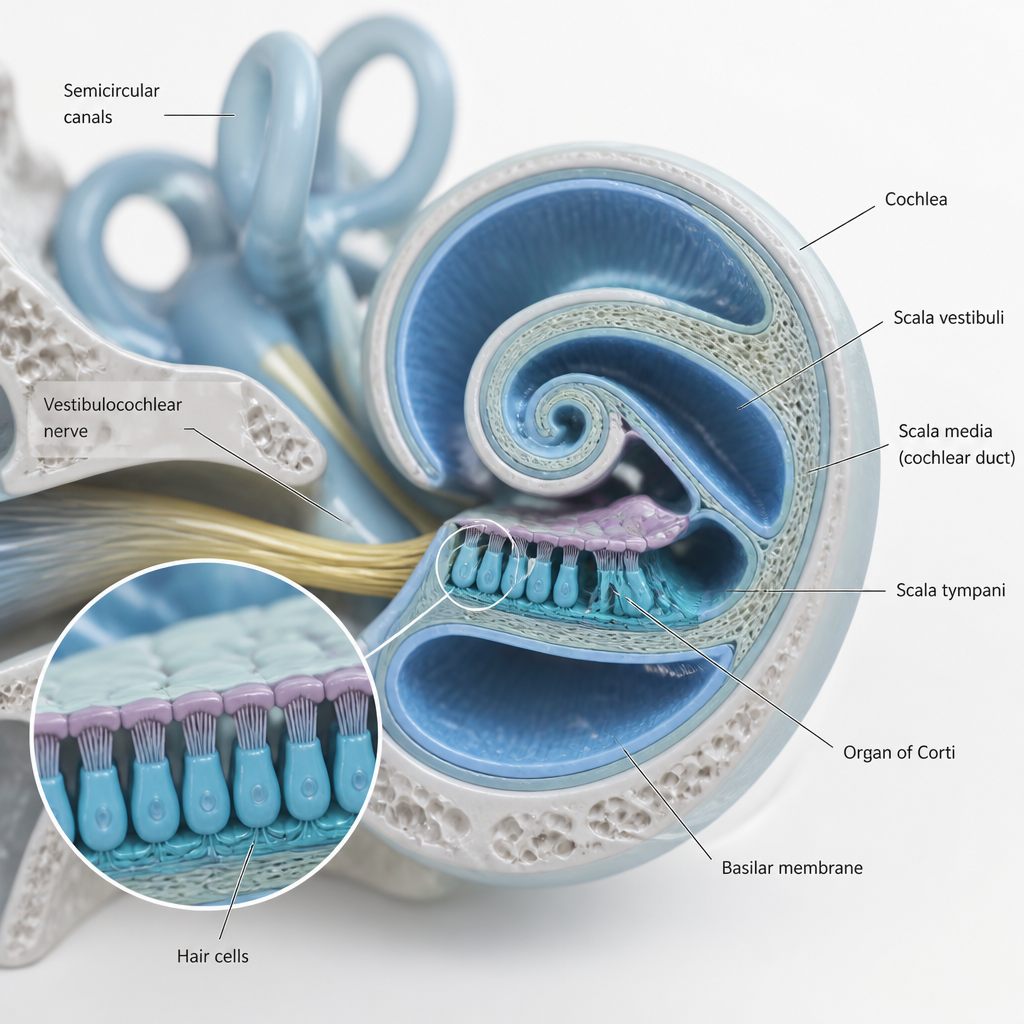
The mechanism is straightforward but brutal. Your inner ear contains tiny sensory hair cells that convert sound-wave vibrations into electrical signals the brain interprets as sound. When those cells are subjected to noise above a safe level, they are physically stressed and eventually destroyed. Because humans cannot regenerate these cells, every episode of damaging noise exposure moves you permanently closer to hearing loss.
What makes NIHL particularly deceptive is that it rarely announces itself with dramatic symptoms at first. The cumulative nature of the damage means that hearing can degrade substantially before a person notices that conversations are harder to follow or that the television volume keeps creeping up.
Understanding the specific NIHL causes is the first step toward avoiding them. The pathophysiology is multifactorial, involving both genetic susceptibility and environmental exposures, but the environmental side is where prevention lives.
Construction, manufacturing, mining, and military service top the list of high-risk occupations. Machinery, power tools, heavy equipment, and weapons fire generate sustained noise levels that sit well above the 85 dB safety threshold. OSHA mandates a hearing conservation programme whenever workplace exposure over an eight-hour period averages 85 dB or greater, yet occupational NIHL remains one of the most common work-related injuries.
The practical risk in these environments is not just the peak noise level but the daily dose accumulated over years. A worker exposed to 90 dB for eight hours a day, five days a week, year after year, is accumulating damage even if no single moment of exposure felt dangerous.
Loud music at concerts, clubs, and sporting events is one of the fastest-growing NIHL causes outside the workplace. A live concert can easily reach 100 to 110 dB at the stage. At that level, safe exposure time without protection is measured in minutes, not hours.
Personal audio devices are the other major recreational driver. Listening at high volume through headphones or earbuds concentrates damaging sound directly in the ear canal. Many listeners exceed safe levels without realising it because the damage builds invisibly over months and years.
A single explosive sound, a gunshot, an industrial blast, or an airbag deploying, can cause immediate and permanent hearing loss. Impulse noise with extremely fast rise times and peak amplitudes over 85 dB causes damage more rapidly than steady-state noise. Military personnel and firearm users face this risk every time they train or operate without adequate hearing protection.
Noise damage is not like a pulled muscle that heals with rest. Every decibel above the safe threshold is a permanent withdrawal from an account you cannot replenish.
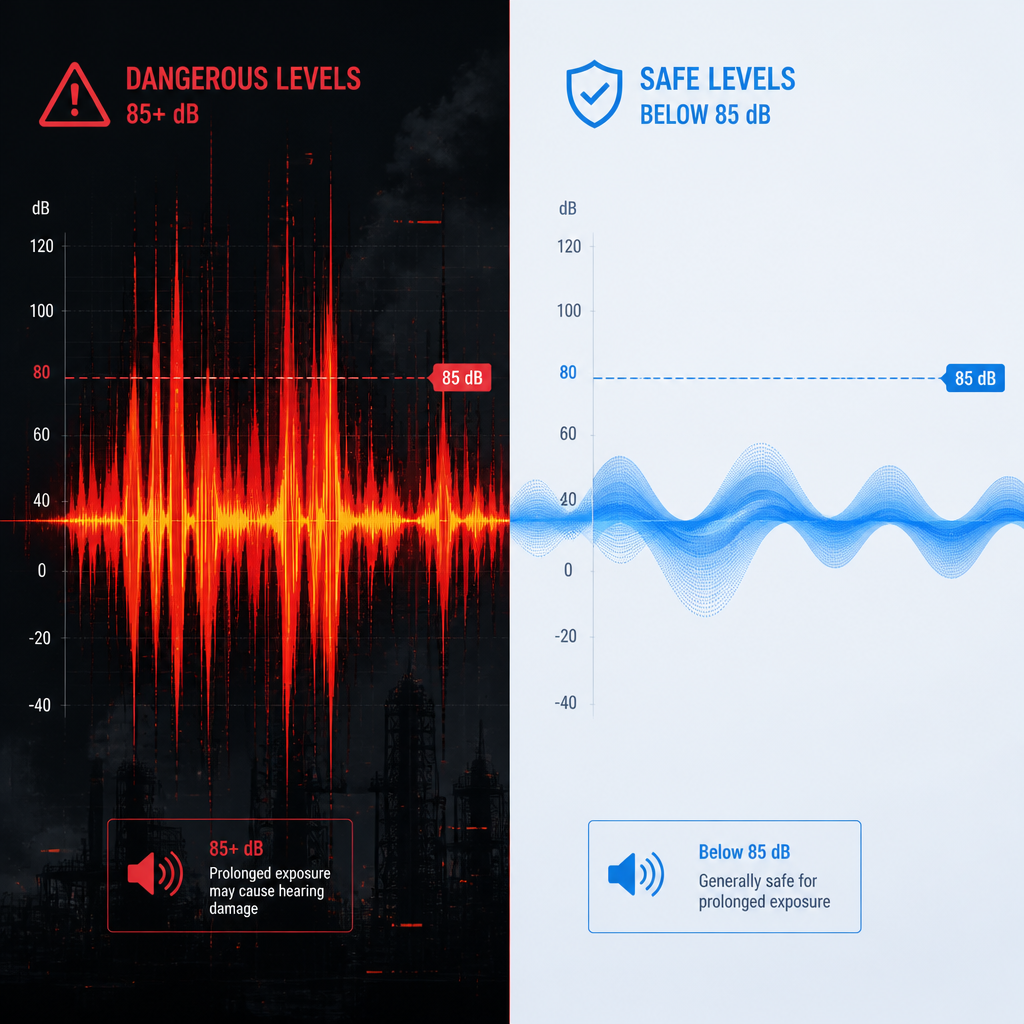
The decibel scale is logarithmic, which means small number increases represent enormous jumps in sound energy. Normal conversation sits at roughly 60 to 70 dB. A single very loud noise or long or repeated exposure to sounds at or above 85 dB can cause hearing loss. That 15-decibel gap between comfortable conversation and the danger threshold is narrower than most people assume.
Here is what the exposure limits look like in practice. For unprotected ears, the allowed exposure time decreases by one half for each 5 dB increase in average noise level. That means exposure is limited to 8 hours at 90 dB, 4 hours at 95 dB, and 2 hours at 100 dB. Using a stricter 3 dB exchange rate (the NIOSH recommended standard), every 3 dB increase halves the safe exposure time: at 88 dB the safe limit is four hours; at 91 dB it drops to two hours.
Common everyday sources that regularly exceed 85 dB include lawnmowers, motorcycles, power tools, and heavy traffic. The key insight is that most people underestimate how loud their daily environment is because hearing damage is painless and gradual until it is not.
Pro tip: Download a free sound level meter app on your phone and spend one day measuring the environments you move through. Most people are surprised to discover their morning commute, gym, or workplace already exceeds the 85 dB threshold for extended periods.
The symptoms of NIHL range from subtle early signs to unmistakable permanent impairment. Catching them early is the only way to prevent further deterioration.
The most important early signal is tinnitus after noise exposure. A ringing, buzzing, or roaring sound in one or both ears following a loud event means the hair cells in your inner ear were stressed. If the tinnitus fades after a few hours, that is a temporary threshold shift. Repeated temporary shifts accumulate into permanent damage over time.
Other early symptoms include muffled or distorted hearing immediately after noise exposure, a temporary sensation of fullness in the ears, and the need to ask others to repeat themselves more often than usual. Many people dismiss these signs as normal tiredness, which is exactly why NIHL progresses unnoticed for so long.
As the condition progresses, the damage becomes impossible to ignore. Difficulty understanding speech in noisy environments is one of the clearest functional signs of established NIHL. High-pitched sounds, such as birdsong, alarm tones, and consonants in conversation, are usually the first frequencies lost because the hair cells responsible for high-frequency processing are physically positioned in the most exposed part of the cochlea.
Persistent tinnitus, hearing loss that does not recover after a period of quiet, and the need to significantly increase television or phone volume are all signs that the damage has moved beyond temporary into the permanent zone.
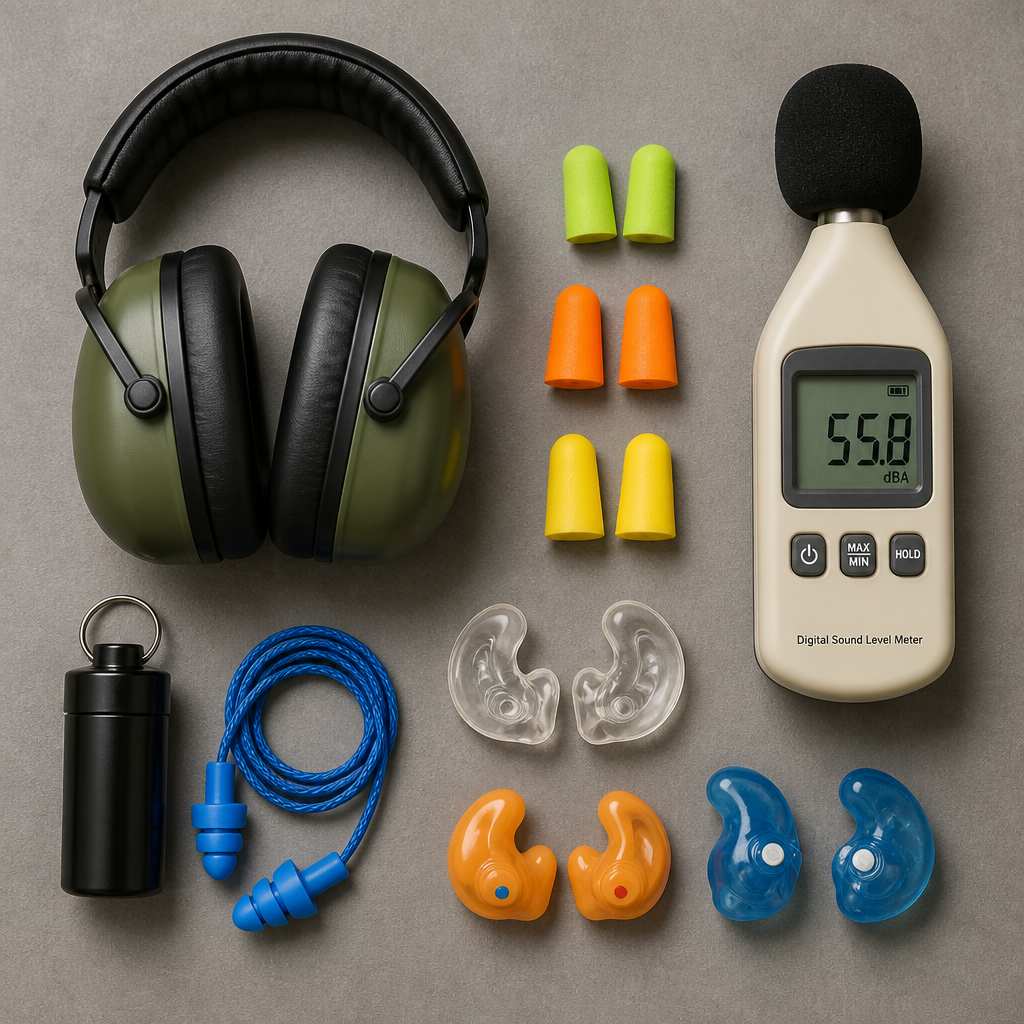
The best ways to protect your hearing are to avoid exposure to loud sounds, move away from the noise, or turn down the volume. When those options are not possible, hearing protectors are the most practical and effective defence available. The strategies below are ordered from most to least impactful.
Consistency matters more than the protection rating on the box. A well-fitted earplug with a moderate Noise Reduction Rating (NRR) worn every single time outperforms a maximum-rated plug used only occasionally or inserted incorrectly. The NRR is calculated under laboratory conditions, and real-world attenuation is always lower than the label figure because fit varies between users.
This is where reusable, precision-fitted earplugs have a clear advantage over disposable foam. ATTENU8’s metal-bodied reusable earplugs are engineered with a concave aluminium body that sits securely in the ear canal, paired with three sizes of memory foam tips (XS, S, M) so every user finds the fit that actually seals. The result is a consistent 32 dB noise reduction in real-world conditions, not just in a lab. Because the body itself is permanent, there is no excuse not to have them on hand.
Pro tip: Keep your earplugs in the same place every day, on your keys, in your jacket pocket, or in your work bag. The single biggest reason people skip hearing protection is that they did not have it with them when they needed it.
Many people think of earplugs only for extreme situations. The reality is that any environment where you need to raise your voice to speak to someone three feet away is likely above 85 dB. That includes many bars, gyms, stadium sports events, and busy construction sites. If you work in one of these environments, you need protection during every shift, not just the loudest ones.
Think of your daily noise exposure as a budget. If you are commuting on a loud train, working in a noisy office, and then attending a concert on the same day, your cumulative dose may exceed a safe threshold even if no single environment felt extreme. Spacing out loud exposures and using quiet recovery periods helps reduce the total burden on your inner ear.
Because NIHL is silent in its early stages, an audiogram is the only reliable way to catch it before the damage is severe. If you work in a noisy environment, annual hearing tests are a reasonable minimum. Any confirmed threshold shift at high frequencies should be treated as a serious warning and trigger immediate changes to your protection habits.
Not all hearing protection is created equal. The choice between disposable foam earplugs, reusable precision earplugs, and over-ear earmuffs depends on the environment, the frequency and duration of use, and the practical likelihood that you will actually wear them consistently.
| Protection Type | Real-World Effectiveness | Best For |
|---|---|---|
| Disposable foam earplugs | High NRR on paper (up to ~33), but real-world attenuation drops significantly with incorrect insertion. Hygiene degrades after one use. Most users insert them too loosely. | Short-term, occasional high-noise events where fit can be carefully optimised |
| Reusable memory foam earplugs with rigid body (e.g., ATTENU8) | Consistent ~32 dB reduction with correct tip size. The rigid aluminium body holds position in the ear canal, making it far easier to achieve a reliable seal than with all-foam plugs. Replaceble tips every 6-8 weeks maintain hygiene without replacing the whole unit. | Daily use in occupational settings, regular travel, sleep, concerts. Ideal for anyone who needs protection often enough that consistency matters. |
| Over-ear earmuffs | Consistent attenuation when worn correctly. Can be combined with earplugs for environments above 100 dB. Bulky and uncomfortable for extended wear or sleep. | Heavy industrial environments, shooting ranges, short-duration extreme-noise work |
The comparison above makes one thing clear: the best hearing protection is the one you will actually use every day. A pair of reusable earplugs that lives in your pocket and takes three seconds to insert is more valuable to your long-term hearing health than the highest-rated muff sitting in your locker.
Most discussions of NIHL focus on daytime exposure, but the connection between noise and sleep is a critical and underappreciated part of the picture. Chronic sleep disruption caused by environmental noise, a snoring partner, street traffic, or shift-work schedules, compounds the physiological stress on the body in ways that make individuals more vulnerable to the effects of any kind of noise exposure.
For light sleepers and noise-sensitive individuals, unprotected sleep in a noisy environment means both poor recovery and, in the case of genuinely loud overnight noise sources, potential additional exposure to damaging sound levels. Protecting your ears at night is not just about sleep quality, though that alone justifies it. It is about reducing the total daily dose of acoustic stress your auditory system has to absorb.
This is one reason the ATTENU8 earplug design specifically addresses side sleepers, including a bottom foam tip profile suited to lying down, so that wearing ear protection to sleep is physically comfortable rather than something you abandon after twenty minutes. An earplug you remove at 2 a.m. because it digs into your ear canal solves nothing. Consistent, comfortable protection through the night does.
For professionals in loud occupational environments, the math is stark. An eight-hour shift at 90 dB already uses up your entire safe daily dose under OSHA’s permissible exposure limit. Any unprotected noise exposure after hours, whether from recreational sources or a noisy sleeping environment, is damage stacked on top of an already maxed-out account.
No. Once the sensory hair cells in the inner ear are destroyed by noise exposure, they do not regenerate. There is currently no clinically proven treatment that restores hearing lost to NIHL. This is why prevention is not just the best strategy, it is the only one that actually works.
It depends on the intensity. A single exposure to an explosive impulse sound above 140 dB can cause immediate and permanent damage. At 100 dB, damage can begin in as little as 15 minutes without protection. At 90 dB, the permissible unprotected exposure under OSHA is eight hours, though stricter standards recommend shorter limits. The key point is that any level above 85 dB carries risk if sustained long enough.
Sounds below 70 dB are generally considered safe for unlimited exposure. Sounds at or above 85 dB begin to carry hearing damage risk with extended exposure. The risk increases sharply with every additional decibel. Normal conversation (60 to 70 dB) is safe; a motorcycle exhaust, power saw, or concert speaker stack is not.
In real-world use, reusable earplugs with a well-designed body, like the metal-bodied ATTENU8 design, are often more effective than disposable foam because the rigid body helps maintain a consistent seal in the ear canal. The NRR of a disposable foam plug is measured under ideal laboratory insertion conditions that most users never replicate. A precision-fit reusable earplug with the right tip size delivers reliable attenuation every time it is worn.
If your sleep environment involves sustained noise above 70 to 75 dB, such as a partner who snores loudly, heavy traffic outside, or industrial equipment nearby, then yes, hearing protection while sleeping is a reasonable and practical precaution. Even if the levels do not reach the damage threshold, the sleep disruption from unprotected noise exposure has measurable health consequences on its own. Comfortable, well-fitted earplugs designed for side sleepers solve both problems at once.
Both are standardised laboratory measurements of how much noise reduction a hearing protector provides, but they use different testing methods. NRR (Noise Reduction Rating) is the standard used in the United States. SNR (Single Number Rating) is the European equivalent. ATTENU8 earplugs carry an SNR 32 rating, meaning they are tested to reduce sound by up to 32 dB under the European CE certification standard. The two figures are not directly interchangeable, but both communicate the same basic idea: the higher the number, the greater the potential attenuation.
For memory foam tips on reusable earplugs, replacement every six to eight weeks is a sensible baseline under regular daily use. Tips that have lost their springback, become compressed, discoloured, or dirty will not form an adequate seal, which directly reduces the noise attenuation you are actually receiving. The advantage of a reusable system like ATTENU8 is that only the tips require replacement, not the entire device, making it far more cost-effective than constantly restocking disposable plugs.
Have you made changes to your hearing protection habits recently, or are you dealing with an environment where consistent protection has been a challenge? Share your experience below.

