


 0
0

Most people go to concerts to hear music, not a muddy, bass-heavy blur of noise coming through a pair of cheap foam plugs. Yet that is exactly what standard disposable earplugs deliver. The real question is not whether to wear ear plugs for concerts, it is how to choose a pair that protects your hearing without turning a live show into something unrecognizable. Get this right and you will actually enjoy concerts more, not less.
| Key Insight | Explanation |
|---|---|
| Concerts typically reach 100-120 dB | That level can cause hearing damage in as little as 15 minutes without protection. |
| Flat attenuation is everything | High-fidelity plugs reduce all frequencies equally so music sounds like itself, just quieter. |
| Target NRR/SNR of 15-25 dB for concerts | This range protects your hearing without isolating you from the crowd and the full musical experience. |
| Foam plugs cut high frequencies far more than lows | The result is muffled, distorted sound where you lose vocal clarity, cymbal detail, and guitar character. |
| Fit determines protection level as much as rating does | A poorly seated earplug, regardless of its stated NRR, leaks sound and underperforms significantly. |
| Reusable plugs with replaceable tips beat disposables on cost and reliability | A durable body means consistent performance every show; only the tips need refreshing over time. |
| Multiple tip sizes are not optional, they are essential | An earplug that does not seal your canal is not providing the protection or sound quality its specs promise. |
Live music is one of the loudest environments most people voluntarily spend time in. Sound levels at most concerts range between 100 and 120 dB, which is high enough to cause hearing damage in as little as 15 minutes without any protection. The OSHA guideline for safe noise exposure sits at 85 dB for extended periods. At a typical concert, you are exposed to levels well over double that threshold.
The damage is not always dramatic or immediate. You might leave with ringing ears, a condition called tinnitus, and write it off as part of the experience. But repeated exposure builds into permanent, irreversible hearing loss. The ringing after a show is not atmosphere. It is a symptom.
This is why hearing protection at concerts is not a preference, it is a practical necessity for anyone who values their long-term ability to enjoy music. The good news is that protecting your hearing does not mean sacrificing the experience.
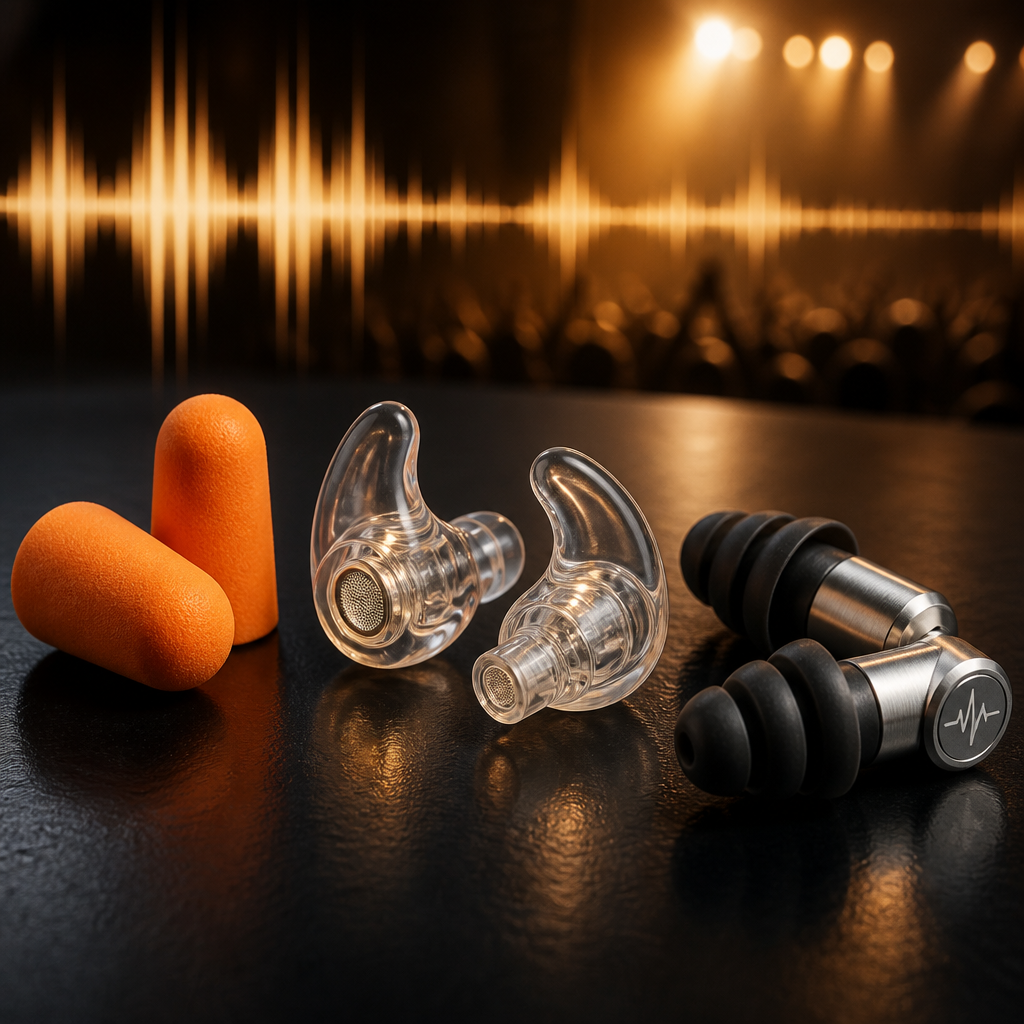
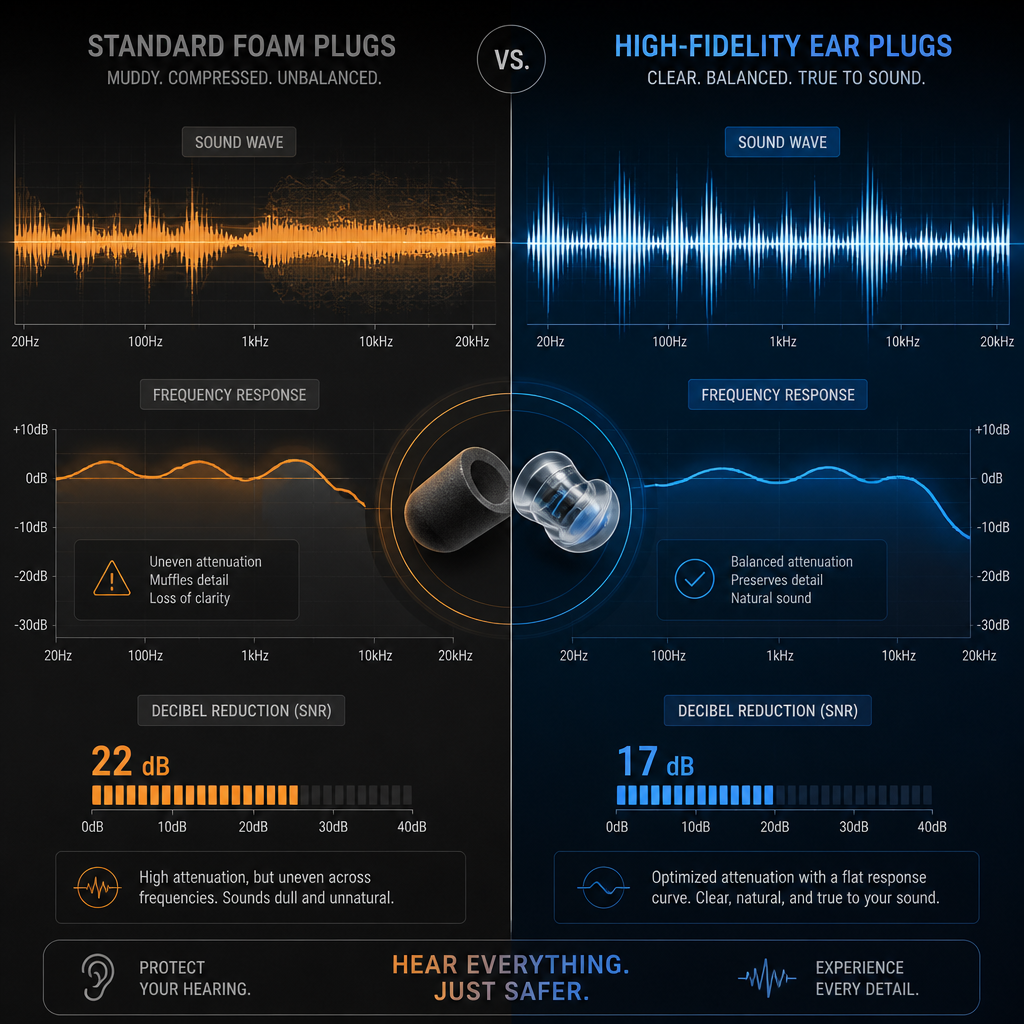
The foam earplugs you find in a convenience store or handed out at the venue door have one job: block noise. They do that job indiscriminately. Standard foam plugs attenuate high frequencies far more than low frequencies. In practice, this means a 110 dB concert becomes a 110 dB concert where the kick drum still pounds through but the vocals sound distant and underwater, the guitars lose their character, and the hi-hats almost disappear entirely.
This is not a minor audio inconvenience. It changes the fundamental character of the music. Many concertgoers who try foam plugs once never go back to them. They tolerate the noise damage instead, which is exactly the wrong outcome.
A disposable foam plug might reduce high frequencies by 30-35 dB while only cutting low frequencies by around 15 dB. The gap between those two numbers is what makes music sound wrong. You are not hearing a quieter version of the performance. You are hearing a tonally distorted version of it. The mix the sound engineer worked to create is completely undermined by an uneven attenuation curve.
Pro tip: If the only earplugs available are standard foam ones and you have no alternative, wear just one in the ear closest to the speakers, and position yourself away from the main PA stacks rather than directly in front of them. It is an imperfect workaround, but better than nothing.
High-fidelity earplugs solve the frequency imbalance problem through acoustic engineering. Instead of a dense foam mass that physically blocks sound, they use a small acoustic resistor, sometimes described as a tuned bore, membrane, or filter, that attenuates sound evenly across the full audible spectrum. The result is a quieter version of the concert, not a distorted one.
When the attenuation is equal across all frequencies, the music retains its tonal balance. Vocals stay clear. Cymbals stay present. Bass does not overpower everything else. The sound engineer’s mix remains largely intact. You are simply hearing it at a safer volume.
The difference between hearing protection and high-fidelity hearing protection is flat frequency response. One protects your ears. The other protects your ears and the music.
Flat attenuation means the plug reduces sound by approximately the same number of decibels at every frequency point, from the deep bass registers to the highest treble. A filter rated at 20 dB should reduce both 100 Hz and 8,000 Hz by roughly 20 dB each. In practice, no earplug achieves perfect flatness, but high-fidelity designs come significantly closer than foam equivalents.
This is the core specification to look for when shopping for the best ear plugs for music events. The marketing language to seek out includes “flat attenuation,” “linear response,” and “open-air membrane filter.” Ignore any earplug that does not describe its attenuation curve at all.
Choosing the right concert ear plugs comes down to five factors. Each one matters, and none of them are interchangeable.
For concerts, an NRR (or SNR in European ratings) of roughly 15-25 dB is the target zone. Below 15 dB and you are not providing adequate protection at a loud show. Above 25 dB and you risk over-damping the experience, leaving you isolated from the crowd energy and missing quiet musical passages entirely. Most high-fidelity concert earplugs sit in the 15-25 dB range deliberately, because that sweet spot brings a 110-115 dB venue down to a safe listening level without making you feel like you are watching the show through soundproofing glass.
As covered above, this is the single most important technical specification. Without flat attenuation, the number on the box is largely irrelevant to sound quality. Prioritize this over everything else.
A perfectly engineered earplug that does not seal your ear canal is not performing to its rated specification. The acoustic seal is what activates the filter. Without it, sound leaks around the plug and the attenuation is inconsistent. Always choose plugs that come with multiple tip sizes. Ear canals vary significantly between people, and the size that seals one person’s ear completely may leave a gap in another’s.
Memory foam tips are particularly effective here because they conform to the unique shape of your canal rather than imposing a fixed geometry on it. This is why ATTENU8’s metal-body plugs pair their rigid aluminium body with three sizes of soft memory foam tips (XS, S, M). The body maintains the acoustic performance; the tips ensure the seal.
If you attend concerts regularly, a durable reusable plug will outlast hundreds of disposable pairs and maintain more consistent acoustic performance across its lifetime. A metal or hard-shell body resists compression and deformation, meaning the filter geometry stays intact show after show. ATTENU8’s aluminium-bodied design is built on exactly this principle. Only the memory foam tips need replacing, roughly every 6-8 weeks depending on use, rather than the entire unit.
A common practical concern is visibility. Many concertgoers, particularly at smaller venues or when attending with unfamiliar groups, prefer plugs that do not visually announce themselves. Low-profile designs that sit flush with the outer ear are worth considering. A plug you actually wear consistently is worth far more than a technically superior one you leave in your pocket because it looks bulky.
Pro tip: Before a big show, test your earplugs at home with music you know well. If the sound still feels balanced, with clear highs and defined mids, the attenuation curve is working correctly. If everything sounds thick and muddy, you have not found a high-fidelity design yet.
| Feature | Disposable Foam Plugs | Plastic High-Fidelity Plugs (e.g., Loop, Flare) | Reusable Metal-Body Plugs (e.g., ATTENU8) |
|---|---|---|---|
| Sound quality at concerts | Poor. Heavy high-frequency roll-off creates muffled, distorted sound. | Good. Flat attenuation filters preserve tonal balance. | Excellent. Aluminium body preserves filter geometry for consistent flat attenuation. |
| Noise reduction range | High raw NRR (often 30+ dB) but uneven across frequencies. | Typically 15-25 dB with more even frequency response. | Approximately 32 dB with even attenuation across frequencies, suitable for very loud venues. |
| Fit and seal consistency | Variable. Soft foam can degrade quickly; single size fits poorly for many users. | Moderate. Plastic bodies offer limited conformity to canal shape. | Strong. Multiple tip sizes (XS, S, M) in memory foam ensure a reliable acoustic seal. |
| Durability | Single use. Inconsistent from pair to pair. | Moderate. Plastic shells can crack; tips wear over time. | High. Metal body does not deform. Only foam tips require periodic replacement (every 6-8 weeks). |
| Long-term cost | Low per pair but high over time if used regularly at shows. | Mid-range upfront; full replacement needed when worn out. | Higher upfront but low ongoing cost. Only replacement tips needed. |
| Best suited for | One-off industrial or construction use. Not ideal for music. | Casual concertgoers who attend a few shows per year. | Regular attendees, frequent travellers, and anyone who needs consistent performance across different noise environments including concerts, transport, and sleep. |
Not all concert environments are equal. A stadium rock show and an intimate jazz club present very different exposure profiles, and the right earplug choice reflects that.
These are the loudest environments. Stacked line arrays, subwoofers, and the sheer physical scale of the PA systems push levels to the upper end of the 100-120 dB range. A higher-attenuation plug in the 20-25 dB range is appropriate here. The acoustic pressure is intense enough that even a high-fidelity plug at this rating will still feel engaging.
Smaller rooms with reflective walls can actually be more damaging in some frequency ranges because the sound has nowhere to dissipate. A 15-20 dB flat-attenuation plug works well here. The mix in a smaller room is often clearer to begin with, so the high-fidelity advantage is especially noticeable.
These tend to be quieter by comparison, with peak levels around 90-100 dB. The dynamic range is wider, which means the plug you choose needs to handle both very quiet passages and sudden loud ones. A lower-attenuation, extremely flat-response plug preserves the most musical detail in this context. Fit and seal quality are critical here because any leakage will disrupt the listening experience at lower volumes.
Even the technically best earplug fails if it is uncomfortable enough that you remove it halfway through a show. Comfort over a three-hour set is a real-world specification, not a secondary concern.
The two main comfort factors are tip material and body weight. Memory foam tips conform to the canal and create a seal without the rigid pressure that harder silicone tips can produce over long periods. A lightweight body, whether metal or plastic, matters because even a few grams of additional weight becomes noticeable when you are moving and turning your head throughout a performance.
A common mistake is assuming the medium tip is right for most ears. In practice, ear canals vary considerably, and an oversized tip that creates a pressure seal is just as problematic as an undersized one that does not seal at all. Both fail in different ways. The oversized tip causes discomfort that leads to early removal. The undersized tip leaks sound and underperforms on attenuation.
This is why ATTENU8 includes XS, S, and M memory foam tips with every pair. Trying all three at home before a show to identify the correct fit is the single most impactful thing you can do to ensure both comfort and full rated noise reduction.
Reusable plugs need basic maintenance. Wipe the body down after each use to remove oils and debris. Replace memory foam tips when they lose their elasticity, roughly every 6-8 weeks under regular use. Keep them in a case rather than loose in a pocket or bag where they accumulate grit. A plug that fits and seals correctly at the start of the night should feel the same at the end of it.
Not if you choose the right attenuation level. A plug in the 15-20 dB NRR range will bring a typical concert from a damaging 110-115 dB down to a safer 90-95 dB level. That is still loud. The show still feels energetic and immersive. The goal is not silence, it is a safer volume that preserves the full musical experience rather than cutting it off.
NRR (Noise Reduction Rating) is the standard used in the United States, while SNR (Single Number Rating) is used in Europe and Australia. They are calculated slightly differently, so the numbers are not directly interchangeable. A product rated SNR 20 dB is broadly similar in performance to one rated NRR 18-20 dB, but always check which standard a product is using before comparing numbers across brands.
For regular concert use, yes. A metal body resists the deformation and compression that gradually changes the geometry of plastic shells over time. That means the acoustic filter inside maintains its designed performance for much longer. The ATTENU8 aluminium-body design specifically addresses this by keeping the structural integrity of the plug stable across years of use, with only the foam tips needing replacement.
Yes, and a reusable plug with memory foam tips is one of the best dual-purpose options available. The same properties that make ATTENU8 plugs effective at a concert, a firm body with conforming foam tips that seal the canal, also make them effective for blocking noise during sleep or travel. The key is having the right tip size for a comfortable overnight seal. Many users find that the same size that works at a concert is also ideal for sleep.
A correct seal produces a clear, immediate change in the volume of the environment when the plug is fully seated. If you insert an earplug and the change in sound level is gradual or incomplete, the tip is too small or not seated deeply enough. At a concert, cup your hands lightly over your ears with the plugs in. If the volume drops further significantly, you have a seal problem. A good seal means your cupped hands add very little additional reduction.
Every 6-8 weeks under regular use is a reasonable benchmark. The signal that tips need replacing is loss of elasticity. Memory foam should spring back to shape after compression. When it no longer does that reliably, the seal consistency drops. For someone attending one to two concerts per month and also using the plugs for travel or sleep, that 6-8 week window is a practical guideline rather than a strict deadline. Replace them when the foam no longer recovers its original shape.
Have you found a concert earplug setup that works well for you, or are you still searching for the right fit and attenuation level? Share your experience in the comments.

