


 0
0

Most people buy ear plugs the same way they buy batteries: they grab whatever is cheapest and closest, use them until discomfort forces them to stop, and then wonder why their sleep or hearing still suffers. That approach wastes money and often delivers none of the protection you actually need. This ear plug buying guide for 2026 cuts through the marketing noise (literally) so you can match the right plug to your specific situation, understand what noise reduction ratings actually mean in the real world, and avoid the most common fit and comfort mistakes that cause people to give up on ear plugs altogether.
| Key Insight | Explanation |
|---|---|
| Real-world NRR is much lower than the label | NIOSH and OSHA derate NRR values because most users do not insert foam plugs correctly. A rated 33 dB plug may deliver only 10-15 dB of actual protection for an untrained user. |
| Seal quality beats material every time | A well-sealed reusable plug with a structured body consistently outperforms a poorly inserted disposable foam plug, regardless of which has the higher rated NRR. |
| Three tip sizes matter more than you think | Ear canals vary significantly between people. Plugs that come with XS, S, and M memory foam tips (like ATTENU8) allow you to find a genuine seal rather than settling for a one-size approximation. |
| Foam tips, not full plugs, need replacing | Premium reusable designs require only foam tip replacement every 6-8 weeks. You replace the part that degrades, not the entire product, which dramatically lowers the long-run cost. |
| SNR (Europe) and NRR (USA) are not interchangeable | SNR is the European standard, NRR is the US standard. An SNR of 32 dB and an NRR of 32 dB describe similar real-world protection but are measured under different protocols. |
| Side sleepers need low-profile, pressure-free designs | Bulky plugs create pressure pain against the pillow within 20-30 minutes. A concave metal body or a flat, low-profile design is the practical requirement for all-night wear. |
| Matching plug to environment prevents over- and under-protection | For sleep and travel, 27-32 dB is the target range. For construction or heavy industrial work, you want at minimum NRR 25-30 on a well-fitted plug, or double protection for exposures above 100 dB. |
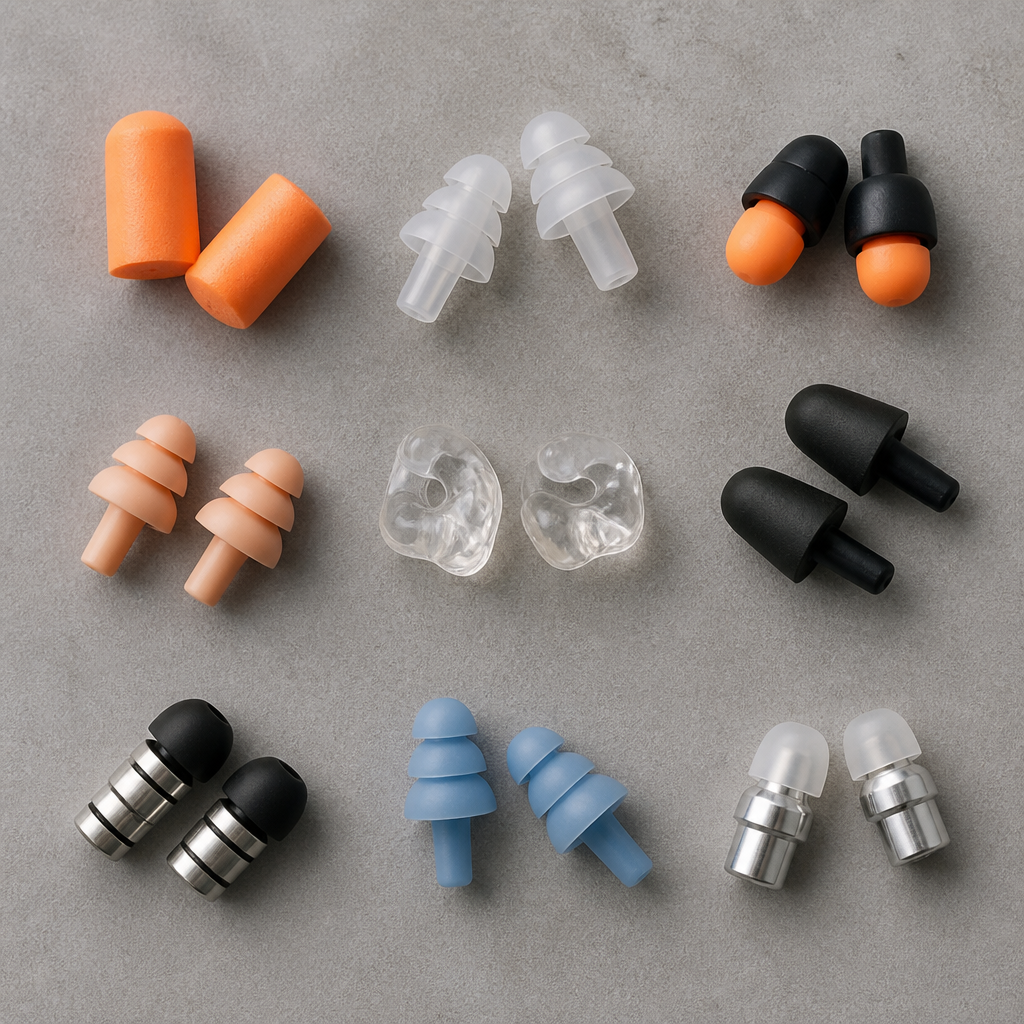
Walking into this purchase without knowing the categories is how people end up with the wrong product entirely. There are four distinct ear plug types, and each makes a different set of trade-offs between protection level, comfort, reusability, and price per use.
The classic roll-down cylindrical foam plug is the most common and the cheapest per-unit purchase. It reaches the highest NRR ratings, typically NRR 29 to 33, when inserted correctly. The catch is that phrase “when inserted correctly.” Disposable foam requires you to compress the plug tightly, insert it deep into the canal, and hold it in place while it expands. Most people skip steps, which is why independent field studies consistently show real-world attenuation far below the lab rating.
Disposable foam is genuinely ideal for high-turnover industrial environments, single-use hygiene requirements, and anyone who needs maximum noise blocking for a short, one-off exposure. It is the wrong tool for nightly sleep use because the replacement cost accumulates quickly and the insertion inconsistency means you never quite know how much protection you are getting on a given night.
Pro tip: If you use disposable foam plugs for sleeping, you should be replacing each pair every single night. Reusing them compresses the foam so it no longer seals properly, and compressed foam also collects earwax that pushes back into the canal on the next use.
Flanged plugs push into the canal without rolling and can be washed clean and reused for weeks. They typically rate NRR 25 to 27, which is sufficient for most industrial environments and more than enough for sleep and travel. The lower ceiling compared to foam is the main drawback. The benefit is consistency: the flanged structure gives you the same insertion depth every time, which means your protection is predictable.
This is the category ATTENU8 occupies, and it solves the two biggest shortcomings of the other designs simultaneously. The structured aluminium body guides correct insertion every time, addressing the consistency problem of foam. The replaceable memory foam tips address the hygiene and degradation problem of flanged plugs. ATTENU8’s concave body with three interchangeable tip sizes (XS, S, M) delivers approximately 32 dB of noise reduction with the seal reliability that most people never achieve with disposable foam.
Electronic plugs use active noise cancellation or compression circuitry. Filtered plugs attenuate specific frequency ranges while allowing others through, which is useful for musicians who want to protect hearing while maintaining audio clarity. These are specialty products with a specific audience and a significantly higher price point. They are not the right starting point for sleep, travel, or general industrial hearing protection.
The single most misunderstood aspect of any ear plug buying guide is the noise reduction rating. People see a number on the box and assume it represents the decibels subtracted from their environment. It does not work that way in practice.
NRR (Noise Reduction Rating) is the US standard, governed by EPA regulations and referenced by OSHA and NIOSH. SNR (Single Number Rating) is the European equivalent under ISO/EN standards. Both are measured under laboratory conditions with trained subjects inserting plugs correctly. The SNR and NRR numbers describe similar real-world protection but come from different measurement protocols, so they are not directly interchangeable despite often producing similar numerical values.
OSHA recommends halving the NRR to estimate real-world protection. NIOSH goes further, applying a 50 to 70 percent derating factor because field studies consistently show that most users do not achieve lab conditions. A plug rated NRR 33 may realistically deliver only 10 to 15 dB of protection for an average user who has not been trained in proper insertion technique.
The derating issue is not a product flaw. It is a human behaviour pattern. A structured plug body that guides correct placement every time closes most of the gap between rated and real-world protection without requiring the user to learn a technique.
This is why the design of the plug body matters as much as the NRR number on the label. An NRR 32 plug that consistently seals correctly protects your hearing better than an NRR 33 plug that most users insert 50 percent depth.
For sleep and domestic noise (snoring, street traffic, neighbours), a real-world reduction of 25 to 32 dB is the useful target range. You do not want complete silence. You want the edge taken off disruptive noise while retaining enough awareness to hear an alarm. For construction and manufacturing environments with sustained noise above 90 dB, you need a minimum of NRR 25 on a correctly fitted plug, and exposures above 100 dB warrant double protection (plug plus earmuff).
Pro tip: When comparing products with different ratings, use the OSHA derating formula as your benchmark: subtract 7 from the NRR, then divide by 2. This gives you a conservative estimate of real-world dB reduction. An NRR 32 plug becomes approximately 12.5 dB of estimated field protection under this formula, which is still meaningful protection against moderate sleep noise.
The most practical section of any how to buy ear plugs guide is this one: matching the product to the actual problem you are solving. Different environments demand different priorities.
Sleep use has the most demanding physical requirements of any ear plug application. You wear them for 6 to 8 hours, often on your side, and comfort degradation over time is the primary reason most people abandon ear plugs within weeks of buying them. The key requirements for sleep ear plugs are low profile (to avoid pillow pressure), soft material at the canal contact point (memory foam wins here), and a design that stays in place without pressure building up as the foam expands.
Disposable foam plugs swell as they expand, creating increasing pressure over time that wakes many side sleepers. A memory foam tip on a metal-bodied plug like ATTENU8 expands gently against the canal wall without the same outward swelling force, which is why users report all-night comfort that disposable foam rarely achieves.
Travel use is about two distinct problems: cabin pressure changes and sustained ambient noise (engine hum, passenger noise). For pressure changes during takeoff and landing, a slow-release memory foam tip or a filtered plug is preferable to a hard flanged plug, as the gradual seal adjustment is more comfortable during pressure transitions. For sustained ambient noise reduction on long flights or trains, a 27 to 32 dB plug in a durable carry case is the practical requirement. A metal-bodied plug with a case holds up to bag handling in a way that a loose pair of foam plugs simply does not.
Occupational hearing protection operates under regulatory frameworks (OSHA 29 CFR 1910.95 in the US) that set mandatory exposure limits. The basic requirement is that your plug brings noise exposure below 85 dBA as an 8-hour time-weighted average. For a 95 dB environment, an NRR 25 or higher correctly fitted plug meets that threshold. For louder environments at 105 dB or above, double protection (plug plus earmuff) is the practical standard.
In industrial settings, the insertion consistency problem is most acute because workers are inserting plugs repeatedly across shifts, often with gloved hands or in poor lighting. A push-to-fit design with a structured body removes the technique variable and delivers more predictable protection across a team than roll-down foam.
Fit is the variable that renders all other specifications secondary. A perfectly engineered ear plug with an excellent NRR delivers zero protection if the user removes it after 45 minutes because it is uncomfortable. This is not a minor concern. It is the primary reason most ear plug purchases fail.
Human ear canals vary considerably in diameter and length. A one-size foam plug compresses to fill the space but does not account for whether that space is actually being sealed. Products that offer multiple tip sizes (XS, S, and M) allow users to match the seal contact area to their actual canal geometry, which produces both better noise reduction and more comfortable long-term wear. This is not a minor upgrade; it is the structural difference between a plug that works and one that the user tolerates for a week before giving up.
Memory foam conforms slowly to the exact shape of the canal, distributing pressure across a larger surface area. Silicone flanges contact the canal at specific flange edges, creating higher local pressure points. For short-duration wear (30 minutes to 2 hours), silicone is comfortable and effective. For all-night sleep use, memory foam is the more comfortable material at the canal contact point for most users. The combination of a structured body (for consistent insertion and acoustic engineering) and a memory foam tip (for comfort and seal) is why metal-bodied designs with replaceable foam tips perform well across both sleep and industrial use cases.
This deserves its own paragraph because it eliminates a large portion of available products immediately. Standard cylindrical foam plugs protrude from the ear canal by 10 to 15 mm. When a side sleeper presses their ear into a pillow, that protrusion creates a lever that pushes the plug sideways against the canal wall. The result is discomfort within 20 to 40 minutes that either wakes the user or causes them to remove the plug in their sleep. A low-profile, concave-bodied design that sits flush with the outer ear solves this mechanically, and it is a non-negotiable feature for side sleepers.
| Feature | Disposable Foam | Reusable Silicone Flanged | Reusable Metal-Bodied with Memory Foam Tips (e.g. ATTENU8) |
|---|---|---|---|
| Noise Reduction Rating | NRR 29-33 (rated); 10-15 dB typical real-world | NRR 25-27; more consistent real-world delivery | Approximately 32 dB SNR; consistent seal due to structured body |
| Comfort for Sleep | Poor for side sleepers; pressure builds over hours | Moderate; flanges can create pressure points overnight | High; memory foam distributes pressure, low-profile body suits side sleepers |
| Insertion Consistency | Technique-dependent; widely variable between users | Better than foam; push-to-fit reduces variation | Best; structured body guides correct canal placement every use |
| Lifespan and Replacement | Single use; replace every wear | Weeks; replace full plug when flanges degrade | Body lasts indefinitely; replace foam tips only every 6-8 weeks |
| Long-Run Cost | Lowest per unit, highest cumulative cost for daily use | Low per-use cost over weeks | Lowest per-use cost for daily or nightly users; tip replacements are the only ongoing expense |
| Best Use Case | High-turnover industrial, single-use hygiene needs, occasional use | Daily industrial wear, occasional travel | Sleep, travel, noise-sensitive daily use, professionals wanting consistent protection |
| Environmental Impact | High waste; daily disposal | Moderate; periodic full replacement | Low; only tips replaced, aluminium body is durable and reusable |
The best ear plugs to buy are always the ones that match your primary use case, fit your ear canal, and that you will actually keep wearing. Here is the decision process that removes guesswork from the purchase.
Be specific. “Noisy” is not an environment. “Snoring partner in a quiet bedroom” is a different problem from “operating a pneumatic drill at 105 dB for 8 hours.” The first needs 25-32 dB of comfortable long-wear protection. The second needs regulatory-compliant double protection. Write down the actual situation and its approximate decibel level before you look at any product page.
If you need ear plugs every night or every working day, a reusable design is the rational choice from any economic or environmental angle. If you need them once a month for a specific event, a box of quality disposable foam makes sense. The break-even point between disposable and reusable typically arrives within the first few weeks of daily use.
Do not buy a one-size product without first checking whether you have a small, medium, or large ear canal. Most people have never tried a smaller tip and assume their current discomfort is just “how ear plugs feel.” Often, it is simply the wrong size. Look for products that include at least two tip size options, and ideally three (XS, S, M) so you can trial-fit before committing to a single size.
Apply the OSHA derating formula (subtract 7 from NRR, divide by 2) to get your working estimate of real-world protection. Compare that number to the noise level you are trying to manage. If your environment is 90 dB and you need to get below 85 dB, a derated 12.5 dB from an NRR 32 plug still closes that gap. If your environment is 105 dB, you need a higher-rated plug or double protection.
If any portion of your use involves lying down or sleeping, reject any product that protrudes more than a few millimetres from the ear canal opening. Check the product dimensions or user reviews specifically from side sleepers before purchasing.
Pro tip: Read one-star reviews specifically for comfort complaints from side sleepers, not from people who disliked the noise reduction level. Those reviews will tell you more about whether a plug is genuinely usable overnight than any manufacturer claim will.
The maintenance question separates thoughtful buyers from people who end up disappointed. Every ear plug type has a different maintenance requirement, and ignoring it reduces both performance and hygiene significantly.
Disposable foam plugs should be used once and discarded. Reusing them flattens the cellular foam structure so it no longer expands to a full seal. Beyond the performance issue, compressed used foam accumulates earwax that reintroduces contamination into the canal on the next insertion. The rule is simple: one use, then gone.
Reusable silicone plugs need washing with mild soap and water after each use. Inspect the flanges every two to three weeks. When flanges soften, crack, or lose their shape, the plug no longer seals correctly and should be replaced in full. A common mistake is continuing to use a flanged plug well past its effective life because it “still looks okay.”
The maintenance advantage of a metal-bodied design like ATTENU8 is that the component that degrades (the memory foam tip) is the component that gets replaced, on a schedule of approximately every 6 to 8 weeks. The aluminium body itself requires only occasional cleaning with a damp cloth and does not degrade. This modular approach means you are never discarding a functional acoustic component; you are only replacing the comfort and seal element that wears out through use.
In practice, this maintenance schedule is easy to keep: replace tips at the same time you replace your toothbrush. The cost and effort are minimal, and you always have a fresh seal without having to replace the entire product.
NRR (Noise Reduction Rating) is the US standard regulated by the EPA and referenced by OSHA and NIOSH. SNR (Single Number Rating) is the European standard under ISO/EN protocols. Both reflect the decibels of noise reduction measured in a laboratory setting, but they use different test methodologies, so the numbers are not directly interchangeable. When comparing products, make sure you are comparing NRR to NRR or SNR to SNR, not mixing the two.
Disposable foam plugs should be replaced after every single use. Reusable silicone flanged plugs typically last several weeks before the flanges degrade and should be inspected regularly. Reusable metal-bodied plugs with memory foam tips require only tip replacement every 6 to 8 weeks; the body itself lasts indefinitely with basic cleaning. The right answer depends entirely on which type you own.
Wearing ear plugs does not damage hearing by itself. Incorrect insertion that pushes earwax deeper into the canal over time is the concern most audiologists raise about regular foam plug use. A plug that does not require deep canal insertion, and that is cleaned properly between uses, eliminates most of this risk. If you notice earwax buildup, tinnitus, or changes in hearing after regular plug use, consult an audiologist.
Price alone is not a reliable quality indicator. What matters is whether the design delivers consistent seal quality for your ear canal size, fits your specific use case (sleep, industrial, travel), and is comfortable enough for the duration you need to wear it. A well-designed premium reusable plug that you actually wear all night is objectively better than a high-NRR disposable plug you pull out at 2 AM because it hurts. Match the product to the requirement, then evaluate whether the price reflects the value for your specific situation.
Side sleepers need a low-profile design that does not protrude significantly from the ear opening. Standard cylindrical foam plugs are among the worst options for side sleepers because they protrude and create pillow pressure that either causes pain or pushes the plug out during sleep. A concave or flush-profile body with a soft memory foam tip provides comfort through the night without the lever-pressure problem. ATTENU8’s concave aluminium body was specifically designed with this geometry in mind, making it a practical option for consistent overnight wear.
Start with the medium (M) tip if the product offers multiple sizes, as it fits the majority of adult ear canals. If the M tip feels loose or you can remove it easily without any resistance, size down to S. If it causes immediate pressure or pain before the foam has time to seat, size up. The correct size should feel snug but not painful within the first 30 seconds of insertion. A proper seal also produces a subtle muffling of ambient sound immediately upon insertion; if you hear no change after inserting the plug, the seal is incomplete.
Ear plugs do reduce snoring noise meaningfully when they achieve a proper seal. Snoring typically registers between 60 and 80 dB at close range. A plug delivering a real-world reduction of 25 to 32 dB brings that range down to 30 to 55 dB, which is below the threshold that triggers most light sleepers’ arousal responses. The result is not silence, but it is often the difference between waking repeatedly and sleeping through the night. The caveat is that seal quality is everything: a poorly fitted plug that delivers only 10 to 12 dB of real-world reduction may not move the needle enough for a very light sleeper.
Have you switched from disposable foam to a reusable ear plug design? Share what made the biggest difference to your comfort or protection in the comments below.

