


 0

Construction is one of the loudest industries on the planet, and the damage it does to workers’ hearing is permanent. Earplugs for construction workers are not an optional accessory; they are a frontline defence against irreversible noise-induced hearing loss. Yet despite the well-documented risks, construction workers report wearing hearing protection devices less than 20% of the time on site. The result: an industry where 14% of all construction workers already have measurable hearing difficulty. If you are choosing hearing protection for a construction environment, the decision matters more than most workers realise, and getting it wrong is a mistake you cannot undo.
Construction sites produce some of the most sustained and varied noise exposures of any workplace. The noise is not a single tone you can mentally tune out. It shifts throughout the day: concrete saws, jackhammers, pneumatic tools, heavy machinery reversing, and the ambient roar of plant equipment running in the background for hours at a time.
The National Institute for Occupational Safety and Health (NIOSH) sets the recommended occupational exposure limit at 85 dBA. Common construction equipment routinely exceeds that threshold. Forklifts produce around 90 dBA and hammer drills can reach 120 dBA. At those levels, sustained exposure without protection does not cause gradual, manageable decline. It causes cumulative, irreversible cochlear damage that typically goes unnoticed until a worker has already lost a significant portion of their hearing range.
The insidious part of noise-induced hearing loss is that it rarely hurts. Workers dismiss temporary ringing after a shift as normal. Over years, those “temporary” episodes become permanent. By the time a worker notices they are struggling to follow conversations, the damage is already done.
Every hearing protection device sold in the United States carries a Noise Reduction Rating (NRR), a single number measured in decibels that reflects how much noise the device blocks under ideal laboratory conditions. A higher NRR means greater theoretical noise reduction. In practice, the real-world attenuation is almost always lower than the lab figure.
OSHA recommends derating the NRR by 50% for foam earplugs to account for the gap between lab performance and real-world use. So a foam earplug with a 33 dB NRR will deliver roughly 11 to 16 dB of actual attenuation on a job site when worn by someone who has not been trained to insert them correctly. That is a significant gap, and it means that the number on the box alone should never be the sole basis for choosing a product.
The reason for the gap is technique. Disposable foam earplugs require a precise insertion method: roll the plug tightly, insert it before it begins to expand, and hold it firmly in place for 20 to 30 seconds until the foam fully conforms. Skip any step and the seal is compromised, sometimes dramatically. Field observations consistently show that a large proportion of workers skip the holding step entirely, cutting real attenuation by 8 dB or more.
Pro tip: If you can still hear your own voice clearly and loudly while wearing foam earplugs and talking, the seal has probably failed. A properly sealed earplug produces a noticeable occlusion effect, where your own voice sounds hollow and amplified inside your head.
OSHA’s construction noise standards are primarily governed by 29 CFR 1926.52 and 29 CFR 1926.101. The permissible exposure limit (PEL) for construction workers is 90 dBA over an 8-hour time-weighted average. When exposures reach or exceed this level and engineering or administrative controls cannot bring noise down to safe levels, employers are required to provide hearing protection.
Importantly, OSHA also requires that employers make hearing protectors available at no cost to employees exposed to an 8-hour time-weighted average of 85 dBA or greater. If a worker already shows signs of noise-induced hearing loss, the threshold tightens further, and protection must reduce exposure to at least 85 dB. OSHA does not mandate a specific brand or style of hearing protection. Instead, the requirement is that the device provides a sufficient NRR for the environment and that workers are trained to use it correctly.
Under 29 CFR 1926.101, ear protective devices that are inserted into the ear canal must be individually fitted or determined to fit the worker by a competent person. This is not just a procedural box to tick. A poorly fitted earplug delivers a fraction of its rated protection, making individual fit assessment a genuine safety requirement, not a bureaucratic formality.
The NRR printed on a box of disposable foam earplugs is a laboratory number. It reflects what trained subjects achieved under ideal conditions with expert insertion in a calibrated test environment. Real job sites are not calibrated test environments.
| Key Insight | Explanation |
|---|---|
| Aim for NRR 25 or higher on active construction sites | Most construction equipment operates between 85 and 110 dBA. An NRR of 25 to 33 dB gives meaningful protection across this range when fitted correctly. |
| Fit matters more than the number on the box | An NRR 33 foam plug worn incorrectly can deliver less real-world protection than an NRR 25 plug that fits perfectly every time, every shift. |
| Dusty and oily conditions degrade disposable foam fast | Foam absorbs oils from skin and dust from the environment, breaking down its cell structure and reducing its ability to form an acoustic seal. |
| OSHA mandates individually fitted ear protection in construction | 29 CFR 1926.101 requires that inserted ear protectors are fitted or verified by a competent person, not just handed out in bulk. |
| Reusable earplugs with replaceable tips cut long-term costs significantly | For construction crews using disposables daily, switching to a quality reusable programme with tip replacements every 6 to 8 weeks can reduce annual hearing protection spend by 65 to 80 percent. |
| Hearing loss on construction sites is cumulative and permanent | There is no treatment for noise-induced cochlear damage. Prevention through consistent, correctly worn hearing protection is the only effective strategy. |
| Comfort determines compliance | Workers who find earplugs painful, hot, or irritating remove them. The best hearing protection on a construction site is the one that stays in all shift. |
Not every earplug design suits construction environments equally. Understanding the differences between the main categories helps you choose something that will actually be worn, not pocketed after the first hour of a shift.
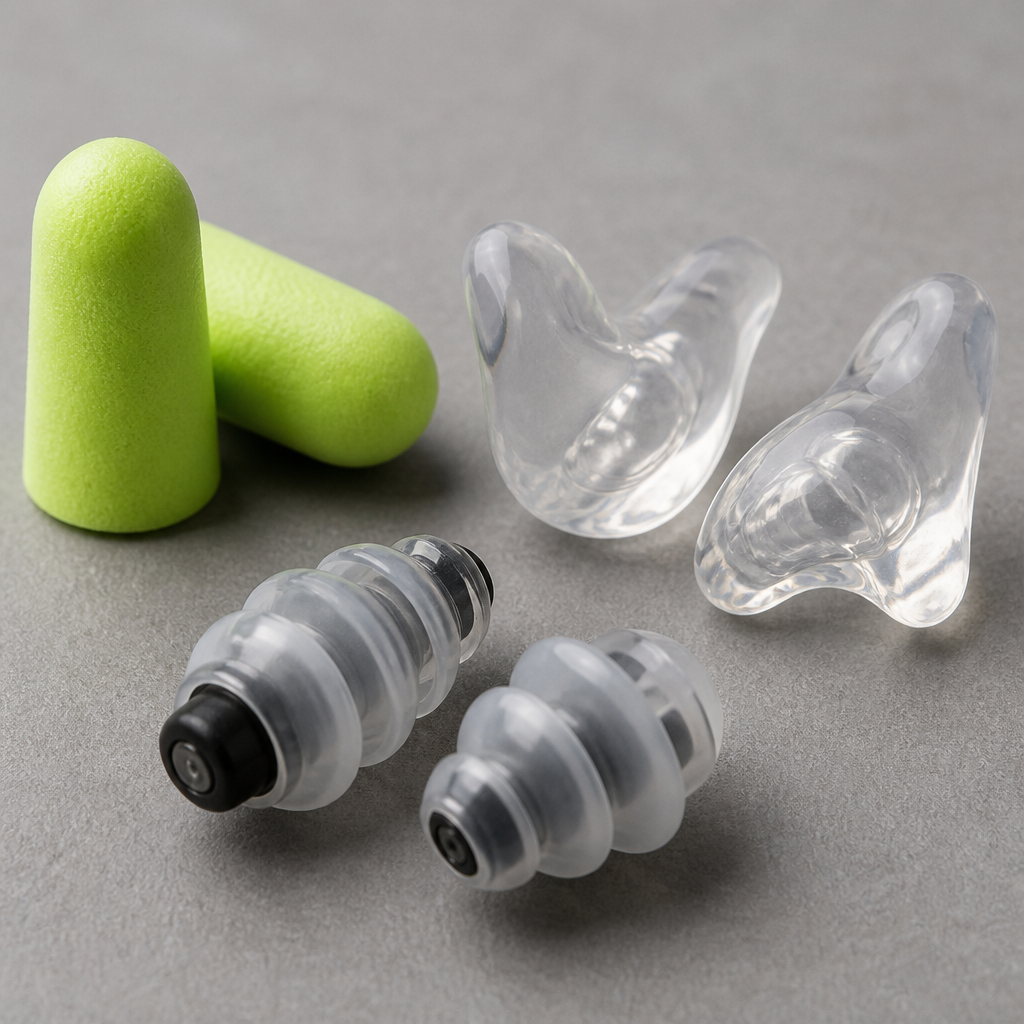

Disposable foam plugs are the most widely distributed form of occupational hearing protection. They are inexpensive per unit, widely available, and, in a laboratory environment with a trained user, capable of achieving very high NRR ratings. For construction sites, their weaknesses are significant. Foam absorbs the natural oils from fingertips during insertion, and on a dusty site it collects particulates that embed in the cell structure. Repeated use across a shift, or using a single pair for multiple days, accelerates this degradation. A foam plug that started the day at an effective NRR of 20 dB may be delivering 10 dB or less by afternoon.
There is also the technique problem. Correct insertion of a foam plug is a skill that must be taught and consistently maintained. On a busy site, workers inserting protection quickly between tasks rarely achieve the tight roll, deep placement, and prolonged hold that the lab test assumes.
Reusable earplugs built around a rigid body, particularly those with a metal housing, address most of the degradation problems that make disposables unreliable in industrial environments. The structured body maintains shape regardless of handling. The foam tips, which carry the NRR performance, can be replaced on a set schedule rather than relying on a worker to visually assess whether a small foam plug still functions correctly.
A premium metal-bodied earplug with memory foam tips delivers approximately 32 dB of noise reduction when properly fitted, covering most construction environments up to around 100 dBA. Three tip sizes ensure a seal that suits different ear canal geometries rather than assuming a universal fit. This is directly relevant to the OSHA 29 CFR 1926.101 individual fit requirement: a sized tip system is a practical mechanism for demonstrating that fit has been considered per worker, not just per job site.
Over-ear earmuffs offer the advantage of being easy to put on and remove quickly, which suits intermittent noise environments. Their weakness on a construction site is compatibility with other PPE. Hard hats, safety glasses, and face shields all compromise the seal of an over-ear muff. When the muff cushion cannot create a continuous contact with the skin around the ear, NRR drops sharply. For environments exceeding 100 dBA or for workers using equipment like jackhammers or concrete saws at close range, combining quality earplugs with earmuffs worn over the top is the appropriate solution. The two devices work together, with combined attenuation calculated according to OSHA guidance rather than by simply adding the two NRR values.
The purchasing decision for construction earplugs involves more variables than the NRR number. Here is what actually matters in a high-noise, high-usage environment.
A construction site is not a controlled environment. Earplugs get dropped on concrete, stuffed into pockets with gloves and fasteners, and handled with sweaty or dirty hands. A metal-bodied earplug outlasts foam and plastic equivalents significantly because the housing does not compress, crack, or absorb contamination the way softer materials do. The structured body also means the acoustic properties of the housing itself remain consistent throughout the product’s life. Only the foam tips, which are the consumable part, need periodic replacement.
Ear canal dimensions vary considerably between individuals. A one-size approach that uses a medium foam plug as the default leaves workers with smaller or larger canals with a compromised seal. A system offering at least three tip sizes, such as XS, S, and M, allows each worker to use the size that creates a genuine acoustic seal for their anatomy. This is not a comfort nicety. It is the difference between achieving the rated NRR and falling well short of it throughout the working day.
Eight-hour shifts are standard. Longer shifts are common. An earplug that causes pressure pain, skin irritation, or canal soreness after two hours is an earplug that will be removed. Comfort is the primary driver of compliance, and compliance is what determines whether hearing protection actually protects hearing. Memory foam conforms to the shape of the canal without exerting constant outward pressure the way standard expanded foam does, making it a more comfortable choice for extended wear.
Pro tip: Before committing to a hearing protection system for a crew, have workers trial the product for a full shift. Comfort reports after 8 hours are far more useful than comfort reports after 5 minutes. Any earplug can feel fine initially. The ones that stay in all day are the ones that matter.
Construction sites are dirty. Hearing protection that cannot be cleaned or that degrades with exposure to dust and sweat is not a good fit for the environment. A metal body can be wiped clean. Memory foam tips that are replaced on a schedule of every 6 to 8 weeks stay hygienic without requiring workers to make daily judgements about whether their protection is still serviceable. Disposable foam, by contrast, is technically single-use but is routinely used across multiple days or even weeks, accumulating contamination that compromises both the hygiene and the acoustic performance of the plug.
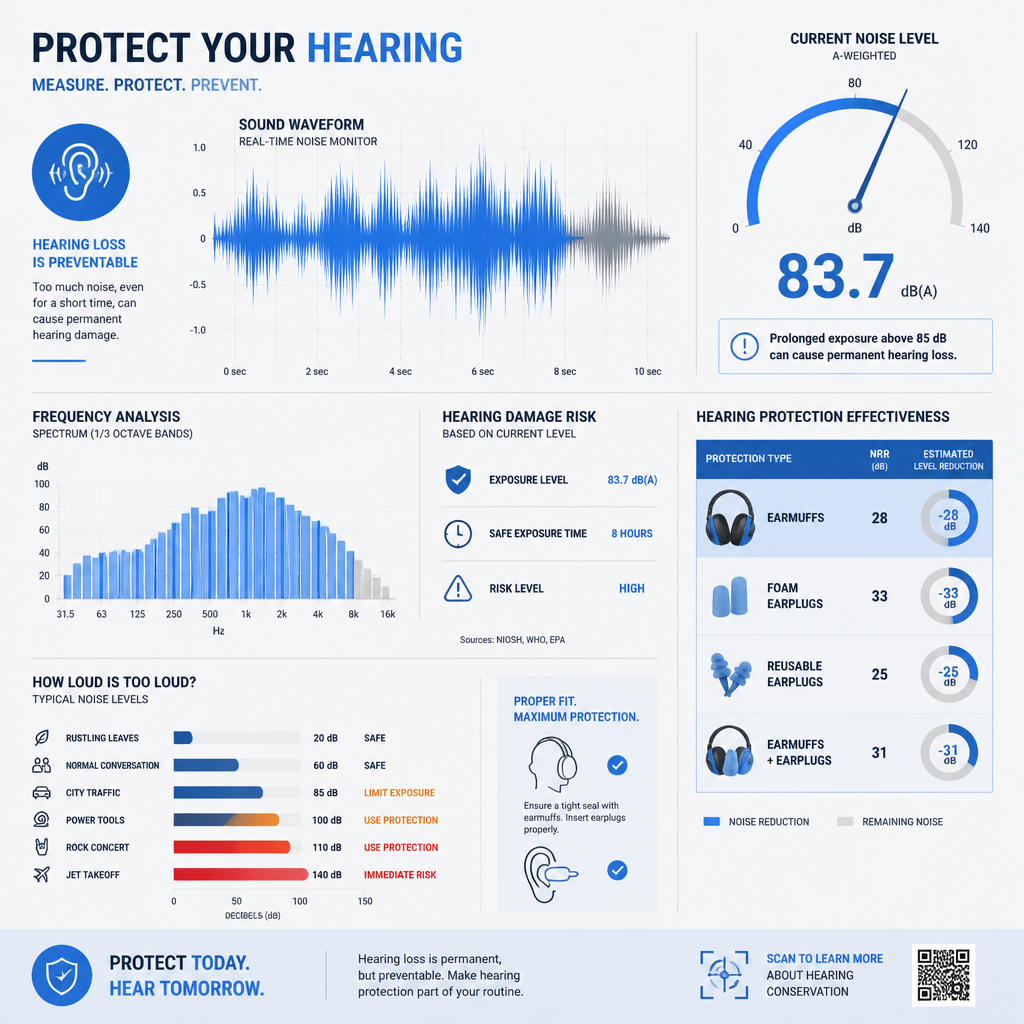
The comparison between reusable and disposable earplugs in a construction context is not purely a cost question. It involves practical performance, compliance, and long-term programme management.
| Factor | Disposable Foam Earplugs | Premium Reusable Earplugs (Metal Body, Memory Foam Tips) |
|---|---|---|
| Upfront cost per worker | Low per unit; cumulative cost is high with daily replacement | Higher upfront; tip replacements every 6 to 8 weeks are the only ongoing cost |
| NRR consistency across a shift | Degrades as foam absorbs oil, sweat, and dust throughout the day | Consistent when tips are within their replacement cycle and correctly sized |
| Fit assurance | Dependent entirely on insertion technique, which varies per worker and per insertion | Sized tips create a repeatable seal without requiring the same technique precision as rolled foam |
| Durability on a construction site | Single-use design; performance falls immediately when reused beyond intended life | Metal housing withstands drops, pocket storage, and worksite conditions without structural degradation |
| Hygiene management | Accumulates contamination if reused; hygiene depends on worker replacing as directed | Metal body is wipeable; foam tips replaced on a schedule regardless of appearance |
| Environmental impact | High waste volume for large crews using daily disposables across a full year | Significantly reduced waste with only tip replacements going to disposal |
For a construction crew switching from disposables to a reusable programme with scheduled tip replacements, the long-term cost reduction can reach 65 to 80 percent annually. The performance benefit compounds that financial case: protection that workers actually want to wear because it is comfortable, that does not degrade mid-shift because of site conditions, and that provides a repeatable seal regardless of whether someone is inserting their third or three-hundredth pair.
The gap between rated NRR and real-world attenuation is almost entirely caused by seal failure. Closing that gap comes down to consistent technique, the right tip size, and knowing when tips have reached the end of their effective life.
With a memory foam tip earplug, insertion is more straightforward than with a rolled disposable foam plug because the structured body gives you something to hold and guide. The tip should be lightly compressed between two fingers, then inserted with a gentle rotational motion while pulling the outer ear up and back with the opposite hand. This straightens the ear canal and allows the tip to seat fully. The earplug is correctly positioned when the body sits flush with the outer ear, not protruding, and when you hear a noticeable reduction in ambient noise immediately on insertion.
If the earplug consistently works loose during the shift, the tip is too small for the canal. If insertion is painful or the earplug creates significant pressure even after the foam has had time to warm and conform, the tip is likely too large. A proper fit sits securely without requiring force to stay in place. For first-time users, trialling the smallest tip first and working up is usually the most reliable approach, because an earplug that does not seat causes fewer problems to identify than one that is forced into place.
Memory foam tips give clear visual signals before acoustic performance fails completely. Tips that no longer recover their shape within a few seconds of compression, tips that have become stiff or sticky, or tips with visible surface contamination embedded in the foam have passed their useful life. Replacing tips on a regular schedule of every 6 to 8 weeks removes the subjectivity from this decision entirely, which is the right approach for a worksite programme where individual workers cannot be expected to make daily condition assessments on a small consumable.
For those looking at structured earplug programmes for a construction team, the ATTENU8 range is built specifically around this model: a durable metal body designed to outlast the job site, with memory foam tips in XS, S, and M that are replaced on a schedule rather than when they look worn.
For most construction environments, an NRR of 25 to 33 dB is the practical target range. Sites with equipment operating around 85 to 95 dBA need protection that brings exposure below the OSHA PEL of 90 dBA. For higher-noise tasks, such as operating concrete saws or jackhammers, combining earplugs with over-ear muffs provides supplementary protection. An NRR of 32 dB, properly fitted, covers the majority of construction work environments.
Disposable foam plugs are designed for single-use and should be replaced daily at minimum. In practice, they degrade faster on dusty or oily sites and should be inspected at the start of each shift. For reusable earplugs with memory foam tips, the body is durable and does not need replacement, but the foam tips should be swapped every 6 to 8 weeks to maintain their acoustic performance and hygiene.
Earplugs have a practical advantage on most construction sites because they are compatible with hard hats, safety glasses, and face shields without compromising the acoustic seal. Earmuffs lose significant NRR when their cushion seal is broken by PPE components. For extremely high-noise tasks above 100 dBA, the correct answer is both: earplugs worn beneath earmuffs provides combined protection that neither device achieves alone.
OSHA does not mandate a specific brand or product type. The requirements under 29 CFR 1926.52 and 1926.101 are that hearing protection provides a sufficient NRR for the exposure level, that it is provided at no cost to workers exposed at or above 85 dBA, and that inserted ear protectors are individually fitted or verified by a competent person. Workers must also be trained to use the protection correctly.
The most common reasons are discomfort during long shifts, the perception that noise exposure is not severe enough to cause harm, and the inconvenience of inserting and removing protection frequently throughout the day. Comfort-driven compliance is a documented pattern in occupational health research: workers will wear protection consistently only when it does not actively interfere with their ability to do their job. This makes comfort a safety specification, not a luxury.
Yes, provided the NRR is sufficient and the fit is comfortable for extended wear in both contexts. A 32 dB NRR earplug with sized memory foam tips works equally well for blocking a snoring partner as it does for reducing exposure on a job site. The key is that the product maintains consistent attenuation, and that the tips are kept in good condition. For construction use, replace tips more frequently if you are wearing them in high-dust environments.
A correctly inserted earplug significantly changes how you perceive your own voice. Speaking while wearing well-seated earplugs produces a noticeably hollow, amplified sound internally. If ambient conversation and machinery sound only slightly muffled rather than substantially reduced, the seal has failed and the earplug needs to be reinserted or the tip size reconsidered. Ringing in your ears after leaving the site is a clear sign that attenuation during the shift was insufficient.
Have you changed your approach to hearing protection on site, and what made the difference? Share your experience below.

