


 0

Most people assume earplugs work by stuffing something soft into their ear canal and hoping for the best. That assumption explains why so many people roll a cheap foam plug into their ear, watch it spring back out, and decide earplugs simply “don’t work for them.” The truth is that metal earplugs noise reduction is not a marketing claim but a measurable acoustic outcome rooted in materials science and the physics of how sound energy travels, reflects, and dissipates. Understanding the design science behind an aluminium-bodied earplug tells you exactly why rigid shell construction outperforms traditional foam bodies on almost every performance dimension that matters for sleep, travel, and sustained hearing protection.
| Key Insight | Explanation |
|---|---|
| Rigid bodies block more sound at the structural level | Analytical acoustic models show that rigid earplugs achieve sound transmission loss values not practically reachable through soft foam alone, because a rigid shell presents a near-impenetrable barrier to airborne sound. |
| A single leak destroys attenuation | Research shows an ill-fitting earplug can lose roughly 18dB of transmission loss compared to a properly sealed one. Fit quality is as important as material choice. |
| The aluminium body adds a secondary attenuation stage | Sound energy that passes through the memory foam tip must then travel through or around the metal shell before reaching the ear canal. This extra barrier contributes measurable additional reduction. |
| Memory foam tips create the primary acoustic seal | The soft tip conforms to the unique contours of each ear canal. The aluminium body holds the tip in optimum position, improving seal consistency insertion after insertion. |
| NRR figures are laboratory ratings and require real-world adjustment | OSHA and NIOSH both recommend derating published NRR figures because real-world insertion is never as controlled as lab conditions. A design that actively supports correct insertion recovers much of that gap. |
| Concave shell geometry serves an acoustic function | A concave aluminium surface creates a small resonance chamber at the earplug face. Sound energy entering this space undergoes additional dissipation before it reaches the foam seal. |
| Durability keeps attenuation consistent over time | Traditional foam earplug bodies degrade with each use, compressing less effectively and sealing less reliably. An aluminium body maintains its geometry indefinitely, so only the replaceable foam tip changes. |
Sound is mechanical energy. It travels as pressure waves through air, and those waves lose energy only when they encounter resistance: a change in medium, a surface that absorbs or reflects them, or a path that forces them to do extra work. An earplug’s entire job is to introduce enough resistance in the ear canal to reduce the amplitude of those waves before they reach the eardrum.
The material of the earplug body determines how much of that resistance is structural. Soft foam absorbs sound by increasing air resistance inside its cell structure, converting wave energy into small amounts of heat as the wave is forced through hundreds of tiny pockets of air. That mechanism works, but it has a ceiling. The foam itself is not a rigid barrier; sound energy can still pass through it, particularly at lower frequencies.
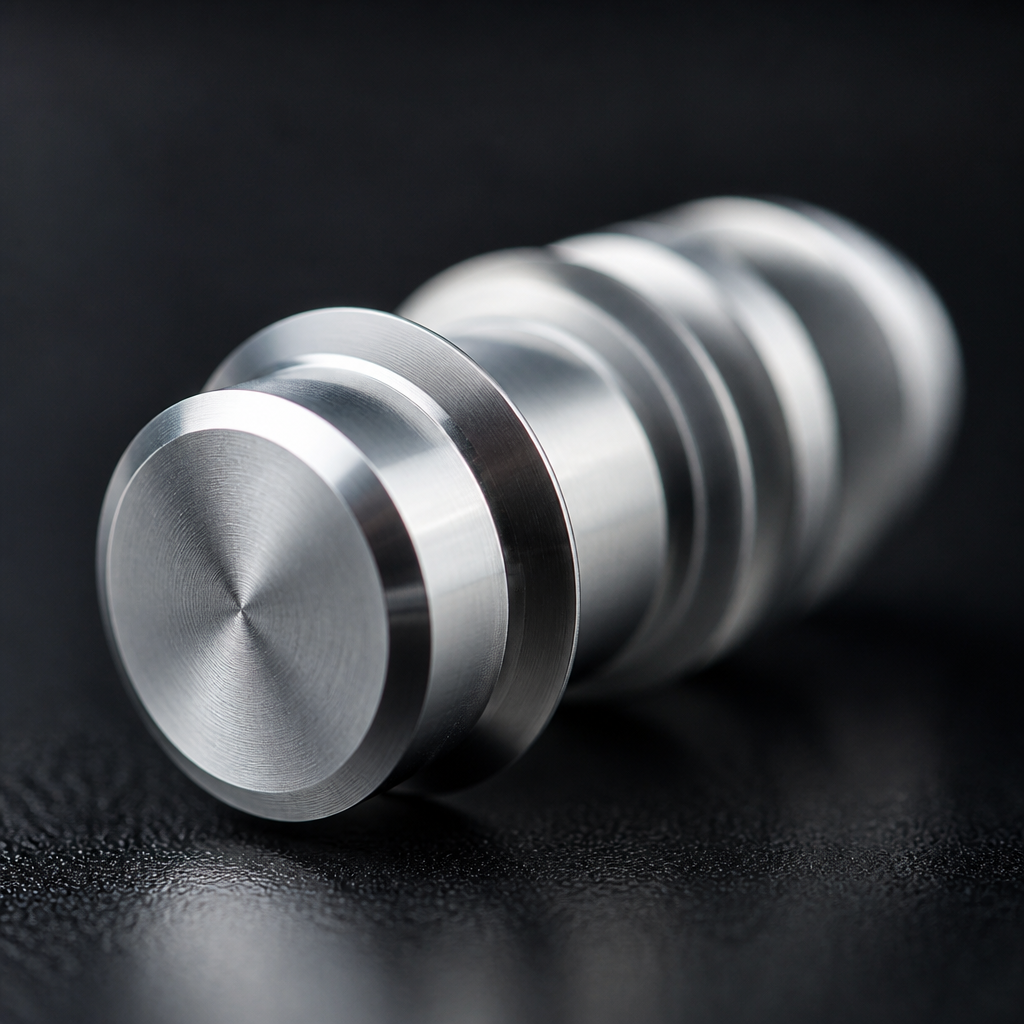
A metal body operates on a different principle. Aluminium is several orders of magnitude denser than polyurethane foam. When a sound wave hits a dense rigid surface, the acoustic mismatch between air and metal is so large that most of the wave’s energy is reflected rather than transmitted. The small fraction that does transmit through the metal must then work against the material’s stiffness before it can continue its journey toward the ear canal. This is why earplug design science increasingly points toward rigid outer structures as a meaningful performance upgrade over soft-only designs.
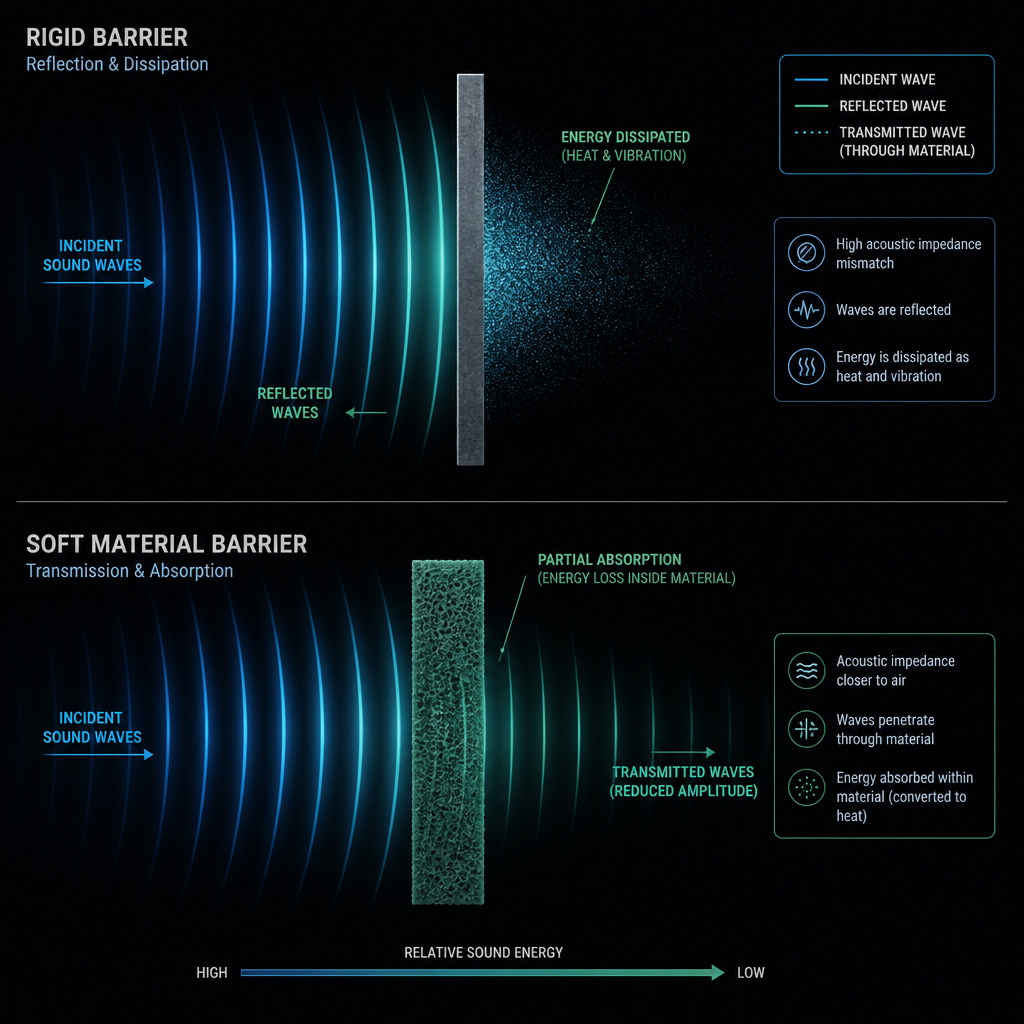
The technical term for the resistance a medium offers to sound propagation is acoustic impedance. When sound travels from a low-impedance medium (air) to a high-impedance medium (aluminium), the impedance mismatch causes the majority of the wave’s energy to reflect back at the boundary rather than pass through. This is not a design opinion; it is a consequence of the wave equation applied at material boundaries.
A soft foam earplug has an acoustic impedance that is closer to air than aluminium is. That means less reflection and more transmission through the body of the plug at the air-to-plug boundary. An aluminium body creates a far larger impedance mismatch, reflecting significantly more energy before that energy can propagate deeper.
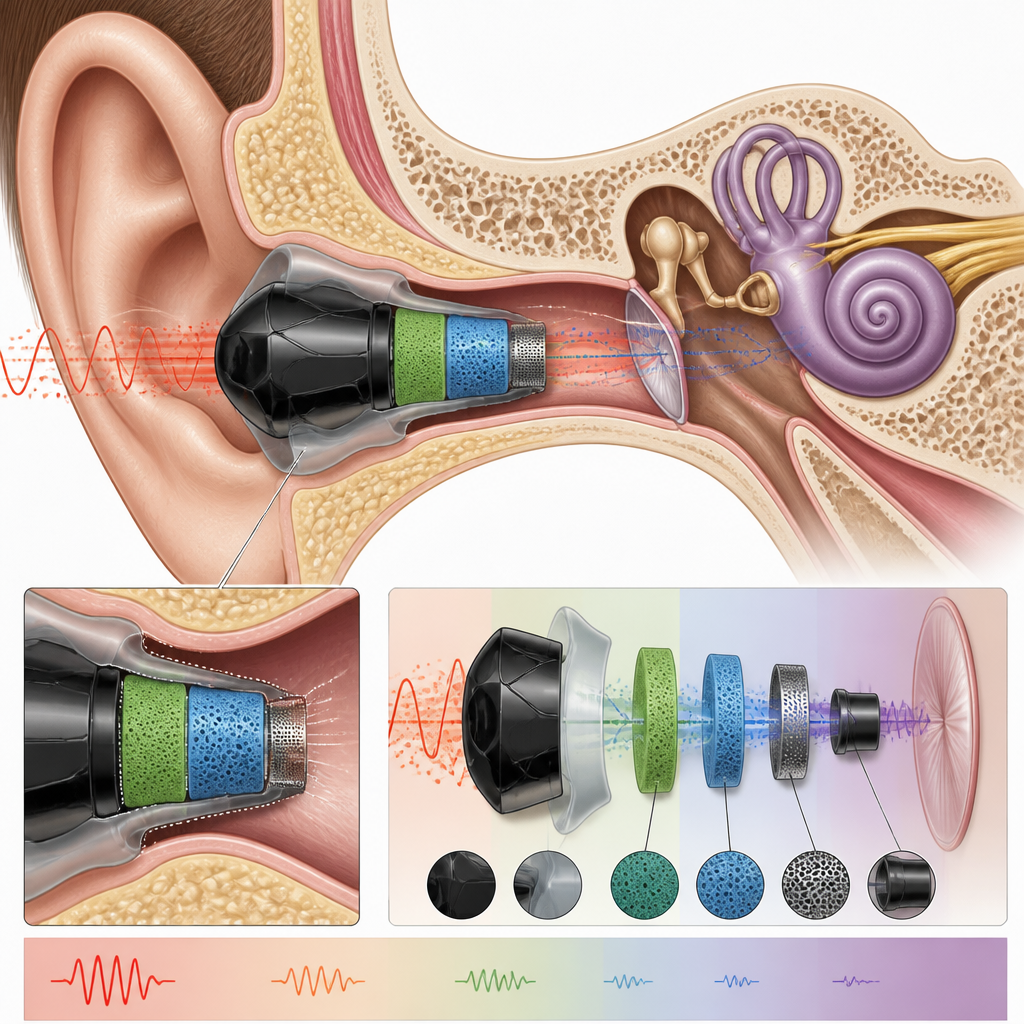
The practical result is that the aluminium shell acts as a first barrier while the memory foam tip handles the acoustic sealing function inside the ear canal. These are two distinct mechanisms operating in sequence. Neither does the other’s job; both contribute to the total attenuation the system delivers.
The concave face geometry of an aluminium earplug body is not only ergonomic. A concave surface facing the noise source creates a small bounded air volume between the outer face of the plug and the immediate environment. Sound energy entering this space reflects back and forth between the concave walls before encountering the foam tip behind it. Each reflection represents energy that does not make it cleanly to the foam seal, adding an extra dissipation step that a flat or convex foam body simply does not provide.
The most underappreciated variable in earplug performance is not the foam hardness or the NRR label. It is how well the plug’s geometry supports a consistent, repeatable seal every single time the wearer inserts it.
Published noise reduction ratings are measured under controlled laboratory conditions with trained subjects inserting earplugs with careful technique. Real-world use is messier. Research on earplug acoustics consistently shows that a leaking seal is the single largest cause of attenuation failure in practice. An ill-fitting earplug can lose a substantial portion of its rated transmission loss relative to a properly sealed configuration, simply because air gaps around the plug create a direct bypass path for sound waves.
This is the reason that earplug design matters as much as earplug material. A soft foam body that changes shape slightly with each compression-and-release cycle will eventually stop sealing as consistently as it did when new. The seal degrades not because the foam stops being foam, but because its mechanical recovery weakens with use.
An aluminium body solves the seal problem by separating two functions that traditional foam plugs force a single material to perform simultaneously. The rigid shell handles structural positioning inside the ear canal: it does not compress, does not deform, and does not fatigue. The memory foam tip, attached to that rigid anchor, handles conforming to the unique contours of the canal wall. Because the foam tip has only one job, it can do that job better. And because it attaches to a stable metal body rather than being compressed from both ends, it expands against the canal wall in a more controlled and consistent manner.
Pro tip: To get the most consistent seal from a metal-bodied earplug, gently pull the outer ear upward and back before insertion. This straightens the ear canal and allows the foam tip to expand against a flat, unobstructed surface rather than a curved one, improving both comfort and acoustic seal quality.
Regulatory bodies including OSHA recommend derating published NRR values by 50 percent for real-world exposure estimates, because the gap between lab conditions and actual use is that significant. NIOSH similarly recommends substantial derating for foam earplugs used in occupational settings. A design that actively helps the wearer achieve correct fit every time recovers a meaningful portion of that derated performance. Over the course of a full night’s sleep or an eight-hour shift in a noisy environment, that consistency difference compounds into substantially better hearing protection.
Breaking down the aluminium earplug body’s acoustic contributions into discrete mechanisms makes the design logic clear. There are three distinct mechanisms at work, each verified by materials physics.
The outer aluminium shell presents a high-impedance surface to incoming sound waves. At the air-to-metal boundary, a significant proportion of wave energy is reflected back toward the noise source rather than transmitted through the plug body. This is a passive, physics-driven attenuation stage that requires no special fit technique from the wearer.
Sound transmission through a solid material decreases as the material’s mass and stiffness increase. Aluminium’s density and stiffness mean that the small fraction of energy that does cross the air-to-metal boundary encounters significant resistance as it attempts to travel through the shell thickness. Analytical models of rigid earplug designs confirm that structurally rigid materials achieve transmission loss values far beyond what soft-body designs can reach at equivalent thicknesses.
The aluminium body acts as a precision insertion tool. Because it does not compress during fitting, it positions the foam tip at a repeatable depth and angle within the ear canal. This controlled positioning means the tip expands against the canal wall consistently, without the angle variance that affects soft-foam-only plugs where the entire body deforms under finger pressure. The outcome is a tighter acoustic seal with less variation between uses.
Pro tip: Replace the memory foam tips on a metal-bodied earplug every 6 to 8 weeks under regular daily use. The aluminium body never degrades, but the foam tip gradually loses its elastic recovery. A fresh tip on a rigid body delivers the same seal quality as the very first day of use, something a traditional foam earplug body cannot replicate.
| Design Type | Acoustic Mechanism | Key Performance Limitation |
|---|---|---|
| Traditional disposable foam | Foam absorbs sound via air resistance within cell structure, converting wave energy to heat. Entire body compresses to form seal. | Body deformation during insertion varies seal depth and angle. Cell structure degrades with repeated compression. Single material must handle both insertion mechanics and acoustic sealing simultaneously. |
| Rigid aluminium body with memory foam tips | Metal shell reflects high-impedance boundary energy. Foam tip creates conforming canal seal. Concave shell geometry adds resonance-based dissipation stage at the plug face. | Tip replacement required every 6 to 8 weeks under daily use. Correct tip size selection matters for initial fit, though multiple tip sizes (XS, S, M) address most canal geometries. |
| Soft silicone or elastomer bodies | Flexible body conforms to canal shape over time. Some acoustic absorption within the material. Lower acoustic impedance than metal means less reflective boundary effect. | Acoustic impedance closer to air than aluminium, limiting the reflective contribution of the body itself. Seal consistency depends heavily on canal shape compatibility and custom fit. |
The noise reduction rating (NRR) is a single-number laboratory measure that the U.S. Environmental Protection Agency requires on hearing protector packaging sold in the United States. A rating of 32dB represents the top end of what hearing protection devices typically deliver under controlled test conditions. The range for existing hearing protectors runs from approximately 0 to 30dB for most categories, with only a small number of well-engineered products exceeding that range.
What 32dB means in practical terms: if the ambient noise level at your ear is 92dB (a moderately loud construction site, an aircraft cabin, or a loud urban environment), an earplug rated at 32dB reduces the level entering your ear to approximately 60dB, which is roughly the equivalent of a normal conversation. For sleep, that difference means the difference between lying awake listening to traffic or a snoring partner and actually getting restorative rest.
OSHA calculates worker noise exposure by derating the NRR by 50 percent across all hearing protector types. NIOSH also recommends significant derating for foam earplugs in occupational settings, because the gap between carefully controlled laboratory insertion and actual field use is substantial. A 32dB-rated plug derated by 50 percent delivers an estimated real-world reduction of roughly 16dB. That is still meaningful protection, but it underlines why achieving and maintaining a good seal on every single use is the most important variable in actual protection performance.
An aluminium-bodied design with consistent geometry directly addresses this gap. Because the metal body positions the tip at the same depth and angle every time, real-world attenuation is closer to laboratory attenuation than it is with variable-geometry foam-only designs. The design is doing part of the insertion work for you.
NRR is a single number, but noise is not a single frequency. Foam works better at higher frequencies and is often less effective at low-frequency rumbles, which is why traffic noise, aircraft engine hum, and bass-heavy music are the sounds people complain foam plugs fail to block adequately. The mass and stiffness of an aluminium shell provide better low-frequency attenuation than foam alone, because mass law in acoustics states that heavier, stiffer structures resist low-frequency vibration more effectively. This is the reason metal-bodied earplugs often feel more effective against the frequencies that bother light sleepers most.
ATTENU8’s aluminium earplugs are engineered with all three of these mechanisms working together: the rigid shell’s high acoustic impedance, the concave body geometry, and the conforming memory foam tip seal. The result is a how earplugs work story that is quite different from the disposable foam roll-and-insert that most people have tried and found inadequate. For anyone serious about consistent, repeatable noise reduction for sleep, travel, or hearing protection in loud environments, the physics of the design are not incidental. They are the product.
The aluminium body contributes acoustic attenuation that soft foam alone cannot deliver. The rigid shell creates a high acoustic impedance boundary that reflects sound energy, and it acts as a stable insertion tool that improves seal consistency. A properly seated metal-bodied earplug with a good foam tip seal will generally outperform a disposable foam earplug inserted with typical technique, particularly at lower frequencies where foam is acoustically weakest.
The concave face creates a small bounded air volume between the earplug surface and the sound source. Sound energy entering that space reflects between the curved walls, dissipating before reaching the foam tip. It also gives the earplug a larger effective acoustic surface area than a flat or convex face, which increases the proportion of incident energy that encounters the plug rather than diffracting around it.
Acoustic impedance is a measure of how much resistance a material offers to sound wave propagation. When sound moves from a low-impedance medium like air to a high-impedance medium like aluminium, most of the wave energy reflects at the boundary rather than passing through. The larger the impedance mismatch, the more energy is reflected. Aluminium has a much higher acoustic impedance than polyurethane foam, which is why the metal shell provides a qualitatively different type of attenuation than the foam tip alone.
NRR ratings are measured under laboratory conditions with trained subjects following precise insertion protocols. Real-world use produces variable results because most people do not insert earplugs as consistently as lab conditions require. OSHA recommends a 50 percent derate for all hearing protectors; NIOSH makes similar recommendations for foam earplugs. A metal-bodied design that supports consistent insertion reduces the performance gap between lab and real-world use, meaning the effective derate is smaller in practice.
Under regular daily use, memory foam tips should be replaced every 6 to 8 weeks. The aluminium body retains its geometry indefinitely, so only the tip changes. This matters acoustically because the seal quality of a fresh foam tip is consistently higher than that of a compressed and degraded one. With disposable foam earplugs, the entire plug body degrades together, and the acoustic performance decline is not visible until the plug noticeably fails to expand. With a metal-bodied design, replacing the tip restores full acoustic performance immediately.
Comfort during sleep depends on earplug profile and tip softness, not body material in isolation. A low-profile aluminium body that sits flush with or slightly inside the outer ear, paired with a soft memory foam tip, can be significantly more comfortable for side-sleeping than a protruding foam roll that presses against the pillow. The rigid body does not compress under pillow pressure in a way that creates canal pressure, which is one of the common complaints about large disposable foam designs used for sleep.
Have you noticed a difference between metal-bodied and foam-only earplugs in your own experience with sleep or hearing protection? Share what you found in the comments.

