


 0

Most people board a long-haul flight hoping to sleep. Most people land exhausted. The reason is not always the seat or the time zone: it is the constant, grinding roar of the cabin. Research published in the Journal of the Canadian Acoustical Association measured continuous in-cabin noise at 80 to 85 dB(A) during cruise, with sudden bursts reaching as high as 88 dB(A). That is roughly the volume of a lawnmower running beside your head for 14 hours. The right earplugs for travel do not just muffle noise. They are the difference between arriving functional and arriving wrecked.
| Key Insight | Explanation |
|---|---|
| Cabin noise peaks at 80-85 dB(A) during cruise | That is loud enough to cause fatigue and impair sleep even without causing immediate hearing damage. You need real attenuation, not token protection. |
| NRR is a lab number, not a real-world guarantee | The actual noise reduction you experience depends almost entirely on fit and seal quality. A perfectly fitted earplug with a 32 dB rating beats a poorly fitted 33 dB one every time. |
| Fit beats raw dB rating for sleep comfort | An earplug that presses uncomfortably against your ear canal will wake you up before the engine noise does. Soft, size-matched tips are not a luxury feature. |
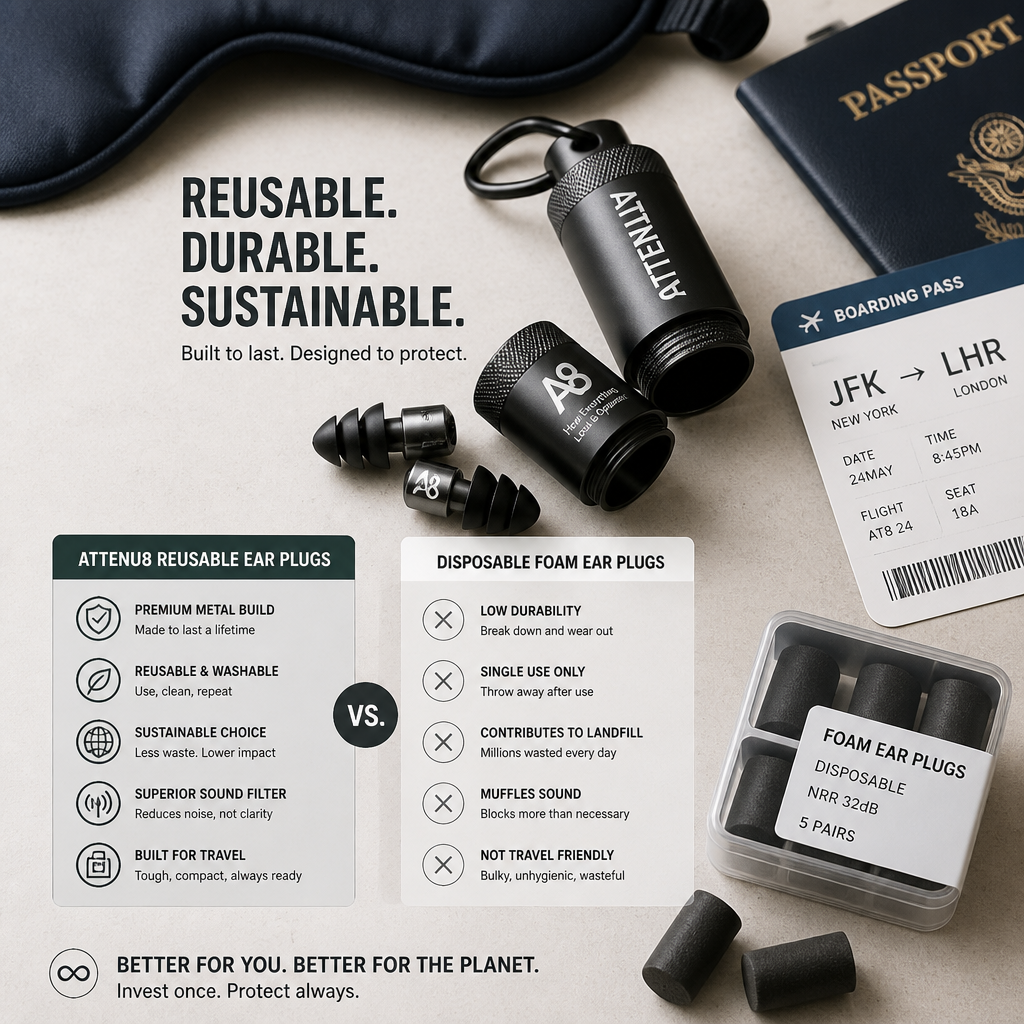
| Disposable foam is wasteful and inconsistent on repeat trips | Single-use foam earplugs degrade in quality from day one and clog with earwax, making each subsequent use less effective. Reusable options maintain consistent performance. |
| Tip size matters more than most travelers realize | Using a tip that is too large causes pressure pain; too small means an incomplete seal and significant noise bleed. Multiple tip sizes in a single kit solve this without guesswork. |
| Side-sleepers need low-profile earplug bodies | Bulky earplug bodies press against the seat headrest or travel pillow and dislodge during sleep. A compact, smooth-bodied design stays seated through the night. |
| Replacing tips, not the whole earplug, is more cost-effective long term | Premium reusable earplugs designed for tip-only replacement offer far better value over a year of travel than repeatedly buying multipacks of disposables. |
The cabin is not just loud. It is loud in a specific, physiologically punishing way. Continuous engine noise settles at around 80 to 85 dB(A) during cruise altitude, according to peer-reviewed measurements of in-flight sound levels. A separate study published on PubMed found a median in-flight sound level of 83.5 dB(A) across multiple aircraft types and flight phases, with peaks exceeding 110 dB(A) near engine-mounted fuselages.
What makes this particularly disruptive for sleep is not just the volume. It is the relentlessness. There are no quiet gaps for your nervous system to relax into. The low-frequency rumble of turbofan engines penetrates most lightweight acoustic barriers because low frequencies carry more energy and require denser or better-fitted protection to block effectively.
Add to that the irregular bursts from the galley, announcements, crying children, and pressurization changes, and you have a sound environment that is actively hostile to sleep. Cabin noise is not a minor inconvenience. It is a documented driver of travel fatigue, which research characterizes as general fatigue, disorientation, and headache resulting from the disruption of normal sleep patterns.
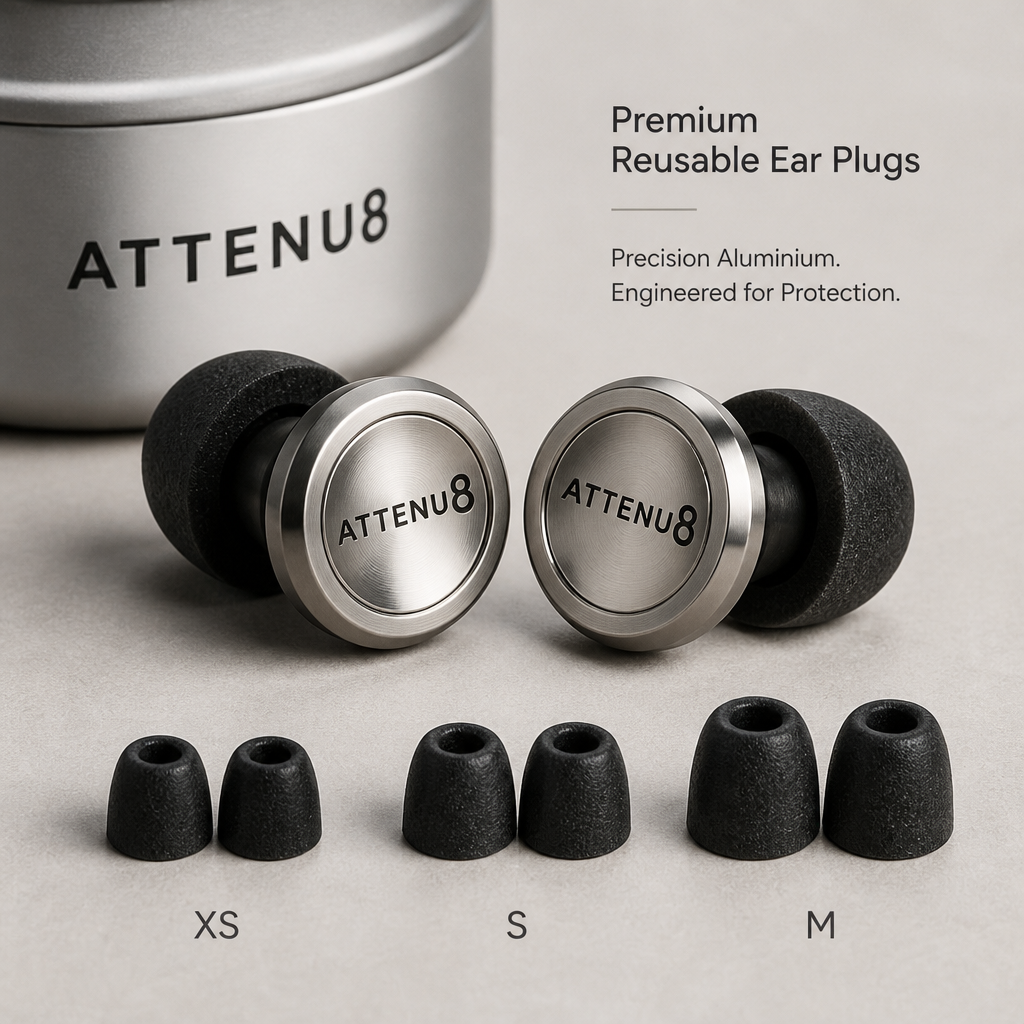
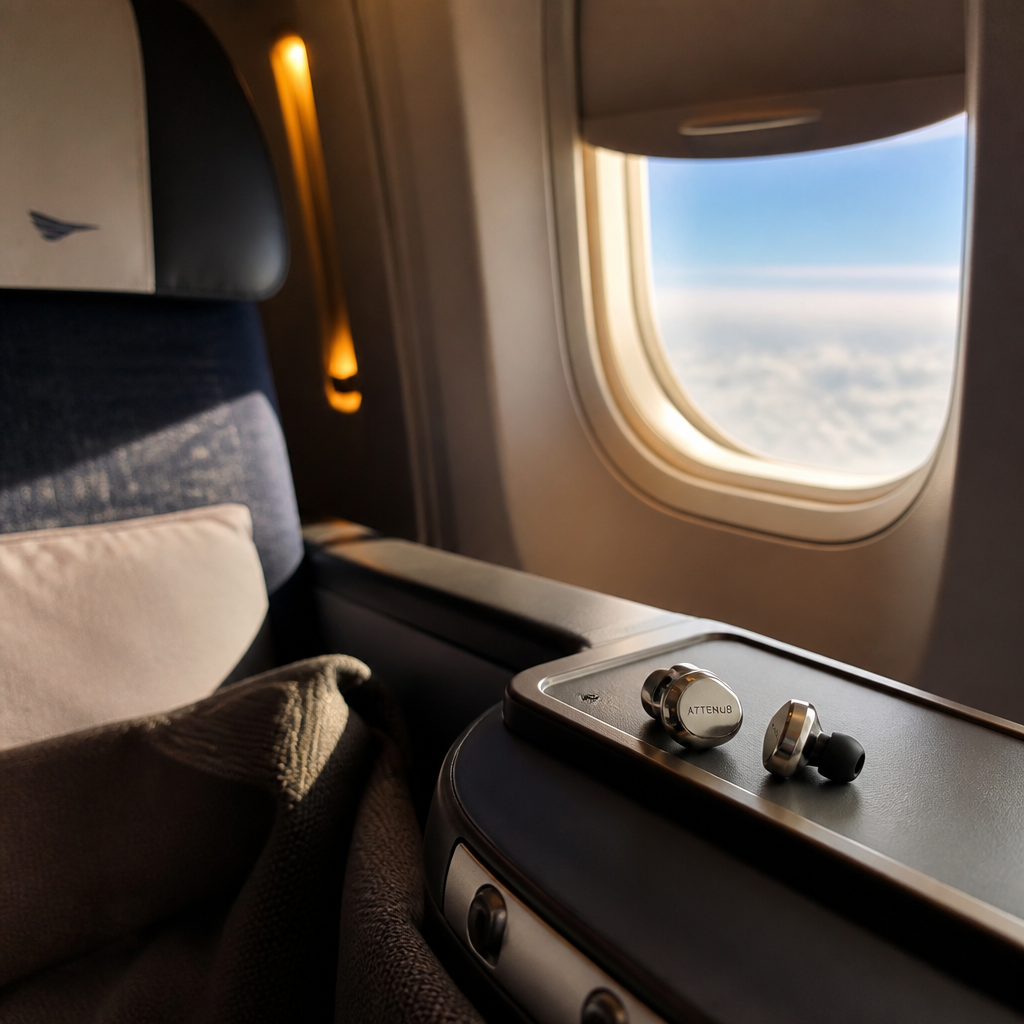
Every earplug sold for hearing protection carries a Noise Reduction Rating (NRR), measured in decibels. The rating reflects maximum noise reduction under ideal, controlled laboratory conditions. For most general hearing protection, an NRR of 20 to 30 dB is considered effective. ATTENU8 earplugs deliver approximately 32 dB of noise reduction, which places them at the upper end of this effective range.
The catch is how NRR translates to real-world use. Audiologists and occupational health researchers consistently note that actual protection achieved is often lower than the rated figure, because real-world fit is never as perfect as the laboratory insertion technique used during testing. The standard adjustment formula takes roughly half the NRR value as a more realistic estimate of real-world performance. This means that the quality of the seal you achieve matters enormously, sometimes more than the NRR number itself.
At 83 dB(A) cabin noise and a real-world effective reduction of around 16 to 20 dB from a well-fitted 32 dB-rated earplug, you can bring your perceived noise environment down to somewhere around 63 to 67 dB. That is roughly the volume of a normal conversation at arm’s length. It is not silence, but it is a level at which most people can fall and stay asleep, particularly with a travel pillow and eye mask doing their part.
Pro tip: The difference between an earplug that achieves 15 dB real-world reduction and one that achieves 20 dB is not just 5 dB. Because decibels are logarithmic, each 10 dB reduction cuts perceived loudness roughly in half. Getting that extra few dB through a better seal is worth the effort of learning correct insertion technique.
There are three categories of earplugs commonly used for air travel. Each has a legitimate use case, but they are not equally suited to long-haul sleep on a plane.
Disposable foam is the default option in most pharmacies and airport shops. The foam expands after insertion to fill the ear canal, creating a seal. NRR ratings for quality foam plugs can reach the low 30s, and they are inexpensive per pair. The problems are consistency and comfort on long flights.
Foam degrades quickly. A pair that delivers solid attenuation when new will be noticeably less effective after a few uses as the foam loses its memory and compression recovery. They also accumulate earwax, which is unhygienic over the course of a long trip if you are reusing them across multiple days. For a single overnight flight once a year, disposable foam is acceptable. For frequent travelers who fly monthly or more, it is a false economy.
Moldable silicone putty sits against the ear canal entrance rather than inserting into it. These work well for people with narrow or sensitive ear canals and are comfortable during side-sleeping because there is no rigid body protruding from the ear. Their limitation is attenuation. Because they do not seal inside the canal, they tend to deliver lower and less consistent noise reduction than properly inserted foam or tipped earplugs, making them a better fit for lower-noise environments than a busy long-haul cabin.
The most practical category for frequent travelers. A rigid or semi-rigid body holds a replaceable soft foam tip in position. Done well, this combines the acoustic performance of foam with the durability and hygienic benefits of a reusable design. The body maintains consistent depth and angle of insertion, which addresses one of the main reasons disposable foam underperforms: people do not insert it deeply enough.
ATTENU8 earplugs are built on a different premise than most travel earplugs. The body is machined aluminium, which is precisely where the value becomes apparent for frequent flyers. Aluminium does not deform, does not absorb earwax, and does not degrade with exposure to humidity or temperature changes, all of which are relevant inside an aircraft cabin where condensation and recycled air are constants.
The concave aluminium body sits comfortably and securely in the concha of the ear without creating the pressure points that elongated or cylindrical earplug bodies sometimes cause. For side-sleepers pressing their ear against a headrest or travel pillow, a low-profile, smooth-bodied earplug is not a preference: it is a practical necessity if you want to stay asleep for more than an hour at a stretch.
Each ATTENU8 pair comes with three sizes of soft memory foam tips (XS, S, and M). This matters for a reason that most one-size-fits-all earplug products ignore entirely: ear canal diameter varies significantly between individuals, and even between left and right ears on the same person. A tip that is marginally too small creates a noise leak at the canal wall. A tip that is too large causes discomfort that wakes you up within an hour, negating any sleep benefit the earplug was supposed to provide.
Having three sizes available in one kit removes the guesswork. Spend five minutes on the ground before boarding testing which tip size seats comfortably and creates a clean muffling of ambient sound when pressed in, and you board the plane knowing your seal will hold for the duration of the flight.
The memory foam tips are the only consumable component. ATTENU8 recommends replacing tips every 6 to 8 weeks, which covers roughly 10 to 15 long-haul flights at typical business traveler frequency. The aluminium body is essentially permanent. This is a meaningfully different cost and waste profile compared to buying disposable foam packs before every trip, and it means the attenuation quality you calibrated on your first use is maintained consistently across every subsequent flight.
Insertion technique is the single most overlooked variable in earplug performance. Most people push a foam tip straight into the ear canal. That is incorrect, and it is why so many travelers report that earplugs “do not really work” for them on flights.
Reach your opposite hand behind your head and gently pull the top of your outer ear upward and slightly backward. This straightens the natural curve of the ear canal. Then insert the earplug with your other hand, rolling the foam tip gently between your fingers first to compress it if it is a compressible tip. Hold it in place for several seconds while the foam expands and conforms to the canal wall. Release your outer ear. When done correctly, the difference in ambient sound level is immediate and obvious.
Pro tip: Do this before takeoff, not after you are already settled in your seat. The act of reaching around your head to pull your ear tends to disturb your neighbor less when you are still arranging yourself rather than mid-flight in a dark, quiet cabin.
Some travelers remove their earplugs during takeoff and landing to manage ear pressure equalization. This is often unnecessary if you are not experiencing pain. Earplugs do not block the equalization mechanism in the Eustachian tube. If you do experience discomfort, brief removal and a few swallowing or yawning motions are usually enough to equalize. Reinsert immediately after, because takeoff and landing are acoustically some of the noisier phases of flight.
The effective noise reduction you achieve from an earplug depends far less on its rated number than on how well it seals against your specific ear canal. Fit is the variable that all the testing in the world cannot substitute for.
Noise-cancelling headphones are excellent for in-flight entertainment and reducing the engine drone during waking hours. They are poor sleep tools on a plane. They are physically large, which means side-sleeping on a headrest with them on is immediately uncomfortable. They require power, which means they can fail mid-flight or mid-sleep. And many experienced travelers report waking from light sleep with their headphones pushed askew, introducing a sudden rush of cabin noise that disrupts the sleep cycle.
Earplugs have none of those failure modes. They are passive, meaning no battery, no firmware, no pairing sequence at 2 a.m. when you are groggy. A pair of well-fitted travel earplugs in a metal case fits in a shirt pocket, survives a bag search without damage, and works identically on a 3-hour regional hop and a 16-hour transpacific flight.
The practical approach for most long-haul travelers is to use noise-cancelling headphones for the first few hours of a flight during entertainment and meals, then switch to earplugs for sleep. The two tools complement rather than compete with each other.
| Feature | Disposable Foam Earplugs | Moldable Silicone Putty | Reusable Metal-Bodied with Foam Tips (ATTENU8) |
|---|---|---|---|
| Noise Reduction | High when new, degrades quickly | Moderate, inconsistent seal | Up to 32 dB, consistent across uses |
| Comfort for Side-Sleeping | Protrudes, can dislodge on headrest | Low profile, comfortable | Low-profile concave body, stays seated |
| Hygiene | Accumulates wax, single use recommended | Can be rinsed but putty degrades | Aluminium body wipes clean, tips replaced on schedule |
| Fit Options | One size, no adjustment | Moldable but no size guidance | Three tip sizes (XS, S, M) included |
| Long-Term Cost | High, constant repurchase | Medium, putty degrades | Low, tips replaced every 6-8 weeks only |
| Durability for Travel | Crushes in bags, degrades with humidity | Melts in heat, loses moldability | Aluminium body is essentially permanent |
| Best Use Case | Occasional flights, emergencies | Sensitive ears, low-noise environments | Frequent travel, long-haul sleep, loud environments |
No earplug eliminates all in-flight noise, and none should aim to. A well-fitted earplug with around 32 dB attenuation can reduce a typical cruise noise level of 83 dB(A) down to a manageable range where sleep is genuinely possible. The goal is not complete silence but noise reduction sufficient to allow the brain to disengage from monitoring the environment, which is what prevents sleep onset in loud conditions.
Yes. Reusable earplugs with soft foam or silicone tips are safe for air travel. They do not interfere with Eustachian tube function or pressure equalization. If you experience ear pressure discomfort during takeoff or landing, remove the earplugs briefly, equalize by yawning or swallowing, and reinsert. This is a minor inconvenience that most travelers encounter only rarely.
For long-haul flights, aim for an NRR of at least 28 to 33 dB. Cabin noise at cruise altitude typically measures around 80 to 85 dB(A), and you need meaningful attenuation to bring that into a sleep-friendly range. An NRR of 32 dB, like that delivered by ATTENU8 earplugs, sits at the effective upper end for wearable, comfortable travel use without requiring industrial hearing protection.
Test each size before your flight. Insert the tip using the correct technique, straightening the ear canal by pulling the outer ear upward and back, then pressing the tip in and holding it for several seconds. The right size produces a clear, immediate dampening of ambient sound with no pain or feeling of pressure. If you feel discomfort within a minute, the tip is too large. If you can still hear clearly at normal volume, the tip is too small or the seal is incomplete.
Wearing earplugs throughout the flight is reasonable for anyone sensitive to noise or working to manage fatigue on long routes. Cabin noise at 80 to 85 dB(A) over many hours is fatiguing even when you are not trying to sleep. That said, most people prefer to remove them when engaging in conversation or watching entertainment, then reinsert for sleep. With a reusable earplug, reinsertion is quick and does not degrade the product the way repeated handling degrades disposable foam.
Yes, and this is exactly where multiple tip size options become important rather than optional. Standard disposable foam earplugs are sized for average adult ear canals. People with smaller canals often find them uncomfortable or ineffective because the foam cannot compress enough on insertion without causing pain. An XS foam tip on a correctly sized earplug body solves this problem directly. If you have historically found earplugs uncomfortable, the issue is almost certainly tip size rather than earplugs as a category.
The aluminium body of a metal-bodied earplug wipes clean with a damp cloth or a travel antibacterial wipe. The memory foam tips should not be soaked or submerged in water, but they can be wiped with a dry or lightly damp cloth between uses. Plan to replace the foam tips every 6 to 8 weeks during active travel use. Carry a small travel case to protect them between uses. This is significantly less maintenance than most travelers assume.
Have your earplugs ever made or broken a long-haul flight for you? Drop your experience in the comments, we would genuinely like to hear what worked and what did not.

