


 0

Most people assume that wearing earplugs means their hearing is protected. That assumption is costing people their hearing. The signs earplugs not working are easy to miss because hearing loss accumulates quietly, and by the time you notice something is wrong, the damage is already done. Whether you are a light sleeper relying on earplugs every night, a construction worker clocking hours on a loud site, or a frequent flyer trying to survive cabin noise, getting this wrong has real consequences. Here are five specific, identifiable signs that your current earplugs are failing you, and what to do about each one.
| Key Insight | Explanation |
|---|---|
| A poor seal lets all noise through | Even a tiny gap in the earplug seal allows harmful noise levels to reach your eardrum. The seal must be complete to work. |
| Earplugs that migrate out of the ear canal are not protecting you | If an earplug shifts or falls out during sleep or work, you are exposed to full noise levels for that entire period. |
| Post-removal ringing is a warning sign, not normal | Temporary ringing or muffled hearing after wearing earplugs suggests the protection was insufficient for the noise level you were exposed to. |
| Worn foam loses its expansion ability | Foam that no longer springs back fully after compression cannot create the tight canal seal needed for real noise reduction. |
| Discomfort drives premature removal | An earplug you take out halfway through a shift or a night’s sleep gives zero protection for the time it is out. Comfort and protection are inseparable. |
| The NRR on the packaging is a lab figure, not your figure | Real-world noise reduction is consistently lower than the rated value. Fit, insertion technique, and earplug condition all reduce the actual protection received. |
| Replacing foam tips is not the same as replacing the whole earplug | A reusable metal-bodied earplug with fresh foam tips can restore full protection without buying a new product every few weeks. |
The most obvious sign of an earplug not reducing noise is simply that you can still hear the problem noise with uncomfortable clarity. Not just faintly, but well enough that it continues to bother you or pull you awake. If your partner’s snoring, the hum of engines, or a construction site next door still cuts through, your earplugs are not doing the job they claim to do.
The cause is almost always a broken seal. Harmful noise levels can pass through even a very tiny gap between the earplug and the wall of the ear canal. A seal that looks correct from the outside can still be leaking if the earplug material has compressed unevenly, the size is wrong, or the insertion was too shallow. This is not a marginal difference. A gap of even a fraction of a millimetre can eliminate most of the noise reduction entirely.
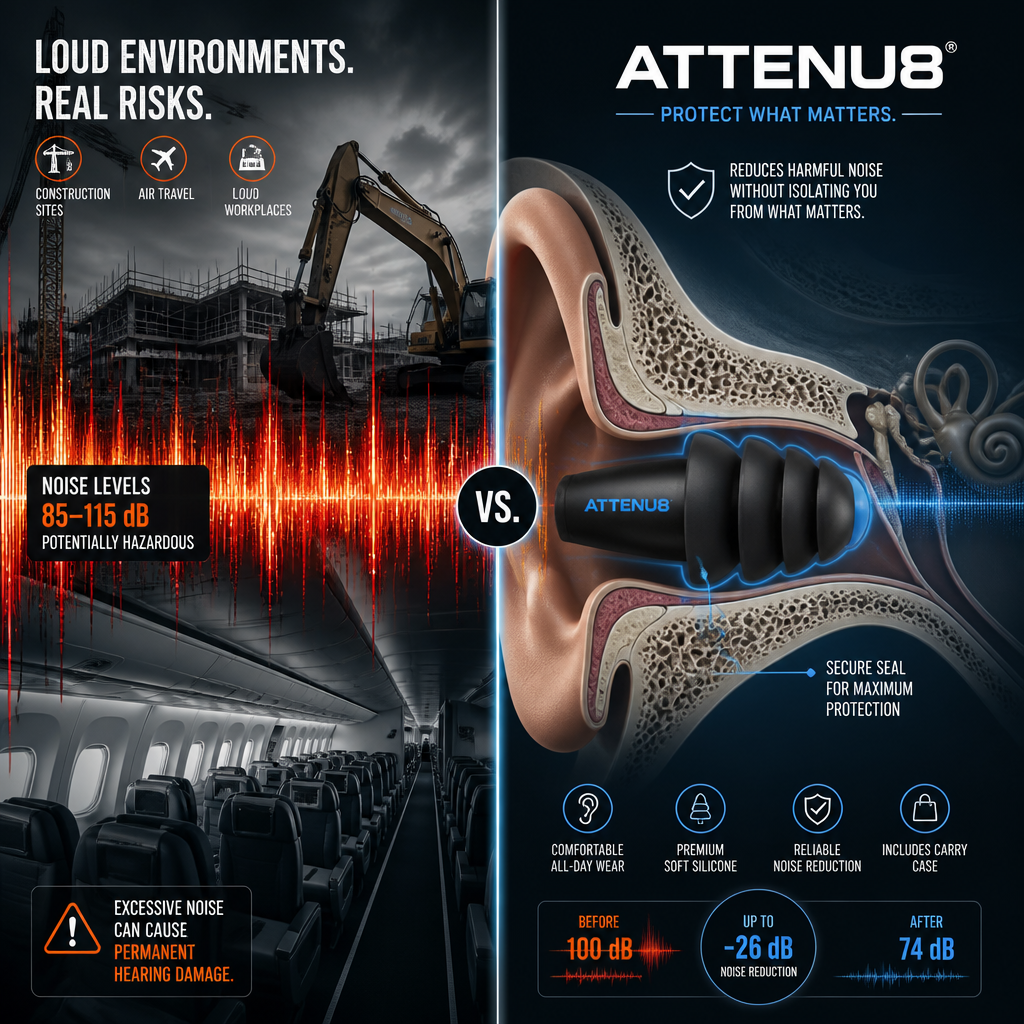
Every earplug sold for hearing protection carries a Noise Reduction Rating (NRR). What most people do not realize is that this figure comes from controlled lab testing, not from the variable conditions of real life. The National Institute for Occupational Safety and Health (NIOSH) has recommended that the real-world noise reduction from foam earplugs be treated as approximately 50% of the stated NRR when assessing actual protection. In practice, some users get significantly less than that, with effective protection approaching zero when fit is poor.
This means an earplug rated at 32dB does not automatically give you 32dB of protection. It means 32dB is what a correctly fitted, properly inserted earplug of that type can achieve under ideal conditions. Every compromise in fit, insertion depth, or earplug condition eats into that number.
A hearing protector’s rated NRR often does not reflect the actual protection provided. Individual fit is the most important variable determining real-world noise reduction.
Pro tip: To do a basic fit check without specialist equipment, count out loud while slowly cupping and uncupping your hands over your ears. According to the CDC, if your earplugs are correctly seated, your voice should sound roughly the same whether your hands are cupped or not. If your voice gets noticeably louder when you remove your hands, the seal is leaking.
An earplug that migrates out of your ear canal during use is providing exactly zero protection for every minute it is not correctly seated. For side sleepers, this is a persistent problem with standard foam earplugs. The pressure of a pillow pushes the plug inward or dislodges it completely over the course of a night. For workers, jaw movement, sweating, and physical activity all work against a stable fit.
If you are regularly waking up with one or both earplugs resting on your pillow rather than in your ears, your nighttime noise exposure is essentially unprotected. This is not a minor inconvenience. If you are sleeping in a noisy environment, those hours of unprotected exposure add up significantly.
Earplugs fall out when they are the wrong size for the ear canal, when the foam has lost its expansion capacity and can no longer grip the canal walls, or when the shape of the earplug does not match the geometry of the ear. Standard one-size-fits-all foam earplugs fail a significant portion of users for exactly this reason. Human ear canals vary considerably in diameter and angle, and a plug designed for an average ear will not hold in ears at either end of that range.
A properly fitted earplug should feel stable under light finger pressure and should not shift when you move your jaw or turn your head. If you can wobble it easily from the outside, it is not sealing properly and it will not stay put through a full night of sleep or a full working shift.
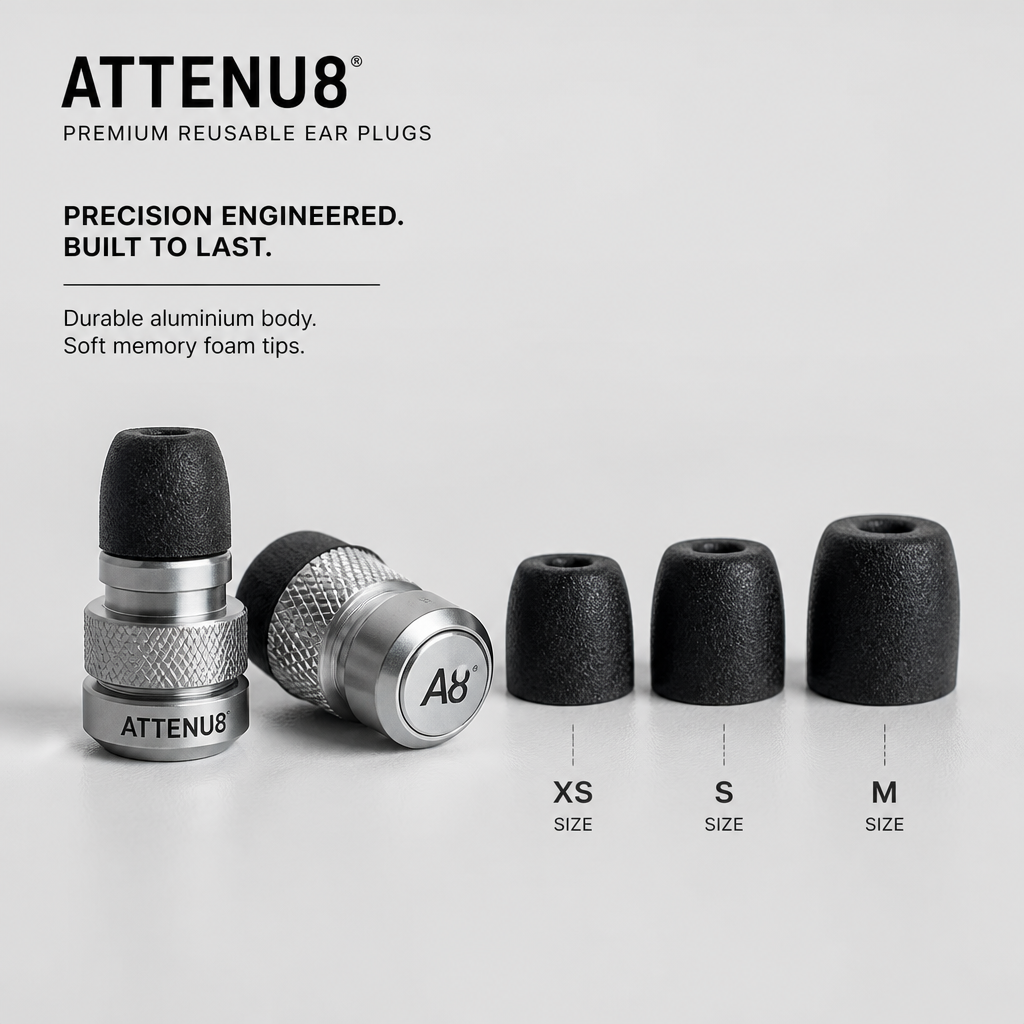
Pro tip: If your earplugs shift when you open your mouth wide or move your jaw, they are too large for your canal or they have not been inserted to the correct depth. Try a smaller tip size before assuming earplugs simply do not work for you. Size matters more than most people think, and most earplug products only come in one size, which is why having access to multiple tip sizes (XS, S, and M) makes a measurable difference in real-world fit and retention.
Temporary ringing in the ears, a condition known as tinnitus, or a muffled, cotton-wool quality to sounds after removing earplugs is a serious warning sign. Most people dismiss it as normal. It is not. These sensations indicate that your inner ear was exposed to a level of noise that exceeded what the earplugs were filtering, and the hair cells in your cochlea are reacting to that overexposure.
Noise-induced hearing loss is cumulative and permanent. Each episode of overexposure degrades hearing slightly. The ringing fades, which people interpret as recovery, but the underlying damage does not reverse. If you are regularly experiencing post-exposure ringing despite wearing earplugs, your current hearing protection is not adequate for the noise environment you are in.
Ringing after noise exposure while wearing earplugs means one of three things: the earplugs were not inserted correctly, the noise level exceeded what your earplugs are rated to handle, or the earplugs themselves have degraded to the point where they are no longer delivering their rated reduction. All three are solvable, but only if you recognize the ringing for what it is rather than ignoring it.
If the ringing is mild and brief, it suggests the protection was close but insufficient. If the ringing is strong or persists for hours, the noise exposure was significant and the gap between what you needed and what your earplugs delivered was large. Either way, it is a direct prompt to reassess both your earplug choice and your insertion technique.
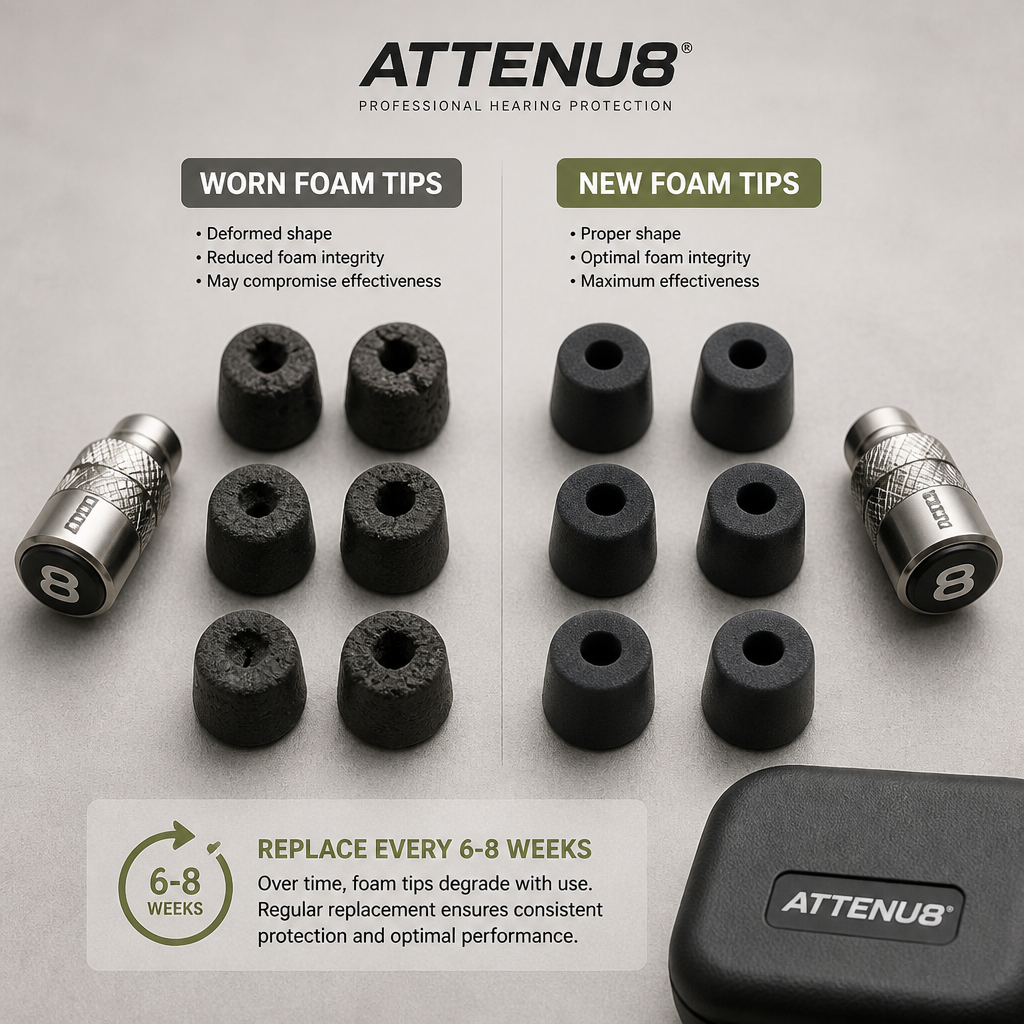
Physical deterioration is the most overlooked sign of poor earplug performance, because people tend to use earplugs until they fall apart rather than replacing them at the point where effectiveness drops. By the time a foam earplug looks noticeably worn, it has typically been underperforming for weeks.
The key test is compression recovery. Roll the foam tip between your fingers and compress it fully, then watch how it expands. Fresh memory foam expands slowly and evenly, filling the canal walls as it returns to shape. Worn foam expands too quickly, unevenly, or not fully at all. When foam loses its expansion capacity, it cannot form the complete seal the earplug depends on for noise reduction. A foam tip that springs back instantly has lost the memory quality that makes it effective.
Beyond compression recovery, look for discoloration (yellowing or darkening from earwax and skin oils), surface hardening or stickiness, and any visible cracking or tearing in the foam. These are not cosmetic issues. They indicate that the material has broken down at a structural level and can no longer conform to the unique contours of the ear canal.
Heat, moisture, skin oils, and repeated compression all degrade foam over time. A foam earplug that has been used nightly for several months and cleaned multiple times will not perform the same as a fresh tip, even if it looks superficially intact. This is why foam tip replacement on a regular schedule matters, not just replacement when the tips look visibly destroyed.
With ATTENU8 earplugs, the aluminium body retains its geometry indefinitely. Only the memory foam tips need replacing, roughly every 6 to 8 weeks depending on use frequency. This approach is more economical than discarding entire disposable earplugs when they degrade, and it ensures the part of the earplug that actually fails (the foam seal) is always fresh without throwing away the part that never degrades (the structural body).
An earplug that causes enough discomfort to make you take it out is providing no protection at all for the remainder of the exposure period. This is the sign of poor earplug performance that people rationalize most aggressively. “I only had them in for part of the night.” “I took them out after an hour because they hurt.” That reasoning does not reduce the hearing damage that accumulates during the unprotected portion.
Discomfort during earplug use is not an inevitable trade-off. It is a sign of wrong fit, wrong size, wrong material, or an earplug design that prioritizes noise reduction ratings over wearability. Comfort and effectiveness are directly linked, not competing properties. An earplug that cannot be worn consistently for its intended duration is, by definition, not an effective hearing protection solution for that person.
We would love your feedback and any insights you would share with others. What perspective would you add?
Pressure pain comes from earplugs that are too large for the canal, or inserted too deeply. Soreness over time comes from materials that harden against the canal wall during extended wear. Side-sleeper pain comes from earplug bodies that protrude from the ear and press against the pillow. Each of these has a specific solution, but the first step is recognizing them as fit and design problems, not as evidence that earplugs generally do not work for you.
The concave aluminium body design of ATTENU8 earplugs is specifically built to address protrusion discomfort for side sleepers. Paired with three tip sizes (XS, S, and M) in soft memory foam, the combination allows for a fit that does not create pressure over extended wear. The foam sits inside the canal while the body sits flush against the outer ear, rather than sitting proud of it. For people who have given up on earplugs entirely because of discomfort, the problem is almost always the earplug design rather than the person’s ear.
Understanding why certain earplug formats consistently underperform helps you make a better choice. The table below compares the three most common earplug formats across the factors that actually determine real-world performance.
| Earplug Type | Key Strengths | Common Failure Points |
|---|---|---|
| Standard disposable foam | Low cost per pair, widely available, high NRR rating on packaging | Degrades rapidly with repeated use, requires correct roll-and-insert technique, one-size-fits-all approach misses many ear canal sizes, no size options for different users |
| Pre-moulded silicone or rubber | Reusable body, does not require rolling technique, easier insertion | Flanged design can create pressure points over extended wear, less adaptable to canal shape variation than foam, NRR typically lower than foam options |
| Metal-bodied reusable with replaceable foam tips (e.g., ATTENU8) | Durable aluminium body never degrades, multiple tip sizes for genuine fit matching, concave design reduces side-sleeper protrusion, consistent fit once correct size is found | Higher upfront cost than disposables, foam tips still require scheduled replacement every 6 to 8 weeks for consistent performance |
The practical takeaway is that disposable foam earplugs are only effective when inserted correctly every single time, and they degrade with every use. A reusable format that isolates the degradable component (the foam tip) from the structural component (the body) eliminates the most common source of gradual performance decline.
The most reliable quick check is to count out loud while slowly cupping and uncupping your hands over your ears. If the earplugs are correctly seated and sealing well, your voice should sound roughly the same volume whether your hands are cupped over your ears or not. If your voice sounds noticeably louder with your hands away, the seal is leaking and the earplugs need to be reinserted or replaced with a better-fitting size.
The most common reason is an incomplete seal. Even a small gap between the earplug and the canal wall allows noise to pass through. This can happen because the tip size is wrong for your canal, the foam has degraded and no longer expands fully, or the insertion was too shallow. Try a smaller or larger tip size, and make sure the foam is fully compressed before inserting. If the problem persists across multiple correct insertions, the earplug material may have degraded past the point of usefulness.
For foam tips on a reusable earplug used nightly, replacement every 6 to 8 weeks is a reasonable guideline. The critical test is whether the foam still compresses fully and then expands slowly back to its original shape. If the foam springs back too quickly, feels stiff, or has visible discoloration or surface changes, it should be replaced regardless of how long it has been in use. Frequency of use and storage conditions also affect how quickly foam degrades.
Earplugs that do not fit properly cause hearing damage indirectly, by failing to reduce noise to safe levels while giving the wearer a false sense of protection. They do not cause physical damage to the ear canal in typical use, but incorrectly sized or inserted earplugs that create excessive pressure can cause discomfort, soreness, and irritation of the canal skin over time. The more serious risk is the ongoing noise exposure that poor-fitting earplugs fail to block.
The Noise Reduction Rating (NRR) is measured under controlled laboratory conditions and represents the maximum potential noise reduction from that earplug type. In real-world conditions, the actual protection is consistently lower because insertion technique, canal fit, earplug condition, and user habit all affect the seal. NIOSH has recommended treating the real-world noise reduction from foam earplugs as roughly 50% of the stated NRR for practical safety assessments. This does not mean the rated NRR is meaningless. It means a higher-rated earplug that fits well will still outperform a lower-rated one, but the gap between the packaging claim and your actual protection depends heavily on how the earplug is used and maintained.
Mild initial awareness of the earplug in the first few minutes is normal as the foam settles. Actual discomfort, meaning pressure pain, soreness, or the persistent urge to remove the earplug, is a fit problem, not an unavoidable feature of hearing protection. The most common causes are using a tip that is too large for the canal, inserting too deeply, or using an earplug with a body that protrudes and presses against the pillow or external ear. Trying a smaller tip size and checking insertion depth resolves most discomfort issues. If discomfort persists across sizes, the earplug design itself may not suit your ear anatomy.
If you have had a clear sign that your earplugs are not working, share what gave it away in the comments. Knowing which failure mode is most common helps everyone make a better choice.

