


 0

Most people grab a pair of earplugs, shove them in, and wonder why they can still hear everything. The problem is almost never the earplug itself. It is almost always the size. An earplug size guide is not a luxury for the overly particular. It is the single most important factor in whether you get the noise reduction and comfort you paid for. A plug that is even slightly too small breaks its seal, letting sound leak in around the edges. A plug that is too large creates uncomfortable pressure that wakes you up or makes a full shift at work unbearable. Getting this right changes everything.
Ear canals are not standard. They vary significantly from person to person in diameter, depth, and shape, and in many people the left and right canals are not even symmetrical. A plug engineered to deliver 32dB of noise reduction delivers that figure only when it is correctly sized and properly seated. The rated noise reduction on the packaging assumes a complete acoustic seal. Break that seal with the wrong size and you lose a substantial portion of the protection.
The material matters too. Memory foam tips compress on insertion and then expand to fill the canal. This means the size you choose is the approximate diameter of the canal, not a size you squeeze down to a point and hope for the best. If the foam expands and still cannot reach the canal walls, sound gets through. If it over-fills the canal, you feel pressure, soreness, or a vacuum sensation that makes wearing them impossible for more than a few minutes.
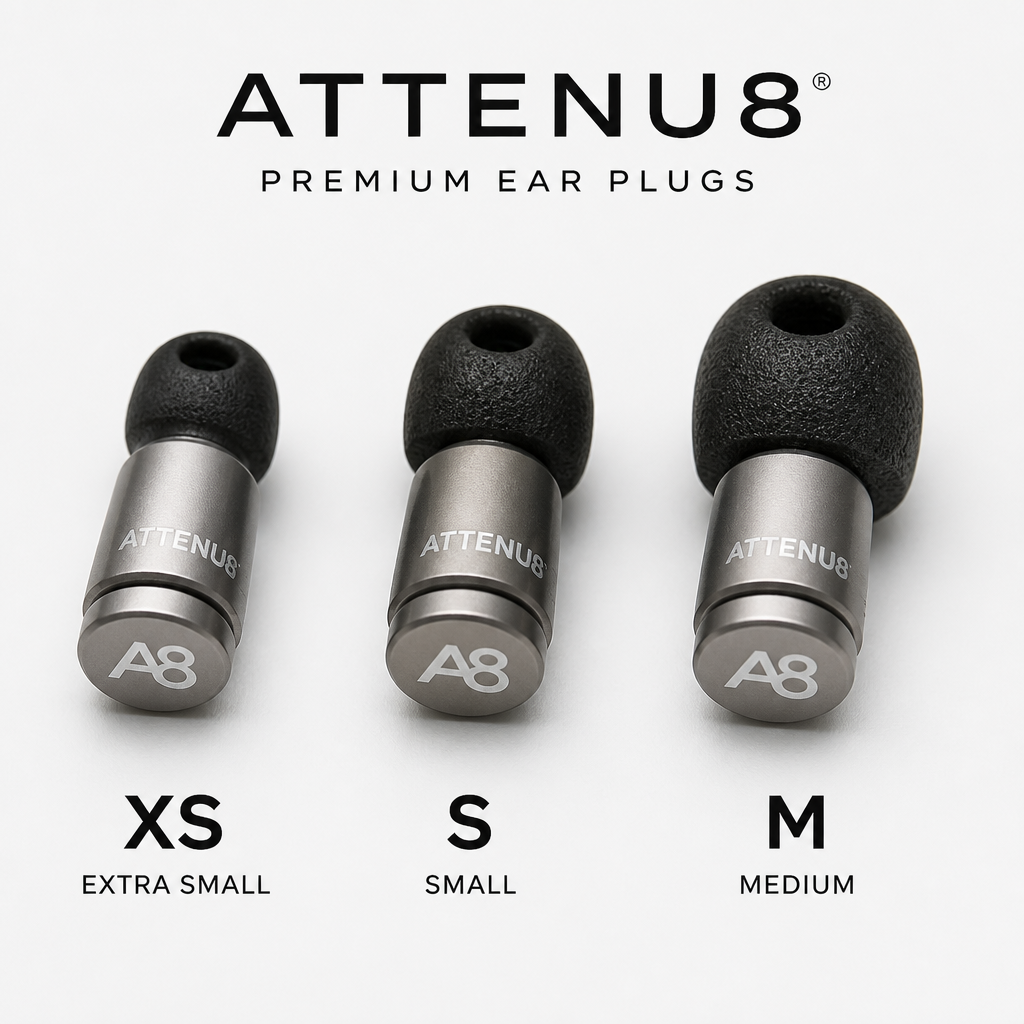
This is why ATTENU8 includes three foam tip sizes, XS, S, and M, with every pair rather than shipping a single “universal” tip. No single diameter fits every ear. Matching the tip size to your canal is what makes the aluminium body and 32dB rating actually work for you.
| Key Insight | Explanation |
|---|---|
| Start with size M and adjust from there | Medium is the closest to an average adult canal diameter and is the right baseline for most adults before fine-tuning. |
| A proper seal should feel snug, not painful | Mild resistance and a gentle muffling of ambient sound immediately on insertion tells you the foam is sealing correctly. |
| Too small means sound leaks, not just looseness | An undersized tip cannot reach the canal walls. You may not notice the gap, but noise will get through even if the plug feels seated. |
| Too large causes pressure pain and poor sleep | An oversized tip creates a strong vacuum sensation or soreness within minutes. It also tends to work itself out of the canal overnight. |
| Left and right ears can need different sizes | Ear canal asymmetry is common. Test each ear independently rather than assuming one size works for both. |
| Insertion technique is just as important as size | Even the correct size will underperform if not inserted deeply enough. The roll-pull-hold method is essential for memory foam tips. |
| Replace foam tips every 6 to 8 weeks | Worn-out foam loses its expansion memory and cannot form a reliable seal regardless of size. The tip, not the body, drives fit quality over time. |
When ATTENU8 includes three tip sizes in a single pack, it is acknowledging something the industry has historically ignored: one size does not fit most people, let alone all people. The XS, S, and M designations correspond to the compressed insertion diameter and the expanded sealing diameter of the memory foam tip. Each step up in size increases both dimensions, which is why using the wrong one has such a direct effect on both comfort and acoustic performance.
XS tips are designed for narrow ear canals. This is more common than most people assume. Children aged roughly ten and older, many women, and some adults with naturally narrow canals find that standard or medium tips cause immediate discomfort or do not stay in place during movement. If you have ever had a standard foam earplug feel genuinely painful on insertion, XS is the size you should try first.
The XS tip also works well for people who sleep on their side. A smaller, properly fitted tip creates less lateral pressure against the pillow-side ear, which makes it dramatically more comfortable through a full night of sleep.
Small tips bridge the gap between XS and M. They suit people whose canals fall in a below-average to average range but find XS tips too loose and M tips too tight. Many adults who describe “sensitive ears” or “earplugs always hurt me” are actually just using medium tips in what are, anatomically, small canals. Switching to S often resolves the problem entirely without any sacrifice in noise reduction.
M tips are the best starting point for most adults. The average adult ear canal is approximately 9mm in diameter, and M tips are designed to create a reliable seal at that range. If M tips feel comfortable, stay in place during normal head movement, and produce a clear reduction in ambient noise immediately on insertion, you have found your size and there is nothing more to do.
Pro tip: If you have never sized your ears before, insert one M tip and leave it in place for 60 seconds. If it stays secure, feels snug without pain, and reduces ambient sound noticeably and evenly, M is your size. If it creeps outward, feels loose, or lets sound through unevenly, drop to S.
The fastest and most reliable method is a simple size test using all three tips, one ear at a time. This takes about five minutes and eliminates guesswork entirely.
Start with M. Roll the foam tip between your fingers until it compresses to a narrow cylinder. Reach over your head with your opposite hand, pull the outer ear gently upward and back to straighten the canal, then insert the compressed tip with a slight rotating motion until it sits just inside the canal opening. Hold it in place gently for 20 to 30 seconds while the memory foam expands.
After it has fully expanded, assess three things: comfort, fit stability, and noise reduction quality. A correctly sized tip feels snug but not painful, does not shift when you move your jaw or turn your head, and produces a clear, even muffling of background sound. If the M tip passes all three, you are done.
If M feels tight or causes a vacuum-like pressure sensation, move to S. If M sits loosely or you can hear background sound clearly through it, you have an unusual situation, and a retest with fresh insertion technique is worth trying before concluding M is too small. Poor insertion technique mimics the symptoms of an undersized tip.
Pro tip: Test each ear separately. A meaningful number of people have one canal that takes S and one that takes M. ATTENU8’s design allows you to use different tip sizes on each earplug, so asymmetric sizing is entirely practical.
After insertion, look in a mirror. The foam tip should sit just inside the canal opening with the aluminium body of the earplug resting close to the ear rather than protruding outward at a visible angle. If the earplug is angling sharply outward, the tip is not seated deeply enough. This is usually a technique issue, not a size issue, but it is worth ruling out before changing sizes.
The body gives clear feedback when an earplug is the wrong size. The problem is that most people interpret these signals as “earplugs just aren’t for me” rather than as a straightforward sizing issue with a simple fix.
An undersized tip cannot form a complete seal against the canal walls. The most obvious sign is that the earplug feels loose or shifts during normal movement. You may need to push it back in frequently, and it often works its way out entirely during sleep. The subtler and more important sign is reduced noise protection: ambient sound comes through more clearly than expected, often with a directional or uneven quality because the seal is inconsistent rather than absent.
If you are using earplugs specifically for sleep and find that sound still wakes you despite wearing them, an undersized tip is one of the first things to check. The gap around an undersized foam tip is often small enough to be invisible but large enough to let enough sound through to disturb light sleep.
An oversized tip announces itself through discomfort. Pain or soreness within minutes of insertion is a strong indicator that the earplug is pressing against sensitive canal tissue. Some people also describe a strong vacuum sensation or a feeling of excessive fullness. These are not signs that you need to “get used to earplugs.” They are signs you need a smaller tip.
A secondary sign is that oversized tips sometimes work themselves out during sleep despite feeling tight on insertion. This happens because the foam is compressing the canal walls rather than filling the canal, and the body’s natural response is to push the foreign object out. Switching down one size typically solves both the discomfort and the displacement problem at once.
A well-fitting earplug stays in place during movement and sleep, reduces noise evenly in both ears, and does not cause pain or strong pressure. If yours does not meet all three criteria, the issue is almost always size or insertion depth, not the earplug itself.
| Size | Best Suited For | Common Fit Failure If Wrong |
|---|---|---|
| XS | Narrow canals, children (10+), side sleepers, adults who find standard tips painful on insertion | If too small for the canal: loose seal, tip migrates out during sleep, reduced noise reduction |
| S | Below-average to average canals, adults with “sensitive ears,” anyone for whom M causes pressure | If too small: intermittent seal loss during jaw movement; if too large: mild pressure, less severe than M in the wrong ear |
| M | Average to larger adult canals, industrial or occupational hearing protection where maximum seal is priority | If too large: pain, vacuum sensation, tip ejected by ear overnight; if too small: sound leakage, inconsistent noise reduction |
Sizing and insertion are inseparable. You can have the correct tip size and still get poor noise reduction if the insertion is shallow or rushed. Memory foam tips require a specific technique because the foam needs to expand inside the canal, not in front of it.
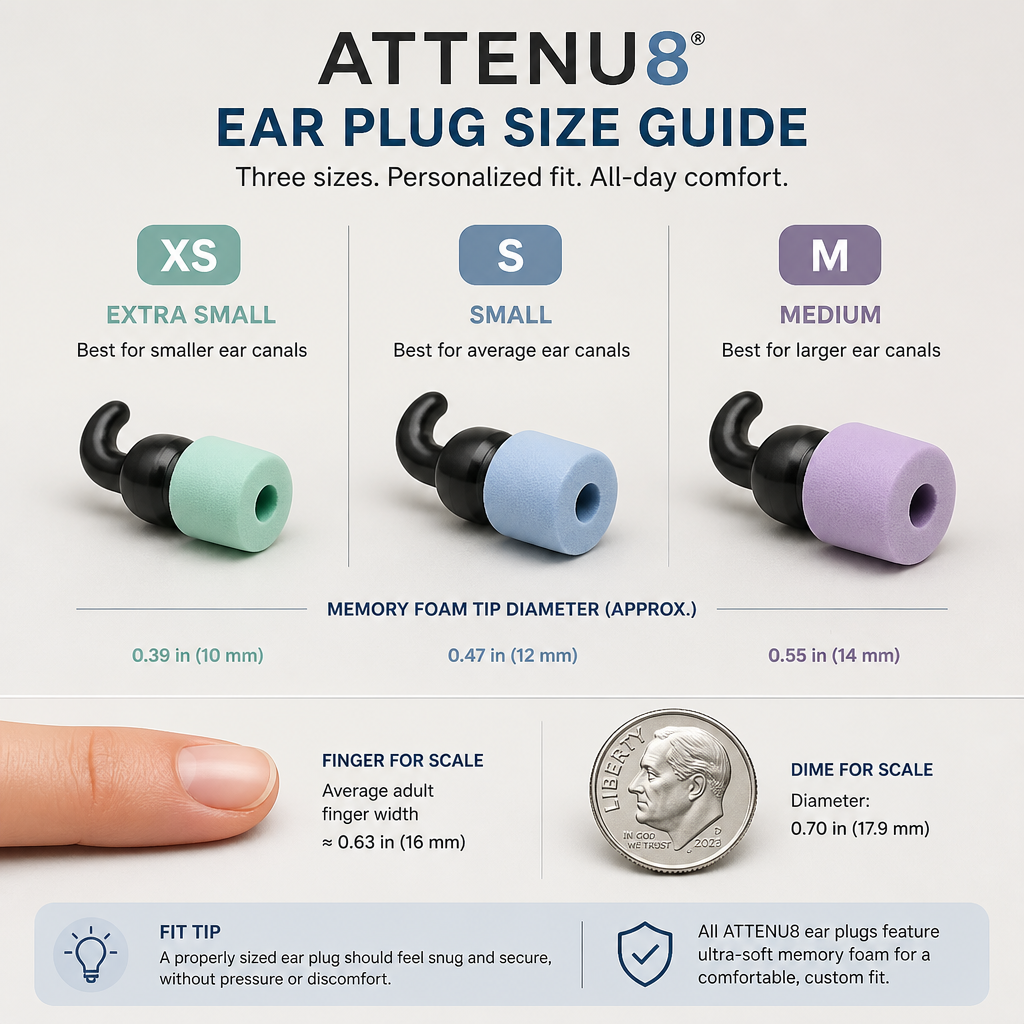
Roll the foam tip between your fingers into the narrowest cylinder you can manage. Reach over your head with the hand on the opposite side to the ear you are inserting, grasp the outer ear, and pull gently upward and back. This straightens the ear canal, making insertion significantly easier and deeper. Insert the compressed tip with a slight rotating motion and push it in until it sits inside the canal entrance. Hold it firmly in place for 20 to 30 seconds while the foam expands to fill the canal.
The holding step is where most people fail. Letting go too early means the foam expands while partially outside the canal and then stops short of a full seal. The discomfort of holding it in place for 30 seconds is worth the complete seal you get as a result.
Once the foam has fully expanded, snap your fingers or click near each ear individually. The sound should be noticeably and roughly equally muffled on both sides. If one ear lets through significantly more sound than the other, either the tip on that side is undersized or the insertion was incomplete. Remove, reroll, and reinsert before concluding it is a size problem.
Another useful check is to hum gently. With a proper bilateral seal, your own voice resonates with a noticeably “in your head” quality. If it does not, at least one seal is incomplete.
The demands on an earplug differ considerably between a sleeping environment and an occupational noise environment, and those differences have implications for how tightly you should prioritize the seal when choosing your size.
For sleep, comfort is the first filter. An earplug that causes even mild discomfort will disrupt sleep more reliably than the noise it was supposed to block. Side sleepers in particular find that one size too large creates enough pressure against the pillow-side ear to become a consistent source of waking through the night. Start with the smallest size that still produces a clear seal, rather than the largest size that technically fits.
The other sleep-specific consideration is tip retention. A tip that is correctly sized for your canal will stay in place for a full night without any tendency to migrate out. If you frequently wake up to find one or both tips on your pillow, undersizing is almost certainly the cause.
In construction, manufacturing, or any environment where noise levels regularly exceed safe thresholds, the acoustic seal takes priority. The 32dB noise reduction rating on ATTENU8’s tips is a ceiling, not a guarantee. You only approach that ceiling with the right size and correct insertion. In a workplace context, this is not just about comfort. It is about actual hearing protection over months and years of exposure.
If you work in a high-noise environment, test your fit at the start of each shift rather than assuming yesterday’s insertion was typical. Foam tips that are due for replacement, roughly every 6 to 8 weeks, lose their expansion memory and provide a weaker seal even when the size is correct. Fresh tips on a correctly sized canal are the baseline for reliable protection.
Pro tip: In loud work environments, do the snap-finger seal check after every insertion. It takes three seconds and tells you immediately whether you have a functioning seal before you are exposed to the noise source. Do not wait until your hearing feels fatigued to check.
Start with M. It corresponds to the approximate average adult ear canal diameter, making it the most statistically likely fit for a first attempt. Insert it using the roll-pull-hold technique, hold for 30 seconds, and assess comfort and noise reduction. If M is comfortable and the seal is clear, you are done. If it is too tight or too loose, move to S or try reseating with improved insertion technique before switching sizes.
Yes, and more often than most people expect. Ear canal asymmetry is a normal anatomical variation. Testing each ear independently is the only way to know for certain. ATTENU8’s design allows each earplug to carry a different tip size, so there is no practical barrier to using XS on one side and S on the other if that is what your ears require.
There are two common causes. First, the tip may be undersized: it felt snug immediately after insertion because the fresh foam had just expanded, but it gradually shifted or partially unseated as you moved in your sleep. Second, the foam tips may be due for replacement. Memory foam that has been compressed and expanded repeatedly loses its ability to fully expand, which means it no longer fills the canal even if the size was correct originally. Replace tips every 6 to 8 weeks to maintain consistent performance.
No. This is one of the most common misconceptions about earplug sizing. A properly sized tip that forms a complete seal provides the full rated noise reduction. An oversized tip may feel tighter initially, but it creates pressure against canal walls rather than filling the canal, which can actually result in a less consistent seal and causes significant discomfort that makes you remove the earplugs earlier. Correct size, not maximum size, is what delivers optimal protection.
ATTENU8 recommends replacing the memory foam tips every 6 to 8 weeks with regular use. Over time, foam loses its expansion memory, which means a worn tip behaves like an undersized tip even if you chose the right size originally. If your earplugs are providing noticeably less noise reduction than when they were new and your insertion technique has not changed, worn tips are the most likely explanation. When you fit new replacement tips, take a moment to reconfirm your size, since the expansion of fresh foam is different enough from worn foam to occasionally change what feels comfortable.
XS tips are for narrow ear canals, and canal diameter has no reliable relationship to body size, height, or gender. Some adults with larger frames have naturally narrow canals and need XS or S tips for the same anatomical reason that some smaller-framed adults comfortably wear M. The only way to know is to test. If M causes discomfort and S still feels tight, try XS before concluding that reusable foam-tip earplugs will not work for you.
Have you found that one size works better in one ear than the other, or discovered that switching sizes made a significant difference to your sleep or hearing protection? Share your experience in the comments.

