


 0

Hearing loss and tinnitus have ranked as the top two service-connected disabilities among veterans for longer than most active-duty personnel have been serving. That is not a coincidence. It is the direct, documented result of operating in some of the loudest environments human beings can survive, often without adequate ear protection in place. The case for earplugs for military use is not a comfort story. It is a readiness story, a career-longevity story, and for tens of thousands of veterans drawing disability compensation right now, a story that ended far too late.
| Key Insight | Explanation |
|---|---|
| Tinnitus is the single most compensated VA disability | More than 3.5 million veterans receive VA disability compensation for tinnitus, a direct consequence of noise exposure during service. |
| Hazardous impulse noise starts at 140 dBP | A single gunshot or explosion can permanently damage hearing. Damage from impulse noise can occur in a fraction of a second, with no warning and no recovery. |
| Most hearing damage in the field is preventable | DoD mandates hearing testing before and after deployment precisely because noise-induced hearing loss is a preventable injury when protection is worn consistently. |
| Off-duty hearing protection is just as important | Noise exposure on base, in barracks, or during transit accumulates. Using earplugs during rest periods reduces total daily exposure and improves sleep quality. |
| Situational awareness fears can be addressed by fit and design | The main reason soldiers skip hearing protection is fear of missing critical soft sounds. Well-fitted, appropriately-rated earplugs allow ambient sound while blocking hazardous peaks. |
| Reusable, durable earplugs reduce compliance failure | Single-use foam earplugs get discarded, lost, or improperly fitted. Durable reusable options with consistent tip sizing remove the excuse of “I didn’t have any with me.” |
| Hearing protection directly supports combat effectiveness | A soldier with degraded hearing is a liability. Protecting hearing is not a personal choice, it is a force readiness issue that commanders increasingly enforce. |
The numbers here are not abstractions. According to the 2024 U.S. Department of Veterans Affairs Annual Benefits Report, tinnitus ranked as the single most compensated service-connected disability among veterans, with more than 3.5 million veterans drawing compensation for it. Hearing loss consistently ranks second. These two conditions have held those top two spots for as long as the VA has reported them.
Estimates from hearing research suggest that approximately 68% of deployed soldiers return with some degree of ear damage, and that the majority did not consistently protect both ears during combat. The auditory rehabilitation costs that flow from this are substantial, running into hundreds of millions of dollars annually. This is not a problem at the margins of military health. It is the single most common occupational injury in uniform.
The scale matters because it reframes the conversation. Military hearing protection is not a niche health topic for soldiers stationed near artillery ranges. It applies to every infantry soldier, every aircrew member, every vehicle operator, and every sailor working near engine rooms. If your role puts you within range of any weapon system, any explosion, or any sustained machinery noise, your hearing is at risk on every operation.
Tinnitus and hearing loss have remained the number one and two most common injuries of service members for as long as the U.S. Department of Veterans Affairs has reported such statistics.
Understanding why earplugs are non-negotiable starts with understanding what the ears are actually up against. The threshold for hazardous continuous noise exposure is 85 decibels (dBA) over an eight-hour period. Hazardous impulse noise, the kind produced by firearms and explosions, begins at 140 decibels of peak pressure (dBP). A single shot from a standard infantry rifle exceeds this threshold significantly.
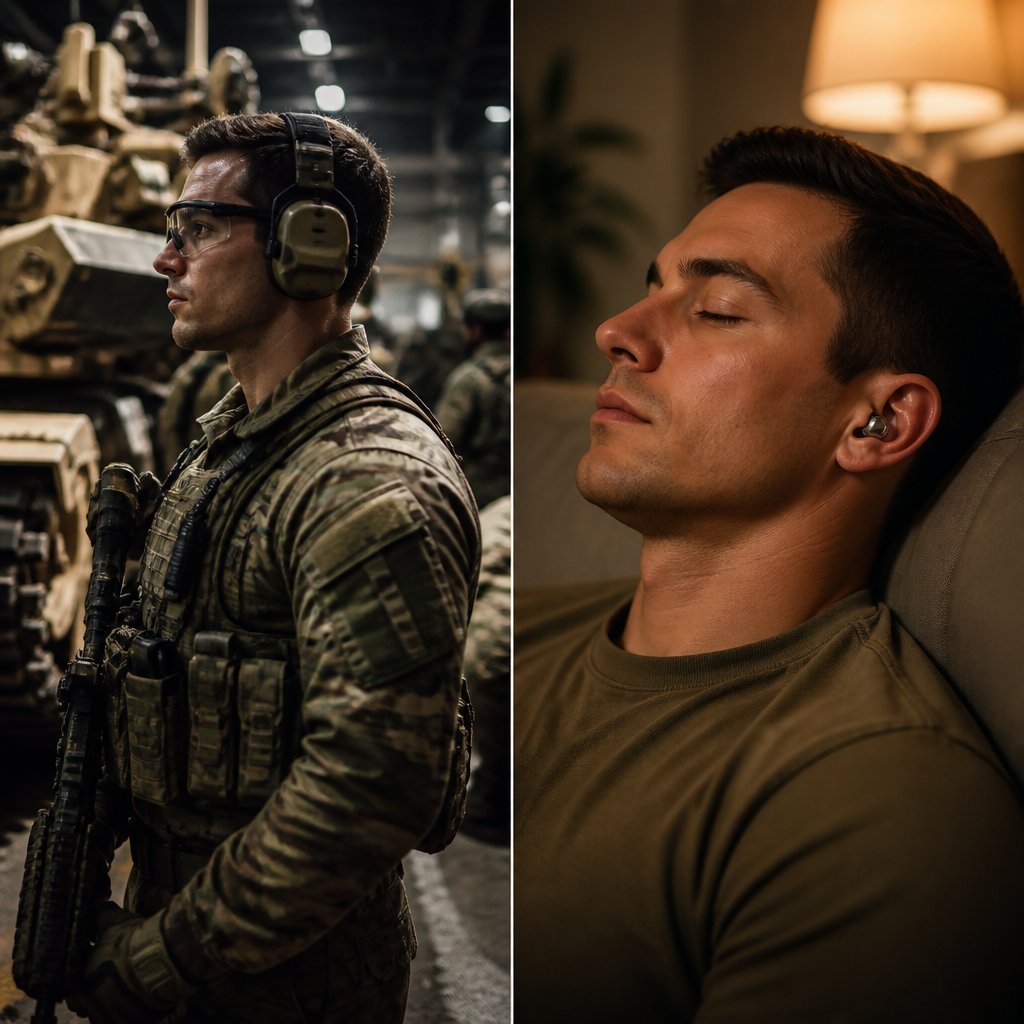
What makes impulse noise so dangerous is that it does not give the ear time to respond. The acoustic reflex, the ear’s natural protective mechanism, takes around 25 milliseconds to activate. A close-range gunshot reaches the cochlea far faster than that. Every unprotected shot fired or heard in the field contributes to cumulative damage that is silent, painless, and irreversible.
The noise hazards in military environments extend well beyond combat. Training ranges, helicopter operations, armored vehicle interiors, naval deck operations, and even certain maintenance tasks all generate sustained or peak noise levels that exceed safe exposure thresholds. A soldier who fires on a range twice a week without tactical earplugs in place is accumulating damage every single training cycle, not just in a combat zone.
Continuous operational noise such as that inside an armored vehicle or aircraft can push past 85 dBA with ease. Over an eight-hour shift or a full day’s operation, even moderate noise levels compound into significant physiological stress on the cochlear hair cells, which do not regenerate. Once those cells are gone, the hearing they provided is gone permanently.
Pro tip: If you have to raise your voice to be heard by someone standing three feet away, you are already in a noise environment that qualifies as hazardous exposure. That is a practical field test that requires no equipment.
Compliance with hearing protection orders in combat settings has historically been poor, and the reason is specific: soldiers fear they will miss a critical soft sound, such as an enemy movement or a whispered command, that could cost them or their team their lives. This concern is understandable. It is also, when examined closely, an argument for better earplugs rather than an argument against wearing any.
The logic breaks down the moment you consider the alternative. A soldier who takes unprotected fire from a weapon system at close range risks acute acoustic trauma that can cause immediate, severe hearing loss. Even sub-acute exposure across a deployment degrades the exact auditory sensitivity that the soldier was trying to preserve. Refusing hearing protection in the name of hearing acuity is a strategy that destroys the very asset it claims to protect.
A significant part of why soldiers skip protection is that standard-issue disposable foam earplugs fit poorly for a large percentage of the population. An improperly fitted foam earplug does not deliver its rated noise reduction. It sits loose, falls out during movement, and blocks low-frequency ambient sound more than the high-frequency impulse peaks that actually cause damage. That experience teaches soldiers that earplugs do not work, when the real issue is that the earplug they used was the wrong size and inserted incorrectly.
This is the practical argument for premium-fit hearing protection. An earplug with multiple tip sizes, soft memory foam that conforms precisely to the ear canal, and a stable body that stays seated during active movement will consistently deliver its rated protection. Consistent fit means consistent protection. There is no other way to get there.
Pro tip: Always test your earplug seal before relying on it. Cup your hands over your ears and compare the perceived sound level to the earplug-only level. A properly seated earplug should produce a noticeably quieter result than cupped hands alone.
The noise exposure problem in military life does not stop when operations do. Barracks environments, flight lines, naval vessels, and forward operating bases are noisy around the clock. Generators, aircraft, vehicle traffic, and shared sleeping quarters create ambient noise environments that erode sleep quality even when personnel are technically off duty.
Research published in military health literature confirms that sleep loss in military settings is pervasive and has measurable negative effects on cognitive performance, physiological recovery, and operational functioning. The Human Performance Resource Center, a DoD resource, specifically identifies foam earplugs as a recommended tool for minimizing environmental noise disturbance during sleep in operational contexts.
Sleep and hearing are linked at the physiological level. Chronic noise-disrupted sleep elevates stress hormone levels, impairs immune function, and degrades the attentional systems that soldiers rely on for situational awareness. Using hearing protection for armed forces personnel during rest periods is not a soft wellness recommendation. It is a readiness measure that supports the same combat effectiveness that training and physical conditioning are supposed to deliver.
For personnel who struggle with light sleep or who are stationed in environments with persistent background noise, reusable earplugs with a reliable seal and comfortable foam tips make the difference between five hours of fractured sleep and a full recovery cycle. That difference is measurable in reaction time, decision quality, and physical output the following day.
Not all earplugs are equal, and the difference matters most when you are trying to protect hearing in genuinely dangerous noise environments. The characteristics that separate a reliable earplug from an inadequate one come down to fit consistency, material durability, noise reduction rating, and whether the earplug can be trusted to perform the same way every single time it is inserted.
A noise reduction rating (NRR) of approximately 32 dB is highly relevant for military applications. It means that at the frequencies where impulse noise causes the most cochlear damage, the earplug attenuates the incoming pressure wave by around 32 decibels. For reference, a firearm that produces 165 dBP at the shooter’s ear would be reduced to approximately 133 dBP with 32dB-rated protection in place. That difference is the line between temporary threshold shift and permanent cochlear cell death.
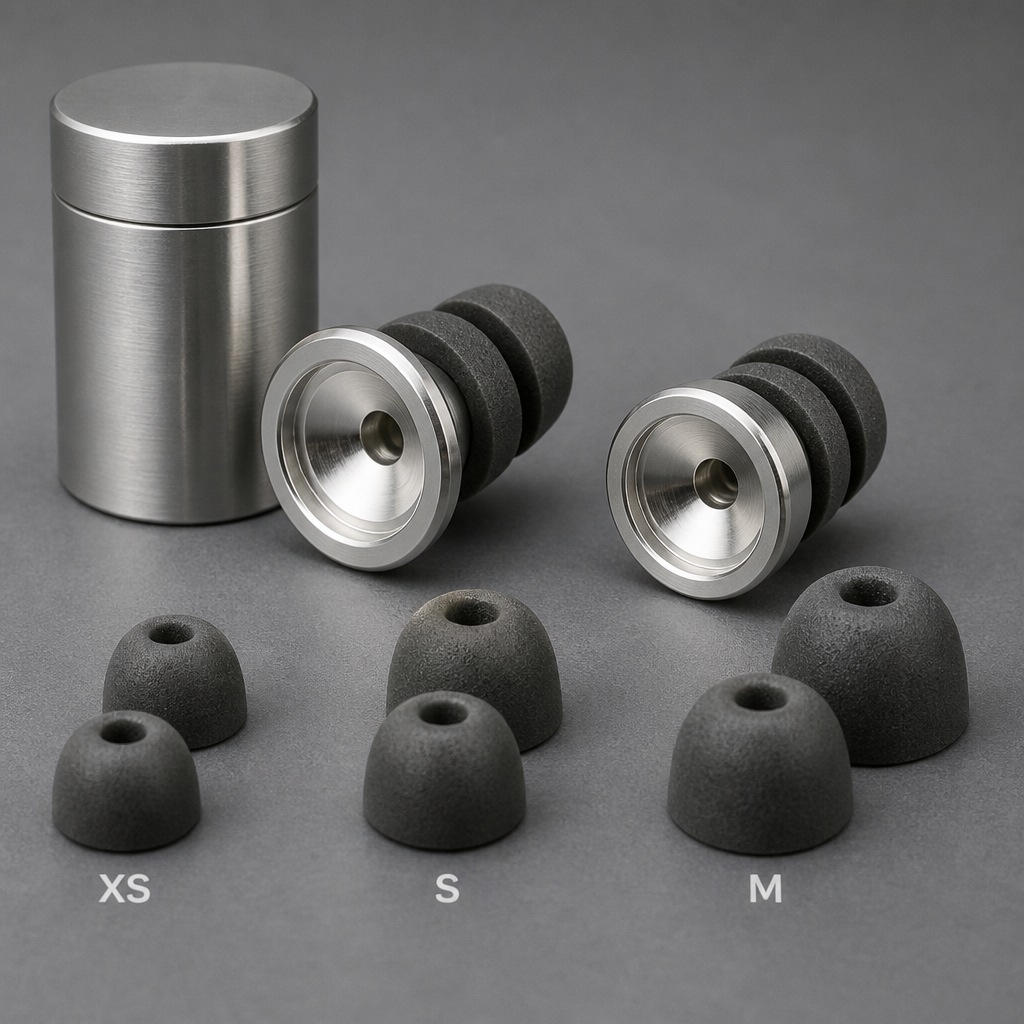
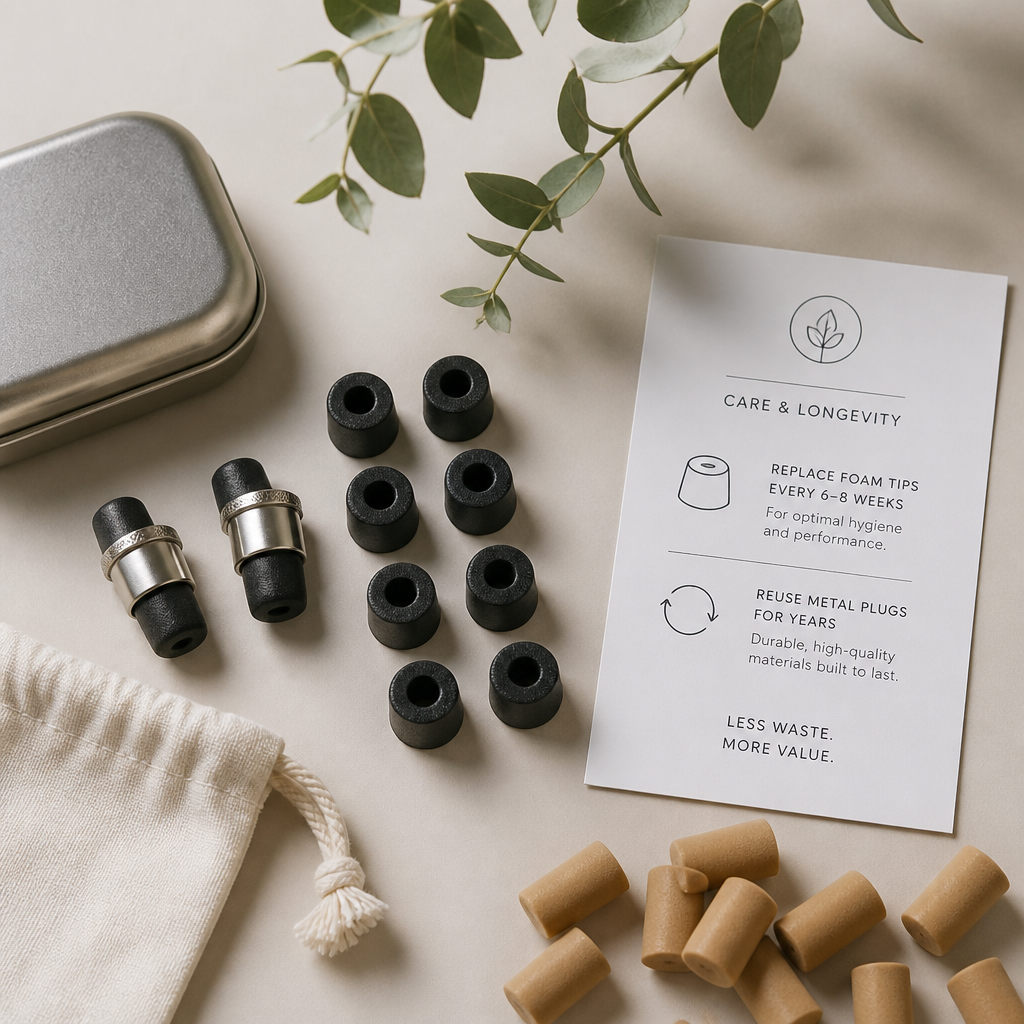
ATTENU8 earplugs are built precisely around this standard, with a concave aluminium body that maintains its shape across thousands of uses and three sizes of soft memory foam tips (XS, S, M) that allow personnel to achieve a genuine acoustic seal regardless of ear canal diameter. The tips require replacement every six to eight weeks with regular use, but the body itself is effectively permanent. That durability matters in the field, where single-use foam earplugs get lost, crushed, or contaminated.
Single-use foam earplugs are the default issue item in most militaries because they are cheap per unit. But they are only cheap if every soldier uses them correctly, every time, and replaces them at the right intervals. In practice, soldiers reuse disposables past the point of effectiveness, fail to insert them properly because the technique requires practice, and discard them when the foam degrades. The result is hearing protection that exists on paper but fails in the field.
A reusable earplug with a fixed body and replaceable foam tips removes most of that failure mode. The insertion technique becomes consistent because the earplug’s physical form does not change. The seal is reliable because the tip material is fresh and correctly sized. And the earplug is actually present because it is kept with the soldier’s kit rather than used once and thrown away.
| Earplug Type | Key Advantage | Key Limitation for Military Use |
|---|---|---|
| Standard disposable foam | Low cost per unit, widely available, no maintenance required | Inconsistent fit, degrades rapidly, frequently reused past effectiveness, high waste, easy to lose |
| Reusable metal-bodied with memory foam tips (e.g., ATTENU8) | Consistent fit across uses, durable body, multiple tip sizes for reliable seal, approximately 32dB NRR, only tips need periodic replacement | Higher upfront cost, tips require replacement every 6-8 weeks with regular use |
| Electronic tactical communication earplugs (TCAPS) | Amplify ambient sound while blocking impulse peaks, enable communication in high-noise environments | Expensive, battery-dependent, require maintenance and charging, not always field-practical for all roles |
The choice between these types depends on role and context. Electronic TCAPS are the gold standard for combat where communication is simultaneous with noise hazard exposure, but they are not always accessible or practical. For training, off-duty recovery, travel, and base environments, a high-quality reusable earplug with a confirmed noise reduction rating is the most reliable and most frequently available option. It is also the option most soldiers are likely to actually have on their person.
The U.S. Department of Defense has formal policy mandating hearing conservation across all branches. Hearing Conservation Programs (HCPs) are required whenever personnel are exposed to continuous or intermittent noise with an eight-hour time-weighted average at or above 85 dBA, or to impulse noise at or above 140 dBP. Those thresholds cover an enormous range of military occupational tasks.
DoD policy now mandates baseline hearing testing before deployment and follow-up testing after return. This is a direct acknowledgment that deployment-related noise exposure causes measurable threshold shifts, and that these shifts need to be tracked at the individual level. The intent is to catch damage early, before a soldier is discharged with a 10% VA disability rating for tinnitus that will follow them for the rest of their life.
HCPs are a command-level responsibility, but they only work if individual soldiers comply. A program that issues earplugs but does not enforce wearing them produces audiograms that document the damage rather than prevent it. Commanders who treat hearing protection as optional are not making a trade-off between readiness and safety. They are accepting guaranteed long-term readiness degradation in exchange for short-term operational comfort.
The practical implication is that soldiers should carry quality hearing protection as standard kit, not as something to be requested from supply. Personnel who take responsibility for their own hearing protection, rather than waiting for a command to issue something adequate, exit service with functional hearing. Those who do not often spend the rest of their lives managing tinnitus that wakes them at 3am.
Pro tip: Store your reusable earplugs in a hard case attached to your kit. The single most common reason soldiers do not wear hearing protection when they should is that they left it somewhere else. Proximity drives compliance. If the earplug is within arm’s reach, it gets used.
For most military applications involving firearms and explosive noise, an NRR of 29 dB or higher is the practical minimum. An NRR of around 32 dB provides meaningful attenuation of the impulse noise peaks most likely to cause permanent cochlear damage. Higher NRR ratings are available but can come with trade-offs in fit comfort and ambient awareness, depending on the design.
With standard passive earplugs, some reduction in communication clarity is inevitable. The critical insight is that the damage done by unprotected impulse noise degrades hearing far more severely and permanently than the temporary muffling effect of a well-fitted passive earplug. Electronic TCAPS resolve this trade-off entirely for roles where budget and logistics support them, but for the majority of military applications, a passive earplug with a reliable seal is far better than nothing.
Memory foam tips on reusable earplugs should be replaced every six to eight weeks with regular daily use, or sooner if the foam shows visible compression, cracking, or contamination. The rigid body of a quality reusable earplug such as ATTENU8’s aluminium-bodied design does not degrade and does not need replacement, which is the core durability advantage over disposable alternatives.
It is genuinely among the most common service-connected conditions in military medicine. According to the 2024 VA Annual Benefits Report, tinnitus is the single most compensated service-connected disability, with hearing loss close behind in second place. These figures represent real veterans drawing real monthly compensation for conditions that were preventable with consistent use of adequate hearing protection during their service.
They are required by DoD policy whenever personnel operate in environments meeting defined noise thresholds, including continuous noise averaging 85 dBA or above over an eight-hour period and impulse noise at or above 140 dBP. Hearing Conservation Programs are mandatory across all DoD components, not optional guidance. The gap between policy and field compliance is real, but the regulatory requirement is unambiguous.
The term tactical earplugs typically refers to earplugs designed with the specific demands of military operational environments in mind, including durability under field conditions, secure fit during active movement, and compatibility with other head-worn equipment such as helmets and communication headsets. Standard consumer foam earplugs may carry a comparable NRR on paper but frequently fail in practice due to poor fit consistency and low durability. For military use, the design and materials of the earplug matter as much as the rated attenuation.
What has been your experience with hearing protection in training or operational settings? Share your thoughts below and help others in the community find what actually works.

