


 0

If you have a newborn, you already know the hardest hours are rarely the feeds themselves. They are the stretch between one and four in the morning, when a baby stirs in the next room, a partner rolls over, and a car alarm down the street makes you listen for the next sound. Ear plugs for new parents can take the edge off that constant background noise, but only if they still let you hear the one sound that matters. This guide covers how to choose the right fit, when to wear them, and where the safety limits sit.
| Key Insight | Explanation |
|---|---|
| Wear them for a protected block, not all night | Use them for the first three to four hours, then take them out so you can respond to the later feeds without fumbling. |
| Fit matters more than the decibel rating | The approximately 32dB rating assumes a clean seal. Test all three tip sizes (XS, S, M) lying on your usual sleep side. |
| A working monitor is non-negotiable | Ear plugs must never replace a monitor or a second adult who can hear the room. Test the monitor with the plugs in. |
| Practice insertion while you are awake | Inserting plugs at 2 a.m. in the dark is where most people give up. A few practice runs in daylight make the difference. |
| Replace foam tips every 6-8 weeks | Fresh tips keep the seal consistent. You replace only the tips, not the whole pair. |
| Agree on a handover before the first night shift | Decide who responds to the first cry and when the other parent takes over, so neither of you has to judge it in the moment. |
Most new parents expect the feeding schedule to wreck their sleep. Fewer expect the noise to do the real damage. In a newborn household, night noise is rarely one loud event. It is a steady stream of small triggers, like a grunt over the monitor, the fridge cycling on, or a phone buzzing on the nightstand.
Your brain keeps watch on the room even when you are asleep. Sound is one of the most common reasons sleep breaks up, and light sleep is where it hits hardest. New parents spend much of the night in exactly that lighter zone, which is why a quiet room can still feel too loud.
A typical night with a newborn is not one long break. It is a feed, a diaper change, a settle, and then a wait to see whether the settle held. Each stage gives your nervous system a reason to stay alert, so you rarely drop into deep sleep before the next cry.
In practice, the wait is the part that wears people down. You are not awake enough to get up, but you are not asleep enough to rest. Noise makes that in-between state worse, because every creak becomes a possible cry.
Noise affects both adults, even when only one of them is on feeds. The parent who is not feeding often hears every rustle and waits for the call to take over. Ear plugs can give that parent a few uninterrupted hours, which often matters more than the raw number of hours slept.
Sleep is not only about total hours. It is also about how many times you were pulled out of it, and noise is one of the biggest reasons that number climbs.
The goal is not total silence. A parent who cannot hear a baby startle or fuss is missing the cues that matter most, so you want reduction and comfort, not isolation. That distinction should shape every choice you make about fit, material, and size.
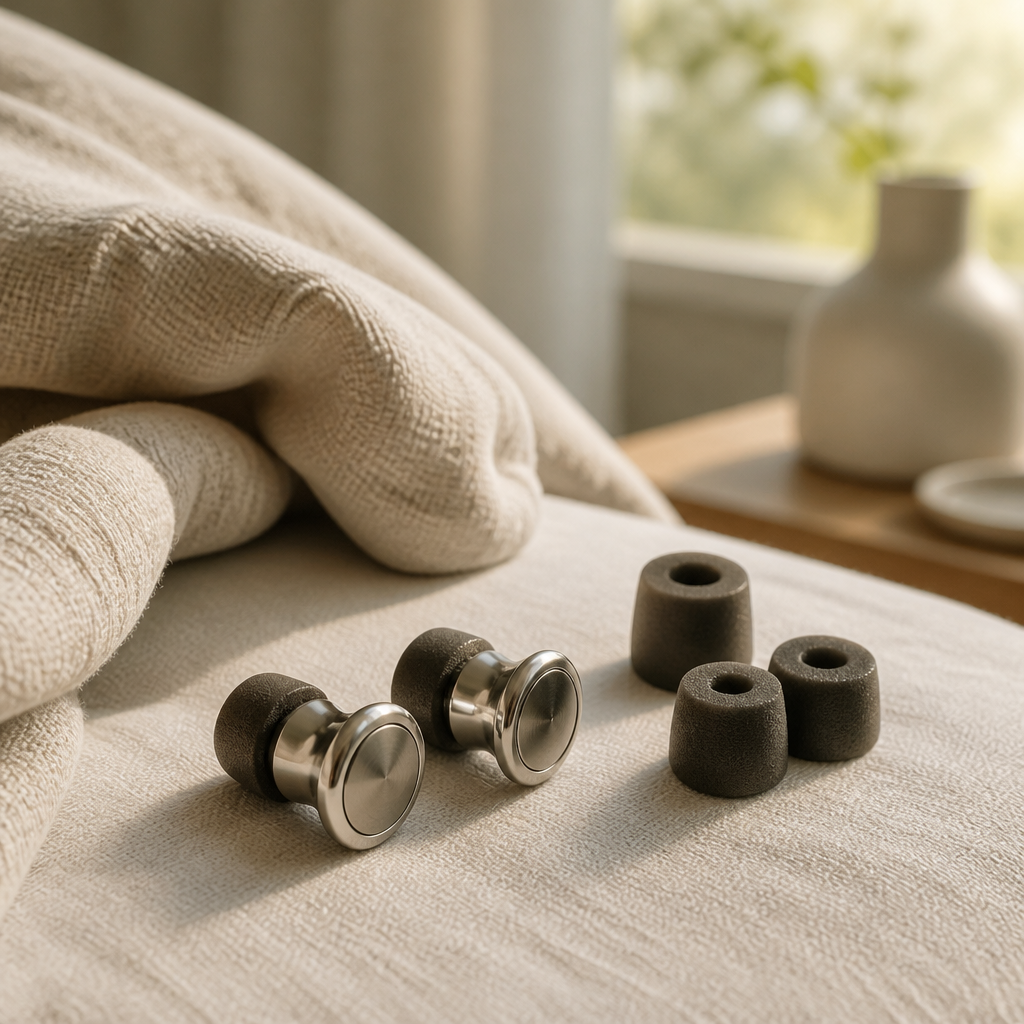
Our own pair is built around that balance. Each set has a concave aluminium body and three sizes of soft memory foam tips (XS, S, and M), with approximately 32dB of noise reduction. That rating is a ceiling, and what you actually get on a given night depends on how well the tip seals.
A noise reduction figure assumes a good seal. If the tip sits slightly out of the ear canal, the real experience drops quickly, and the wearer often concludes the product does nothing. Most people find that one size seals best, and the wrong size is the most common reason ear plugs feel useless.
Check the seal by talking or humming. If your own voice sounds hollow or booming, the seal is probably working. If sounds from the room still come through crisp, the tip is leaking.
Memory foam tips compress for insertion and then expand slowly, which makes them feel softer than hard tips during long wear. Light sleepers often find that foam sits more comfortably when lying on one side. Try all three sizes on your usual side before the first night.
Pro tip: Test each size for at least five minutes lying on your usual sleep side. If the tip presses on your jaw or shifts when you swallow, drop down one size.
Ear plugs are a tool for the adult’s rest, not a substitute for supervision. Before you use them at night, make sure every other safeguard is in place and working. The rules below are the ones we give every family that asks.
Keep the receiver switched on, charged, and placed where you would normally hear it. Test the setup with the plugs in: ask your partner to make soft sounds in the nursery and confirm the monitor still picks them up. If you cannot hear the monitor clearly, the plugs are doing too much.
Do not wear them when you are the only adult responsible for the baby and there is no monitor. Keep your ears open while feeding, since you need to hear breathing and early fussing. Never wear them while driving, cooking, or moving around the house with a child in your care.
Tips and small detachable parts are a choking hazard for babies and young children. Nothing belongs in a baby’s sleep space, and that includes spare tips, cases, and used plugs. Store them on a shelf or in a bedside drawer, well out of reach of a sleeping or crawling baby.
Ear plugs are one tool among several, and most families end up using two or three together. The right mix depends on whether you need to block noise for your own sleep, soften sound in the nursery, or simply test whether you tolerate plugs at all. Start with the approach that matches your most urgent problem.

The table below compares three common approaches. Use it to decide what to try first and what to avoid buying twice.
| Option | Best For | Main Trade-off |
|---|---|---|
| Reusable metal-bodied ear plugs with foam tips | Repeat nightly use and a fit you can adjust by tip size | Higher upfront cost and a fit that takes a few nights to learn |
| Disposable foam ear plugs | Trying a fit for a few nights or as a travel backup | Constant replacement and inconsistent compression |
| White noise machine in the nursery | Softening sudden household sounds across the room | Adds a constant layer of sound that some light sleepers find harder to ignore |
Reusable plugs make sense when you expect to wear them most nights for months. The body stays the same, so you only buy foam tips when they wear out. The trade-off is the learning curve, since you need to find the right size and practice insertion before the plugs feel automatic.
Disposable foam is a reasonable way to check whether you tolerate plugs before committing to a set. The problem is that foam often compresses unevenly and gets replaced constantly. Many parents spend more over a few months than they expected to.
A white noise machine can soften sudden sounds from the rest of the house, and some families use it to help the baby settle. It does not solve your own sensitivity to the room. Some light sleepers find the constant hum becomes its own distraction after a few weeks.
Ear plugs fail most often because they are introduced at the worst possible time. The first attempt happens at 2 a.m., in the dark, with a crying baby and a tired partner waiting. A simple routine fixes most of that problem.
Practice inserting and removing your plugs during the day, while you are alert and the room is bright. Roll the foam between your fingers, compress it fully, then pull the outer ear gently up and back as you insert. Repeat until you can do it in a few seconds without thinking about it.
Decide in advance what the plugs are for. A good rule is to wear them for a protected block of sleep, such as the first three to four hours, then remove them before the later feeds. Write the rule down on the nightstand so neither of you has to negotiate at 3 a.m.
Pro tip: Keep the case on the same spot every night so you can find the plugs in the dark without turning on a light. A predictable routine signals your brain to wind down, and it keeps the room quiet for the baby.
The most effective use of ear plugs in a new-baby household is often a shared schedule, not solo use. When one adult is on duty and the other is protected, both of you usually get better sleep than either would manage alone. The arrangement only works if the handover is clear.
Choose one adult to be the responder for each block of the night, and make that adult the only one who stays unplugged. The off-duty parent wears plugs and sleeps. Swap roles at a fixed time, such as midnight or after the second feed, so nobody has to decide when to take over.
Protect a four-hour block where possible, because that is long enough for several full sleep cycles. Dark curtains and a closed door help, but a good seal in the ear is the piece most people miss. Pair the plugs with a short handover conversation so the responder knows what happened earlier.
The metal body is built to last, but the foam tips are the part that wears out first. Good care keeps the seal consistent, which is what gives you the noise reduction you paid for. Most people who stop using their plugs after a few weeks have dirty or compressed tips, not a faulty product.

Replace the foam tips every six to eight weeks, or sooner if they stop springing back, look discoloured, or feel stiff. You do not need to replace the whole pair. Swapping tips alone keeps the body you already own and avoids the cost of a new set.
Wipe the metal body with a dry or lightly damp cloth after use, and let it dry fully before storing it. Keep plugs in a clean, dry case away from bathrooms and damp shelves. Remove earwax buildup gently from the body with a soft cloth, never with a sharp object.
They reduce sound, but they do not switch it off. A loud or sustained cry can still reach you, especially if the seal is loose, which is why a monitor should always be on as a backup.
For the adult, they are generally fine as long as you can still hear the monitor and respond quickly. Keep the plugs and any spare tips away from the cot, and never leave loose parts where a baby can reach them.
Most families use them for a protected block, such as the first three to four hours, rather than the whole night. That keeps you reachable for later feeds and avoids the feeling of being cut off from the room.
Replace them every six to eight weeks, or sooner if they feel stiff or no longer spring back. You only replace the tips, so the metal body lasts much longer.
Yes, provided one adult stays responsible for the baby and can hear the monitor. Agree on the handover time before you start so both adults know who is on duty.
They can help by removing sudden noises that wake light sleepers. They do not change how alert you feel, so pair them with a calm bedroom and a consistent handover routine.
Have you tried ear plugs during the newborn stage, and what made them work or fail for your household?

