


 0
0

Construction sites generate noise levels that routinely exceed 85 decibels, the threshold where permanent hearing damage begins. OSHA mandates hearing protection at this level, yet enforcement data shows that 40% of construction sites still fail compliance audits for inadequate hearing conservation programs. The issue is not awareness but implementation. Workers need construction ear plugs that meet regulatory standards while remaining comfortable enough to wear during 10-hour shifts, and site managers need clear guidelines to avoid citations and protect their teams.
| Key Insight | Explanation |
|---|---|
| 85 dB triggers OSHA requirements | Any worker exposed to 85 decibels or higher for 8 hours must be enrolled in a hearing conservation program with provided protection |
| NRR 25+ meets most construction needs | Construction ear plugs with a Noise Reduction Rating of 25 to 33 dB cover the majority of construction environments without over-protection |
| Fit testing is mandatory | OSHA requires documented evidence that workers achieve proper attenuation with their assigned hearing protection devices |
| Reusable ear plugs reduce costs 80% | Metal-bodied reusable construction ear plugs with replaceable tips cost $0.08 per day versus $0.40 for disposables over 6 months |
| Annual audiometric testing is required | Workers in hearing conservation programs must receive baseline and annual hearing tests to detect threshold shifts early |
| Comfort drives compliance rates | Sites using premium memory foam tips report 92% consistent wear rates compared to 61% with standard foam disposables |
| Documentation prevents citations | OSHA fines average $14,502 for hearing protection violations, all preventable with proper program documentation |
OSHA Standard 29 CFR 1926.52 establishes that construction employers must reduce noise exposure through engineering controls, administrative controls, or hearing protection devices when sound levels exceed permissible exposure limits. The regulation operates on a 5 dB exchange rate, meaning allowable exposure time cuts in half for every 5 dB increase above 90 dB.
At 90 dB, workers can be exposed for 8 hours. At 95 dB, exposure drops to 4 hours. At 100 dB, only 2 hours. The data consistently shows that jackhammers produce 100-110 dB, concrete saws reach 105 dB, and impact wrenches generate 95-100 dB. Most construction activities therefore require OSHA hearing protection immediately upon task initiation.
The hearing conservation program mandate kicks in at 85 dB time-weighted average exposure. This program must include noise monitoring, audiometric testing, hearing protector provision at no cost to employees, training, and recordkeeping. In practice, site supervisors need dosimetry data for each work area and task to determine where protection becomes mandatory rather than optional.
The 85 dB action level differs critically from the 90 dB permissible exposure limit. At 85 dB, employers must implement the full hearing conservation program. At 90 dB, employers must use feasible engineering or administrative controls, and if those fail to reduce noise below 90 dB, construction ear plugs become mandatory, not optional.
A common mistake is treating 85 dB as a recommendation rather than a regulatory trigger. Sites that delay hearing conservation programs until workers report hearing difficulty face both OSHA citations and potential workers’ compensation claims for noise-induced hearing loss.
Pro tip: Conduct noise monitoring during the loudest operational periods, not during breaks or setup. Afternoon demolition and concrete work typically produces peak exposures that morning surveys miss.
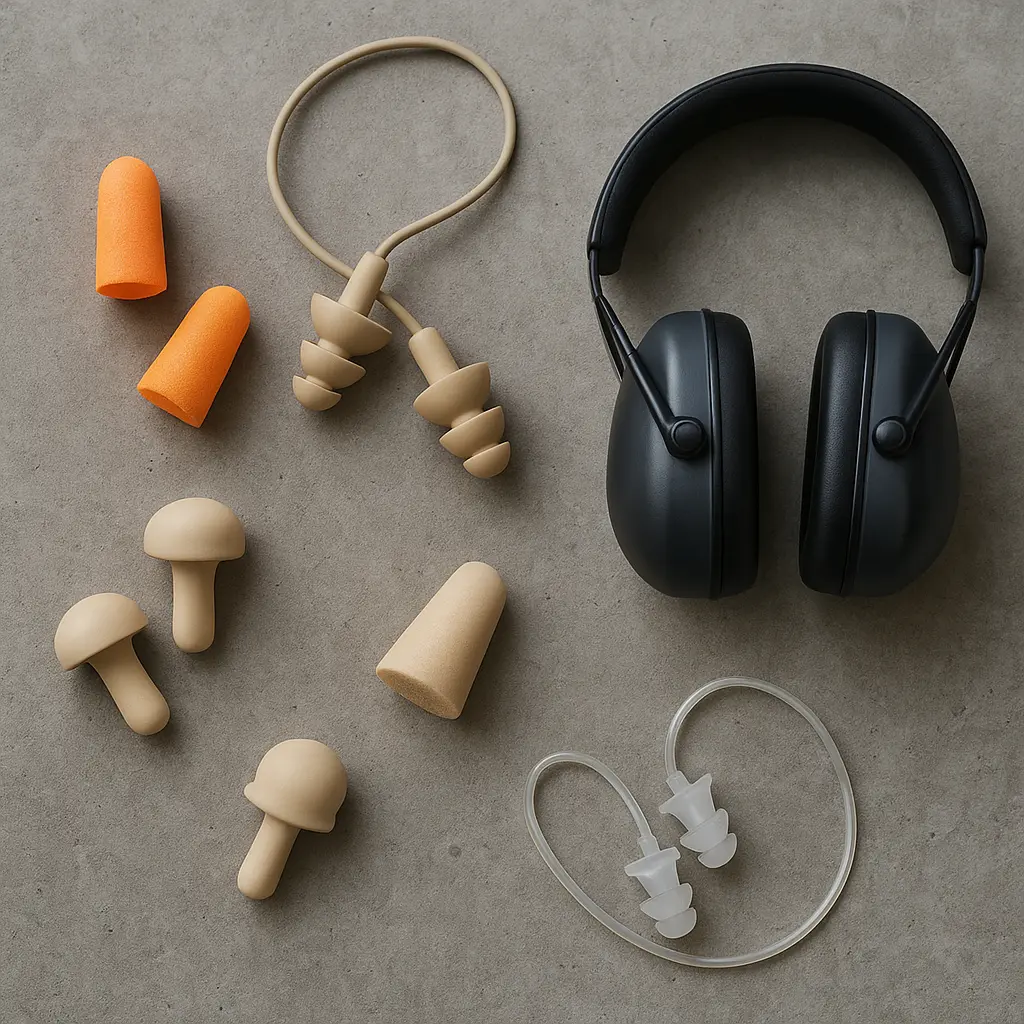
The Noise Reduction Rating (NRR) indicates the maximum noise attenuation in decibels that a hearing protector can provide when worn correctly under laboratory conditions. The EPA requires this rating on all hearing protection packaging. An NRR of 32 dB means the device can reduce noise exposure by 32 decibels in ideal circumstances.
Real-world attenuation falls significantly below labeled NRR due to improper fit, intermittent removal, and degradation over time. OSHA requires employers to derate NRR values when calculating actual protection. For ear plugs, subtract 7 from the NRR and divide by 2. A 32 NRR ear plug provides approximately 12.5 dB real-world reduction using OSHA’s formula: (32-7)/2 = 12.5 dB.
This derating accounts for field conditions but remains controversial. NIOSH studies show that workers who receive proper fit training and use premium materials like memory foam achieve 75-80% of labeled NRR rather than the 50% OSHA assumes. The difference between disposable foam and reusable construction ear plugs with fitted tips often means the difference between adequate and inadequate protection after derating.
To determine if hearing protection is adequate, subtract the derated NRR from the actual noise exposure. If a concrete saw produces 105 dB and a worker uses ear plugs with 32 NRR (12.5 dB real-world protection), their effective exposure is 92.5 dB. This still exceeds the 90 dB permissible exposure limit and requires additional controls or higher-rated protection.
For workplace hearing safety, combining ear plugs with engineering controls like saw blade guards or tool enclosures produces cumulative benefits. A 5 dB reduction from enclosure plus 13 dB from quality ear plugs brings that 105 dB saw down to 87 dB effective exposure, meeting compliance requirements.
Effective construction ear plugs balance three factors: attenuation level, comfort for extended wear, and durability under job site conditions. The selection process starts with documented noise levels from dosimetry, not guesswork. Sites with multiple noise environments need multiple protection options rather than one-size-fits-all approaches.
For concrete work, demolition, and metal fabrication where noise exceeds 100 dB, select ear plugs rated NRR 30-33. For framing, electrical, and plumbing work in the 85-95 dB range, NRR 25-28 provides adequate protection without over-attenuating communication and safety signals. Over-protection creates hazards because workers cannot hear backup alarms, warnings, or equipment malfunctions.
Material composition directly impacts compliance. Standard PVC foam compresses and loses memory within 2-3 insertions, creating gaps that allow noise penetration. Memory foam tips maintain seal integrity through 20+ insertions and conform to individual ear canal geometry. Metal-bodied reusable ear plugs with replaceable memory foam tips deliver consistent NRR performance across 6-8 week replacement cycles.
| Feature | Disposable Foam | Reusable Metal-Body |
|---|---|---|
| NRR Consistency | Degrades after 1-2 uses, requires daily replacement for rated protection | Maintains rated NRR for 6-8 weeks with tip replacement, metal body lasts years |
| Fit Reliability | Varies by compression technique, 40% of users fail to achieve seal | Consistent insertion depth with flanged design, 85% achieve proper fit |
| Cost Per Day | $0.40 for quality foam plugs replaced daily | $0.08 when amortized over tip replacement schedule |
Compliance rates correlate directly with comfort. ATTENU8’s concave aluminium body construction with three tip sizes (XS, S, M) addresses the fit variability that causes workers to remove standard foam plugs during shifts. The difference between 60% and 90% wear consistency over a 10-hour day determines whether hearing conservation programs succeed or fail.
Pro tip: Stock all three tip sizes on-site and require workers to try each size during initial fitting. Ear canal dimensions vary by 40% across populations, and most hearing protection failures stem from wrong-size selection rather than product defects.

Disposable foam ear plugs dominate construction sites because of low upfront cost and zero maintenance requirements. Workers receive a fresh pair daily, use them once, and discard them. This approach prevents hygiene issues and eliminates tracking individual devices. However, the economic and environmental costs accumulate rapidly at scale.
A 50-person construction crew using disposable ear plugs consumes 12,500 pairs annually at $0.30-0.50 per pair, totaling $3,750-6,250 in direct costs. Reusable construction ear plugs require initial investment of $15-25 per worker ($750-1,250 for 50 workers) plus replacement foam tips every 6-8 weeks at $3-5 per set. Annual program cost drops to $1,500-2,000, a 65-80% reduction.
Performance differences matter more than cost for OSHA compliance. Disposable foam achieves rated NRR only when rolled, compressed, inserted while compressed, and held until fully expanded. Field observations show that 55% of workers skip the hold step, creating partial seals that reduce actual attenuation by 8-12 dB. Reusable ear plugs with pre-sized tips eliminate the compression step, improving fit consistency.
Disposable foam degrades when exposed to moisture, dust, and oils. Workers with dirty hands contaminate foam during insertion, reducing expansion and creating bacterial growth risks. Reusable metal-bodied construction ear plugs tolerate job site conditions without performance loss. The aluminium body withstands impacts, temperature extremes, and contamination that destroy foam plugs.
Maintenance requirements favor reusables for permanent site workers and disposables for temporary or subcontractor labor. Sites with consistent crews benefit from issuing individual reusable sets with personal storage cases. Projects with high worker turnover find disposables easier to manage despite higher costs.
An effective workplace hearing safety program extends beyond distributing ear plugs. OSHA requires documented noise exposure assessments, worker notification of exposure levels, hearing protector selection based on attenuation needs, fit testing to verify effectiveness, annual audiometric testing, training, and recordkeeping for the duration of employment plus 30 years.
Noise monitoring must occur whenever processes, equipment, or work practices change. Installing new equipment, changing tool types, or modifying building enclosures all trigger re-assessment requirements. Dosimetry badges worn by representative workers in each job category for full shifts provide the exposure data needed to update hearing conservation programs.
Training content must cover noise sources and levels, hearing protection options and proper use, audiometric testing procedures and result interpretation, and the purpose and requirements of the hearing conservation program. Generic safety meetings fail compliance standards. Training must be job-specific, demonstrate proper ear plug insertion with mirror checks, and document individual worker attendance.
According to NIOSH research, construction workers experience noise-induced hearing loss at rates 2.5 times higher than workers in general industry, making hearing conservation programs essential rather than optional administrative tasks.
Baseline audiograms must be established within 6 months of enrollment in the hearing conservation program. Annual audiograms compare current hearing levels to baseline, identifying standard threshold shifts of 10 dB or more at 2000, 3000, or 4000 Hz in either ear. These shifts trigger follow-up actions including retraining, refitting hearing protection, and medical evaluation.
The data consistently shows that early threshold shifts are reversible with improved protection and reduced exposure. Waiting for workers to report hearing difficulty means permanent damage has already occurred. Annual testing catches deterioration while intervention can still prevent progression.
Pro tip: Schedule audiometric testing during slower project phases when temporary threshold shifts from noise exposure have resolved. Testing immediately after high-noise work produces false positives that complicate record interpretation.
OSHA inspection data reveals recurring hearing protection violations that account for 73% of construction citations. The most frequent failure is inadequate noise monitoring. Sites assume that because ear plugs are provided, compliance is automatic. OSHA requires documented exposure assessments that prove which workers need protection and whether selected devices provide adequate attenuation.
Improper fit testing ranks second. Providing construction ear plugs without verifying that workers achieve proper seal and rated attenuation violates program requirements. Fit testing using field attenuation estimation systems or visual inspection protocols must be documented for each worker using each hearing protector model.
Training documentation failures create citations even when effective programs exist. OSHA requires records showing training date, topics covered, trainer identity, and worker acknowledgment. Sites that conduct training without documentation cannot prove compliance during audits. Annual retraining is mandatory, not optional, because studies show that insertion technique degrades over time without reinforcement.
OSHA hearing protection violations carry serious penalties because hearing loss is permanent and irreversible. Standard violations result in penalties up to $14,502 per violation. Willful or repeated violations reach $145,027. Multi-worker exposures multiply these amounts because each affected employee constitutes a separate violation.
The financial risk extends beyond citations. Workers’ compensation claims for occupational hearing loss cost employers $60,000-120,000 per claim when considering medical costs, wage replacement, and administrative expenses. Prevention through proper OSHA hearing protection programs costs 5-10% of these amounts.
Disposable foam ear plugs must be replaced daily or whenever they become soiled, damaged, or lose their expansion capability. Reusable construction ear plugs with metal bodies last years with proper care, but the memory foam tips require replacement every 6-8 weeks to maintain rated NRR performance. The metal body should be cleaned with mild soap and water weekly. Replace reusable ear plugs immediately if the body cracks, tip attachment points loosen, or tips show tears or compression set.
Yes, but only if the selected ear plugs provide adequate attenuation for the highest noise exposure the worker encounters. Using NRR 32 construction ear plugs rated for 100+ dB environments remains safe in lower 85-90 dB areas, though slight over-protection may occur. The reverse does not work. Ear plugs selected for 85 dB office areas fail to protect adequately in 100 dB demolition zones. Sites with variable noise levels should either provide high-rated protection for all areas or implement task-specific protection with documented changeover procedures.
Proper fit means the hearing protector creates an acoustic seal that delivers the calculated attenuation needed to reduce noise exposure below permissible limits. For ear plugs, this requires full insertion into the ear canal with the tip expanding to contact canal walls without gaps. Visual inspection should show only the plug stem or flange visible outside the ear canal entrance. Quantitative fit testing using field attenuation estimation systems provides objective verification, measuring actual sound reduction achieved by individual workers. OSHA accepts qualitative methods like the user seal check, where workers listen for voice or snap reduction with protectors inserted versus removed.
Yes, reusable construction ear plugs with metal bodies and memory foam tips meet OSHA requirements provided they achieve the necessary NRR for documented noise exposures and workers are properly fitted and trained in their use. ATTENU8’s aluminum-bodied ear plugs with 32 dB NRR and three tip sizes qualify for hearing conservation programs across all construction environments. The durable metal construction and replaceable tips maintain consistent attenuation performance superior to degraded disposable foam. OSHA regulations specify performance requirements, not product types, so any hearing protector that delivers adequate, documented attenuation complies with standards.
Start with the measured noise exposure level in decibels from dosimetry. Subtract the derated NRR of your hearing protector using OSHA’s formula: (NRR-7)/2 for ear plugs. If the result is 90 dB or less, protection is adequate for the 8-hour permissible exposure limit. If exposure is 85-90 dB, you meet the action level requirements for hearing conservation programs. For example, 105 dB saw noise with NRR 32 ear plugs: (32-7)/2 = 12.5 dB reduction, resulting in 92.5 dB effective exposure. This exceeds 90 dB, requiring additional controls or higher-rated protection. Always calculate using actual measured noise levels, not equipment specifications or estimates.
OSHA requires training that covers the effects of noise on hearing, the purpose and advantages of hearing protectors, the selection and fitting of appropriate protection, proper use and maintenance procedures, and the purpose and procedures of audiometric testing. Training must be job-specific and include hands-on demonstration of insertion techniques for the actual ear plugs workers will use. Workers must demonstrate proper insertion and achieve documented fit. Training must occur at enrollment in the hearing conservation program and annually thereafter. Generic safety meetings or video-only training do not satisfy requirements. Documentation must include date, attendees, trainer, topics covered, and worker acknowledgment signatures.
What has your experience been with maintaining hearing protection compliance on active construction sites, and which obstacles have proven most challenging?
