


 0
0

Roughly 30% of adults report difficulty sleeping due to noise, yet most people grabbing foam ear plugs off a pharmacy shelf have no idea they are choosing between materials with dramatically different noise reduction profiles, comfort levels, and long-term costs. Memory foam ear plugs dominate the market, but silicone and wax each have genuine strengths that make them the right choice in specific situations. This guide cuts through the marketing noise and tells you exactly which material wins for sleep, why the others fall short in particular scenarios, and what to consider if you need something built to last longer than a single night.
| Key Insight | Explanation |
|---|---|
| Memory foam delivers the highest NRR for sleep | A correctly inserted memory foam plug achieves 29-33dB noise reduction, outperforming silicone and wax in controlled tests. |
| Wax moulds well but degrades quickly | Wax conforms to the ear canal shape but picks up debris, loses adhesion within a few uses, and cannot be properly cleaned. |
| Silicone is the best choice for occasional poolside or travel use | Silicone repels water and is easier to clean, but its rigid body reduces acoustic sealing compared to compressed foam. |
| Insertion technique changes everything for foam | A poorly inserted memory foam plug drops from 32dB to under 15dB of effective attenuation, making technique as important as material. |
| Single-use foam is expensive and wasteful long-term | A regular user discards 52 or more pairs per year from disposable foam, while a reusable metal-bodied plug with replaceable tips costs a fraction of that over 12 months. |
| Ear canal size is the most underrated fit variable | Most packaged ear plugs include only one tip size. Plugs that offer XS, S, and M foam tip options consistently report higher comfort and retention through the night. |
| Side sleepers need a low-profile body | Bulky silicone flanged plugs press against pillows and create discomfort within an hour. A compact, concave body design minimises this pressure point. |
Understanding what each material physically does inside your ear canal explains why performance varies so widely between types.
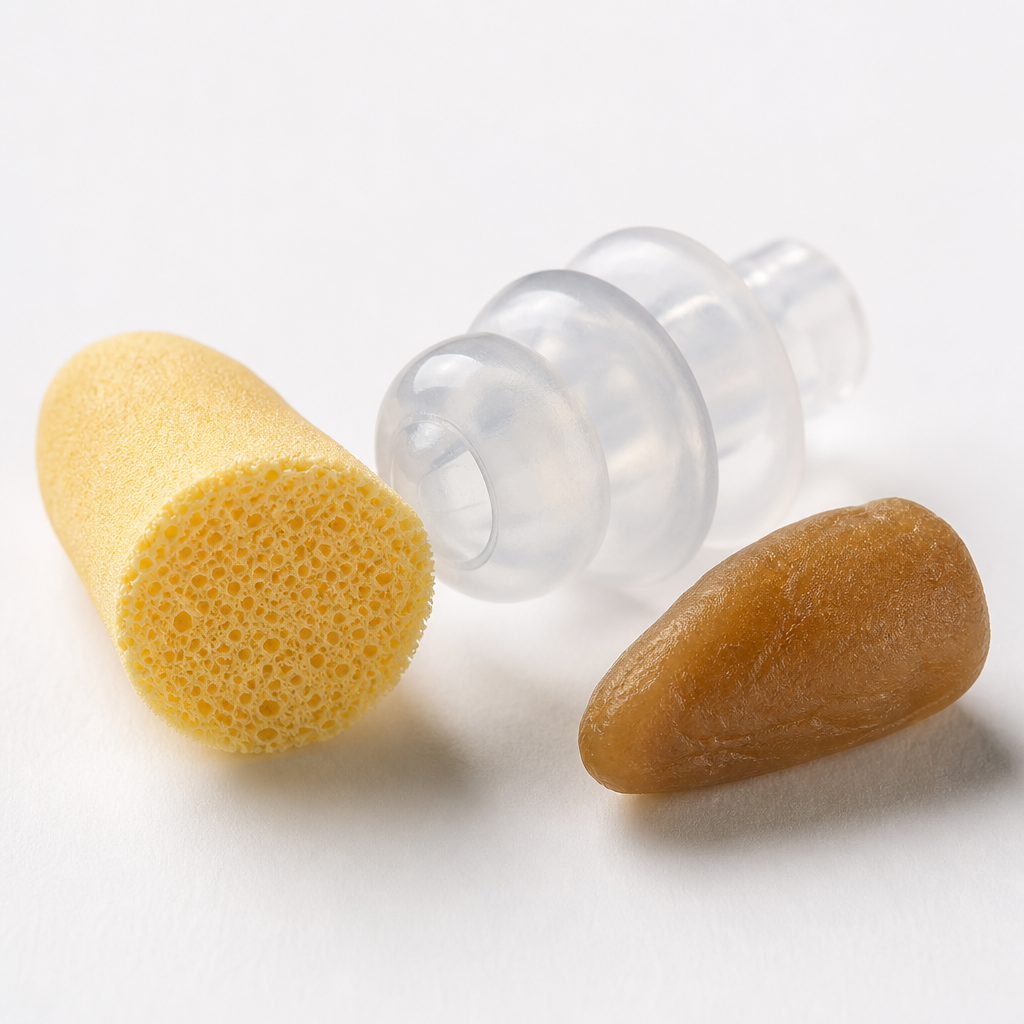
Memory foam ear plugs use slow-recovery polyurethane foam. You compress the plug between your fingers, insert it into the ear canal, and the foam slowly expands to fill the canal’s unique geometry. This expansion is the source of its acoustic advantage: the material conforms to the specific contours of your ear rather than approximating a seal. The result is a genuine acoustic barrier rather than a rough approximation of one.
The limitation is that the foam cell structure absorbs skin oils, earwax, and bacteria over time. Disposable versions become unhygienic after one or two uses. Premium reusable versions, like those from ATTENU8, solve this by housing the foam tip inside a cleanable aluminium body and offering tip replacements every 6-8 weeks rather than replacing the entire unit.
Silicone ear plugs come in two forms: pre-moulded flanged plugs with a fixed shape, and mouldable silicone putty that you flatten over the ear opening. Flanged silicone does not enter the ear canal the way foam does. It sits at the entrance, which limits its noise reduction ceiling. Mouldable silicone putty gets closer to canal-conforming performance but still lacks the pressure-recovery behaviour of memory foam.
Silicone’s real advantage is water resistance. It does not absorb moisture, which matters for swimming, travel, or humid climates. It is also more durable per unit than foam and can be rinsed repeatedly without material degradation.
Wax ear plugs, typically made from petroleum wax or beeswax blended with cotton, are mouldable and self-adhering. You warm the wax between your palms, roll it into a ball, and press it over the ear canal opening. Like mouldable silicone putty, wax does not enter the canal but creates an external seal. The adhesive quality means it stays in place reasonably well during sleep, which is its primary appeal.
In practice, wax accumulates lint, hair, and debris from the first use onward. It cannot be cleaned without losing its structural integrity. Most manufacturers recommend a maximum of two or three uses per plug, making it one of the most wasteful ear plug options available.
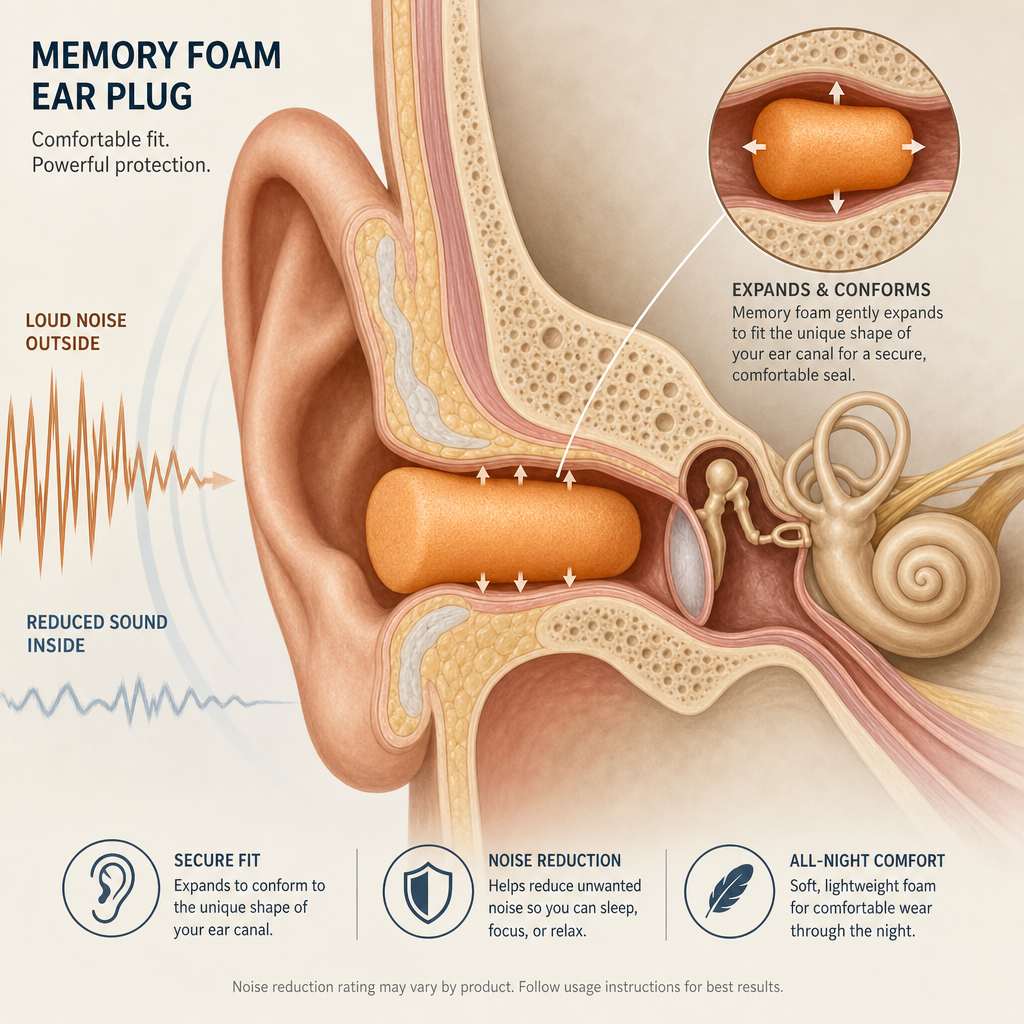
The Noise Reduction Rating (NRR) is the standardised US measure of how many decibels an ear plug attenuates under laboratory conditions. The real-world figure is typically 50% of the listed NRR, according to OSHA’s recommended field correction method. This is where material choice becomes critical for light sleepers.
Correctly inserted memory foam plugs regularly achieve NRR 29-33. After the OSHA field correction, that is roughly 14-16dB of real-world attenuation, which is enough to reduce a snoring partner (approximately 60dB) to something closer to a quiet conversation. ATTENU8’s design targets approximately 32dB NRR, placing it at the high end of the memory foam category. The concave aluminium body also helps users insert the foam tip at the correct depth consistently, which is a design advantage that generic foam cylinders do not offer.
Flanged silicone ear plugs typically achieve NRR 25-27. Mouldable silicone putty plugs generally rate lower, in the NRR 22-25 range, because the external-only seal is inherently less efficient. For moderate noise environments (office air conditioning, light traffic) silicone is adequate. For sleep beside a loud snorer or near a street with heavy vehicle traffic, the gap between silicone and quality memory foam becomes noticeable within the first hour.
Wax plugs typically rate NRR 22-25. The external seal is comparable to mouldable silicone putty in laboratory conditions, but wax degrades between uses, meaning the second and third use of the same plug performs measurably worse than the first. The data consistently shows that wax provides inferior noise reduction compared to well-inserted memory foam across every measured decibel range relevant to sleep noise.
Pro tip: When comparing ear plug NRR ratings, divide the listed number by two to estimate real-world performance. A plug rated NRR 32 provides roughly 16dB of practical noise reduction, not 32dB. Use this calculation to set realistic expectations before purchase.
Noise reduction is irrelevant if you remove the plug at 2am because it is causing ear pain. Comfort during sleep is a more complex requirement than comfort during, say, a concert, because you are lying down for 6-8 hours and changing positions repeatedly.
Standard cylindrical foam plugs create a uniform pressure inside the canal regardless of the individual’s anatomy. For some users, this causes a dull ache after 2-3 hours, particularly in narrower ear canals. A common mistake is choosing the largest available foam plug on the assumption that bigger means better attenuation. Oversized plugs create excessive radial pressure and almost always result in removal during the night.
Memory foam tips in multiple sizes solve this directly. ATTENU8’s system includes XS, S, and M tips precisely because ear canal diameter varies significantly between individuals. Fitting the correct size reduces canal pressure while maintaining the acoustic seal.
Side sleeping introduces a mechanical problem that is rarely discussed in ear plug reviews: the pillow exerts lateral force on anything protruding from the ear. Flanged silicone plugs with their multi-layered fin structure create the most pillow resistance. Standard cylindrical foam plugs that protrude significantly also press inward when a pillow pushes against them, which can cause the plug to migrate deeper into the canal overnight, an uncomfortable and occasionally risky outcome.
A low-profile, concave-bodied metal plug sits flush or recessed against the ear, dramatically reducing pillow contact. This is not a minor comfort preference. For dedicated side sleepers, it is often the difference between sleeping through the night with plugs in and waking up to remove them.
Wax and mouldable silicone both sit at the ear entrance rather than inside the canal, which means they avoid canal pressure entirely. This is comfortable initially, particularly for users with sensitive ear canals. The downside is that external-only plugs shift with jaw movement during sleep and lose their seal more easily than in-canal designs. Users who talk or clench their jaw during sleep report noticeably poorer retention with wax and silicone putty.

The hidden cost of cheap ear plugs is not the purchase price. It is the cumulative expense and waste of constant replacement, plus the hygiene risk of reusing degraded materials.
A pack of 50 disposable foam pairs costs roughly $10-15 USD. A person using ear plugs every night exhausts that pack in 25 nights. Over one year, they spend $146-219 USD and discard over 700 individual foam plugs. The polyurethane foam in most disposable plugs is not recyclable. This is an environmental and financial inefficiency that is easy to overlook when buying individual packs.
Wax accumulates debris and loses cohesion rapidly. Most wax plug manufacturers acknowledge a useful life of one to three uses. There is no cleaning method that restores a wax plug to its original performance. For anyone using ear plugs more than occasionally, wax is the most expensive option per effective use when you account for how quickly each unit degrades.
Pre-moulded silicone flanged plugs are the most durable single-unit option. They can be washed with soap and water, dried, and reused for months before the flange structure shows meaningful wear. This makes them economically sensible for infrequent use. The problem is that their acoustic performance ceiling remains lower than well-inserted memory foam, so the longevity advantage does not compensate for the noise reduction gap if your primary need is sleep in a genuinely noisy environment.
The design philosophy behind ATTENU8’s metal-bodied system addresses the core problem with disposable foam directly. The aluminium body is permanent and cleanable. The memory foam tips are replaced every 6-8 weeks rather than after every use. This maintains the acoustic performance of fresh foam while eliminating the waste and cost of full-unit disposal. Over a year of nightly use, the cost per effective use is significantly lower than any disposable foam option, and the noise reduction performance remains consistently at the top of what the material category can deliver.
Pro tip: Clean the aluminium body of a metal-bodied ear plug weekly using a cotton swab lightly dampened with isopropyl alcohol. This prevents earwax buildup in the body cavity without damaging the metal finish and extends the interval between tip replacements.
| Feature | Memory Foam (e.g., ATTENU8 reusable) | Silicone (flanged, pre-moulded) | Wax (petroleum or beeswax) |
|---|---|---|---|
| Typical NRR | 29-33dB | 25-27dB | 22-25dB |
| Seal type | In-canal, conforming | Canal entrance, fixed flange | External, adhesive |
| Side sleeping comfort | High (low-profile body) | Low (flange protrudes) | Moderate (flat but shifts) |
| Hygiene / cleanability | High (cleanable body, replaceable tips) | High (washable) | Poor (cannot clean without destroying) |
| Usable life per unit | 6-8 weeks per tip, body is permanent | Several months with care | 1-3 uses maximum |
| Annual cost (nightly use) | Low (tip replacements only) | Low-moderate | Very high |
| Water resistance | Low (foam absorbs moisture) | High | Moderate |
| Best use case | Nightly sleep, noise-sensitive users | Swimming, occasional travel | One-off use, travel emergencies |
The right material depends on the specific problem you are solving. Here are the clear-cut recommendations based on use case rather than marketing claims.
Memory foam is the correct answer here, and specifically a reusable version with multiple tip size options. The NRR advantage over silicone and wax is meaningful at the noise levels produced by snoring (50-80dB) and street traffic (60-85dB). The conforming seal also handles low-frequency sound better than external-seal alternatives, and low frequencies are precisely where snoring and traffic noise concentrate.
Workers in loud environments often need hearing protection that doubles as a sleep aid during irregular daytime sleep. Memory foam at NRR 32 meets OSHA’s recommended protection threshold for most industrial noise environments. The durability and hygiene of a metal-bodied reusable system also matters in this context because workers cannot always maintain a pristine storage environment for foam tips. A plug you can wipe clean and reuse reliably is practically superior to disposable alternatives on a job site.
Silicone flanged plugs are a reasonable choice for someone who needs ear plugs a few times a month for flights or hotel stays. They travel well, do not compress oddly in a bag, and can be rinsed after use. For this user, the lower NRR relative to foam is an acceptable trade-off given the lower frequency of use.
This group should avoid wax entirely. Wax debris left in the canal from a degrading plug is a documented contributor to external ear canal irritation. Silicone or a properly fitted, correctly sized memory foam tip is the better choice. Fitting the right tip size is non-negotiable: an oversized foam tip causes canal abrasion, and an undersized one loses its seal, defeating the purpose entirely.
“Noise-induced hearing loss is 100% preventable, but once it occurs, it is permanent. The choice of hearing protection should be based on fit, comfort, and correct noise reduction rating for the environment, not convenience alone.” – National Institute for Occupational Safety and Health (NIOSH), hearing loss prevention guidelines.
Most material comparisons stop at the tip and ignore the body entirely. This is a significant oversight for anyone buying ear plugs intended for regular, long-term use.
A disposable foam plug has no body separate from the tip. The entire unit is the acoustic material, which means the same material doing the acoustic work is also being compressed, handled, stored loose in a drawer, and eventually discarded. There is no structural component to ensure consistent insertion depth, no housing to protect the foam from contamination between uses, and no mechanism to separate hygiene management of the outer surface from the acoustic performance of the core material.
ATTENU8’s approach separates these functions deliberately. The aluminium body handles insertion geometry (the concave shape naturally positions the tip at the correct canal depth), durability (metal does not degrade from handling), and outer surface hygiene (metal can be cleaned without damage). The memory foam tip handles the acoustic work and is replaced on a schedule that maintains performance without replacing the entire unit. This is the same logic applied in the design of precision instruments: the housing and the working component have different maintenance cycles because they have different wear rates.
Competitors in the premium ear plug space like Flare Audio and Loop have moved toward reusable designs, but their approaches use silicone tips or solid acoustic channel designs rather than memory foam. This gives them a durability advantage over disposable foam but caps their noise reduction ceiling below what a correctly inserted memory foam tip achieves. For users whose primary need is maximum noise attenuation during sleep rather than a lifestyle accessory, the acoustic physics of conforming foam remain the strongest argument for the material category.
Yes, provided you use the correct tip size and replace the foam tips regularly. The risk with nightly foam ear plug use comes from hygiene neglect rather than the material itself. Old, oil-saturated foam tips can harbour bacteria and contribute to external ear canal irritation. Replacing tips every 6-8 weeks and keeping the body clean eliminates this risk. Users who experience recurring ear discomfort should check tip size first, as oversized tips cause canal abrasion over time.
Technically yes, but wax is not the best choice for side sleepers. Wax plugs sit at the ear entrance and are held in place by light adhesion. When you roll onto your side and rest your ear against a pillow, the lateral pressure disrupts the wax seal and often dislodges the plug partially. The noise reduction benefit disappears when the seal breaks. Memory foam with a low-profile body is significantly more stable for side sleeping.
Silicone flanged plugs sit at the entrance of the ear canal rather than inside it. This reduces the pressure sensation inside the canal, which many users interpret as comfort. But the acoustic seal formed at the canal entrance is less complete than a seal formed by a material that expands to fill the canal’s full cross-section. The foam’s in-canal conforming expansion is less immediately comfortable for some users but produces a measurably tighter acoustic barrier, which is what delivers the higher NRR.
Correct insertion produces a noticeable muffling effect within 10-15 seconds of insertion as the foam expands. If you can hear ambient noise at roughly the same level as before insertion, the plug has not sealed. The most common mistakes are not compressing the foam fully before insertion, releasing the plug before it reaches the correct depth in the canal, and inserting without pulling the outer ear upward and back to straighten the canal. This last step is the one most people skip, and it accounts for a large proportion of poor foam plug performance.
Not necessarily. A very high NRR can create a sensation of pressure or fullness that some users find disruptive to sleep. It can also make it difficult to hear an alarm clock or safety alert in the morning. The goal is attenuation sufficient to bring the ambient noise in your sleep environment below the threshold that disrupts sleep onset, roughly 40dB or lower. For most urban sleep environments, an NRR of 28-32 achieves this without over-attenuating. Custom or professional-grade plugs exceeding NRR 33 are typically unnecessary for home sleep use.
A reusable metal-bodied plug with replaceable foam tips is more hygienic than disposable foam in practice, provided the user follows the recommended cleaning and replacement schedule. The reason is counterintuitive: people tend to replace disposable foam plugs less frequently than recommended because they feel wasteful throwing away a plug that still looks intact. A scheduled tip replacement system removes that psychological barrier and ensures the acoustic material is always within its hygiene window.
Have you tried more than one type of ear plug material for sleep, and which worked best for your specific situation? Share your experience in the comments below.

