


 0
0

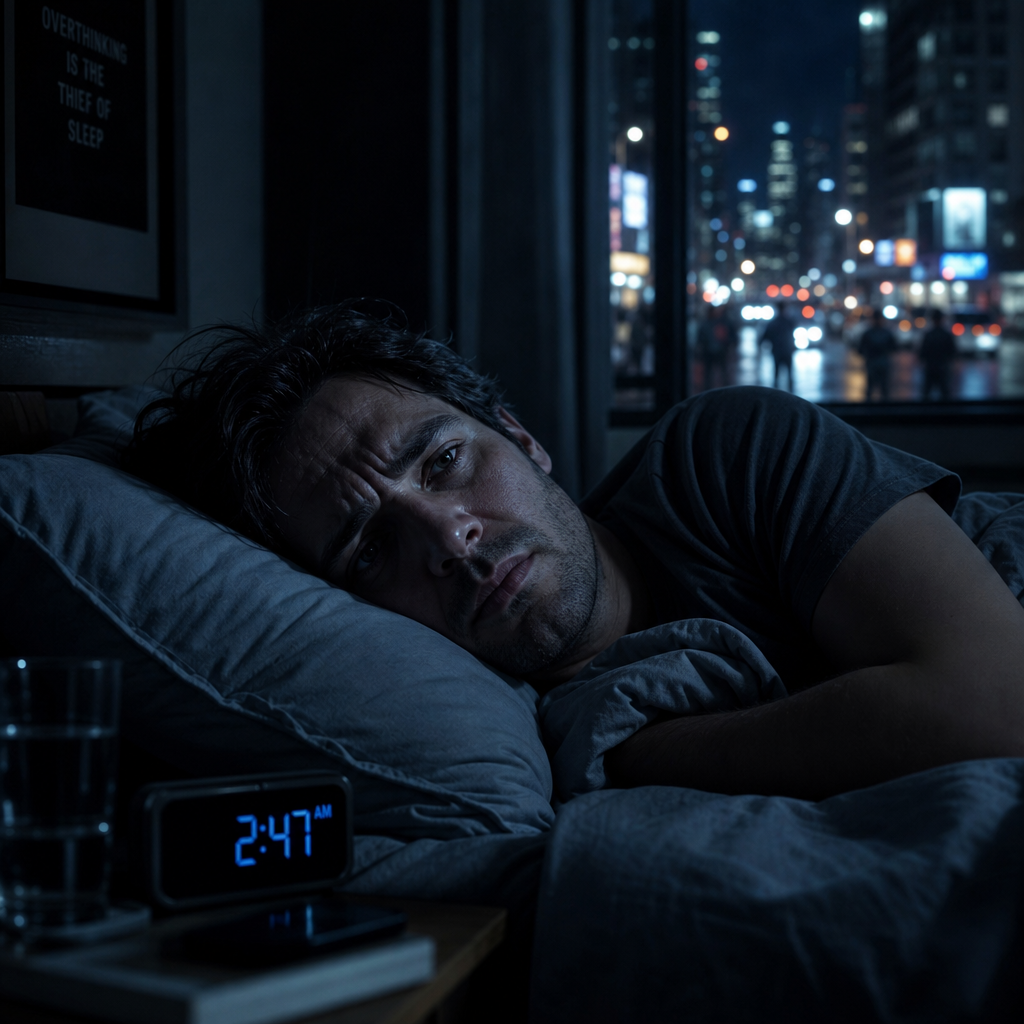
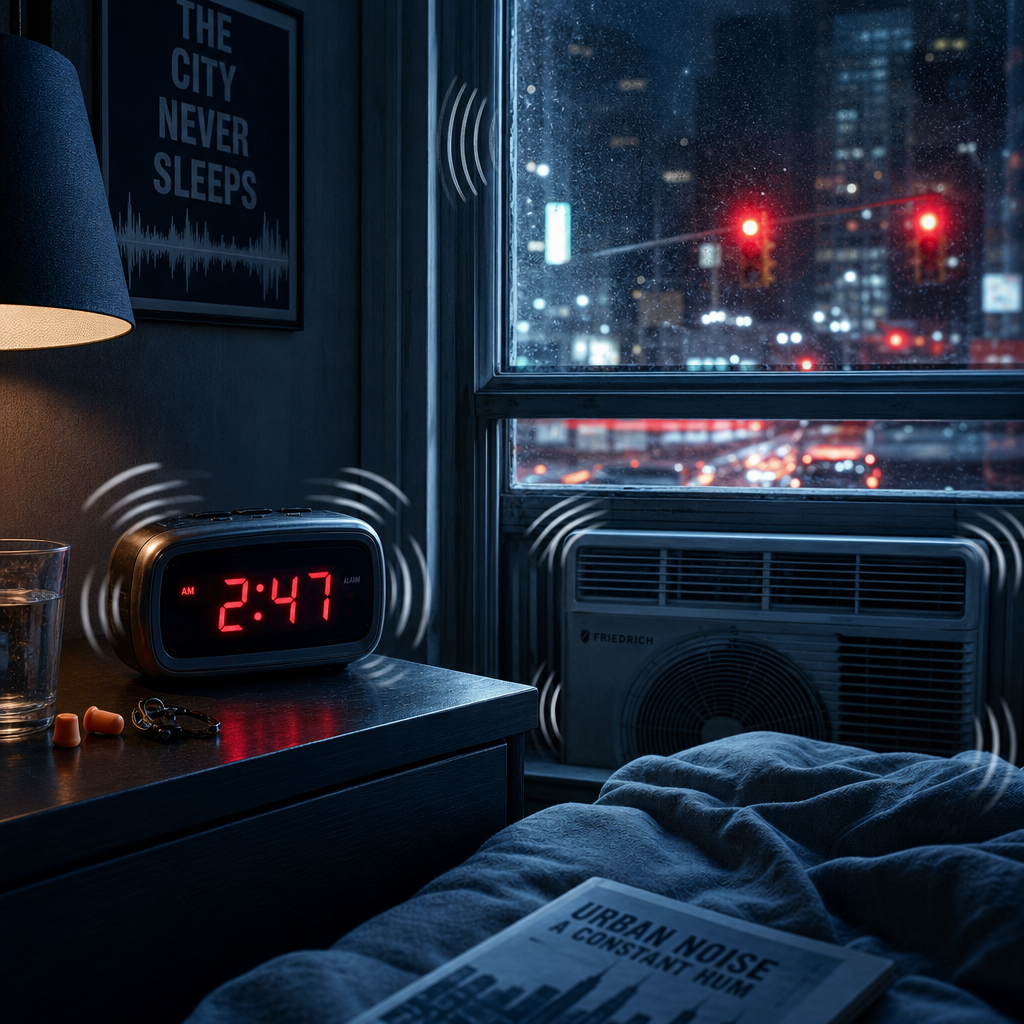
If you live in a city and wake up exhausted, urban noise pollution sleep disruption is almost certainly a contributing factor. The World Health Organization estimates that environmental noise causes at least one million healthy life years lost annually in Western Europe alone, with sleep disturbance ranking as the most damaging effect. Traffic rumble at 2 AM, a neighbour’s air conditioning unit, a garbage truck at 5 AM – none of these need to wake you fully to do serious damage. They fragment your sleep architecture in ways you may never consciously notice but will absolutely feel the next day.
| Key Insight | Explanation |
|---|---|
| 40 dB is the sleep disruption threshold | The WHO identifies 40 dB as the nighttime noise level above which sleep quality measurably deteriorates. City ambient noise frequently exceeds 55-65 dB. |
| You don’t need to wake up to be harmed | Noise events below full waking threshold still trigger cortisol spikes, heart rate increases, and micro-arousals that shorten deep sleep stages. |
| Deep sleep and REM are the most vulnerable stages | Intermittent city noise specifically suppresses slow-wave sleep and REM, the two stages most critical for physical recovery and memory consolidation. |
| Traffic noise is the worst offender | Road traffic noise affects more urban residents than any other noise source and is strongly linked to cardiovascular disease risk in people with chronic sleep disruption. |
| 32 dB attenuation changes the equation | Ear plugs with a Noise Reduction Rating of 32 dB can bring a 65 dB city environment down to a tolerable 33 dB, well within restorative sleep range. |
| Reusable metal-bodied ear plugs outperform disposable foam long-term | Disposable foam plugs degrade in noise reduction performance after a single use. Premium reusable options with replaceable memory foam tips maintain consistent attenuation over months of nightly use. |
| Comfort determines compliance | The best ear plug is the one you actually keep in all night. Concave ergonomic designs with multiple tip sizes dramatically improve overnight retention compared to standard cylindrical foam plugs. |
The brain does not fully shut down during sleep. It continues processing auditory signals, and when those signals are loud or unpredictable enough, it triggers a stress response even if you stay technically asleep. This is the mechanism that makes city noise sleep problems so insidious. You go to bed, you fall asleep, and you think everything is fine. But your autonomic nervous system has been quietly fighting traffic noise all night.
Research published through the European Environment Agency shows that nocturnal noise causes measurable increases in blood pressure, heart rate variability, and adrenaline secretion, all while the sleeper remains unconscious. A single night of this is manageable. Years of it in a city apartment are associated with significantly elevated risks of hypertension, type 2 diabetes, and cardiovascular disease.
The sleep architecture damage is specific and predictable. Noise events during slow-wave sleep (stages 3 and 4) cause the brain to retreat to lighter sleep stages. Because the body cycles through sleep stages roughly every 90 minutes, a single loud truck at 3 AM can cost you an entire slow-wave sleep cycle for the night. Do this repeatedly across weeks and months, and the cumulative cognitive and physical deficit becomes substantial.
Pro tip: If you wake up consistently between 3 AM and 5 AM feeling unrested but cannot identify a clear cause, noise-triggered micro-arousals are almost certainly the culprit. City garbage collection, early delivery vehicles, and street cleaning machines operate heavily in these hours.
Cortisol is your primary stress hormone, and it operates on a strict circadian schedule. Normally, cortisol levels are at their lowest between midnight and 2 AM, then begin rising gradually to support morning waking. Unpredictable noise events at night spike cortisol out of sequence, which disrupts this natural rhythm and makes it harder for the body to return to deep sleep after disturbance.
In practice, this means a person sleeping in a noisy city apartment may produce cortisol at 1 AM in a pattern that more closely resembles a stress response than restorative rest. Over time, chronically elevated nocturnal cortisol is linked to immune suppression, weight gain, and accelerated cognitive decline.
The WHO’s 2018 Environmental Noise Guidelines for the European Region set outdoor nighttime noise limits at 45 dB, with 40 dB identified as the level below which the majority of the population is protected from serious sleep disturbance. For context, a quiet library measures around 30 dB. A normal conversation is 60 dB. A city street at night typically measures between 55 dB and 75 dB depending on location and time.
Most urban bedrooms, even with windows closed, receive ambient noise levels of 45 dB to 60 dB. This is consistently above the WHO’s protective threshold. A building facade and closed windows typically provide 20 dB to 30 dB of sound attenuation. That brings a 70 dB street into a 40 dB to 50 dB bedroom, still squarely in the zone where noise and sleep quality are meaningfully compromised.
This is where targeted hearing protection with a genuine Noise Reduction Rating becomes important. Ear plugs rated at 32 dB NRR, used correctly with a proper fit, can bring that 50 dB bedroom environment down to approximately 18 dB, which is quieter than a whisper and well within the range for uninterrupted sleep.
“Environmental noise is increasingly recognized as not only an annoyance but a significant public health problem, with sleep disturbance identified as the most critical health effect at low to moderate noise levels.” – World Health Organization Environmental Noise Guidelines, 2018
Not all city noise is equal in terms of sleep disruption. The type, frequency, and predictability of a noise source each affect how severely it fragments sleep. Understanding this matters because different noise sources require different mitigation strategies.
Road traffic noise is the dominant urban noise source and the one most studied in relation to sleep health. Its damage comes less from individual loud events and more from the continuous low-frequency rumble that keeps the auditory cortex partially alert all night. Even at 50 dB, sustained traffic noise reduces slow-wave sleep duration and produces more frequent cortisol responses than complete quiet.
People who live near highways or major arterials frequently report feeling unrested despite logging adequate total sleep time. This is consistent with the research: sleep duration is not the same as sleep quality, and traffic noise preferentially degrades quality while leaving duration intact enough that sufferers often blame other factors entirely.
Sporadic loud events, a car horn, a neighbour’s door slamming, a motorcycle accelerating, produce a sharper and more damaging sleep disruption pattern than continuous noise. The brain’s threat-detection system responds to sudden acoustic changes more vigorously than to steady-state background noise. A single 80 dB impulse noise event can produce a full cortical arousal that takes 20 to 30 minutes of lighter sleep before the body re-enters deep sleep.
For light sleepers particularly, this type of intermittent city noise is the primary driver of poor sleep quality. Ear plugs with consistent, high NRR attenuation are especially effective here because they reduce the peak amplitude of these events below the arousal threshold without requiring the sleeper to do anything active.
Pro tip: If you are a light sleeper living above a busy intersection, prioritise attenuation over everything else. A 32 dB NRR ear plug that fits well and stays in place all night will do more for your sleep than a white noise machine alone, because white noise masks frequency-specific sounds inconsistently and at the cost of adding its own noise floor.
There are three main approaches city dwellers use to address noise and sleep quality. Each has legitimate use cases, but their effectiveness varies significantly depending on noise type, budget, and sleep position.
| Approach | Noise Reduction Effectiveness | Practical Limitations for Urban Sleepers |
|---|---|---|
| White Noise Machines | Moderate: masks consistent background noise reasonably well, but struggles with impulse noise above 70 dB | Adds its own noise floor (typically 50-65 dB), requires electricity, does not travel easily, and can disturb partners at effective masking volumes |
| Window Acoustic Treatments (double glazing, acoustic seals) | High: can add 10-20 dB of additional attenuation beyond standard windows, effective across all noise types | Expensive (often $500-$3,000+ per window), requires landlord approval in rental properties, does not help with internal building noise from neighbours |
| High-NRR Reusable Ear Plugs with Memory Foam Tips | Very High: 32 dB NRR at the ear canal level is the most direct and reliable form of personal noise attenuation available without specialist equipment | Requires correct insertion technique and proper tip sizing, may take 2-3 nights of adjustment for new users, not suitable for those who need to hear alarms at full volume |
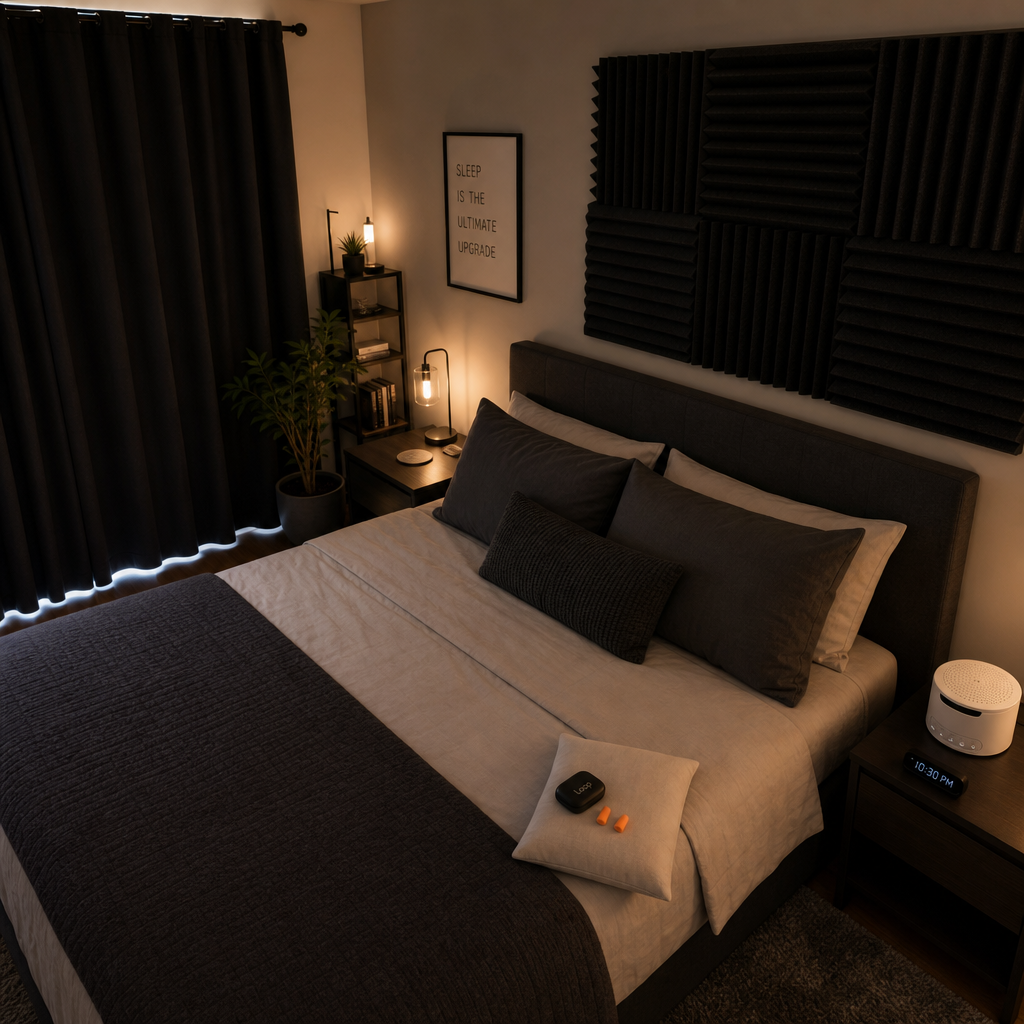
In practice, the most effective approach for the majority of urban sleepers is to combine acoustic ear plugs with at least some passive room treatment such as heavy curtains and door seals. Ear plugs address residual and intermittent noise that room treatment cannot fully eliminate, while room treatment reduces the total noise load that ear plugs need to handle.
The standard single-use foam ear plug is the default solution most people try first. It is cheap, widely available, and rated at up to 33 dB NRR in laboratory conditions. The problem is that laboratory conditions bear no resemblance to nightly city sleep use.
Single-use foam plugs lose a significant portion of their attenuation performance after the first use. The foam cell structure compresses and does not fully recover, meaning the plug expands less completely in the ear canal and seals less effectively. By the third or fourth use of the same plug, you may be getting closer to 20 dB of real-world attenuation rather than the rated 33 dB. Most people reuse them anyway because buying a new pair every night is impractical and expensive at scale.
There is also the comfort problem. Cylindrical foam plugs create pressure points inside the ear canal that become genuinely painful after four to five hours. For someone who needs eight hours of sleep, this means the plug comes out at 2 AM and the remaining hours of sleep are unprotected. The plug that seemed like it worked is only working for half the night.
A premium reusable ear plug with a concave aluminium body addresses both failure modes. The metal core does not degrade in the way foam does. It maintains its shape and dimensional consistency night after night, meaning the memory foam tip sits correctly at the canal entrance every time. The concave shape distributes pressure differently than a cylindrical plug, reducing the canal pressure that causes discomfort during extended wear.
The tip replacement schedule, roughly every six to eight weeks with regular nightly use, is the only maintenance required. This preserves the attenuation performance of the system because fresh memory foam expands fully and seals effectively, while the body itself continues to deliver consistent fit geometry. Over a year of city living, a single pair of quality reusable plugs with periodic tip replacements costs a fraction of the disposable equivalent while delivering more consistent protection.
This is the design philosophy behind ATTENU8 ear plugs: a durable aluminium body with three sizes of replaceable memory foam tips (XS, S, M) to accommodate actual ear canal variation across different users, delivering consistent 32 dB attenuation whether it is your first night or your two hundredth.
Addressing urban noise pollution sleep damage effectively means treating your bedroom as a system rather than addressing one noise source in isolation. Here is a layered approach that reflects how real urban noise behaves.
Heavy, floor-length curtains with a dense woven backing can add 5 to 10 dB of sound reduction on top of standard windows. Acoustic door seals applied to gaps around bedroom doors address internal building noise from hallways, stairwells, and neighbours. These are the cheapest structural interventions and should be the first step for renters who cannot modify windows.
White noise or brown noise at a moderate volume (40 to 45 dB) can reduce the perceptual salience of the traffic rumble that gets through your curtains and seals. It does not eliminate the noise but reduces the contrast between silence and noise events, which is part of what makes the brain trigger arousal responses. Keep the volume conservative. Running white noise at 65 dB to cover 60 dB street noise is simply exchanging one noise problem for another.
This is where ear plugs for city living with proper NRR ratings do their most important work. After layers one and two, you may still have 40 to 50 dB of residual noise in the room. That is still above the WHO’s protective threshold. A 32 dB NRR ear plug fitted correctly to your specific ear canal brings that final figure down to safe, restorative levels. The correct tip size is critical here, which is why access to XS, S, and M tip options matters in practice rather than having a one-size product that fits no one particularly well.
Finding the right tip size takes one or two nights of experimentation. A correctly fitted memory foam tip should expand to fill the canal and feel snug but not pressurised. If you remove the plug in the morning and it is unchanged in shape, it did not expand and seal properly. If your ear canal feels sore at the rim, the tip is too large. The XS option is specifically important for women and people with smaller ear canals who are chronically underserved by one-size foam plug products.
Pro tip: Insert memory foam tips by compressing them fully, reaching over the top of your head with your opposite hand to pull the ear upward and outward to straighten the canal, then inserting and holding for 20 to 30 seconds while the foam expands. This technique improves effective attenuation by an estimated 5 to 8 dB compared to a casual insertion, which is a significant difference in a 65 dB city environment.
For people who work in loud professional environments during the day, such as construction, manufacturing, or industrial settings, and then need genuine recovery sleep at night, this layered approach is not optional. Hearing fatigue and noise-induced stress that begins at a job site does not stop when you leave the workplace. Recovery requires both adequate sleep duration and genuine acoustic quiet, and a noisy city apartment provides neither without active intervention.
The World Health Organization identifies 40 dB as the nighttime outdoor noise limit above which sleep disturbance becomes measurable across the general population. Most urban bedrooms with standard windows experience 45 to 60 dB of ambient noise, consistently above this threshold. Impulse noise events above 55 dB are sufficient to trigger cortical arousal even during deep sleep stages.
Yes, and this is one of the better-supported interventions in sleep research. Studies conducted in hospital settings, which share many acoustic properties with urban environments, consistently show that ear plugs reduce the frequency of nocturnal awakenings and improve slow-wave and REM sleep duration. The key variable is whether the ear plug achieves an adequate seal, which depends on fit quality and correct insertion technique rather than rated NRR alone.
A correctly fitted memory foam tip should feel snug within the ear canal after expanding, without creating pain or pressure at the canal entrance. The sound environment should noticeably mute upon insertion. If you can still hear voices clearly at a normal conversational distance immediately after fitting, the tip has not sealed properly and is either too small, inserted too shallowly, or needs to be held in place longer during expansion. Most people find they need different sizes for their left and right ear, which is normal human anatomy.
This is a legitimate concern and one of the main reasons the body geometry of a reusable ear plug matters. A concave aluminium body that sits flush with or slightly recessed from the ear canal entrance creates significantly less lateral pressure when your ear is pressed against a pillow compared to a plug that protrudes. Most side sleepers who switch from standard foam plugs to a properly fitted reusable option with a low-profile body report substantially better overnight comfort, though the first two to three nights of adjustment are common.
White noise machines and ear plugs address the problem differently and are not equivalent. White noise masks background noise by adding a broadband sound that reduces the perceptual contrast of specific noise events. It is moderately effective for consistent low-frequency traffic noise but struggles with sharp impulse events above 70 dB such as car horns, construction starts, or motorcycles. Ear plugs with 32 dB NRR attenuation physically reduce the amplitude of all incoming sound including impulse events, making them more reliable for the type of intermittent noise that is most disruptive to city sleep architecture. The two approaches are complementary rather than competing.
With nightly use, memory foam ear plug tips should be replaced approximately every six to eight weeks. Signs that replacement is needed include visible surface degradation, a reduction in how snugly the tip expands within the canal, or a noticeable increase in background sound reaching you despite correct insertion. Tip degradation is the primary failure mode for reusable ear plug systems, and regular replacement keeps the effective attenuation close to the original specification rather than allowing gradual performance decline.
Regular ear plug use is safe provided basic hygiene is maintained. Reusable plugs should be cleaned according to the manufacturer’s guidance. The main risks associated with ear plug misuse are ear canal infections from unclean plugs and impacted earwax from plugs pushed too deeply into the canal. A correctly fitted plug sits in the outer portion of the ear canal and does not contact the eardrum. If you experience ear discomfort, itching, or muffled hearing that persists after removing your plugs, consult a physician to rule out wax impaction or infection.
Have you found a noise reduction approach that genuinely transformed your sleep in a city environment? Share your experience in the comments so others can learn from what actually worked for you.

