


 0
0

Noise-induced hearing loss does not announce itself. It builds across years of unprotected exposure to jackhammers, concrete saws, and compressors, until one day you realize you are asking people to repeat themselves constantly. Construction sites routinely generate sound levels above 90 dB, and sustained exposure above 85 dB causes permanent auditory damage. Choosing the right ear plugs for construction workers is not a minor purchasing decision. It is a long-term investment in your hearing health, and the type of plug you choose, how it fits, and how consistently you wear it all determine whether you are actually protected or just going through the motions.
| Key Insight | Explanation |
|---|---|
| Real-world attenuation is lower than the label | Most users achieve only 50 to 70 percent of the labeled NRR in actual field conditions. Proper insertion technique closes most of that gap. |
| 32dB NRR is a strong protection threshold for most construction environments | Sites running jackhammers, grinders, and compressors typically peak between 95 and 110 dB. A 32dB-rated plug brings perceived exposure down to a manageable level when worn correctly. |
| Disposable foam plugs are a hygiene and consistency liability | Dirty hands contaminate disposable foam plugs on every insertion, and workers who rush insertion on a busy site consistently under-seat the plug, reducing effective protection. |
| Memory foam tips outperform standard foam for long shifts | Slow-rebound memory foam conforms to irregular ear canal shapes and reduces pressure fatigue across multi-hour wear, making it the practical choice for full-day industrial work. |
| Tip replacement beats full product replacement | Premium reusable plugs with replaceable foam tips, replaced every 6 to 8 weeks, maintain consistent hygiene and attenuation without the cost of buying new plugs constantly. |
| Ear canal size variation is a real fit problem | A single-size plug leaves a significant proportion of workers with a poor seal. Products offering XS, S, and M tip sizes dramatically improve fit consistency across a workforce. |
| Durable body materials matter in industrial environments | Plastic-bodied reusable plugs crack, warp, and degrade in dirty, high-temperature environments. Metal-bodied plugs survive tool belt and pocket carry without structural failure. |
Walk onto any active construction site and you will find a predictable pattern. There is a box of disposable foam ear plugs somewhere near the site entrance, workers grab them in the morning with hands covered in grease or dust, roll them quickly between two fingers, and shove them in. The plug never fully seats. The seal is inconsistent. By mid-afternoon, the plug has either fallen out, been pulled out because of discomfort, or become so compressed and dirty that it is no longer providing meaningful attenuation.
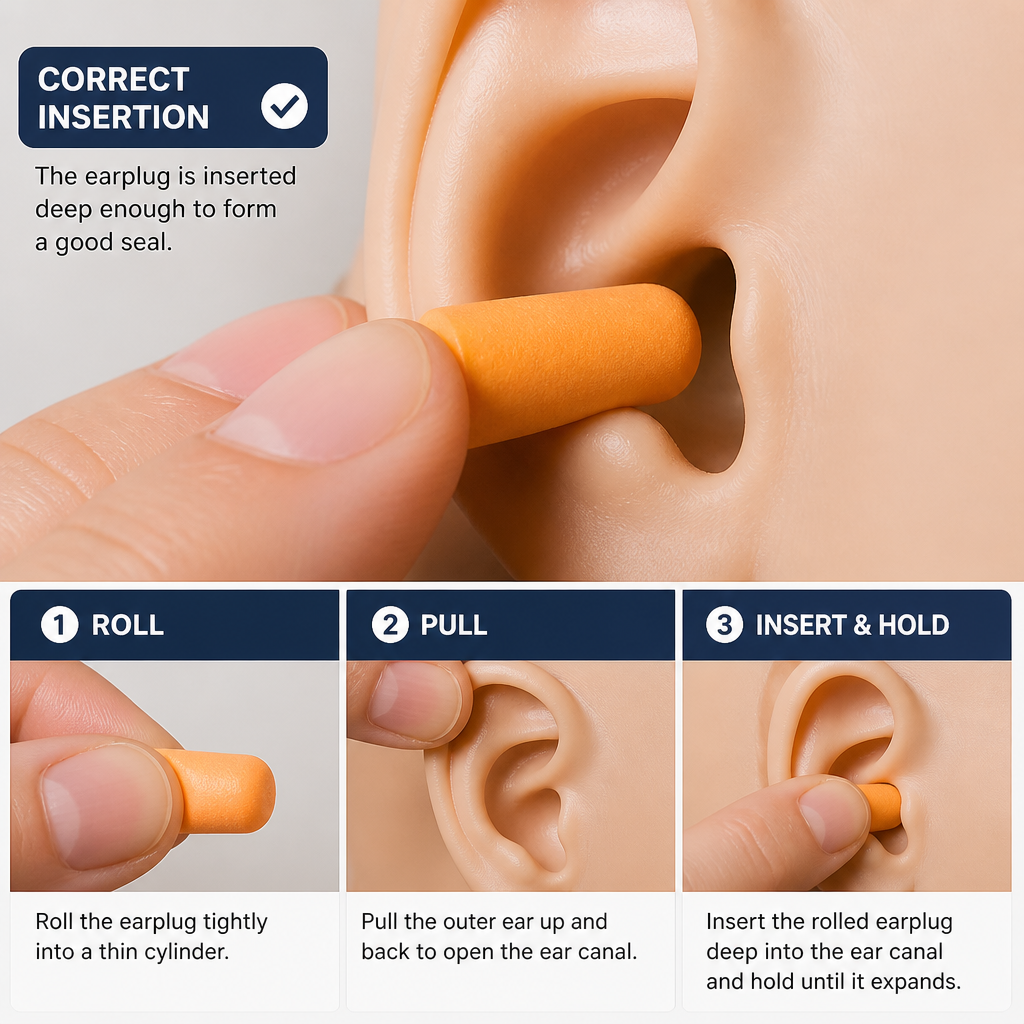
This is not a worker discipline problem. It is a product design problem. Disposable foam plugs were designed for controlled environments with trained users inserting them under supervision, not for fast-moving job sites where workers are putting them in one-handed while carrying equipment. The insertion process for a foam plug, done correctly, requires clean hands, a full roll-down, canal stretching, and a 20 to 30 second hold. That sequence rarely happens in practice.
The consequence is real. High-frequency hearing loss, particularly the kind that begins around 4 kHz, develops slowly and asymptomatically. Workers do not realize the damage is accumulating until it becomes noticeable in conversation. By that point, it is irreversible. Choosing ear plugs for construction workers that are designed to be inserted correctly every time, not just in ideal conditions, is the only approach that delivers consistent protection.

Pro tip: If you manage a crew, look at the plugs people are actually wearing at the end of the day, not what is in the box. A plug that has been worn for 8 hours should show compression and slight discoloration. A clean, barely-compressed plug was not worn properly, if at all.
The Noise Reduction Rating, or NRR, is a standardized laboratory measurement of how much sound a hearing protection device blocks under controlled conditions. In the United States, it is governed by ANSI standards and appears on every certified hearing protection product. A higher NRR means more attenuation in ideal conditions. But the gap between ideal conditions and a real job site is significant, and understanding it changes how you evaluate products.
To estimate real-world noise exposure with ear plugs in place, safety professionals typically halve the NRR value and subtract it from the ambient noise level. So an NRR 33 plug used on a site running at 100 dB would reduce effective exposure to roughly 83 to 84 dB, not 67 dB as the raw number might suggest. The derating accounts for insertion variability, fit inconsistency, and user behavior. Under poor insertion technique, effective protection can drop to as little as 50 percent of the labeled NRR.
A 32dB NRR rating, the level delivered by ATTENU8’s metal-bodied reusable ear plugs, is a serious industrial-grade specification. Properly worn, it brings a 105 dB grinding environment down to around 89 dB effective exposure, and a 95 dB site down to roughly 79 dB. That difference is not trivial. Every 3 dB reduction cuts the sound energy in half. The critical factor, as always, is consistent correct insertion, which is where plug design either helps or hinders you.
The NRR is measured in a lab under ideal insertion conditions. In real industrial settings, most users achieve only 50 to 70 percent of the labeled NRR. Fit consistency is what separates protection from false confidence.
Not all ear plugs are the same product with different branding. The material, design, and fit mechanism each make a meaningful difference in how well a plug works across a full working day in a dirty, demanding environment.
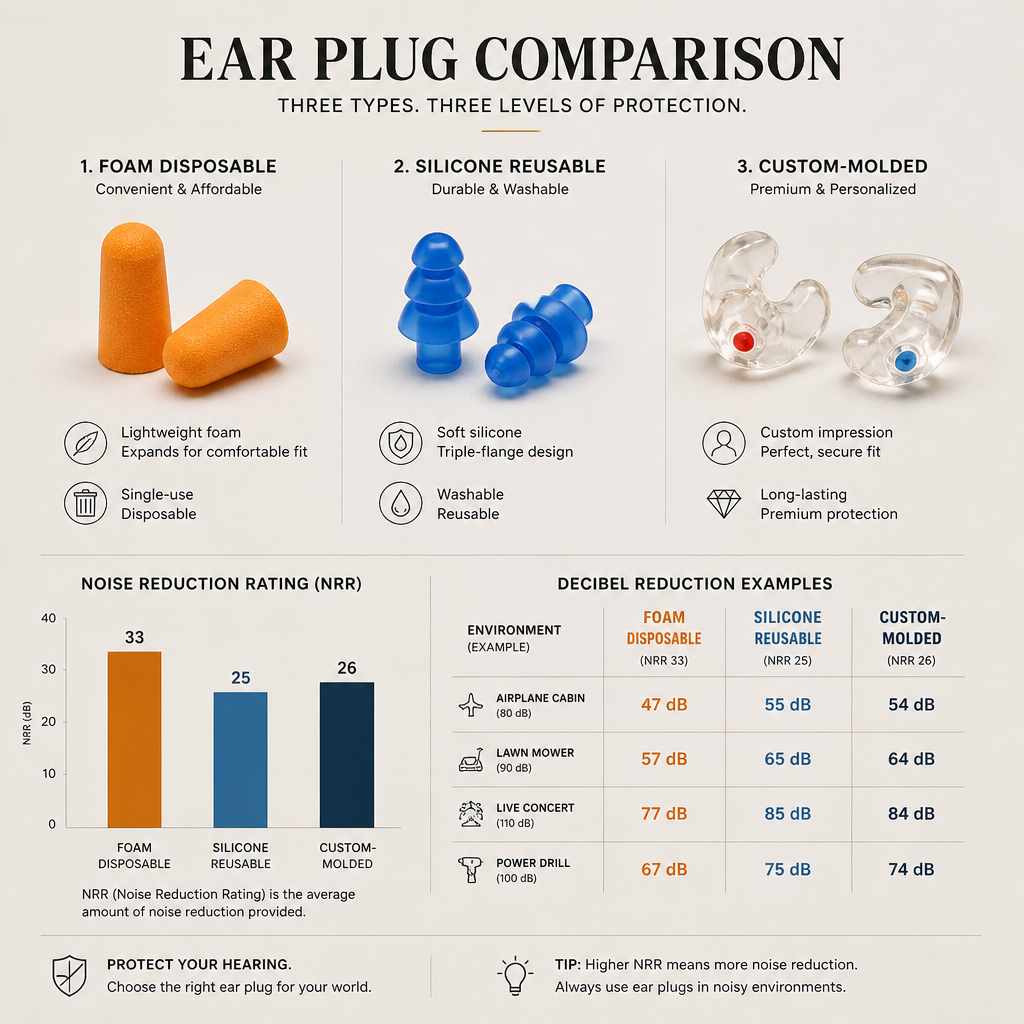
Disposable foam plugs are the most common type on construction sites because they are cheap and available in bulk. Products in this category, including polyurethane foam designs, can achieve high NRR ratings of 33 dB or above in laboratory conditions. The problem is that they require clean, dry hands and careful technique on every insertion, they degrade in hygiene terms quickly in industrial environments, and they create ongoing waste and cost. They are appropriate for occasional use or as backup protection, not as the primary hearing protection strategy for workers logging 8 to 10 hour shifts five days a week.
Reusable silicone and multi-flanged plugs address the hygiene problem by being washable. They do not require a roll-down technique, which makes insertion faster and more consistent. The trade-off is that rigid flanged designs do not conform to irregular ear canal shapes as effectively as foam, and workers with non-standard canal anatomy often report poor seals. NRR ratings for this category typically sit between 23 and 27 dB, which is adequate for moderate noise environments but may fall short for the loudest construction tasks.
This is the category where design sophistication closes the gap between laboratory performance and real-world protection. A rigid metal body, such as the concave aluminium construction used in ATTENU8 ear plugs, protects the foam tip from compression damage during storage and carry. The memory foam tip conforms to the individual ear canal shape and maintains that seal across hours of wear. Tip replacement every 6 to 8 weeks keeps hygiene consistent without replacing the entire product. Multiple tip sizes, typically XS, S, and M, solve the fit problem for workers with non-standard anatomy. This is the right choice for professionals who need reliable, daily hearing protection in manufacturing and construction.
Pro tip: When issuing ear plugs to a crew, provide at least two tip size options. Forcing every worker into a medium-sized tip is the single fastest way to ensure a significant proportion of them are getting a poor seal, even if they do not realize it.
| Factor | Disposable Foam (e.g. GOL-SIV NRR 33) | Reusable Silicone (e.g. Klein Tools 605036) | Premium Metal-Bodied Memory Foam (e.g. ATTENU8) |
|---|---|---|---|
| NRR Rating | Up to 33 dB (lab conditions) | 25 dB typical | 32 dB |
| Insertion Consistency | Poor. Requires careful technique every time. | Moderate. No roll-down needed but flanges vary by canal shape. | High. Memory foam conforms and self-seals with light pressure. |
| Hygiene Over Time | Single use. Disposed after each wear. | Washable but plastic body degrades over time. | Replaceable foam tips every 6 to 8 weeks. Metal body is cleanable and durable. |
| Long-Shift Comfort | Pressure buildup after 2 to 3 hours is common with dense foam. | Flanges can cause discomfort during extended wear. | Soft memory foam reduces pressure fatigue across full-day shifts. |
| Durability in Industrial Environments | Single use. No durability consideration. | Plastic bodies crack under rough handling or high temperatures. | Aluminium body survives tool belt and pocket carry without damage. |
| Long-Term Cost | Low unit price but high cumulative cost at daily use volumes. | Medium. Body lasts but buying new pairs periodically adds up. | Higher upfront cost, lower running cost due to tip-only replacement. |
| Fit Options | Typically one size. Workers with small or large canals get poor seals. | Some corded options come in limited sizes. | XS, S, and M tip sizes included. Covers the full range of canal anatomy. |
A 32dB NRR specification is not a marketing number. It corresponds to the level of attenuation required to bring serious industrial noise sources within acceptable daily exposure limits. Concrete saws, pneumatic drills, and heavy demolition equipment regularly produce sound levels between 100 and 115 dB. Without protection, a worker can suffer hearing damage in under a minute at the highest end of that range.
With a correctly seated 32dB plug, those same exposures are reduced by roughly 16 dB in real-world conditions after derating, bringing a 110 dB exposure down to roughly 94 dB. That shifts the allowable daily exposure time from seconds to hours. It is the difference between working safely and systematically destroying your hearing over a career. The key word, again, is correctly seated. A 32dB plug worn poorly delivers far less than a 25dB plug worn properly.
This is why industrial ear plugs rated at 32dB need to be paired with a design that supports consistent insertion. Memory foam tips that conform automatically, multiple size options that match the wearer’s anatomy, and a body design that makes correct insertion the path of least resistance are not premium features. They are functional requirements for the protection to work as rated.
Manufacturing environments present a different noise profile from construction sites. Where construction noise is episodic, manufacturing noise is often continuous. A factory press running at 90 to 95 dB for an 8-hour shift creates a different type of exposure burden than intermittent demolition work. The cumulative effect of that steady drone is what drives the high-frequency hearing loss pattern typical of long-tenure manufacturing workers.
Continuous noise exposure at moderate levels is in some ways more insidious than peak noise on a construction site. Workers on a demolition site know the noise is extreme and generally wear protection. Workers on a press floor that runs at 90 dB often rationalize that the noise is not bad enough to bother with plugs, particularly if they have habituated to it over months or years. The auditory damage accumulates regardless of subjective perception.
For hearing protection in manufacturing, long-shift comfort is non-negotiable. A plug that causes ear canal pressure or discomfort after two hours will not be worn consistently, no matter how well it performs in a laboratory. Memory foam tips that distribute pressure evenly and do not create a tight rigid seal are the right design for this context. The ability to replace tips regularly rather than discard and replace full plugs also matters in manufacturing settings where hygiene standards are often more formalized.
Workers who spend extended periods on a factory floor also benefit from plugs that can be inserted and removed easily without contaminating the foam. A metal-bodied plug with a smooth, easy-grip exterior allows for quick removal during communication and re-insertion without touching the foam tip itself, which is a genuine hygiene and convenience advantage over disposable foam that gets handled directly on every insertion.
Insertion technique is the single biggest variable in real-world hearing protection performance. It matters more than the NRR difference between a 30dB plug and a 33dB plug, because poor insertion on the higher-rated plug will deliver less actual protection than correct insertion on the lower-rated one. Every industrial worker who uses ear plugs should know this sequence.
For memory foam tip plugs like those on ATTENU8’s system, the process is straightforward. Reach over the top of your head with the opposite hand, grasp the top of your ear, and pull gently upward and backward to straighten the ear canal. Insert the plug with a slight twisting motion and gentle forward pressure until the foam tip is flush with the entrance to the ear canal. Release your ear. You should notice a meaningful reduction in ambient sound within a few seconds as the foam expands and seats against the canal walls.
The most common mistake is under-insertion, pushing the plug in just far enough to feel resistance but not far enough to create a proper seal. This leaves a gap around the foam tip that allows sound to pass freely. The second most common mistake is inserting without straightening the canal first. The adult ear canal curves, and inserting without pulling the ear straight means the plug is sealing against a curve rather than seating properly. Both mistakes are easy to fix once a worker is aware of them.
Pro tip: A simple insertion check costs nothing. After inserting both plugs, cup your hands over your ears and press lightly. If the sound level changes noticeably when you add that extra seal, your plugs are not seated properly and need to be reinserted.
Most active construction environments run between 90 and 110 dB depending on the equipment in use. An NRR of 25 dB provides adequate protection at the lower end of that range. For sites running heavy equipment, concrete cutting, or demolition work, an NRR of 32 to 33 dB is the appropriate specification. Always apply the real-world derating factor: treat the effective protection as roughly half the labeled NRR to account for insertion variability in field conditions.
For workers wearing ear plugs every day, reusable plugs are the better choice on every practical measure. They reduce daily waste and cost, they can be maintained hygienically rather than replaced with dirty hands, and premium reusable designs with replaceable foam tips maintain consistent attenuation without requiring the purchase of entirely new plugs every few weeks. Disposable foam plugs are best suited to occasional use, visitors to a site, or as emergency backup.
Foam tips on reusable ear plugs should be replaced every 6 to 8 weeks under regular daily use. The foam gradually loses its slow-rebound properties, becoming either too soft to create an adequate seal or too compacted to expand properly. Discoloration and a change in texture are the visible signs. On ATTENU8’s system, the metal body lasts indefinitely while only the foam tips require periodic replacement, which is both the economical and hygienic approach.
Yes. Using ear plugs under ear muffs is called dual protection and is recommended for extremely loud environments such as those involving explosive tools, some heavy demolition equipment, or powered industrial machinery at close range. The combined attenuation is not simply additive, but the combination does provide meaningfully higher protection than either device alone. For most standard construction and manufacturing environments, a well-fitted 32dB plug is sufficient without the added bulk of ear muffs.
Discomfort after extended wear is usually caused by one of three things: the wrong tip size creating excess pressure, incorrect insertion causing the plug to press against the canal walls at the wrong angle, or foam that is too dense for your canal anatomy. The solution is to start by trying a smaller tip size, then check your insertion angle. If you are using rigid flanged silicone plugs, switching to a softer memory foam tip design typically eliminates pressure discomfort during long shifts. A plug that hurts will not be worn. Comfort and protection are not competing priorities.
For metal-bodied plugs with foam tips, the correct approach is to clean the metal body with a damp cloth and mild soap, keeping the foam tip as dry as possible. Foam tips should not be submerged in water or cleaned with chemical solvents. If a foam tip has accumulated significant contamination, replace it rather than attempting to clean it. This is why the 6 to 8 week replacement cycle exists. The metal body can be fully cleaned without concern about damage to the structural component.
Have you found a particular insertion method or ear plug design that works best for your work environment? Share your experience in the comments.

