


 0
0

If you have ever hesitated to wear ear plugs because you were worried about getting an ear infection, you are not alone. It is one of the most persistent fears around hearing protection, and it has quietly stopped people from protecting their hearing, getting better sleep, and doing their jobs safely. The reality is that the question “do ear plugs cause ear infections” has a clear, research-supported answer, and the myths surrounding it are doing real harm. This article breaks down the most common ear plug myths, separates fear from fact, and gives you a practical framework for using ear plugs safely, every single time.
The idea that ear plugs cause ear infections sounds plausible on the surface. You are inserting a foreign object into your ear canal, so something bad must eventually happen, right? Research does not support that conclusion. Studies have found no higher incidence of new ear infections among ear plug wearers compared to the general population. To put that in perspective: you are statistically more likely to pick up an ear infection from swimming in contaminated water than from regular ear plug use.
Where the concern has genuine merit is in the hygiene of the ear plug itself. Bacteria can thrive on ear plugs that are not cleaned or replaced regularly. The ear plug is not inherently the problem. A dirty ear plug absolutely can be. This distinction matters enormously, because it shifts the conversation away from “should I use ear plugs?” toward “how should I care for them?” Those are very different questions with very different answers.
One published study referenced in The Laryngoscope found higher bacterial colonization in regular earplug users compared to non-users, yet clinical infection rates remained low among people who maintained proper care routines. The takeaway is straightforward: the ear canal is resilient, and clean ear plugs used correctly pose minimal infection risk for most healthy adults.
| Key Insight | Explanation |
|---|---|
| Ear plugs do not inherently cause infections | Research shows no elevated infection rates among ear plug users compared to the general population, provided hygiene is maintained. |
| The real culprit is a dirty ear plug | Bacteria accumulate on uncleaned or overused ear plugs. Cleaning reusable plugs regularly and replacing foam tips on schedule eliminates this risk. |
| Earwax buildup is possible but preventable | Ear plugs can slow the natural migration of earwax, but the risk is minimised by not inserting plugs too deeply and taking regular breaks. |
| Ear plugs do not cause hearing loss | Ear plugs themselves do not damage hearing. Improper use leading to infection is the indirect pathway to hearing disruption, not the plug itself. |
| Reusable ear plugs with replaceable tips are a hygiene advantage | A metal-bodied reusable plug with swappable foam tips means you maintain a clean tip surface every 6-8 weeks without discarding the entire product. |
| Pre-existing ear conditions change the risk profile | If you have a perforated eardrum, an active infection, or recent ear surgery, consult an ENT specialist before using ear plugs. |
| Noise reduction rating (NRR) is not a hygiene measure | A high NRR (such as 32 dB) tells you about sound attenuation, not safety. Hygiene practices determine safety; NRR determines performance. |
Understanding the difference between a hygiene problem and an inherent product risk is the foundation of everything else in this article. Every myth below collapses once you make that distinction clearly.
This myth usually comes from people who notice that their hearing feels muffled for a short time after removing their ear plugs. That sensation is temporary and normal. It is your auditory system readjusting after a period of reduced stimulation, not a sign of damage.
Ear plugs themselves do not cause hearing loss. In fact, the entire purpose of hearing protection is the opposite: to prevent the permanent threshold shifts that result from sustained noise exposure above 85 decibels. Workers in construction, manufacturing, and military environments who skip hearing protection are at a vastly greater risk of noise-induced hearing loss than those who wear well-fitted ear plugs consistently.
The only indirect pathway between ear plugs and hearing disruption runs through infection. If a chronically dirty ear plug causes a persistent infection that goes untreated, the inflammation can temporarily affect hearing. But that is a hygiene failure, not a product failure. An ear plug with an NRR of 32 dB, like those from ATTENU8, is performing exactly the function it was engineered for: reducing damaging noise to safe levels without touching your auditory function at all.
Pro tip: If your hearing feels dull after removing ear plugs each morning, give your ears 15 to 20 minutes without any audio stimulation. If the sensation persists beyond an hour, that warrants a check with an audiologist, as it may indicate fit or depth issues rather than anything inherent to the plug itself.
Earwax buildup from ear plug use is a real phenomenon, but “always” is the wrong word. The ear canal naturally moves old wax outward through a process called epithelial migration. Ear plugs can slow that process when they are inserted too deeply or worn for extended unbroken periods. The result, in some users, is a gradual accumulation that presents as ear fullness, muffled hearing, mild itchiness, or occasional dizziness.
The prevention strategy is straightforward. Do not insert ear plugs deeper than necessary to achieve a good seal. Take breaks from wearing them, especially during the day if you also wear them overnight. If wax accumulates to the point of impaction, see an audiologist rather than attempting to clear it yourself with cotton swabs, which typically push wax further in.
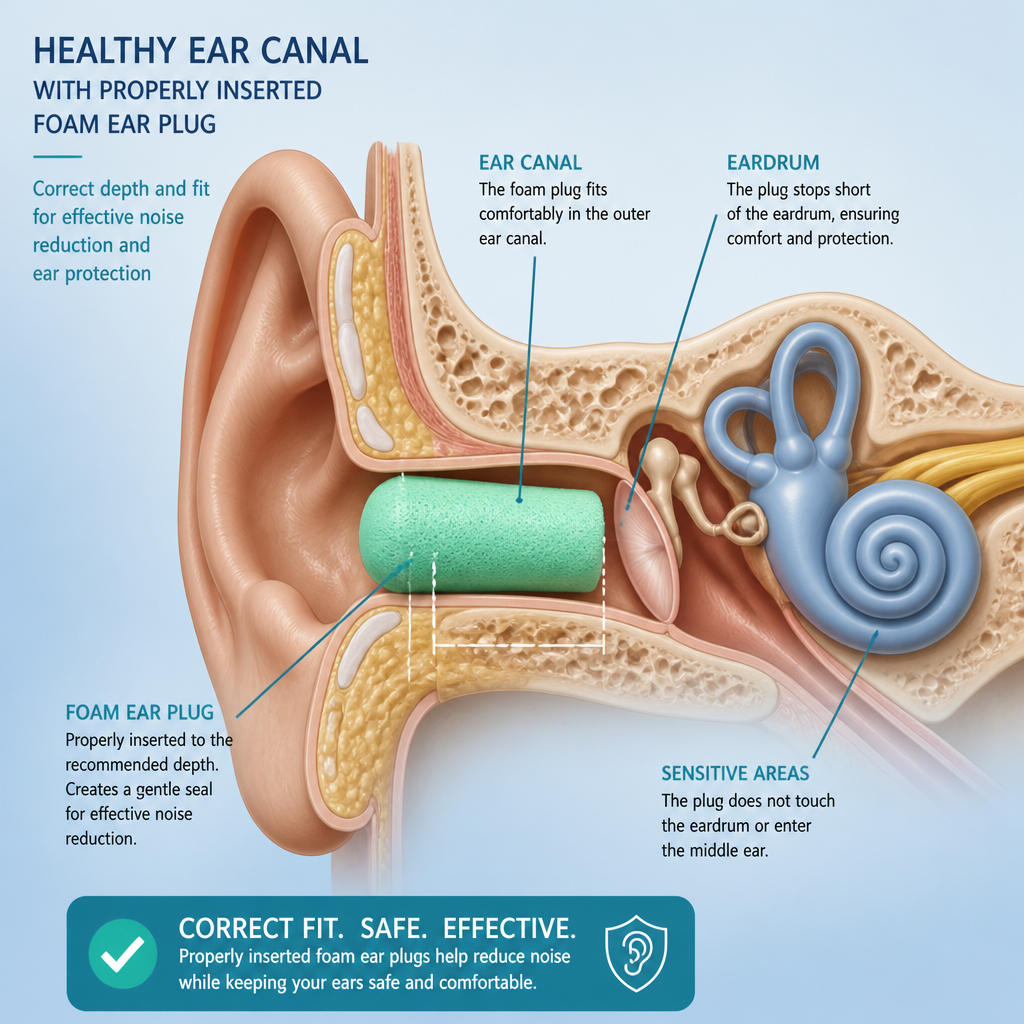
A common mistake is assuming that if a little insertion depth is good, more must be better for noise reduction. It is not. Proper fit means the ear plug sits at the entrance of the ear canal creating a comfortable seal, not driven deep into the canal. ATTENU8’s three-size foam tip system (XS, S, M) exists precisely to give different ear canal sizes an appropriate fit without forcing a one-size compromise that leads to over-insertion. A tip that fits correctly sits naturally at the right depth without needing to be pushed.
The goal of proper ear plug insertion is a reliable acoustic seal, not maximum depth. Deeper does not mean quieter, and it does mean more disruption to the ear canal’s natural self-cleaning process.
This myth has some intuitive logic: a fresh disposable foam plug used once and thrown away can never harbour bacteria from a previous use. That is technically true. But the assumption that people actually discard disposable plugs after each use is where the logic falls apart. In practice, most users keep and reuse disposable foam plugs for days or weeks, handling them with fingers that have touched phones, door handles, and work surfaces. A “single-use” plug treated as a reusable one is one of the dirtiest objects you can put in your ear.
A well-designed reusable ear plug with a cleanable body and replaceable tips actually has a hygiene advantage over poorly managed disposables. The aluminium body of an ATTENU8 plug can be wiped clean, and the memory foam tips are replaced every 6 to 8 weeks on a schedule, not whenever the user remembers or the tip visibly disintegrates. That is a predictable hygiene cycle, which is far more protective than hoping someone discards a foam plug after each single use.
Pro tip: Mark your ear plug tip replacement date on your phone calendar when you first open a new set of tips. Six to eight weeks passes quickly, and a visible reminder removes the guesswork from one of the simplest hygiene steps in your routine.
Dismissing every concern about ear plugs as myth would be as misleading as amplifying them. There are specific circumstances where ear plug use carries genuine, clinically relevant risk. Knowing these situations is not about fear. It is about making an informed decision.
If you have a perforated eardrum, an active ear infection, recent ear surgery, or chronic ear canal inflammation, inserting ear plugs without clearance from an ear, nose, and throat specialist is not advisable. Inserting anything into a compromised ear canal risks worsening the underlying condition. This is not a permanent restriction for most people. It is a temporary precaution while the ear heals. In these situations, over-ear protection (earmuffs) is a practical alternative for maintaining noise reduction without canal insertion.
Even without a formal diagnosis, a small uninfected abrasion inside the ear canal, from a previous plug insertion or aggressive ear cleaning, creates a point of vulnerability. If you notice any soreness, tenderness, or itching inside the canal, take a few days off from ear plug use. Continuing to insert a plug over an irritated canal is how a minor irritation becomes an actual infection.
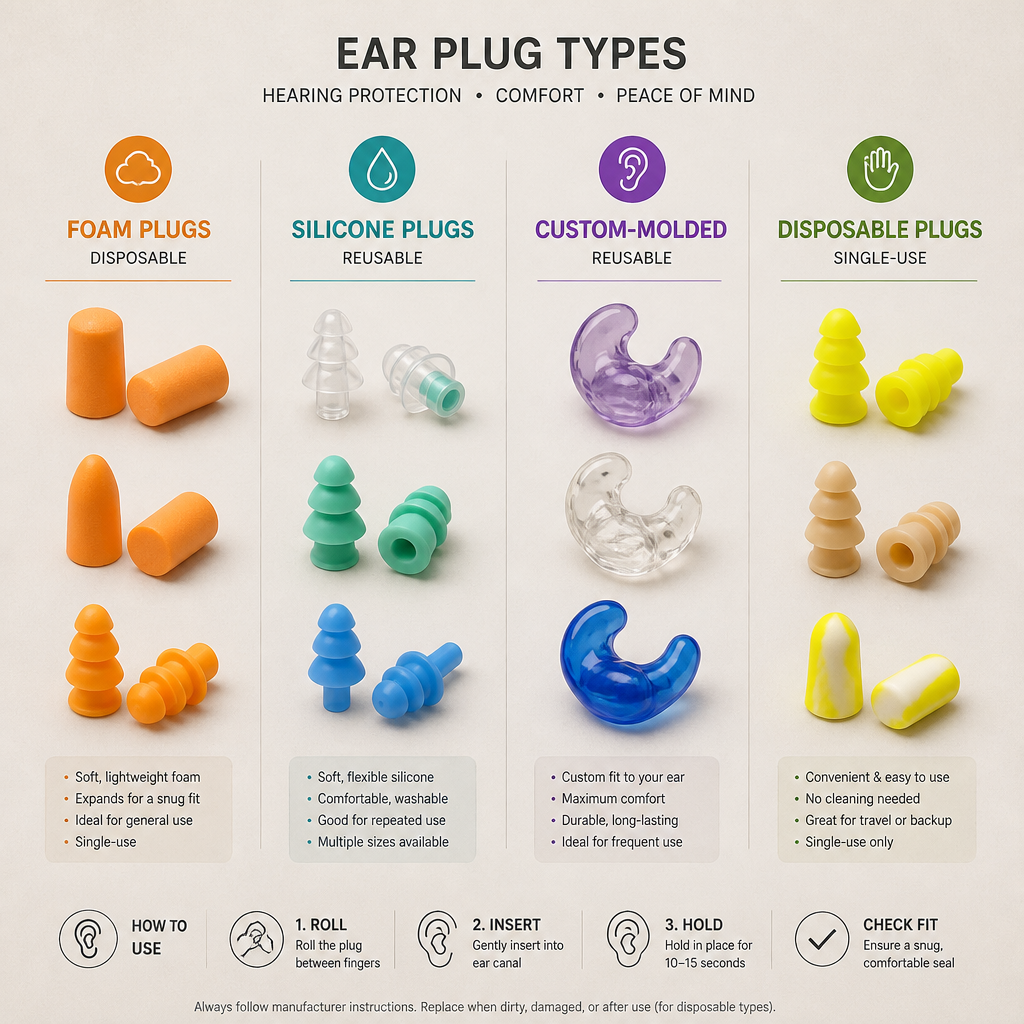
Not all ear plugs carry the same hygiene demands or infection risk profile. The table below compares three main categories on the factors most relevant to safe, long-term use.
| Ear Plug Type | Infection Risk Factor | Hygiene Management |
|---|---|---|
| Single-use disposable foam | Low if discarded after each use; high if reused multiple times without cleaning | Replace after every single use. No cleaning method is reliable once foam is compressed and contaminated. |
| Standard reusable silicone or rubber | Moderate if cleaning is irregular; low with consistent routine | Wash with mild soap and water after each use. Inspect for visible dirt or damage before each insertion. |
| Premium reusable with replaceable foam tips (e.g., ATTENU8) | Low. Metal body is easy to wipe clean; tips replaced on a set schedule before degradation | Wipe aluminium body regularly. Replace memory foam tips every 6-8 weeks. No guesswork about when hygiene has been compromised. |
The pattern is clear: infection risk is not a product category problem. It is a maintenance behaviour problem. The products that make it easiest to maintain consistent hygiene are the ones that carry the lowest practical risk for most users.
For light sleepers and people who rely on ear plugs to get through the night in noisy environments, a consistent safe-use routine is not optional. It is the practice that keeps ear plugs beneficial rather than problematic. The following applies whether you are using ATTENU8 plugs for sleep or hearing protection in a loud work environment.
Wash your hands before handling any ear plug. This single step eliminates the most common vector for bacterial transfer. Insert the plug to the point of a comfortable acoustic seal, not maximum depth. With memory foam tips, compress the tip gently, insert, and hold for a few seconds while the foam expands to fill the canal. If you need to push hard or feel pressure or pain, the tip size is wrong, not the insertion depth.
For reusable plugs with a hard body, wipe the body down regularly with a clean cloth. For replaceable foam tips, follow the 6-to-8-week replacement cycle regardless of whether the tips look visibly dirty. Foam degrades over time in ways that are not always visible, and degraded foam is harder to keep hygienic. For disposable plugs, treat them as the product name says: disposable. One use, then out.
Store ear plugs in a clean, dry case rather than loose in a bag, pocket, or on a bedside table. A case keeps the tips from picking up surface bacteria between uses. ATTENU8 plugs come ready for this kind of use with a durable metal body that does not degrade or absorb contaminants the way foam-only plugs do over time.
Pro tip: If you wear ear plugs nightly for sleep, a simple routine of wiping the plug body each morning after removal, paired with a calendar reminder for tip replacement, is all the maintenance the product needs. Overcomplicated cleaning routines are actually a barrier to consistent hygiene. Keep it simple and repeatable.
Yes, for most healthy adults, nightly ear plug use is safe when hygiene is maintained. This means clean hands before insertion, a clean plug, and regular replacement of foam tips. Clinical infection rates among consistent ear plug users with good hygiene practices remain low, even when bacterial colonization levels are slightly higher than in non-users.
Symptoms to watch for include pain or aching inside the ear canal, discharge (particularly if it has any odour), a feeling of pressure or fullness that does not resolve within a few hours of removing the plug, and reduced hearing that persists. Any of these warrant a visit to a doctor rather than continued plug use while hoping the problem resolves.
A quality reusable ear plug with a cleanable body and replaceable tips, used on a consistent maintenance schedule, is more reliably hygienic than disposable foam plugs that are routinely reused without cleaning. The deciding factor is always the actual care routine, not the product category label.
They can, particularly when inserted too deeply or used for extended unbroken periods. The ear canal’s natural wax-clearing process can be slowed by regular plug use. The practical solution is correct insertion depth (not too deep), occasional breaks, and monitoring for symptoms like ear fullness or muffled hearing. If wax becomes impacted, an audiologist can clear it safely.
No. Noise reduction rating (NRR) measures how much sound attenuation a plug provides, not how risky it is to the ear canal. An ear plug rated at 32 dB, like ATTENU8’s plugs, is not more or less likely to cause an infection than one rated at 20 dB. Infection risk is determined by hygiene practices and fit, not by attenuation performance.
Stop using ear plugs and seek medical advice if you experience persistent pain inside the ear, discharge, a significant sudden drop in hearing, or if you have a known ear condition such as a perforated eardrum or a history of chronic ear infections. These situations require professional assessment before ear plug use continues.
Yes. A metal body, such as the concave aluminium construction used by ATTENU8, does not absorb moisture, sweat, or bacteria the way foam does. The hard surface can be wiped clean between uses, while the foam tips are the only component that requires periodic replacement. This design separates the cleanable structural component from the consumable hygiene component, which is a meaningful practical advantage for frequent users.
Have you ever avoided ear plugs because of concerns about ear infections, or do you have a hygiene routine that works particularly well? Share your experience in the comments below.

