


 0

Most people associate hearing damage with dramatic, obvious events: a gunshot, a rock concert, an industrial accident. The reality is far less dramatic, and far more common. Noise-induced hearing damage builds silently, exposure by exposure, across the ordinary soundtrack of daily life. The lawnmower on Saturday morning, the subway commute on Monday, the earbuds you wear to get through the afternoon: each one is doing work on your inner ear that your body cannot undo. Approximately 40 million American adults may have hearing loss resulting from noise exposure, and the mechanism is the same every time: once the hair cells inside your cochlea are gone, they do not grow back.
| Key Insight | Explanation |
|---|---|
| 85dB is the damage threshold | Sounds at or above 85 decibels can start damaging your hearing over time. Heavy traffic from inside a car already sits at this level. |
| Damage is cumulative and irreversible | Each loud exposure adds to a running total. Inner ear hair cells do not regenerate once destroyed. |
| Earbuds are a major underrated risk | Listening at high volume through earbuds or headphones consistently puts users above safe thresholds, especially with noise-cancelling devices cranked up. |
| Time at volume matters as much as the volume itself | At 85dB, 8 hours of exposure is the working safety limit. Every 3dB increase roughly halves the safe exposure duration. |
| Over 1.5 billion people worldwide have hearing impairment | The WHO reports this figure, with noise exposure being the primary occupational cause in adults. The number is projected to grow. |
| Reusable ear plugs with high SNR ratings offer consistent daily protection | A product rated at SNR 32 (like ATTENU8) delivers meaningful attenuation across the noise types you meet every day, not just in extreme environments. |
| Protection must be comfortable to be used consistently | Foam tips that conform to the ear canal create a seal. Rigid or ill-fitting plugs are discarded when they become uncomfortable, leaving you exposed. |
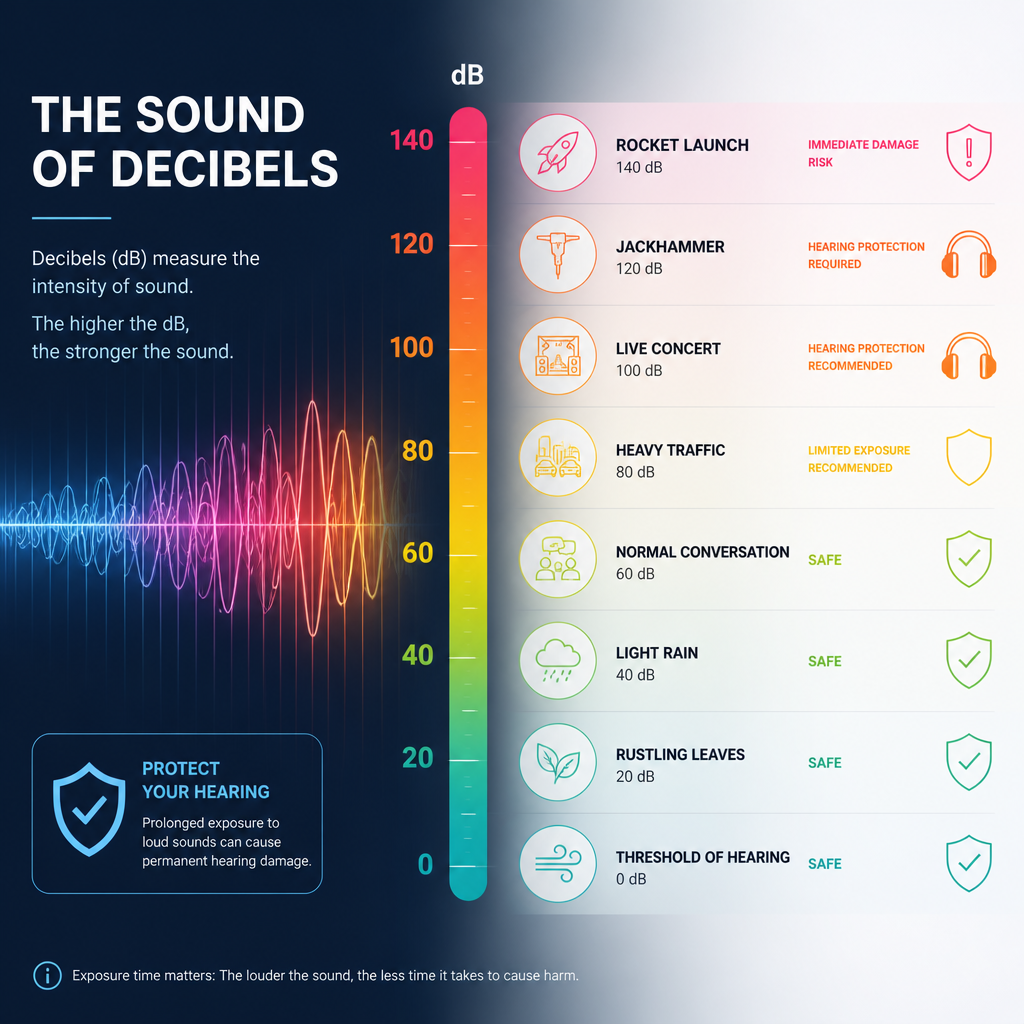
Decibels are not a linear scale. Every 3dB increase represents a doubling of sound intensity, which means the jump from 85dB to 100dB is not a modest step up but a dramatic one. Occupational safety standards in most countries set 85 decibels over eight hours as the maximum safe daily dose for workplace noise. Exceed that either in volume or in duration, and you are accumulating damage.
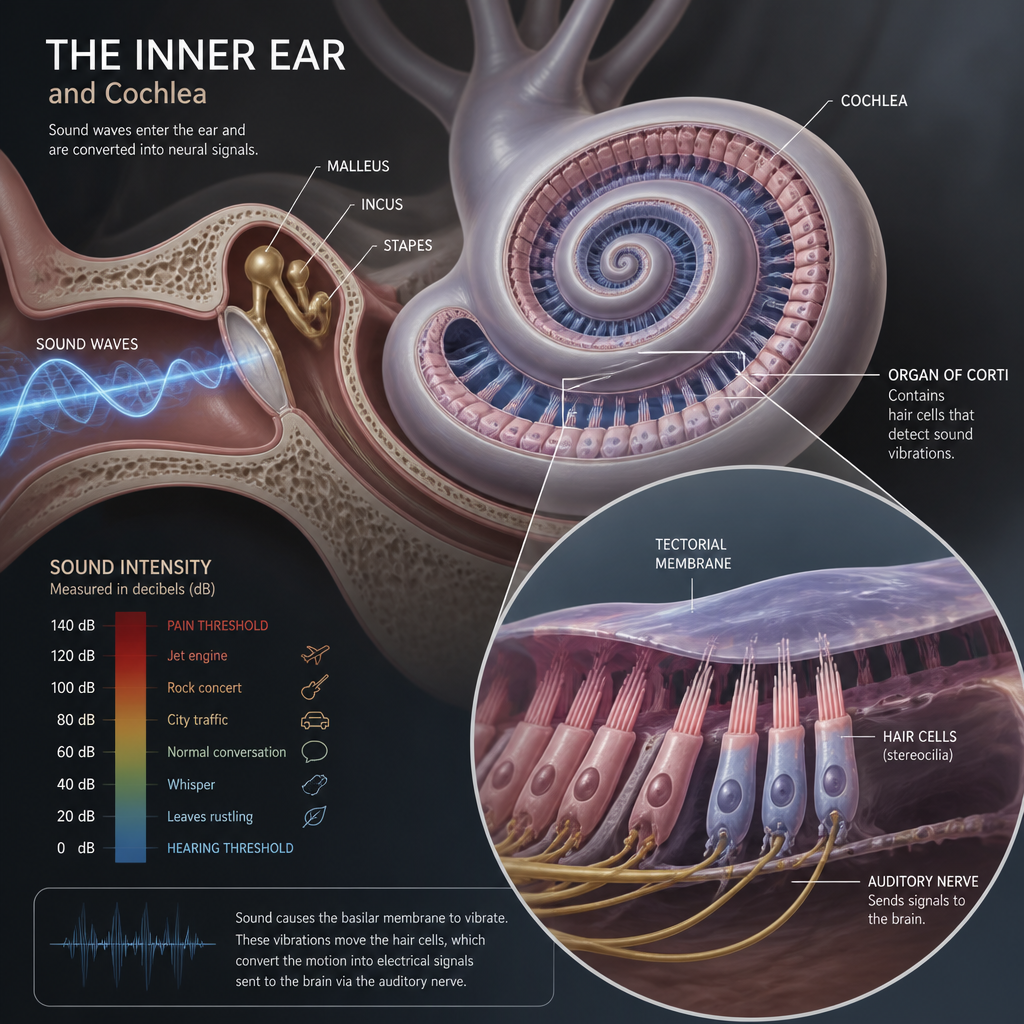
The physiology is straightforward and unforgiving. Your inner ear contains thousands of tiny hair cells in the cochlea. These cells convert sound vibrations into electrical signals your brain reads as sound. Loud noise physically bends and eventually destroys these cells. Unlike skin or bone, they do not regenerate. The loss is permanent, and it tends to start in the higher frequency ranges, which is why people with early noise-induced hearing damage often struggle to follow conversation in noisy rooms before they even notice anything is wrong.
Sounds at or below 70dB are generally considered safe for indefinite exposure. Normal conversation between two people sits at around 60dB. The problem is that almost everything else in a typical day edges closer to the danger zone than most people expect.
None of the following noise sources are exotic. Most people encounter several of them every single day without giving their hearing a second thought. That indifference is exactly the problem.
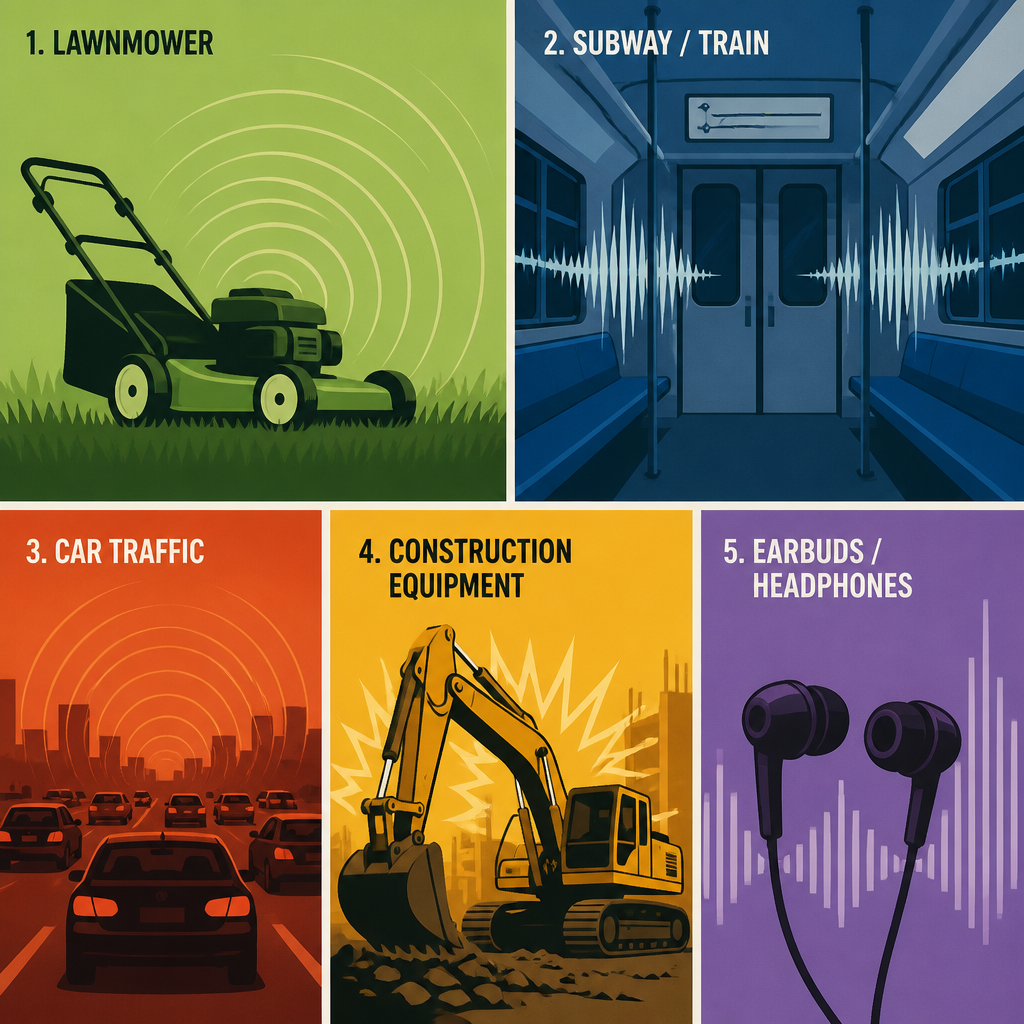
Sitting inside a car in heavy urban traffic already puts you at approximately 85dB, which is the occupational safety threshold. For daily commuters spending an hour or more in stop-and-go traffic with windows down or in a convertible, this exposure adds up across working weeks and years in a way that is genuinely consequential.
Subway noise regularly reaches 90dB or above, particularly when trains are accelerating or braking in enclosed stations. A 30-minute commute each way means an hour of near-constant 90dB exposure daily. Many commuters compound this by turning their earbuds up to overcome the background noise, pushing total exposure into a far more damaging range.
This is the most widespread source of noise-induced hearing damage in people under 35. Used at unsafe volumes, earbuds and headphones are contributing to an epidemic of hearing loss, particularly among young people. The World Health Organization has warned that over 1 billion young people aged 12 to 35 are at risk of permanent hearing damage from recreational noise exposure, with personal audio devices identified as a primary driver.
The problem is compounded by noisy environments. When you put earbuds in on a subway platform, you instinctively turn the volume up to hear your music over the train noise. You are now stacking two damaging sources on top of each other.
Yard work tools like power mowers and leaf blowers regularly register sounds over 90 decibels. A standard lawnmower session of 30 to 45 minutes without protection delivers a meaningful dose of noise-induced stress to your hearing. Most people operating this equipment are focused on the task and give no thought to their ears.
Hair dryers sit at around 90dB and are held close to the ear. A daily hair-drying routine of 10 to 15 minutes may seem trivial, but it is a daily, sustained exposure at a level above the safe threshold. The proximity to the ear matters: sound intensity drops with distance, so a dryer held close to the head delivers more energy than the same device at arm’s length.
Blenders, food processors, and garbage disposals all cluster around 85 to 90dB. Brief exposures from short appliance runs are less concerning than sustained ones, but households that run these appliances for extended periods daily, as in a commercial kitchen or a family preparing multiple meals, accumulate genuine noise exposure through this route.
DIY work is one of the most underappreciated sources of recreational hearing damage. Drills, circular saws, sanders, and nail guns operate well above 90dB, with some reaching 100 to 110dB. At 100dB, safe exposure time drops to roughly 15 minutes. Most home renovation sessions run for hours. The noise is not continuous, but the spikes are severe.
Busy restaurants and bars are noisier than most people realize. Background music, hard surfaces, and the collective noise of many conversations can push ambient levels to 85 to 95dB. A two-hour dinner in a loud venue is not a trivial exposure. This is a source that people tend to dismiss because it feels social rather than industrial, but the ears cannot distinguish context.
Live music venues are among the loudest environments most people voluntarily enter. Levels of 100dB or more are common, and at these intensities, safe exposure limits are measured in minutes rather than hours. A three-hour concert without protection is a significant acoustic event for your cochlea, and the ringing in your ears afterward is not a quirk: it is your auditory system signaling that damage has occurred.
Stadium crowds, air horns, and PA systems in enclosed arenas can reach 100dB or above. Like concerts, these are events people attend enthusiastically and repeatedly. The fact that the experience is enjoyable does not mitigate the physical effect on your inner ear hair cells.
Understanding noise-induced hearing damage requires thinking in terms of dose, not just peak volume. The relationship between loudness and safe exposure time is roughly this: at 85dB, you have about 8 hours. At 88dB, that drops to around 4 hours. At 91dB, roughly 2 hours. Every 3dB increase in sound level halves the duration you can safely tolerate.
This is why a commuter who spends 45 minutes on a loud subway, then works out with earbuds at high volume, then attends a loud restaurant lunch has potentially exceeded a safe daily noise dose before 2pm, without ever visiting a construction site or a concert.
The danger of everyday noise is not drama. It is repetition. The sounds that do the most cumulative damage are the ordinary ones you stop noticing precisely because they are ordinary.
Recreational noise is particularly problematic because it is not regulated or tracked the way occupational noise is. Workplace regulations set a cap of 85dB for eight hours, but this limit does not account for recreational noise exposure outside work, which can push total daily exposure well beyond a safe threshold.
Pro tip: If you need to raise your voice to be heard by someone standing an arm’s length away, the background noise is likely at or above 85dB. That is a reliable real-world signal to put hearing protection in.
Not all hearing protection is equivalent. The format, fit, attenuation rating, and practicality for real-life use vary considerably. Here is a direct comparison of the three main categories people use for everyday noise-induced hearing damage prevention.
| Protection Type | Typical Noise Reduction | Best For / Limitations |
|---|---|---|
| Disposable foam ear plugs | Up to ~33dB NRR (when correctly inserted) | Cheap and widely available, but inconsistent fit, single-use waste, and uncomfortable for extended wear. Correct insertion is harder than it looks, reducing real-world attenuation significantly. |
| Earmuffs / over-ear protection | 20-30dB NRR depending on model | Easy to put on correctly and suitable for construction or power tool use. Bulky, hot, and impractical for commuting, sleep, or wearing in social environments. |
| Premium reusable metal-bodied ear plugs (e.g. ATTENU8, SNR 32) | Approximately 32dB noise reduction | Consistent attenuation across noise types, with memory foam tips in multiple sizes (XS, S, M) that conform to the ear canal for a proper seal. Durable body requires only foam tip replacement every 6 to 8 weeks rather than full replacement. Practical for sleep, commuting, concerts, and occupational use. |
The practical gap between disposable foam plugs and a well-designed reusable option is significant. A disposable plug that is not inserted correctly delivers a fraction of its rated protection. A plug with a concave body that is easy to grip and memory foam tips that seal to the individual ear canal removes that variable. You either have a seal or you do not, and a proper fit tells you immediately.
Pro tip: If you are wearing ear plugs for sleep or travel, the body shape matters as much as the attenuation rating. A flat or cylindrical plug presses against the ear canal when you lie on your side. A concave design reduces that contact pressure, making sustained wear far more tolerable and far more likely to actually stay in through the night.
Generic advice about hearing protection tends to be useless because it treats protection as an occasional intervention for extreme situations. The sources of noise-induced hearing damage outlined above are not extreme. They are the ordinary pattern of daily life. Protection that only gets used at concerts will not prevent the damage being done on the subway every morning.
For sleep, the priorities are comfort during sustained wear and sufficient attenuation to block snoring partners, traffic outside, or urban ambient noise. For commuting, you need something that fits discreetly in an ear without falling out on a moving train. For construction or power tools, you need the highest practical attenuation you can achieve with a well-sealed fit. One product does not always serve all three contexts equally well, but a premium reusable plug with multiple tip sizes gives you a much better chance of finding a configuration that works across them.
A common mistake is treating hearing protection as equipment for specific jobs rather than a daily item. If your ear plugs are in your work locker or your tool bag, they are not with you when you need them at a restaurant, on a train, or at a weekend event. Carrying a compact reusable case in a pocket or everyday bag removes the friction point that causes people to go without protection in situations where they clearly need it.
Memory foam tips that have degraded do not seal as effectively even if they appear intact. With ATTENU8, the replacement schedule is every 6 to 8 weeks for regular users. Ignoring this means you are wearing protection that delivers less attenuation than the rated figure, which defeats the purpose, particularly at borderline noise levels around 85 to 90dB where a few extra decibels of reduction make a genuine difference.
Sounds at or below 70dB are considered safe for extended listening. That gives you a practical target: keep your personal audio at a volume where you could still hold a conversation with someone nearby without raising your voice significantly. If you cannot hear someone speaking normally over your music, you are almost certainly above safe levels. Noise-cancelling features in some headphones let you lower volume while maintaining clarity, which is one of the more practical ways to reduce total daily noise dose from personal audio.
For anyone whose work or lifestyle involves regular loud noise exposure, the most effective approach is layering protection: keep your personal audio at safe volumes, use ear plugs during high-noise activities, and treat protection as a non-negotiable part of the day rather than an inconvenience to consider at the last minute.
Sounds at or above 85 decibels can damage your hearing over time, depending on how long you are exposed. Brief exposure to very high levels, such as a gunshot or explosion, can cause immediate damage in a single event. For everyday sounds like traffic, appliances, and personal audio devices, it is the sustained duration at or above 85dB that accumulates into measurable hearing loss.
No. The inner ear hair cells in the cochlea that are destroyed by loud noise do not regenerate. Some very brief exposures may cause temporary threshold shifts, which is the muffled feeling and ringing you experience after a loud concert, and hearing may seem to recover. But repeated temporary damage leads to permanent loss, and the cells responsible for high-frequency hearing tend to go first.
At maximum volume, many consumer earbuds and headphones can reach 100 to 110dB or higher. Even at 60 to 70 percent volume, some devices deliver levels well above 85dB directly into the ear canal. The proximity of the speaker to the eardrum amplifies the effect compared to a distant sound source at the same decibel reading.
Daily ear plug use is safe for most people when plugs are kept clean and tips are replaced regularly. Using dirty or degraded tips can increase the risk of minor ear canal irritation. The bigger practical risk is wearing plugs that do not fit correctly, which reduces their protective value and can cause pressure discomfort during extended wear. Soft memory foam tips in multiple sizes address both issues by conforming to the individual ear canal rather than forcing a rigid fit.
Yes, if you do these things frequently. Lawn mowers and hair dryers both sit at approximately 90dB, and at that level, repeated exposures without protection add to cumulative hearing damage. A single session is not the issue. The problem is doing these things daily or weekly for years without any protection, which is exactly how noise-induced hearing damage progresses without anyone noticing until the loss is significant.
Both are standardized measures of how much noise a hearing protection device reduces, but they use different testing methods and are used in different markets. NRR (Noise Reduction Rating) is the standard used in the United States, while SNR (Single Number Rating) is used in Europe. An SNR of 32, as carried by ATTENU8 ear plugs, means the device is certified to reduce noise exposure by 32 decibels under the European standard, which represents strong attenuation for everyday and occupational noise sources.
Have you found a particular noise source in your daily routine that surprised you once you started paying attention to it? Share your experience in the comments below.

