


 0

If you lie awake listening to traffic, a snoring partner, or neighbourhood noise, you are not just unlucky. You are dealing with a documented physiological problem. Research into noise and sleep quality makes one thing very clear: your brain never fully switches off its response to sound, even during deep sleep. The noise that does not fully wake you is still doing damage, triggering stress hormones, shifting you into lighter sleep stages, and quietly eroding the recovery your body depends on. This article breaks down exactly what the science says and what you can practically do about it.
| Key Insight | Explanation |
|---|---|
| Your brain stays alert to noise all night | Even during deep sleep, auditory processing continues. Sounds trigger physiological reactions without necessarily causing full wakefulness. |
| Noise pushes you into lighter sleep stages | Environmental noise increases stage 1 (lightest) sleep and reduces slow-wave and REM sleep, the two most restorative stages. |
| Sounds as low as 30 dB can disturb rest | Even relatively quiet noise can affect sleep. A whispered conversation sits around 30 dB. Your bedroom does not need to be loud to be disruptive. |
| Noise activates your stress hormones at night | Nighttime noise triggers adrenaline and cortisol production, elevates heart rate, and raises blood pressure, even without waking you. |
| Sound machines are not a reliable fix | Recent research published in the journal Sleep found that pink noise reduced REM sleep by nearly 19 minutes and worsened outcomes when combined with traffic noise. |
| Earplugs outperform sound masking for deep sleep protection | The same study found that wearing earplugs was far more effective than pink noise at protecting deep, restorative sleep from traffic noise disruption. |
| Noise sensitivity is partly neurological | Research suggests brain rhythm patterns influence how vulnerable an individual is to noise-related awakenings, meaning light sleepers are not imagining it. |
Sleep is not a single state. It is a cycle of distinct stages, each with a different function and a different level of vulnerability to noise. Stage 1 is the lightest, barely distinguishable from wakefulness. Stage 2 is where most of us spend roughly half the night. Slow-wave sleep (stage 3) is the deepest, most physically restorative stage. REM sleep is where memory consolidation, emotional processing, and cognitive recovery happen.
Environmental noise, particularly from traffic and aircraft, has been shown to increase time spent in stage 1 sleep while reducing slow-wave and REM sleep. That trade-off matters enormously. You might technically sleep for eight hours, but if noise keeps pulling you out of slow-wave and REM and pushing you into stage 1, you will wake up feeling like you barely rested. Stage 2 is also where noise is most likely to cause a full awakening, since auditory awakening thresholds are generally lower there than in slow-wave sleep.
One important nuance: most noise-triggered arousals are not remembered. Your brain briefly surfaces, registers the sound, and partially settles again, all without you being consciously aware. This is why many people insist they slept through the noise when their sleep quality data tells a completely different story.
Pro tip: If you consistently feel unrefreshed despite getting enough hours in bed, noise-triggered micro-arousals are a credible cause. You do not need to remember waking up for the disruption to be real.
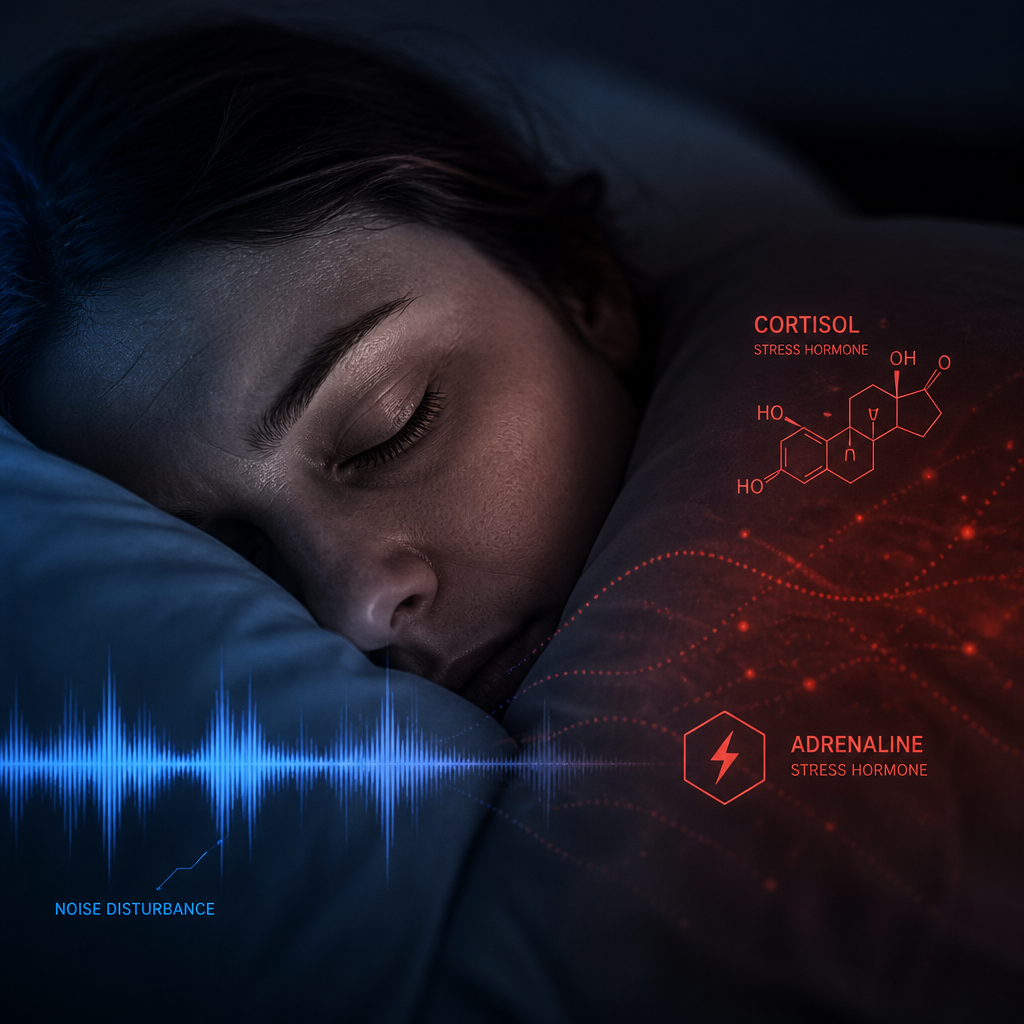
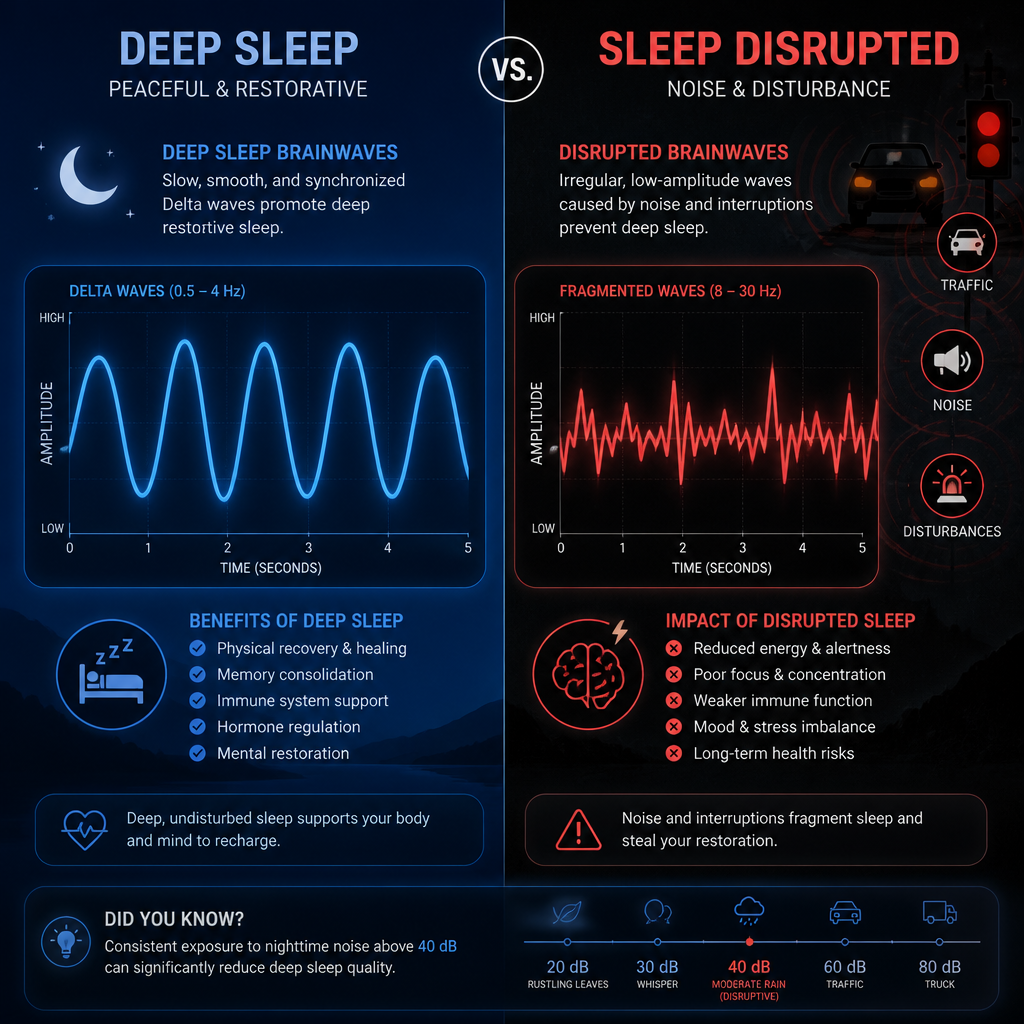
The effects of noise during sleep are not limited to wakefulness. Even sounds that do not cause a full awakening trigger measurable physiological responses. Research has found that a noise of around 48 dB, quieter than the hum of a refrigerator, was 3.4 times more likely to cause a change in pulse wave amplitude, a measure related to blood flow. Sounds above 40 dB produced detectable increases in heart rate.
Nighttime noise also stimulates the production of stress hormones including adrenaline and cortisol, and can elevate blood pressure. Researchers have suggested that these responses may be a primitive survival mechanism, the body preparing to respond to a potential threat. That is useful if a predator actually approaches. It is damaging if it happens every time a truck changes gear outside your window.
Chronic exposure compounds the problem. When noise-triggered cardiovascular responses occur repeatedly night after night, research indicates they may increase the risk of hypertension, heart disease, and other adverse health outcomes. This is not a fringe finding. Research has estimated that traffic-related noise alone causes the loss of over one million years of healthy life among Western Europeans annually.
Even when you sleep through the noise, your nervous system does not. Adrenaline, cortisol, elevated heart rate, disrupted blood flow: the body keeps score, even when the conscious mind does not.
Health guidance generally recommends keeping nighttime bedroom noise below 30 decibels to support uninterrupted sleep. For context, busy road traffic runs at roughly 70 to 85 dB, a subway at around 90 dB, and even a conversation in an adjacent room can exceed 30 dB when sound travels through walls. Reaching that 30 dB threshold in a typical urban or suburban bedroom is harder than it sounds.
If you have ever shared a room with someone who sleeps through a thunderstorm while you lie awake at the sound of a dripping tap, you already know that noise sensitivity is not uniform. Research confirms this is not just a personality trait. Brain rhythm patterns, specifically the activity of sleep spindles during stage 2 sleep, appear to play a role in how effectively a person’s brain filters out external sounds during sleep. People with more active sleep spindles show greater resilience to noise disruption.
Age is another significant factor. Studies show that children and older adults are the most vulnerable to sound-related sleep disruption. Emotional salience also matters: a sound with personal significance, such as your baby’s cry, your name, or an alarm, cuts through sleep far more effectively than a neutral sound at the same volume. The brain is not passively receiving noise. It is actively evaluating it.
For genuine light sleepers, this neurological sensitivity is not something that can be trained away easily. It calls for a practical, physical reduction in the noise reaching the ears, rather than an expectation that willpower or adaptation will solve the problem.
Pro tip: If you identify as a light sleeper and you have tried relaxation techniques without much success, focus on the environment first. Reducing the decibel level reaching your ears is a more reliable intervention than trying to change how your brain processes sound during sleep.
Understanding the scale of the problem helps calibrate the solution. Not all noise is equal, and what disrupts sleep is a combination of volume, frequency, unpredictability, and duration. A single loud event is disruptive; repeated unpredictable events across the night are far worse, because the brain cannot habituate to irregular patterns the way it can to constant background sound.
The most common sleep-disrupting noise sources include road traffic, aircraft, snoring partners, neighbours, and environmental sounds like air conditioning or plumbing. In urban settings, it is rare to have a bedroom that stays below 40 dB through the night without active intervention. Even a quiet suburban environment can see regular spikes from passing vehicles, animals, or wind.
Snoring deserves a specific mention because it is uniquely difficult to habituate to. Research on emotional noise shows that personally relevant sounds are harder to filter out, and few sounds are more personally relevant at 2 AM than a partner’s snoring directly beside you. Snoring typically registers between 50 and 70 dB, well above the threshold for disrupting sleep architecture.
There are broadly three categories of approach to managing sleep disruption noise: physical noise blocking, acoustic masking, and environmental modification. Each has a different evidence base and a different practical ceiling.
| Approach | How It Works | Evidence and Limitations |
|---|---|---|
| Ear protection (earplugs) | Physically reduces sound reaching the ear canal. High-quality options with memory foam tips can reduce noise by 25 to 32 dB across a wide frequency range. | Research from the University of Pennsylvania found earplugs outperformed pink noise machines at protecting both REM and deep slow-wave sleep from traffic noise disruption. Most direct evidence of benefit. |
| Sound masking (white, pink, or brown noise) | Adds continuous background sound to reduce the perceived contrast when disruptive noises occur. | A study published in the journal Sleep found pink noise at 50 dB reduced REM sleep by nearly 19 minutes on its own, and worsened sleep further when combined with traffic noise. Popular but overstated in effectiveness. |
| Environmental modification (windows, insulation, room positioning) | Structural changes to reduce external noise entering the room: double glazing, heavy curtains, door seals, changing which room you sleep in. | Double-pane windows can reduce noise by 10 to 20 dB. Effective but expensive and impractical for renters. Best used in combination with ear protection rather than as a standalone solution. |
The practical takeaway is that earplugs, particularly well-fitted ones that maintain a seal throughout the night, represent the most evidence-backed immediate intervention for noise-related sleep disruption. Sound masking is better suited to situations where earplugs are not practical, and even then the evidence for benefit is weaker than most sound machine marketing implies.
For light sleepers and anyone dealing with persistent sleep disruption noise, the goal is not to eliminate every sound from the universe. It is to reduce the spikes, the sudden changes in volume that pull you out of deeper sleep stages. That is where the right ear protection makes a significant difference.
Comfort across an entire night’s sleep is the non-negotiable factor that most people underestimate. A plug that works well for 30 minutes may become painful by hour three, particularly for side sleepers. Foam tips that conform to the ear canal are more comfortable for extended wear than rigid options. Having multiple tip sizes available matters too, because ear canal dimensions vary significantly between individuals, and a poor fit means both discomfort and reduced noise attenuation.
Durability is the second factor. Disposable foam earplugs need to be replaced constantly, accumulate in landfill, and often lose their expansion capacity after a single use. A well-constructed reusable option with replaceable foam tips addresses both the environmental cost and the long-term economics. The ATTENU8 aluminium-bodied earplug is built around exactly this principle: a precision-machined metal body with three sizes of soft memory foam tips (XS, S, and M), delivering around 32 dB of noise reduction with foam tips that only need replacing every six to eight weeks rather than after every use.
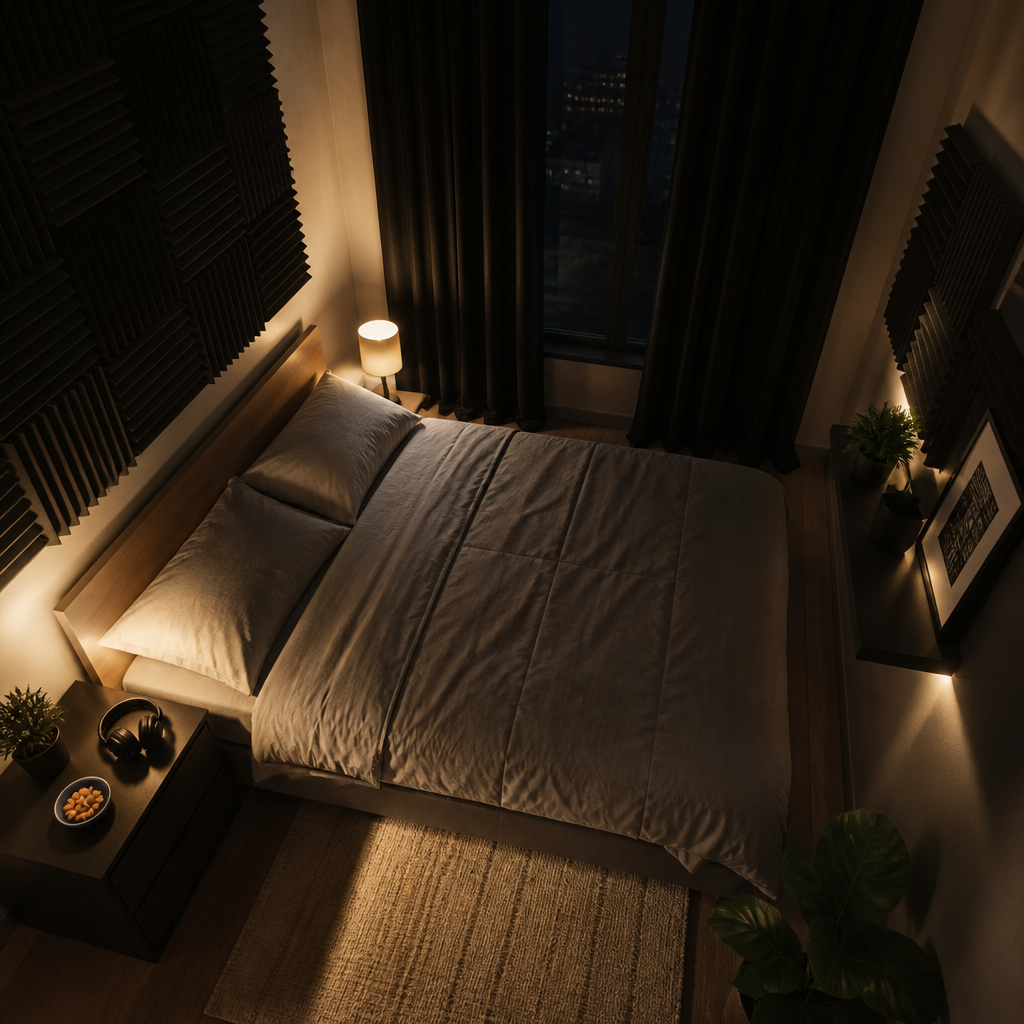
In practice, ear protection works best as the primary intervention, with environmental modifications as a supporting layer. Closing windows, using heavier curtains to absorb sound reflections, and positioning the bed away from the noisiest wall all reduce the baseline noise level before earplugs need to do their work. Start with the physical environment, then add ear protection, and you compound the benefit of both without needing to reach for a sound machine that the evidence suggests may be doing more harm than good.
For people in genuinely loud occupational environments, such as construction or manufacturing, the principle that protects hearing at work applies at home too: sustained noise exposure at levels that trigger physiological stress responses has cumulative consequences. The same discipline that goes into workplace hearing protection should extend to the sleep environment.
Pro tip: If you travel frequently for work and struggle with hotel noise, carrying your own earplugs is one of the highest-return sleep interventions available. Hotel rooms vary wildly in noise levels, and blackout curtains handle light but do nothing for sound from corridors, traffic, or thin walls.
Research suggests sounds as low as 30 decibels can affect rest, and noises above 40 dB produce measurable cardiovascular responses even without waking a sleeper. For context, a quiet conversation registers around 40 to 50 dB. You do not need to be startled awake for noise to be damaging your sleep quality.
Partially, but not fully. The brain can become less likely to fully wake in response to familiar, predictable sounds over time. However, the underlying physiological responses, including cortisol production and heart rate changes, persist even with adaptation. Chronic exposure to noise does not become harmless simply because it becomes familiar.
The evidence is more cautious than the marketing. A recent study published in the journal Sleep found that pink noise, one of the most popular formats, reduced REM sleep by nearly 19 minutes per night, and made sleep quality worse when combined with traffic noise. Sound masking can reduce the perceived contrast of disruptive noises, but it does so by adding more sound to the ear. Physical noise blocking through well-fitted earplugs is better supported by the research for protecting deep and REM sleep.
Stage 2 sleep is where most full awakenings triggered by noise occur, largely because auditory awakening thresholds are lower there than in slow-wave sleep. However, slow-wave sleep and REM sleep are both reduced by environmental noise exposure even when the noise does not cause a full waking event. All stages are affected; stage 2 is just where you are most likely to notice it consciously.
Yes. Chronic exposure to nighttime noise has been linked in research to elevated risk of hypertension, heart disease, and other cardiovascular conditions. The mechanism is the repeated activation of stress responses during sleep, including cortisol and adrenaline release and heart rate elevation, which accumulate as a physiological burden over time. This is why managing your sleep noise environment is a health priority, not just a comfort preference.
Memory foam tips that expand to form a seal within the ear canal are generally the most comfortable for extended wear and the most effective at reducing noise across a broad frequency range. The key variables are tip size, which must match your ear canal for both comfort and attenuation, and the body design, which should not create pressure points for side sleepers. Reusable earplugs with replaceable foam tips are more practical and economical for nightly use than single-use disposables.
Yes. Studies consistently show that children and older adults are the most vulnerable to noise-related sleep disruption. Children spend a higher proportion of sleep in REM, which is particularly sensitive to audio interference. Older adults tend to experience lighter sleep overall, which raises their vulnerability to being woken by noise events. Both groups benefit disproportionately from a quieter sleep environment.
Have you found a particular approach that helped you manage noise and get better sleep? Share your experience below, as it might help someone else dealing with the same problem.

