


 0

If you use earplugs every night for sleep or wear them daily on a noisy worksite, the cost of disposable foam adds up faster than most people expect. The reusable earplugs vs disposable debate is not really about upfront price. It is about what you actually spend over 12 months, what protection you actually receive, and how much plastic you throw away in the process. Run the numbers honestly and the comparison is not close.
| Key Insight | Explanation |
|---|---|
| Disposable foam costs far more annually than it appears | A nightly foam earplug user spends roughly $60 to $180 per year on disposables alone, depending on brand and quantity purchased. |
| The break-even point for reusables is faster than expected | For a daily user, a quality reusable pair typically pays for itself within 8 to 12 weeks of switching from disposable foam. |
| Real-world NRR attenuation from foam plugs is significantly lower than the label | NIOSH research consistently shows untrained users achieve roughly 50% of the labeled NRR under real-world conditions, meaning a 33 dB plug may deliver only around 16 dB in practice. |
| Foam tip replacements are the only recurring cost of a premium reusable | ATTENU8 memory foam tips need replacing every 6 to 8 weeks. The annual replacement cost is well under $20, far below disposable spend. |
| Disposable foam is made from non-biodegradable plastics | Most foam earplugs are made from PVC or polyurethane, neither of which biodegrades. Manufacturing an estimated 40 billion foam earplugs annually requires around 1.3 million barrels of oil. |
| Sized memory foam tips deliver more consistent seals than rolled foam | Choosing XS, S, or M tips removes the technique variable that causes most disposable foam failures. The seal is consistent regardless of lighting conditions or fatigue level. |
| Metal-bodied reusables are designed for years of use, not weeks | The aluminium body of a premium reusable earplug does not degrade with daily use. Only the foam tips are consumable, which keeps the long-term cost of ownership extremely low. |
Disposable foam earplugs look cheap because the per-pair price is low. A bulk box of 50 pairs typically runs between $5 and $25 depending on the brand, putting each pair somewhere in the range of $0.10 to $0.50. That number feels negligible, which is exactly why most people never do the yearly math.
If you use foam earplugs every night for sleep, you go through roughly 365 pairs in a year. Even at the lower end of $0.10 per pair, that is $36.50. At $0.50 per pair, it reaches $182.50. The average daily user typically lands somewhere in the $60 to $100 range annually, and that is before factoring in the habit most light sleepers share: doubling up pairs when one does not seal well, which is common with disposable foam.
For workers in loud environments, the math gets worse. A construction worker or manufacturing professional who uses two pairs per shift, because single-use foam degrades quickly in dusty or oily conditions, can spend well over $100 per year as an individual. For a 50-person crew, a disposable foam program can cost between $3,750 and $6,250 in direct materials annually.
The sticker price of a single pair of disposable earplugs is the least useful number for making a purchasing decision. The number that matters is what you spend in a year.
Pro tip: Before you buy your next box of disposable foam earplugs, multiply the per-pair cost by 365 (or by the number of working days in your year). That single calculation changes how most people see the value of switching to a reusable alternative.
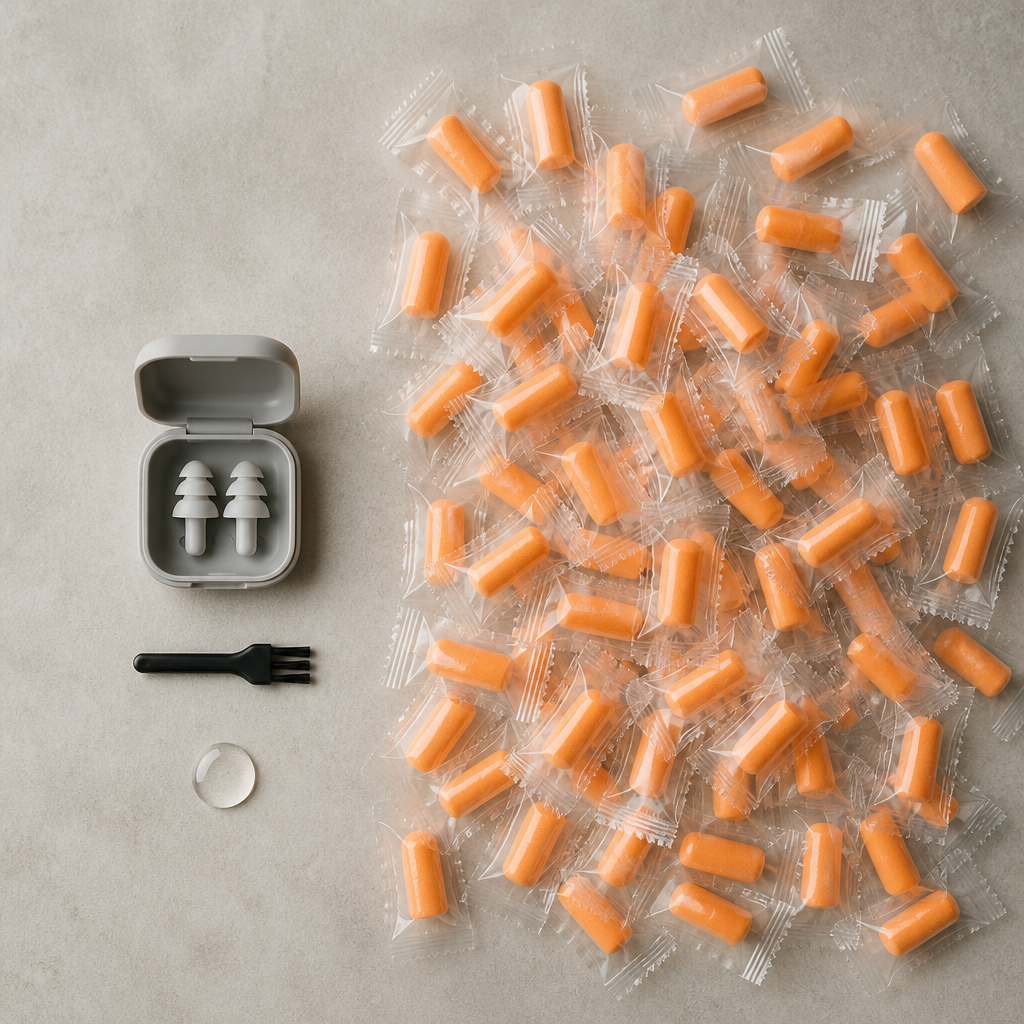
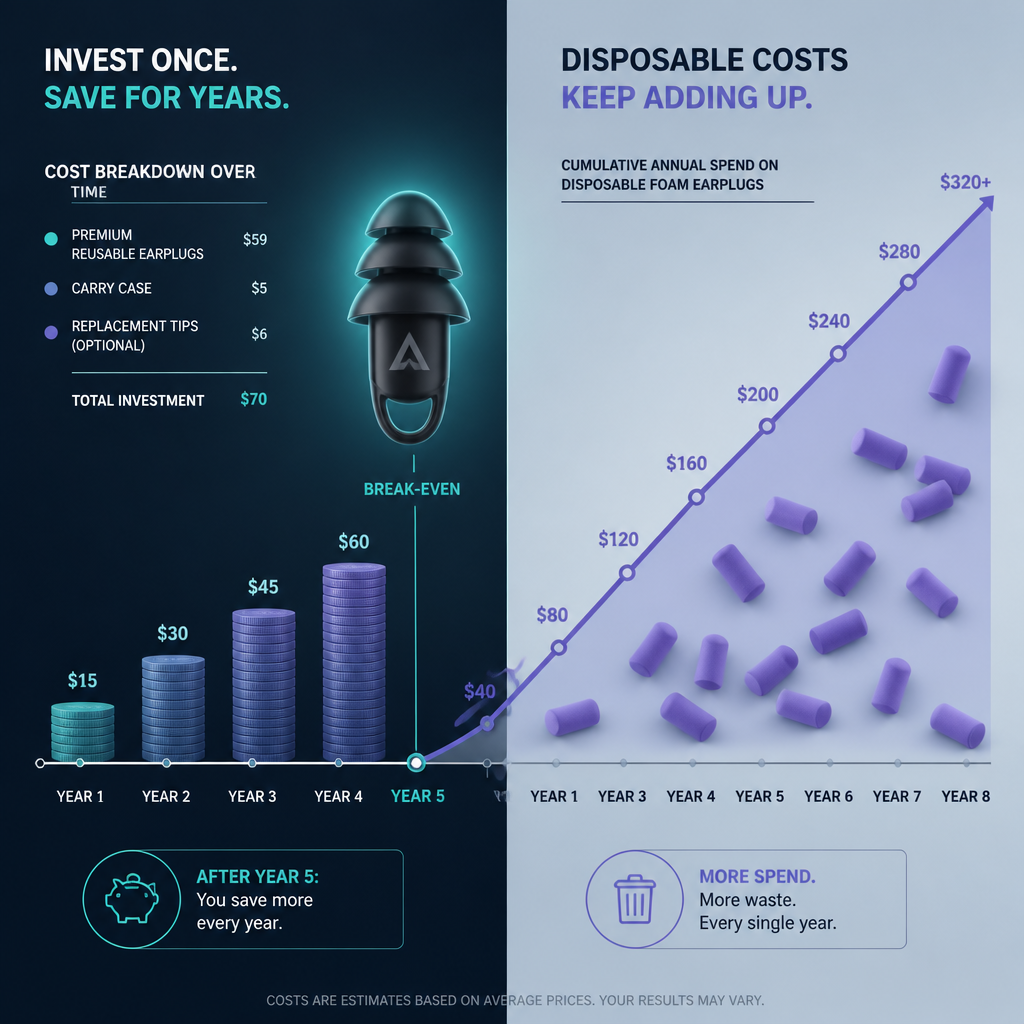
The upfront cost of a quality reusable earplug is higher than a single pair of disposable foam, which is the comparison most people instinctively make. It is also the wrong comparison. The correct comparison is the reusable’s total first-year cost versus 12 months of disposable spend.
A quality pair of metal-bodied reusable earplugs, such as ATTENU8, costs between $25 and $45 for the body, which does not degrade with daily use. The only consumable is the memory foam tip. With daily overnight use, foam tips need replacing every 6 to 8 weeks. A replacement tip set typically costs $10 to $15 for a multi-pair pack.
Over a full year of nightly use, the total spend on a premium reusable system runs approximately $40 to $60 when you include the initial body purchase and all tip replacements. That is a fraction of what the same user spends on disposables, and it provides more consistent performance throughout.
For a daily user spending roughly $4 to $5 per box of 10 pairs on disposables, the break-even point against a quality reusable is typically between 8 and 12 weeks. After that, the reusable is simply cheaper with every passing week. For a construction crew, switching from disposable to a reusable program with replacement tips can cut annual hearing protection costs by 65 to 80 percent.
Pro tip: Track your earplug spend for just one month by saving receipts or checking your purchase history. Most daily users are surprised to find they are spending more on disposable foam in a single month than a full year of reusable tip replacements would cost.
The NRR (Noise Reduction Rating) printed on a box of disposable foam earplugs is a laboratory number. It reflects what trained subjects achieved under ideal conditions with expert insertion in a calibrated test environment. It does not reflect what a light sleeper inserting foam plugs in the dark, half-asleep, actually receives.
NIOSH research consistently shows that average foam earplug users achieve roughly 50% of the labeled NRR under real-world conditions. An earplug labeled NRR 33 dB typically delivers around 16 dB of actual attenuation for an untrained user. In one study of U.S. Marine Corps recruits, pre-training attenuation values with a 33 dB NRR foam plug ranged from 0 to 50 dB, illustrating the enormous variability that insertion technique introduces.
Disposable foam requires a specific technique: roll tightly, insert before expansion begins, hold in place for 20 to 30 seconds. Skip any step and the seal is compromised. Field observations suggest that a significant proportion of workers skip the holding step entirely, reducing actual attenuation by 8 to 12 dB.
Sized memory foam tips eliminate the technique variable. When you select the correct size from XS, S, and M options and pair them with a stable metal body, the insertion is consistent each time. The seal does not depend on how well you rolled the plug or whether you held it long enough. This matters most to light sleepers inserting in low light and to professionals who insert quickly under worksite pressure.
ATTENU8’s metal-bodied design delivers approximately 32 dB of noise reduction with properly fitted tips. Because the body maintains its shape and the tip is always pre-sized rather than relying on user compression, the attenuation you achieve in practice tracks far closer to the rated figure than standard disposable foam does.

The financial comparison between reusable and disposable earplugs is compelling on its own. The environmental comparison adds another dimension that is increasingly relevant to buyers choosing eco-friendly earplugs.
Most disposable foam earplugs are made from polyvinyl chloride (PVC) or polyurethane, both fossil-fuel-derived plastics that do not biodegrade. Manufacturing an estimated 40 billion foam earplugs annually requires approximately 1.3 million barrels of oil. When these plugs reach landfill, PVC products can leach toxic chemicals into soil and groundwater. When incinerated, PVC releases hydrogen chloride gas and greenhouse gases.
A nightly user who replaces foam earplugs daily discards approximately 146 pairs per year, sending plastic-packaged foam waste directly to landfill. A construction worker using two pairs per shift generates even more. Multiply that across a large workforce and the waste volume becomes significant.
A single premium reusable earplug body, made from anodised aluminium, lasts for years under daily use. The only waste generated is the memory foam tip, replaced every 6 to 8 weeks. That is roughly 6 to 8 tip changes per year instead of 146 to 365 full earplug disposals. The volume reduction in landfill contribution is substantial.
For buyers who prioritise both cost and environmental responsibility, the calculation is the same: a durable metal-bodied design with replaceable tips is simply a better system on both counts. Choosing eco-friendly earplugs does not require accepting inferior performance. It means choosing a design where durability and sustainability reinforce each other.
| Factor | Disposable Foam Earplugs | Standard Pre-Formed Reusable | ATTENU8 Premium Metal-Bodied Reusable |
|---|---|---|---|
| Upfront Cost | Very low per pair ($0.10 to $0.50) | Low to moderate ($2 to $15) | Moderate ($25 to $45 for the body) |
| Annual Cost (daily use) | $60 to $180+ | Variable, body needs periodic full replacement | Under $20 in tip replacements after initial purchase |
| Noise Reduction (real-world) | Often 50% below rated NRR due to technique dependence | More consistent but fit varies by ear canal size | Approximately 32 dB with sized XS/S/M memory foam tips |
| Fit Consistency | Highly variable, technique-dependent | Better than foam, limited by single-size design | Three tip sizes create consistent seal across ear canal shapes |
| Environmental Impact | High: 146 to 365 pairs discarded per year per user | Lower, but full-body replacement still generates waste | Lowest: only foam tips replaced every 6 to 8 weeks |
| Durability | Single use only | Weeks to months before degradation | Aluminium body is indefinitely durable; only tips are consumable |
| Best For | Occasional, emergency, or one-off use | Moderate-frequency users who need a step up from foam | Daily sleepers, frequent travellers, worksite professionals |
Cost and noise reduction numbers matter, but for daily wearers, comfort determines whether a product actually gets used. A light sleeper who finds earplugs uncomfortable after two hours will remove them at 3 a.m. and wake up to every sound in the house. The best earplug is the one that stays in comfortably throughout the night.
Disposable foam earplugs are designed to expand after insertion. That expansion creates the seal, but it also creates sustained outward pressure against the ear canal wall. Over time, especially during a full night’s sleep, that continuous pressure causes irritation and soreness. Many users describe waking up with aching ear canals after several hours of foam plug use.
Memory foam tips on a stable metal body behave differently. The foam conforms to the canal shape and settles rather than continuously pushing outward. Combined with the concave aluminium body sitting partially in the concha bowl rather than deep in the canal, the pressure profile is gentler. Side sleepers in particular notice the difference: a low-profile metal body does not create the pillow-pressure pain that a protruding foam plug often does.
A disposable foam earplug picks up skin oils, earwax, and bacteria from the very first insertion. Because it is discarded after one or two uses, that contamination is not a long-term concern in theory. In practice, many users reuse disposable foam well beyond its intended single-use lifespan, either because they forget or because discarding every pair feels wasteful.
A metal-bodied reusable with replaceable foam tips keeps the aluminium body cleanable and replaces only the foam component on a set schedule. Replacing tips every 6 to 8 weeks with fresh memory foam means the contact surface is never older than two months, regardless of how long you keep the body. This is a more hygienic system than either single-use foam that gets reused or older reusable designs where the entire body accumulates contamination without a clear replacement schedule.
Pro tip: When you are a side sleeper, choose an earplug with the smallest possible external profile. A metal-bodied design with a flush or recessed fit in the ear sits flat against the head, while a protruding foam plug creates a pressure point against the pillow that wakes most side sleepers within a few hours.
On paper, high-rated disposable foam plugs can match or exceed the rated NRR of many reusables. In practice, disposable foam consistently underperforms its rating because correct insertion requires a specific technique that most users do not execute consistently. Reusable earplugs with sized memory foam tips deliver more predictable real-world attenuation because the fit does not depend on how well the user rolled and timed the insertion. For daily sleepers and worksite users, that consistency matters more than the rated number on the box.
A well-made metal-bodied reusable earplug body, such as those made from anodised aluminium, lasts for years under daily use because the structural component does not degrade with normal wear. The memory foam tips are the consumable part. With daily overnight use, tips typically need replacing every 6 to 8 weeks, or around 300 to 350 insertion cycles. Following that schedule keeps both comfort and noise reduction performance consistent throughout the body’s lifespan.
A nightly disposable foam earplug user goes through roughly 365 pairs per year. At typical retail prices of $0.10 to $0.50 per pair, the annual spend ranges from about $36 to $182. Most daily users fall somewhere in the $60 to $100 range annually, and those who habitually replace plugs mid-night because of poor initial fit spend more. Compare that to a premium reusable system at under $20 per year in tip replacements after the initial body purchase, and the financial case for switching is straightforward.
Significantly so. Most disposable foam earplugs are made from PVC or polyurethane, both non-biodegradable plastics that go directly to landfill after use. A nightly user discards around 146 pairs per year. A reusable user with a metal-bodied earplug replaces only the memory foam tip every 6 to 8 weeks, generating a fraction of that waste. The aluminium body is durable enough to last for years, making the total material footprint of a premium reusable system far lower over time than an equivalent period of disposable use.
Yes, and this is one of the strongest arguments for premium reusable designs. A metal-bodied earplug with replaceable memory foam tips delivers approximately 32 dB of noise reduction, which covers light sleepers dealing with snoring or traffic noise as well as worksite professionals in environments up to moderate industrial noise levels. The consistent seal from sized tips makes a single pair genuinely versatile across both use cases, unlike disposable foam, which degrades quickly in dusty or oily worksite conditions and requires technique precision that is hard to maintain during a busy shift.
Memory foam tips show several clear signs of degradation before they fail completely. The foam takes longer to expand after compression, feels less resilient in the hand, or shows visible discoloration from accumulated oils and wax. You might also notice that the seal feels less secure or that sounds you previously blocked are coming through more clearly. Replace tips at the first signs of performance change rather than waiting for complete failure. For daily overnight users, the 6 to 8 week replacement schedule generally aligns with when these signs first appear.
For genuinely occasional users, such as someone who only needs earplugs a few times a year for travel or a specific event, a small pack of disposable foam is a practical choice. The calculus shifts quickly for anyone using earplugs more than a few times per week. Once you cross into regular daily or nightly use, the reusable system pays for itself within weeks and continues to save money for as long as you own the body. The upfront investment is only “high” relative to a single pair of foam plugs, not relative to the annual total cost of daily disposable use.
If you have made the switch from disposable to reusable earplugs, or are still weighing it up, share what drove your decision in the comments, your experience could help someone else make the right call.

