


 0

Most people don’t realise they’re damaging their hearing until it’s already gone. Noise-induced hearing loss is permanent. There is no surgery, no pill, and no device that restores cochlear hair cells once they are destroyed. The question of how loud is too loud isn’t academic. It determines whether you wake up tomorrow able to hear a whispered conversation, or whether you spend the next decade straining in every meeting. This guide cuts through the noise, literally, and gives you a practical decibel reference for your daily life, whether you’re a light sleeper tormented by a snoring partner, a construction worker running a drill, or just someone trying to protect their hearing for the long haul.
| Key Insight | Explanation |
|---|---|
| 85 dB is the critical threshold | NIOSH recommends keeping occupational noise exposure below 85 dBA over an 8-hour shift. Above this, damage accumulates with every hour. |
| The decibel scale is logarithmic | A 10 dB increase is not a little louder. It represents a dramatically larger increase in sound intensity, not a simple step up. |
| 70 dB or below is considered safe | Sounds at or below 70 dB are generally safe even with long-term exposure. Normal conversation sits around 50-60 dB. |
| Bedrooms should be under 30 dB at night | The WHO recommends less than 30 dB inside bedrooms at night for good sleep quality. Snoring can reach 60-80 dB or more. |
| 120 dB can cause immediate damage | Short-term exposure exceeding 120 dB, such as a jet engine or rock concert, can cause temporary or permanent hearing loss on the spot. |
| The arm’s length test is a practical field check | If you must raise your voice to be heard by someone an arm’s length away, background noise is likely at or above 85 dBA. |
| Hearing loss is 100% preventable | Noise-induced hearing loss cannot be reversed, but it can be entirely prevented by reducing exposure time and wearing adequate protection. |
A decibel (dB) is the unit used to measure the intensity of sound. The scale starts at 0 dB, which represents the faintest sound a healthy human ear can detect, and extends upward to around 140 dB, which is the threshold of pain. What trips people up is that the scale is logarithmic, not linear. A 10 dB increase does not mean sound is slightly louder. It represents a dramatic jump in acoustic energy, and a noticeably larger increase in perceived loudness.
This matters practically. The difference between a quiet library at 30 dB and busy city traffic at 85 dB is not a gentle progression. It’s an enormous leap in energy that the ear must process. Most people underestimate environmental noise because it doesn’t always feel loud in the moment. That underestimation is what makes gradual hearing damage so common.
When sound is measured for health risk, the A-weighted decibel (dBA) is the standard used. This weighting adjusts the measurement to reflect the frequencies the human ear is most sensitive to, making it a more accurate predictor of hearing risk than a raw dB reading.
Pro tip: Many smartphones now include a built-in decibel meter through their health apps. Apple’s Health app and compatible Android apps can measure ambient noise levels and alert you when exposure enters a risky range. It’s not a calibrated scientific instrument, but it gives you a useful real-world baseline.
Numbers on a chart mean little without context. Here is what the decibel scale looks like in environments most people encounter regularly. These figures are typical reference values. Actual levels vary depending on distance from the source, room acoustics, and specific equipment.
| Sound Source | Approximate Decibel Level | Risk Level |
|---|---|---|
| Whisper / rustling leaves | 20-30 dB | Safe |
| Normal conversation | 50-60 dB | Safe |
| Household vacuum cleaner | 70 dB | Safe (threshold) |
| Heavy traffic / busy street | 80-85 dB | Moderate risk with extended exposure |
| Construction site / power tools | 85-95 dB | Hazardous above 85 dB |
| Motorcycle engine | ~95 dB | Hazardous |
| Chainsaw | ~110 dB | Hazardous. Immediate damage possible |
| Rock concert / amplified music | 110-115 dB | Hazardous. Very short safe exposure time |
| Jet plane at takeoff (nearby) | ~120 dB | Pain threshold. Immediate risk |
| Gunshot / explosion | 140+ dB | Immediate, potentially permanent damage |
Notice that construction sites and heavy traffic are already at or approaching the hazardous threshold. These are not extreme environments. They are Tuesday for millions of workers and commuters worldwide. The gap between “loud but familiar” and “actively damaging” is narrower than most people assume.
Pro tip: Distance matters enormously. Sound intensity drops significantly as you move away from its source. If you’re at an outdoor event and the speakers feel uncomfortable, moving further away is not a retreat. It’s a practical hearing health decision. At every doubled distance, intensity reduces substantially.
The number 85 dB is the most important figure in this entire guide. NIOSH sets its recommended exposure limit for occupational noise at 85 dBA over an 8-hour shift. At exactly that level, 8 hours of continuous exposure is the maximum considered safe. But every 3 dB increase above 85 dBA cuts the safe exposure time roughly in half. At 88 dB, you’re at 4 hours. At 94 dB, you’re at 1 hour. This halving effect is why construction and manufacturing environments are so genuinely dangerous.
Below 70 dB, you’re on solid ground. Sounds at or below 70 dBA are considered safe even with prolonged exposure. Between 70 and 85 dB is a zone worth watching during extended exposure. Above 85 dB, every hour without protection is a small, irreversible withdrawal from your hearing account. You won’t notice the deficit immediately. But it compounds.
The cochlear hair cells that convert sound into nerve signals do not regenerate. Once damaged by excessive noise, that hearing capacity is gone permanently. No medical intervention currently exists to restore them.
At very high levels, 120 dB and above, the timeline for damage collapses entirely. A single impulsive noise event, like a gunshot or explosion near the unprotected ear, can cause immediate permanent hearing loss in a single moment. This is why hearing protection in shooting ranges, military environments, and industrial blast zones is not optional equipment. It is the difference between hearing and not hearing for the rest of your life.
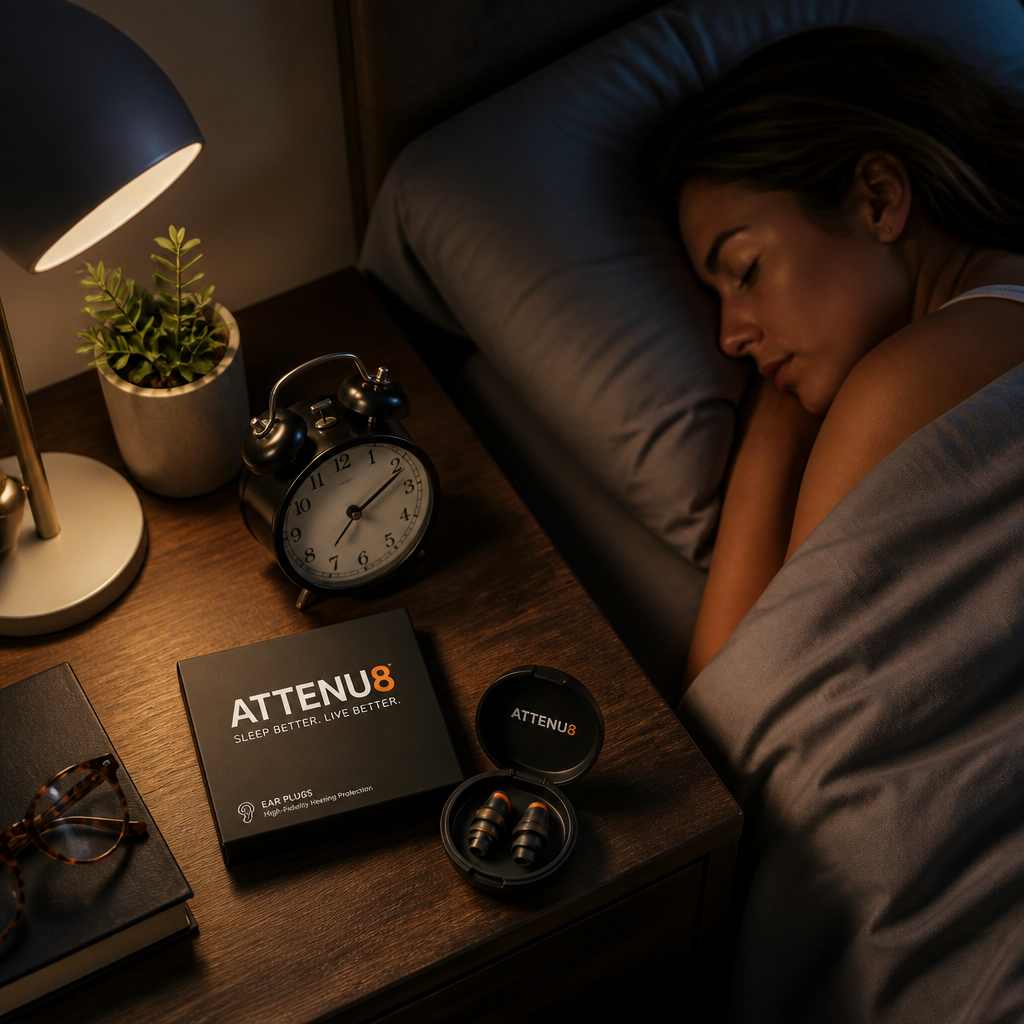
Sleep is where the safe noise level drops dramatically, and where many people are unknowingly suffering the consequences of too much ambient sound. The WHO recommends less than 30 dB inside bedrooms during the night to allow quality sleep. For context, a quiet rural night sits around 20-30 dB. A typical residential area with ambient traffic easily pushes 40-50 dB. That gap matters.
A snoring partner is one of the most common noise complaints among light sleepers, and the numbers explain exactly why. Average snoring typically sits in the 60-80 dB range. Severe snoring can push well beyond that. At those levels, you are not experiencing “some background noise.” You are experiencing noise equivalent to heavy city traffic, sustained throughout the night, inches from your head.
The impact is not just inconvenience. Repeated fragmentation of sleep by noise, even at levels that don’t fully wake you, reduces time spent in deep, restorative sleep stages. Over weeks and months, this contributes to chronic fatigue, impaired concentration, and measurable strain on cardiovascular health. Poor sleep driven by noise is a genuine medical issue, not just a comfort problem.
The WHO also recommends that outdoor noise levels around bedrooms not exceed 40 dB on average through the night. In practice, many people in cities face consistent outdoor noise well above this, from traffic, neighbours, and general urban activity. The bedroom is supposed to be a refuge. For many people, it isn’t.
For anyone in this situation, the most direct solution is reducing the noise that reaches your ears. Thicker curtains and better window seals help at the room level. But if the noise source is inside the room, as with a snoring partner, or if your environment simply doesn’t allow structural changes, wearing quality ear plugs with proven noise reduction is the most reliable and immediate intervention available.
A 32 dB noise reduction rating, such as that delivered by ATTENU8’s aluminium-bodied ear plugs with memory foam tips, brings a 75 dB snoring environment down to a level compatible with genuine sleep. That’s not a marginal improvement. It’s the difference between six broken hours and a full night.
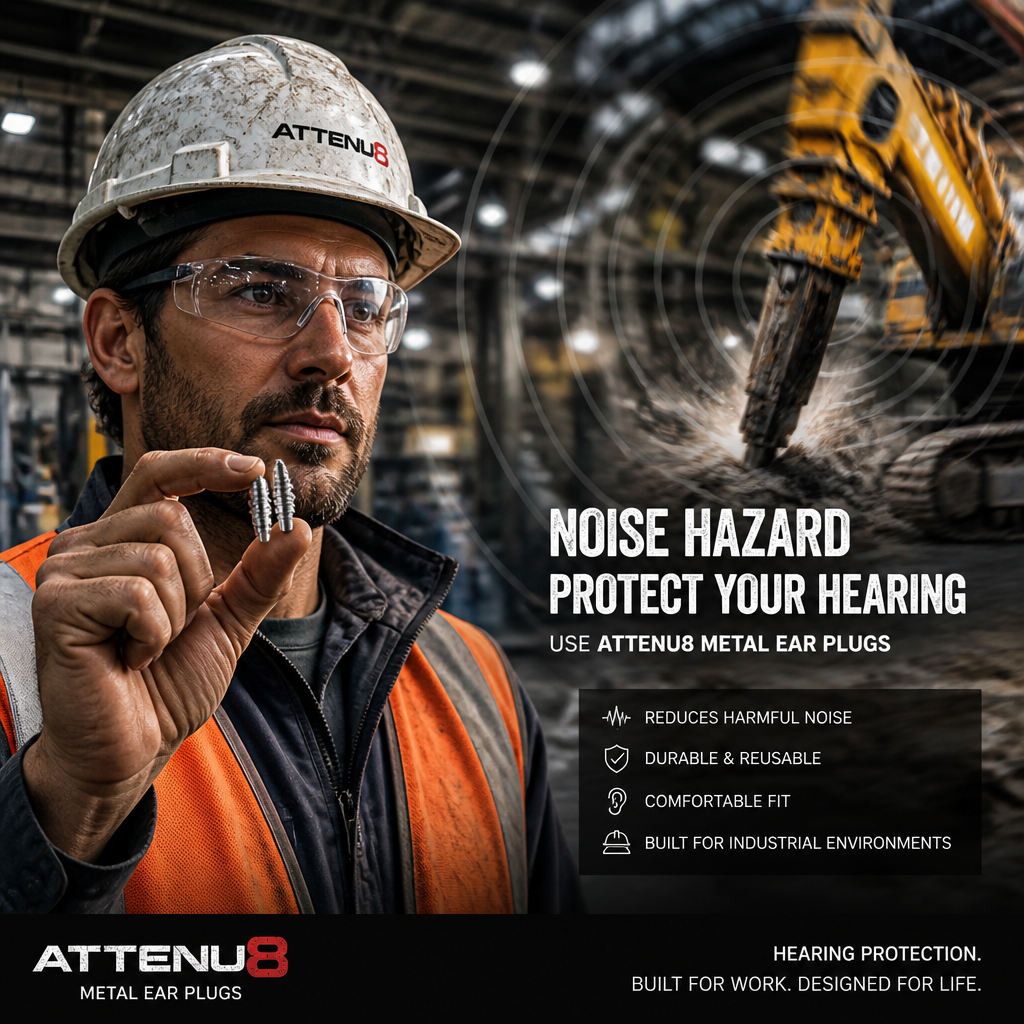
For professionals in construction, manufacturing, and military environments, the safe noise level question is not hypothetical. It’s a daily calculation with long-term consequences. NIOSH is direct: noise levels are likely hazardous if you must raise your voice to speak with someone an arm’s length away. If that describes your normal working day, your hearing is at risk.
Construction sites routinely measure 85-95 dB. Power tools, heavy machinery, compressors, and demolition equipment all push well beyond the 85 dBA threshold. An 8-hour shift on a busy site without protection is not a minor inconvenience. It is a medically significant noise exposure event. Workers who spend years in these environments without consistent protection often develop noise-induced hearing loss and tinnitus, sometimes before they reach 50.
OSHA requires employers to provide hearing protection when noise exposure at or above the 85 dBA time-weighted average is measured. But compliance and actual consistent use are different things. The practical reality is that foam ear plugs are often uncomfortable, get contaminated quickly, and are used inconsistently because workers find them irritating to wear all day. A reusable, well-fitting option that stays comfortable for extended wear changes that calculation.
Military personnel face some of the most severe noise exposures of any occupational group. Gunfire, artillery, aircraft engines, and armoured vehicle interiors produce impulsive and sustained noise well above 120 dB. Even a single unprotected exposure at these levels can cause irreversible hearing damage. Hearing loss is consistently among the most common service-connected disabilities for veterans. The ear plugs used in this environment need to perform reliably, fit securely, and be easy to insert and remove quickly when conditions change.
Pro tip: In high-noise workplaces, the Noise Reduction Rating (NRR) printed on ear plug packaging is your practical guide. An NRR of 32 means the ear plugs are rated to reduce exposure by approximately 32 dB under test conditions. In real-world use, actual protection depends heavily on fit. A poorly fitted ear plug provides far less protection than its rating suggests. This is why fit, comfort, and proper sizing matter as much as the NRR number itself.
Not all ear protection is equal. Understanding the practical differences between the main types helps you choose protection that you will actually wear consistently, which is what determines whether it works.
| Protection Type | Noise Reduction | Practical Considerations |
|---|---|---|
| Single-use foam ear plugs | Up to ~33 dB NRR (when correctly fitted) | Cheap per unit but wasteful, often poorly fitted, degrade quickly, become unhygienic with reuse |
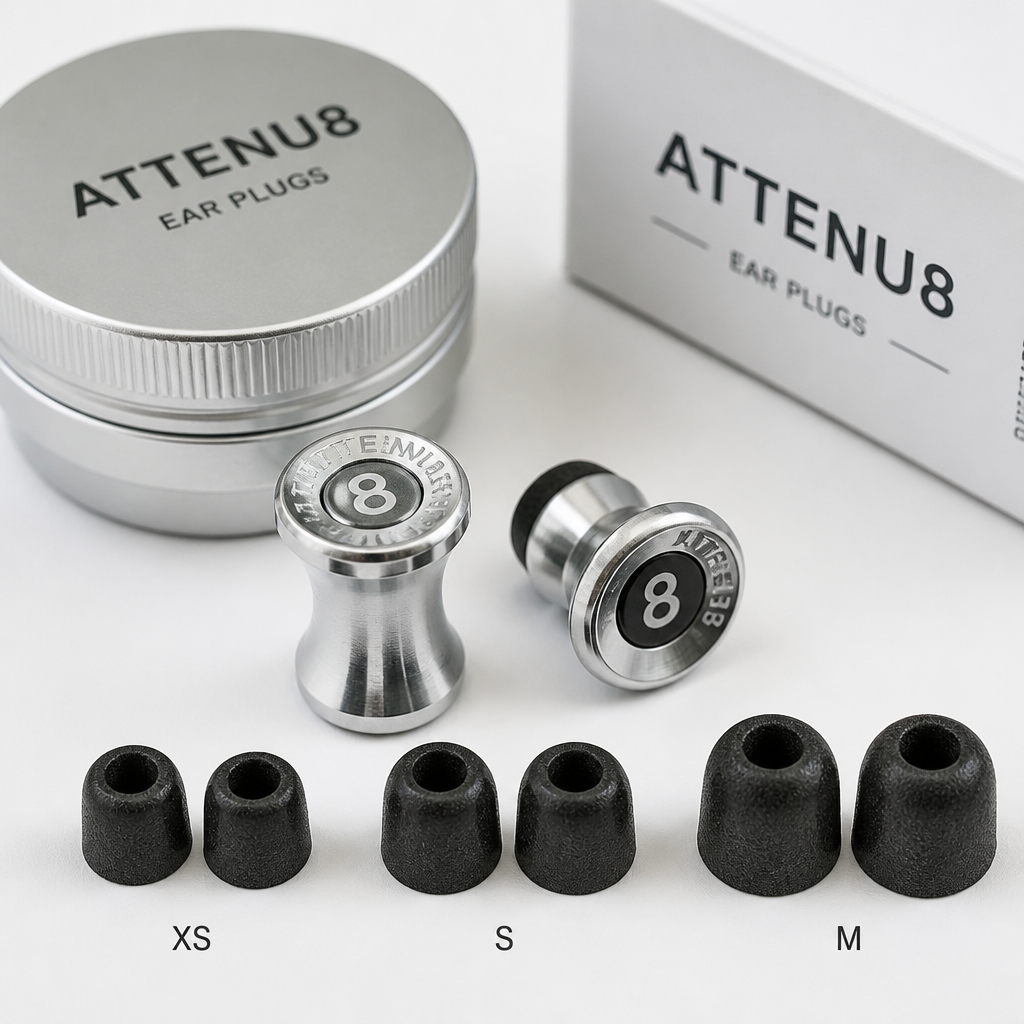
| Reusable metal-bodied ear plugs with memory foam tips (e.g. ATTENU8) | ~32 dB NRR | Durable aluminium body lasts long-term. Only foam tips need replacing every 6-8 weeks. Multiple tip sizes ensure a proper fit. Hygienic and cost-effective over time. |
| Over-ear hearing protection (ear muffs) | Typically 20-30 dB NRR depending on model | Good for short, intermittent use. Bulky, uncomfortable for extended wear, impractical during sleep or travel |
The single biggest failure mode in hearing protection is inconsistent use. People abandon ear plugs that are uncomfortable, that don’t fit properly, or that feel like a disposable afterthought. The goal of durable, well-engineered ear plugs is not just better specs on paper. It’s protection you actually wear every time the situation calls for it, whether that’s a job site, a flight, or a bed shared with someone who snores.
Hearing damage doesn’t usually announce itself with a dramatic event. It builds quietly over time. But there are reliable early warning signs that your ears have been pushed too far in a given day or over a period of months.
Ringing or buzzing after exposure: Temporary tinnitus after a concert, a power tool session, or a loud event is a signal that cochlear hair cells were stressed. If it fades within hours, no permanent damage has necessarily occurred yet. If it persists, it may indicate damage that won’t fully reverse.
Muffled hearing after noise exposure: A dulled or muffled quality to sound after a loud environment is a temporary threshold shift, the auditory system recovering from overload. Repeated episodes of temporary threshold shift contribute directly to permanent loss over time. If you’re experiencing this regularly, your environment is too loud.
Struggling to follow speech in groups: Difficulty tracking conversations in background noise, especially in restaurants or social gatherings, is often one of the first signs of early noise-induced hearing loss. It’s frequently dismissed as inattention when it is actually an early auditory impairment.
Having to raise your voice consistently: Both OSHA and NIOSH use this as a practical field test. If you must raise your voice to be understood by someone an arm’s length away, the environment is likely at or above 85 dBA. If that is your normal, your hearing is being tested every day.
Sounds at or below 70 dB are considered safe even with prolonged exposure. Normal conversation sits at around 50-60 dB, which is well within the safe range. Problems begin when sustained exposure exceeds 70-75 dB regularly, and become genuinely hazardous above 85 dB.
The NIOSH recommended exposure limit is 85 dBA over an 8-hour shift. At exactly 85 dB, 8 hours is the maximum considered safe. For every 3 dB increase above that, the recommended safe exposure time roughly halves. At 88 dB, that’s 4 hours. At 94 dB, it’s approximately 1 hour. This is why industrial and construction environments require hearing protection throughout the entire workday.
Sustained noise above 85 dB can cause hearing damage regardless of whether you’re awake or asleep, though it’s more practically significant during waking hours. The more common sleep noise problem is sleep disruption rather than hearing damage directly. The WHO recommends bedroom noise stay below 30 dB at night for quality sleep. Snoring, traffic, and urban ambient noise regularly exceed this, causing fragmented sleep and accumulating health effects over time.
NRR (Noise Reduction Rating) is the standard used in the United States, while SNR (Single Number Rating) is the European equivalent used in CE-certified products. Both express the approximate decibel reduction a hearing protector provides under test conditions. An SNR of 32, for example, means the ear plugs are rated to reduce noise exposure by approximately 32 dB. Real-world performance depends on proper fit, which is why choosing ear plugs with multiple tip sizes to suit your ear canal is important.
Reusable ear plugs with proper fit can match or exceed the noise reduction of disposable foam options. The key variable is fit. A well-sized, correctly inserted ear plug provides its full rated protection. An ill-fitting disposable plug, regardless of its NRR rating, delivers far less. Reusable ear plugs with replaceable foam tips in multiple sizes solve both problems: they maintain consistent performance and allow you to find the fit that works for your ear canal, which changes everything.
Snoring commonly reaches 60-80 dB, with severe cases exceeding that. The WHO recommends bedroom noise below 30 dB for quality sleep. The gap between where snoring sits and where sleep-quality noise should sit is significant. Wearing ear plugs rated at around 32 dB noise reduction brings even a moderately loud snoring environment down to a range that allows genuinely restorative sleep.
If you’ve ever woken up frustrated, exhausted, or wondering whether what you’re hearing at work or at night is actually harming you, we’d like to hear about your experience. Leave a comment or share your situation below.
We would love your feedback and any insights you would share with others. What perspective would you add?

