


 0

Noise-induced hearing loss in the workplace is not an abstract risk. It is the most prevalent occupational health problem in the United States, quietly stripping millions of workers of a sense they will never fully recover. An estimated 22 million workers in the United States are exposed to hazardous noise levels every working day, and roughly 40 million American workers have already recorded hearing test findings that indicate damage. Despite decades of regulation, compliance guidance, and available protection technology, occupational hearing loss continues to climb. This guide cuts through the noise, laying out exactly what employers must do, what workers need to know, and how to choose protection that actually holds up on the job.
| Key Insight | Explanation |
|---|---|
| OSHA’s action level is 85 dBA (8-hour TWA) | At this threshold, employers in general industry must enroll affected workers in a hearing conservation program, even before noise reaches the legal limit. |
| The permissible exposure limit (PEL) is 90 dBA | Exposures above 90 dBA averaged over 8 hours require immediate engineering or administrative controls, not just ear protection. |
| Noise-induced hearing loss is permanent | Damaged hair cells in the inner ear do not regenerate. Prevention is the only cure, making early-stage protection critical. |
| 53% of noise-exposed workers report not wearing hearing protection | Availability of protective equipment is not the problem. Fit, comfort, and compliance culture are the real barriers. |
| Reusable ear plugs outperform disposable foam in long-term use | Disposable foam degrades with each use and is frequently worn incorrectly. A well-fitted reusable plug with a consistent seal delivers more reliable protection shift after shift. |
| Construction sub-sectors show hearing loss rates above 25% | Highway, street, and bridge construction workers have among the highest prevalences of occupational hearing loss of any sector studied. |
| Dual protection adds 5-10 dB of additional reduction | Wearing earplugs and earmuffs together is appropriate for extremely loud environments, and OSHA allows employers to estimate combined protection by adding 5 dB to the highest-rated device. |
Noise-induced hearing loss (NIHL) is a slow, progressive deterioration of the inner ear caused by repeated or sustained exposure to loud sound. Unlike a sudden acoustic trauma, occupational NIHL typically accumulates over years without a single memorable moment of injury. Workers often do not notice significant decline until they begin struggling to follow conversations or find themselves turning up the television volume at home.
The damage happens inside the cochlea, where tiny hair cells convert sound waves into nerve signals. Prolonged exposure to excessive noise levels destroys these hair cells. They cannot regenerate. The loss is permanent, and it is cumulative. Every unprotected hour in a loud environment adds to the total damage already done.
Tinnitus, a persistent ringing or buzzing in the ears, frequently accompanies noise-induced hearing loss and can be more immediately debilitating than the hearing loss itself. It disrupts sleep, concentration, and mental wellbeing. Hearing conservation programs that focus only on audiogram thresholds often underserve workers because they do not adequately address tinnitus awareness and prevention.
OSHA’s occupational noise exposure standard (29 CFR 1910.95 for general industry) establishes two pivotal thresholds. Understanding the difference between them is not optional for any employer with workers in loud environments.
When workers experience an 8-hour time-weighted average (TWA) noise exposure of 85 dBA or higher, employers must implement a hearing conservation program. This includes noise monitoring, audiometric testing, provision of hearing protection devices, training, and recordkeeping. The action level is a warning line, not a safe one, and the obligation to act kicks in well before noise reaches the permissible limit.
The permissible exposure limit (PEL) is a TWA of 90 dBA over 8 hours. Above this threshold, engineering controls and administrative controls must be the first line of response. Hearing protection alone is not an acceptable substitute if engineering solutions are feasible. The permissible exposure time drops sharply as noise increases: 95 dBA allows only 4 hours, 100 dBA allows 2 hours, 105 dBA allows 1 hour, and 115 dBA is the absolute ceiling regardless of duration.
Construction is governed by a separate OSHA standard. In construction, engineering or administrative controls are required when exposures exceed 90 dBA for an 8-hour shift, and hearing protection must be provided when controls are not feasible or do not reduce noise to safe levels. Given the fluid, multi-employer nature of construction sites, compliance monitoring is both more difficult and more important.
Pro tip: OSHA does not “approve” specific hearing protection devices. The employer’s obligation is to provide equipment capable of reducing noise exposure to safe levels. Choosing a device with an appropriate Noise Reduction Rating (NRR) for the specific environment is the employer’s responsibility, not a regulator’s.
Hazardous noise exposure is not limited to the most obvious industries. Occupational hearing loss surveillance data identifies consistent high-risk sectors that every safety program should prioritize.
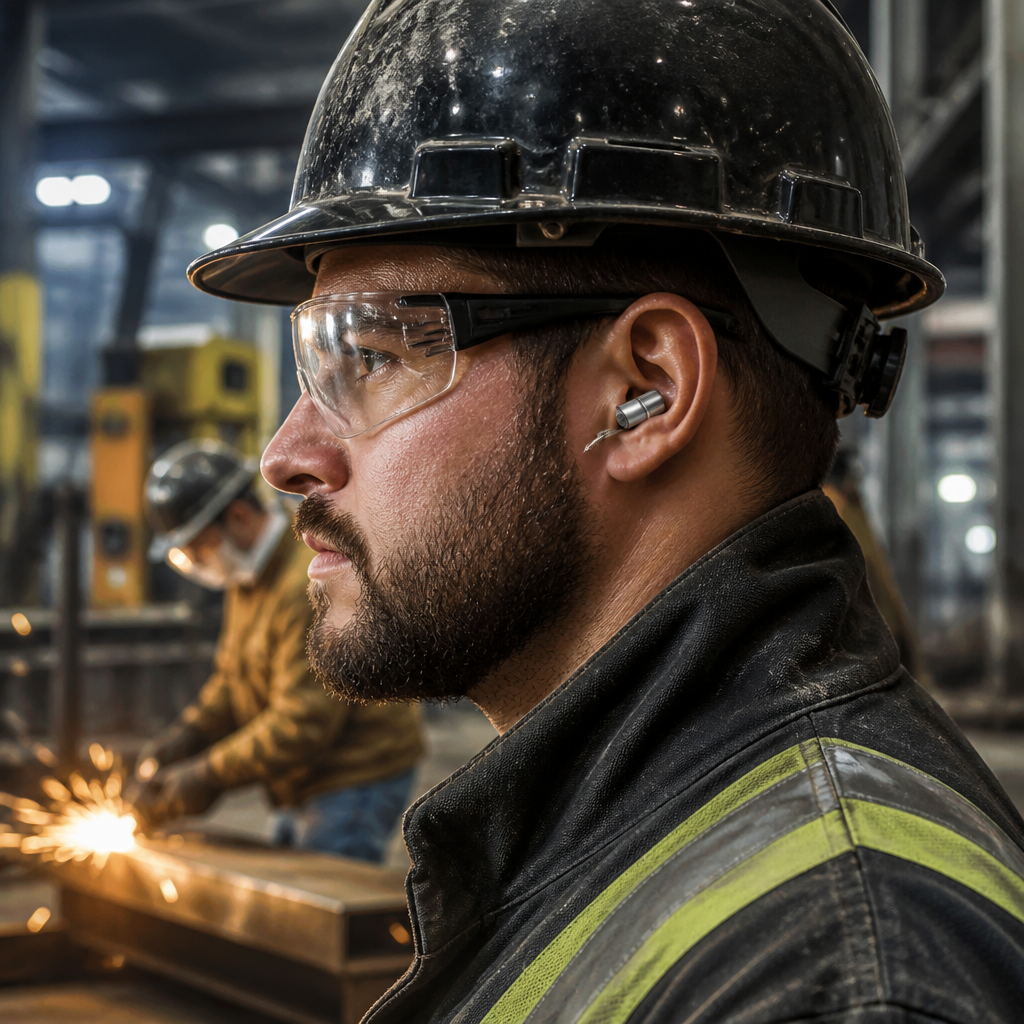
Construction carries some of the most severe occupational hearing loss rates of any sector studied. A NIOSH study covering data from 2010 to 2019 found that sub-sectors including highway, street, and bridge construction (28%), site preparation contractors (26%), and new single-family housing construction (25%) had among the highest prevalences of hearing loss in the entire construction industry. Pile drivers can reach 101 dB at distance, rock drills 98 dB, and front loaders 96 dB, and these are not momentary exposures. Workers on active sites face sustained noise from multiple sources simultaneously.
Manufacturing encompasses an enormous range of noise environments, from stamping and pressing operations to CNC machining and assembly lines. The sustained nature of manufacturing noise, combined with long shift durations, means cumulative daily exposures regularly exceed safe thresholds without any single dramatic event. Mining and manufacturing workers consistently show high prevalences across decades of audiogram review data.
Military personnel face impulse noise from firearms and explosives in addition to sustained noise from vehicles and aircraft. Impulse noise is particularly damaging because it is brief enough to escape TWA-based monitoring but intense enough to cause immediate cochlear damage. Workers in this category frequently present with both high-frequency hearing loss and tinnitus simultaneously.
Pro tip: Any occupational environment where workers routinely raise their voices to be heard at arm’s length is likely exceeding the 85 dBA action level. That single observation is a reasonable field trigger to initiate formal noise monitoring, even before dosimeter data is available.
A hearing conservation program (HCP) is not a folder of paperwork stored in an HR filing cabinet. Done correctly, it is an active, living system that continuously identifies exposure, reduces risk, and tracks outcomes over time. OSHA’s required elements provide the skeleton. Effective implementation requires genuine commitment from management and a culture where workers understand why protection matters.
The first step is establishing which workers are actually exposed at or above 85 dBA TWA. Personal noise dosimeters are the most accurate tool for this because they capture the full range of noise a worker encounters during a real shift rather than point-in-time measurements from a sound level meter. All employees found to be exposed to a single 8-hour TWA of 85 dBA or greater must be enrolled in the HCP. Monitoring must be repeated whenever process, equipment, or controls change in ways that may affect exposure levels.
Baseline audiograms establish each worker’s hearing profile before significant occupational exposure. Annual audiograms detect standard threshold shifts, which are defined as an average change of 10 dB or more in hearing sensitivity at specific frequencies. Catching a standard threshold shift early allows for intervention before the loss becomes functionally significant. A common failure in HCP administration is treating audiometric testing as a checkbox exercise rather than a diagnostic tool that should trigger follow-up action.
Workers must receive training at the time of enrollment in the HCP and annually thereafter. But the format matters enormously. Generic safety videos watched in a break room produce worse retention than brief, task-specific conversations at the worksite. Effective training connects the specific noise sources in that worker’s environment to specific risks and specific protective actions they can take today. Abstract statistics do not motivate behavior change. Concrete, personalized risk information does.
OSHA requires that noise exposure measurement records be retained for two years and audiometric test records for the duration of employment. These records are not just compliance artifacts. Longitudinal audiogram data is the only way to detect trends in hearing loss across a workforce and evaluate whether the HCP is actually protecting people.
Hearing protection is only effective when it is actually worn, worn correctly, and provides adequate attenuation for the specific noise environment. All three conditions must be met simultaneously. In practice, failing any one of them renders the device nearly useless.
The Noise Reduction Rating (NRR) is a single-number estimate of how much noise a device reduces under ideal laboratory conditions. The maximum NRR for earplugs is 33; for earmuffs it is 31. However, real-world performance is consistently lower than laboratory ratings because fit varies, insertion technique varies, and workers often remove protection during periods they perceive as “not that loud” but which still accumulate exposure.
OSHA uses a derating approach when estimating real-world protection from the NRR. Working from NRR values as-stated provides a more conservative and practical baseline for calculating whether a chosen device achieves the required attenuation in a specific environment.
The NRR number on the packaging is irrelevant if the device does not seal. A disposable foam earplug rolled and inserted correctly in a controlled setting delivers reasonable attenuation. That same earplug, pushed in partially by a worker who is cold, wearing gloves, and in a hurry, delivers a fraction of its rated protection. This is not a theoretical risk. It is the dominant practical reason why a large proportion of noise-exposed workers still develop hearing loss despite having access to hearing protection.
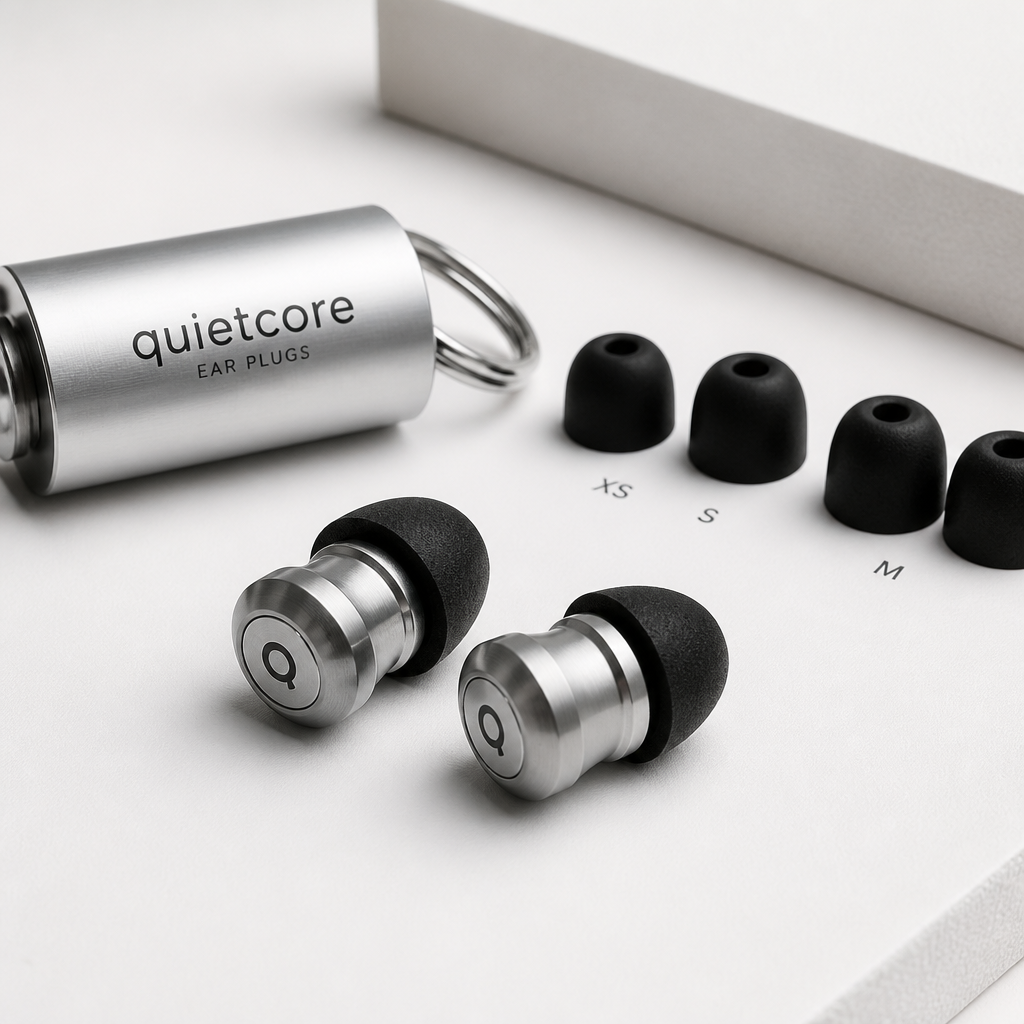
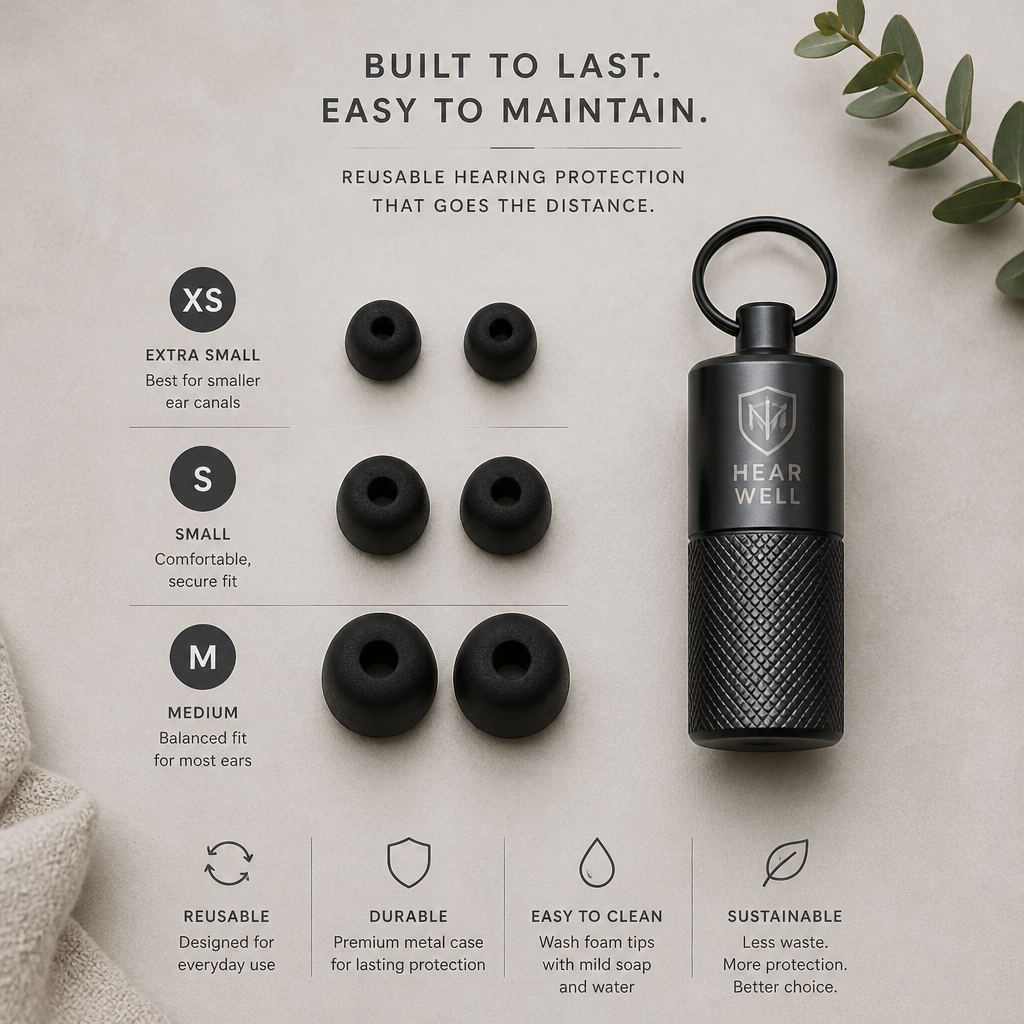
Reusable metal-bodied earplugs, such as those made by ATTENU8, address this problem through design. The rigid aluminium shell maintains its shape and the acoustic seal geometry regardless of how the worker handles it. The soft memory foam tips conform to the individual ear canal on insertion and hold their position during the shift. With three tip sizes included (XS, S, and M), fit can be individually optimized rather than forcing every worker into a one-size default. The result is approximately 32 dB of noise reduction that is consistent from day one to day three hundred.
Disposable foam earplugs are not washable and lose their acoustic properties as they compress, soil, and deform. A reusable earplug with replaceable foam tips changes the economics and hygiene profile entirely. ATTENU8’s foam tips require replacement roughly every 6 to 8 weeks rather than after each use, keeping ongoing costs low while ensuring the acoustic performance remains predictable. The metal body itself does not degrade, meaning the investment in the device is a long-term one.
The most reliable hearing protector is the one the worker will actually wear correctly, every hour of every shift. Comfort and usability are not secondary concerns. They are the primary determinants of real-world effectiveness.
| Protection Type | Key Strengths | Key Limitations |
|---|---|---|
| Single-use disposable foam earplugs | Low upfront cost, widely available, no cleaning required | Frequently inserted incorrectly, performance degrades with use, significant ongoing waste, cannot be individually sized |
| Reusable metal-bodied earplugs (e.g., ATTENU8) | Consistent shape and seal, durable construction, multiple tip sizes for individual fit, low long-term cost, up to ~32 dB NRR | Higher initial cost, foam tips require periodic replacement every 6-8 weeks, worker must carry and store the device |
| Over-ear earmuffs | Easy to put on and remove, no insertion technique required, suitable for intermittent exposure | Bulky, uncomfortable in heat, can be dislodged by PPE interactions (hard hat, glasses, face shields), maximum NRR of 31 |
For workers in continuous noise environments where earplugs will be worn for a full shift, a well-fitted reusable earplug with confirmed individual sizing consistently outperforms both disposable alternatives and earmuffs in terms of total daily protection. Earmuffs are most practical where hearing protection is needed intermittently and workers need to put on and remove protection frequently throughout the day.
Workers in noise-exposed roles have specific legal rights that many do not know about or exercise. Employers covered by OSHA’s noise standard must provide hearing protection at no cost to the employee, offer a choice of hearing protectors from among a suitable selection, and allow workers to observe noise monitoring procedures. Audiometric testing must also be provided at no cost.
The legal framework gives workers access to protection. Using that protection properly is the worker’s part of the equation. This means wearing hearing protection for the entire duration of exposure, not just during the loudest moments. Even brief unprotected periods in a high-noise environment can significantly reduce the effective daily protection provided by an otherwise-compliant device.
Workers should report any changes in hearing, new onset of tinnitus, or discomfort from hearing protection devices to their supervisor. These are medical indicators that the current program may not be providing adequate protection for that individual, and they trigger specific employer obligations under OSHA’s standard.
Beyond OSHA citations and financial penalties, the cost of occupational hearing loss falls on workers, employers, and the broader economy. U.S. workers’ compensation claims for occupational hearing loss have been estimated to cost employers tens of millions of dollars annually. That figure does not capture the productivity impact of a workforce with diminished hearing acuity, the increased accident risk from reduced situational awareness, or the personal cost to workers who spend their retirement years unable to hold a clear conversation with their grandchildren.
OSHA defines the action level for general industry at 85 dBA as an 8-hour time-weighted average. Exposure at or above this level requires employers to implement a hearing conservation program. The permissible exposure limit is 90 dBA over 8 hours, above which engineering and administrative controls are required as the primary response. Any environment where workers cannot comfortably hold a conversation at arm’s length without raising their voices is likely at or above the action level.
Yes. Noise-induced hearing loss results from the destruction of hair cells in the cochlea, and these cells do not regenerate in humans. The damage is cumulative and irreversible. Early-stage NIHL may not be functionally noticeable, but it accelerates further loss with continued exposure. Prevention through consistent use of appropriate hearing protection is the only effective strategy.
Under OSHA’s general industry standard (29 CFR 1910.95), employers must conduct noise monitoring when exposures may equal or exceed 85 dBA TWA, notify workers of their exposure results, implement a hearing conservation program including audiometric testing and training, provide hearing protection at no cost, and maintain records of both monitoring and audiometric data. In construction, slightly different thresholds apply under a separate OSHA standard.
Start by determining the actual noise level in the work environment using dosimetry or sound level measurement. Then select a hearing protector with an NRR sufficient to bring effective exposure below 85 dBA. Fit quality matters more than the number on the label. A reusable earplug with multiple tip sizes and a rigid body that maintains its seal geometry will deliver more consistent real-world protection than a disposable foam earplug worn incorrectly. Comfort over a full shift is not optional. It directly determines whether workers keep the protection in place.
Yes, and in very high-noise environments this dual protection approach is appropriate and sometimes required. Wearing both earplugs and earmuffs together provides an additional 5 to 10 dB of noise reduction compared to either device worn alone. OSHA allows employers to estimate the combined protection by adding 5 dB to the NRR of whichever device has the higher rating. This approach is most useful for workers exposed to noise levels well above 100 dBA for sustained periods.
Disposable foam earplugs should be replaced after each use. They are not washable, and repeated use degrades both their acoustic properties and hygiene. Reusable earplugs with replaceable foam tips, such as the ATTENU8 design, require foam tip replacement approximately every 6 to 8 weeks under regular use, while the durable metal body does not require replacement. Earmuffs should have cushions and foam inserts inspected regularly and replaced when cracked, hardened, or no longer forming a complete seal against the head.
Construction, mining, and manufacturing consistently record the highest rates of occupational hearing loss across workforce audiogram studies. Within construction specifically, highway and street construction, site preparation, and residential housing construction sub-sectors show prevalences of hearing loss above 25% among noise-exposed workers. Military personnel face particularly complex noise exposures combining sustained machinery noise with acute impulse noise from weapons systems, producing high combined rates of hearing loss and tinnitus.
Have you dealt with hearing conservation compliance challenges in your workplace, or switched from disposable to reusable ear protection? Share what worked for you in the comments below.

