


 0

You fall asleep, but a car door slams outside. A neighbour’s TV bleeds through the wall. Your partner shifts and the floorboards creak. You drift off again, but the damage is already done. Most people underestimate just how much sleep and productivity are intertwined, and fewer still connect the dots between that one noisy night and the slow-motion cognitive erosion that follows them into the office, the job site, or the cockpit the next morning. The research on this is not subtle: sleep deprivation costs the U.S. economy alone an estimated $411 billion in lost productivity every year. Noise is a primary driver. And yet it remains almost entirely preventable.
| Key Insight | Explanation |
|---|---|
| Sleep deprivation is a billion-dollar productivity drain | A RAND Corporation study estimated U.S. productivity losses from insufficient sleep at approximately $411 billion per year, with around 1.23 million working days lost annually. |
| Noise disrupts sleep at very low volumes | WHO guidelines indicate that sound above 30 dB(A) for continuous background noise can impair sleep quality, well below the level most people notice consciously. |
| Noise reduces REM and slow-wave sleep specifically | Environmental noise increases light sleep stages at the direct expense of restorative slow-wave sleep and REM, the stages most critical for memory consolidation and cognitive repair. |
| Cognitive impairment from sleep loss mirrors intoxication | Research documents that sustained wakefulness produces cognitive deficits comparable to being legally drunk, affecting decision-making speed, memory recall, and sustained focus. |
| Noise sleep deprivation has measurable next-day effects | Studies show that road traffic noise during sleep leads to decreased perceived sleep quality, impaired mood, and slower reaction times the following day. |
| Even one poor night compounds across the week | Chronic partial sleep restriction accumulates cognitive debt that a single weekend recovery sleep cannot fully reverse, making every noisy night a compounding performance liability. |
| Blocking noise at the source is the most direct fix | Unlike white noise masking or environmental renovation, high-attenuation ear protection worn during sleep targets the problem at the point where noise enters the body. |
Most productivity conversations focus on tools, habits, and time management. Sleep rarely gets the same attention, despite carrying more leverage over daily output than almost any other single factor. When researchers at RAND Corporation modelled the economic impact of sleep insufficiency across five countries, they found that the U.S. alone loses up to $411 billion per year in productivity, representing about 2.28 percent of GDP. Around 1.23 million working days are lost annually as a direct result of sleep insufficiency.
The individual-level numbers are just as striking. Research cited by occupational health sources suggests a poor sleeper costs their employer roughly $2,280 more per year than a well-rested counterpart, both in performance losses and health-related costs. Fatigue at work across the U.S. workforce is estimated to cost companies around $136 billion annually in lost productive time. These are not rounding errors. They are structural drags on output that most organisations are treating as invisible.
The reason sleep quality work performance is so tightly coupled comes down to what sleep actually does. It is not passive downtime. It is the period when the brain consolidates memory, clears metabolic waste, restores emotional regulation, and primes the prefrontal cortex for the kind of high-order reasoning that demanding jobs require. Skip it, and you are not just tired. You are operating with a demonstrably impaired instrument.
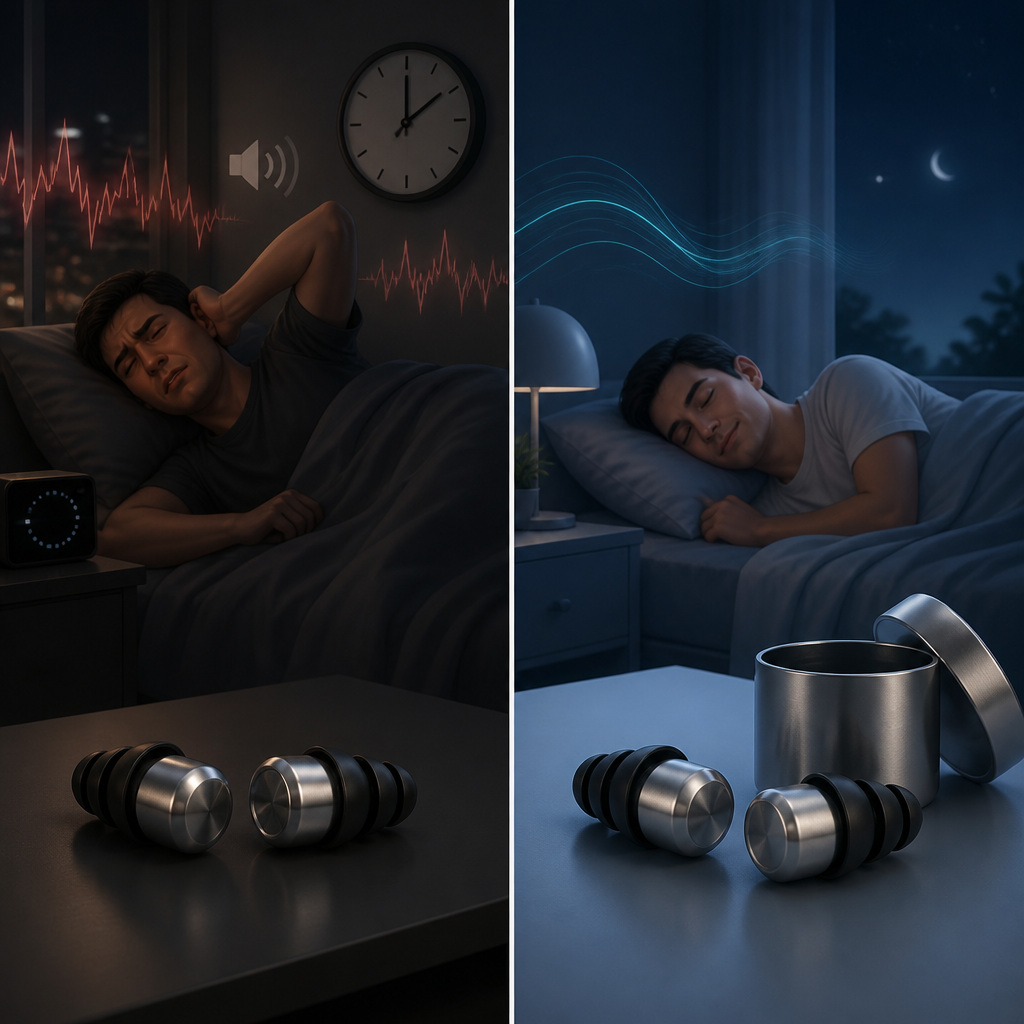
Noise does not need to wake you up fully to cause harm. That is the part most people miss. You can sleep through a noise event and still suffer measurable physiological consequences from it. Research published in peer-reviewed sleep and health journals shows that even during sleep, the auditory system remains active and responsive. A noise event triggers a cascade: increased brain activity, body movement, elevated blood pressure and heart rate, and a release of stress hormones, all without you ever becoming consciously aware of it.
The World Health Organization recommends that continuous background noise should not exceed 30 dB(A) during sleep, and that individual noise events should stay below 45 dB(A). To give those numbers context: a quiet bedroom with a ticking clock sits around 30 dB. Busy street traffic registers around 70 dB. A subway train hits 90 dB. Most urban and suburban bedrooms regularly exceed the WHO’s recommended sleep threshold.
The cruelest part of noise sleep deprivation is what it steals. Environmental noise specifically reduces slow-wave sleep and REM sleep, pushing the brain into lighter stages instead. These deeper stages are not just more restful in a vague sense. Slow-wave sleep is when the brain consolidates procedural and declarative memory. REM sleep is when emotional processing and creative problem-solving are rehearsed. Lose enough of them, and the effect accumulates night after night.
During the active waking phase, your body requires a higher noise intensity to trigger a stress response than it does during sleep. This asymmetry is important because it explains why people routinely underestimate how noise-damaged their sleep actually is. You feel like you slept through it. The data from a polysomnogram would tell a different story: more arousals, less deep sleep, a night profile that looks shallower than it should.
Reducing indoor noise levels can increase the amount of slow-wave sleep and REM sleep. After a noise-disrupted night, next-day effects include decreased perceived sleep quality, impaired mood, and slower reaction time.
Pro tip: If you wake up feeling unrested despite what seemed like a full night of sleep, noise arousals are a primary suspect. You do not need to remember waking up for noise to have fragmented your sleep architecture.
The cognitive consequences of disrupted sleep are well-documented and show up in the exact capabilities that professional performance depends on. Research published in peer-reviewed neuroscience journals confirms that sleep deprivation significantly impairs sustained attention and reaction time. A 2025 study in Frontiers in Neuroscience found that acute sleep deprivation prolonged reaction time in participants by over 83 milliseconds on auditory tasks, a difference that in real-world settings translates to missed cues, delayed responses, and compounding errors.
Sleep-deprived workers show measurable decline in: decision-making speed, working memory, emotional regulation, sustained concentration, creative problem-solving, and judgment under pressure. The emotional regulation piece is consistently underappreciated. A tired person does not just think more slowly. They become more reactive, less tolerant of ambiguity, and less capable of collaborative work. Meetings get longer. Conflicts escalate more easily. Projects stall.
Research has also documented that operating on chronically insufficient sleep produces cognitive deficits comparable to being legally intoxicated. Yet the person experiencing them often does not recognise the level of their own impairment. This is one of the most operationally dangerous aspects of the problem: unlike intoxication, sleep-deprived people tend to believe they are performing fine.
A single bad night is recoverable. Chronic exposure to nighttime noise, the kind that shaves 30-45 minutes off your deep sleep every night for months, is not something you simply sleep off on a Sunday. Cognitive debt accumulates, and the research on chronic shift workers, who experience ongoing sleep disruption, shows that they develop persistent performance deficits even after what they report as adequate sleep. For anyone sharing a room with a snorer, living near a main road, or sleeping in a thin-walled apartment, this is not a hypothetical.
Not all sleep-noise sufferers are in the same position. But certain groups face amplified consequences that make the stakes considerably higher than a groggy morning.
Light sleepers spend more time in shallower sleep stages by default, which means any intrusive noise has a higher probability of triggering a full arousal or microarousal. Their sleep architecture is already less robust. Add a noisy environment and the margin between a functional night and a broken one narrows to almost nothing. Shift workers compound this with circadian misalignment, making noise protection during daytime sleep especially critical.
Construction workers, military personnel, and manufacturing operators often face a double exposure: occupational noise during work hours followed by insufficient or disrupted recovery sleep. The performance degradation that results is not abstract. Slower reaction times and impaired judgment in high-noise, high-risk workplaces directly increase the probability of accidents and injury. For this population, sleep is not a lifestyle preference. It is a safety input.
Pro tip: If your job requires sustained attention, rapid decision-making, or physical coordination, protect your sleep with the same seriousness you apply to your hearing protection at work. The risks of sleep deprivation on job performance are just as quantifiable.
There are several approaches people use to reduce noise during sleep. They are not equivalent. The right choice depends on the consistency of noise exposure, the noise frequency range involved, and how much disruption the sleep environment generates every night.
| Approach | Noise Reduction Effectiveness | Practical Considerations |
|---|---|---|
| Disposable foam ear plugs | Moderate (typically 25-33 dB NRR depending on brand and fit). Effective when correctly inserted. | Single-use design creates significant ongoing cost and waste. Fit consistency varies with each insertion. Material degrades quickly. Not suitable for daily long-term use without frequent replacement. |
| White noise machines or apps | Masking effect only. Does not reduce decibel level. Effectiveness depends on relative volume between masking sound and intrusive noise. | Works well for low-level ambient noise. Less effective against sudden peaks (traffic, snoring). Adds sound rather than removing it. No protection value in occupational settings. |
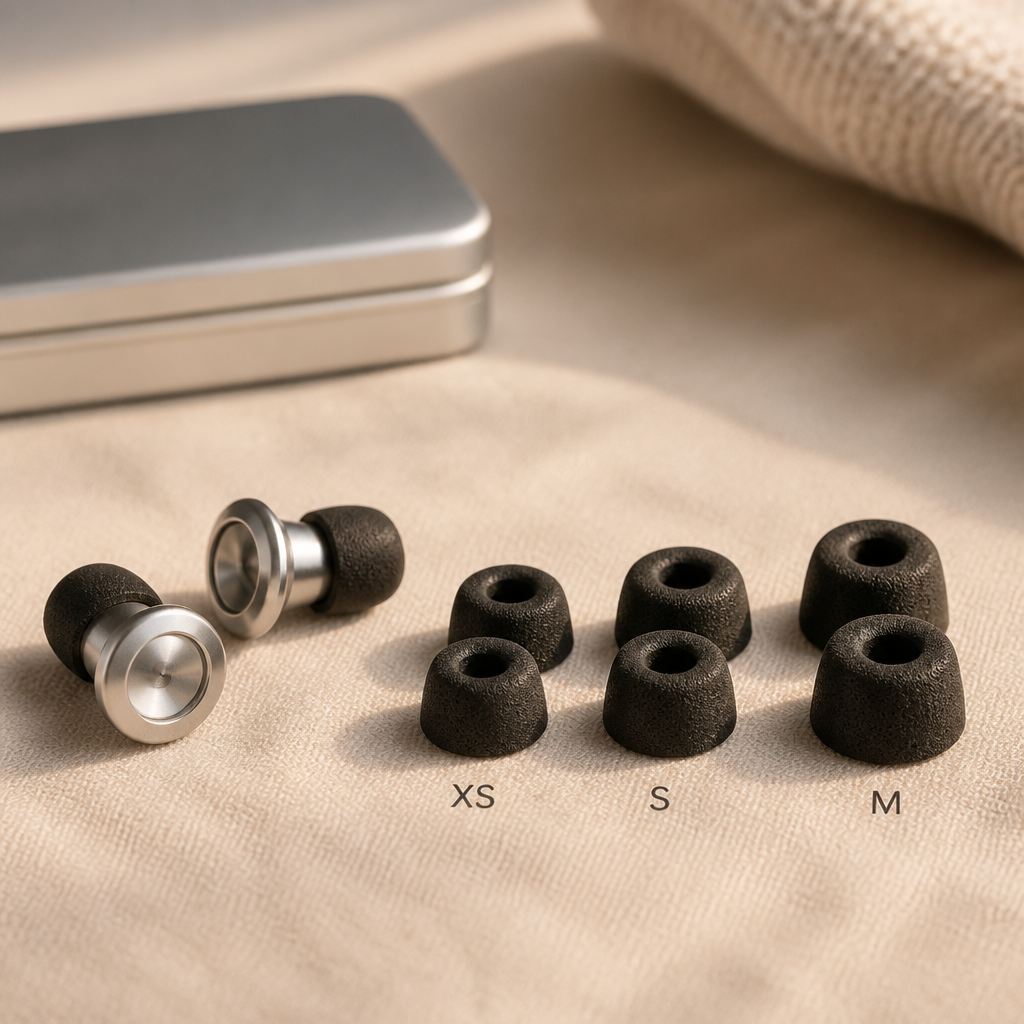
| Premium reusable ear plugs with memory foam tips | High and consistent, up to approximately 32 dB NRR. Consistent fit achieved via sized foam tips (XS, S, M) that conform to ear canal shape. | Durable metal body lasts significantly longer than disposable alternatives. Foam tips require replacement every 6-8 weeks rather than after each use. Suitable for nightly use, travel, and occupational environments. Higher initial cost, substantially lower long-term cost. |
The comparison above reflects a practical reality: masking noise and blocking noise are fundamentally different strategies. Masking works by introducing a competing sound. Blocking works by physically attenuating the sound wave before it reaches the eardrum. For anyone dealing with intermittent high-intensity noise events, the type most likely to cause sleep-disrupting arousals, blocking is the more effective approach.
If you want to improve sleep quality, start with the environment, not the supplement stack or the sleep hygiene checklist. Most sleep hygiene advice assumes a quiet room. For people who do not have one, it is partially irrelevant. Getting the noise problem solved first creates the conditions where everything else can actually work.
Spend one week paying deliberate attention to what wakes you, or what you suspect might be waking you without your conscious awareness. Common sources include partner snoring or movement, traffic and street noise, air conditioning and plumbing, thin walls between apartments, and early morning deliveries or bin collections. Once you know the source, you can match the solution to the problem rather than guessing.
A noise reduction rating of 32 dB brings a 70 dB traffic noise environment down to roughly 38 dB at the ear, which sits just above the WHO’s individual event threshold for sleep. That represents a meaningful improvement that moves you into a range where restorative sleep stages become achievable. For louder environments, pairing ear protection with some room-level mitigation (heavy curtains, weatherstripping on windows) gets you further.
The ATTENU8 approach takes this seriously. The aluminium-bodied reusable design provides consistent attenuation night after night because the structure does not degrade the way disposable foam does. Three foam tip sizes allow a proper fit regardless of ear canal dimensions, and that fit consistency directly determines how reliably the 32 dB attenuation is actually delivered. A poorly fitting ear plug that delivers 15 dB in practice is not the same product as one delivering 32 dB. The fit and attenuation mechanism matters as much as the stated NRR.
A common mistake with reusable ear plugs is neglecting tip replacement. The memory foam degrades with use and washing, which reduces both hygiene and acoustic performance. Replacing foam tips every 6-8 weeks keeps attenuation consistent and maintains the comfort that determines whether you actually wear them every night or abandon the habit after a week. Explore the full range of replacement options to build this into a simple routine.
Pro tip: Keep a spare set of foam tips on your bedside table. The moment they start feeling less comfortable or less snug, replace them. The cost of a foam tip is trivial compared to the cost of one week of degraded sleep performance at work.
Most adults require between seven and nine hours of sleep per night to maintain full cognitive function. Research indicates that consistently sleeping fewer than six hours produces accumulating cognitive deficits that impair the kinds of skills most jobs depend on: sustained attention, decision-making, memory, and emotional regulation. There is no reliable evidence that people can adapt to chronic short sleep without performance consequences.
Yes, and this is one of the most important things to understand about noise sleep deprivation. The auditory system remains active during sleep. Environmental noise can trigger measurable physiological responses, including elevated heart rate, increased blood pressure, and shifts in brain activity, without ever bringing you to full wakefulness. These microarousals reduce the proportion of time spent in restorative slow-wave and REM sleep, with real effects on next-day performance.
WHO guidelines set the threshold for continuous background noise at 30 dB(A) for sleep, with individual noise events ideally staying below 45 dB(A). These are low numbers. A quiet bedroom fan can sit at or near the continuous threshold. Street traffic, snoring, and plumbing sounds regularly exceed it. The practical implication is that most urban and suburban sleeping environments are noisier than they need to be for genuinely restorative sleep.
Premium reusable ear plugs with correctly sized memory foam tips deliver comparable or superior attenuation to standard disposable foam plugs, with one important practical advantage: fit consistency. Disposable plugs rely on a roll-and-insert technique that produces variable results. A reusable plug with a fitted, maintained foam tip delivers more predictable attenuation every night, which matters for anyone using them as a systematic sleep quality tool rather than an occasional fix.
The effects are broad but most pronounced in the domains of sustained attention, working memory, decision-making speed, and emotional regulation. These are the precise functions that deteriorate under sleep pressure. Improving sleep quality means more time spent in restorative sleep stages, which supports memory consolidation, clearer thinking under pressure, faster reaction times, and a measurably calmer, more focused presence at work. The downstream effects on error rates, interpersonal friction, and creative output are all real and documented.
Yes, when used correctly and maintained properly. The key practices are choosing the right tip size for a comfortable fit (not over-inserted), replacing foam tips regularly to maintain hygiene and performance, and keeping the plugs clean. A well-fitting, well-maintained reusable ear plug causes no long-term issues with regular nightly use. Discomfort is almost always a function of poor fit, which is resolved by selecting the right tip size from the XS, S, or M options available.
Noise is consistently identified as one of the top factors disrupting adult sleep, alongside temperature, light, and stress. It is also one of the most practically addressable. You cannot always control your work schedule, your anxiety levels, or your bedroom temperature without significant life changes. You can control whether disruptive sound reaches your ears during sleep with a reliable ear plug. That makes it one of the highest-return interventions available, particularly for light sleepers and anyone in a noisy environment.
Have you noticed a direct connection between noisy nights and your ability to focus or make decisions the next day? Share your experience below.

