


 0

The ATTENU8 earplugs story starts with a simple frustration: most foam earplugs are cheap, work well for a night or two, and get thrown away long before they stop being useful. For light sleepers, shift workers, and anyone who spends time near loud machinery, that cycle gets expensive and uncomfortable fast. The ATTENU8 approach was to build a reusable pair with a solid aluminium body and replace only the foam tips. Crowdfunding put the idea in front of backers first, which forces a team to answer hard questions about fit, fulfilment, and replacement tips long before a retail shelf does.
| Key Insight | Explanation |
|---|---|
| The metal body is the long-life part | The aluminium body is designed for reuse, so your ongoing cost is the foam tips, not a new plug each time. |
| Budget for tips every 6 to 8 weeks | Nightly users will go through roughly six to nine sets of tips per year, so plan replacement stock in advance. |
| Fit sets the real attenuation | The 32dB rating only applies when the tip seals the ear canal, so test all three sizes before you rely on them. |
| Ratings are not interchangeable | Different regions and test methods produce different numbers, so compare products only when you know how each figure was measured. |
| Match the plug to the job | Sleep, flights, live music, and industrial work each need a different balance of comfort and reduction. |
| Early feedback is a design tool | Repeated questions from early backers reveal where instructions, packaging, or sizing guidance need to change. |
| Medical signs override any plug | Ear pain, discharge, or sudden hearing change should be checked by a clinician before you use any earplug regularly. |
Most people meet earplugs as a disposable item. You buy a bag, use a pair, and replace them when they stop expanding or start feeling gritty. ATTENU8 takes a different route, with a concave aluminium body as the long-lived part and three sizes of memory foam tips as the consumable.
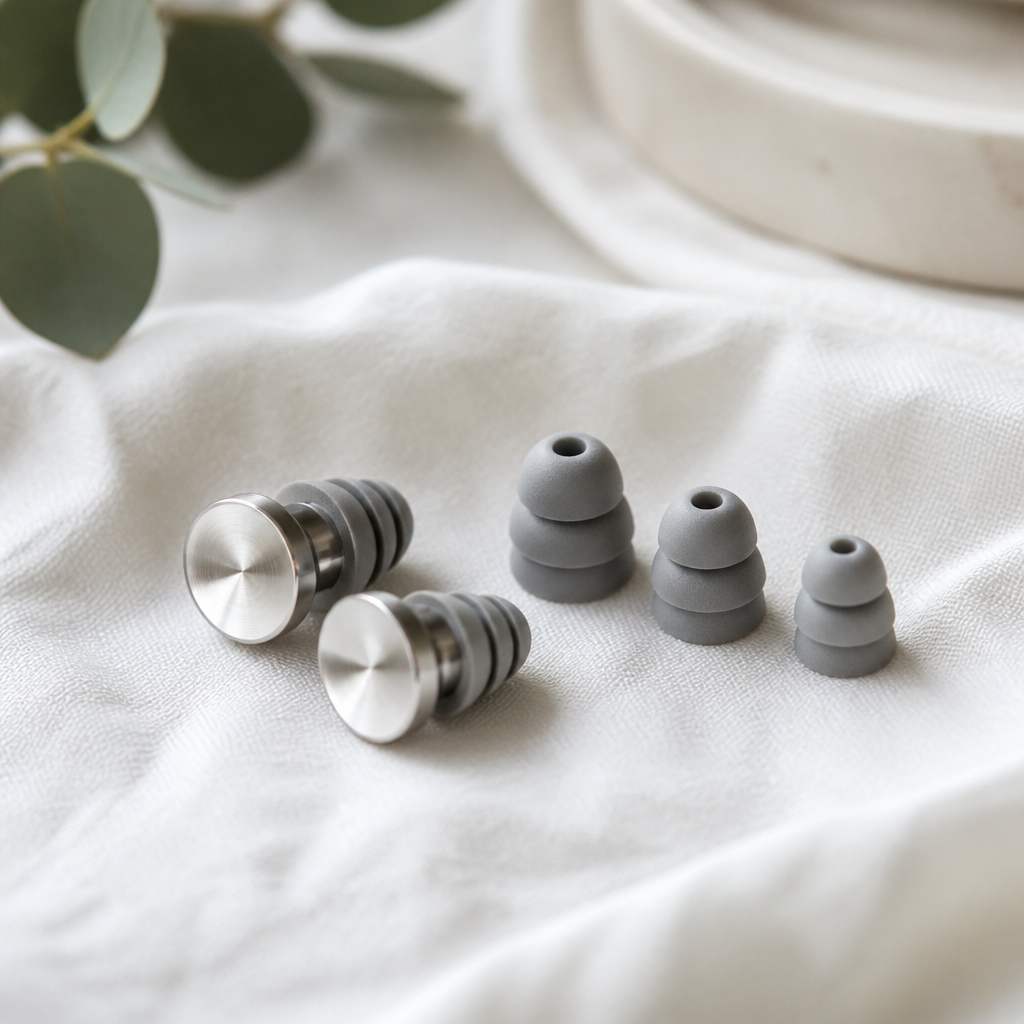
In the original press coverage, the company described a metal body that lasts for years while the tips are expected to last six to eight weeks. Those figures match the replacement schedule the brand gives customers today. The body is built to be reused, and the tips are the part expected to wear out.
A rigid body does two jobs. It holds a consistent shape in the ear canal, so the seal does not drift when you turn over at night. It also gives you a firm grip for insertion and removal, which is harder with a soft foam plug that collapses between your fingers. The product is described as offering balanced noise reduction across the frequency range, with a rating of about 32dB, rather than simply blocking the loudest sounds.
Balanced reduction matters more than a headline number. A plug that cuts high frequencies hard but lets low rumble through leaves a truck or a generator audible, and that low rumble is exactly what wakes light sleepers.
Memory foam is the trade-off. Foam conforms to the canal more readily than many rigid designs, which is why the company says the tips promise a better fit than traditional foam plugs. Foam also has a short life. It compresses, picks up earwax, and loses its recovery over time. Keeping the tips replaceable lets the metal body stay in service while the part that touches your ear gets refreshed.
The best hearing protection is the one still sealed in your ear at three in the morning, not the one with the highest number on the box.
Pro tip: Write the date you fitted new tips on the storage case. Six to eight weeks passes quickly, and a visible reminder is the most reliable way to stop using worn tips.
A crowdfunding campaign is a demand test with a deadline. A Facebook mentions page for the brand describes the first ATTENU8 campaign as reaching 360% of its funding goal. That is a strong signal that people wanted a reusable plug with a metal body. It is not proof that the product will sell the same way through a retail shelf or a repeat purchase cycle, and treating the two as the same is where many campaign teams get into trouble.
Backers buy at a different stage than most customers. They are early adopters who will tolerate rough edges and write about them. Their feedback tends to cluster around which tip size fits most people, whether the body is comfortable for side sleepers, and how the case behaves in a bag. None of that shows up in a single test session. Messages that repeat across early feedback should drive design changes faster than any one measurement.
Public questions are useful too. The brand’s Kickstarter FAQ covers how the product should be fitted and what level of comfort to expect. Questions that appear in a public FAQ show where the instructions are unclear. If the same question appears three times, the product page, packaging, or insert card needs to change, not just the reply.
The hard part comes after the pre-order. Fulfilling a campaign is a one-time logistics event. A product people reorder needs a steady supply of replacement tips, consistent packaging, and a clear route for customers who need a different size. The business case depends on whether a customer comes back in month four to buy tips, not on how quickly the first shipment left the warehouse.
A common mistake is treating the first batch of backers as the whole market. Those buyers already believe in the idea. Repeat sales depend on people who arrive with a sleep problem or a noisy job and need convincing on fit and durability alone. Plan the retail story around that second group from the start.
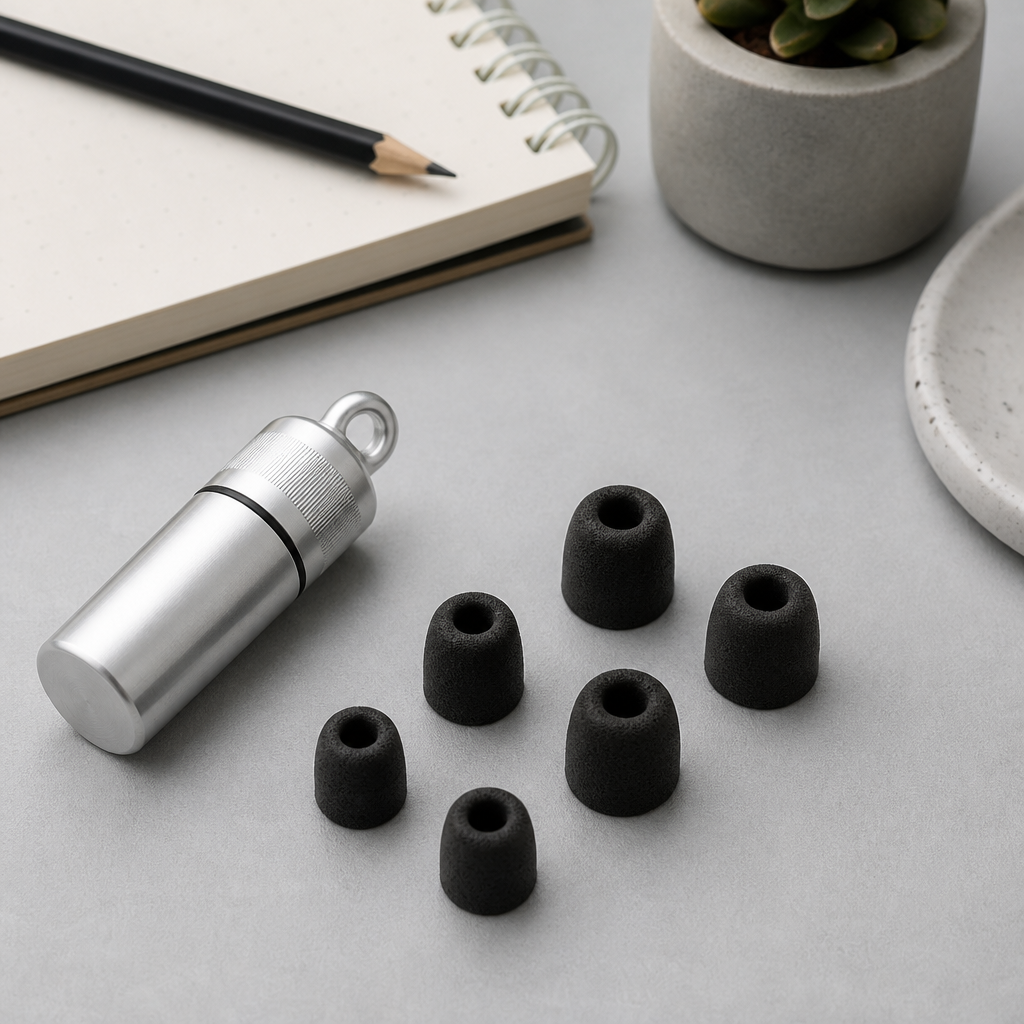
A 32dB rating is a laboratory figure, and it only applies when the tip seals the ear canal. ATTENU8 ships three sizes of memory foam tips, XS, S, and M, because canal shapes vary widely between people. Choosing the wrong size is the most common reason a reusable plug underperforms, and it is why we tell customers to test before relying on the product for sleep or work.
The official FAQ puts it plainly: when fitted correctly, the product reduces noise to more bearable levels while still giving the hearing protection you need. That sentence carries the whole instruction. Correct fit is the feature, not an add-on.
Start with the size that seals without pressure. A correct tip should feel secure but not painful, and it should not push outward when you chew or move your jaw. If the plug feels loose, step up one size. If it aches after twenty minutes, step down. Many people end up with different sizes in each ear, which is normal and worth checking rather than assuming.
A simple home test works well. Insert the plug, then listen to a low, steady sound such as a fridge hum or a fan. If the hum drops away clearly, the seal is working. If low tones still come through strongly, the tip is probably too small or sitting at an angle.
Most poor results come from insertion, not from the product itself. Pushing the body in too shallowly leaves a gap at the entrance, and forcing it too deep can irritate the canal. The foam tip needs a moment to expand fully after insertion. In practice, hold the body gently in place for several seconds until the tip settles, then check the seal before you walk away.
Another common error is inserting a tip that has been left out on a nightstand and is partly expanded. Keep the tips in the case and compress them as you insert. Dust, earwax, or moisture on the tip reduces grip, so keep the tips dry and clean.
The replacement cycle is the part of the ATTENU8 model customers ask about most. The tips are expected to last six to eight weeks, while the body is built to last for years. For someone who wears plugs every night, that means roughly six to nine sets of tips a year. Budgeting for that schedule is more realistic than assuming you will buy one pair and never think about it again.

Work out the cost of a replacement cycle rather than the price of a single set. Divide 52 weeks by the number of weeks one set lasts, and you get the number of sets per year. At six weeks per set that is about nine sets a year, and at eight weeks it is about six and a half. The number that matters most is how often you wear them, because heavier use wears tips out faster.
Wipe the metal body with a dry or slightly damp cloth after use, and let it dry before returning it to the case. Earwax is the main enemy of foam. Once a tip is stained or stiff, it rarely returns to its original seal. Store the body and tips in a dry case away from heat, since warm, humid conditions speed up foam breakdown.
Pro tip: Keep a spare set of tips in your bag or desk drawer. The worst time to discover a worn tip is the night before a long flight or the first morning of a shift that requires hearing protection.
Many customers ask whether they can rotate tips between two pairs. That only works if both sets stay clean and are not swapped between ears, since each ear canal shapes the foam differently. Label the tips if you share them between people.
Manufacturer ratings are useful, but they are not interchangeable. Different regions and test standards use different methods, and a single number can hide how a plug performs across low, mid, and high frequencies. ATTENU8 is reported with an SNR of 32, which corresponds to the roughly 32dB reduction described in product coverage. Compare that with other ratings only when you know the test method behind each figure.
A higher number means more reduction under test conditions, which is a fair starting point for sleep and loud work. It does not tell you how comfortable the plug will feel after eight hours, how it handles jaw movement, or whether the seal survives a pillow. A plug can test well and still fail in daily use if the fit is poor. Treat the rating as the ceiling of performance, not the average you will get every night.
Heavy reduction can also make speech sound muffled. That is normal, and it is why people in shared workspaces sometimes choose a lower level for everyday use and save the high-reduction option for loud tasks.
The table below compares three common approaches. The categories are generic, but they reflect the trade-offs buyers actually face when choosing between disposable, fixed-tip reusable, and replaceable-tip designs.
| Approach | Where it works well | Where it falls short |
|---|---|---|
| Disposable foam plugs | Low cost per pair, easy to find, suits one-off use | Short life, a new pair each time, fit becomes inconsistent if reused |
| Reusable plugs with fixed silicone tips | Long life, easy cleaning, no foam to replace | Fit depends heavily on the canal, and comfort can vary over long wear |
| Metal-bodied plugs with replaceable memory foam tips | Rigid reusable body, three tip sizes, foam conforms to the canal, tips replaced on a schedule | Ongoing tip cost, requires correct sizing, rating depends on a good seal |
For a light sleeper, the replaceable-tip option usually wins on comfort and reuse. For someone who needs a dependable seal for a short job, a disposable option may be easier to justify. The right pick depends on how often you wear hearing protection and how much the feel of the tip matters to you.
ATTENU8 targets two groups that rarely have the same needs. Light sleepers and noise-sensitive people want comfort, a reliable seal through a full night, and a plug they will not dread reinserting. Professionals in loud environments want consistent attenuation, durability on a job site, and a body that survives a hard day in a tool bag. The same product can serve both, but how you use it changes.
The original coverage suggested the product for sleeping, live music, flying, and for some people who are sensitive to loud noise, including some autistic people. Those uses share one requirement: a seal that stays put without constant adjustment.
For sleep, the main failure is rarely noise reduction. It is the plug shifting out of place. Many light sleepers wake when a plug moves, which means the product did its job for an hour and then stopped. A rigid body helps, but only if the tip is the right size for the side you sleep on. Test the plug while lying on your usual side before you rely on it.
Flights and shared rooms are another good fit. A steady, reduced level of engine or hotel noise is easier to ignore than sudden spikes, and that is where balanced reduction matters more than a headline number.
Workplace hearing protection is a different discipline. Construction, manufacturing, and military settings often run formal programs that specify approved products and how fit is checked. A consumer rating should never replace the requirements of your employer or regulator. If your role mandates protection, confirm with your safety officer that a reusable plug meets the requirement before you switch.
In practice, the workers who get the most from reusable plugs carry a spare set, clean the body at the end of a shift, and keep a note of when tips were replaced. Those habits matter more than the specification sheet.
Pro tip: If your work involves very high noise levels over long periods, ask for a noise exposure assessment before relying on any single product. A reusable plug is one part of a protection plan, not the whole plan.
Yes. The metal body is designed for long-term reuse, and only the foam tips need replacing, roughly every six to eight weeks depending on how often you wear them.
The product is rated at about 32dB, the SNR figure reported in product coverage. You only get that level when the tip seals the ear canal, so test your fit before relying on it.
Start with the size that seals without pressure. If it feels loose, step up one size, and if it becomes sore after a while, step down. Check each ear separately because they often differ.
Use them only if they meet the requirements set by your employer or regulator. A consumer rating does not replace a formal hearing protection program, and your safety officer should confirm suitability.
Wipe the metal body with a dry or slightly damp cloth, let it dry fully, and store it in a dry case away from heat. Keep earwax off the tips, since staining and stiffness reduce the seal.
If you have ear pain, discharge, sudden hearing loss, or ringing that does not go away, see a clinician before using any plug regularly. Earplugs should not be used to mask a problem that needs medical attention.
Have you tried a reusable plug with replaceable tips, and did the fit hold up across a full week of use? Share your experience in the comments, since real-world feedback helps us refine our tip sizing guidance.

