


 0

Hearing protection for office workers rarely comes up in a workplace safety briefing. Nobody hands out earplugs at a desk job, and most people assume that real hearing damage belongs to factory floors and job sites. Yet the person in a shared, open-plan room with phone calls, printers and air conditioning running all day is exposed to a steady load of sound for eight hours. The concern is not sudden deafness at a desk. It is the cumulative cost to concentration, stress, recovery and, for some people, long-term health. This guide covers the risks that rarely make it into office policy and the practical steps that actually work.
| Key Insight | Explanation |
|---|---|
| Office noise is chronic, not a one-off event | Background sound from open-plan rooms, calls and ventilation builds up across a full workday, so it deserves the same attention as occasional loud spikes. |
| Hearing loss from noise is permanent | OSHA explains that loud noise can damage the hearing receptor cells in the inner ear, and that damage does not reverse. |
| Concentration loss is a measurable cost | Industry write-ups on noise-induced fatigue describe reduced concentration and fatigue in noisy workplaces, which shows up in output long before it shows up in a hearing test. |
| Headset volume can double your dose | Turning up a headset to beat a noisy room adds exposure on top of the room itself. Lower the volume first, then decide whether plugs are needed. |
| Reusable plugs suit desk-plus-life use | A pair with replaceable foam tips covers focus time, commutes and hotel nights without buying disposables every day. |
| Fit matters more than the rating | A plug that leaks sound protects far less than its label suggests, so test the seal in your own office during the first week. |
Open-plan offices were sold on collaboration and lower fit-out costs. In practice, they place dozens of people within earshot of each other, with hard floors, glass partitions and bare ceilings that reflect sound instead of absorbing it. The result is a room where nobody is loud enough to complain about, yet everyone works under a constant layer of noise.

Most workplace safety programs were built around factories, warehouses and construction sites. Those environments have obvious hazards, signage and formal training. A desk job has none of that, so the noise gets filed under nuisance rather than exposure. A manager who would never let a welder skip hearing protection may never think to ask whether the person beside the printer needs it.
Pro tip: Ask your team to note which rooms feel hardest to think in over one week. Those rooms are usually the loudest, and they are the first place to fix with a seating change, a booth or a pair of plugs.
Workers adapt. They turn up headphones, lean into their screens and stop noticing the hum. Adaptation feels like progress, but it is mostly a change in attention, not in exposure. The sound still reaches the ear and the nervous system, even when the person has stopped registering it consciously.
That gap between what you notice and what you absorb is why office noise is so easy to dismiss. You can feel fine at 9 a.m. and be noticeably drained by 4 p.m. without ever connecting the two.
A 2024 research review on occupational noise and employee health reports that prolonged exposure to high occupational noise levels significantly increases the risk of cardiovascular, renal and colorectal diseases. The key word there is high. Most open offices are quieter than a factory floor, so the risk for a typical desk worker is smaller, but it is not zero for someone spending years in a consistently loud room.
The UC Davis Center for Environmental Health notes that long-term noise exposure is associated with cardiovascular events such as heart attacks and strokes. It also points out that most research has focused on traffic noise. That gap matters for office workers, because the evidence base for indoor workplace noise is thinner than the evidence for traffic. You should not assume an office is safe just because the research is quiet on it.
A 2001 study by S. Melamed examined how noise exposure and job complexity interact to affect blood pressure and job satisfaction. The hypothesis was that the two factors combine, so noise may hit harder when the work demands careful thought. I would not overstate what one study shows, but the interaction is the part worth paying attention to.
That interaction describes the analyst, engineer or writer trying to hold a complicated argument in mind while a colleague’s call bleeds through a thin partition. The task is hard, the sound is distracting, and the combination is where the strain comes from. If your job is cognitively demanding, treat noise as a working condition, not a personal failing.
OSHA’s overview of occupational noise exposure explains that loud noise can damage and kill the hearing receptor cells in the inner ear, resulting in permanent hearing loss. Those cells do not grow back, which is why damage accumulates rather than recovering over a weekend. The harm is slow, and that is exactly why it gets overlooked.
Most office workers never experience a single loud moment, so they do not feel the cost. The more common pattern is a long, moderately noisy day layered with a headset turned up to compete with the room. That combination is harder to spot than a single bang, and it is the pattern I would watch for first.
Picture a worker with six hours of back-to-back calls. The headset stays in the ear, the volume creeps up to beat the background chatter, and the ear takes both loads at once. The people I would worry about most are the ones who wear noise-cancelling headphones all day and assume they are protected. Noise cancelling reduces some background sound, but it does not stop you from raising the volume.
Plugs under a headset feel awkward, so most people skip them. A better sequence is to lower the headset volume, use a boom microphone that isolates your voice, and take sensitive calls in a room with a door. Plugs come after those changes, not instead of them.
Industry write-ups on noise-induced fatigue describe workers exposed to high noise who experience measurable fatigue, reduced concentration and increased injury risk. Office noise is rarely at those levels, but the same pattern appears at lower volumes when the sound is unpredictable, because the brain keeps monitoring it.
Unpredictable sound is the real issue. A steady fan is easy to ignore. A colleague’s speakerphone, a door that bangs every ten minutes and a conversation two desks away are not. Each one pulls attention from the task, and each pull costs a little recovery. Predictable noise is tolerable, unpredictable noise is expensive.
Attention is a finite resource, and every unpredictable sound takes a small withdrawal from it.
Noise-related stress tends to show up as irritability around 3 p.m., a shorter temper with colleagues and a feeling of being tired without having done anything physically hard. People usually blame the workload or the coffee. In many cases the room is the cause, and the symptoms only fade when the person leaves it.
A practical test: on a day when you feel unusually drained, note how many hours you spent in the room and how loud it felt. If the same pattern repeats in the same space, change the space before you change your schedule. Moving to a quieter desk for two afternoons often reveals the cause faster than any productivity app.
Many office workers take the day’s noise home with them. The same people who struggle to focus in an open plan often report poor sleep in a city flat with traffic, a neighbour’s television or a partner who snores. Light sleepers respond to sound that would not wake someone else, and the ear keeps working through the night.
Sleep is where the cumulative effect becomes most obvious. If your ears have been working hard all day, the night is the one time they are supposed to rest. A pair of reusable plugs that fits comfortably can make the difference between lying awake and falling asleep.
Train platforms, bus interiors and airport concourses are often louder than offices. A twenty-minute ride on a crowded carriage can be the loudest part of the day. Hotel rooms are not much better, because corridors, lifts and ventilation units carry sound through thin walls. Travel is where many office workers first wish they had something small in a pocket.
Pro tip: Keep your plugs in the same pocket or bag every day. The habit matters more than the product, because you will not use them if you have to hunt for them at the station or the front desk.
Hearing protection is not one product. For desk-based workers, the realistic choices are disposable foam plugs, reusable plugs with replaceable tips and over-ear protectors. Each solves a different problem. The right choice depends on whether you need protection for a few hours at a desk, a commute, or a long shift in a genuinely loud environment.
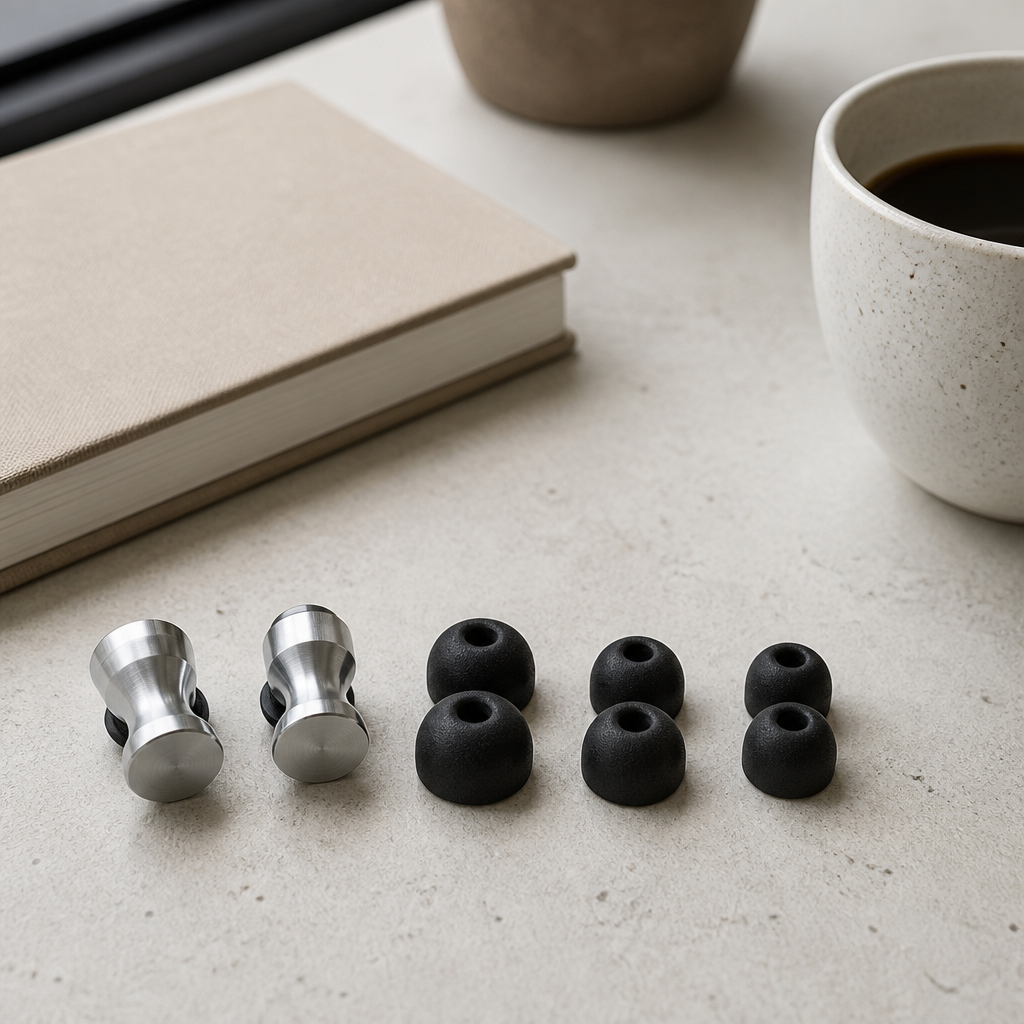
ATTENU8 makes reusable metal-bodied plugs with a concave aluminium body and three sizes of soft memory foam tips (XS, S and M), rated at approximately 32dB of noise reduction. They are built for people who want one device for focus time, travel and sleep, and who do not want to replace the whole thing when the tips wear out.
| Option | Best Use Case | Main Trade-off |
|---|---|---|
| Disposable foam plugs | Occasional use, one-off flights, a backup in your bag | Replaced often, costs add up over time, and fit varies from ear to ear |
| Reusable metal-bodied plugs with replaceable foam tips | Daily desk work, commutes and sleep | Higher upfront cost, and the tips need replacing every six to eight weeks |
| Over-ear protectors | Long shifts in loud settings where you have space around your head | Bulky, hard to wear with a headset or glasses, and impractical for a crowded train |
In practice, most desk workers do well with a reusable pair for everyday use and keep a few disposables for emergencies. Over-ear protectors make sense for people who spend hours in a loud room, such as a shared print hall or a workshop next to the office. Choose for your real week, not for the most protective option on the shelf.
Fit is the variable most people get wrong. A plug that sits loosely lets sound leak around the tip and reduces protection, no matter what the label says. Roll foam plugs, insert them and check that your own voice sounds muffled and the room noticeably drops away.

For reusable plugs, try all three tip sizes before deciding, because ear canal size differs from person to person. Wear each size for a full afternoon in the office, not just for a few minutes at home. A quiet bedroom tells you very little about how a plug performs against a live open-plan room.
Pro tip: Do the fit check at your desk, with a colleague talking nearby or a phone ringing in the next bay. If the sound drops clearly, the seal is working. If you can still pick out every word, try a different tip size.
Foam tips wear out with ear wax and repeated use. Replace them every six to eight weeks, and wipe the metal body with a dry cloth at the end of each day. Wax buildup reduces the seal slowly, and most people only notice when the plug feels looser than it used to.
Set a calendar reminder when you start using a new pair. The tips are cheap compared with the whole device, and a fresh set restores the fit faster than any other fix. A worn tip is the most common reason a reusable plug seems to stop working.
Asking for a quieter room can feel like a complaint, so frame it as a productivity issue. Explain which tasks suffer, when the noise peaks and what you need to do the work well. Many workplaces already have a phone room, a quiet area or a booking system for focus space, so the request is often a matter of access rather than budget.
Bring a specific ask instead of a general complaint. A booth for calls, a rule that speakerphones stay out of shared bays or a single room with soft furnishings are all concrete requests. Vague requests for “less noise” tend to get polite agreement and no action.
Propose a two-week trial. Ask colleagues whether they notice fewer interruptions, and track how often you move to a quieter space. A trial makes the request easy to approve, and the results give your manager something concrete to weigh.
If your role involves exposure to loud equipment or machinery in or near the office, ask whether hearing protection is provided for those tasks and whether the employer’s existing safety arrangements cover them. That keeps the conversation grounded in duties the workplace already has, rather than a personal preference.
Office noise is usually lower than the levels that cause fast damage, so the main concern is long, cumulative exposure combined with loud headsets. OSHA notes that loud noise can damage the inner ear’s hearing receptor cells and cause permanent loss, so both volume and duration matter.
Not always. If you can hear a colleague clearly at arm’s length without raising your voice, and your headset volume stays moderate, you probably do not need plugs at the desk. Use them when the room is consistently loud, when you spend hours on calls, or when your focus and sleep start to suffer.
For daily use, usually yes. The cost per use falls over time, and a well-chosen tip size is easier to keep consistent than a new disposable every day. Disposable plugs still make sense for one-off trips or as a backup in a bag.
Replace foam tips every six to eight weeks, or sooner if they look flattened, discoloured or feel loose in the ear. Worn tips are the most common reason a plug stops sealing properly.
They can make your own voice sound closed-in and make it harder to hear the other side. Try them on a non-critical call first. For important meetings, keep the headset volume moderate or remove one plug so you can hear speakers clearly.
It can. Light sleepers respond to sound that would not wake other people, and the ear keeps working through the night. Reducing daytime exposure and using comfortable plugs at night can both help a restless sleeper settle.
Tell us which noise in your workday wears you down most, and which fix, if any, has actually worked for you.

