


 0
0

You finish a 10-hour night shift, drive home in broad daylight, and crawl into bed while the rest of the world is mowing lawns, running deliveries, and letting their kids play outside. If you are a shift worker trying to sleep during the day, noise is not just annoying. It is physiologically working against you. Studies consistently show that daytime sleep is shorter, lighter, and more fragmented than nighttime sleep, even when the person is genuinely exhausted. Choosing the right earplugs for shift workers is not a comfort upgrade. It is a health decision. This guide explains exactly what to look for, what actually works, and why a premium pair of reusable earplugs beats a bag of disposables every single time.
According to research cited by the American College of Emergency Physicians, daytime sleep while working night shifts is routinely impacted by reduced sleep quality and duration, increased sleep latency, and fragmented sleep. This is not just about noise. Your circadian rhythm is actively signaling your body to stay awake during daylight hours, and external sounds amplify that problem considerably.
The scale of the issue is significant. According to the US Bureau of Labor Statistics, roughly 15 to 20 million American workers work nights or rotating shifts, representing a meaningful share of the entire adult workforce. Research estimates that up to 62% of night-shift workers complain of short sleep duration. That chronic sleep debt accumulates quickly, and its effects go well beyond tiredness. Shift work sleep disorder is associated with increased risks of cardiovascular disease, metabolic disorders, gastrointestinal problems, mood disturbances, and reduced cognitive performance.
Noise is one of the few variables a shift worker can actually control. And it is worth controlling properly.
| Key Insight | Explanation |
|---|---|
| 32dB noise reduction is the target for daytime sleep | Daytime ambient noise levels are significantly higher than nighttime. A high-NRR earplug at approximately 32dB gives you meaningful attenuation against traffic, voices, and household activity. |
| Disposable foam fails daily users quickly | Single-use foam earplugs were designed for occasional industrial use. Used every day, they compress unevenly, accumulate bacteria, and stop forming a reliable seal within days. |
| A hard earplug body causes real pain for side sleepers | Many shift workers sleep on their side. A rigid or bulky earplug presses against the ear canal and pillow, causing soreness that disrupts sleep regardless of noise reduction rating. |
| Multiple tip sizes are essential, not optional | Ear canals vary significantly between people. An earplug that does not seal properly loses most of its rated noise reduction. Three tip sizes (XS, S, M) allow a proper, comfortable fit for nearly every user. |
| Reusable earplugs save money and reduce waste | A pair of premium reusable earplugs with replaceable foam tips every 6-8 weeks costs a fraction of buying disposable packs weekly. For a daily shift worker, this adds up fast. |
| Earplugs work best as part of a layered noise strategy | Combining earplugs with other noise-reduction measures (white noise, acoustic curtains) produces better results than either alone, particularly against low-frequency rumble. |
| Consistency of use matters more than perfection | The best earplug is the one you will actually wear every sleep session. Comfort and ease of insertion determine long-term use more than any single specification. |
Not all earplugs are built for the specific demands of a shift worker sleeping in a noisy, sunlit environment during peak daytime hours. There is a short list of features that genuinely matter, and a longer list of marketing terms that do not.
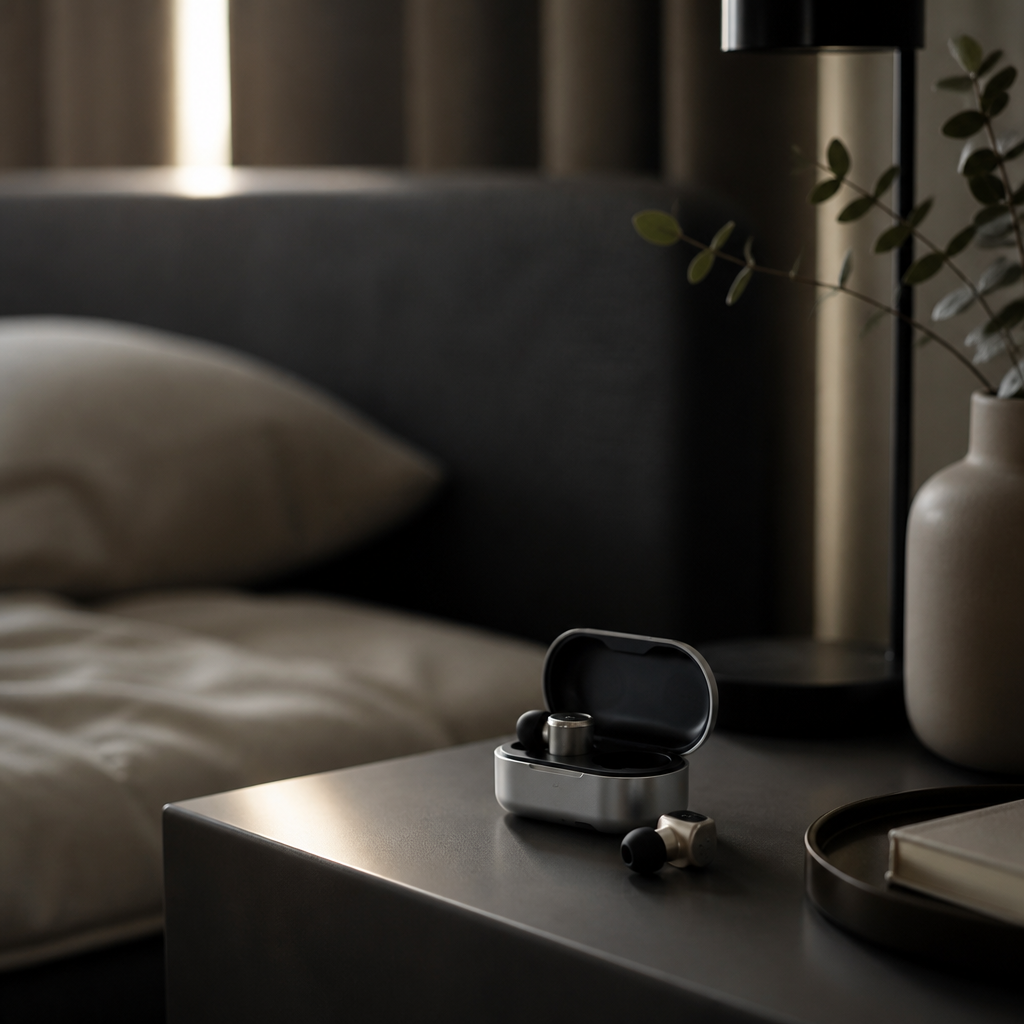
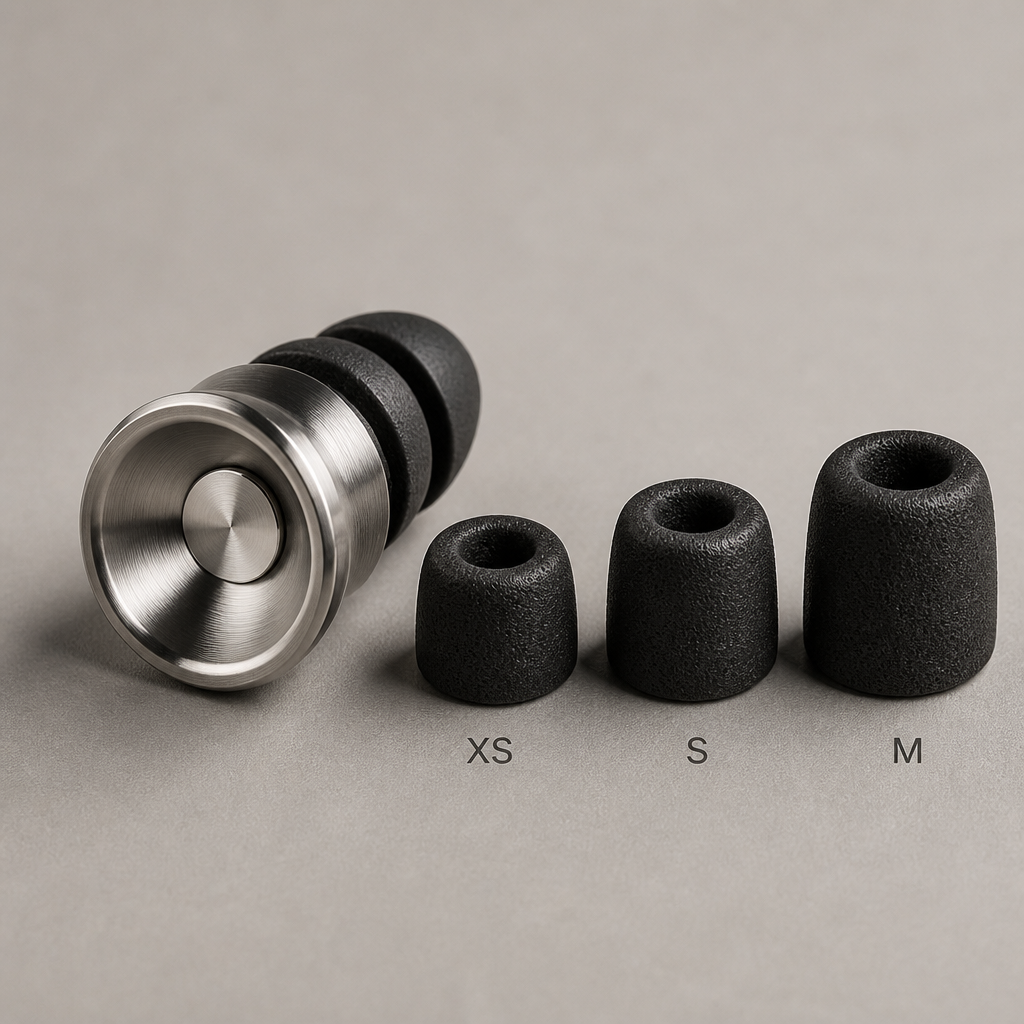
Look for an NRR (Noise Reduction Rating) of 30dB or higher for daytime sleep. Daytime ambient noise, including traffic, construction, lawnmowers, and children, regularly exceeds 70dB. A 32dB noise reduction rating brings that down to a manageable level that allows the brain to stay in deeper sleep stages without being jolted awake. This is the rating ATTENU8 earplugs are engineered to deliver, placing them at the high end of what is appropriate for sleep use without over-isolating the wearer.
This is where most generic earplugs fail shift workers. A thick, protruding earplug body is tolerable sitting upright. It becomes a pressure point the moment your head hits a pillow on its side. ATTENU8’s concave aluminium body sits flush rather than protruding, which means side sleepers are not fighting a lump pressed between their ear and the pillow for hours at a stretch.
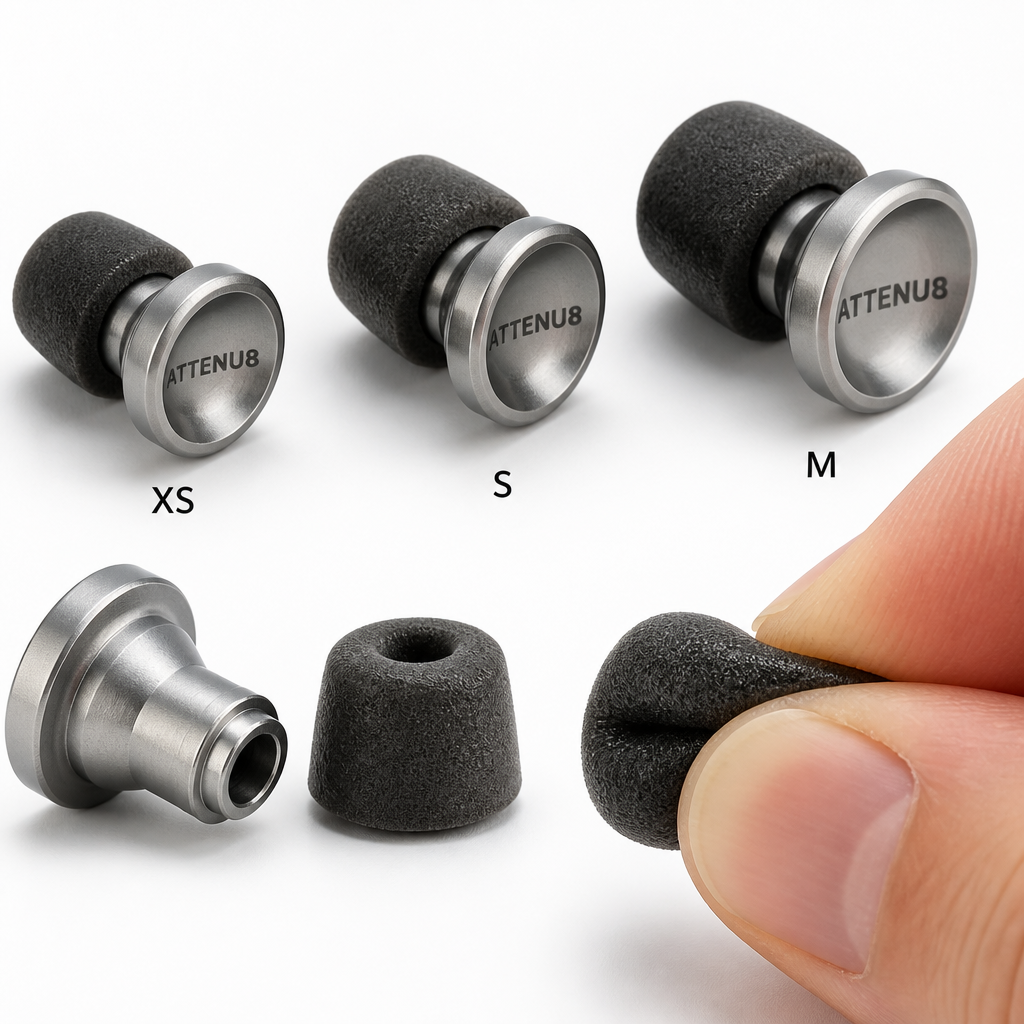
Soft memory foam tips conform to the individual ear canal shape and hold a seal without the wearer needing to constantly re-insert. The ATTENU8 design comes with XS, S, and M tip sizes precisely because a one-size earplug is genuinely not a good fit for most people. A poor fit does not just reduce comfort, it directly reduces the effective noise attenuation you receive. Using the wrong size can cut your actual noise reduction by 10dB or more.
Pro tip: To find your correct tip size, insert each size and hum quietly. The size that produces the most resonance in your own voice is the one forming the best seal in your ear canal. Start with S if you are unsure.
Shift workers use their earplugs every single day, not occasionally. A disposable foam earplug used daily accumulates ear wax, compresses unevenly, and degrades its seal within a few uses. A metal-bodied earplug with replaceable foam tips solves both problems at once. The body stays clean, durable, and consistent. The tips are replaced every 6-8 weeks, ensuring a fresh seal without the cost or waste of replacing the entire unit.
Earplugs are your most direct tool for blocking daytime noise, but they work best inside a layered environment designed to reduce the total sound load before it reaches your ears. Think of it as building concentric rings of noise control around your sleep space.
Noise, even if it does not fully awaken you, will alter sleep cycles and reduce the restorative quality of sleep. Shift workers experience this effect continuously and cumulatively. Reducing the noise burden at every layer is not overkill. It is necessary maintenance for a functioning sleep environment.
Seal gaps under doors and around windows with acoustic weatherstripping. Thick curtains or acoustic panels absorb mid-to-high frequency sounds like voices and traffic. A white noise machine or a steady brown noise source played at low volume can mask the irregular, unpredictable sounds that are most likely to trigger arousal, such as a door slamming or a dog barking. These sounds are difficult for earplugs alone to fully mask because they are sudden and broadband.
This is where your earplugs sit. At 32dB of noise reduction, a quality earplug is doing the heavy lifting of bringing residual room noise down to a level your sleeping brain can ignore. The combination of a treated room and high-performance earplugs is meaningfully more effective than either alone, particularly for low-frequency sound like traffic rumble that passes through walls relatively easily.
Pro tip: If you live in a particularly noisy area (near a highway, flight path, or construction zone), combine earplugs with a white noise machine set to brown noise rather than white. Brown noise has more low-frequency energy and does a better job masking rumble and bass-heavy outdoor sounds.
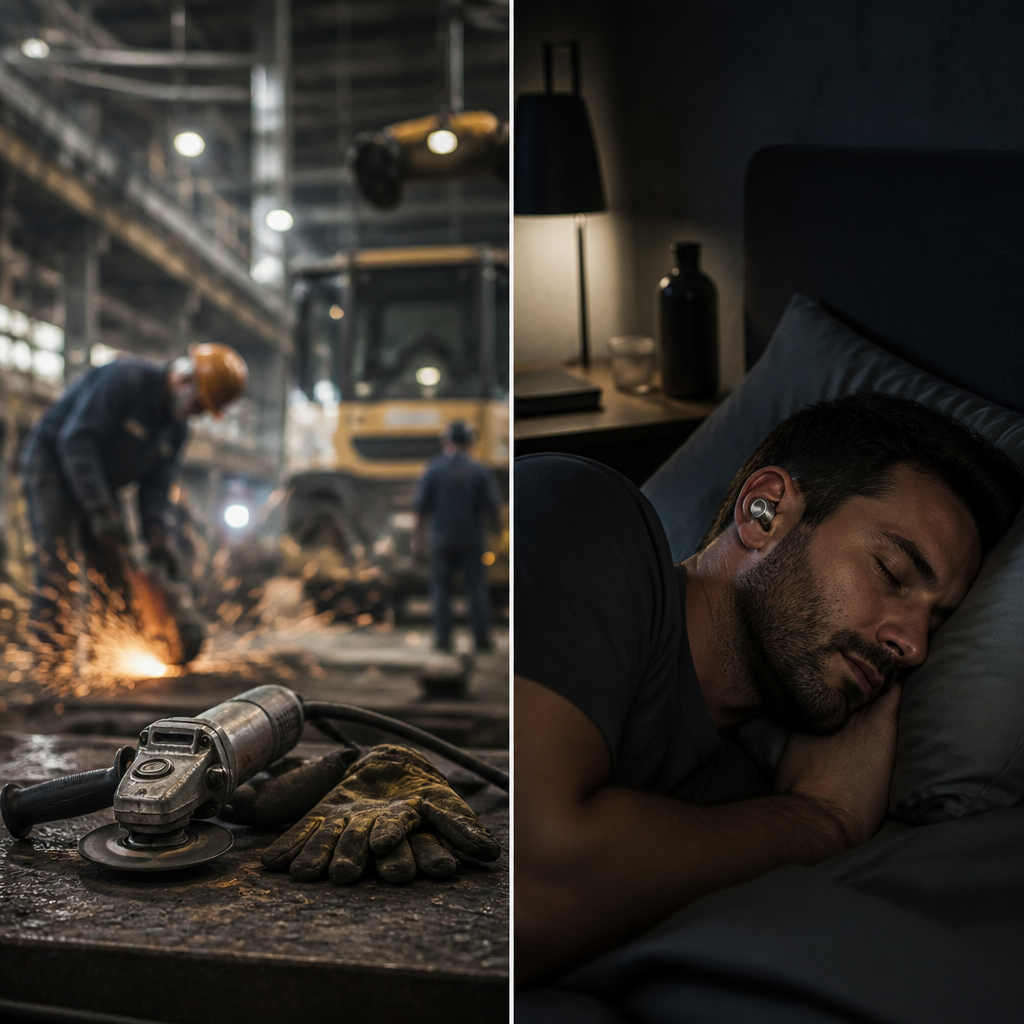
There are three main categories of earplug available to shift workers for daily daytime sleep use. Here is an honest comparison of how they perform in real, everyday conditions.
| Earplug Type | Best Suited For | Key Limitations for Daily Shift Workers |
|---|---|---|
| Disposable foam | Occasional, high-noise industrial environments. Inexpensive entry point. | Degrades quickly with daily use. Accumulates bacteria. Uncomfortable for side sleepers due to expansion pressure. Generates significant waste over weeks of use. Inconsistent seal as foam ages. |
| Soft silicone or wax plug-style | Light sleepers sensitive to in-canal pressure. Occasional travel use. | Generally lower NRR (22-27dB), which may be insufficient for noisy daytime environments. Less consistent seal than foam. Some styles can work loose during sleep. |
| Premium reusable with replaceable foam tips (e.g., ATTENU8) | Daily shift workers needing consistent 32dB noise reduction with long-term comfort. | Higher upfront cost than disposable foam. Tips need replacement every 6-8 weeks, though this is minimal ongoing cost compared to daily disposable use. |
In practice, the disposable foam option is tempting purely on unit price, but it is the most expensive over a month of daily use and produces the most inconsistent results. The reusable metal-body design wins on every practical metric for a daily shift-work user: consistent seal quality, hygiene, side-sleeper comfort, and long-term cost.
Earplugs handle the noise problem directly. But if the rest of your sleep environment and pre-sleep routine is working against you, even the best earplugs will only get you so far. These are the night shift sleep tips that make a measurable difference and the ones that are mostly theater.
Blackout curtains with sealed edges are non-negotiable. Light suppresses melatonin production regardless of your level of exhaustion. Standard curtains with gaps around the sides let in enough light to keep your circadian clock confused. Use curtains with a 99-100% blackout rating and consider tape or magnetic strips to seal the edges if gaps remain.
Keeping your bedroom temperature in the range of 16-19 degrees Celsius (60-67 degrees Fahrenheit) actively supports the drop in core body temperature that accompanies sleep onset. This is one of the few environmental factors with consistent research support, and it costs nothing beyond a habit adjustment.
Consistent sleep scheduling, even on days off, reduces the cumulative misalignment between your body clock and your environment. Varying your sleep window by more than an hour or two on rest days effectively resets the disruption you spent the rest of the week trying to minimize.
Leaving screens on for background noise is counterproductive. The visual flicker and irregular audio spikes from television or video content produce micro-arousals in ways that steady white noise does not. Use a dedicated white noise device or a simple fan instead.
Posting “Day Sleeper” signs on your door has limited practical effect unless you also communicate with the specific people in your household or building who are actually disrupting your sleep. The sign does not reach the neighbors. A direct conversation, and a set of quality earplugs, does.
Shift workers in loud industries face a compounding challenge: they need hearing protection at work and noise reduction for sleep. Using the same premium reusable earplug for both contexts, or having a dedicated pair for each, is a more sustainable approach than constantly cycling through disposable foam. ATTENU8’s design specifically addresses this by pairing a durable aluminium body with soft memory foam tips that protect comfort across extended wear periods, whether that is an 8-hour shift or an 8-hour sleep window.
A common mistake is choosing earplugs based on NRR rating alone without considering insertion comfort and daily wearability. A 33dB foam earplug that you stop wearing after two weeks because it causes ear soreness delivers zero noise reduction. A 32dB reusable earplug you can wear comfortably every day delivers its full rated benefit, compounded across months of consistent use.
Yes, provided you keep them clean and replace worn components. The main risks with daily earplug use are ear wax buildup and hygiene issues, both of which are directly addressed by reusable designs with replaceable tips. With a metal-bodied earplug like ATTENU8, the body can be wiped clean regularly, and foam tips are swapped every 6-8 weeks so you are never sleeping on degraded, bacteria-laden material. Wearing clean, well-fitting earplugs every day poses no inherent risk to your hearing health.
Aim for a minimum of 28-30dB NRR, with 32dB being the practical sweet spot for daytime sleep in a typical residential environment. Daytime ambient noise in suburban and urban areas commonly sits between 60-75dB, including traffic, lawn equipment, children, and general household activity. A 32dB reduction brings that into the range where your sleeping brain can stay in deeper sleep stages rather than being repeatedly pulled toward lighter, more fragmented sleep.
Yes, but earplug design matters enormously here. Bulky or protruding in-ear designs press against the ear canal when your head is on a pillow, creating pressure and soreness that disrupts sleep over a long session. ATTENU8’s concave aluminium body sits flush rather than protruding, which specifically addresses this problem. Memory foam tips also compress against pillow pressure rather than transmitting it directly to the ear canal wall.
For daily use, memory foam earplug tips should be replaced every 6-8 weeks. Daily insertion, removal, and the natural accumulation of ear wax and skin oils gradually degrades the foam, reducing both its sealing ability and its hygiene. With ATTENU8 replacement tips, the process is straightforward and inexpensive because you are only replacing the consumable component, not the entire earplug. This is a significant practical advantage over disposable designs that require purchasing an entirely new unit.
No earplug blocks all noise, and a 32dB NRR earplug is not intended to. At that level, a standard alarm clock or phone alarm set to a reasonable volume remains audible and effective. What changes is the baseline of ambient noise that surrounds your sleep, which is the traffic, voices, appliances, and background activity that pull you out of deep sleep stages repeatedly. If you are genuinely concerned about sleeping through alarms, place your phone closer to your head or use a vibration-based alarm as a backup. Most shift workers find this is not a practical problem with standard 32dB earplugs.
Earplugs attenuate sound entering the ear canal across a broad frequency range. A white noise machine works differently: it creates a consistent ambient sound that masks the sudden, irregular noises most likely to cause micro-arousals, such as a door slamming or a vehicle backfiring. Used together, they address complementary problems. Earplugs reduce the overall noise floor. White noise smooths out the unpredictable peaks that earplugs alone cannot fully neutralize. For shift workers in particularly noisy environments, the combination is meaningfully more effective than either alone.
Have you found a particular combination of noise-blocking strategies that finally made daytime sleep work for you? Share your experience below. What you have tried, and what actually helped, could make a real difference for another shift worker reading this.
Most people grab a pair of earplugs, shove them in, and wonder why they can still hear everything. The problem is almost never the earplug itself. It is almost always the size. An earplug size guide is not a luxury for the overly particular. It is the single most important factor in whether you get the noise reduction and comfort you paid for. A plug that is even slightly too small breaks its seal, letting sound leak in around the edges. A plug that is too large creates uncomfortable pressure that wakes you up or makes a full shift at work unbearable. Getting this right changes everything.
Ear canals are not standard. They vary significantly from person to person in diameter, depth, and shape, and in many people the left and right canals are not even symmetrical. A plug engineered to deliver 32dB of noise reduction delivers that figure only when it is correctly sized and properly seated. The rated noise reduction on the packaging assumes a complete acoustic seal. Break that seal with the wrong size and you lose a substantial portion of the protection.
The material matters too. Memory foam tips compress on insertion and then expand to fill the canal. This means the size you choose is the approximate diameter of the canal, not a size you squeeze down to a point and hope for the best. If the foam expands and still cannot reach the canal walls, sound gets through. If it over-fills the canal, you feel pressure, soreness, or a vacuum sensation that makes wearing them impossible for more than a few minutes.
This is why ATTENU8 includes three foam tip sizes, XS, S, and M, with every pair rather than shipping a single “universal” tip. No single diameter fits every ear. Matching the tip size to your canal is what makes the aluminium body and 32dB rating actually work for you.
| Key Insight | Explanation |
|---|---|
| Start with size M and adjust from there | Medium is the closest to an average adult canal diameter and is the right baseline for most adults before fine-tuning. |
| A proper seal should feel snug, not painful | Mild resistance and a gentle muffling of ambient sound immediately on insertion tells you the foam is sealing correctly. |
| Too small means sound leaks, not just looseness | An undersized tip cannot reach the canal walls. You may not notice the gap, but noise will get through even if the plug feels seated. |
| Too large causes pressure pain and poor sleep | An oversized tip creates a strong vacuum sensation or soreness within minutes. It also tends to work itself out of the canal overnight. |
| Left and right ears can need different sizes | Ear canal asymmetry is common. Test each ear independently rather than assuming one size works for both. |
| Insertion technique is just as important as size | Even the correct size will underperform if not inserted deeply enough. The roll-pull-hold method is essential for memory foam tips. |
| Replace foam tips every 6 to 8 weeks | Worn-out foam loses its expansion memory and cannot form a reliable seal regardless of size. The tip, not the body, drives fit quality over time. |
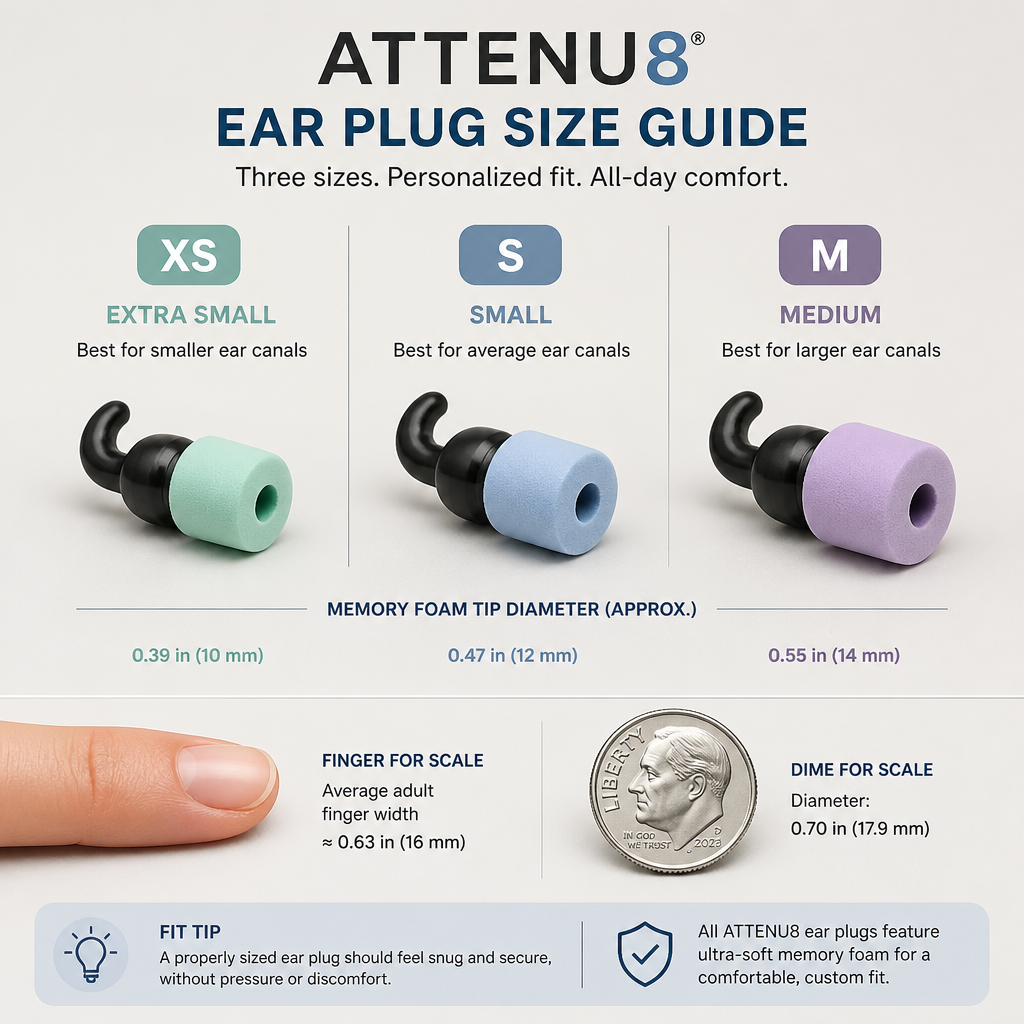
When ATTENU8 includes three tip sizes in a single pack, it is acknowledging something the industry has historically ignored: one size does not fit most people, let alone all people. The XS, S, and M designations correspond to the compressed insertion diameter and the expanded sealing diameter of the memory foam tip. Each step up in size increases both dimensions, which is why using the wrong one has such a direct effect on both comfort and acoustic performance.
XS tips are designed for narrow ear canals. This is more common than most people assume. Children aged roughly ten and older, many women, and some adults with naturally narrow canals find that standard or medium tips cause immediate discomfort or do not stay in place during movement. If you have ever had a standard foam earplug feel genuinely painful on insertion, XS is the size you should try first.
The XS tip also works well for people who sleep on their side. A smaller, properly fitted tip creates less lateral pressure against the pillow-side ear, which makes it dramatically more comfortable through a full night of sleep.
Small tips bridge the gap between XS and M. They suit people whose canals fall in a below-average to average range but find XS tips too loose and M tips too tight. Many adults who describe “sensitive ears” or “earplugs always hurt me” are actually just using medium tips in what are, anatomically, small canals. Switching to S often resolves the problem entirely without any sacrifice in noise reduction.
M tips are the best starting point for most adults. The average adult ear canal is approximately 9mm in diameter, and M tips are designed to create a reliable seal at that range. If M tips feel comfortable, stay in place during normal head movement, and produce a clear reduction in ambient noise immediately on insertion, you have found your size and there is nothing more to do.
Pro tip: If you have never sized your ears before, insert one M tip and leave it in place for 60 seconds. If it stays secure, feels snug without pain, and reduces ambient sound noticeably and evenly, M is your size. If it creeps outward, feels loose, or lets sound through unevenly, drop to S.
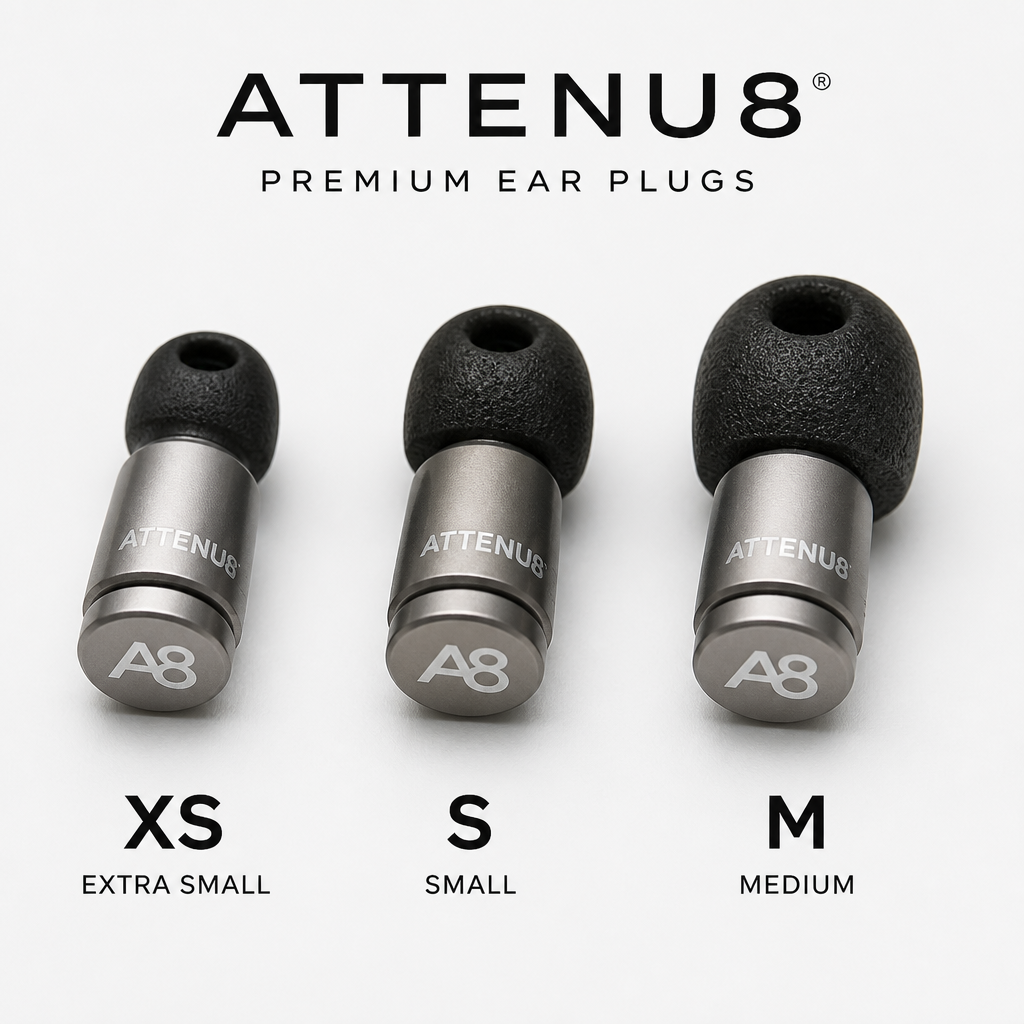
The fastest and most reliable method is a simple size test using all three tips, one ear at a time. This takes about five minutes and eliminates guesswork entirely.
Start with M. Roll the foam tip between your fingers until it compresses to a narrow cylinder. Reach over your head with your opposite hand, pull the outer ear gently upward and back to straighten the canal, then insert the compressed tip with a slight rotating motion until it sits just inside the canal opening. Hold it in place gently for 20 to 30 seconds while the memory foam expands.
After it has fully expanded, assess three things: comfort, fit stability, and noise reduction quality. A correctly sized tip feels snug but not painful, does not shift when you move your jaw or turn your head, and produces a clear, even muffling of background sound. If the M tip passes all three, you are done.
If M feels tight or causes a vacuum-like pressure sensation, move to S. If M sits loosely or you can hear background sound clearly through it, you have an unusual situation, and a retest with fresh insertion technique is worth trying before concluding M is too small. Poor insertion technique mimics the symptoms of an undersized tip.
Pro tip: Test each ear separately. A meaningful number of people have one canal that takes S and one that takes M. ATTENU8’s design allows you to use different tip sizes on each earplug, so asymmetric sizing is entirely practical.
After insertion, look in a mirror. The foam tip should sit just inside the canal opening with the aluminium body of the earplug resting close to the ear rather than protruding outward at a visible angle. If the earplug is angling sharply outward, the tip is not seated deeply enough. This is usually a technique issue, not a size issue, but it is worth ruling out before changing sizes.
The body gives clear feedback when an earplug is the wrong size. The problem is that most people interpret these signals as “earplugs just aren’t for me” rather than as a straightforward sizing issue with a simple fix.
An undersized tip cannot form a complete seal against the canal walls. The most obvious sign is that the earplug feels loose or shifts during normal movement. You may need to push it back in frequently, and it often works its way out entirely during sleep. The subtler and more important sign is reduced noise protection: ambient sound comes through more clearly than expected, often with a directional or uneven quality because the seal is inconsistent rather than absent.
If you are using earplugs specifically for sleep and find that sound still wakes you despite wearing them, an undersized tip is one of the first things to check. The gap around an undersized foam tip is often small enough to be invisible but large enough to let enough sound through to disturb light sleep.
An oversized tip announces itself through discomfort. Pain or soreness within minutes of insertion is a strong indicator that the earplug is pressing against sensitive canal tissue. Some people also describe a strong vacuum sensation or a feeling of excessive fullness. These are not signs that you need to “get used to earplugs.” They are signs you need a smaller tip.
A secondary sign is that oversized tips sometimes work themselves out during sleep despite feeling tight on insertion. This happens because the foam is compressing the canal walls rather than filling the canal, and the body’s natural response is to push the foreign object out. Switching down one size typically solves both the discomfort and the displacement problem at once.
A well-fitting earplug stays in place during movement and sleep, reduces noise evenly in both ears, and does not cause pain or strong pressure. If yours does not meet all three criteria, the issue is almost always size or insertion depth, not the earplug itself.
| Size | Best Suited For | Common Fit Failure If Wrong |
|---|---|---|
| XS | Narrow canals, children (10+), side sleepers, adults who find standard tips painful on insertion | If too small for the canal: loose seal, tip migrates out during sleep, reduced noise reduction |
| S | Below-average to average canals, adults with “sensitive ears,” anyone for whom M causes pressure | If too small: intermittent seal loss during jaw movement; if too large: mild pressure, less severe than M in the wrong ear |
| M | Average to larger adult canals, industrial or occupational hearing protection where maximum seal is priority | If too large: pain, vacuum sensation, tip ejected by ear overnight; if too small: sound leakage, inconsistent noise reduction |
Sizing and insertion are inseparable. You can have the correct tip size and still get poor noise reduction if the insertion is shallow or rushed. Memory foam tips require a specific technique because the foam needs to expand inside the canal, not in front of it.
Roll the foam tip between your fingers into the narrowest cylinder you can manage. Reach over your head with the hand on the opposite side to the ear you are inserting, grasp the outer ear, and pull gently upward and back. This straightens the ear canal, making insertion significantly easier and deeper. Insert the compressed tip with a slight rotating motion and push it in until it sits inside the canal entrance. Hold it firmly in place for 20 to 30 seconds while the foam expands to fill the canal.
The holding step is where most people fail. Letting go too early means the foam expands while partially outside the canal and then stops short of a full seal. The discomfort of holding it in place for 30 seconds is worth the complete seal you get as a result.
Once the foam has fully expanded, snap your fingers or click near each ear individually. The sound should be noticeably and roughly equally muffled on both sides. If one ear lets through significantly more sound than the other, either the tip on that side is undersized or the insertion was incomplete. Remove, reroll, and reinsert before concluding it is a size problem.
Another useful check is to hum gently. With a proper bilateral seal, your own voice resonates with a noticeably “in your head” quality. If it does not, at least one seal is incomplete.
The demands on an earplug differ considerably between a sleeping environment and an occupational noise environment, and those differences have implications for how tightly you should prioritize the seal when choosing your size.
For sleep, comfort is the first filter. An earplug that causes even mild discomfort will disrupt sleep more reliably than the noise it was supposed to block. Side sleepers in particular find that one size too large creates enough pressure against the pillow-side ear to become a consistent source of waking through the night. Start with the smallest size that still produces a clear seal, rather than the largest size that technically fits.
The other sleep-specific consideration is tip retention. A tip that is correctly sized for your canal will stay in place for a full night without any tendency to migrate out. If you frequently wake up to find one or both tips on your pillow, undersizing is almost certainly the cause.
In construction, manufacturing, or any environment where noise levels regularly exceed safe thresholds, the acoustic seal takes priority. The 32dB noise reduction rating on ATTENU8’s tips is a ceiling, not a guarantee. You only approach that ceiling with the right size and correct insertion. In a workplace context, this is not just about comfort. It is about actual hearing protection over months and years of exposure.
If you work in a high-noise environment, test your fit at the start of each shift rather than assuming yesterday’s insertion was typical. Foam tips that are due for replacement, roughly every 6 to 8 weeks, lose their expansion memory and provide a weaker seal even when the size is correct. Fresh tips on a correctly sized canal are the baseline for reliable protection.
Pro tip: In loud work environments, do the snap-finger seal check after every insertion. It takes three seconds and tells you immediately whether you have a functioning seal before you are exposed to the noise source. Do not wait until your hearing feels fatigued to check.
Start with M. It corresponds to the approximate average adult ear canal diameter, making it the most statistically likely fit for a first attempt. Insert it using the roll-pull-hold technique, hold for 30 seconds, and assess comfort and noise reduction. If M is comfortable and the seal is clear, you are done. If it is too tight or too loose, move to S or try reseating with improved insertion technique before switching sizes.
Yes, and more often than most people expect. Ear canal asymmetry is a normal anatomical variation. Testing each ear independently is the only way to know for certain. ATTENU8’s design allows each earplug to carry a different tip size, so there is no practical barrier to using XS on one side and S on the other if that is what your ears require.
There are two common causes. First, the tip may be undersized: it felt snug immediately after insertion because the fresh foam had just expanded, but it gradually shifted or partially unseated as you moved in your sleep. Second, the foam tips may be due for replacement. Memory foam that has been compressed and expanded repeatedly loses its ability to fully expand, which means it no longer fills the canal even if the size was correct originally. Replace tips every 6 to 8 weeks to maintain consistent performance.
No. This is one of the most common misconceptions about earplug sizing. A properly sized tip that forms a complete seal provides the full rated noise reduction. An oversized tip may feel tighter initially, but it creates pressure against canal walls rather than filling the canal, which can actually result in a less consistent seal and causes significant discomfort that makes you remove the earplugs earlier. Correct size, not maximum size, is what delivers optimal protection.
ATTENU8 recommends replacing the memory foam tips every 6 to 8 weeks with regular use. Over time, foam loses its expansion memory, which means a worn tip behaves like an undersized tip even if you chose the right size originally. If your earplugs are providing noticeably less noise reduction than when they were new and your insertion technique has not changed, worn tips are the most likely explanation. When you fit new replacement tips, take a moment to reconfirm your size, since the expansion of fresh foam is different enough from worn foam to occasionally change what feels comfortable.
XS tips are for narrow ear canals, and canal diameter has no reliable relationship to body size, height, or gender. Some adults with larger frames have naturally narrow canals and need XS or S tips for the same anatomical reason that some smaller-framed adults comfortably wear M. The only way to know is to test. If M causes discomfort and S still feels tight, try XS before concluding that reusable foam-tip earplugs will not work for you.
Have you found that one size works better in one ear than the other, or discovered that switching sizes made a significant difference to your sleep or hearing protection? Share your experience in the comments.
Noise-induced hearing loss in the workplace is not an abstract risk. It is the most prevalent occupational health problem in the United States, quietly stripping millions of workers of a sense they will never fully recover. An estimated 22 million workers in the United States are exposed to hazardous noise levels every working day, and roughly 40 million American workers have already recorded hearing test findings that indicate damage. Despite decades of regulation, compliance guidance, and available protection technology, occupational hearing loss continues to climb. This guide cuts through the noise, laying out exactly what employers must do, what workers need to know, and how to choose protection that actually holds up on the job.
| Key Insight | Explanation |
|---|---|
| OSHA’s action level is 85 dBA (8-hour TWA) | At this threshold, employers in general industry must enroll affected workers in a hearing conservation program, even before noise reaches the legal limit. |
| The permissible exposure limit (PEL) is 90 dBA | Exposures above 90 dBA averaged over 8 hours require immediate engineering or administrative controls, not just ear protection. |
| Noise-induced hearing loss is permanent | Damaged hair cells in the inner ear do not regenerate. Prevention is the only cure, making early-stage protection critical. |
| 53% of noise-exposed workers report not wearing hearing protection | Availability of protective equipment is not the problem. Fit, comfort, and compliance culture are the real barriers. |
| Reusable ear plugs outperform disposable foam in long-term use | Disposable foam degrades with each use and is frequently worn incorrectly. A well-fitted reusable plug with a consistent seal delivers more reliable protection shift after shift. |
| Construction sub-sectors show hearing loss rates above 25% | Highway, street, and bridge construction workers have among the highest prevalences of occupational hearing loss of any sector studied. |
| Dual protection adds 5-10 dB of additional reduction | Wearing earplugs and earmuffs together is appropriate for extremely loud environments, and OSHA allows employers to estimate combined protection by adding 5 dB to the highest-rated device. |
Noise-induced hearing loss (NIHL) is a slow, progressive deterioration of the inner ear caused by repeated or sustained exposure to loud sound. Unlike a sudden acoustic trauma, occupational NIHL typically accumulates over years without a single memorable moment of injury. Workers often do not notice significant decline until they begin struggling to follow conversations or find themselves turning up the television volume at home.
The damage happens inside the cochlea, where tiny hair cells convert sound waves into nerve signals. Prolonged exposure to excessive noise levels destroys these hair cells. They cannot regenerate. The loss is permanent, and it is cumulative. Every unprotected hour in a loud environment adds to the total damage already done.
Tinnitus, a persistent ringing or buzzing in the ears, frequently accompanies noise-induced hearing loss and can be more immediately debilitating than the hearing loss itself. It disrupts sleep, concentration, and mental wellbeing. Hearing conservation programs that focus only on audiogram thresholds often underserve workers because they do not adequately address tinnitus awareness and prevention.

OSHA’s occupational noise exposure standard (29 CFR 1910.95 for general industry) establishes two pivotal thresholds. Understanding the difference between them is not optional for any employer with workers in loud environments.
When workers experience an 8-hour time-weighted average (TWA) noise exposure of 85 dBA or higher, employers must implement a hearing conservation program. This includes noise monitoring, audiometric testing, provision of hearing protection devices, training, and recordkeeping. The action level is a warning line, not a safe one, and the obligation to act kicks in well before noise reaches the permissible limit.
The permissible exposure limit (PEL) is a TWA of 90 dBA over 8 hours. Above this threshold, engineering controls and administrative controls must be the first line of response. Hearing protection alone is not an acceptable substitute if engineering solutions are feasible. The permissible exposure time drops sharply as noise increases: 95 dBA allows only 4 hours, 100 dBA allows 2 hours, 105 dBA allows 1 hour, and 115 dBA is the absolute ceiling regardless of duration.
Construction is governed by a separate OSHA standard. In construction, engineering or administrative controls are required when exposures exceed 90 dBA for an 8-hour shift, and hearing protection must be provided when controls are not feasible or do not reduce noise to safe levels. Given the fluid, multi-employer nature of construction sites, compliance monitoring is both more difficult and more important.
Pro tip: OSHA does not “approve” specific hearing protection devices. The employer’s obligation is to provide equipment capable of reducing noise exposure to safe levels. Choosing a device with an appropriate Noise Reduction Rating (NRR) for the specific environment is the employer’s responsibility, not a regulator’s.
Hazardous noise exposure is not limited to the most obvious industries. Occupational hearing loss surveillance data identifies consistent high-risk sectors that every safety program should prioritize.
Construction carries some of the most severe occupational hearing loss rates of any sector studied. A NIOSH study covering data from 2010 to 2019 found that sub-sectors including highway, street, and bridge construction (28%), site preparation contractors (26%), and new single-family housing construction (25%) had among the highest prevalences of hearing loss in the entire construction industry. Pile drivers can reach 101 dB at distance, rock drills 98 dB, and front loaders 96 dB, and these are not momentary exposures. Workers on active sites face sustained noise from multiple sources simultaneously.
Manufacturing encompasses an enormous range of noise environments, from stamping and pressing operations to CNC machining and assembly lines. The sustained nature of manufacturing noise, combined with long shift durations, means cumulative daily exposures regularly exceed safe thresholds without any single dramatic event. Mining and manufacturing workers consistently show high prevalences across decades of audiogram review data.
Military personnel face impulse noise from firearms and explosives in addition to sustained noise from vehicles and aircraft. Impulse noise is particularly damaging because it is brief enough to escape TWA-based monitoring but intense enough to cause immediate cochlear damage. Workers in this category frequently present with both high-frequency hearing loss and tinnitus simultaneously.
Pro tip: Any occupational environment where workers routinely raise their voices to be heard at arm’s length is likely exceeding the 85 dBA action level. That single observation is a reasonable field trigger to initiate formal noise monitoring, even before dosimeter data is available.
A hearing conservation program (HCP) is not a folder of paperwork stored in an HR filing cabinet. Done correctly, it is an active, living system that continuously identifies exposure, reduces risk, and tracks outcomes over time. OSHA’s required elements provide the skeleton. Effective implementation requires genuine commitment from management and a culture where workers understand why protection matters.
The first step is establishing which workers are actually exposed at or above 85 dBA TWA. Personal noise dosimeters are the most accurate tool for this because they capture the full range of noise a worker encounters during a real shift rather than point-in-time measurements from a sound level meter. All employees found to be exposed to a single 8-hour TWA of 85 dBA or greater must be enrolled in the HCP. Monitoring must be repeated whenever process, equipment, or controls change in ways that may affect exposure levels.
Baseline audiograms establish each worker’s hearing profile before significant occupational exposure. Annual audiograms detect standard threshold shifts, which are defined as an average change of 10 dB or more in hearing sensitivity at specific frequencies. Catching a standard threshold shift early allows for intervention before the loss becomes functionally significant. A common failure in HCP administration is treating audiometric testing as a checkbox exercise rather than a diagnostic tool that should trigger follow-up action.
Workers must receive training at the time of enrollment in the HCP and annually thereafter. But the format matters enormously. Generic safety videos watched in a break room produce worse retention than brief, task-specific conversations at the worksite. Effective training connects the specific noise sources in that worker’s environment to specific risks and specific protective actions they can take today. Abstract statistics do not motivate behavior change. Concrete, personalized risk information does.
OSHA requires that noise exposure measurement records be retained for two years and audiometric test records for the duration of employment. These records are not just compliance artifacts. Longitudinal audiogram data is the only way to detect trends in hearing loss across a workforce and evaluate whether the HCP is actually protecting people.
Hearing protection is only effective when it is actually worn, worn correctly, and provides adequate attenuation for the specific noise environment. All three conditions must be met simultaneously. In practice, failing any one of them renders the device nearly useless.
The Noise Reduction Rating (NRR) is a single-number estimate of how much noise a device reduces under ideal laboratory conditions. The maximum NRR for earplugs is 33; for earmuffs it is 31. However, real-world performance is consistently lower than laboratory ratings because fit varies, insertion technique varies, and workers often remove protection during periods they perceive as “not that loud” but which still accumulate exposure.
OSHA uses a derating approach when estimating real-world protection from the NRR. Working from NRR values as-stated provides a more conservative and practical baseline for calculating whether a chosen device achieves the required attenuation in a specific environment.
The NRR number on the packaging is irrelevant if the device does not seal. A disposable foam earplug rolled and inserted correctly in a controlled setting delivers reasonable attenuation. That same earplug, pushed in partially by a worker who is cold, wearing gloves, and in a hurry, delivers a fraction of its rated protection. This is not a theoretical risk. It is the dominant practical reason why a large proportion of noise-exposed workers still develop hearing loss despite having access to hearing protection.
Reusable metal-bodied earplugs, such as those made by ATTENU8, address this problem through design. The rigid aluminium shell maintains its shape and the acoustic seal geometry regardless of how the worker handles it. The soft memory foam tips conform to the individual ear canal on insertion and hold their position during the shift. With three tip sizes included (XS, S, and M), fit can be individually optimized rather than forcing every worker into a one-size default. The result is approximately 32 dB of noise reduction that is consistent from day one to day three hundred.
Disposable foam earplugs are not washable and lose their acoustic properties as they compress, soil, and deform. A reusable earplug with replaceable foam tips changes the economics and hygiene profile entirely. ATTENU8’s foam tips require replacement roughly every 6 to 8 weeks rather than after each use, keeping ongoing costs low while ensuring the acoustic performance remains predictable. The metal body itself does not degrade, meaning the investment in the device is a long-term one.
The most reliable hearing protector is the one the worker will actually wear correctly, every hour of every shift. Comfort and usability are not secondary concerns. They are the primary determinants of real-world effectiveness.
| Protection Type | Key Strengths | Key Limitations |
|---|---|---|
| Single-use disposable foam earplugs | Low upfront cost, widely available, no cleaning required | Frequently inserted incorrectly, performance degrades with use, significant ongoing waste, cannot be individually sized |
| Reusable metal-bodied earplugs (e.g., ATTENU8) | Consistent shape and seal, durable construction, multiple tip sizes for individual fit, low long-term cost, up to ~32 dB NRR | Higher initial cost, foam tips require periodic replacement every 6-8 weeks, worker must carry and store the device |
| Over-ear earmuffs | Easy to put on and remove, no insertion technique required, suitable for intermittent exposure | Bulky, uncomfortable in heat, can be dislodged by PPE interactions (hard hat, glasses, face shields), maximum NRR of 31 |
For workers in continuous noise environments where earplugs will be worn for a full shift, a well-fitted reusable earplug with confirmed individual sizing consistently outperforms both disposable alternatives and earmuffs in terms of total daily protection. Earmuffs are most practical where hearing protection is needed intermittently and workers need to put on and remove protection frequently throughout the day.
Workers in noise-exposed roles have specific legal rights that many do not know about or exercise. Employers covered by OSHA’s noise standard must provide hearing protection at no cost to the employee, offer a choice of hearing protectors from among a suitable selection, and allow workers to observe noise monitoring procedures. Audiometric testing must also be provided at no cost.
The legal framework gives workers access to protection. Using that protection properly is the worker’s part of the equation. This means wearing hearing protection for the entire duration of exposure, not just during the loudest moments. Even brief unprotected periods in a high-noise environment can significantly reduce the effective daily protection provided by an otherwise-compliant device.
Workers should report any changes in hearing, new onset of tinnitus, or discomfort from hearing protection devices to their supervisor. These are medical indicators that the current program may not be providing adequate protection for that individual, and they trigger specific employer obligations under OSHA’s standard.
Beyond OSHA citations and financial penalties, the cost of occupational hearing loss falls on workers, employers, and the broader economy. U.S. workers’ compensation claims for occupational hearing loss have been estimated to cost employers tens of millions of dollars annually. That figure does not capture the productivity impact of a workforce with diminished hearing acuity, the increased accident risk from reduced situational awareness, or the personal cost to workers who spend their retirement years unable to hold a clear conversation with their grandchildren.
OSHA defines the action level for general industry at 85 dBA as an 8-hour time-weighted average. Exposure at or above this level requires employers to implement a hearing conservation program. The permissible exposure limit is 90 dBA over 8 hours, above which engineering and administrative controls are required as the primary response. Any environment where workers cannot comfortably hold a conversation at arm’s length without raising their voices is likely at or above the action level.
Yes. Noise-induced hearing loss results from the destruction of hair cells in the cochlea, and these cells do not regenerate in humans. The damage is cumulative and irreversible. Early-stage NIHL may not be functionally noticeable, but it accelerates further loss with continued exposure. Prevention through consistent use of appropriate hearing protection is the only effective strategy.
Under OSHA’s general industry standard (29 CFR 1910.95), employers must conduct noise monitoring when exposures may equal or exceed 85 dBA TWA, notify workers of their exposure results, implement a hearing conservation program including audiometric testing and training, provide hearing protection at no cost, and maintain records of both monitoring and audiometric data. In construction, slightly different thresholds apply under a separate OSHA standard.
Start by determining the actual noise level in the work environment using dosimetry or sound level measurement. Then select a hearing protector with an NRR sufficient to bring effective exposure below 85 dBA. Fit quality matters more than the number on the label. A reusable earplug with multiple tip sizes and a rigid body that maintains its seal geometry will deliver more consistent real-world protection than a disposable foam earplug worn incorrectly. Comfort over a full shift is not optional. It directly determines whether workers keep the protection in place.
Yes, and in very high-noise environments this dual protection approach is appropriate and sometimes required. Wearing both earplugs and earmuffs together provides an additional 5 to 10 dB of noise reduction compared to either device worn alone. OSHA allows employers to estimate the combined protection by adding 5 dB to the NRR of whichever device has the higher rating. This approach is most useful for workers exposed to noise levels well above 100 dBA for sustained periods.
Disposable foam earplugs should be replaced after each use. They are not washable, and repeated use degrades both their acoustic properties and hygiene. Reusable earplugs with replaceable foam tips, such as the ATTENU8 design, require foam tip replacement approximately every 6 to 8 weeks under regular use, while the durable metal body does not require replacement. Earmuffs should have cushions and foam inserts inspected regularly and replaced when cracked, hardened, or no longer forming a complete seal against the head.
Construction, mining, and manufacturing consistently record the highest rates of occupational hearing loss across workforce audiogram studies. Within construction specifically, highway and street construction, site preparation, and residential housing construction sub-sectors show prevalences of hearing loss above 25% among noise-exposed workers. Military personnel face particularly complex noise exposures combining sustained machinery noise with acute impulse noise from weapons systems, producing high combined rates of hearing loss and tinnitus.
Have you dealt with hearing conservation compliance challenges in your workplace, or switched from disposable to reusable ear protection? Share what worked for you in the comments below.
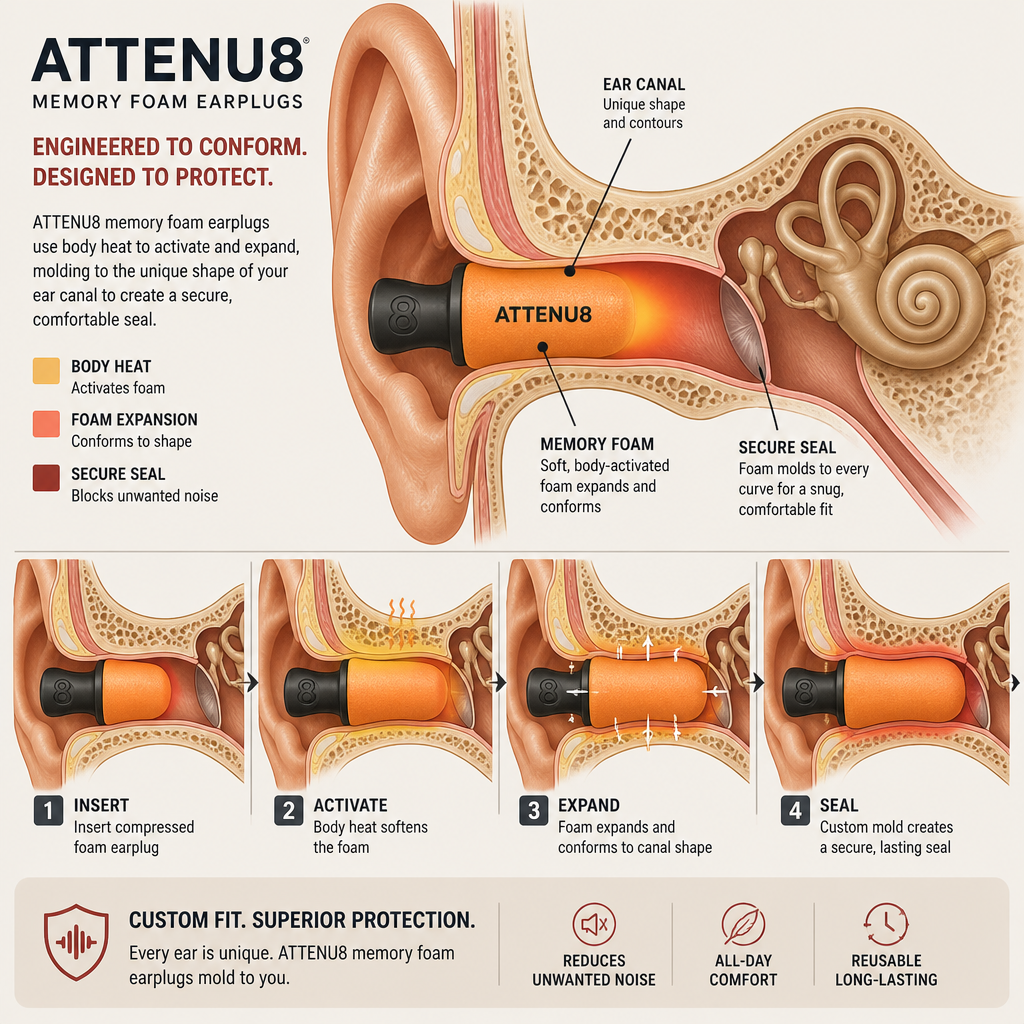
Most people buying earplugs focus on the noise reduction rating and stop there. That is a mistake. The number printed on the packaging only tells you what the earplug achieved in a controlled lab setting with trained insertion. What determines whether you actually get close to that rating every single night is the material the earplug tip is made from, and specifically how well it conforms to the unique geometry of your ear canal. Memory foam earplugs outperform alternatives not because of a marketing claim, but because of a specific physical property: they respond to body heat and pressure to fill the canal from the inside out, forming a seal that other materials simply cannot replicate.
| Key Insight | Explanation |
|---|---|
| Memory foam is viscoelastic polyurethane | It responds to both body heat and pressure, softening and conforming to the exact shape of your ear canal rather than holding a fixed shape. |
| Foam NRR consistently outperforms silicone | High-quality memory foam earplugs reach NRR ratings of 28-33 dB. Silicone alternatives typically range from 20-26 dB, a meaningful gap in genuinely noisy environments. |
| The seal is the whole game | A rating means nothing if the plug does not seal properly. Memory foam expands after insertion to fill the canal’s irregular cross-section, while silicone holds a rigid shape it arrived with. |
| Soft earplugs reduce pressure pain for side sleepers | Memory foam compresses under pillow pressure and slowly re-expands. Flanged silicone stays rigid, transmitting that pressure directly into the canal wall, which wakes most people within hours. |
| Tip size selection is non-negotiable | An oversized foam tip causes abrasion; an undersized one breaks the seal. Having three tip sizes available, such as XS, S, and M, is the difference between a tool that works and one that doesn’t. |
| Reusable foam tips need replacing, not the whole earplug | Memory foam tips degrade over time as they absorb skin oils and ear secretions. Replacing only the tip every 6-8 weeks preserves performance without discarding the entire earplug. |
| Real-world reduction is lower than the lab rating | In practice, most users achieve 13-20 dB of real-world reduction from a 32 dB rated earplug. That is still enough to reduce a loud urban bedroom to comfortable sleeping levels. |
Memory foam is a type of polyurethane foam that responds to body heat and pressure. When exposed to warmth, the open-cell structure softens and slowly conforms to whatever shape is pressing against it. When pressure is removed, it returns to its original form. This combination of properties is described as viscoelastic, meaning the material exhibits both viscous (flow-like) and elastic (spring-back) behavior at the same time.
The material was originally developed for aerospace applications, and its transition into consumer products happened because those properties turned out to be extremely useful anywhere the goal is even pressure distribution and custom fit. Manufacturers eventually applied it to mattresses, pillows, orthotic braces, and, critically for this discussion, earplug tips.
What separates memory foam from standard polyurethane foam is not just density but the responsiveness to temperature. A standard foam earplug expands mechanically after you release the compression. A memory foam tip softens as it warms to body temperature inside the canal, which means it continues to adapt for the first thirty seconds after insertion rather than simply springing open immediately.
The open-cell structure and what it does for noise
The internal structure of memory foam is an interconnected network of open cells. When compressed for insertion, the cells collapse. Once inside the canal and warmed by body heat, those cells slowly re-inflate and the foam presses outward in every direction equally. That outward pressure creates contact with the canal walls across the full circumference, which is what closes the acoustic pathway that sound travels through.
Standard foam achieves a similar effect mechanically, but without the temperature response, the expansion is faster and less controlled. The result is often a plug that seals well in some spots and less well in others, depending on the individual canal geometry. Memory foam’s slower, heat-driven expansion fills in those irregular spots.
Pro tip: When inserting memory foam earplugs, compress the tip fully, insert it, then hold it gently in place for 20-30 seconds while it warms and expands. Releasing too early before the seal has formed is the single most common reason people underperform the rated NRR.
No two ear canals are shaped the same. They vary in diameter, length, curvature, and cross-sectional shape. A rigid material, whether silicone or plastic, can only contact the canal at its outermost point unless it happens to match that canal’s exact geometry by chance. Memory foam sidesteps this problem entirely by conforming to whatever shape it encounters.
The acoustic seal is what blocks sound. Sound travels as pressure waves through air. Interrupting the air column inside the ear canal, from the canal entrance to the eardrum, is what reduces the sound reaching the auditory system. The better the seal, the more complete that interruption. Any gap, even a small one, allows sound to bypass the earplug entirely.
The choice of hearing protection should be based on fit, comfort, and correct noise reduction rating for the environment. A plug that fits correctly and is worn consistently outperforms a higher-rated plug that is worn incorrectly or removed during sleep.
Memory foam’s conforming expansion is particularly effective at low frequencies, which are the hardest to block. Traffic rumble, snoring, HVAC noise, and machinery hum all sit in the lower frequency ranges. A material that fills the canal completely and presses against the walls uniformly provides better low-frequency attenuation than one that seats only at the canal entrance.
Shallow insertion is the most common earplug error. When a foam tip sits at the entrance of the canal rather than inside it, the effective noise reduction drops significantly, particularly for low frequencies. The roll-pull-hold method recommended by occupational safety researchers exists because it gets the tip seated deeply enough for the foam to seal the full canal cross-section rather than just the opening.
This is one reason a well-designed memory foam tip on a structured body performs more consistently than a bare foam cylinder. The body provides a reference point for insertion depth and gives you something to grip and hold steady while the foam expands. Without that structure, users often push the tip in too shallow, feel the expansion at the entrance, and assume the job is done.
Silicone earplugs are the most common alternative to foam, and they are genuinely good at some things. They are washable, reusable, and comfortable for shorter wear periods. But on the measures that matter most for sleep and hearing protection in loud environments, the comparison is not close.
Foam earplugs, including memory foam, frequently achieve NRR ratings of 30-33 dB. Silicone earplugs typically range from 20-26 dB. That gap of roughly 7-10 dB is not a rounding error. On a logarithmic scale, 10 dB represents a tenfold change in sound intensity. The practical difference between a 22 dB and a 32 dB earplug is the difference between muffling a snoring partner and actually sleeping through the night.
| Property | Memory Foam Tips | Silicone Earplugs |
|---|---|---|
| Typical NRR / SNR rating | 28-33 dB | 20-26 dB |
| Seal mechanism | Expands to fill canal from inside | Seats at canal entrance or flanges at discrete points |
| Low-frequency attenuation | Strong, especially with deep insertion | Moderate, weaker at low frequencies |
| Comfort for side sleeping | Compresses under pressure, re-expands slowly | Remains rigid, transmits pillow pressure into canal |
| Adaptation to canal shape | Full conforming expansion to canal geometry | Depends on flanged fit at predetermined points |
| Longevity per tip/plug | Tips replaced every 6-8 weeks | Washable, longer tip life but lower performance throughout |
Silicone does hold one genuine advantage: it maintains its noise reduction more consistently over repeated use without material degradation. Foam, including memory foam, can permanently compress with extended use, which is why tip replacement on a defined schedule is not optional, it is the maintenance requirement built into the format. A silicone plug that delivers 22 dB reliably for months may outperform a foam tip that degraded to 15 dB effective performance because nobody replaced it.
The correct answer to “memory foam vs silicone earplugs” is therefore: memory foam for maximum noise reduction and sleep comfort, silicone for occasional use where convenience matters more than peak attenuation.
Pro tip: If you share a sleeping environment with a partner who snores, silicone earplugs will reduce noise but are unlikely to block low-frequency snoring sounds effectively enough to stop sleep disruption. Snoring peaks between 50 Hz and 500 Hz, which is exactly the frequency range where silicone underperforms foam most sharply.
The word “soft” in the context of soft earplugs is doing more work than it looks like. Softness is not just a comfort preference. It is a functional requirement for overnight use, particularly for anyone who sleeps on their side.
When you lie on a pillow, pressure transfers from the pillow surface through your outer ear and into the ear canal. A rigid earplug sitting in that canal becomes a pressure point. Most side sleepers using flanged silicone or harder earplug formats report discomfort within three to four hours. Memory foam, because of its viscoelastic properties, compresses slowly under pillow pressure and re-expands just as slowly. The ear does not experience a sharp pressure spike. It experiences a gradual, manageable compression that the material itself absorbs.
The shape of the earplug body also matters. A concave, low-profile design that sits flush with or slightly below the outer ear creates far less leverage when the pillow pushes inward compared to a protruding cylindrical earplug. The geometry of the housing is what makes a high-NRR foam tip wearable for a full eight-hour night rather than just the first few hours of it.
Light sleepers and noise-sensitive individuals face a compounding problem. They wake more easily from noise, which is why they reach for earplugs in the first place. But they also tend to be more sensitive to physical discomfort, which means an earplug that causes canal pressure or skin irritation will wake them just as reliably as the noise it was meant to block.
Memory foam distributes pressure evenly across the entire contact surface with the canal wall rather than concentrating it at a few points. This is the same property that makes memory foam mattresses useful for pressure relief. Applied at earplug scale, it means the canal wall is never experiencing a sharp localized force, it is experiencing gentle distributed contact that most people stop noticing within minutes of insertion.
Standard disposable foam earplugs are made from the same polyurethane foam family, but they are engineered for single use. They are not built to maintain their acoustic properties after contact with skin oils, ear secretions, and repeated compression cycles. In practice, a disposable foam earplug left in a pocket or toolbox degrades before it is even inserted, losing the cellular structure that allows it to expand correctly.
Reusable memory foam tips, paired with a durable body, solve this problem by separating two functions. The body, whether metal or hard plastic, provides the structure, grip, and insertion mechanics. The foam tip provides the seal. When the foam tip begins to degrade, typically after six to eight weeks of regular use, only the tip is replaced. The body remains. This is a fundamentally different cost and waste model than disposable earplugs.
The ATTENU8 design applies this principle using a concave aluminium body. The density contrast between the metal body and the memory foam tip creates an additional acoustic benefit: different materials attenuate sound differently, and the combination provides better low-frequency attenuation than a uniform foam material alone. Three tip sizes, XS, S, and M, allow genuine fit customization rather than forcing every ear canal into one diameter.
Memory foam tips accumulate skin oils and ear secretions with each use. These substances gradually fill the open-cell structure, reducing the foam’s ability to compress for insertion and expand to form a seal. A tip that no longer expands reliably is a tip that no longer seals reliably, regardless of what the original NRR rating was.
Replacing tips on schedule, rather than waiting until they visibly deteriorate, is the correct approach. The external appearance of a memory foam tip often looks acceptable well past the point where its acoustic performance has meaningfully declined. Set a calendar reminder every six to eight weeks. Do not rely on the tip looking dirty as your trigger for replacement.
Memory foam tips perform best when the insertion technique is correct and the tip size actually matches the canal. These two factors account for most of the gap between a rated 32 dB NRR and the 13-20 dB real-world reduction most users experience. Closing that gap is entirely within the user’s control.
Start with tip size selection. Insert a medium tip and note whether you feel pressure or whether there is no resistance at all. Pressure suggests the tip is too large for your canal diameter; no resistance suggests it is too small and the seal will be incomplete. The correct size sits snugly in the canal with light, even contact around the full circumference. Most people find their correct size on the first or second attempt when three options are available.
For insertion: compress the tip fully between your thumb and index finger, reach the opposite hand over your head to gently pull the outer ear upward and backward to straighten the canal, then insert the compressed tip and hold it in position for at least 20 to 30 seconds. The warmth from your finger contact begins the expansion process. Releasing before that process completes is where most people lose performance.
Pro tip: Test your seal by cupping both hands firmly over your ears immediately after insertion. If the earplug is sealed, the sound level should drop noticeably when you cup your hands compared to when you release them. If there is no change, the tip has not sealed and you need to re-insert or size down.
For professionals using earplugs in occupational settings, the same insertion principles apply, but consistency matters more. An earplug inserted correctly on Monday and carelessly on Tuesday means your protection level varies daily. Build the insertion routine until it is automatic, not something you rush through before walking onto a loud work floor.
Memory foam is a type of polyurethane foam manufactured with additives that make it viscoelastic. The “viscoelastic” description means it is both viscous, responding to pressure with a slow flow-like deformation, and elastic, returning to its original shape once pressure is removed. The open-cell structure within the foam is what allows it to compress for insertion and then expand again as it warms to body temperature.
For most sleep applications, yes. Memory foam earplugs consistently achieve higher noise reduction ratings than silicone alternatives, with foam typically rated at 28-33 dB compared to silicone’s usual range of 20-26 dB. More importantly for sleep, memory foam compresses under pillow pressure and slowly re-expands rather than remaining rigid, which makes it significantly more comfortable for side sleepers over a full night.
With regular nightly use, memory foam tips typically maintain good acoustic performance for around six to eight weeks. The degradation is driven by the accumulation of skin oils and ear secretions in the open-cell structure rather than visible wear. The tip may still look acceptable past this point, but its ability to compress cleanly and expand to a full seal has usually diminished. Replacing on a schedule rather than waiting for visible deterioration is the correct approach.
The right size sits snugly in the canal with even contact around the full circumference, with no feeling of painful pressure and no slipping or loose fit. With three tip sizes available, such as XS, S, and M, most people identify their correct size within one or two trial insertions. If you feel significant pressure or ear canal pain, size down. If the plug falls out or provides noticeably less noise reduction on one side, size up. Note that your two ear canals may not be the same size.
Yes, provided the rated noise reduction is appropriate for your specific noise environment and the earplug meets any relevant regional occupational safety standards. Memory foam earplugs rated at approximately 32 dB cover most construction, manufacturing, and industrial settings. The key variable is consistent, correct insertion. An earplug worn incorrectly provides a fraction of its rated protection. Building a reliable insertion routine is as important as the rating itself.
The pressure sensation felt immediately after insertion is the foam expanding against the canal walls. This is the seal forming, not a sign of poor fit. For most people the sensation fades within one to two minutes as the ear adjusts to the contact. If pressure persists or intensifies rather than fading, the tip size is likely too large. Persistent canal pain after removal is a signal to size down or consult a hearing health professional.
Yes, and they are genuinely well-suited to both. For sleep, the softness and conforming seal provide comfort and noise reduction through the night. For travel, the same properties block aircraft cabin noise and the lower-frequency rumble of engines that silicone earplugs handle less effectively. A reusable design with a carrying case is practical for both contexts without requiring you to carry a separate earplug for each use case.
Have you made the switch from disposable foam or silicone earplugs to memory foam tips, and if so, what difference did you actually notice in your sleep quality or hearing protection? Share your experience in the comments below.
Most people assume that wearing earplugs means their hearing is protected. That assumption is costing people their hearing. The signs earplugs not working are easy to miss because hearing loss accumulates quietly, and by the time you notice something is wrong, the damage is already done. Whether you are a light sleeper relying on earplugs every night, a construction worker clocking hours on a loud site, or a frequent flyer trying to survive cabin noise, getting this wrong has real consequences. Here are five specific, identifiable signs that your current earplugs are failing you, and what to do about each one.
| Key Insight | Explanation |
|---|---|
| A poor seal lets all noise through | Even a tiny gap in the earplug seal allows harmful noise levels to reach your eardrum. The seal must be complete to work. |
| Earplugs that migrate out of the ear canal are not protecting you | If an earplug shifts or falls out during sleep or work, you are exposed to full noise levels for that entire period. |
| Post-removal ringing is a warning sign, not normal | Temporary ringing or muffled hearing after wearing earplugs suggests the protection was insufficient for the noise level you were exposed to. |
| Worn foam loses its expansion ability | Foam that no longer springs back fully after compression cannot create the tight canal seal needed for real noise reduction. |
| Discomfort drives premature removal | An earplug you take out halfway through a shift or a night’s sleep gives zero protection for the time it is out. Comfort and protection are inseparable. |
| The NRR on the packaging is a lab figure, not your figure | Real-world noise reduction is consistently lower than the rated value. Fit, insertion technique, and earplug condition all reduce the actual protection received. |
| Replacing foam tips is not the same as replacing the whole earplug | A reusable metal-bodied earplug with fresh foam tips can restore full protection without buying a new product every few weeks. |
The most obvious sign of an earplug not reducing noise is simply that you can still hear the problem noise with uncomfortable clarity. Not just faintly, but well enough that it continues to bother you or pull you awake. If your partner’s snoring, the hum of engines, or a construction site next door still cuts through, your earplugs are not doing the job they claim to do.
The cause is almost always a broken seal. Harmful noise levels can pass through even a very tiny gap between the earplug and the wall of the ear canal. A seal that looks correct from the outside can still be leaking if the earplug material has compressed unevenly, the size is wrong, or the insertion was too shallow. This is not a marginal difference. A gap of even a fraction of a millimetre can eliminate most of the noise reduction entirely.
Every earplug sold for hearing protection carries a Noise Reduction Rating (NRR). What most people do not realize is that this figure comes from controlled lab testing, not from the variable conditions of real life. The National Institute for Occupational Safety and Health (NIOSH) has recommended that the real-world noise reduction from foam earplugs be treated as approximately 50% of the stated NRR when assessing actual protection. In practice, some users get significantly less than that, with effective protection approaching zero when fit is poor.
This means an earplug rated at 32dB does not automatically give you 32dB of protection. It means 32dB is what a correctly fitted, properly inserted earplug of that type can achieve under ideal conditions. Every compromise in fit, insertion depth, or earplug condition eats into that number.
A hearing protector’s rated NRR often does not reflect the actual protection provided. Individual fit is the most important variable determining real-world noise reduction.
Pro tip: To do a basic fit check without specialist equipment, count out loud while slowly cupping and uncupping your hands over your ears. According to the CDC, if your earplugs are correctly seated, your voice should sound roughly the same whether your hands are cupped or not. If your voice gets noticeably louder when you remove your hands, the seal is leaking.
An earplug that migrates out of your ear canal during use is providing exactly zero protection for every minute it is not correctly seated. For side sleepers, this is a persistent problem with standard foam earplugs. The pressure of a pillow pushes the plug inward or dislodges it completely over the course of a night. For workers, jaw movement, sweating, and physical activity all work against a stable fit.
If you are regularly waking up with one or both earplugs resting on your pillow rather than in your ears, your nighttime noise exposure is essentially unprotected. This is not a minor inconvenience. If you are sleeping in a noisy environment, those hours of unprotected exposure add up significantly.
Earplugs fall out when they are the wrong size for the ear canal, when the foam has lost its expansion capacity and can no longer grip the canal walls, or when the shape of the earplug does not match the geometry of the ear. Standard one-size-fits-all foam earplugs fail a significant portion of users for exactly this reason. Human ear canals vary considerably in diameter and angle, and a plug designed for an average ear will not hold in ears at either end of that range.
A properly fitted earplug should feel stable under light finger pressure and should not shift when you move your jaw or turn your head. If you can wobble it easily from the outside, it is not sealing properly and it will not stay put through a full night of sleep or a full working shift.
Pro tip: If your earplugs shift when you open your mouth wide or move your jaw, they are too large for your canal or they have not been inserted to the correct depth. Try a smaller tip size before assuming earplugs simply do not work for you. Size matters more than most people think, and most earplug products only come in one size, which is why having access to multiple tip sizes (XS, S, and M) makes a measurable difference in real-world fit and retention.
Temporary ringing in the ears, a condition known as tinnitus, or a muffled, cotton-wool quality to sounds after removing earplugs is a serious warning sign. Most people dismiss it as normal. It is not. These sensations indicate that your inner ear was exposed to a level of noise that exceeded what the earplugs were filtering, and the hair cells in your cochlea are reacting to that overexposure.
Noise-induced hearing loss is cumulative and permanent. Each episode of overexposure degrades hearing slightly. The ringing fades, which people interpret as recovery, but the underlying damage does not reverse. If you are regularly experiencing post-exposure ringing despite wearing earplugs, your current hearing protection is not adequate for the noise environment you are in.
Ringing after noise exposure while wearing earplugs means one of three things: the earplugs were not inserted correctly, the noise level exceeded what your earplugs are rated to handle, or the earplugs themselves have degraded to the point where they are no longer delivering their rated reduction. All three are solvable, but only if you recognize the ringing for what it is rather than ignoring it.
If the ringing is mild and brief, it suggests the protection was close but insufficient. If the ringing is strong or persists for hours, the noise exposure was significant and the gap between what you needed and what your earplugs delivered was large. Either way, it is a direct prompt to reassess both your earplug choice and your insertion technique.
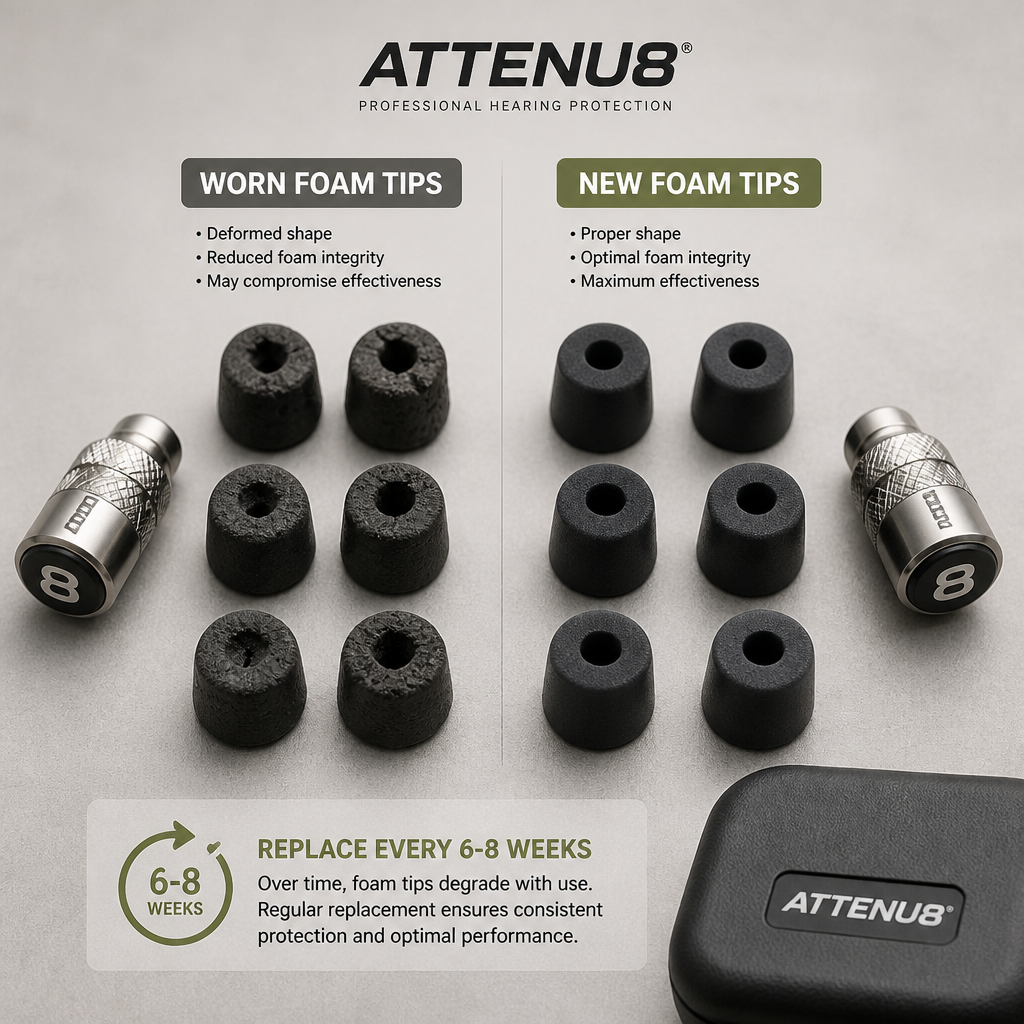
Physical deterioration is the most overlooked sign of poor earplug performance, because people tend to use earplugs until they fall apart rather than replacing them at the point where effectiveness drops. By the time a foam earplug looks noticeably worn, it has typically been underperforming for weeks.
The key test is compression recovery. Roll the foam tip between your fingers and compress it fully, then watch how it expands. Fresh memory foam expands slowly and evenly, filling the canal walls as it returns to shape. Worn foam expands too quickly, unevenly, or not fully at all. When foam loses its expansion capacity, it cannot form the complete seal the earplug depends on for noise reduction. A foam tip that springs back instantly has lost the memory quality that makes it effective.
Beyond compression recovery, look for discoloration (yellowing or darkening from earwax and skin oils), surface hardening or stickiness, and any visible cracking or tearing in the foam. These are not cosmetic issues. They indicate that the material has broken down at a structural level and can no longer conform to the unique contours of the ear canal.
Heat, moisture, skin oils, and repeated compression all degrade foam over time. A foam earplug that has been used nightly for several months and cleaned multiple times will not perform the same as a fresh tip, even if it looks superficially intact. This is why foam tip replacement on a regular schedule matters, not just replacement when the tips look visibly destroyed.
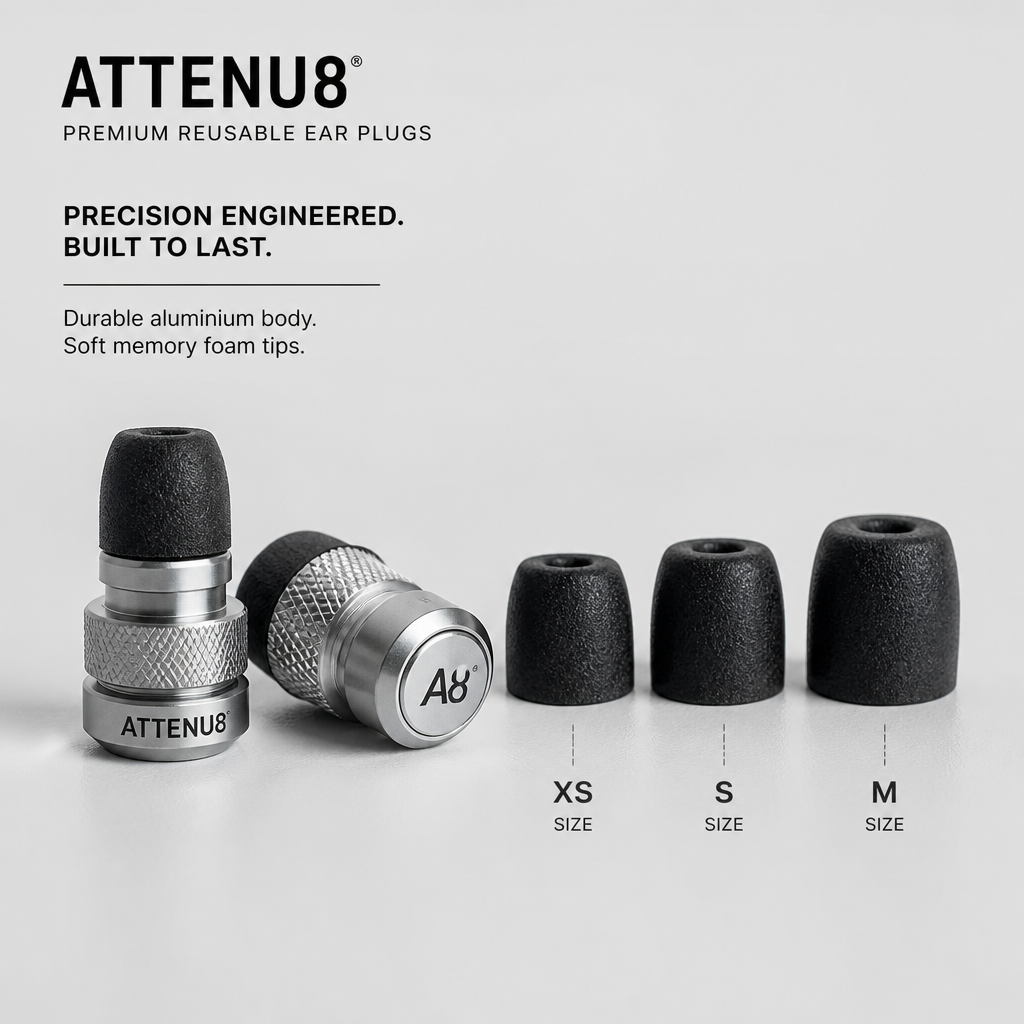
With ATTENU8 earplugs, the aluminium body retains its geometry indefinitely. Only the memory foam tips need replacing, roughly every 6 to 8 weeks depending on use frequency. This approach is more economical than discarding entire disposable earplugs when they degrade, and it ensures the part of the earplug that actually fails (the foam seal) is always fresh without throwing away the part that never degrades (the structural body).
An earplug that causes enough discomfort to make you take it out is providing no protection at all for the remainder of the exposure period. This is the sign of poor earplug performance that people rationalize most aggressively. “I only had them in for part of the night.” “I took them out after an hour because they hurt.” That reasoning does not reduce the hearing damage that accumulates during the unprotected portion.
Discomfort during earplug use is not an inevitable trade-off. It is a sign of wrong fit, wrong size, wrong material, or an earplug design that prioritizes noise reduction ratings over wearability. Comfort and effectiveness are directly linked, not competing properties. An earplug that cannot be worn consistently for its intended duration is, by definition, not an effective hearing protection solution for that person.
We would love your feedback and any insights you would share with others. What perspective would you add?
Pressure pain comes from earplugs that are too large for the canal, or inserted too deeply. Soreness over time comes from materials that harden against the canal wall during extended wear. Side-sleeper pain comes from earplug bodies that protrude from the ear and press against the pillow. Each of these has a specific solution, but the first step is recognizing them as fit and design problems, not as evidence that earplugs generally do not work for you.
The concave aluminium body design of ATTENU8 earplugs is specifically built to address protrusion discomfort for side sleepers. Paired with three tip sizes (XS, S, and M) in soft memory foam, the combination allows for a fit that does not create pressure over extended wear. The foam sits inside the canal while the body sits flush against the outer ear, rather than sitting proud of it. For people who have given up on earplugs entirely because of discomfort, the problem is almost always the earplug design rather than the person’s ear.
Understanding why certain earplug formats consistently underperform helps you make a better choice. The table below compares the three most common earplug formats across the factors that actually determine real-world performance.
| Earplug Type | Key Strengths | Common Failure Points |
|---|---|---|
| Standard disposable foam | Low cost per pair, widely available, high NRR rating on packaging | Degrades rapidly with repeated use, requires correct roll-and-insert technique, one-size-fits-all approach misses many ear canal sizes, no size options for different users |
| Pre-moulded silicone or rubber | Reusable body, does not require rolling technique, easier insertion | Flanged design can create pressure points over extended wear, less adaptable to canal shape variation than foam, NRR typically lower than foam options |
| Metal-bodied reusable with replaceable foam tips (e.g., ATTENU8) | Durable aluminium body never degrades, multiple tip sizes for genuine fit matching, concave design reduces side-sleeper protrusion, consistent fit once correct size is found | Higher upfront cost than disposables, foam tips still require scheduled replacement every 6 to 8 weeks for consistent performance |
The practical takeaway is that disposable foam earplugs are only effective when inserted correctly every single time, and they degrade with every use. A reusable format that isolates the degradable component (the foam tip) from the structural component (the body) eliminates the most common source of gradual performance decline.
The most reliable quick check is to count out loud while slowly cupping and uncupping your hands over your ears. If the earplugs are correctly seated and sealing well, your voice should sound roughly the same volume whether your hands are cupped over your ears or not. If your voice sounds noticeably louder with your hands away, the seal is leaking and the earplugs need to be reinserted or replaced with a better-fitting size.
The most common reason is an incomplete seal. Even a small gap between the earplug and the canal wall allows noise to pass through. This can happen because the tip size is wrong for your canal, the foam has degraded and no longer expands fully, or the insertion was too shallow. Try a smaller or larger tip size, and make sure the foam is fully compressed before inserting. If the problem persists across multiple correct insertions, the earplug material may have degraded past the point of usefulness.
For foam tips on a reusable earplug used nightly, replacement every 6 to 8 weeks is a reasonable guideline. The critical test is whether the foam still compresses fully and then expands slowly back to its original shape. If the foam springs back too quickly, feels stiff, or has visible discoloration or surface changes, it should be replaced regardless of how long it has been in use. Frequency of use and storage conditions also affect how quickly foam degrades.
Earplugs that do not fit properly cause hearing damage indirectly, by failing to reduce noise to safe levels while giving the wearer a false sense of protection. They do not cause physical damage to the ear canal in typical use, but incorrectly sized or inserted earplugs that create excessive pressure can cause discomfort, soreness, and irritation of the canal skin over time. The more serious risk is the ongoing noise exposure that poor-fitting earplugs fail to block.
The Noise Reduction Rating (NRR) is measured under controlled laboratory conditions and represents the maximum potential noise reduction from that earplug type. In real-world conditions, the actual protection is consistently lower because insertion technique, canal fit, earplug condition, and user habit all affect the seal. NIOSH has recommended treating the real-world noise reduction from foam earplugs as roughly 50% of the stated NRR for practical safety assessments. This does not mean the rated NRR is meaningless. It means a higher-rated earplug that fits well will still outperform a lower-rated one, but the gap between the packaging claim and your actual protection depends heavily on how the earplug is used and maintained.
Mild initial awareness of the earplug in the first few minutes is normal as the foam settles. Actual discomfort, meaning pressure pain, soreness, or the persistent urge to remove the earplug, is a fit problem, not an unavoidable feature of hearing protection. The most common causes are using a tip that is too large for the canal, inserting too deeply, or using an earplug with a body that protrudes and presses against the pillow or external ear. Trying a smaller tip size and checking insertion depth resolves most discomfort issues. If discomfort persists across sizes, the earplug design itself may not suit your ear anatomy.
If you have had a clear sign that your earplugs are not working, share what gave it away in the comments. Knowing which failure mode is most common helps everyone make a better choice.
Most people board a long-haul flight hoping to sleep. Most people land exhausted. The reason is not always the seat or the time zone: it is the constant, grinding roar of the cabin. Research published in the Journal of the Canadian Acoustical Association measured continuous in-cabin noise at 80 to 85 dB(A) during cruise, with sudden bursts reaching as high as 88 dB(A). That is roughly the volume of a lawnmower running beside your head for 14 hours. The right earplugs for travel do not just muffle noise. They are the difference between arriving functional and arriving wrecked.
| Key Insight | Explanation |
|---|---|
| Cabin noise peaks at 80-85 dB(A) during cruise | That is loud enough to cause fatigue and impair sleep even without causing immediate hearing damage. You need real attenuation, not token protection. |
| NRR is a lab number, not a real-world guarantee | The actual noise reduction you experience depends almost entirely on fit and seal quality. A perfectly fitted earplug with a 32 dB rating beats a poorly fitted 33 dB one every time. |
| Fit beats raw dB rating for sleep comfort | An earplug that presses uncomfortably against your ear canal will wake you up before the engine noise does. Soft, size-matched tips are not a luxury feature. |
| Disposable foam is wasteful and inconsistent on repeat trips | Single-use foam earplugs degrade in quality from day one and clog with earwax, making each subsequent use less effective. Reusable options maintain consistent performance. |
| Tip size matters more than most travelers realize | Using a tip that is too large causes pressure pain; too small means an incomplete seal and significant noise bleed. Multiple tip sizes in a single kit solve this without guesswork. |
| Side-sleepers need low-profile earplug bodies | Bulky earplug bodies press against the seat headrest or travel pillow and dislodge during sleep. A compact, smooth-bodied design stays seated through the night. |
| Replacing tips, not the whole earplug, is more cost-effective long term | Premium reusable earplugs designed for tip-only replacement offer far better value over a year of travel than repeatedly buying multipacks of disposables. |
The cabin is not just loud. It is loud in a specific, physiologically punishing way. Continuous engine noise settles at around 80 to 85 dB(A) during cruise altitude, according to peer-reviewed measurements of in-flight sound levels. A separate study published on PubMed found a median in-flight sound level of 83.5 dB(A) across multiple aircraft types and flight phases, with peaks exceeding 110 dB(A) near engine-mounted fuselages.
What makes this particularly disruptive for sleep is not just the volume. It is the relentlessness. There are no quiet gaps for your nervous system to relax into. The low-frequency rumble of turbofan engines penetrates most lightweight acoustic barriers because low frequencies carry more energy and require denser or better-fitted protection to block effectively.
Add to that the irregular bursts from the galley, announcements, crying children, and pressurization changes, and you have a sound environment that is actively hostile to sleep. Cabin noise is not a minor inconvenience. It is a documented driver of travel fatigue, which research characterizes as general fatigue, disorientation, and headache resulting from the disruption of normal sleep patterns.
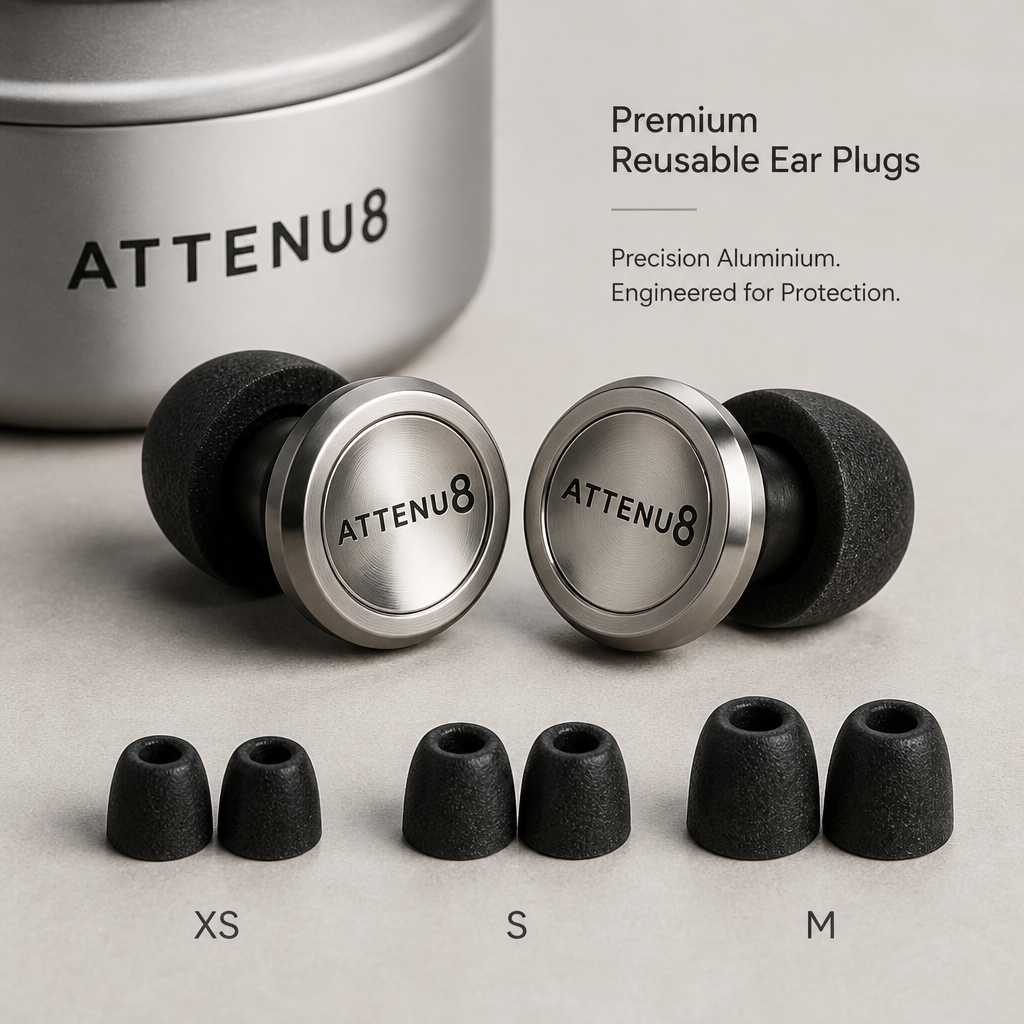
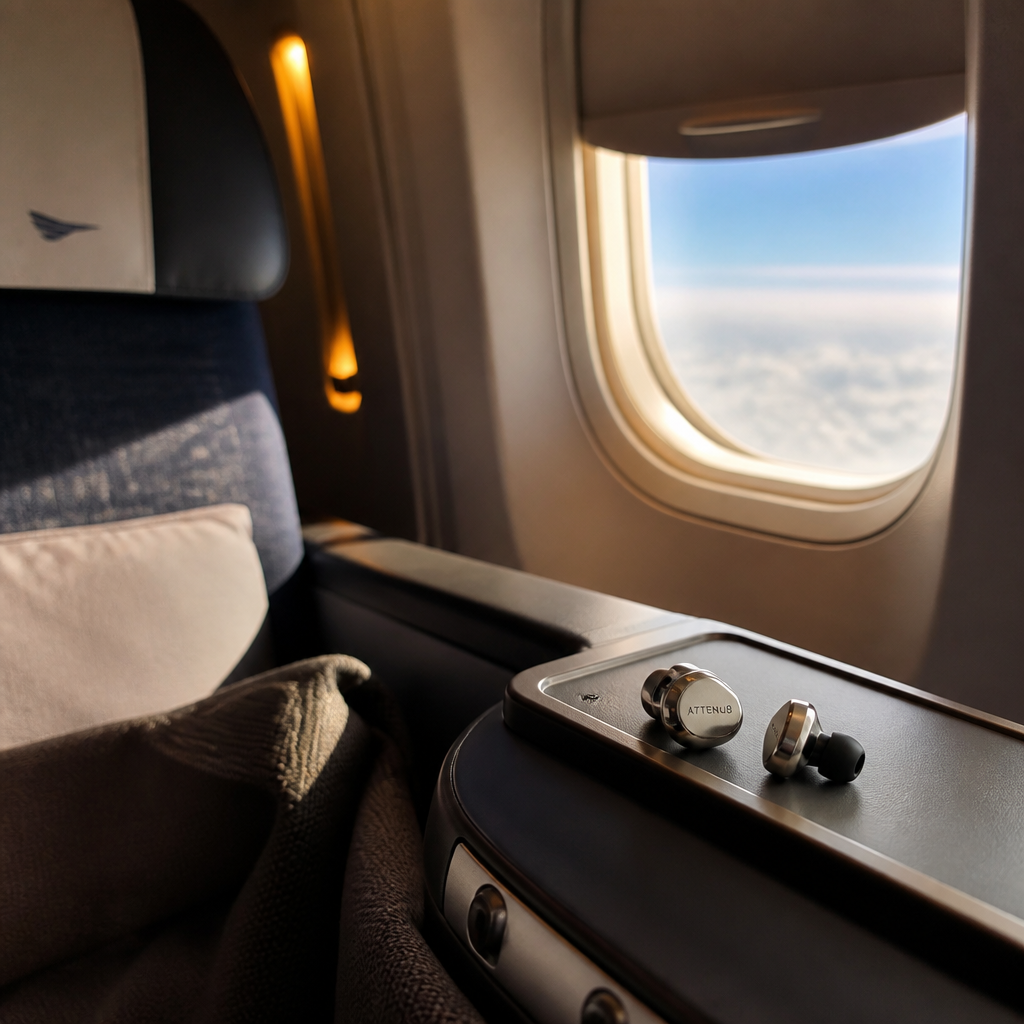
Every earplug sold for hearing protection carries a Noise Reduction Rating (NRR), measured in decibels. The rating reflects maximum noise reduction under ideal, controlled laboratory conditions. For most general hearing protection, an NRR of 20 to 30 dB is considered effective. ATTENU8 earplugs deliver approximately 32 dB of noise reduction, which places them at the upper end of this effective range.
The catch is how NRR translates to real-world use. Audiologists and occupational health researchers consistently note that actual protection achieved is often lower than the rated figure, because real-world fit is never as perfect as the laboratory insertion technique used during testing. The standard adjustment formula takes roughly half the NRR value as a more realistic estimate of real-world performance. This means that the quality of the seal you achieve matters enormously, sometimes more than the NRR number itself.
At 83 dB(A) cabin noise and a real-world effective reduction of around 16 to 20 dB from a well-fitted 32 dB-rated earplug, you can bring your perceived noise environment down to somewhere around 63 to 67 dB. That is roughly the volume of a normal conversation at arm’s length. It is not silence, but it is a level at which most people can fall and stay asleep, particularly with a travel pillow and eye mask doing their part.
Pro tip: The difference between an earplug that achieves 15 dB real-world reduction and one that achieves 20 dB is not just 5 dB. Because decibels are logarithmic, each 10 dB reduction cuts perceived loudness roughly in half. Getting that extra few dB through a better seal is worth the effort of learning correct insertion technique.
There are three categories of earplugs commonly used for air travel. Each has a legitimate use case, but they are not equally suited to long-haul sleep on a plane.
Disposable foam is the default option in most pharmacies and airport shops. The foam expands after insertion to fill the ear canal, creating a seal. NRR ratings for quality foam plugs can reach the low 30s, and they are inexpensive per pair. The problems are consistency and comfort on long flights.
Foam degrades quickly. A pair that delivers solid attenuation when new will be noticeably less effective after a few uses as the foam loses its memory and compression recovery. They also accumulate earwax, which is unhygienic over the course of a long trip if you are reusing them across multiple days. For a single overnight flight once a year, disposable foam is acceptable. For frequent travelers who fly monthly or more, it is a false economy.
Moldable silicone putty sits against the ear canal entrance rather than inserting into it. These work well for people with narrow or sensitive ear canals and are comfortable during side-sleeping because there is no rigid body protruding from the ear. Their limitation is attenuation. Because they do not seal inside the canal, they tend to deliver lower and less consistent noise reduction than properly inserted foam or tipped earplugs, making them a better fit for lower-noise environments than a busy long-haul cabin.
The most practical category for frequent travelers. A rigid or semi-rigid body holds a replaceable soft foam tip in position. Done well, this combines the acoustic performance of foam with the durability and hygienic benefits of a reusable design. The body maintains consistent depth and angle of insertion, which addresses one of the main reasons disposable foam underperforms: people do not insert it deeply enough.
ATTENU8 earplugs are built on a different premise than most travel earplugs. The body is machined aluminium, which is precisely where the value becomes apparent for frequent flyers. Aluminium does not deform, does not absorb earwax, and does not degrade with exposure to humidity or temperature changes, all of which are relevant inside an aircraft cabin where condensation and recycled air are constants.
The concave aluminium body sits comfortably and securely in the concha of the ear without creating the pressure points that elongated or cylindrical earplug bodies sometimes cause. For side-sleepers pressing their ear against a headrest or travel pillow, a low-profile, smooth-bodied earplug is not a preference: it is a practical necessity if you want to stay asleep for more than an hour at a stretch.
Each ATTENU8 pair comes with three sizes of soft memory foam tips (XS, S, and M). This matters for a reason that most one-size-fits-all earplug products ignore entirely: ear canal diameter varies significantly between individuals, and even between left and right ears on the same person. A tip that is marginally too small creates a noise leak at the canal wall. A tip that is too large causes discomfort that wakes you up within an hour, negating any sleep benefit the earplug was supposed to provide.
Having three sizes available in one kit removes the guesswork. Spend five minutes on the ground before boarding testing which tip size seats comfortably and creates a clean muffling of ambient sound when pressed in, and you board the plane knowing your seal will hold for the duration of the flight.
The memory foam tips are the only consumable component. ATTENU8 recommends replacing tips every 6 to 8 weeks, which covers roughly 10 to 15 long-haul flights at typical business traveler frequency. The aluminium body is essentially permanent. This is a meaningfully different cost and waste profile compared to buying disposable foam packs before every trip, and it means the attenuation quality you calibrated on your first use is maintained consistently across every subsequent flight.
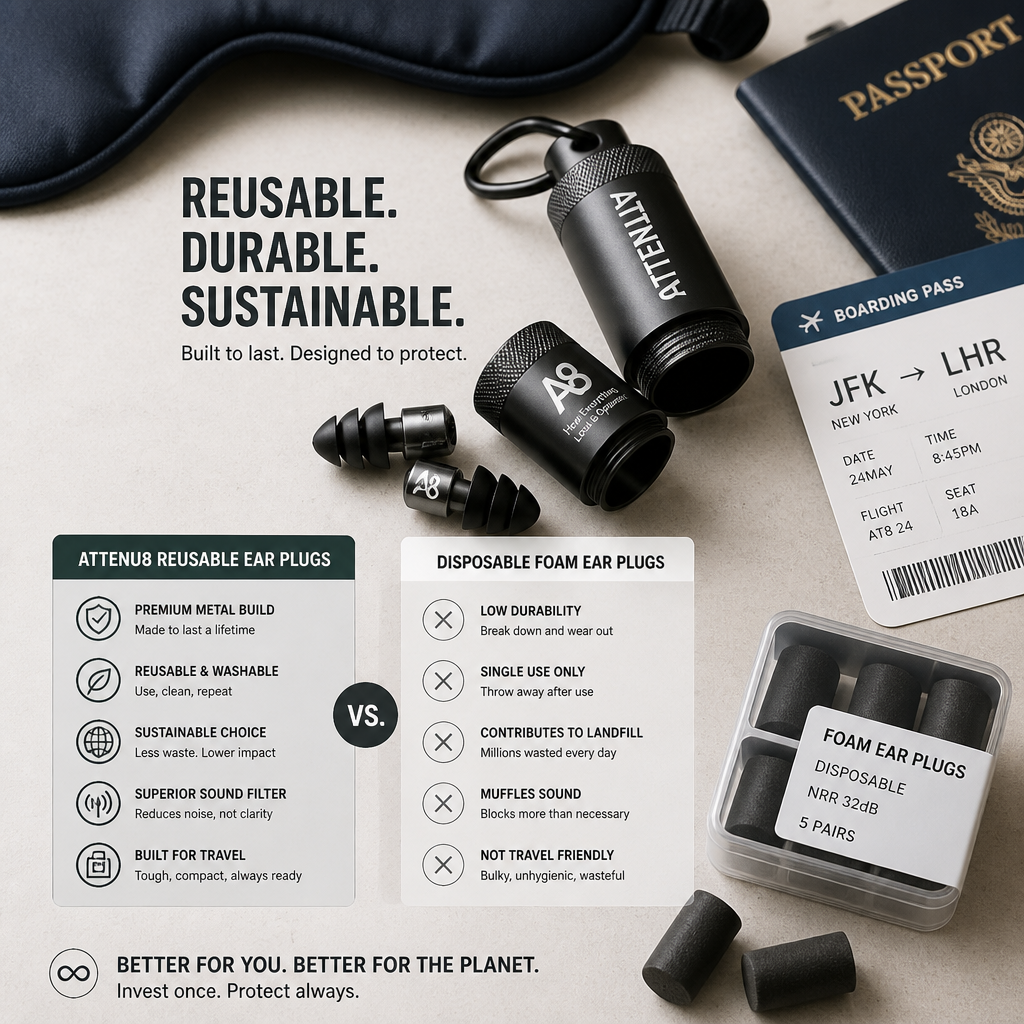
Insertion technique is the single most overlooked variable in earplug performance. Most people push a foam tip straight into the ear canal. That is incorrect, and it is why so many travelers report that earplugs “do not really work” for them on flights.
Reach your opposite hand behind your head and gently pull the top of your outer ear upward and slightly backward. This straightens the natural curve of the ear canal. Then insert the earplug with your other hand, rolling the foam tip gently between your fingers first to compress it if it is a compressible tip. Hold it in place for several seconds while the foam expands and conforms to the canal wall. Release your outer ear. When done correctly, the difference in ambient sound level is immediate and obvious.
Pro tip: Do this before takeoff, not after you are already settled in your seat. The act of reaching around your head to pull your ear tends to disturb your neighbor less when you are still arranging yourself rather than mid-flight in a dark, quiet cabin.
Some travelers remove their earplugs during takeoff and landing to manage ear pressure equalization. This is often unnecessary if you are not experiencing pain. Earplugs do not block the equalization mechanism in the Eustachian tube. If you do experience discomfort, brief removal and a few swallowing or yawning motions are usually enough to equalize. Reinsert immediately after, because takeoff and landing are acoustically some of the noisier phases of flight.
The effective noise reduction you achieve from an earplug depends far less on its rated number than on how well it seals against your specific ear canal. Fit is the variable that all the testing in the world cannot substitute for.
Noise-cancelling headphones are excellent for in-flight entertainment and reducing the engine drone during waking hours. They are poor sleep tools on a plane. They are physically large, which means side-sleeping on a headrest with them on is immediately uncomfortable. They require power, which means they can fail mid-flight or mid-sleep. And many experienced travelers report waking from light sleep with their headphones pushed askew, introducing a sudden rush of cabin noise that disrupts the sleep cycle.
Earplugs have none of those failure modes. They are passive, meaning no battery, no firmware, no pairing sequence at 2 a.m. when you are groggy. A pair of well-fitted travel earplugs in a metal case fits in a shirt pocket, survives a bag search without damage, and works identically on a 3-hour regional hop and a 16-hour transpacific flight.
The practical approach for most long-haul travelers is to use noise-cancelling headphones for the first few hours of a flight during entertainment and meals, then switch to earplugs for sleep. The two tools complement rather than compete with each other.
| Feature | Disposable Foam Earplugs | Moldable Silicone Putty | Reusable Metal-Bodied with Foam Tips (ATTENU8) |
|---|---|---|---|
| Noise Reduction | High when new, degrades quickly | Moderate, inconsistent seal | Up to 32 dB, consistent across uses |
| Comfort for Side-Sleeping | Protrudes, can dislodge on headrest | Low profile, comfortable | Low-profile concave body, stays seated |
| Hygiene | Accumulates wax, single use recommended | Can be rinsed but putty degrades | Aluminium body wipes clean, tips replaced on schedule |
| Fit Options | One size, no adjustment | Moldable but no size guidance | Three tip sizes (XS, S, M) included |
| Long-Term Cost | High, constant repurchase | Medium, putty degrades | Low, tips replaced every 6-8 weeks only |
| Durability for Travel | Crushes in bags, degrades with humidity | Melts in heat, loses moldability | Aluminium body is essentially permanent |
| Best Use Case | Occasional flights, emergencies | Sensitive ears, low-noise environments | Frequent travel, long-haul sleep, loud environments |
No earplug eliminates all in-flight noise, and none should aim to. A well-fitted earplug with around 32 dB attenuation can reduce a typical cruise noise level of 83 dB(A) down to a manageable range where sleep is genuinely possible. The goal is not complete silence but noise reduction sufficient to allow the brain to disengage from monitoring the environment, which is what prevents sleep onset in loud conditions.
Yes. Reusable earplugs with soft foam or silicone tips are safe for air travel. They do not interfere with Eustachian tube function or pressure equalization. If you experience ear pressure discomfort during takeoff or landing, remove the earplugs briefly, equalize by yawning or swallowing, and reinsert. This is a minor inconvenience that most travelers encounter only rarely.
For long-haul flights, aim for an NRR of at least 28 to 33 dB. Cabin noise at cruise altitude typically measures around 80 to 85 dB(A), and you need meaningful attenuation to bring that into a sleep-friendly range. An NRR of 32 dB, like that delivered by ATTENU8 earplugs, sits at the effective upper end for wearable, comfortable travel use without requiring industrial hearing protection.
Test each size before your flight. Insert the tip using the correct technique, straightening the ear canal by pulling the outer ear upward and back, then pressing the tip in and holding it for several seconds. The right size produces a clear, immediate dampening of ambient sound with no pain or feeling of pressure. If you feel discomfort within a minute, the tip is too large. If you can still hear clearly at normal volume, the tip is too small or the seal is incomplete.
Wearing earplugs throughout the flight is reasonable for anyone sensitive to noise or working to manage fatigue on long routes. Cabin noise at 80 to 85 dB(A) over many hours is fatiguing even when you are not trying to sleep. That said, most people prefer to remove them when engaging in conversation or watching entertainment, then reinsert for sleep. With a reusable earplug, reinsertion is quick and does not degrade the product the way repeated handling degrades disposable foam.
Yes, and this is exactly where multiple tip size options become important rather than optional. Standard disposable foam earplugs are sized for average adult ear canals. People with smaller canals often find them uncomfortable or ineffective because the foam cannot compress enough on insertion without causing pain. An XS foam tip on a correctly sized earplug body solves this problem directly. If you have historically found earplugs uncomfortable, the issue is almost certainly tip size rather than earplugs as a category.
The aluminium body of a metal-bodied earplug wipes clean with a damp cloth or a travel antibacterial wipe. The memory foam tips should not be soaked or submerged in water, but they can be wiped with a dry or lightly damp cloth between uses. Plan to replace the foam tips every 6 to 8 weeks during active travel use. Carry a small travel case to protect them between uses. This is significantly less maintenance than most travelers assume.
Have your earplugs ever made or broken a long-haul flight for you? Drop your experience in the comments, we would genuinely like to hear what worked and what did not.
Most people don’t realise they’re damaging their hearing until it’s already gone. Noise-induced hearing loss is permanent. There is no surgery, no pill, and no device that restores cochlear hair cells once they are destroyed. The question of how loud is too loud isn’t academic. It determines whether you wake up tomorrow able to hear a whispered conversation, or whether you spend the next decade straining in every meeting. This guide cuts through the noise, literally, and gives you a practical decibel reference for your daily life, whether you’re a light sleeper tormented by a snoring partner, a construction worker running a drill, or just someone trying to protect their hearing for the long haul.
| Key Insight | Explanation |
|---|---|
| 85 dB is the critical threshold | NIOSH recommends keeping occupational noise exposure below 85 dBA over an 8-hour shift. Above this, damage accumulates with every hour. |
| The decibel scale is logarithmic | A 10 dB increase is not a little louder. It represents a dramatically larger increase in sound intensity, not a simple step up. |
| 70 dB or below is considered safe | Sounds at or below 70 dB are generally safe even with long-term exposure. Normal conversation sits around 50-60 dB. |
| Bedrooms should be under 30 dB at night | The WHO recommends less than 30 dB inside bedrooms at night for good sleep quality. Snoring can reach 60-80 dB or more. |
| 120 dB can cause immediate damage | Short-term exposure exceeding 120 dB, such as a jet engine or rock concert, can cause temporary or permanent hearing loss on the spot. |
| The arm’s length test is a practical field check | If you must raise your voice to be heard by someone an arm’s length away, background noise is likely at or above 85 dBA. |
| Hearing loss is 100% preventable | Noise-induced hearing loss cannot be reversed, but it can be entirely prevented by reducing exposure time and wearing adequate protection. |
A decibel (dB) is the unit used to measure the intensity of sound. The scale starts at 0 dB, which represents the faintest sound a healthy human ear can detect, and extends upward to around 140 dB, which is the threshold of pain. What trips people up is that the scale is logarithmic, not linear. A 10 dB increase does not mean sound is slightly louder. It represents a dramatic jump in acoustic energy, and a noticeably larger increase in perceived loudness.
This matters practically. The difference between a quiet library at 30 dB and busy city traffic at 85 dB is not a gentle progression. It’s an enormous leap in energy that the ear must process. Most people underestimate environmental noise because it doesn’t always feel loud in the moment. That underestimation is what makes gradual hearing damage so common.
When sound is measured for health risk, the A-weighted decibel (dBA) is the standard used. This weighting adjusts the measurement to reflect the frequencies the human ear is most sensitive to, making it a more accurate predictor of hearing risk than a raw dB reading.
Pro tip: Many smartphones now include a built-in decibel meter through their health apps. Apple’s Health app and compatible Android apps can measure ambient noise levels and alert you when exposure enters a risky range. It’s not a calibrated scientific instrument, but it gives you a useful real-world baseline.
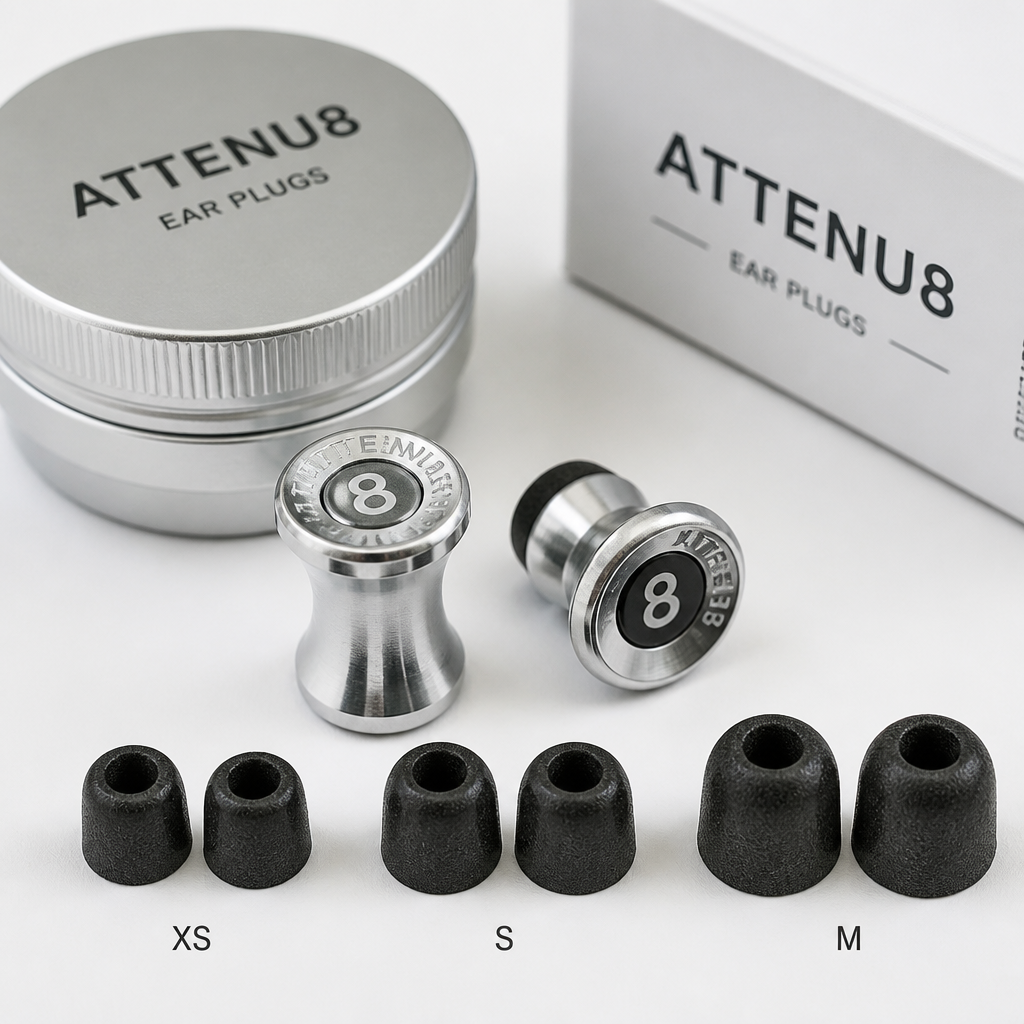
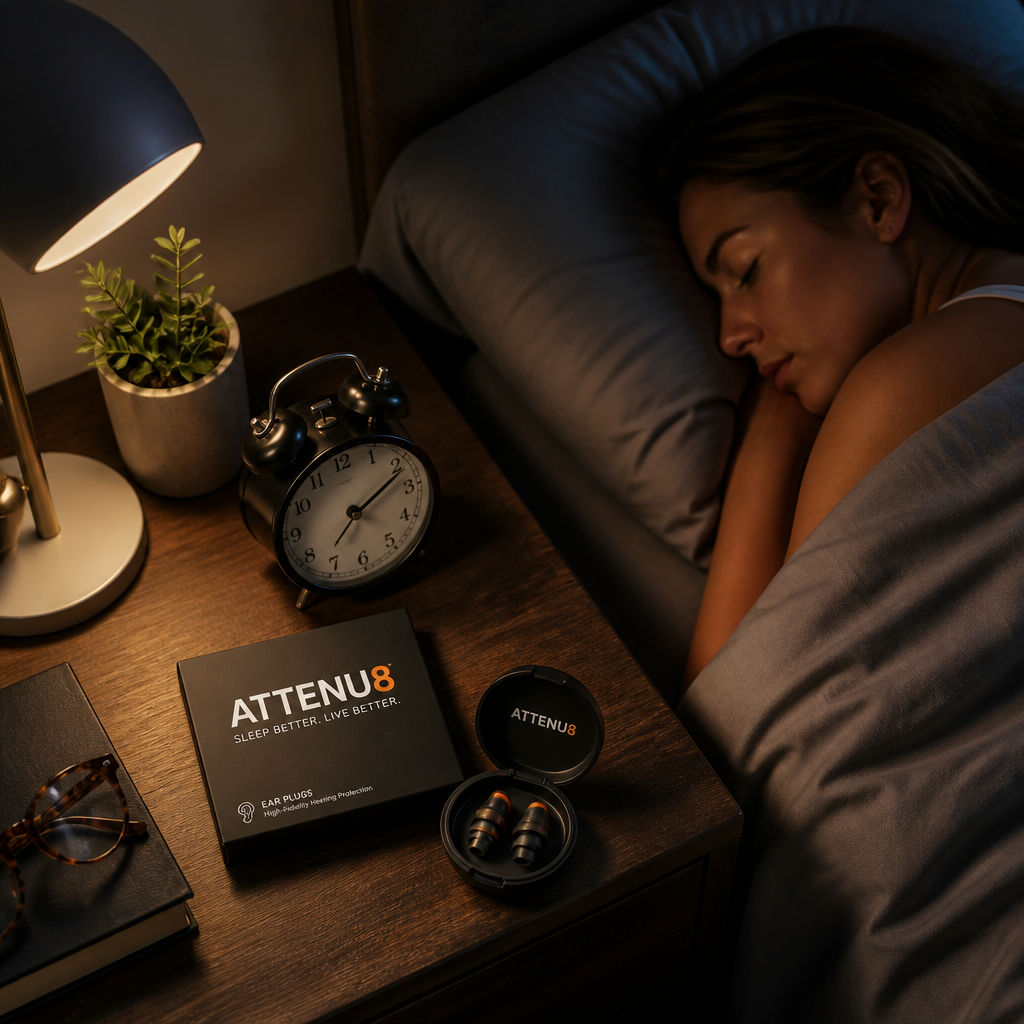
Numbers on a chart mean little without context. Here is what the decibel scale looks like in environments most people encounter regularly. These figures are typical reference values. Actual levels vary depending on distance from the source, room acoustics, and specific equipment.
| Sound Source | Approximate Decibel Level | Risk Level |
|---|---|---|
| Whisper / rustling leaves | 20-30 dB | Safe |
| Normal conversation | 50-60 dB | Safe |
| Household vacuum cleaner | 70 dB | Safe (threshold) |
| Heavy traffic / busy street | 80-85 dB | Moderate risk with extended exposure |
| Construction site / power tools | 85-95 dB | Hazardous above 85 dB |
| Motorcycle engine | ~95 dB | Hazardous |
| Chainsaw | ~110 dB | Hazardous. Immediate damage possible |
| Rock concert / amplified music | 110-115 dB | Hazardous. Very short safe exposure time |
| Jet plane at takeoff (nearby) | ~120 dB | Pain threshold. Immediate risk |
| Gunshot / explosion | 140+ dB | Immediate, potentially permanent damage |
Notice that construction sites and heavy traffic are already at or approaching the hazardous threshold. These are not extreme environments. They are Tuesday for millions of workers and commuters worldwide. The gap between “loud but familiar” and “actively damaging” is narrower than most people assume.
Pro tip: Distance matters enormously. Sound intensity drops significantly as you move away from its source. If you’re at an outdoor event and the speakers feel uncomfortable, moving further away is not a retreat. It’s a practical hearing health decision. At every doubled distance, intensity reduces substantially.
The number 85 dB is the most important figure in this entire guide. NIOSH sets its recommended exposure limit for occupational noise at 85 dBA over an 8-hour shift. At exactly that level, 8 hours of continuous exposure is the maximum considered safe. But every 3 dB increase above 85 dBA cuts the safe exposure time roughly in half. At 88 dB, you’re at 4 hours. At 94 dB, you’re at 1 hour. This halving effect is why construction and manufacturing environments are so genuinely dangerous.
Below 70 dB, you’re on solid ground. Sounds at or below 70 dBA are considered safe even with prolonged exposure. Between 70 and 85 dB is a zone worth watching during extended exposure. Above 85 dB, every hour without protection is a small, irreversible withdrawal from your hearing account. You won’t notice the deficit immediately. But it compounds.
The cochlear hair cells that convert sound into nerve signals do not regenerate. Once damaged by excessive noise, that hearing capacity is gone permanently. No medical intervention currently exists to restore them.
At very high levels, 120 dB and above, the timeline for damage collapses entirely. A single impulsive noise event, like a gunshot or explosion near the unprotected ear, can cause immediate permanent hearing loss in a single moment. This is why hearing protection in shooting ranges, military environments, and industrial blast zones is not optional equipment. It is the difference between hearing and not hearing for the rest of your life.
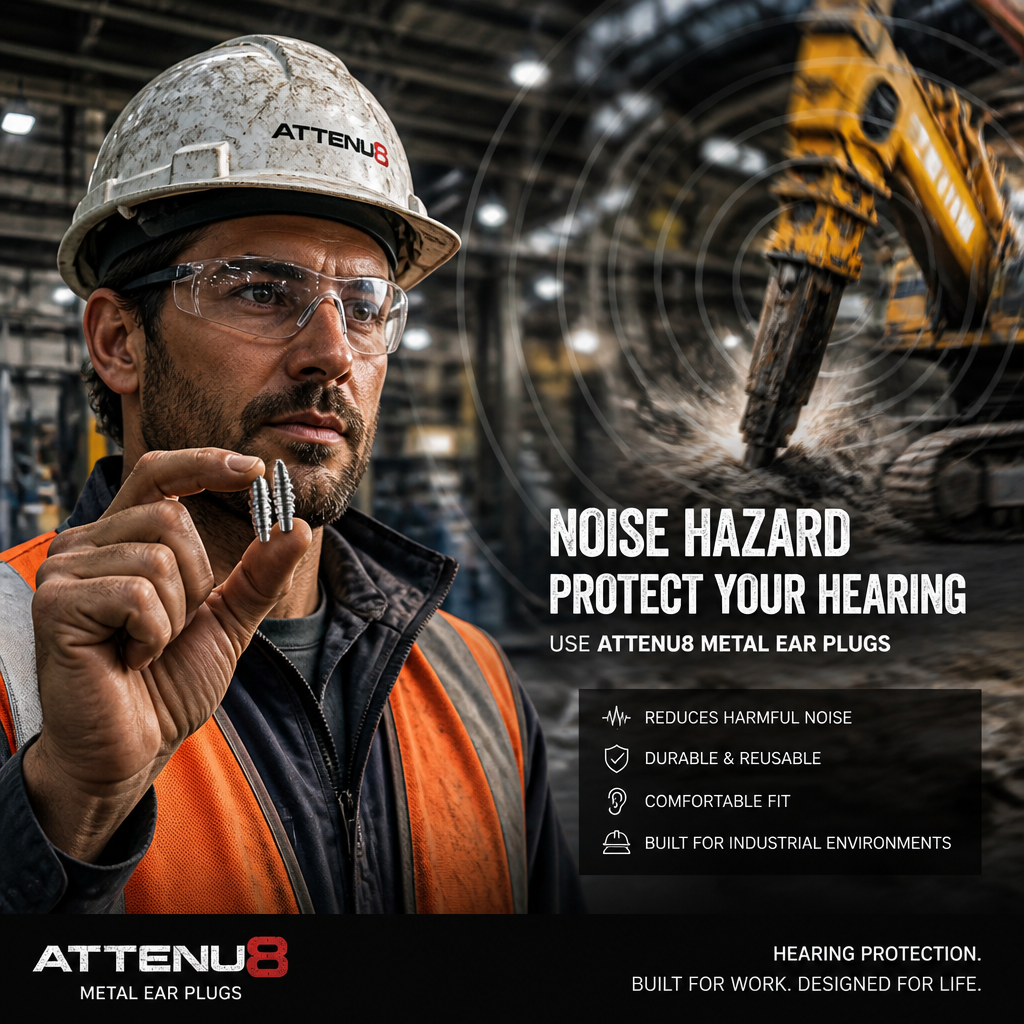
Sleep is where the safe noise level drops dramatically, and where many people are unknowingly suffering the consequences of too much ambient sound. The WHO recommends less than 30 dB inside bedrooms during the night to allow quality sleep. For context, a quiet rural night sits around 20-30 dB. A typical residential area with ambient traffic easily pushes 40-50 dB. That gap matters.
A snoring partner is one of the most common noise complaints among light sleepers, and the numbers explain exactly why. Average snoring typically sits in the 60-80 dB range. Severe snoring can push well beyond that. At those levels, you are not experiencing “some background noise.” You are experiencing noise equivalent to heavy city traffic, sustained throughout the night, inches from your head.
The impact is not just inconvenience. Repeated fragmentation of sleep by noise, even at levels that don’t fully wake you, reduces time spent in deep, restorative sleep stages. Over weeks and months, this contributes to chronic fatigue, impaired concentration, and measurable strain on cardiovascular health. Poor sleep driven by noise is a genuine medical issue, not just a comfort problem.
The WHO also recommends that outdoor noise levels around bedrooms not exceed 40 dB on average through the night. In practice, many people in cities face consistent outdoor noise well above this, from traffic, neighbours, and general urban activity. The bedroom is supposed to be a refuge. For many people, it isn’t.
For anyone in this situation, the most direct solution is reducing the noise that reaches your ears. Thicker curtains and better window seals help at the room level. But if the noise source is inside the room, as with a snoring partner, or if your environment simply doesn’t allow structural changes, wearing quality ear plugs with proven noise reduction is the most reliable and immediate intervention available.
A 32 dB noise reduction rating, such as that delivered by ATTENU8’s aluminium-bodied ear plugs with memory foam tips, brings a 75 dB snoring environment down to a level compatible with genuine sleep. That’s not a marginal improvement. It’s the difference between six broken hours and a full night.
For professionals in construction, manufacturing, and military environments, the safe noise level question is not hypothetical. It’s a daily calculation with long-term consequences. NIOSH is direct: noise levels are likely hazardous if you must raise your voice to speak with someone an arm’s length away. If that describes your normal working day, your hearing is at risk.
Construction sites routinely measure 85-95 dB. Power tools, heavy machinery, compressors, and demolition equipment all push well beyond the 85 dBA threshold. An 8-hour shift on a busy site without protection is not a minor inconvenience. It is a medically significant noise exposure event. Workers who spend years in these environments without consistent protection often develop noise-induced hearing loss and tinnitus, sometimes before they reach 50.
OSHA requires employers to provide hearing protection when noise exposure at or above the 85 dBA time-weighted average is measured. But compliance and actual consistent use are different things. The practical reality is that foam ear plugs are often uncomfortable, get contaminated quickly, and are used inconsistently because workers find them irritating to wear all day. A reusable, well-fitting option that stays comfortable for extended wear changes that calculation.
Military personnel face some of the most severe noise exposures of any occupational group. Gunfire, artillery, aircraft engines, and armoured vehicle interiors produce impulsive and sustained noise well above 120 dB. Even a single unprotected exposure at these levels can cause irreversible hearing damage. Hearing loss is consistently among the most common service-connected disabilities for veterans. The ear plugs used in this environment need to perform reliably, fit securely, and be easy to insert and remove quickly when conditions change.
Pro tip: In high-noise workplaces, the Noise Reduction Rating (NRR) printed on ear plug packaging is your practical guide. An NRR of 32 means the ear plugs are rated to reduce exposure by approximately 32 dB under test conditions. In real-world use, actual protection depends heavily on fit. A poorly fitted ear plug provides far less protection than its rating suggests. This is why fit, comfort, and proper sizing matter as much as the NRR number itself.
Not all ear protection is equal. Understanding the practical differences between the main types helps you choose protection that you will actually wear consistently, which is what determines whether it works.
| Protection Type | Noise Reduction | Practical Considerations |
|---|---|---|
| Single-use foam ear plugs | Up to ~33 dB NRR (when correctly fitted) | Cheap per unit but wasteful, often poorly fitted, degrade quickly, become unhygienic with reuse |
| Reusable metal-bodied ear plugs with memory foam tips (e.g. ATTENU8) | ~32 dB NRR | Durable aluminium body lasts long-term. Only foam tips need replacing every 6-8 weeks. Multiple tip sizes ensure a proper fit. Hygienic and cost-effective over time. |
| Over-ear hearing protection (ear muffs) | Typically 20-30 dB NRR depending on model | Good for short, intermittent use. Bulky, uncomfortable for extended wear, impractical during sleep or travel |
The single biggest failure mode in hearing protection is inconsistent use. People abandon ear plugs that are uncomfortable, that don’t fit properly, or that feel like a disposable afterthought. The goal of durable, well-engineered ear plugs is not just better specs on paper. It’s protection you actually wear every time the situation calls for it, whether that’s a job site, a flight, or a bed shared with someone who snores.
Hearing damage doesn’t usually announce itself with a dramatic event. It builds quietly over time. But there are reliable early warning signs that your ears have been pushed too far in a given day or over a period of months.
Ringing or buzzing after exposure: Temporary tinnitus after a concert, a power tool session, or a loud event is a signal that cochlear hair cells were stressed. If it fades within hours, no permanent damage has necessarily occurred yet. If it persists, it may indicate damage that won’t fully reverse.
Muffled hearing after noise exposure: A dulled or muffled quality to sound after a loud environment is a temporary threshold shift, the auditory system recovering from overload. Repeated episodes of temporary threshold shift contribute directly to permanent loss over time. If you’re experiencing this regularly, your environment is too loud.
Struggling to follow speech in groups: Difficulty tracking conversations in background noise, especially in restaurants or social gatherings, is often one of the first signs of early noise-induced hearing loss. It’s frequently dismissed as inattention when it is actually an early auditory impairment.
Having to raise your voice consistently: Both OSHA and NIOSH use this as a practical field test. If you must raise your voice to be understood by someone an arm’s length away, the environment is likely at or above 85 dBA. If that is your normal, your hearing is being tested every day.
Sounds at or below 70 dB are considered safe even with prolonged exposure. Normal conversation sits at around 50-60 dB, which is well within the safe range. Problems begin when sustained exposure exceeds 70-75 dB regularly, and become genuinely hazardous above 85 dB.
The NIOSH recommended exposure limit is 85 dBA over an 8-hour shift. At exactly 85 dB, 8 hours is the maximum considered safe. For every 3 dB increase above that, the recommended safe exposure time roughly halves. At 88 dB, that’s 4 hours. At 94 dB, it’s approximately 1 hour. This is why industrial and construction environments require hearing protection throughout the entire workday.
Sustained noise above 85 dB can cause hearing damage regardless of whether you’re awake or asleep, though it’s more practically significant during waking hours. The more common sleep noise problem is sleep disruption rather than hearing damage directly. The WHO recommends bedroom noise stay below 30 dB at night for quality sleep. Snoring, traffic, and urban ambient noise regularly exceed this, causing fragmented sleep and accumulating health effects over time.
NRR (Noise Reduction Rating) is the standard used in the United States, while SNR (Single Number Rating) is the European equivalent used in CE-certified products. Both express the approximate decibel reduction a hearing protector provides under test conditions. An SNR of 32, for example, means the ear plugs are rated to reduce noise exposure by approximately 32 dB. Real-world performance depends on proper fit, which is why choosing ear plugs with multiple tip sizes to suit your ear canal is important.
Reusable ear plugs with proper fit can match or exceed the noise reduction of disposable foam options. The key variable is fit. A well-sized, correctly inserted ear plug provides its full rated protection. An ill-fitting disposable plug, regardless of its NRR rating, delivers far less. Reusable ear plugs with replaceable foam tips in multiple sizes solve both problems: they maintain consistent performance and allow you to find the fit that works for your ear canal, which changes everything.
Snoring commonly reaches 60-80 dB, with severe cases exceeding that. The WHO recommends bedroom noise below 30 dB for quality sleep. The gap between where snoring sits and where sleep-quality noise should sit is significant. Wearing ear plugs rated at around 32 dB noise reduction brings even a moderately loud snoring environment down to a range that allows genuinely restorative sleep.
If you’ve ever woken up frustrated, exhausted, or wondering whether what you’re hearing at work or at night is actually harming you, we’d like to hear about your experience. Leave a comment or share your situation below.
We would love your feedback and any insights you would share with others. What perspective would you add?
Most people who switch to reusable earplugs eventually notice the same thing: after a few weeks, the foam tips feel slower to expand, the metal body feels slightly tacky, and the earplugs start to smell faintly of something they would rather not think about. That is not a product failure. That is a maintenance failure. Knowing how to clean reusable earplugs correctly is the single most important habit that separates people who get months of reliable performance from their earplugs and people who throw them out after six weeks convinced reusable options are not worth it. This guide covers every part of earplug hygiene, from daily wiping to weekly deep cleans, and tells you exactly when foam tips need replacing.
| Key Insight | Explanation |
|---|---|
| Metal body and foam tips need separate cleaning approaches | The aluminium body can handle a damp cloth with mild soap. The foam tip cannot be submerged in liquid or cleaned with alcohol without permanent damage to its expansion properties. |
| Never use alcohol on foam tips | Alcohol degrades open-cell foam at a cellular level, causing the tip to lose its shape-memory and noise-sealing ability. Use alcohol wipes only on the metal body, never the foam. |
| Wipe the foam tip after every single use | A dry lint-free cloth removes surface earwax before it hardens and embeds deeper into the foam. This one habit extends tip lifespan significantly more than any deep-clean routine. |
| Replace foam tips every 6 to 8 weeks with daily use | Memory foam begins losing its expansion properties around week five due to accumulated oils and compressed cellular structure. Visual cleanliness is not a reliable indicator of functional life remaining. |
| Dirty earplugs can cause ear infections | Bacteria and fungi accumulate on unclean earplug surfaces and are reintroduced into the ear canal on every insertion. Regular cleaning eliminates this cycle. |
| Store earplugs in a closed, dry case after every use | Leaving earplugs on a nightstand exposes the foam to airborne dust and debris. A closed case also prevents accidental compression that deforms the tip prematurely. |
| The expansion test reveals actual tip condition | Compress the tip fully and release. A healthy tip returns to 90% of its original shape within 3 to 4 seconds. If it takes 6 to 8 seconds or longer, the foam is due for replacement regardless of how it looks. |
The ear canal is one of the warmest, most humid environments on the human body. Every time you insert an earplug, the foam tip picks up earwax, skin oils, and dead skin cells. Left on the surface of porous foam, that material becomes a bacterial culture sitting directly against your ear canal wall on the next use.
The health consequences are real. Repeatedly blocking the ear canal with unclean earplugs can cause a buildup of earwax that the ear’s natural self-cleaning mechanism cannot clear. Beyond wax buildup, dirty earplugs can introduce bacteria into the ear canal, increasing the risk of ear infections, including otitis externa, commonly known as swimmer’s ear. These are not hypothetical risks for someone who uses earplugs every night. They are predictable outcomes of poor earplug hygiene.
The performance consequences are just as significant. Earwax and skin oils accumulate inside memory foam tips within days of use, degrading the foam’s expansion speed and reducing noise reduction from the rated level down to something far less effective. If your earplugs once blocked out your partner’s snoring and now seem barely adequate, a dirty foam tip is often the cause before tip replacement is even necessary.
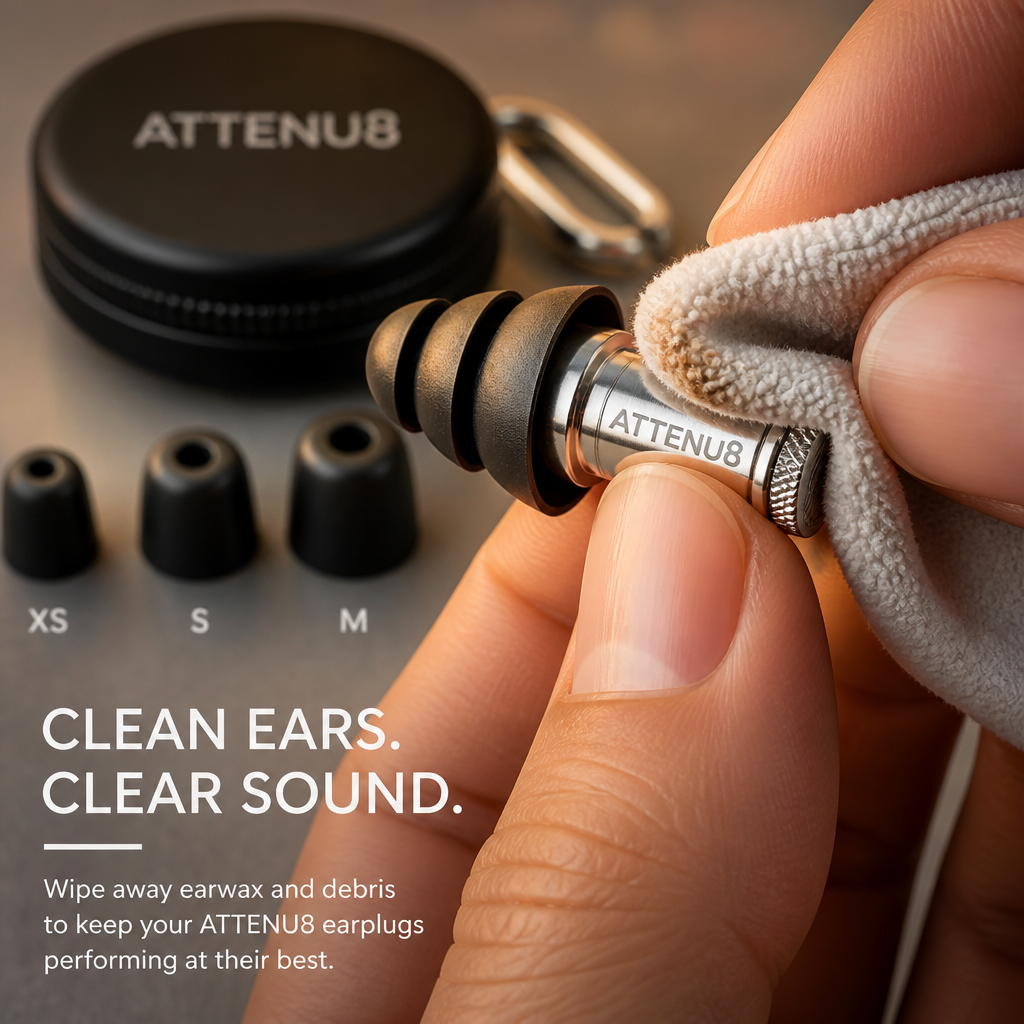
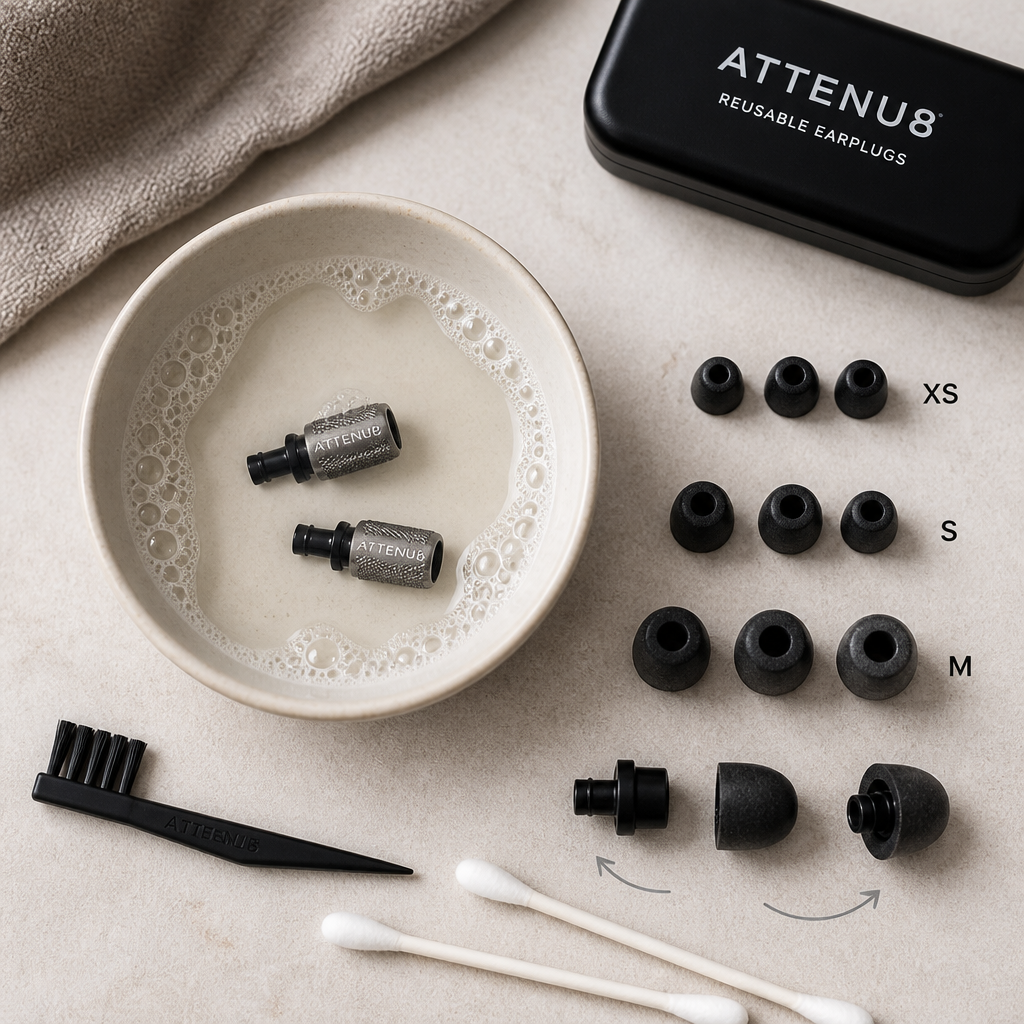
This is the point most earplug hygiene guides miss entirely. Premium reusable earplugs like ATTENU8 have two physically distinct components: an aluminium body and a replaceable memory foam tip. These two materials have completely different hygiene properties and require completely different cleaning approaches.
The anodised aluminium body is non-porous. Contaminants sit on the surface rather than being absorbed into the material. A wipe with a damp cloth removes them effectively. The aluminium does not degrade with routine cleaning, and it does not harbour bacteria beneath the surface the way porous foam does.
The memory foam tip is porous. It absorbs earwax, skin oils, and moisture. It can be surface-cleaned, but cannot be soaked without permanently disrupting the polymer structure that enables shape memory. This creates two firm rules: do not use alcohol on foam tips, and do not submerge foam tips in liquid. Treat both parts the same way and you will either damage the foam or under-clean the metal. The components have different maintenance schedules because they have different hygiene properties.
The cleaning problem with disposable foam is solved by replacement. The advantage of a non-porous aluminium body is that contaminants stay on the surface where cleaning can actually reach them.
After removing the foam tip, wipe the aluminium body with a dry or very lightly damp lint-free cloth. This removes the sebum and surface grime that accumulates from handling and insertion. The concave shape of the body is designed to sit flush against the outer ear, which means skin contact is constant. A daily wipe keeps the body feeling clean to handle and prevents buildup that eventually transfers to your fingers during insertion.
Once per week for daily users, and once every two weeks for occasional users, clean the metal body with warm water and mild soap. Use a soft cloth or cotton pad, not a rough scouring material that could scratch the anodised surface. Work around the body thoroughly, paying attention to any groove or seam where the foam tip attaches, as earwax residue accumulates there from the tip-to-body connection point. Rinse with clean water and dry thoroughly before reattaching the foam tip.
Pro tip: Dry the aluminium body completely before reattaching the foam tip. Moisture trapped between the metal body and foam tip creates a warm, enclosed environment where bacterial growth accelerates, which is exactly the condition you are trying to prevent.
After each use, use a dry lint-free cloth or clean cotton pad to wipe the outer surface of the foam tip. Remove visible earwax before it hardens into the foam surface. This takes five seconds and is the single most effective habit in any earplug maintenance routine. Users who do this consistently report that their foam tips retain expansion speed longer and need replacement less frequently than users who skip it.
If wax has already hardened on the foam surface, dampen a lint-free cloth very lightly with plain warm water and gently work the wax loose. Do not scrub aggressively. The goal is to lift the deposit from the surface, not to push it deeper into the foam structure. A cotton swab can be used to address specific spots, but keep it on the surface and do not press into the foam body. Once cleaned, allow the tip to air dry fully before storage or reuse.
Pro tip: Clean your ear canals with a warm washcloth before inserting earplugs at night. This removes excess earwax and oils that would otherwise transfer directly to the foam tip on insertion, reducing the rate of buildup at the source rather than just managing it after the fact.
The most common mistake in earplug maintenance is doing one big monthly clean and ignoring the earplugs the rest of the time. Consistency matters more than intensity. A quick wipe after every use prevents accumulation from ever reaching a level that requires aggressive cleaning.
Wipe the foam tip with a dry lint-free cloth after removal. Wipe the aluminium body with the same or a fresh cloth. Return both to a clean, closed case. This routine takes under 30 seconds and forms the foundation of earplug hygiene.
Deep clean the metal body with warm water and mild soap. Inspect the foam tip visually for discoloration, embedded earwax, or surface damage. Run the expansion test: compress the tip fully and count the seconds until it returns to shape. If it takes more than 4 to 5 seconds, the tip is approaching replacement time. A healthy tip should recover within 3 to 4 seconds.
Replace the foam tips entirely. If you use your earplugs every night for sleep, replace tips at the 6-week mark rather than waiting for 8 weeks. Daily use accumulates compression fatigue and earwax buildup faster than the 8-week guideline assumes. Setting a recurring reminder every 42 days removes the need to judge tip condition by feel alone. The metal body requires no scheduled replacement, only routine cleaning.
The list of things that will damage your earplugs is shorter than the list of things that will clean them, but the consequences of using the wrong product are significant and often irreversible.
Alcohol and solvent-based cleaners should never be used on foam tips. Alcohol degrades open-cell foam at the cellular level, causing permanent loss of the compression-recovery that creates an acoustic seal. Alcohol wipes are acceptable on the metal body only. This is one of the most common mistakes users make when they decide to “sanitize” their earplugs properly.
Boiling water or very hot water should not be used on foam tips. High heat causes foam to distort and disrupts the shape-memory properties. Warm water only, and only on the surface, not as a soak. Fully soaking memory foam tips compromises their expansion properties permanently, as water disrupts the polymer structure that enables shape memory.
Hydrogen peroxide, bleach, and strong disinfectants are not appropriate for foam tips. They are effective at killing bacteria, but they degrade foam materials in the same session. For the aluminium body, mild soap and water performs the cleaning task without the material risk. Using alcohol wipes only on the metal body is the correct boundary to maintain.
One of the real advantages of a metal-bodied earplug system like ATTENU8 is that only the foam tips need replacing, not the entire product. The aluminium body does not degrade with proper cleaning and lasts indefinitely. The foam tips, which form the acoustic seal and come into direct contact with the ear canal, have a functional lifespan that regular maintenance extends but cannot indefinitely delay.
Memory foam tips begin losing their expansion properties around the five-week mark due to accumulated oils and compressed cellular structure. The 6 to 8 week replacement schedule is based on the point at which foam loses its compression recovery and seal-forming ability, not just its visible cleanliness. Replacing tips on schedule maintains both hygiene and full noise reduction performance without replacing the aluminium body.
Visual inspection reveals obvious problems: discoloration, visible earwax buildup, tears, or permanent compression that does not expand fully. These signs indicate you have already exceeded the optimal replacement window. A more reliable indicator is the expansion test: compress the tip fully between your fingers. A healthy tip returns to 90% of its original shape within 3 to 4 seconds. Tips requiring 6 to 8 seconds or failing to expand fully have lost critical acoustic performance, regardless of how they look. Also replace tips immediately if they feel sticky, emit a persistent odor, or show any visible cracking.
ATTENU8 foam tips come in three sizes: XS, S, and M. The right size is not about comfort preference. It is about achieving a proper acoustic seal. If you are noticing sounds that your earplugs used to block, and you have ruled out an environment change, the foam tips are the most likely culprit, but so is using a tip that is too small for your ear canal. Replacement time is also a good opportunity to verify that you are using the correct tip size.
Where you store your earplugs between uses has a direct effect on how quickly they accumulate contamination and how long the foam tips perform. Most people store them incorrectly, then wonder why cleaning never quite removes the problem.
Store your earplugs in a clean, dry, closed case after every use. Leaving them on a nightstand or loose in a pocket exposes the foam to airborne dust, skin cells, and environmental debris that embeds into the foam surface before you even put them in your ears. A closed case also prevents accidental compression from objects sitting on top of the tips, which contributes to premature deformation.
Avoid storing earplugs in humid environments such as bathroom cabinets. Trapped moisture against foam tips accelerates bacterial growth and material breakdown. Room temperature storage in a bedroom nightstand drawer is the correct approach. Car glove compartments are a particularly bad choice. Temperature fluctuations between extreme heat and cold degrade foam elasticity, and one summer week in a hot car can reduce foam tip lifespan by the equivalent of two to three weeks of normal use.
A simple habit worth adopting: keep a small note in your earplug case with the date you last replaced the tips. Six to eight weeks passes faster than expected when you are using them every night, and degraded tips are often the silent cause of progressively worsening fit and noise reduction.
| Cleaning Method | Safe for Foam Tips | Safe for Metal Body |
|---|---|---|
| Dry lint-free cloth wipe | Yes. Recommended for daily use on foam tips. Removes surface wax without moisture risk. | Yes. Effective for daily maintenance of the aluminium surface. |
| Warm water and mild soap | Surface only. A very lightly damp cloth on the foam surface is acceptable. Do not soak or submerge. | Yes. The recommended weekly deep-clean method for the aluminium body. Rinse and dry thoroughly. |
| Alcohol wipes or solvent cleaners | No. Alcohol degrades open-cell foam at a cellular level and permanently reduces expansion properties. | Yes, with care. Effective for sanitising the anodised aluminium surface. Keep away from foam contact points. |
The foam tip should be wiped with a dry lint-free cloth after every single use. The metal body benefits from a daily wipe-down and a more thorough clean with warm water and mild soap once per week. The frequency of deep cleaning increases with the frequency of use. Daily sleepers should clean the metal body weekly and replace foam tips every 6 weeks. Occasional users can extend the deep-clean interval to every two weeks and replace tips at the 8-week mark.
For ATTENU8-style memory foam tips, a very lightly damp cloth on the surface is acceptable, but soaking or submerging the foam tip in soapy water is not. Water disrupts the polymer structure that enables shape memory. Fully soaking a memory foam tip permanently compromises its expansion properties. The foam tip should be surface-cleaned and allowed to dry completely before reuse. Traditional disposable foam earplugs should simply be discarded rather than washed, as water damage destroys their function entirely.
Alcohol on a foam tip degrades the open-cell foam structure at a cellular level. The tip may appear unchanged visually, but its compression-recovery speed will decrease noticeably over subsequent uses, reducing the acoustic seal and therefore the noise reduction. Alcohol wipes are safe to use on the aluminium body of ATTENU8 earplugs, but should never contact the foam tip directly. If you want to sanitise the foam surface, allow the dry wipe routine and the natural anti-microbial properties of the aluminium body to do the work.
The most reliable test is the expansion test. Compress the foam tip fully between your fingers and count the seconds until it returns to its original shape. A tip in good condition recovers to 90% of its shape within 3 to 4 seconds. A tip that takes 6 to 8 seconds or longer has lost critical seal-forming ability and should be replaced. Also replace tips if they show visible discoloration, hardened earwax that will not clean off, a persistent odor, or any tearing or cracking. As a baseline schedule, replace tips every 6 weeks with daily nighttime use and every 8 weeks with less frequent use.
No. Sharing earplugs transfers bacteria and earwax from one person’s ear canal to another. Even with cleaning in between, this practice introduces hygiene risks that are not worth taking. If multiple people in a household need ear protection, each person should have their own set. The cost of additional foam tips is minimal compared to the hygiene risk of sharing.
Yes, and this is more significant than most people expect. Earwax and skin oils embedded in the foam surface alter the tip’s texture and slow its expansion rate. A tip that expands too slowly does not fully seal the ear canal before you settle your head on a pillow, leaving gaps that reduce effective noise reduction substantially below the rated level. Consistent cleaning keeps expansion speed close to the original performance of a fresh tip, which is the single best indicator that noise reduction is being maintained.
Always store earplugs in a closed, dry case after each use. A nightstand drawer in a bedroom is ideal. Avoid bathrooms, which have elevated humidity, and car glove compartments, which experience extreme temperature swings that degrade foam elasticity. Never toss earplugs loose into a bag or pocket where they can pick up debris and suffer accidental compression. A clean case is part of the hygiene system, not optional.
If you have a cleaning routine that has worked particularly well for your ATTENU8 earplugs, share it in the comments below. We would genuinely like to hear what other users have found effective.
If you share a bed with a snorer, you already know the ritual: lying awake in the dark, staring at the ceiling, counting the seconds between rumbles. The exhaustion is real, the resentment builds quietly, and eventually the relationship starts paying the price. Finding the right earplugs for a snoring partner is not a luxury or an overreaction. For light sleepers especially, it is one of the most direct, practical steps you can take to protect both your health and your relationship. This guide covers exactly what to look for, what to avoid, and how to use earplugs so they actually work.
Most people underestimate how loud snoring is until they try to sleep through it. Snoring can range from around 50 decibels up to over 100 decibels, and the threshold at which noise starts disrupting sleep is only about 40 decibels. To put that in perspective, research shows mean peak snoring levels sit between 50 and 65 decibels, roughly equivalent to a vacuum cleaner at full throttle running beside your head all night.
The health consequences of sleeping next to a snorer go well beyond feeling tired in the morning. Studies have found that exposure to loud snoring can contribute to high blood pressure, heart disease, and stroke. These are not edge-case outcomes. They are the predictable result of chronic sleep fragmentation.
The relationship damage is equally well-documented. Roughly one-third of couples report relationship problems because of a partner’s snoring, and around 23 percent have resorted to sleeping in separate rooms to cope. Losing the shared bed is often framed as a practical solution, but for most couples it is a slow erosion of intimacy. Earplugs offer a way to stay in the same room without suffering through the noise.
| Key Insight | Explanation |
|---|---|
| Aim for at least 30 dB noise reduction | Snoring regularly hits 50-65 dB or higher. An earplug rated below 30 dB NRR will take the edge off but is unlikely to let a light sleeper stay asleep through the night. |
| Fit determines performance, not just rating | An earplug with a 32 dB rating inserted incorrectly gives you far less than 32 dB of real protection. Proper insertion technique matters as much as the product specification. |
| Memory foam outperforms hard foam for side sleepers | Firm or pre-moulded plugs create pressure points when you press your ear against a pillow. Soft memory foam compresses without pushing back, making it far more comfortable through the night. |
| Multiple tip sizes are not optional | Ear canals vary significantly between people. An ill-fitting earplug not only blocks less noise, it also risks falling out mid-sleep or causing irritation. Always choose a product with multiple size options. |
| Reusable earplugs save money and reduce waste | Disposable foam plugs need to be replaced every use. A well-designed reusable earplug with replaceable tips, where only the foam is swapped every 6-8 weeks, costs far less over a year of nightly use. |
| Snoring harms the listener’s health, not just their sleep | Chronic exposure to partner snoring is linked to cardiovascular strain. Addressing noise exposure is a genuine health decision, not just a comfort preference. |
| Earplugs work best as part of a conversation, not a secret fix | Using earplugs unilaterally without discussing the snoring issue with your partner delays the root-cause conversation. Use them to protect your sleep short-term while addressing the broader issue together. |
Snoring noise is not uniform. It spikes, stops, and restarts unpredictably, which is precisely why light sleepers find it so disruptive. A sudden snore following a moment of silence is often more jarring than continuous background noise. The right earplug reduces the amplitude of those spikes so your nervous system stops treating them as alarms.
Not every earplug that claims to help with sleep is up to the job of blocking snoring noise. There are three factors that actually determine performance: noise reduction rating, fit quality, and comfort over hours of wear.
The Noise Reduction Rating, or NRR, is the standardized measure of how many decibels an earplug reduces sound by under laboratory conditions. NRR values for earplugs generally range from 14 to 33 dB. For snoring specifically, you want an NRR of at least 30 dB for optimal sound blocking.
In practice, real-world performance is always somewhat below the laboratory figure because most people do not achieve a perfect seal. This means a 32 dB rated earplug, correctly inserted, will realistically give you somewhere between 25 and 30 dB of actual reduction. That is still enough to bring a 60 dB snore down to a level your brain can stop flagging as a threat. An earplug rated at 15 dB gives you roughly 10-12 dB in real conditions, which is simply not enough for most light sleepers.
A common mistake is treating earplug sizing as a minor detail. It is not. Ear canals differ significantly in diameter and depth between individuals. An earplug that is too small creates an incomplete seal and falls out. One that is too large causes pressure and pain, especially for side sleepers who compress the plug against a pillow for hours.
Multiple tip sizes, including XS, S, and M options, allow you to match the earplug to your actual ear canal rather than hoping for a universal fit that rarely exists. This is the single most overlooked variable when people report that earplugs “don’t work” for them. In most cases the product is fine. The size is wrong.
Pro tip: If you wake up with your earplugs on the pillow rather than in your ears, the tips are almost certainly too small. Try the next size up and retest for two nights before writing the product off.
Side sleeping is the default position for most adults, and it is the position earplugs are least designed for. Hard pre-moulded plugs create significant pressure points when compressed against a pillow. Memory foam provides a softer feel that may be better for side sleepers because it conforms to the ear canal without a rigid outer shell pushing back against the pillow surface.
The body design of the earplug matters too. A slim, low-profile body sits closer to flush with the ear, reducing the leverage that creates pressure. Bulky earplug bodies with protruding flanges are fine for short-term daytime use but become uncomfortable well before a full night’s sleep is complete.
Understanding how different earplug types perform for snoring noise specifically will save you from buying the wrong product twice. The table below focuses on the three main categories relevant to nightly sleep use.
| Earplug Type | Best For | Main Drawbacks for Nightly Sleep Use |
|---|---|---|
| Disposable foam (single-use) | Occasional use, low upfront cost, highest NRR ceiling available | Absorbs ear oils after one use, unhygienic for repeated wear, inconsistent sizing, generates significant waste over time, and costs more per night than reusable alternatives over a year |
| Reusable metal-body with memory foam tips | Nightly use, light sleepers needing consistent 30+ dB reduction, side sleepers, hygiene-conscious users | Higher upfront cost than a bag of foam plugs, foam tips require replacement every 6-8 weeks (though this is a straightforward swap rather than a full replacement) |
| Mouldable silicone or wax | People who find foam canal insertion uncomfortable, occasional use | Lower NRR than foam alternatives, can tangle in hair, residue buildup with wax, less reliable noise block at peak snoring volumes, not ideal for people who need maximum reduction |
For anyone who needs to block snoring noise every single night, the disposable foam route looks cheap until you run the actual numbers. Replacing foam plugs nightly over a year adds up quickly. A reusable earplug with a durable body and replaceable foam tips keeps the hygiene benefits of fresh foam without the ongoing cost or waste of full replacement.
The gap between an earplug’s rated NRR and its real-world performance comes almost entirely from incorrect insertion. Most people push them in too quickly, too shallowly, or without straightening the ear canal first.
For memory foam tips, compress the tip between your fingers to make it as slim as possible before insertion. Pull the top of the ear up and back with your other hand to open and straighten the ear canal, then insert the compressed foam and hold a finger gently over the end while it expands. Do not let go immediately. Holding it in place for 20-30 seconds lets the foam expand into a full seal rather than partially expanding and sliding back out.
To remove, slowly twist the earplug to break the seal with the ear canal before pulling it out. Pulling straight out without twisting creates a brief vacuum that can be uncomfortable and may irritate the ear canal over time.
Foam that has absorbed skin oils, earwax, and moisture is not only less effective at noise reduction, it is also a potential source of ear infections with repeated use. Foam earplugs absorb skin oils after a single use and cannot be adequately cleaned. This is a genuine hygiene problem for anyone using the same foam plug night after night.
A reusable metal-body earplug solves this at the structural level. The durable body can be wiped clean, and the foam tips, which are the part that actually contacts the ear canal, are replaced on a defined schedule. Replacing tips every 6-8 weeks keeps the contact surface fresh without replacing the entire earplug each time. Clean hands before insertion and a quick wipe-down of the body every few days are the only additional steps required.
Pro tip: Keep your replacement foam tips in the carry case with the earplug itself. When you notice the foam starting to feel stiff, discoloured, or less springy on compression, that is the signal to swap them out. Do not wait for discomfort to tell you the tips are past their best.
The case for reusable earplugs is not just environmental, though that matters. For nightly users specifically, the difference in experience is significant.
Disposable foam plugs are made to a price point. The foam is often coarser, the consistency varies between units in the same bag, and they are almost always one-size-fits-all. Reusable earplugs are more economical in the long run, can be customized to your ear, are made from higher-quality materials, and are ideal for prolonged wear. That last point is the one that matters most for sleep: prolonged wear comfort is what determines whether you still have both earplugs in at 3am or whether you have unconsciously pulled one out.
A premium reusable earplug with a metal body also carries a specific practical advantage. The rigid body does not compress under pillow pressure the way a fully foam plug does. When a full-foam disposable is pressed against a pillow, the outer section compresses and can drive the plug deeper into the canal or alter the seal geometry. A metal body maintains its shape, and the foam tip does the sealing work it is designed to do regardless of external pressure.
The best earplug is the one you are still wearing at 6am. Comfort over hours matters far more than the NRR number on the packaging.
For light sleepers sharing a bed with a snorer, the ATTENU8 approach, a concave aluminium body with soft memory foam tips in three sizes delivering approximately 32 dB of noise reduction, addresses each of the failure points above. The body profile stays low against the ear for side sleeping, the memory foam tips expand into a proper seal, and three size options mean you are not forcing your ear canal to accept a generic fit. The full product can be explored at attenu8.co.
Earplugs are a personal solution to what is actually a shared problem. Used well, they protect your sleep and buy time for a calmer conversation about what to do long-term. Used as a permanent substitute for that conversation, they can quietly widen the distance between partners.
Sleep deprivation does specific things to how you treat the people you live with. Research has shown that sleep-deprived people show less empathy toward their partners and have reduced communication skills. The snoring partner often does not understand why the non-snoring partner is chronically irritable. The non-snoring partner often cannot articulate it clearly because they are too tired to do so effectively. Earplugs break this cycle by giving you back enough sleep to approach the conversation from a less reactive place.
Snoring is sometimes a symptom of obstructive sleep apnea, a condition with its own serious health implications. Chronic exposure to partner snoring has been linked to high blood pressure, and the health consequences become more serious the longer sleep deprivation continues. If the snoring is severe, includes gaps in breathing, or has been present for years, a sleep study is worth raising with a doctor. Earplugs protect the non-snoring partner’s health in the interim, but they do not address what the snoring partner may be experiencing.
The couples who handle this best tend to treat it as a health issue rather than a personal failing. Addressing the issue together may go a long way toward finding peaceful nights, and earplugs are a practical, low-friction starting point that lets both people get more rest while working toward a longer-term solution.
Sleeping in separate rooms stops the immediate noise problem but creates its own costs. Physical proximity during sleep has real effects on intimacy and relationship closeness that are difficult to replicate from another room. About 23 percent of couples sleep in separate rooms because of one partner’s snoring. For many of these couples, the move was made out of desperation during an acute sleep crisis rather than as a considered long-term arrangement. Good earplugs make it possible to stay in the same room, which matters more to most relationships than it initially appears to.
Pro tip: If you are new to sleeping with earplugs, give yourself at least five nights to adjust. The sensation of reduced ambient sound can feel strange initially, and some people find it affects how quickly they fall asleep in the first few days. This normalises quickly. Do not judge the product based on night one.
Full blocking depends on how loud the snoring is and the NRR of the earplug. A 32 dB rated earplug used correctly will reduce a 60-65 dB snore to roughly 30-35 dB, which is low enough for most people to sleep through. Extremely loud snoring above 80 dB will still be audible at a reduced level but significantly less disruptive. In practice, the goal is not perfect silence but reducing spikes to below your arousal threshold.
Yes, provided you maintain basic hygiene. The main risks from nightly earplug use are ear infections from dirty plugs and ear canal irritation from incorrect removal. Using a reusable earplug with replaceable foam tips, cleaning the body regularly, and replacing tips on schedule every 6-8 weeks eliminates the hygiene risk. Correct insertion and a gentle twisting removal technique prevents canal irritation. Millions of people sleep with earplugs every night without issue.
Aim for at least 30 dB NRR. Snoring noise typically sits between 50 and 65 dB, with loud snorers reaching higher. A 30-32 dB rated earplug with a proper fit will bring this down to a level most light sleepers can sleep through. Below 25 dB and you are taking the edge off rather than solving the problem, which is frustrating for committed light sleepers.
Earplugs that fall out are almost always the wrong size. The foam tip is not expanding into a full seal, so there is nothing holding it in place. Try the next size up first. If sizing is already correct, check your insertion technique. The foam should be compressed, inserted into a straightened ear canal, and held in place while it fully expands, which takes about 20-30 seconds. Rushing this step is the most common cause of poor fit and early ejection.
A 30 dB reduction does reduce alarm volume. Most phone alarms at full volume sit above 70 dB, which means they remain clearly audible even with 30 dB of attenuation. A reasonable precaution is placing the alarm physically closer to you, such as on a bedside table rather than across the room, or using a vibrating alarm option. Very heavy sleepers may want to test their alarm responsiveness during the first few nights before relying entirely on it.
For nightly use, foam tips typically need replacing every 6-8 weeks. The signs that tips need swapping are: foam that no longer springs back fully after compression, discolouration or visible buildup, a stiffer texture than when new, or a noticeable reduction in noise blocking effectiveness. On a tip-only replacement schedule, the durable metal body of a premium earplug lasts far longer, making the ongoing cost lower than continuous disposable foam plug purchases.
Both help, but they work differently. White noise adds a masking layer of continuous sound that makes intermittent spikes like snoring less jarring by reducing the contrast between silence and noise. Earplugs reduce the absolute volume of all incoming sound. For most light sleepers dealing with genuine snoring, earplugs provide more direct and reliable relief because they address the volume itself rather than masking it. Some people use both together for the best result.
If earplugs for a snoring partner are something you have tried before without success, we would love to know what did and did not work for you. Share your experience in the comments.
If you wake at 3 a.m. to a snoring partner, a passing truck, or a neighbour’s television, you already know that noise is one of the most reliable destroyers of deep sleep. Sleeping with earplugs is the most direct fix available, yet most people who try them give up within a week because they chose the wrong type, inserted them incorrectly, or worried whether nightly use was actually safe. This guide covers all of it: the real benefits, the genuine risks, how to insert earplugs properly, how to keep them clean, and what to look for when choosing a pair built to last longer than a single night.
| Key Insight | Explanation |
|---|---|
| Nightly use is safe for most adults | Sleeping with earplugs every night is generally safe provided they are kept clean, inserted correctly, and replaced when worn. |
| Fit matters more than noise rating | A poorly fitted earplug with a high noise rating blocks less sound than a well-fitted one with a moderate rating. Three tip sizes help you find the right seal. |
| Earwax buildup is the main hygiene risk | Earplugs can push wax deeper into the canal over time. Taking one or two nights off per week and keeping ears clean prevents most issues. |
| Side sleepers need a low-profile design | Lying on a pillow pushes standard earplugs further in. A concave body design with soft memory foam tips reduces that inward pressure significantly. |
| Reusable metal-bodied earplugs outlast foam | The metal body lasts indefinitely. Only the memory foam tip needs replacing every 6 to 8 weeks, making them far cheaper and less wasteful over time. |
| Around 32 dB reduction is the practical target for sleep | Standard sleep earplugs reduce noise by 25 to 33 dB. That range is sufficient to mask snoring, traffic, and typical urban noise without silencing emergency alerts entirely. |
| Never insert so deeply that removal requires tools | A correctly seated earplug comes out easily with your fingers. If it doesn’t, it is inserted too deeply and may cause eardrum irritation. |
The brain does not fully switch off during sleep. It continues to monitor the auditory environment, and sudden or variable sounds, a truck braking, a partner rolling over and snoring, a neighbour closing a door, trigger a micro-arousal that pulls you out of deep sleep even when you don’t fully wake up. These micro-arousals accumulate across the night, cutting the time you spend in the restorative stages your body actually needs.
Research suggests that reducing noise during sleep may increase the time spent in deeper sleep stages, which translates to better concentration, improved mood, and sharper reaction time the following day. Earplugs address this at the source by reducing the volume of incoming sound before it reaches the ear canal, rather than masking it with another sound the way white noise machines do.
For light sleepers, the effect is immediate. For people living in cities, near construction, or sharing a bedroom with a heavy snorer, earplugs are less a lifestyle accessory and more a genuine necessity. The question is not really whether to use them but how to use them in a way that is comfortable, hygienic, and sustainable over months and years.
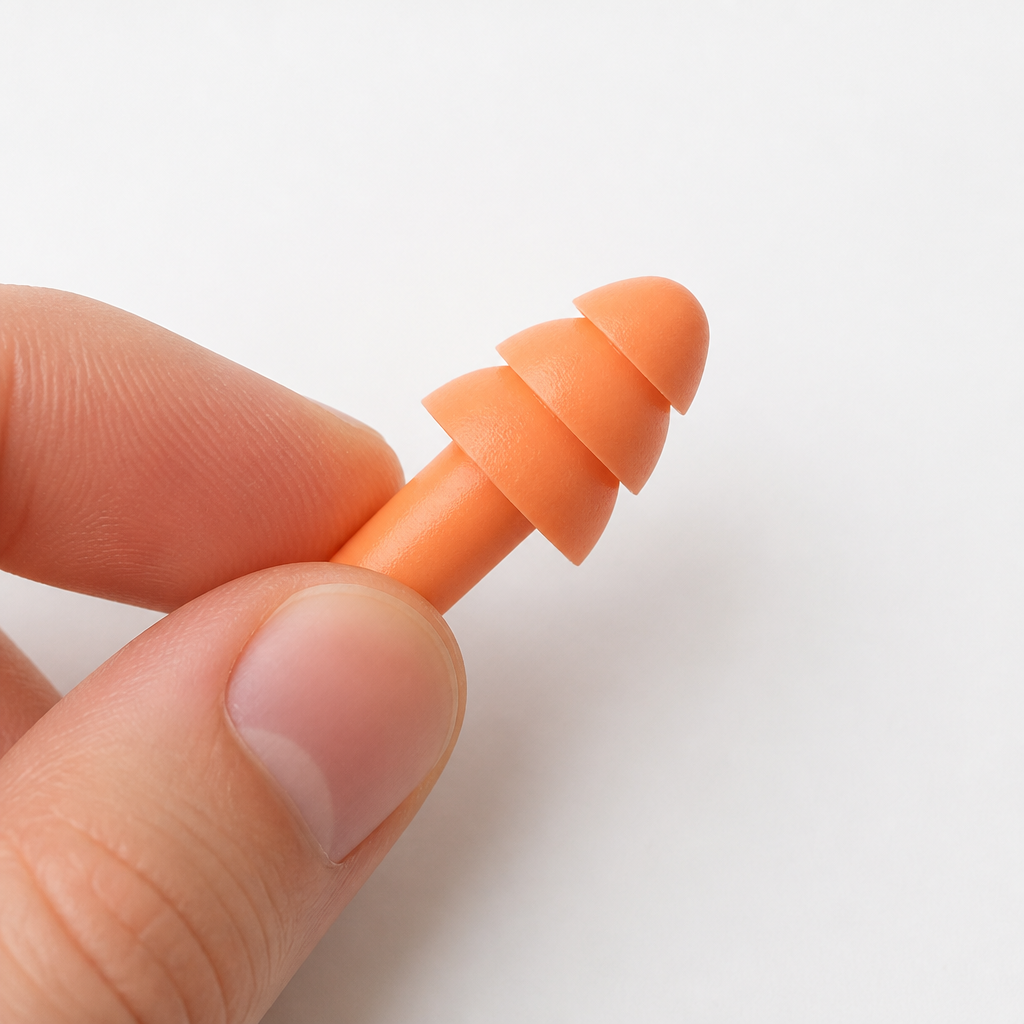

The short answer is yes, for most healthy adults. Earplugs reduce noise by roughly 25 to 33 dB, which is well within safe limits. Hearing damage requires prolonged exposure to sounds above 85 dB. Earplugs do the opposite: they lower the sound level reaching the eardrum, so there is no physiological mechanism by which correctly used earplugs cause hearing loss.
The medical consensus is reassuring. Most audiologists and ENT specialists agree that earplugs are safe for regular use when proper technique is followed. Some practitioners suggest taking one or two nights off per week to allow the ear canal to complete its natural cleaning process, which is a reasonable precaution rather than a hard clinical requirement.
There are two situations where caution is warranted. If you have a history of recurring ear infections, unusual earwax buildup, or a perforated eardrum, speak to a healthcare professional before using earplugs regularly. And if you have a responsibility to hear nighttime alerts, such as a parent of a young infant or someone who relies on a smoke alarm as their only fire warning, factor that into your decision about how much noise reduction you need.
A well-fitted earplug that stays clean and is inserted to the right depth is one of the lowest-risk sleep interventions available. The risks come almost entirely from poor hygiene or improper insertion, not from noise reduction itself.
Pro tip: If you need to hear alarms, set your phone alarm to a maximum volume and place it close to your pillow rather than abandoning earplugs entirely. Most 30 to 32 dB earplugs will still allow a loud alarm to wake you.
Earplug risks are real but almost entirely avoidable. Understanding them is more useful than being frightened by them.
This is the most common side effect of regular earplug use. Earplugs can push earwax deeper into the canal over time, leading to muffled hearing, itching, or temporary hearing loss. The ear is self-cleaning under normal conditions: its outward hair motion gradually moves wax toward the opening. Earplugs can interrupt this. Taking occasional nights off and avoiding pushing earplugs unusually deep addresses this for most people.
Bacteria from unclean or inadequately dried earplugs can cause outer ear infections, a condition sometimes called otitis externa. This risk applies almost exclusively to earplugs that are not cleaned regularly or are stored damp. It is not a reason to avoid earplugs. It is a reason to treat them like any other item that touches your body daily: clean them properly and replace the contact surface when it wears out.
Inserting earplugs too deeply may cause eardrum irritation or pressure pain. A correctly placed earplug should come out easily with your fingers. If removal requires anything other than a gentle fingertip pull, the plug is in too far. This is particularly relevant for foam plugs that expand aggressively after insertion.
Sleeping on your side can push a standard earplug further into the ear canal, increasing pressure on the canal wall. This is one of the most common complaints from people who try earplugs and give up. The solution is a low-profile design that does not protrude significantly from the ear, combined with a soft tip material that compresses gently rather than creating rigid resistance.
Pro tip: If you wake up with pressure pain or a sore ear canal, it almost always means your earplug either sits too deep or uses a tip material that is too firm for your anatomy. Try a smaller tip size before concluding that earplugs are not for you.
Correct insertion is where most people go wrong, and it is responsible for a significant share of earplug complaints including poor noise reduction, discomfort, and infections. The technique is simple once you know it, but it is not intuitive.
Start with clean hands. Reach over your head with the opposite hand and gently pull the top of the ear upward and slightly outward. This straightens the ear canal, which curves slightly in most adults. With your other hand, slide the earplug in until you feel a gentle seal form. You will notice ambient sound become noticeably muffled when the fit is correct. Hold it in place for a few seconds if using an expanding foam tip, so it can fully seat.
For memory foam tips on a metal-bodied earplug like ATTENU8’s, no rolling is required. The tip is already soft and conforms to the canal as it seats. Push gently inward rather than trying to compress the tip first. Once fitted, the earplug should not shift around or pull out easily when tugged gently.
A reliable test: cover your ears with your palms after inserting the earplugs. If there is a significant difference in noise level between covered and uncovered, the seal is incomplete. There should be very little additional sound reduction when you add your palms, because the earplugs are already doing the work. If covering your ears makes a noticeable difference, try a larger tip size or re-seat the earplug.
Never pull an earplug straight out with force, particularly after sleeping, when the tip may have expanded further overnight. The correct technique is to first break the seal: for a metal-bodied earplug, push the body gently upward with your thumb so the tip faces slightly downward in the canal. This releases the suction and allows the plug to come out cleanly at a better angle. Do not twist or unscrew the stem from the tip during this process.
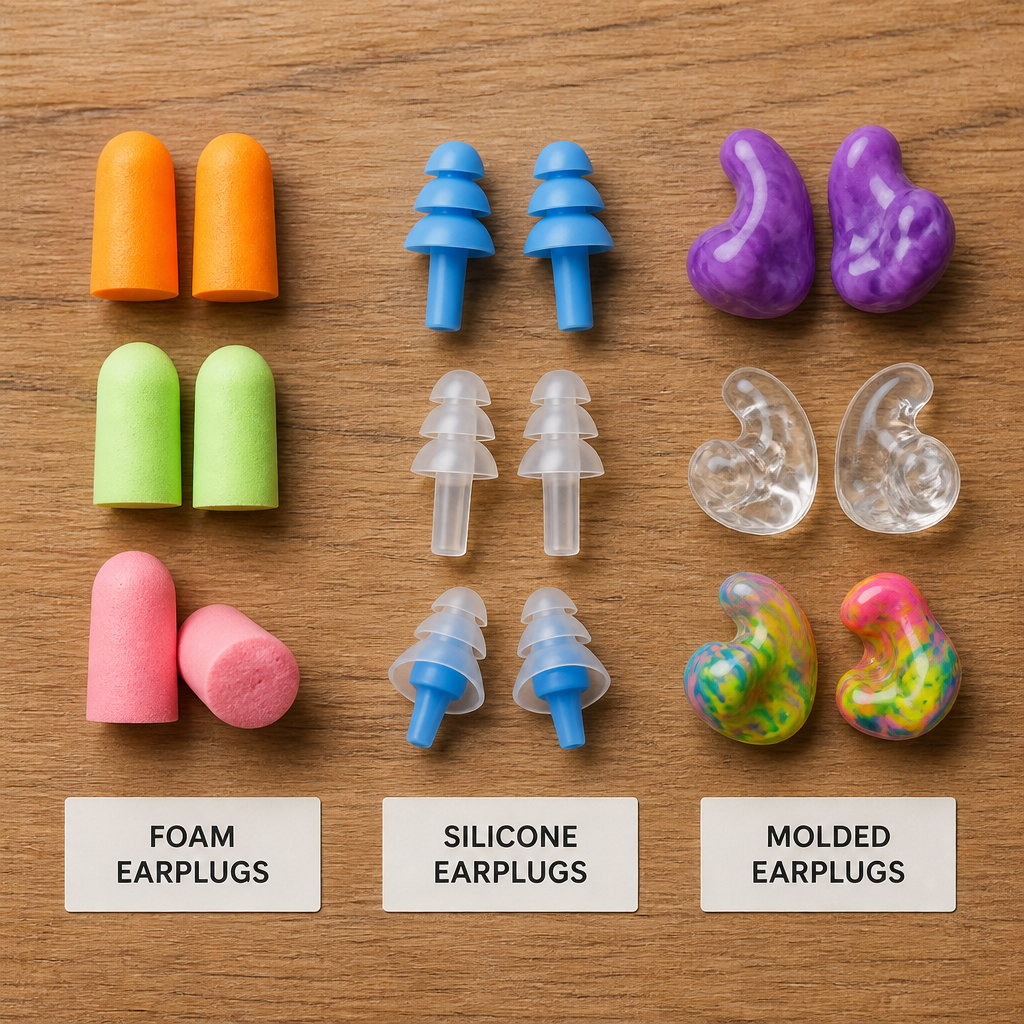
Not all earplugs are designed with sleep in mind, and the differences between types matter more than the marketing copy on the packaging. The table below compares the three main types you will encounter when choosing earplugs for sleeping.
| Earplug Type | Comfort for Sleep | Longevity and Hygiene |
|---|---|---|
| Disposable foam (single-use polyurethane) | Soft but bulky. The roll-and-insert technique is awkward for side sleepers. Degrades quickly, losing expansion recovery within a few uses. | Poor. Porous surface traps moisture and bacteria. Must be replaced every few days for hygiene. Generates significant waste over months of daily use. |
| Silicone or wax moulded (pre-shaped, reusable) | Sits in the outer ear rather than the canal, which suits some people. Less effective noise reduction. Can feel rigid against the pillow for side sleepers. | Moderate. Easier to clean than foam. However, the moulded shape degrades or distorts over time, reducing the seal. |
| Metal-bodied with memory foam tips (e.g. ATTENU8) | Excellent. The concave aluminium body keeps the earplug low-profile against the pillow. Soft memory foam tips seat comfortably without aggressive expansion. Three tip sizes (XS, S, M) allow a precise fit for different canal shapes. | Excellent. The metal body is permanent and easy to clean. Only the foam tip needs replacing every 6 to 8 weeks, rather than disposing of the entire earplug. |
The practical conclusion: disposable foam earplugs are fine for occasional use, such as a noisy hotel or a one-off event, but they are a poor long-term solution for nightly sleep. They accumulate bacteria quickly, lose their shape, and the roll-insert-hold technique is tedious at 11 p.m. A reusable, metal-bodied earplug with replaceable foam tips gives you consistent noise reduction, better hygiene control, and a fraction of the waste over a year of use.
Pro tip: When comparing earplugs, pay attention to whether tip sizes are included. A single-size earplug is a compromise for everyone. The difference between a size S and a size M tip can be the difference between a functional seal and a plug that falls out overnight.
Earplug hygiene is the single most neglected aspect of daily earplug use, and it is directly responsible for the most common side effects, including infections and irritation. Cleaning earplugs is not complicated, but it requires consistency.
For a metal-bodied earplug, wipe the aluminium body with a clean damp cloth or wash it with mild soap and warm water. Rinse thoroughly and allow it to dry completely before storing. A damp metal surface stored in a closed case will foster bacterial growth, so drying is not optional.
Memory foam tips accumulate skin oils, moisture, and earwax with each use. Even with regular cleaning, the foam material begins to lose its elasticity and becomes less hygienic over time. The practical replacement interval for memory foam tips used nightly is every 6 to 8 weeks. Replacing only the tips, rather than the entire earplug, keeps the cost low and eliminates waste from the durable metal body, which does not need to be discarded.
Replace foam tips immediately if you notice visible discolouration, a persistent odour, a change in texture such as hardening or crumbling, or if the tip no longer expands and returns to its original shape. Any of these changes mean the foam has degraded past the point where it provides a reliable seal or meets basic hygiene standards.
Taking a night or two off from earplugs each week also allows the ear canal to complete its natural self-cleaning cycle. This simple habit prevents the gradual wax accumulation that is the most common complaint among nightly earplug users.
Side sleeping with earplugs is where most people struggle. The problem is straightforward: when your ear is against a pillow, any earplug that protrudes from the canal gets pushed inward. Standard foam earplugs, which stick out significantly when inserted, create uncomfortable inward pressure that either wakes you up or causes soreness by morning.
A low-profile design solves this. The ATTENU8 metal-bodied earplug uses a concave aluminium body specifically shaped to sit flush and reduce pillow-to-earplug contact. Unlike cylindrical foam plugs that protrude outward, the concave body keeps the bearing surface close to the ear. The foam tips supplied for the underside of the earplug are also designed to cushion contact for side sleepers specifically.
Beyond earplug design, a few adjustments make side sleeping significantly more comfortable. Use a pillow with some softness or give: a firm foam pillow pushes back against the earplug with more force than a softer fill. Some side sleepers find a small indentation or travel-style pillow with a central cutout removes the pressure entirely. These are minor changes, but combined with the right earplug shape, they make nightly use genuinely sustainable.
A common mistake is choosing a tip that is too large in an attempt to maximise noise reduction. An oversized tip creates a tighter canal seal but also more outward pressure, which means more resistance when the pillow pushes the plug inward. Use the smallest tip size that still passes the palm-cover test for a good seal. On the ATTENU8 fit guide, start with size S and move up or down based on whether the plug shifts around or creates discomfort.
Yes, for most healthy adults, sleeping with earplugs every night is safe when they are kept clean, inserted correctly, and replaced or maintained when worn. The main risks, earwax buildup and minor irritation, are manageable with basic hygiene habits. If you have a history of ear infections or perforated eardrums, consult a healthcare professional before making earplugs a nightly habit.
No. Standard sleep earplugs reduce noise by around 25 to 33 dB, which is well within safe hearing limits. Hearing damage requires prolonged exposure to sounds above 85 dB. Earplugs do the opposite of this: they lower the sound level reaching the eardrum. There is no mechanism by which correctly used earplugs cause hearing loss.
Ear soreness after sleeping with earplugs almost always comes from one of three causes: the tip size is too large and creating excessive canal pressure, the plug was inserted too deeply and pressed against sensitive tissue, or a side-sleeping position pushed the earplug further in against the pillow. Try a smaller tip size, ensure you are not inserting past the point of a comfortable seal, and consider a low-profile earplug designed for side sleeping.
For disposable foam earplugs, replace them every few days at most. Their porous surface accumulates bacteria quickly even with regular use. For reusable metal-bodied earplugs with foam tips, the metal body can be cleaned and reused indefinitely. The foam tips should be replaced approximately every 6 to 8 weeks with nightly use, or sooner if they show discolouration, hardening, or loss of expansion.
A 30 to 32 dB earplug will not silence a smoke alarm or loud phone alarm. It will reduce the perceived volume, but both types of alerts are specifically designed to be loud enough to wake sleeping people. If you are concerned, set your phone alarm to maximum volume and place it close to your head. Earplugs reduce ambient noise levels without creating total acoustic isolation.
Side sleepers need a low-profile earplug that does not protrude significantly from the ear canal, combined with a soft tip that compresses gently rather than creating rigid resistance against the pillow. A metal-bodied earplug with a concave shape and soft memory foam tips, available in multiple sizes, addresses the main sources of side-sleeping discomfort. The ATTENU8 design was specifically developed with this use case in mind, including foam tips designed for the underside for side sleeper positioning.
Cover your ears with your palms after inserting the earplugs. If there is a significant drop in noise level when you add your palms, the seal is incomplete and the plug needs to be reseated or a larger tip tried. A well-fitted earplug creates a seal thorough enough that cupping your hands over your ears adds very little additional noise reduction. The plug should also not shift around in the canal and should come out easily with gentle finger contact, without requiring force.
Have you tried sleeping with earplugs before? Share what worked, what didn’t, and whether switching earplug types or tip sizes made a difference for you.

