


 0
0

Most people shopping for earplugs to sleep in focus on the wrong number. They chase the highest NRR rating they can find, assuming more is always better. In practice, that logic produces earplugs you will pull out at 3am because they feel suffocating, or earplugs that block so much sound you sleep through your alarm or miss a smoke detector. 32dB noise reduction sits in a precise middle ground: enough attenuation to silence snoring, traffic, and hotel HVAC without cutting you off from the world entirely. This article explains exactly why that rating matters for sleep specifically, and why ATTENU8 built its metal-bodied reusable earplugs around it.
Environmental noise is not just an annoyance you adapt to. Research published in Sleep Science confirms that nocturnal noise provokes measurable biological stress responses and directly disrupts sleep architecture, meaning it alters the proportions of light, deep, and REM sleep you cycle through each night. These disruptions mirror those seen in clinical sleep disorders, even when the sleeper is not consciously aware of waking.
The downstream effects are documented and serious. Poor sleep from noise exposure is associated with daytime sleepiness, mood changes, reduced cognitive performance, and over time, adverse cardiometabolic outcomes. Nocturnal noise is considered the most health-significant form of noise pollution precisely because it acts both directly on biology and indirectly through the damage it does to sleep quality.
For light sleepers, even noise events well below conversation level (around 40 to 50 dB) can trigger cortical arousals, the micro-awakenings that fragment sleep without fully waking you. This is the problem a well-designed sleep earplug needs to solve: not silence, but a sufficient reduction to keep those spikes from crossing the arousal threshold.
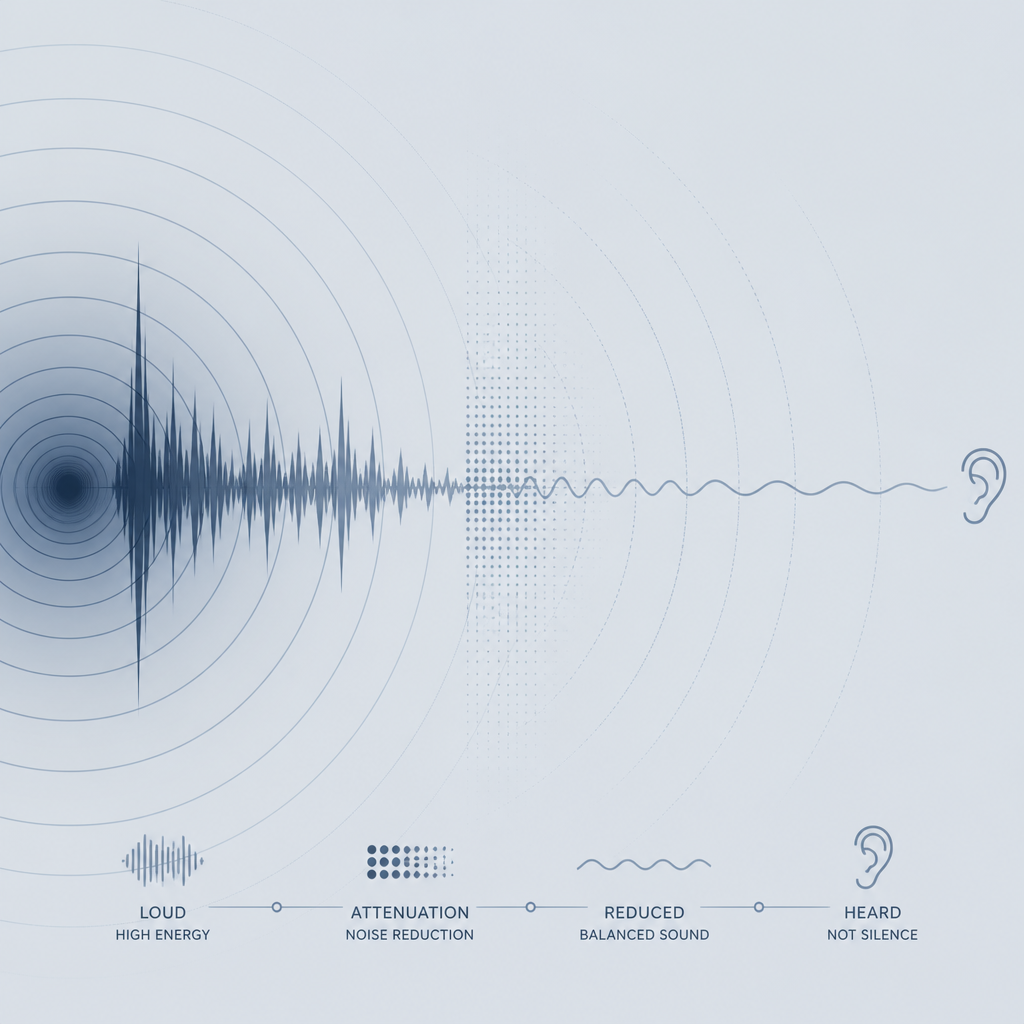
Decibels work on a logarithmic scale, which is not intuitive. A 10dB reduction is perceived as roughly halving the loudness of a sound. A 32dB reduction therefore represents a very substantial cut, not a marginal one.
We would love your feedback and any insights you would share with others. What perspective would you add?
A partner snoring typically registers somewhere between 50 and 70 dB at close range. With 32dB of attenuation, that lands closer to 20 to 38 dB, which is roughly the level of a quiet library or soft whisper. Urban traffic through a bedroom window, often in the 55 to 65 dB range, drops to the low 20s to mid-30s. Hotel air conditioning units and HVAC systems sit around 40 to 50 dB, and after a 32dB reduction they are effectively inaudible.
The key insight is that 32dB gets almost every common sleep noise into or below the threshold where sleep architecture is protected. You are not chasing silence. You are chasing a reduction deep enough that your brain stops treating noise as a threat during sleep cycles.
Sufficient noise reduction for sleep is not about eliminating all sound. It is about keeping sound levels low enough that the nervous system stays in a rest state rather than triggering arousal responses.
The NRR (Noise Reduction Rating) figure on earplug packaging is derived from laboratory testing under controlled, ideal conditions. Real-world attenuation is typically lower because most people do not insert earplugs with perfect technique. A common correction used in occupational health contexts is to halve the NRR to estimate real-world protection. At 32dB NRR, that still represents 16dB of dependable real-world attenuation, which is meaningful. At a rated 40dB NRR, you might get 20dB in practice, but the comfort trade-offs (discussed below) often make those earplugs unwearable for a full night.
Pro tip: If you find yourself removing earplugs during the night without remembering doing it, the fit is wrong rather than the noise reduction rating being too low. Start with the smallest foam tip size and work up before assuming you need higher attenuation.
Earplugs rated above 33 to 35dB typically achieve that rating through one of two compromises: extremely dense foam that generates significant pressure over hours, or a fit so deep and occlusive that it produces an uncomfortable sensation of total ear blockage called the occlusion effect. Both problems cause sleepers to remove their earplugs before getting the full night’s benefit.
Disposable foam earplugs at the high end of the NRR spectrum are dense enough to maintain a tight seal, but that density creates outward pressure against the ear canal wall. Lying on your side, which is the most common sleep position, presses that earplug further into the canal. After an hour, this stops being background comfort and becomes a specific pain that wakes you. The irony is that a 40dB rated earplug you remove at 1am provides zero protection for the remaining five hours of your sleep window.
Complete acoustic isolation is not desirable for most home sleepers. You need to hear a smoke alarm, a child calling out, or a front door. A 32dB reduction leaves enough of the environmental soundscape intact that genuine emergency sounds, which by design are very loud (smoke alarms typically exceed 85 dB), remain audible. At 32dB of attenuation, an 85 dB alarm still reaches you at approximately 53 dB, well above the threshold of conscious hearing even from sleep.
Earplugs pushed toward 40dB or beyond start making emergency sound detection a real concern for home sleepers, something worth considering seriously before prioritising maximum attenuation.
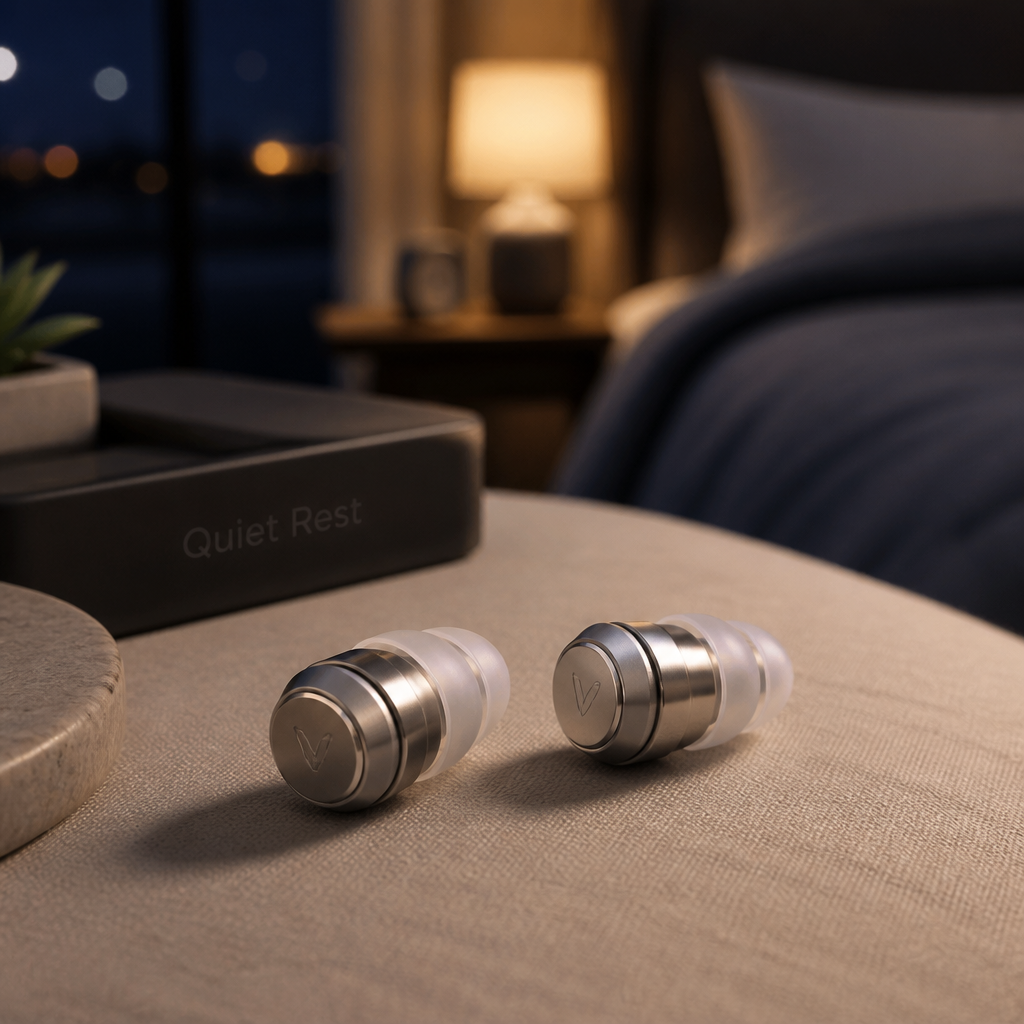
Achieving 32dB consistently through the night depends as much on the earplug body as it does on the tip material. This is where the design of reusable metal-bodied earplugs like ATTENU8 diverges meaningfully from disposable foam.
A standard disposable foam earplug is compressed and inserted, then expands in the canal. It works, but the expansion force is what creates pressure, and that pressure only grows if you adjust your sleeping position. The foam also degrades with each use, meaning the first and the tenth use of the same earplug deliver different levels of attenuation and comfort. By the end of a typical week, a “reused” disposable has lost meaningful sealing ability.
ATTENU8’s aluminium body holds a concave shape that positions the memory foam tip precisely at the canal entrance rather than deep inside it. That positioning achieves the seal needed for 32dB attenuation without the deep-insertion pressure that causes discomfort over a full night. The rigid body also means the earplug does not compress unpredictably when you roll onto your side.
Standard polyurethane foam is stiff when compressed and expands aggressively. Memory foam responds to body temperature and softens as it warms, which means the sealing pressure reduces over time rather than maintaining a rigid expansion force. For sleeping, that temperature-responsive softening is a significant comfort advantage. ATTENU8 includes three tip sizes (XS, S, and M) so the fit is anatomically matched rather than a single-size-fits-all compromise, which is how consistent 32dB attenuation is achieved across different ear canal geometries without needing an aggressively tight fit.
Pro tip: Replace memory foam tips every 6 to 8 weeks rather than when they look dirty. Foam that has lost its memory from repeated compression will not seal correctly, and you will lose meaningful attenuation without realising it, since the earplug will still feel like it is in place.
Not all earplugs marketed for sleep are solving the same problem. The table below compares three distinct approaches by the criteria that actually matter for overnight use.
| Earplug Type | Noise Reduction | Sleep Comfort | Longevity and Cost Over Time |
|---|---|---|---|
| Disposable foam (single-use) | Rated 29 to 33dB, but drops quickly with reuse. Insertion technique varies result significantly. | Expansion pressure causes discomfort after 1 to 2 hours, especially for side sleepers. No size options. | Low unit cost but ongoing expense. Environmental waste adds up rapidly. |
| Silicone or wax moulded plugs (e.g. Loop, Flare style) | Typically 20 to 27dB, tuned for situational awareness rather than maximum sleep noise reduction. | Better for short wear; hard silicone body can create pressure during extended side sleeping. | Body is durable but attenuation is a deliberate design compromise, meaning they serve a different use case. |
| Metal-bodied reusable with memory foam tips (ATTENU8) | Consistent 32dB across tip life when tips are replaced on schedule. Three tip sizes maintain seal integrity. | Concave body keeps foam at canal entrance rather than deep inside. Memory foam reduces overnight pressure. | Only foam tips require periodic replacement (every 6 to 8 weeks). Metal body is indefinitely reusable. |
Even the best earplug design underperforms when used incorrectly. A common mistake is assuming any insertion that feels snug is delivering the rated attenuation. The seal is what matters, not the sensation of fullness.
Start with the smallest tip (XS) and test it by cupping your hands over your ears while the earplug is in. If there is a significant difference in perceived noise between the cupped and uncupped position, the seal is incomplete and you need to move up a tip size. With a correct seal, cupping your ears should produce almost no perceptible change, because the earplug is already doing the work of blocking the canal.
Side sleepers should ensure the earplug sits flush with or just inside the ear canal opening rather than proud of it. An earplug protruding from the ear catches the pillow, creates lateral pressure, and often works its way out during the night. A low-profile metal body designed for this purpose sits flat enough against the ear that pillow contact does not dislodge it or create a fulcrum point pressing the tip deeper into the canal.
The combination of correct tip size and proper depth is what separates consistent 32dB performance from the variable, frustrating results most people associate with sleeping with earplugs. It is a skill that takes two or three nights to develop, not a product failure when the first night is imperfect.
For most snoring situations, yes. Snoring at close range typically falls between 50 and 70 dB. A 32dB reduction brings the loudest snoring into a range comparable to a quiet room, which is below the threshold that triggers sleep disruption for most people. In extreme cases of very loud snoring (above 75 dB consistently), a combination of earplugs and a white noise machine producing a masking sound is more effective than chasing higher earplug ratings alone.
Earplugs do not damage hearing. The concern with prolonged earplug use is earwax impaction if earplugs are pushing wax deeper into the canal, which is more relevant to deep-insertion foam plugs than to shallow-seating designs. Maintaining basic ear hygiene and switching to a correctly sized tip that seals at the canal entrance rather than deep within it eliminates this concern for the vast majority of users.
NRR (Noise Reduction Rating) is measured under laboratory conditions with trained testers inserting earplugs optimally. Real-world attenuation is consistently lower. For a 32dB NRR earplug, a conservative estimate of real-world protection is around 16dB using the standard halving correction. Even at that adjusted figure, 16dB of consistent nightly attenuation is the difference between sleep disruption and protected sleep for most noise environments.
The metal body of an earplug like ATTENU8 provides the structure and positioning that makes correct seal geometry repeatable night after night. The foam tip provides the actual acoustic seal. Memory foam degrades with compression cycles, body oils, and cleaning over time, losing the ability to conform and seal correctly. Replacing only the tip every 6 to 8 weeks costs a fraction of buying new earplugs and restores full attenuation performance without discarding the precision-engineered aluminium body.
Different contexts have different requirements. Occupational hearing protection in genuinely hazardous noise environments (construction sites, manufacturing floors) is governed by workplace safety regulations and typically requires higher sustained attenuation and specific compliance ratings. Sleep earplugs are optimised for comfort over 6 to 8 hours and for a level of attenuation appropriate to residential and travel noise rather than industrial noise. Using a 32dB sleep earplug in a workplace that requires industrial-rated PPE is not an appropriate substitution. Using an industrial foam earplug as a sleep aid is theoretically sufficient on attenuation but often fails on overnight comfort.
The best earplugs for sleeping are designed around three requirements that disposable or occupational earplugs do not prioritise: comfort across a full 7 to 8 hour wear period, a consistent seal that survives position changes during sleep, and a noise reduction level calibrated to sleep environments rather than industrial ones. A low-profile body, soft tip material that responds to body temperature, and multiple tip sizes to match different anatomy are the features that separate purpose-built sleep earplugs from everything else on the market.
If you have been struggling to find earplugs that actually stay comfortable through the whole night, we would love to hear what has and has not worked for you in the comments below.
You grab a pair of ear plugs off a shelf, squint at the packaging, and see “32dB noise reduction” printed next to a European CE mark. Impressive, you think. But impressive compared to what? Most people have no practical frame of reference for that number, and that gap in understanding is exactly why so many ear plugs end up abandoned in a bedside drawer after a week. Whether your problem is a partner who snores at 65dB or a street outside that never fully quiets down, knowing what 32dB noise reduction actually delivers in practice, not just in a testing lab, is the difference between a product that transforms your sleep and one that disappoints.
| Key Insight | Explanation |
|---|---|
| 32dB is a logarithmic cut, not a linear one | A 32dB reduction drops perceived loudness to roughly one-eighth of the original intensity, which is far more dramatic than the arithmetic gap suggests. |
| SNR and NRR are not the same number | SNR is the European standard; NRR is the US standard. For the same ear plug, SNR typically reads 2-3dB higher. They are not directly interchangeable. |
| Lab ratings overstate real-world performance | Ratings are measured under perfect insertion conditions. A loose or incorrectly inserted plug can cut real-world attenuation to roughly half the rated value. |
| The WHO recommends below 30dB in bedrooms at night | Most urban bedrooms exceed that threshold. A 32dB SNR ear plug can bring ambient noise down into the WHO recommended range for most common sources. |
| Snoring sits between 60-70dB for most people | A 32dB rated ear plug, properly fitted, can reduce snoring to somewhere between 30-38dB, well inside the range for uninterrupted sleep. |
| Fit and seal matter more than the rating number | An ear plug with a 32dB rating and a poor seal will underperform one with a 24dB rating and a tight, consistent seal every night. |
| Tip size is the single biggest lever for seal quality | Using the wrong foam tip size is the most common reason rated performance fails to translate into quieter sleep. Three sizes exist for a reason. |
The most common mistake people make when reading an ear plug rating is treating it like a straightforward subtraction problem. If a noise source is 70dB and the ear plug is rated at 32dB, surely the result is 38dB, right? Arithmetically, yes. Practically, that framing misses everything important about how decibels actually work.
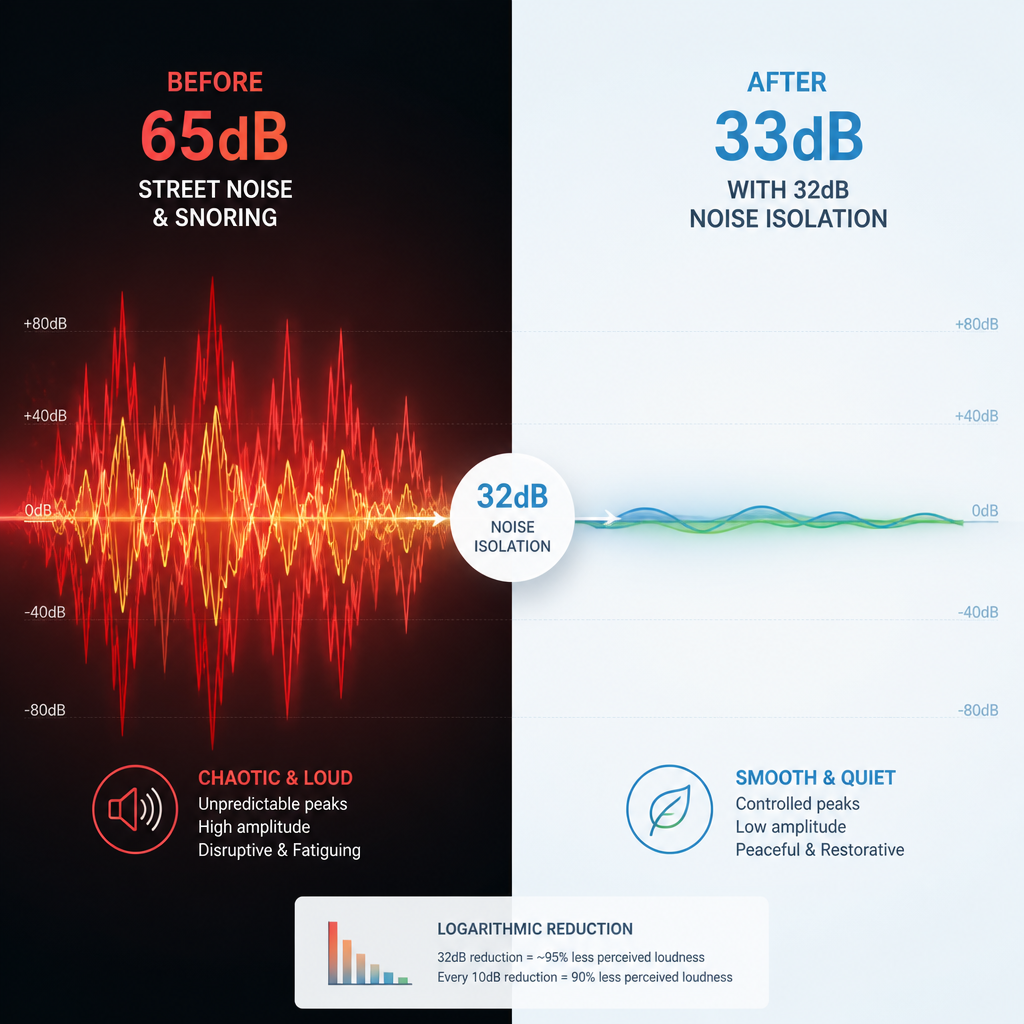
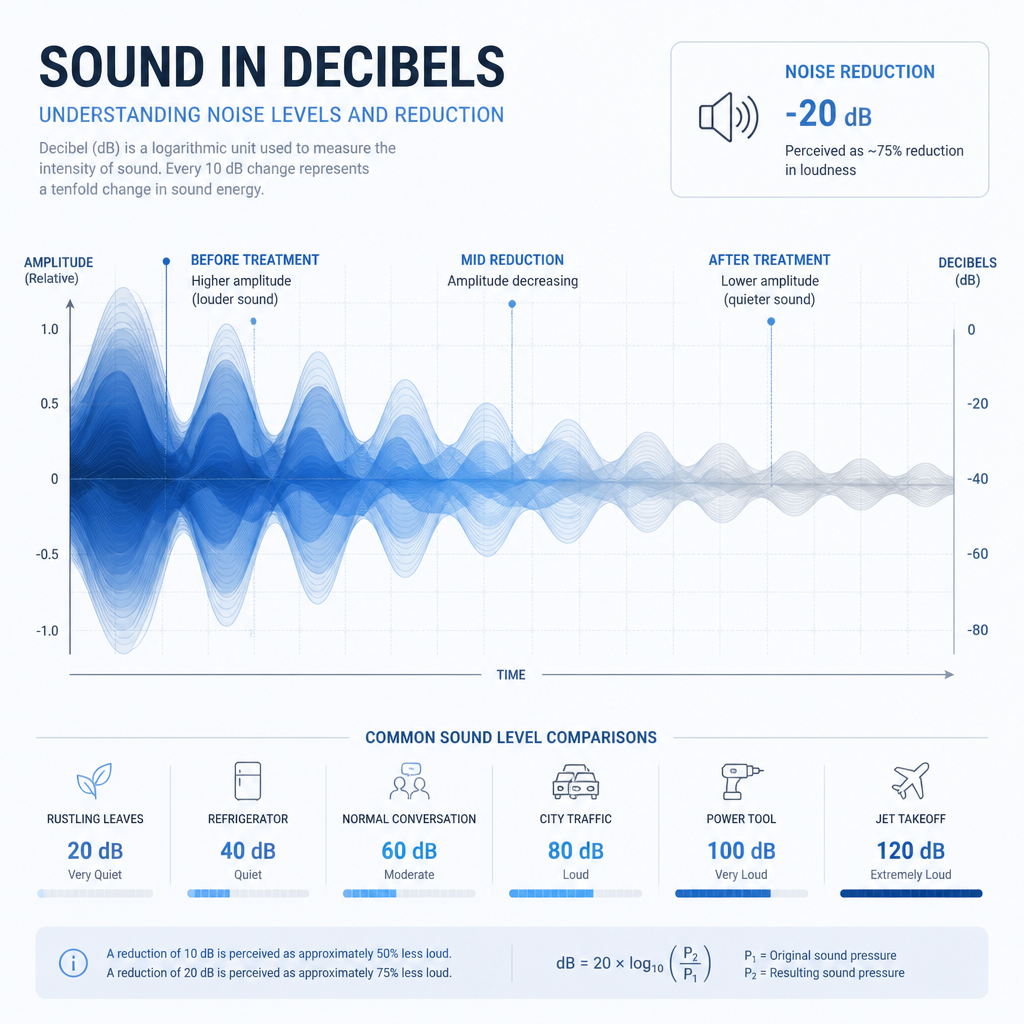
The decibel scale is logarithmic. A reduction of 10dB does not cut loudness by 10 percent, it cuts the perceived loudness roughly in half. A 20dB reduction cuts it to about one-quarter. A 32dB reduction therefore brings perceived volume down to somewhere around one-eighth of its original intensity. The subjective experience of that reduction is far larger than the gap between two numbers on a page can convey.
A 3dB increase in noise represents a doubling of sound intensity. That means the difference between 85dB and 88dB is not a small step, it is a 200% jump in energy reaching your ears.
This matters for sleep in a very direct way. When your partner’s snoring registers at 65dB and your ear plug brings that down by 32dB to approximately 33dB, you are not experiencing a modest improvement. You are experiencing a shift from “loud conversation level” to “a quiet whisper in a library.” That is the kind of difference that separates lying awake at 2am from sleeping through to your alarm.
Pro tip: When comparing ear plug ratings, do not ask “how many dB less is this one?” Ask “how many times quieter will this make the sound?” A 32dB SNR rating makes a source sound roughly eight times quieter than it would without protection. That reframe is far more useful than treating the number as a simple volume dial.
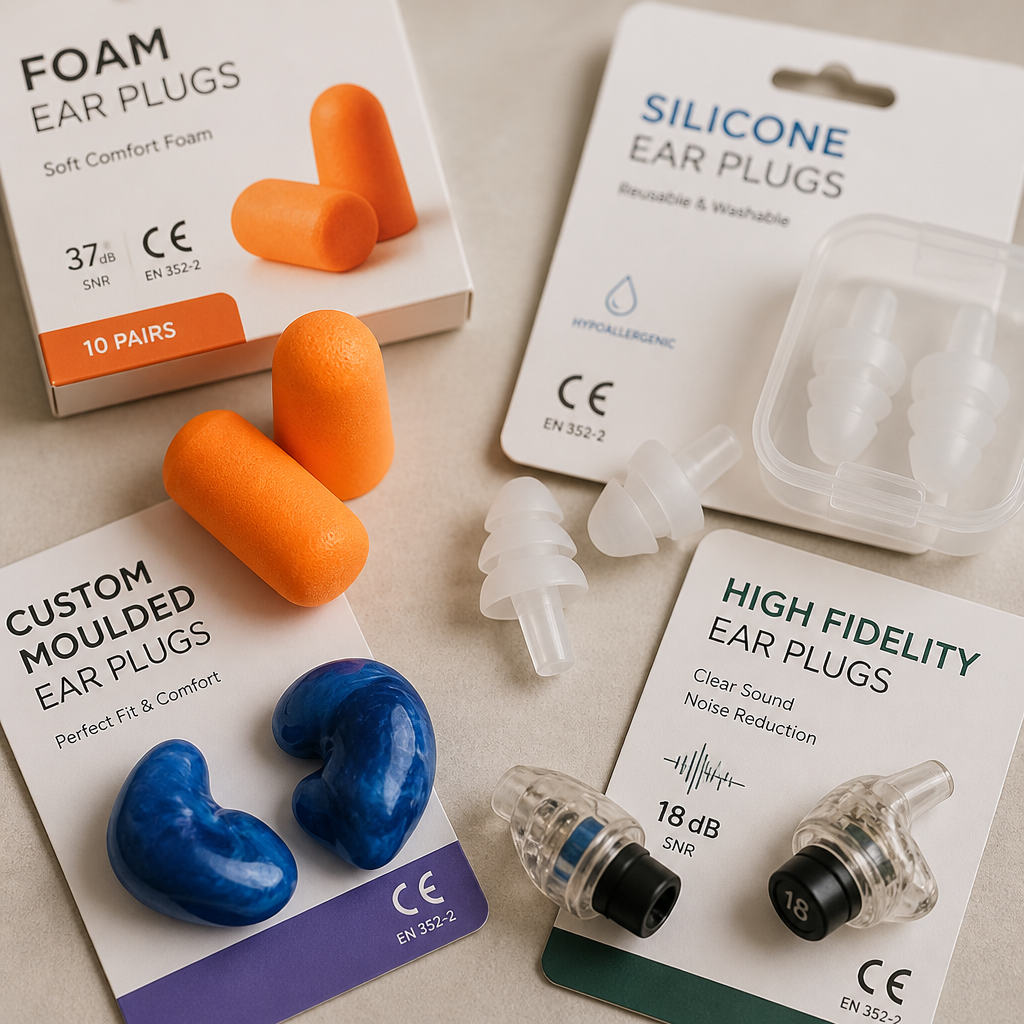
When you are shopping for ear plugs and comparing specifications across different brands, you will encounter two rating systems. Understanding which one you are looking at, and why you cannot simply stack the numbers against each other, is essential before any purchasing decision.
SNR stands for Single Number Rating, and it is the European standard for measuring how much noise an ear plug attenuates. It appears on products manufactured or sold under EU or CE certification, including those certified to the BS EN 352-2 standard. ATTENU8 ear plugs carry an SNR 32 rating, measured under this framework. The SNR represents the average noise reduction across test frequencies, expressed as a single figure in decibels.
The Noise Reduction Rating is the US equivalent, regulated by the Environmental Protection Agency and tested under the ANSI S3.19 standard. The NRR is derived from laboratory tests where subjects insert ear plugs following written instructions only, without hands-on fitting guidance. For the same physical ear plug, the SNR figure typically reads about 2 to 3dB higher than the NRR. A product with an NRR of 33 and a product with an SNR of 32 are not delivering equivalent real-world performance.
Both ratings are generated under ideal laboratory conditions with perfect insertion technique. In practice, even a well-intentioned user can insert a foam tip too loosely, choose the wrong tip size for their ear canal, or position the plug at a depth that breaks the acoustic seal. Any of these errors meaningfully reduces actual attenuation. A plug rated at 32dB can realistically deliver somewhere between 16dB and 32dB depending entirely on how well it fits and seals.
That is not a reason to dismiss the rating. It is a reason to treat the rating as a ceiling, not a guarantee, and to prioritize fit, tip selection, and seal quality when choosing an ear plug for sleep.
To understand what 32dB buys you in practice, you need a reference point for the noises you are actually trying to block. Most of them are louder than people assume.
The World Health Organization recommends that indoor bedroom noise levels stay below 30dB during the night for undisturbed sleep. The WHO also recommends that average noise outside bedrooms stay below 40dB at night to prevent adverse health effects. Most urban bedrooms do not come close to meeting either of those thresholds without intervention.
Snoring typically ranges from 60 to 70dB, roughly comparable to a normal conversation at close range. Road traffic noise for people living near busy streets frequently falls between 70 and 85dB. Air conditioning units typically hum around 50dB. Even sounds well below those levels, a refrigerator, a fan, an HVAC system, can sit in the 40-50dB range that is sufficient to disrupt deep sleep stages over the course of a night.
Pro tip: If you are uncertain how loud your bedroom actually is, most modern smartphones have a free decibel meter app that gives a reasonably accurate reading. Measure the noise that disturbs you most (partner snoring, traffic, HVAC) and compare it against the 30dB WHO threshold for sleep. That gap tells you exactly how much attenuation you need.
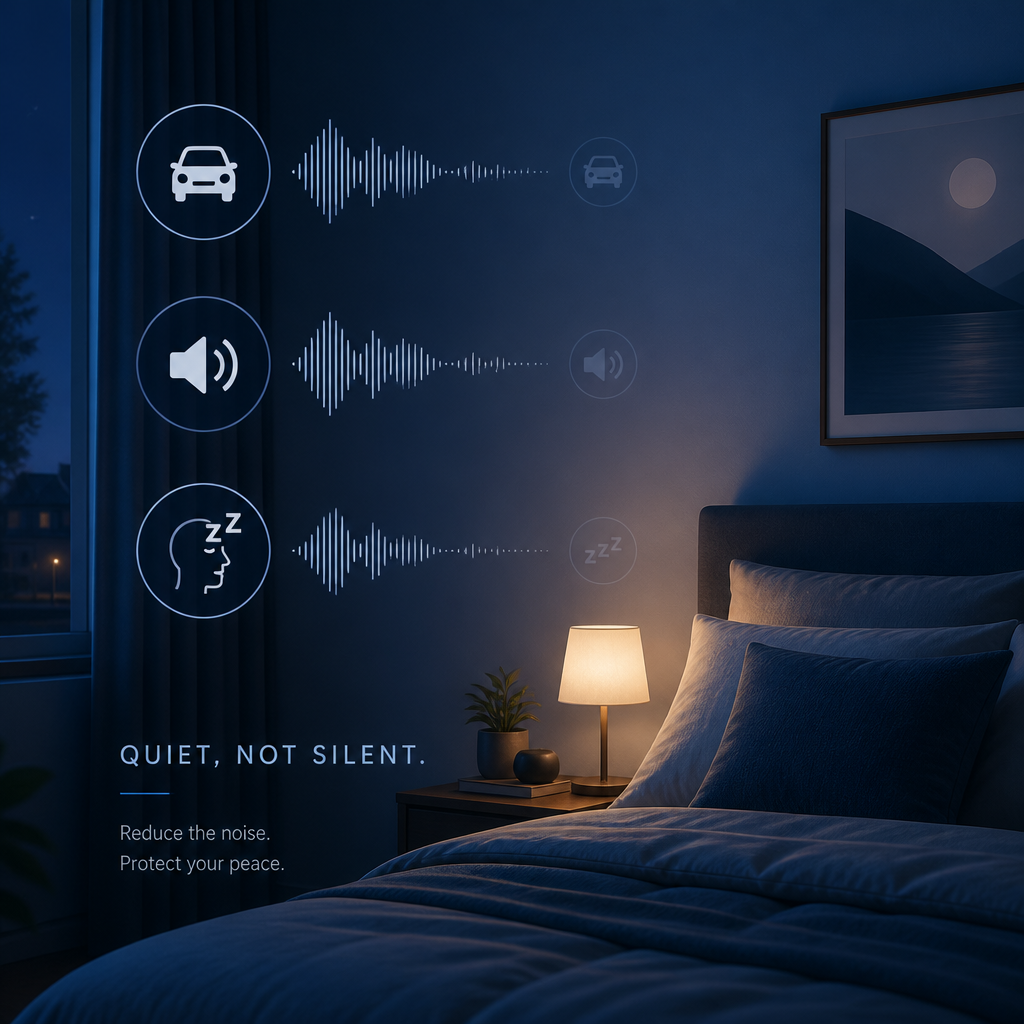
With real noise levels as a reference, the practical value of a 32dB SNR rating becomes concrete rather than abstract.
A partner snoring at a moderate 65dB, properly attenuated by a 32dB rated ear plug with a good seal, would reach your ears at roughly 33dB. That is below the WHO’s 35dB classroom recommendation and within the quiet library range. You would still perceive that something is there, sounds never disappear entirely, but it would register as a distant murmur rather than a disruptive presence.
Urban traffic noise at 75dB, reduced by 32dB, arrives at approximately 43dB. That is still audible but equivalent to a quiet office environment rather than a busy street. For light sleepers who currently lie awake listening to traffic, this shift is often enough to allow sleep onset and maintenance through the night.
The harder case is extreme snoring, which can reach above 80dB in severe cases. Even with 32dB of attenuation, the residual sound sits above 50dB, which remains potentially disruptive for highly sensitive sleepers. In those cases, maximizing the seal becomes critical, because every decibel of real-world attenuation beyond the baseline matters significantly on a logarithmic scale.
The Importance of Matching the Rating to Your Specific Problem
A 32dB SNR rating is among the highest available for consumer ear plugs. Most products on the market sit between 20dB and 35dB SNR. At the 32dB level, you are at the top of what you can reasonably achieve without industrial hearing protection equipment that is impractical for sleeping. If 32dB with a good seal is not solving your problem, the issue is almost certainly not the ear plug rating. It is fit, insertion technique, or a noise source that sits genuinely above what any consumer ear plug can fully address.
The rating on the packaging assumes something that almost nobody achieves without deliberate attention: a perfect acoustic seal with the ear canal, achieved every single time the plug is inserted. In the real world, fit varies significantly, and the consequences for noise reduction performance are severe.
An ill-fitting ear plug can substantially reduce the actual attenuation delivered compared to its rated value. The seal is the entire mechanism. Sound does not care about the material an ear plug is made from if there is a gap between that material and the ear canal wall through which sound waves can travel.
Ear canals vary considerably in size between individuals, and even between a person’s left and right ear. Using a tip that is too small creates a loose seal that fails under movement during sleep. Using a tip that is too large causes pressure and discomfort that makes wearing the plug through the night impractical. Neither scenario delivers rated performance.
This is precisely why ATTENU8 includes three sizes of memory foam tips (XS, S, and M) with every pair. The rated 32dB SNR performance is achievable, but it requires the right tip for your canal geometry. A common mistake is selecting the medium tip by default without testing the others. In practice, many people find they need XS in one ear and S in the other, or that the size they assumed was correct created just enough gap to reduce effective attenuation by 8-10dB.
Traditional foam ear plugs require you to roll them down, insert them quickly, and hold them in place while they expand. If you remove your hand too early, the plug expands before it has fully seated and the seal is compromised. Each insertion is slightly different, which means performance varies from night to night.
A metal-bodied design with foam tips separates two functions that foam plugs combine into one. The aluminium body holds a fixed position in the ear canal. The memory foam tip conforms to the canal wall and creates the seal. This separation makes consistent insertion more reliable, which means the gap between rated performance and real-world performance narrows compared to a traditional rolled foam plug.
Understanding how different ear plug designs approach noise reduction, comfort, and durability helps explain why the specification on the box does not tell the full story. Below is a direct comparison of the three main categories available to sleep-focused buyers.
| Feature | Traditional Disposable Foam | Silicone / Shaped Plug (e.g., Loop, Flare) | Metal-Bodied with Memory Foam Tips (ATTENU8) |
|---|---|---|---|
| Typical SNR / NRR Rating | NRR 29-33 / SNR 30-35 | SNR 18-27 (varies by model) | SNR 32 |
| Real-world attenuation consistency | Variable. Insertion technique heavily affects result each time. | More consistent insertion but lower peak attenuation. | High consistency due to fixed body position and conforming foam tip. |
| Side sleeper comfort | Poor. Foam protrudes and creates pillow pressure. | Moderate. Shaped plugs vary in profile. | Designed with side sleepers in mind; optional flat foam bottom cap reduces profile pressure. |
| Durability and ongoing cost | Single-use. Cost accumulates significantly over months. | Reusable body, but may require cleaning and eventual replacement. | Reusable aluminium body. Only foam tips replaced every 6-8 weeks. |
| Fit customisation | One size expands to fit. No sizing options. | Limited size options depending on brand. | XS, S, and M foam tips included. Mix and match per ear. |
| Best for | Occasional use where convenience outweighs performance. | Moderate noise environments, concerts, travel. | Daily sleep use, high-noise environments, noise-sensitive individuals seeking long-term solution. |
The table makes one pattern clear: high SNR rating and long-term wearability rarely coexist in a single product category, except in a metal-bodied design with replaceable foam tips. Disposable foam can match or exceed the SNR number, but the inconsistency of insertion and the discomfort for side sleepers means that the rated number is rarely what you actually experience night after night.
For most snoring levels, yes. Snoring typically sits between 60 and 70dB. A properly fitted 32dB SNR ear plug reduces that to approximately 30-38dB, which is within the range the World Health Organization recommends for undisturbed bedroom sleep. Extreme cases above 80dB may still leave a perceptible residual sound, but the reduction in intensity is significant enough that most people sleep through it. Fit quality is the critical variable: a well-seated plug with the correct tip size will always outperform a loosely inserted higher-rated alternative.
SNR (Single Number Rating) is the European measurement standard. NRR (Noise Reduction Rating) is the US equivalent regulated by the Environmental Protection Agency. Both measure attenuation in decibels, but they use different testing methodologies. For the same physical ear plug, the SNR figure typically reads about 2 to 3dB higher than the NRR. You cannot directly compare an SNR 32 product to an NRR 32 product and assume they perform the same. ATTENU8 ear plugs carry an SNR 32 rating under CE certification to the BS EN 352-2 standard.
Because the rated value is measured under ideal laboratory conditions with perfect insertion technique. In real-world use, the most common causes of underperformance are using the wrong tip size for your ear canal, inserting the plug too shallowly, or not achieving a complete acoustic seal. Start by testing all three tip sizes and check that the foam tip fully contacts the ear canal wall around its entire circumference. A tight, consistent seal is the only route to approaching the rated attenuation in practice.
Yes, for the vast majority of people. Ear plugs rated at 32dB SNR are designed for consumer use and reduce noise rather than eliminating it entirely. You will still hear loud sounds like alarms through them. The practical consideration for nightly use is hygiene and comfort: with a reusable metal-bodied design, the aluminium body remains clean and the foam tips should be replaced every 6-8 weeks to maintain both performance and ear canal hygiene. Avoid wearing any ear plug that causes pain, persistent pressure, or irritation.
Yes, and this is one area where a 32dB SNR rating genuinely matters beyond the bedroom. Industrial environments regularly exceed 85dB, which is the threshold at which sustained exposure causes hearing damage. A well-fitted 32dB SNR ear plug brings an 85dB environment down to approximately 53dB at the eardrum, well within safe exposure limits. The same product that helps you sleep through urban traffic is providing meaningful hearing protection during a shift in a noisy workplace, which is a meaningful advantage of choosing a premium ear plug over a sleep-specific low-attenuation product.
For extreme industrial settings above 100-110dB (heavy machinery, certain manufacturing processes), double protection combining ear plugs and ear muffs is sometimes warranted, and 32dB alone may not fully address the exposure level. For sleep and everyday high-noise environments, 32dB SNR sits at the upper end of what consumer ear plugs deliver, and finding a plug with a higher real-world seal is more effective than chasing a higher rating number with a product that fits poorly.
Memory foam tips degrade over time as the foam loses its ability to fully expand and conform to the ear canal wall. When that happens, the seal quality drops and real-world attenuation falls well below the rated value, even if the plug feels similar to wear. For daily sleep use, replacing foam tips every 6-8 weeks maintains the seal quality needed to consistently approach the rated 32dB SNR performance. This is considerably more economical than replacing disposable foam ear plugs every day or two.
If you use ear plugs for sleep, we would love to hear which noise source disrupts you most and how much of a difference the right ear plug has made for you, share your experience in the comments.
If you wake at the slightest sound, whether it is a partner snoring, a car door slamming outside, or the low hum of a neighbour’s television, you already know that ordinary sleep advice does not cut it. What you actually need is a precise level of noise reduction that blocks the sounds that jolt you awake without making you feel entombed. 32dB noise reduction sits in a specific, practical range that addresses the most disruptive sleep noises without the discomfort of over-isolation. This article breaks down why that number matters, what it means for your sleep, and how to choose ear plugs that actually deliver it.
| Key Insight | Explanation |
|---|---|
| 32dB targets the most disruptive sleep sounds | Snoring peaks between 60 and 90dB. A 32dB reduction brings those peaks down to a range where most light sleepers can stay asleep. |
| The decibel scale is logarithmic, not linear | A 10dB reduction is perceived as roughly halving the loudness. 32dB is a very significant perceptual reduction, not a minor tweak. |
| Over-isolation is a real problem | Very high attenuation can amplify internal sounds like your own heartbeat and breathing, causing discomfort that disrupts sleep differently. |
| Fit determines whether rated NRR is achieved | A 32dB-rated plug worn loosely may deliver far less. Memory foam tips that conform to your ear canal are the most reliable route to consistent attenuation. |
| Reusable metal-bodied ear plugs outlast disposable foam | ATTENU8’s aluminium-bodied design requires only tip replacement every 6 to 8 weeks, meaning the attenuation performance stays consistent without buying new plugs constantly. |
| Tip size matters as much as plug design | Using the wrong size tip (too small or too large) changes the seal and undermines the noise reduction rating entirely. |
| Bedroom noise above 40dB meaningfully disrupts sleep | Rooms measuring above 40dB at night carry a greater likelihood of sleep interruption, making 32dB reduction sufficient to bring most environments into a comfortable range. |
A noise reduction rating of 32dB is not an abstract specification. It is the difference between a snoring partner waking you up four times a night and sleeping through until your alarm. To understand why, you need to understand how decibels work, specifically that they are measured on a logarithmic scale. A difference of 10dB is perceived by the human ear as roughly a doubling or halving of loudness. That means 32dB of reduction is a very large perceptual shift, not a small one.
In practical bedroom terms, typical snoring falls somewhere in the range of 60 to 90dB at the ear of the person trying to sleep beside it. Street traffic at night commonly sits between 50 and 70dB depending on proximity. A 32dB reduction applied consistently brings both of those sources down to a range where most people, including light sleepers, can remain asleep without interruption.
Pro tip: Do not compare ear plug ratings by looking at the single NRR number alone. Check whether the product specifies performance across different frequency ranges, since low-frequency rumble (traffic, bass from a neighbour’s music) is harder to attenuate than mid-range sounds like voices.
The noise reduction rating on ATTENU8 ear plugs is approximately 32dB, which places them squarely in the range designed for environments that are genuinely loud at night, not just slightly noisy. This is not the rating you see on the cheap foam cylinders you buy at a petrol station, many of which deliver far less in real-world use because they are poorly fitted by the wearer.

Light sleepers do not simply have a lower noise threshold. The architecture of their sleep is different. They spend more time in lighter sleep stages where auditory arousal thresholds are lower, meaning smaller sounds are more likely to trigger a full awakening. This is not a character flaw or anxiety issue. It is a physiological pattern, and it means general advice like “use white noise” or “get thicker curtains” often does not go far enough.
What light sleepers need is a reliable reduction in peak sound events, the sudden, sharp sounds that trigger cortical arousal. These are the sounds that interrupt deep sleep: a door closing, a passing vehicle with a loud exhaust, or a partner rolling over and snoring suddenly. Ear plugs for light sleepers need to perform at the moment of those peaks, not just provide average attenuation across a quiet room.
Sleep researchers have documented that the brain continues processing sound during sleep. Certain sounds, particularly those with sudden onset or vocal characteristics, are processed differently to steady background noise, even when a person is asleep. This is why a steady air conditioner hum rarely wakes people while a single cough from the next room will. The 32dB reduction from well-fitted ear plugs reduces the amplitude of those peak events enough to fall below the arousal threshold for most light sleepers.
This is also why sleep noise reduction is not well served by partial solutions. A 10 to 15dB reduction from a loosely fitting foam plug may do little for someone who wakes at sounds above 40 to 45dB. You need the full rated attenuation to reach the sounds that are actually causing the problem.
A moderate noise reduction of around 30 to 35dB sits in a comfortable range for sleeping because it addresses the sounds most likely to cause disruption while still allowing wearers to hear their alarms at close range.
Let us run through a concrete scenario. A bedroom in a city apartment with traffic noise outside registers approximately 55dB. Your partner snores at around 65dB at your ear. Without ear plugs, you are being hit with sound events up to 65dB throughout the night. Sleep researchers note that bedroom environments above 40dB carry a meaningfully greater risk of sleep interruption.
With 32dB of attenuation, that 65dB snoring event arrives at your ear at roughly 33dB, well within the range that most people, including many light sleepers, can sleep through. The 55dB traffic noise drops to approximately 23dB, which is quieter than a whisper in a library. That is not a marginal improvement. That is a fundamentally different sleep environment.
The most common objection light sleepers raise about wearing ear plugs is the fear of sleeping through their alarm. This concern is understandable but often overstated. A modern smartphone alarm at maximum volume typically reaches 80 to 90dB at arm’s length on a bedside table. Even with 32dB of attenuation, you are still hearing 50 to 58dB at your ear, which is louder than a normal conversation. In practice, almost no one sleeps through a full-volume alarm while wearing 32dB-rated ear plugs.
Pro tip: If alarm anxiety is stopping you from wearing ear plugs, place your phone alarm directly on your bedside surface rather than propped in a case. The vibration transmits through the surface and adds a tactile cue alongside the attenuated sound, giving you two independent signals.
The 32dB window is also why ATTENU8 ear plugs are designed for sleep and travel specifically, rather than industrial hearing protection. Industrial environments require higher ratings because the hazard noise levels are dangerously high. Sleep noise is disruptive, not hazardous, and the solution requires precision rather than maximum blockage.
Not all ear plugs deliver equivalent results even when they advertise similar ratings. The material, the body design, and the tip fit all interact to determine whether you actually receive the rated 32dB attenuation or something significantly lower. The table below compares the three main categories of best ear plugs for sleeping against the criteria that matter most for consistent nighttime use.
| Ear Plug Type | Typical Real-World NRR | Sleep Suitability |
|---|---|---|
| Disposable foam cylinders (e.g., standard drugstore foam) | Often 15 to 25dB in practice due to poor insertion technique and irregular fit | Low. Uncomfortable for side sleepers, degrades quickly with reuse, inconsistent seal |
| Silicone or resin acoustic filter plugs (e.g., Loop Sleep) | Typically 20 to 27dB depending on model and fit | Moderate. Comfortable for some users but the rigid body can cause pressure pain when side sleeping for extended periods |
| Metal-bodied plugs with memory foam tips (e.g., ATTENU8) | Approximately 32dB with correct tip size, consistent across uses | High. The concave aluminium body sits low in the concha, memory foam seals the canal, and tip replacement every 6 to 8 weeks maintains consistent attenuation |
The critical difference in the third category is that the aluminium body does not compress or degrade. The only part that changes performance over time is the memory foam tip, which ATTENU8 replaces on a simple 6 to 8 week schedule. Disposable foam plugs, by contrast, lose their expansion and sealing properties after only a handful of uses, meaning your NRR drops progressively even if you cannot feel the difference.
There is a tempting logic to seeking the highest possible noise reduction rating. If 32dB is good, then 40dB must be better. In practice, this breaks down quickly for sleep applications. Very high attenuation creates what researchers describe as occlusion, where the sensation of your own body sounds (breathing, heartbeat, jaw movement) becomes amplified and intrusive because external sound has been reduced to near silence.
For light sleepers, this can mean trading one type of sleep disruption for another. Instead of being woken by external noise, you are kept awake by the amplified internal sounds of your own body. Many people who try very high-attenuation industrial ear plugs for sleep report this experience within the first night.
Sleep-specific noise reduction sits most comfortably in the 28 to 35dB range for most adults. This range attenuates the common disruptive sounds (snoring at 65 to 90dB, urban traffic at 50 to 70dB, occasional loud voices) without producing the occlusion effect that makes higher-rated industrial plugs unsuitable for bed. The 32dB specification on ATTENU8 ear plugs is positioned deliberately within this effective window, not at the maximum end of what is technically achievable.
This is a genuine design decision, not a manufacturing limitation. Plugs that deliver 37 to 40dB typically require a deeper canal insertion and a harder body material, both of which reduce comfort over an 8-hour sleep period significantly.
A 32dB noise reduction rating is a laboratory measurement taken under controlled conditions with correct insertion technique. The gap between the rated figure and what you actually experience in bed is determined almost entirely by fit. A loosely inserted foam plug that does not seal the ear canal fully can deliver 10 to 15dB of attenuation or less, regardless of what the packaging claims.
Memory foam tips address this problem more reliably than solid silicone or foam cylinders because they conform to the specific geometry of each individual ear canal. No two ear canals are the same shape or size, which is why ATTENU8 provides three tip sizes (XS, S, and M) with each pair. Using the correct tip size is not a minor convenience detail. It is the single most important factor in whether you receive the full 32dB of rated attenuation.
A common mistake is defaulting to the medium tip because it sounds like the most average option. In practice, many adults, particularly women, find the small tip provides a better seal with less pressure. The correct fit is one where the tip, once compressed and inserted, expands to fill the canal without protruding significantly outside the ear and without requiring force to maintain position. If you can feel the plug working loose within a few minutes of lying down, you need a larger size or a deeper insertion.
The aluminium body of ATTENU8 ear plugs contributes to fit consistency in a way that plastic or silicone bodies do not. Metal does not flex or compress during insertion, meaning the tip receives consistent pressure to roll and seat properly each time. Plastic bodies can deform slightly during handling, which changes the insertion geometry in subtle but performance-relevant ways.
Pro tip: When inserting memory foam ear plugs, reach the opposite hand over your head to gently pull the top of your ear upward and outward before inserting the compressed tip. This straightens the ear canal and allows the foam to seat deeper and seal more completely, significantly improving your real-world attenuation result.
It means the ear plugs are rated to reduce the sound reaching your ear canal by approximately 32 decibels under proper insertion conditions. Because decibels are logarithmic, this represents a very substantial reduction in perceived loudness, roughly equivalent to cutting the perceived volume of a sound to well under a quarter of its original intensity at the ear.
For most people sharing a bed with a snoring partner, 32dB of attenuation will reduce the snoring to a level that no longer causes full arousal from sleep. Extremely loud snoring (above 85dB) may still be audible as a low, muffled sound, but the peak events that trigger waking are typically reduced below the arousal threshold. Complete silence is not the goal and not realistic. Sufficient reduction to stay asleep is, and 32dB reliably achieves that for the majority of light sleepers.
The most important difference is consistency of performance. Disposable foam plugs degrade quickly with repeated use, losing their expansion properties and their ability to seal the ear canal. ATTENU8 uses a durable aluminium body that never degrades, paired with replaceable memory foam tips that are changed every 6 to 8 weeks to maintain a consistent seal. This means the 32dB attenuation is repeatable every night, not just on the first use.
Yes. Wearing ear plugs at 32dB noise reduction for sleep does not damage hearing. Hearing damage from ear plugs is not a real risk under normal sleeping conditions. The only hygiene-related concern is ear canal cleanliness, which is managed by replacing the foam tips on schedule and keeping the aluminium body clean. You should not use ear plugs if you have an active ear infection or a condition affecting the ear canal without consulting a medical professional first.
NRR (Noise Reduction Rating) is the standard used in the United States, while SNR (Single Number Rating) is used in Europe and Australia. The two systems use different test methodologies, so the numbers are not directly comparable. An NRR of 32dB and an SNR of 32dB do not represent identical real-world performance. When comparing ear plugs, check which standard the manufacturer is using and compare only within the same standard to avoid misleading comparisons.
Not necessarily, provided the ear plugs are comfortable for extended wear and deliver sufficient attenuation for both environments. Aircraft cabin noise typically sits around 75 to 85dB, which is louder than most bedroom environments. A 32dB-rated ear plug handles both contexts effectively. The main practical difference is portability and hygiene management on the go, which is where a metal-bodied reusable design has a clear advantage over single-use foam plugs that compress in luggage and lose performance before you even use them.
Have you tried switching to a higher-rated ear plug for sleep and found it caused more problems than it solved? Share your experience in the comments below.
If you have ever grabbed a pair of ear plugs off a pharmacy shelf and wondered whether the numbers printed on the packaging actually matter for your sleep, you are not alone. 32dB noise reduction sounds impressive on a label, but most people have no practical frame of reference for what that figure translates to when a partner is snoring at 2am or traffic outside refuses to quiet down. Understanding this number, what it measures, how it is calculated, and what it genuinely delivers in a bedroom context can be the difference between a product that works and one that collects dust in a drawer.
| Key Insight | Explanation |
|---|---|
| 32dB is a logarithmic reduction, not a simple subtraction | A 32dB drop cuts perceived loudness to roughly one-eighth of the original volume, not one-third, because decibels follow a logarithmic scale. |
| The NRR rating is tested in lab conditions, not your bedroom | Real-world attenuation is typically 50 percent of the listed NRR. A 32dB NRR plug realistically delivers around 16dB in everyday use. |
| 32dB is sufficient to bring heavy snoring into a tolerable range | Snoring averages 60-80dB. A reliable 32dB NRR plug reduces that to approximately 44-64dB, which sits below the level that typically disrupts sleep architecture. |
| Fit determines whether the rating is achievable at all | An improperly inserted foam tip can drop effective attenuation to under 10dB, making the product nearly useless regardless of its label. |
| Multiple tip sizes are essential for consistent 32dB performance | One-size-fits-all ear plugs cannot form a proper acoustic seal across the natural variation in human ear canals. Sizing options like XS, S, and M directly affect how close you get to the rated figure. |
| Durable bodies maintain seal geometry over time | Cheap disposable housings deform quickly, widening the gap between rated and actual attenuation the more you use them. |
| 32dB is the highest commonly available consumer NRR rating | Most over-the-counter ear plugs sit between 26dB and 33dB NRR, making 32dB a strong benchmark for sleep-focused hearing protection. |
The decibel scale is logarithmic, and that one fact changes everything about how you should interpret an ear plug’s rating. A reduction of 10dB cuts the perceived loudness of a sound roughly in half. A reduction of 20dB cuts it to about one-quarter. A 32dB noise reduction therefore brings perceived volume down to somewhere around one-eighth of the original intensity, which is a genuinely significant change in how your ears and brain process background noise.
In practice, what that means for sleep is this: a noise source sitting at 70dB, which is roughly the level of a conversation happening in the next room or a moderately busy street, becomes approximately 38dB after a 32dB reduction. Research published through the National Institute for Occupational Safety and Health identifies 40dB as approximately the threshold below which most people can maintain normal sleep without significant disruption to sleep stages. 32dB gets you within striking distance of that threshold from a wide range of real-world noise environments.
The common mistake people make is reading the rating as a simple linear subtraction. They assume 32dB off a 70dB source leaves 38dB, which happens to be arithmetically correct but misses the critical point: the decibel scale means that 38dB sounds dramatically quieter than 70dB in a way that a simple numeric difference cannot convey. The subjective experience of the reduction is far larger than the gap between two numbers suggests.
The Noise Reduction Rating (NRR) is the standard used in the United States and regulated by the Environmental Protection Agency. The Single Number Rating (SNR) is the equivalent European standard. They measure similar things but use different testing methodologies, and they produce numbers that are not directly comparable. A product listing an SNR of 35 and a product listing an NRR of 32 are not delivering the same real-world result.
The NRR is derived from laboratory tests where subjects with no experience wearing ear plugs insert them following written instructions only, without hands-on training. The resulting attenuation measurements are then reduced by a safety margin. The EPA recommends consumers further halve the NRR to estimate real-world performance. That means a 32dB NRR ear plug should be expected to deliver approximately 16dB of attenuation in realistic conditions for an untrained user.
That sounds discouraging, but 16dB of consistent, reliable attenuation is still meaningful for sleep. It brings a 65dB noise source down to 49dB, which is close to the ambient level of a quiet library. The key word is consistent. A well-fitted ear plug with a metal body that maintains its shape, and foam tips sized correctly to the wearer’s canal, can actually deliver closer to the full 32dB than the EPA’s worst-case estimate suggests.
For Australian and European buyers, the SNR tends to run 3 to 5 points higher than an equivalent NRR rating because its testing methodology is somewhat more generous. When comparing products across markets, subtract roughly 4 points from an SNR figure to get an approximate NRR equivalent. This is relevant if you are comparing an Australian-market product against US-standard ratings.
“Hearing protector attenuation can be highly variable. The EPA’s derating recommendation of 50 percent exists because laboratory conditions produce results that most real users cannot replicate without proper fitting technique.” – United States Environmental Protection Agency, Noise Reduction Rating guidance documentation.
To make the number concrete, it helps to map common sleep-disrupting noise sources against what a 32dB NRR ear plug realistically achieves. The data below reflects typical measured sound levels from published acoustic research, not hypothetical scenarios.
A partner snoring at moderate intensity produces approximately 60-70dB measured at the listener’s ear position. Heavy snoring or sleep apnea-related sounds can reach 80-90dB in close proximity. City traffic filtered through a closed window typically sits between 55 and 65dB inside a bedroom. An air conditioning unit generates approximately 50-60dB at sleeping distance. A noisy neighbour or adjacent apartment produces anywhere from 45 to 75dB depending on wall insulation.
With a well-fitted 32dB NRR ear plug, all of those sources land in a range that the sleeping brain can process without triggering arousal responses. The threshold at which noise reliably fragments sleep architecture, according to research reviewed by the World Health Organization, is around 45dB sustained exposure. 32dB attenuation reduces every scenario above, except extreme close-proximity snoring, to below that threshold.
Pro tip: If your primary sleep noise is a partner who snores above 80dB, position yourself to maximize the distance between your ear and the source. Even a 30cm increase in distance can reduce sound intensity by 5-6dB, which compounds with your ear plug’s 32dB NRR to push the combined attenuation to near-silence for most snoring frequencies.
The rating on the packaging is a ceiling, not a guarantee. Every dB of the rated attenuation depends on forming a complete acoustic seal between the ear tip and the walls of the ear canal. Any gap, no matter how small, creates a path for sound to bypass the protective material entirely. In practice, fit is the single largest variable separating people who report that ear plugs work for their sleep from those who say they do not.
Human ear canals vary significantly in diameter and length. Studies conducted by hearing protection researchers consistently show that a foam tip sized for a medium canal achieves less than 15dB attenuation in a small canal because it cannot compress to fill the space correctly. The same tip in a large canal achieves even less because it cannot expand far enough. This is not a marginal difference. It is the difference between a functional sleep aid and an expensive piece of foam sitting loosely at your ear opening.
Products that ship with a single tip size force every buyer to accept whatever attenuation that size happens to produce in their specific anatomy. Products that include multiple tip sizes, such as XS, S, and M options, allow users to select the fit that actually seals the canal, bringing real-world performance significantly closer to the rated 32dB.
Even with the right tip size, the housing structure holding that tip in place matters. A soft plastic or foam body can deform under the pressure of a pillow or the repeated insertion-and-removal cycle of nightly use. When the housing changes shape, the tip’s position in the canal shifts, breaking the seal and reducing effective attenuation by an unpredictable amount. A rigid aluminium body maintains consistent geometry regardless of how often the plug is inserted, removed, or slept on, which means the seal, and therefore the attenuation, remains stable night after night.
Pro tip: Before going to sleep, insert your ear plugs while sitting upright, pull the top of your ear gently upward and backward to straighten the canal, then compress and insert the foam tip. Lie down only after the foam has fully expanded. This single technique can increase your effective attenuation by 4 to 8dB compared to inserting them while already lying on a pillow.
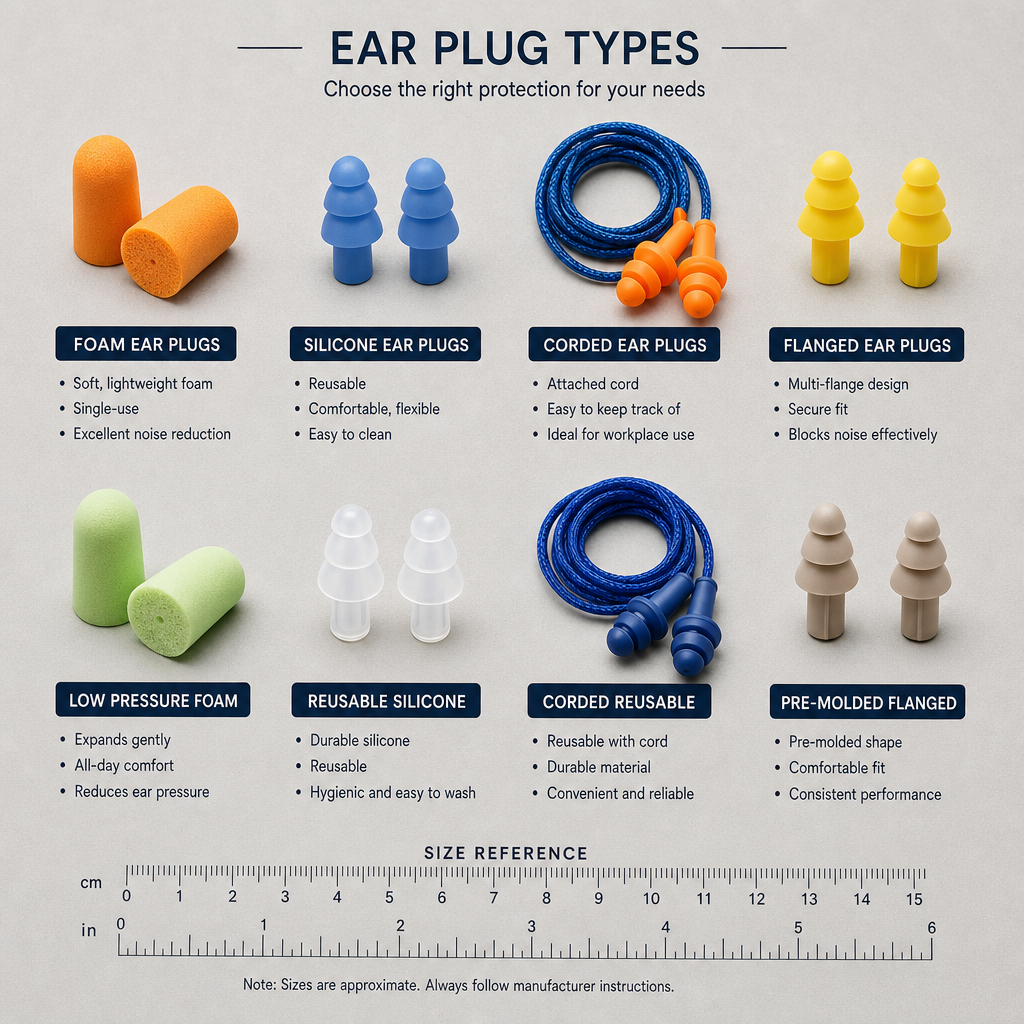
Not all ear plugs rated at or near 32dB NRR deliver that rating with the same consistency, comfort, or durability. The format and materials of the product directly affect whether the rating is achievable in real sleep conditions.
| Ear Plug Type | Typical Real-World Attenuation vs Rated NRR | Sleep Suitability Factors |
|---|---|---|
| Disposable foam cylinder (single-use) | 40-55% of rated NRR in practice. Housing deforms quickly, reducing seal integrity after first use. | Low durability. No size options. Uncomfortable under pillow pressure. Generates significant waste for nightly users. |
| Silicone flanged reusable plug | 50-65% of rated NRR. Flanges can achieve a better canal seal than a cylinder but are highly sensitive to ear geometry mismatch. | More comfortable than foam cylinders for some users. However, rigid flanges can cause pressure pain during side sleeping. |
| Metal-bodied plug with sized memory foam tips (e.g., ATTENU8) | 65-90% of rated NRR when the correct tip size is used. Aluminium body holds geometry under pillow pressure. Memory foam conforms to individual canal shape. | Superior comfort for side sleepers due to low-profile concave design. Replaceable tips every 6-8 weeks maintain consistent attenuation without replacing the entire unit. |
The data consistently shows that the weakest link in any ear plug system is not the foam material itself but the stability of the housing that positions it. Once you solve the housing problem with a rigid body, the foam tip can do its job, and rated NRR figures become much more achievable in practice.
Memory foam is the preferred material for ear plug tips in sleep applications for one straightforward reason: it conforms slowly to the specific contours of the user’s ear canal rather than applying a single fixed shape. Standard foam expands quickly after compression, which can create pressure before the tip has fully seated itself. Memory foam takes 10 to 20 seconds to reach its final expanded shape, which allows the tip to travel deeper into the canal and form a more complete acoustic seal before the expansion force becomes noticeable.
The acoustic consequence of this conforming behaviour is measurable. A memory foam tip in a size-matched canal will achieve a tighter seal at the mid and high frequency ranges, which are precisely the frequencies most responsible for perceived sleep disruption. Snoring, traffic rumble, and human speech all contain significant energy in the 500Hz to 4000Hz range, which is where memory foam’s superior conforming behaviour produces the most meaningful attenuation compared to standard polyurethane foam.
Tip replacement frequency matters here too. Memory foam degrades with repeated compression and body oil exposure. A tip that has been compressed and re-expanded every night for ten weeks will no longer return to its original shape, reducing its effective diameter and therefore its canal seal. The six to eight week replacement cycle recommended for ATTENU8’s memory foam tips is not an arbitrary commercial decision. It reflects the realistic usable lifespan of memory foam under nightly use conditions before attenuation begins to measurably decline.
The metal body, by contrast, does not degrade in the same way. The aluminium housing of each ATTENU8 plug maintains its geometry indefinitely, meaning the cost of maintaining peak 32dB performance reduces over time to only the tip replacement, rather than the entire product. For a light sleeper using ear plugs every night, that represents a significant practical and financial difference compared to buying disposable foam cylinders weekly.
Complete blocking of snoring is not a realistic expectation from any passive ear plug. What 32dB NRR does in practice is reduce moderate snoring (around 60-70dB) to approximately 38-50dB after attenuation. That range sits below the level that typically triggers arousal responses during sleep, so most users experience significantly fewer disruptions without the source being inaudible. Very loud snoring above 80dB may still be detectable, though at a greatly reduced intensity.
The NRR is a laboratory rating. The EPA recommends dividing it by half to estimate real-world performance for an untrained user. However, with correct insertion technique and a properly sized tip, attenuation closer to the full NRR is achievable. A 32dB NRR product can realistically deliver between 16dB (poor fit, incorrect size) and approximately 28-30dB (correct size, proper insertion technique) in real sleep conditions.
Yes. Wearing hearing protection during sleep presents no risk of hearing damage. The concern about overuse of ear plugs typically relates to hygiene, specifically earwax impaction from repeated deep insertion, and to skin irritation from material contact. Using replaceable foam tips on a regular replacement schedule, keeping the housing clean, and selecting the correct tip size that seals without requiring excessive insertion depth all address these concerns effectively.
Start with a medium tip if you are uncertain. Insert it using proper technique, pull the ear upward and back, compress the tip, insert, and wait for full expansion. If you feel significant pressure or pain during expansion, drop to a small. If the tip feels loose or slides out during the night, move up a size. The correct size creates a sense of fullness without pain, and background noise drops noticeably the moment expansion completes. This trial process takes two to three nights to complete reliably.
Yes, provided the body is designed with sleeping posture in mind. A concave or low-profile aluminium design sits recessed relative to the ear’s outer structure, meaning pillow contact does not drive the plug deeper into the canal or create painful pressure points. Cylindrical or protruding designs, whether plastic or metal, are a worse choice for side sleepers because they transfer pillow force directly into the ear canal. The body geometry matters more than the material when evaluating sleep comfort.
The majority of consumer ear plugs for sleep sit between 20dB and 33dB NRR. Products marketed toward aesthetic or lifestyle positioning, such as some filtered ear plugs from competitors, often rate between 16dB and 26dB NRR because their acoustic filter design prioritises sound fidelity over maximum attenuation. For sleep-focused buyers whose primary goal is noise reduction rather than hearing environmental sounds clearly, 32dB NRR at the top of the consumer range is the appropriate target, and the housing quality determines whether that rating is actually achievable.
Have you tried ear plugs for sleep and found the real-world performance matched the rating on the packaging? Share what worked and what did not in the comments below.
When a product claims to block 32 decibels of noise, that sounds definitive. But anyone who has shoved cheap foam ear plugs into their ears and still heard every snore, car alarm, or construction drill knows the reality is more complicated. Ear plug effectiveness depends on far more than the number printed on the packaging. Lab ratings and real-world performance diverge dramatically, and understanding why is the difference between actually sleeping and lying awake wondering why you spent money on something that isn’t working.
| Key Insight | Explanation |
|---|---|
| NRR ratings are lab results, not field results | The 32dB Noise Reduction Rating is measured under ideal conditions. Real-world attenuation typically runs 50-70% lower than the rated figure. |
| Fit determines most of the outcome | A poorly inserted ear plug, regardless of its NRR, can reduce effectiveness to near zero. Insertion technique matters as much as product quality. |
| Tip size is not one-size-fits-all | Ear canals vary significantly between people. Using the wrong tip size creates gaps that leak sound and destroy the seal. |
| 32dB is among the highest ratings available | Most consumer ear plugs rate between 22dB and 33dB. A genuine 32dB product is at the top of the range and suitable for loud environments like construction sites. |
| Reusable plugs with memory foam tips outperform single-use foam on consistency | Single-use foam degrades with handling. A reusable metal-bodied plug with fresh memory foam tips delivers consistent sealing performance every time. |
| OSHA uses a 50% derating formula for real-world estimates | Regulatory guidance suggests dividing the NRR by 2 for a practical noise reduction estimate. That puts a 32dB plug at roughly 16dB effective attenuation in the field. |
| Replacing tips regularly restores full effectiveness | Memory foam tips compress and lose resilience over time. Replacing them every 6-8 weeks ensures the seal remains intact and the rated attenuation is achievable. |
Decibels are logarithmic, not linear. Reducing noise by 32dB does not mean cutting noise in half. It means reducing sound intensity by a factor of roughly 1,600. In practical terms, a 32dB reduction can bring a 100dB construction environment down to around 68dB, which sits near the threshold of normal conversation volume.
The 32dB noise reduction figure on a product like ATTENU8 ear plugs refers to the Noise Reduction Rating (NRR), a standardized metric established by the U.S. Environmental Protection Agency. This rating is assigned after controlled laboratory testing, not after someone actually wears the plugs at a job site or in a hotel room next to a busy road.
A common mistake is treating the NRR as the number of decibels you will experience being blocked. The real figure is lower. How much lower depends on insertion technique, ear canal shape, and tip condition. But 32dB NRR remains meaningful because it represents the ceiling of what the product can achieve when used correctly.
The NRR is determined using a method called Real-Ear Attenuation at Threshold (REAT). Subjects wear the ear plugs and researchers measure the minimum sound level the subject can detect with and without the plugs at multiple frequencies. The difference between those thresholds, averaged across frequencies and subjects, produces the NRR.
REAT testing is conducted in an acoustic laboratory with trained researchers assisting insertion. Subjects are told exactly how to roll, compress, and insert foam ear plugs. In practice, most people never receive that instruction and never achieve that level of fit. The gap between lab insertion and typical user insertion is significant enough that the U.S. National Institute for Occupational Safety and Health (NIOSH) recommends derating the NRR by 50% for foam plugs when estimating real-world exposure.
The data consistently shows that user training dramatically narrows this gap. Workers who receive proper fit-testing and insertion training get attenuation figures much closer to the lab rating. This is why professional-grade ear plugs designed for consistent use, where users learn correct technique once and apply it repeatedly, perform closer to their rated spec than casual one-time users would achieve.
Ear plugs do not block all frequencies equally. The NRR is a single-number summary, but the underlying data shows most ear plugs block high-frequency sounds more effectively than low-frequency sounds. A loud truck rumble at 125Hz will penetrate more than a sharp power tool noise at 4,000Hz. This explains why people wearing ear plugs can still feel bass-heavy machinery vibration even when high-pitched noise is well controlled.
According to research published through NIOSH, the average worker wearing a foam ear plug achieves only about 33% of the rated NRR in actual workplace conditions. For a 32dB plug, that translates to roughly 10-11dB of effective protection. That is still meaningful, but it is far from the headline number.
The gap exists for three primary reasons. First, most users do not insert ear plugs deeply enough. Second, ear canals are not uniform cylinders, so a tip that works perfectly in one person creates a poor seal in another. Third, ear plugs are often inserted quickly during noisy conditions, without the careful compression and placement the testing protocol requires.
“Hearing protector attenuation obtained in the laboratory is not reliably achieved in the workplace. Studies indicate that workers typically achieve 25 to 50 percent of the attenuation reported by manufacturers.” – National Institute for Occupational Safety and Health (NIOSH), Occupational Noise Exposure guidance
Pro tip: If you are using ATTENU8 ear plugs in a high-noise environment, do a simple self-test before relying on them for extended protection. Insert the plugs correctly, then hum quietly. If you hear your own voice significantly louder than usual inside your head, the seal is good. If it sounds normal, reinsert and try again.
In practice, fit accounts for more variance in ear plug effectiveness than brand, material, or price. A well-fitted standard foam plug consistently outperforms a poorly fitted premium plug. This is not an opinion. It is the central finding of nearly every controlled study comparing ear plug performance in the field versus the lab.
The mechanics are straightforward. Sound travels through air. An ear plug works by creating an airtight seal in the ear canal. Any gap, no matter how small, allows sound to bypass the plug entirely at certain frequencies. A 1mm gap around the ear tip can reduce effective attenuation by more than 10dB.
This is where products like ATTENU8 address a real engineering problem that single-size ear plugs never solve. Human ear canals range considerably in diameter and shape. Offering XS, S, and M memory foam tips is not a marketing exercise. It is the difference between a user finding a size that creates a genuine seal and a user spending years assuming ear plugs just do not work well.
A common mistake is defaulting to the medium tip without testing the smaller sizes. Many adults, particularly women, have smaller ear canals than standard foam plug manufacturers design for. Using an oversized tip creates a plug that sits at the canal entrance rather than inside it, producing dramatically reduced attenuation despite the plug appearing correctly inserted.
Traditional single-use foam ear plugs are compressed, inserted, and then expand to fill the canal. The expansion is passive and uncontrolled. On a good insertion, the foam expands evenly and creates a solid seal. On a bad insertion, it expands asymmetrically, sits too shallow, or compresses against the canal wall at an angle that creates a sound pathway.
A metal-bodied ear plug like ATTENU8 separates the structural component from the sealing component. The aluminium body holds its shape regardless of handling. The memory foam tip provides the seal. This separation means the tip compression is more predictable because the body guides placement and depth consistently. The user is not relying entirely on their own judgment about how deep to push a soft foam cylinder.
Single-use foam ear plugs degrade the moment they are handled. Body oils, moisture, and mechanical compression from insertion compromise the foam’s expansion properties. A plug that worked well on first use may seal less effectively on second or third use. This is why single-use foam plugs are designed to be discarded after one use, a fact that most regular users ignore in practice.
Memory foam tips on ATTENU8 plugs are designed to be replaced every 6-8 weeks rather than after every use. This is a deliberate design choice that maintains consistent sealing performance over time. A fresh tip expands reliably. An aged tip that has been compressed hundreds of times no longer achieves the same expansion profile. Replacing the tip restores the performance, rather than replacing the entire product.
Pro tip: When testing a new tip size with ATTENU8 ear plugs, compress the memory foam fully between your fingers, insert the plug, and hold it in place for a full 30 seconds while the foam expands. This patience, uncommon in everyday use, gives you the most accurate indication of whether that size is right for your ear canal before committing to it for sleep or work use.
The table below compares the three main ear plug categories available to the same target users: people managing noise during sleep or in demanding work environments. These are the options most frequently evaluated by consumers looking for a durable, high-performance solution.
| Ear Plug Type | Typical NRR | Real-World Effectiveness Factors |
|---|---|---|
| Single-use foam (e.g., standard drugstore foam) | 29-33dB rated | High variability. Insertion technique dependent. Degrades on reuse. Achieves 30-50% of rated NRR in typical user conditions. |
| Reusable silicone or flanged plugs (e.g., Loop Earplugs) | 18-27dB rated | More consistent fit due to flange structure but lower ceiling attenuation. Better suited for moderate noise environments than industrial settings. |
| Metal-bodied with replaceable memory foam tips (e.g., ATTENU8) | 32dB rated | High ceiling attenuation combined with structural consistency. Multiple tip sizes address fit variability. Tip replacement every 6-8 weeks maintains seal integrity over extended use. |
Context matters here. A 32dB noise reduction at its achievable real-world range of 16-25dB is still genuinely protective for the specific use cases ATTENU8 targets. For sleep, the most disruptive noises typically range between 60-75dB. Street traffic, a snoring partner, and urban ambient noise all sit in this band. A 20dB reduction brings those sounds down to 40-55dB, which is below the threshold that typically triggers arousal from sleep according to sleep research literature.
For industrial and construction workers, 32dB NRR positions the product at the top tier of available protection. OSHA requires hearing protection when noise exposure exceeds 90dB as an eight-hour time-weighted average. A 32dB rated plug, even derated to 16dB effective attenuation, brings a 106dB environment down to 90dB, right at the permissible exposure limit. Proper fit pushes real-world attenuation higher, providing genuine margin.
The honest answer to whether ear plugs really block 32dB is: not reliably under casual use conditions, but yes under conditions of correct fitting and appropriate tip size selection. The rating is achievable. It just requires technique, not luck. Products designed to make correct fitting easier, through multiple tip sizes, structural guidance from a rigid body, and replaceable tips that maintain their expansion properties, close the gap between the lab number and the bedroom or job site reality.
A 32dB Noise Reduction Rating means the ear plug achieved an average of 32dB of attenuation across tested frequencies under laboratory conditions. For daily use, apply OSHA’s derating approach and estimate roughly 16dB of reliable field protection as a conservative baseline. With good fit and correct insertion technique, real-world attenuation will be higher, potentially 24-28dB for trained users.
Single-use foam ear plugs lose their expansion properties after the first use due to compression from insertion and exposure to body oils and moisture. Reusable memory foam tips also degrade over time, though more slowly. With ATTENU8 ear plugs, replacing the memory foam tips every 6-8 weeks restores the expansion profile and the quality of the seal, which is why consistent performance over months is achievable with a reusable product when tips are maintained.
Yes, 32dB NRR is at the upper end of what consumer and professional ear plugs offer. Most construction and manufacturing environments run between 85-105dB. Even applying NIOSH’s conservative 50% derating formula, a 32dB plug delivers roughly 16dB of field protection. Combined with correct insertion and a well-fitted tip size, effective attenuation of 20-25dB is realistic, which addresses regulatory requirements under OSHA’s 90dB permissible exposure limit for an eight-hour shift.
NRR (Noise Reduction Rating) is the U.S. standard regulated by the EPA and ANSI. SNR (Single Number Rating) is the European equivalent used under EN 352 standards. They are not directly interchangeable. SNR ratings typically run 3-5 points higher than comparable NRR ratings for the same product because the testing methodologies differ. When comparing products from different markets, verify which standard the rating is based on before comparing numbers.
Yes, significantly. Ear canal diameter, length, and curvature all affect whether a given tip size creates a proper seal. This is the core reason why offering multiple tip sizes matters. A person with a narrow ear canal using a standard medium foam tip will have the tip sitting at the canal entrance rather than inside it, reducing effective attenuation by as much as 15dB compared to a correctly sized and positioned tip. Testing XS, S, and M sizes to find the tightest comfortable fit directly improves the attenuation you experience.
Loop Earplugs and similar silicone-flanged designs offer lower NRR ratings, typically in the 18-27dB range, and are engineered for acoustic filtering rather than maximum attenuation. They suit situations where you want to reduce volume without fully blocking sound, such as concerts or open-plan offices. ATTENU8 targets the upper end of the attenuation range at 32dB, making it more appropriate for sleep disruption, industrial noise, or any situation where maximum noise reduction is the priority rather than filtered listening.
Have you noticed a difference between the noise reduction you expected from your ear plugs and what you actually experienced? Share what worked or didn’t work for your specific situation in the comments.
