


 0
0

Office noise is not a minor inconvenience. Research from the University of California Irvine found that it takes an average of 23 minutes to fully regain focus after an interruption, and in open-plan offices, workers are interrupted or distracted every 11 minutes. The relationship between noise and concentration at work is one of the most underestimated productivity killers across every professional sector, from finance to manufacturing. If you have ever lost your train of thought mid-task because of a colleague’s phone call or machinery hum, you already understand the problem. This article breaks down what is actually happening in your brain, and what measurable steps you can take to fix it.
| Key Insight | Explanation |
|---|---|
| Noise above 65dB significantly impairs cognitive tasks | Studies show accuracy and speed on complex tasks drop measurably once ambient noise crosses this threshold, common in open offices and industrial environments. |
| Irrelevant speech is more disruptive than white noise | Background conversations pull more cognitive resources than consistent ambient sound because the brain attempts to process language automatically. |
| Standard disposable foam plugs lose effectiveness quickly | Single-use foam degrades and compresses unevenly, reducing their stated NRR within hours of use, making reusable precision-fit options far more reliable. |
| 32dB noise reduction covers most problematic workplace environments | Office chatter peaks around 65-70dB. A 32dB reduction brings that to a near-silent 33-38dB range, well within comfortable working levels. |
| Open plan office layouts correlate with a 66% drop in focus time | A study published in the Philosophical Transactions of the Royal Society B found workers in open offices had significantly less private, focused time than those in enclosed spaces. |
| Ear protection in industrial settings reduces error rates | Noise-induced cognitive load in manufacturing and construction leads to higher error rates and slower response times, not just hearing damage over time. |
| Tip fit determines whether ear plugs actually block noise | A poor seal from a wrong-sized tip can reduce effective attenuation by up to 50%, which is why multi-size tip systems matter more than advertised NRR ratings alone. |
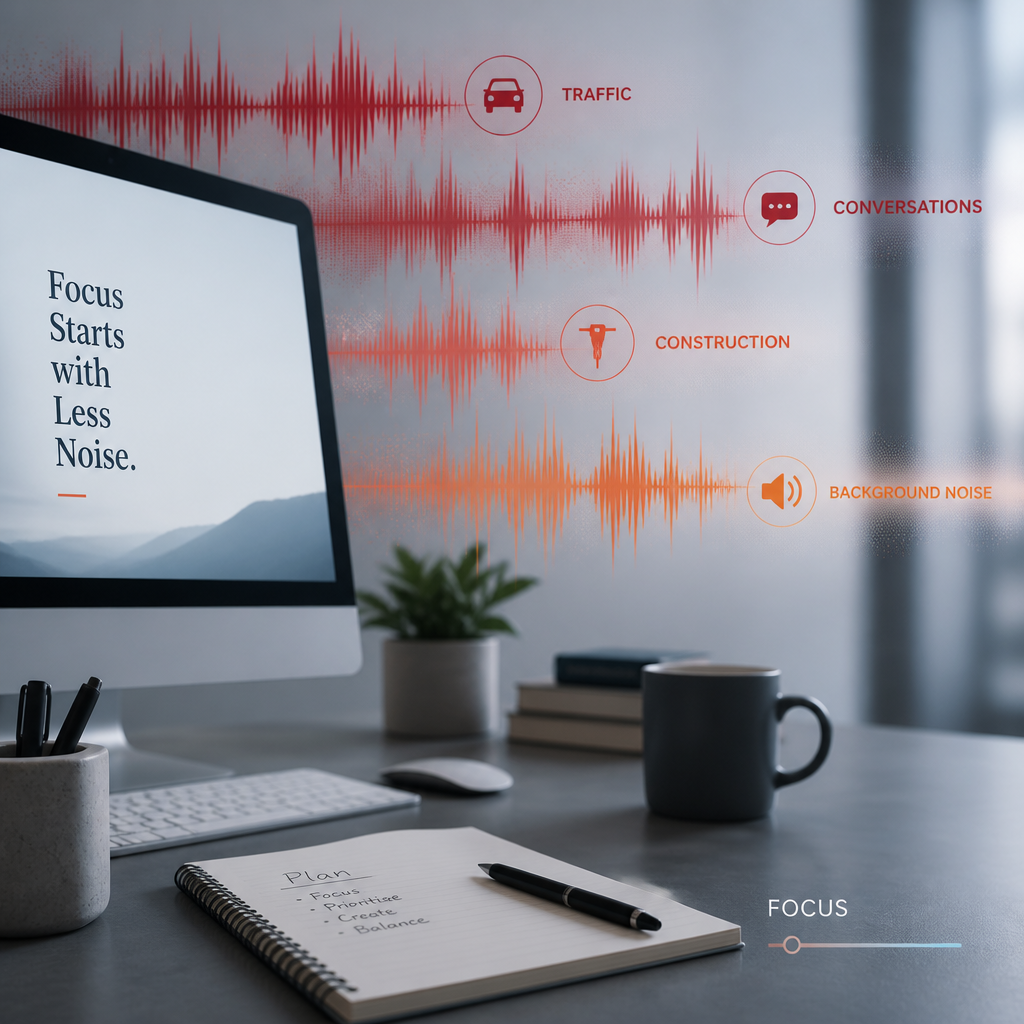
The brain does not passively ignore noise. The auditory cortex processes incoming sound automatically, regardless of whether you consciously want to listen. This is not a personal failing or lack of discipline. It is hardwired neurology. When your colleague takes a call two desks away, your brain begins decoding that speech pattern whether you like it or not, pulling working memory resources away from whatever you were doing.
The result is what cognitive scientists call cognitive load interference. Working memory, which is the mental workspace you use for reading, writing, calculating, and reasoning, is a finite resource. Noise forces it to share capacity with auditory processing. The more semantically rich the noise (speech, for example, is worse than a fan), the more working memory it consumes.
Not all tasks are equally vulnerable. Reading comprehension, written communication, mathematical reasoning, and any task requiring you to hold and manipulate information in your head are the most affected by ambient noise. Tasks that are highly procedural and repetitive show less impact.
In practice, this means a construction site manager reviewing safety compliance documents in a loud site office is operating at a measurable cognitive disadvantage compared to someone doing the same task in a quiet environment. The same applies to a software developer debugging code in a noisy open plan office or an accountant reviewing financial reports near a busy kitchen.
“Noise is a major occupational hazard, not just for hearing health, but for mental performance, decision quality, and long-term stress outcomes.” – Dr. Arline Bronzaft, environmental psychologist and noise pollution researcher, City University of New York
Pro tip: If you find yourself re-reading the same paragraph multiple times at work, the cause is more likely ambient noise than tiredness. Test this by working with proper ear protection for one hour and comparing your reading retention.
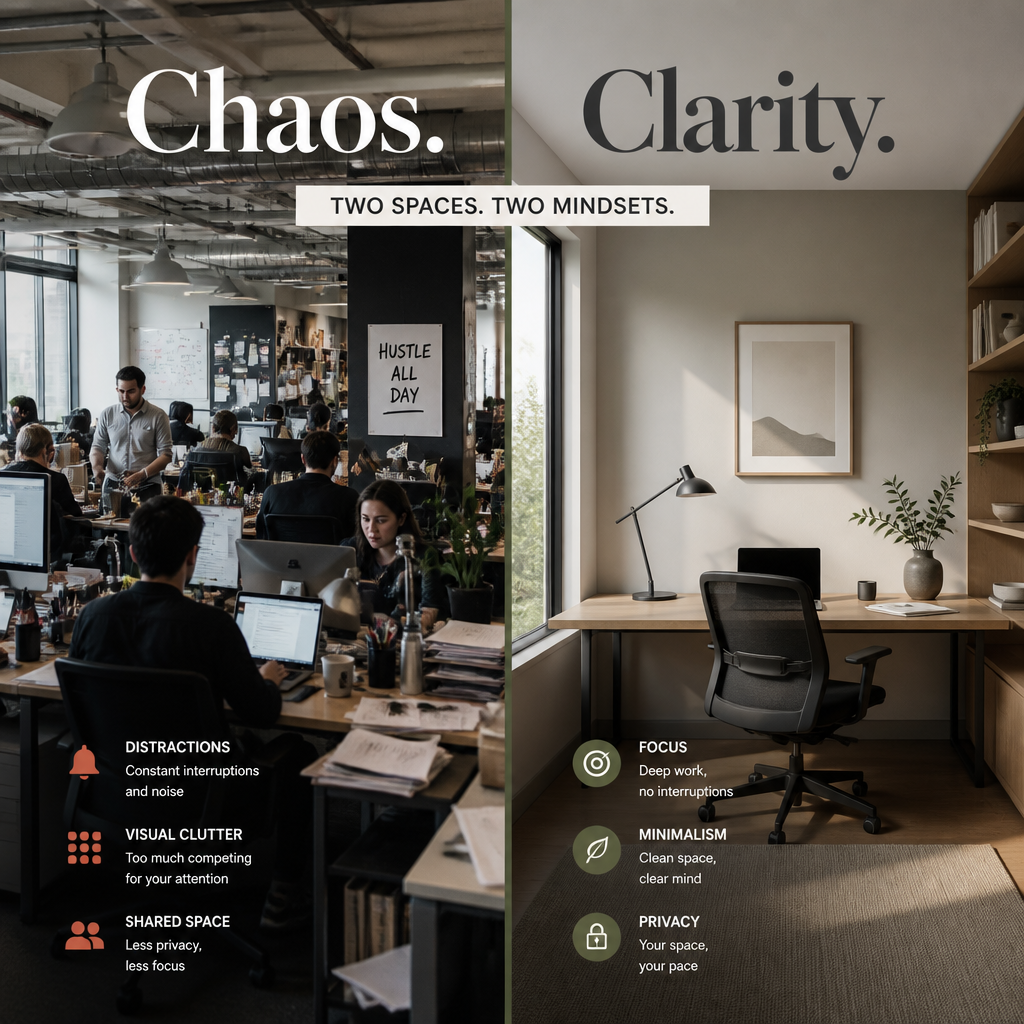
Open plan office noise has been studied extensively, and the findings are not kind to open-plan design advocates. A landmark study published in the Philosophical Transactions of the Royal Society B found that employees in open-plan offices had 73% more time in unproductive, distracted states compared to those in private offices. That is not a marginal difference. That is more than two-thirds of a working day compromised by environmental noise.
The irony is that open-plan offices were sold as collaboration-boosters. In practice, they often reduce meaningful collaboration while increasing low-quality, ambient distraction. Workers compensate by wearing headphones or finding quiet rooms, which negates the supposed collaborative benefit entirely.
Not all workplace noise carries the same cognitive cost. Research consistently shows that intelligible speech, meaning conversations you can partly understand, creates far more disruption than unintelligible noise at the same volume. The brain identifies familiar language patterns and tries to decode them, which is an involuntary process you cannot simply will yourself out of.
White noise machines and low-volume background music work partly because they mask intelligible speech, raising the threshold at which conversation becomes decodable. But this is a band-aid approach. The more effective solution is reducing the amount of noise that reaches your auditory system in the first place.
The data consistently shows that workers who actively manage their acoustic environment, through ear protection, acoustic panels, or designated quiet zones, report higher satisfaction, fewer errors, and better subjective concentration scores than those who simply adapt to the noise.
For professionals in construction, manufacturing, military operations, and heavy engineering, noise is not just a productivity issue. It crosses into occupational health and safety territory. Safe Work Australia sets the occupational exposure limit at 85dB averaged over an eight-hour day, and noise levels in these environments routinely exceed 90-100dB.
At those levels, the consequences split into two categories. First, progressive hearing damage from prolonged exposure. Second, acute cognitive impairment that creates immediate safety risks. A study from the National Institute for Occupational Safety and Health (NIOSH) found that high-noise environments correlate with increased incident rates, not only from mechanical hazards, but from errors in judgment and communication failures caused by noise-induced cognitive load.
When ambient noise makes verbal communication unreliable, workers make assumptions instead of confirming instructions. This is a well-documented precursor to workplace incidents. Ironically, many workers in loud environments avoid wearing hearing protection because they fear missing critical verbal cues from colleagues.
This is where the design of ear protection matters enormously. Protection that attenuates all sound equally, including speech, creates the very communication breakdown workers fear. Better-designed ear plugs that provide strong attenuation of harmful frequencies while preserving some speech intelligibility resolve this conflict. Fit quality is the critical variable here. Ear plugs that seal consistently and sit comfortably over full shifts are used consistently, and that consistent use is what actually provides protection.
Pro tip: If your team removes ear protection to communicate and then forgets to replace it, the problem is comfort and convenience, not discipline. A well-fitting reusable ear plug with a secure carry case is far more likely to stay in use throughout a shift than a disposable foam plug shoved in a pocket.
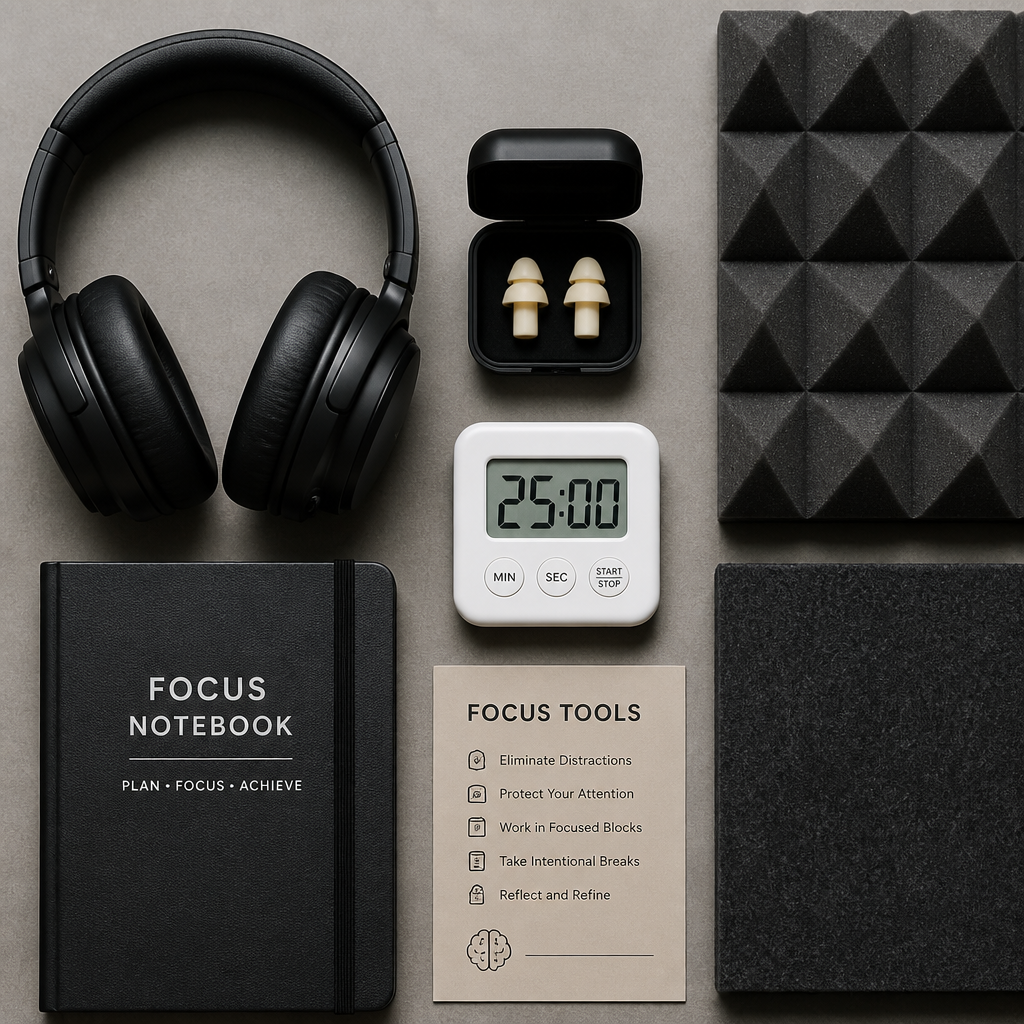
There are three realistic options for professionals seeking to reduce workplace noise through personal hearing protection: disposable foam ear plugs, over-ear noise-cancelling headphones, and reusable precision ear plugs. Each has a specific context where it performs best, and each has meaningful limitations.
Cheap, widely available, and theoretically rated to 30-33dB NRR. In practice, their real-world attenuation is often 10-15dB lower than the stated rating because users do not insert them correctly, and the foam degrades rapidly. A foam plug used for four hours has already compressed and is providing noticeably less protection than when it was first inserted. For occasional use, they are adequate. For consistent daily protection over a full shift, they are unreliable.
Effective for low-frequency continuous noise like HVAC hum or machinery vibration. Much less effective for sudden transient noise or the mid-frequency range where human speech sits. They are also impractical in industrial environments, where they present a catching hazard, and inappropriate in settings where situational awareness matters. Their real use case is the knowledge worker in an open office, and even there, they carry a social signal that can isolate the wearer from legitimate workplace communication.
This is the category where consistent, reliable attenuation lives for daily professional use. Metal-bodied ear plugs like those made by ATTENU8 deliver approximately 32dB noise reduction through a combination of a precision aluminium shell and soft memory foam tips available in XS, S, and M sizes. The multi-size tip system is not a marketing detail. It is the mechanism through which a proper acoustic seal is achieved. A tip that fits the ear canal correctly creates an even, stable seal that holds through movement, talking, and position changes.
The aluminium body also means the ear plug maintains its shape and does not compress or distort the way foam does, so attenuation performance is consistent across the entire wear period. For professionals who need to rely on their ear protection performing the same way at the end of a shift as at the start, this matters considerably. Rather than replacing the entire unit, only the foam tips need replacing every 6 to 8 weeks, which keeps long-term cost well below disposable alternatives used daily.
Choosing the right noise reduction approach depends on your environment, task type, and how long you need protection. The table below compares the three main options professionals actually use.
| Approach | Best Use Case | Key Limitations |
|---|---|---|
| Disposable foam ear plugs | Short-duration, occasional noise exposure. Suitable for infrequent travel or one-off loud events. | Real-world attenuation far below stated NRR. Inconsistent fit leads to unpredictable protection. Not cost-effective or hygienic for daily use. |
| Noise-cancelling headphones (e.g., Sony WH-1000XM5, Bose QC45) | Open-plan office work with continuous ambient hum. Effective for knowledge workers doing solo deep work at a desk. | Poor against transient noise and speech frequencies. Impractical in industrial environments. Expensive. Signals social unavailability, which can harm team communication. |
| Reusable precision ear plugs with memory foam tips (e.g., ATTENU8) | Daily professional use across office and industrial settings. Reliable for full-shift protection with consistent attenuation. Suitable for sleep, travel, and focused work. | Requires correct tip sizing for optimal seal. Not designed for environments requiring amplified situational awareness (tactical operations needing electronic hearing protection). |
Personal hearing protection is the most direct and controllable intervention, but it works best as part of a broader noise management approach. There are several complementary strategies that the data consistently shows have measurable impact on concentration and performance.
Hard surfaces reflect sound. Carpet, acoustic ceiling tiles, upholstered furniture, and fabric wall panels absorb it. The difference between a reverberant hard-floored open office and an acoustically treated one can be 5-10dB of ambient noise reduction, which translates to a meaningful improvement in intelligibility and concentration. This is an infrastructure investment, but it is one that pays dividends across an entire workforce simultaneously.
A common mistake is treating noise management as purely a physical problem. Behavioural and scheduling interventions are often more immediately actionable. Designating certain hours as low-noise periods, where phone calls are taken away from the main floor and conversations are kept brief, can reduce peak noise exposure during the hours when complex work is typically scheduled.
Similarly, assigning concentrated deep work tasks to the quieter parts of the day (early morning, post-lunch slump aside) and using collaborative, communication-heavy tasks for noisier periods is a simple scheduling approach that most teams can implement without any capital expenditure.
Sound masking is different from white noise. Purpose-built sound masking systems emit a carefully calibrated signal across a specific frequency range that makes human speech harder to intelligibly decode at a distance. Well-implemented systems can raise the effective speech privacy radius from a few metres to under one metre, dramatically reducing the cognitive tax of overheard conversations in open plan environments. They work best as a complement to, not a replacement for, individual hearing protection.
The combination of acoustic treatment, scheduling discipline, sound masking, and individual ear protection is the most effective approach. Each layer addresses a different aspect of the problem, and together they create a genuinely quieter cognitive environment.
It depends entirely on the task and the music. Research from Cambridge Sound Management and several academic studies shows that music with lyrics impairs reading comprehension and writing tasks because the brain attempts to process the words. Instrumental music at low volume has a more neutral effect. For most complex cognitive tasks, silence or a consistent low-frequency ambient sound outperforms music with lyrics. If you are using headphones primarily to block noise rather than to listen to music, you would get more consistent results from well-fitted ear plugs that achieve attenuation without the additional cognitive input of audio content.
Office ambient noise typically sits between 60-70dB in open-plan environments. A 32dB noise reduction brings that down to 30-38dB, which is approximately the level of a quiet library. That is more than sufficient for deep focus work. You do not need industrial-grade hearing protection for an office environment, but you do need ear plugs that actually seal correctly. The gap between a stated NRR and real-world performance is almost entirely determined by fit quality.
A well-maintained reusable ear plug with replaceable foam tips is significantly more hygienic in practice. Disposable foam plugs are often used for far longer than they should be, handled repeatedly throughout a day without cleaning, and stored loose in pockets where they collect debris. Reusable metal-bodied ear plugs can be wiped clean, and the foam tips that contact the ear canal are replaced on a regular schedule (every 6 to 8 weeks with products like ATTENU8), rather than accumulating days of wear on a single piece of uncleanable foam.
NRR (Noise Reduction Rating) is the US standard, measured in decibels under laboratory conditions. SNR (Single Number Rating) is the European equivalent. Both represent ideal laboratory performance. Real-world attenuation is typically 50-60% of the NRR when ear plugs are used without specific training and fitting. This is why the fit mechanism matters more than the headline number. An ear plug with a 32dB NRR that seals consistently will outperform a 33dB NRR product that fits poorly every single time.
Yes, and this is one of the least discussed consequences of chronic noise exposure at work. Even at levels well below those that cause hearing damage, persistent ambient noise above 55-65dB increases cortisol levels, elevates heart rate variability, and increases subjective fatigue over a full working day. The Cornell University study on office noise found that workers in noisy open offices showed elevated epinephrine levels and attempted fewer ergonomic adjustments to their workstations, suggesting both physiological stress and reduced motivation even when they reported feeling acclimatised to the noise. Chronic cognitive fatigue from noise is a real phenomenon that does not require measurable hearing loss to occur.
The right tip creates a gentle but complete seal without discomfort. If you can feel the tip pressing unevenly or it works itself out during normal jaw movement, it is either too large or seated incorrectly. If you can still clearly hear conversational speech from a few metres away, the tip is too small or the seal is incomplete. Products with multiple tip sizes, such as XS, S, and M options, allow you to find the size that creates a stable, even seal across both ear canals, which are often slightly different sizes in the same person. Start with the medium tip and adjust from there.
We would like to hear from you: what is the single biggest noise challenge affecting your concentration at work, and what have you tried so far to manage it?

