


 0

Shift workers and night-shift nurses face a sleep problem that most people never have to think about: the world does not quiet down just because your shift ended at 7am. Lawnmowers, delivery trucks, kids heading to school, and a partner going about their morning routine all conspire against the sleep you desperately need. Finding the right ear plugs for shift workers is not a luxury, it is a basic occupational health decision. This guide cuts through the noise, identifies what actually works for daytime sleep, and explains why your choice of ear plug matters far more than most people realise.
| Key Insight | Explanation |
|---|---|
| 32dB noise reduction is the benchmark to aim for | Daytime ambient noise is significantly louder than a quiet night. You need maximum attenuation, not mid-range protection, to compensate for traffic, voices, and household activity. |
| Fit matters more than foam density | An ear plug that does not seal the ear canal properly loses most of its rated attenuation. Three tip sizes (XS, S, M) allow a personalised seal regardless of ear canal shape. |
| Reusable metal-bodied plugs outlast disposable foam by months | Shift workers use ear plugs every single day. A durable aluminium-bodied plug with replaceable memory foam tips costs far less over time than daily disposables. |
| Memory foam tips conform to the ear canal for comfort during long sleep | Sleeping on your side for 7-8 hours with rigid ear plugs causes soreness. Soft memory foam tips compress, conform, and stay comfortable through a full rest period. |
| Daytime noise blocking requires blocking broadband sound, not just high frequencies | Street noise and household sounds span low and high frequencies. Foam-tipped plugs with high NRR ratings address the full spectrum more effectively than acoustic filters alone. |
| Replacing tips every 6-8 weeks keeps attenuation performance consistent | Memory foam degrades with use and body oils. Worn-out tips lose their ability to seal the canal, reducing noise blocking precisely when you need it most. |
| A dark, cool room combined with good ear protection dramatically reduces sleep onset time | Noise and light work against each other in daytime sleep. Addressing both simultaneously compounds the benefit far beyond either intervention alone. |
The human body is wired to be alert during daylight hours. Your circadian rhythm, driven by light exposure and social cues, actively works against sleep between roughly 7am and 10pm. This is not a discipline problem. It is biology. For night-shift nurses finishing a 12-hour overnight rotation, or for construction workers on rotating rosters, this biological resistance to daytime sleep is a genuine occupational hazard.
Sleep deprivation in shift workers is linked to impaired reaction time, reduced clinical decision-making ability, and a higher risk of errors on the job. The solution is not willpower. It is creating an environment that systematically removes the signals your brain uses to stay awake. Noise is one of the most disruptive of those signals, because unlike light, you cannot simply pull a curtain across it.
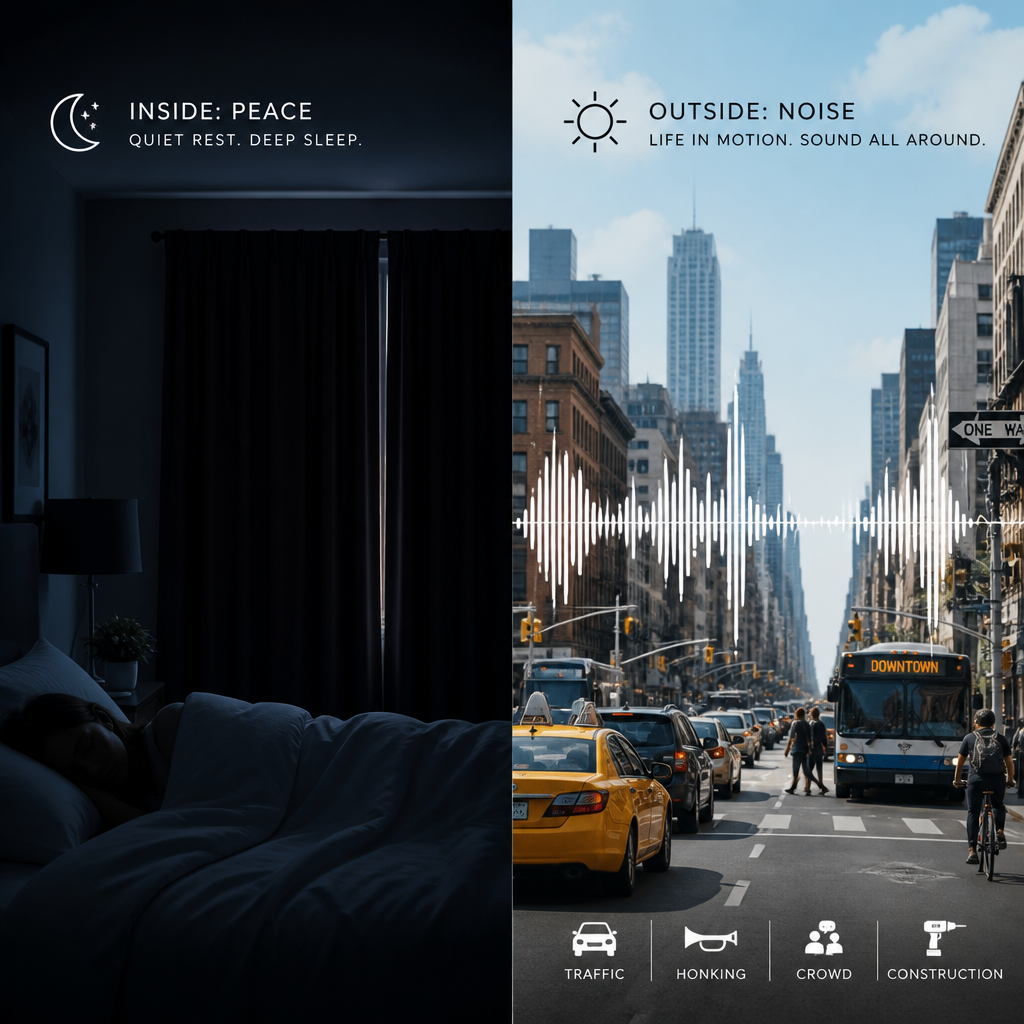
People who have never worked a night shift often underestimate how loud a residential neighbourhood is between 8am and 2pm. Garbage collection, postal deliveries, neighbour conversations, garden machinery, and traffic all peak during exactly the hours a shift worker needs to sleep. Apartment dwellers face the added burden of building noise: lifts, other residents, shared laundry facilities.
The problem is not a single loud event. It is the unpredictability of the noise. Research on sleep disruption consistently shows that it is intermittent, variable-loudness noise that causes the most arousals from sleep, not steady background sound. A truck engine idling outside is far less disruptive than a truck suddenly braking. This is precisely why passive noise blocking through high-NRR ear plugs is so effective for daytime sleep noise blocking: it compresses the dynamic range of external sound, reducing the spike that triggers waking.
Nurses on Night Shift Face a Specific Noise Profile
Night-shift nurses returning home often live in areas they cannot control: family homes with children, shared accommodation, or urban apartments. The sounds they encounter during their sleep window are intimate and unpredictable. A phone ringing in another room, a child coming home from school, a partner doing housework are sounds a well-fitted, high-attenuation ear plug can largely eliminate without requiring the wearer to negotiate their household’s behaviour.
The key is an ear plug that stays in position through hours of side-sleeping. Most disposable foam plugs work loose within an hour or two, particularly if the foam has been compressed and inserted multiple times. A well-constructed reusable plug with fresh memory foam tips holds its seal far more reliably.
Pro tip: If you share a bedroom with a partner who keeps day-time hours, agree on a “quiet window” of at least four consecutive hours and then use maximum-attenuation ear plugs to protect the remaining sleep time. You cannot negotiate away all household noise, but you can build a system around it.
Not all ear plugs are equal, and the marketing language around them is often imprecise. Here is what actually matters for a shift worker trying to sleep during the day.
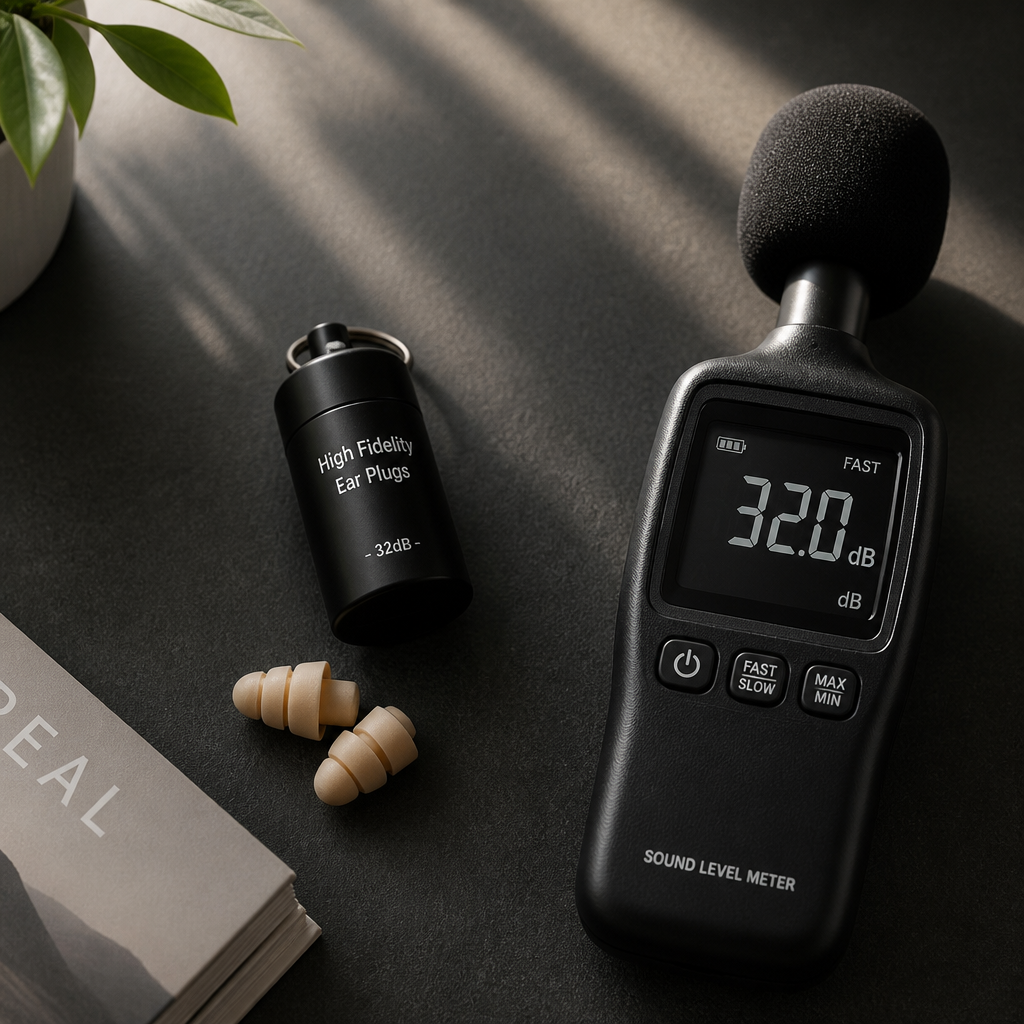
The Noise Reduction Rating (NRR) indicates how much sound attenuation a plug provides under controlled conditions. For daytime sleep, where ambient noise can regularly exceed 60-70dB, you want the highest NRR you can wear comfortably. An NRR of around 32dB is a strong target. At that level, the lawnmower outside your window drops from an intrusive roar to a background hum that your sleeping brain can largely ignore.
A nurse finishing a 12-hour shift needs to sleep for 7-8 hours. An ear plug that causes ear canal soreness after three hours is not a sleep aid, it is a guaranteed 3am wake-up. Soft memory foam tips address this directly. They compress on insertion and slowly expand to fill the canal without exerting sustained pressure against the canal wall. A concave aluminium body keeps the plug stable and prevents it from being pushed further into the ear as you shift sleeping position.
Side-sleeping, which is the most common position among adults, presses the outer ear against a pillow. This changes the geometry of the ear canal and can dislodge plugs with poor body design. Plugs with a low-profile, well-shaped body maintain their seal under pillow pressure. Plugs that protrude significantly from the ear do not.
The gap between the stated NRR and real-world performance almost always comes down to fit. A perfectly-rated plug inserted poorly provides almost no protection at all. Fit is the variable that matters most.
For someone who uses ear plugs once or twice a month, a box of disposable foam plugs is perfectly reasonable. For a shift worker using ear plugs six or seven days a week, the economics and the hygiene calculus shift completely.
A standard single-use foam ear plug is designed to be compressed, inserted once, and discarded. In practice, most people reuse them for several days because buying a fresh pair every morning is genuinely expensive over time. The problem is that repeatedly compressed and body-oil-saturated foam loses both its expansion properties and its sealing ability. You end up wearing a plug that feels like it is in, but is providing a fraction of its rated attenuation.
A reusable, premium ear plug with replaceable memory foam tips solves this directly. The structural body of the plug maintains its shape indefinitely. The tips are replaced every 6-8 weeks, which is the point at which foam degradation meaningfully affects performance. For a shift worker, this is a far more cost-effective and hygienically sound approach than a revolving supply of disposable plugs.
Pro tip: Keep two pairs of reusable ear plugs: one dedicated to sleep and one for on-the-job hearing protection if your workplace requires it. Mixing the two means your sleep plugs pick up industrial contaminants and your work plugs never get a full clean cycle. Separation is simple and worth it.
Ear plugs are the single most impactful intervention for how to sleep during the day, but they work best as part of a deliberate sleep environment. A few supporting habits significantly compound the benefit.
Light suppresses melatonin production, which is already compromised in shift workers whose schedules conflict with natural light-dark cycles. Blackout curtains are non-negotiable. A sleep mask adds a second layer of protection, particularly useful when travelling or sleeping in unfamiliar rooms. Do not rely on regular curtains. The light bleed around the edges of standard curtains is enough to suppress melatonin in sensitive individuals.
Core body temperature naturally drops when you fall asleep. Sleeping during summer afternoons in a warm room fights this process. Air conditioning or a fan set to a comfortable cool temperature accelerates sleep onset. A fan has the added benefit of generating consistent white noise, which helps mask the unpredictable external sounds that ear plugs do not fully eliminate.
The single most common cause of avoidable daytime sleep disruption for shift workers is the phone. Notifications, calls from people who forget you work nights, and the habit of checking the screen before sleep all fragment rest. Set a sleep schedule in your phone’s Do Not Disturb settings, communicate your sleep window clearly to family and close contacts, and charge the phone in another room if possible.
Eating a heavy meal immediately before sleep slows digestion and disrupts sleep quality. Caffeine consumed in the last four hours of a shift will still be active in your system when you try to sleep. Finish caffeine intake several hours before you need to be asleep, and aim for a lighter meal rather than a large one if you eat before bed.
There are three broad approaches shift workers take to managing sleep noise. Each has genuine trade-offs worth understanding before you commit to one.
| Approach | Strengths | Weaknesses for Shift Workers |
|---|---|---|
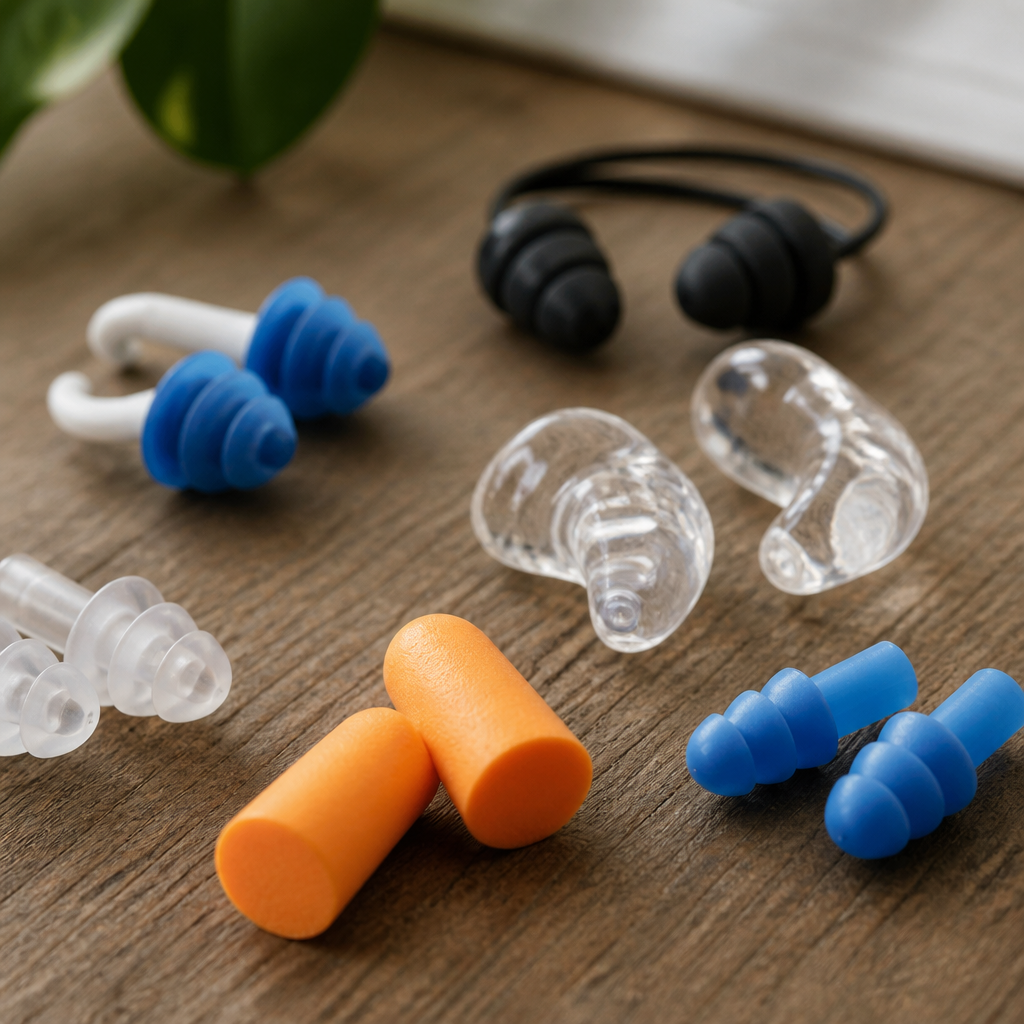
| Disposable single-use foam ear plugs | Cheap upfront, widely available, soft and comfortable initially, high NRR options exist | Degrade quickly with daily use, hygiene issues when reused, ongoing cost adds up, inconsistent fit across different brand shapes, environmentally wasteful |
| Reusable acoustic-filter ear plugs (silicone or rigid body, e.g. Loop, Flare Audio style) | Durable body, fashionable design, good for concert or social use where some sound pass-through is desired | Acoustic filters are designed to let some sound through, which is the opposite of what daytime sleepers need. NRR is typically lower than foam-tipped alternatives. Side-sleeping comfort varies. |
| Premium reusable metal-bodied ear plugs with replaceable memory foam tips (e.g. ATTENU8) | High NRR (around 32dB), durable aluminium body lasts indefinitely, memory foam tips replace every 6-8 weeks, three tip sizes for personalised fit, comfortable for long wear and side-sleeping | Higher initial cost than a box of disposables, requires remembering to replace tips on schedule |
For shift workers and night-shift nurses who need maximum noise blocking for sustained daily sleep, the third approach consistently outperforms the others. The acoustic-filter style plugs designed for social settings are engineered around a different use case entirely. Comparing them directly is like comparing a travel pillow to a proper mattress: both are pillows in a technical sense, but they are not solving the same problem.
Yes, provided you maintain basic hygiene. Reusable plugs should be cleaned regularly, and memory foam tips should be replaced every 6-8 weeks. Disposable plugs should not be reused for multiple days as they accumulate bacteria and lose their sealing ability. The ear canal is self-cleaning, but trapping debris against it with a dirty plug is a genuine hygiene issue.
For daytime sleep in a typical residential environment, aim for an NRR of 30dB or above. Around 32dB is a strong target that handles most household and street noise without requiring an uncomfortable, deeply-inserted plug. Going significantly higher than 32dB is rarely necessary unless you live directly adjacent to a construction site or major road.
Yes, but plug design matters. Plugs that protrude significantly from the ear canal get pushed and dislodged when your ear presses against a pillow. Low-profile plugs with a concave or flush body shape hold their position through side-sleeping far more reliably. Memory foam tips help here too, as their slow-recovery expansion maintains the canal seal even when the outer body of the plug shifts slightly.
Replace them every 6-8 weeks if you use them daily. Visual cues include tips that no longer spring back to their full shape after compression, discolouration from body oils, or a noticeable reduction in how well they seem to block noise. Do not wait until the foam feels hard or crumbly. Declining attenuation happens well before that point.
Not necessarily. Industrial hearing protection, such as earmuffs or deeply-inserted plugs, often has a higher NRR but is not designed for comfort over 7-8 hours of sleep. The better question is whether the plug provides enough attenuation for your specific noise environment and whether you can comfortably wear it for a full sleep period. A well-fitted premium sleep-focused plug at 32dB is almost always the right balance for daytime residential sleep.
White noise and ear plugs solve different parts of the problem. White noise masks unpredictable ambient sound by providing a steady, predictable background. Ear plugs reduce the overall volume of sound reaching the ear. Used together, they work well. Used alone, white noise is significantly less effective than a properly sealed, high-NRR ear plug because it cannot stop a sudden loud sound from spiking above the white noise floor.
Ear plugs for loud work environments are optimised for maximum attenuation and durability under repeated industrial exposure. They are not optimised for comfort over 8 hours of lying down. Sleep-focused ear plugs, particularly those with soft memory foam tips and low-profile bodies, prioritise sustained comfort, side-sleeping suitability, and reliable seal over extended rest periods. ATTENU8’s metal-bodied design bridges both worlds: it provides the high attenuation of a work-grade plug in a body designed for comfortable, all-night (or all-day) sleep use.
Have you found a sleep routine that works around your shift schedule? Share what made the biggest difference for you in the comments.
Roughly 20% of the workforce in industrialised countries works rotating or permanent night shifts, and the single biggest complaint is not fatigue during the shift itself. It is the inability to sleep when the rest of the world is wide awake and making noise. Lawnmowers, traffic, neighbours, delivery drivers, barking dogs – daytime sleep is a war against your environment. Ear plugs for shift workers are not a nice-to-have; they are a core tool for protecting the only recovery window you have. This guide covers exactly how to use them effectively, what to look for, and why getting this wrong costs you more than a bad nap.
| Key Insight | Explanation |
|---|---|
| 32dB attenuation is the practical minimum for daytime sleep | Daytime ambient noise routinely hits 55-70dB outdoors. You need to drop that to below 40dB to reach the threshold where sleep onset becomes possible. Low-rated plugs simply do not get you there. |
| Fit matters more than the NRR number on the box | A plug rated 33dB worn incorrectly delivers closer to 15dB of real-world attenuation. Consistent fit, achieved through proper insertion and the right tip size, is where the actual protection comes from. |
| Disposable foam plugs degrade after a single use | The foam compresses permanently over repeated nights, reducing noise reduction noticeably by day three or four. Shift workers using the same pair all week are sleeping on compromised protection without realising it. |
| Reusable metal-bodied plugs outlast disposables by months | Products like ATTENU8’s aluminium-bodied plugs require only foam tip replacement every 6-8 weeks. The structural attenuation performance stays consistent across that entire period. |
| Daytime noise is spectrally different from night noise | Traffic and construction peak in mid frequencies (500Hz-2kHz), which is exactly where human hearing is most sensitive. Ear plugs with good mid-frequency attenuation are specifically valuable for day sleepers. |
| Three tip sizes dramatically change comfort across a full sleep cycle | Ears that feel fine at insertion often become sore after two or three hours if the tip size is wrong. XS, S, and M options let each individual find the size that stays comfortable through a full 7-8 hour sleep. |
| Side-sleeping puts lateral pressure on the plug body | Hard plastic bodies can cause pain and early removal during the night. A low-profile metal body with a concave design reduces the contact surface and makes side-sleeping genuinely sustainable. |
The circadian rhythm is not a polite suggestion. Your body runs on a deeply wired biological clock that treats daylight as a wake signal and darkness as a sleep signal. When you are a night shift worker, you are asking your brain to override millions of years of evolutionary programming every single day.
Noise compounds the problem directly. Research published through the National Institutes of Health shows that even low-level noise – sounds below the threshold of conscious awakening – increases cortisol production and fragments sleep architecture. You do not need to be woken up fully for noise to devastate your rest. Micro-arousals triggered by irregular sounds (a truck, a door, a conversation outside) pull you out of slow-wave and REM sleep without you ever registering it consciously.
The result is a shift worker who sleeps seven hours but recovers as if they slept four. Daytime sleep noise is not just annoying. It is medically consequential.
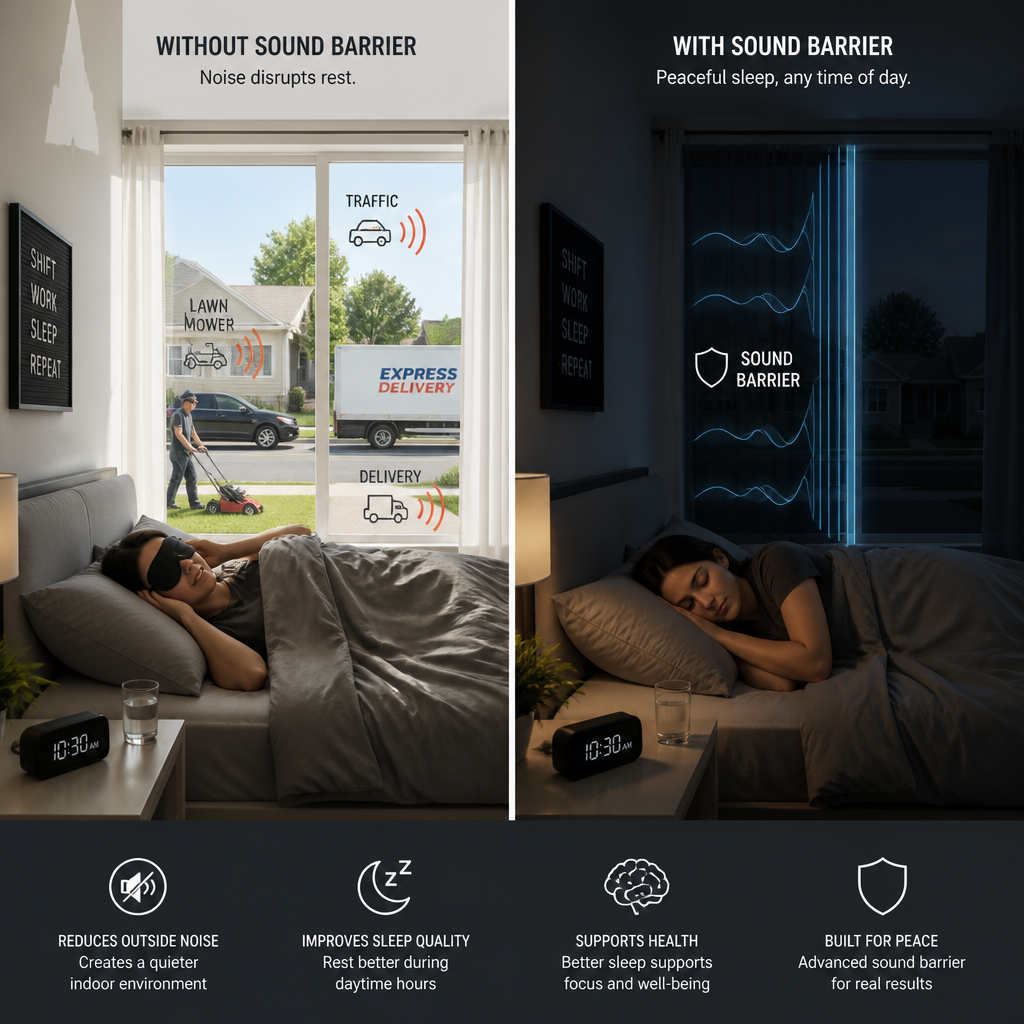
The mechanism is straightforward. Sound waves enter the ear canal, trigger the auditory processing system, and even during sleep, the brain continues to evaluate those sounds for threat relevance. This is a survival function. It kept your ancestors alive. For a nurse trying to sleep at 10am on a Tuesday while a neighbour uses a leaf blower, it is a liability.
Irregular, unpredictable sounds cause far more sleep disruption than steady background noise. A constantly running fan is easy for the brain to habituate to. A dog that barks once every eight minutes is not. The brain keeps processing it as a potential signal.
Construction noise, traffic surges, voices, and phone notifications are all high in irregularity. These are precisely the sounds most common during daytime hours in residential areas, and they are exactly what shift workers face every morning when they try to sleep after a night shift.
Sleep deprivation from noise does not hit physical performance first. It hits cognitive performance. Reaction time, decision-making accuracy, and emotional regulation all degrade before gross motor function does. For shift workers in healthcare, manufacturing, transport, or security, that is not an abstract concern. It is a direct occupational safety issue.
A study from Harvard Medical School’s Division of Sleep Medicine found that workers with chronic sleep disruption showed cognitive impairment equivalent to being legally drunk after just 17 hours of wakefulness. Shift workers regularly operate well past that threshold.
“Sleep disruption from environmental noise is not a comfort issue. It is a public health issue. The downstream effects on metabolic, cardiovascular, and cognitive health are well-documented and dose-dependent.” – Dr. Charles Czeisler, Harvard Medical School Division of Sleep Medicine
The market for ear protection is large, but most of it is designed for industrial hearing conservation during active work hours, not for sleep. The requirements are genuinely different, and conflating the two leads to poor choices.
The Noise Reduction Rating (NRR) system in the US and the Single Number Rating (SNR) used in Europe both measure attenuation across frequencies. For daytime sleep in a typical residential environment, you need a minimum of 30dB attenuation to meaningfully reduce the acoustic load on your auditory system. 32dB is the practical target that covers most real-world daytime noise sources.
Anything rated below 28dB is not adequate for shift workers in urban or suburban environments. Products marketed primarily at concerts or light office noise will not perform here.
Industrial ear plugs are designed to stay in an ear canal during physical movement and variable temperatures. Sleep ear plugs need to stay in during lateral pressure from a pillow. These are different engineering problems.
A concave aluminium body, like the design used by ATTENU8, sits lower in the ear than a protruding foam plug, which means there is less leverage for a pillow to push against. In practice, this allows side-sleepers to maintain a consistent seal throughout the night without repositioning.
Hard plastic bodies create a pressure point that becomes painful after 2-3 hours. This is the most common complaint among shift workers who try standard foam plugs and give up. The plug is uncomfortable, they remove it at 3am, and the noise wakes them at 5am. The solution is not to endure discomfort. It is to choose a plug designed for extended wear.
Human ear canal dimensions vary significantly. A plug that fits one person perfectly creates no seal in another person’s ear, delivering effectively zero noise reduction regardless of the product’s rated NRR. Multiple tip size options are not a premium feature. They are a basic functional requirement for any product claiming to work for sleep.
ATTENU8 includes XS, S, and M memory foam tips with each pair, which covers the vast majority of adult ear canal sizes. The memory foam material conforms to individual canal geometry, which improves both the acoustic seal and long-term comfort compared to rigid tips.
Pro tip: If you wake up with your ear plugs on the pillow rather than in your ears, the tip size is almost certainly wrong. A properly fitted plug stays in place throughout a normal sleep cycle without adhesive or retention straps.
There are three main categories of ear plug that shift workers consider. Each has genuine trade-offs worth understanding before committing to a routine.
| Type | Real-World Performance for Daytime Sleep | Practical Drawbacks |
|---|---|---|
| Disposable foam plugs (e.g., 3M, Howard Leight) | Good NRR on first use (up to 33dB). Widely available, very low per-unit cost. Soft enough for initial comfort. | Foam compresses and loses effectiveness after 2-3 uses. Daily replacement adds up to significant cost over months. No size options. Generates considerable single-use plastic waste. |
| Acoustic filter plugs (e.g., Loop, Flare Audio) | Designed for concert-level noise reduction, typically 18-27dB. Good for reducing overall volume without full blockage. Comfortable for short periods. | Attenuation levels are too low for daytime sleep in noisy residential areas. Designed to preserve sound quality, not maximise blockage. Not purpose-built for extended sleep wear. |
| Premium reusable metal-bodied plugs (ATTENU8) | Consistent 32dB attenuation across the product lifespan. Aluminium body with concave profile designed for side-sleeping. Three memory foam tip sizes. Tips replaced every 6-8 weeks, body lasts indefinitely. | Higher upfront cost than disposables. Requires tip replacement on a schedule. Not suitable for use during active work in loud industrial environments (designed for sleep and travel use). |
The honest comparison here is not about which product has the highest rated NRR on a spec sheet. It is about which product delivers consistent, comfortable attenuation night after night for someone sleeping on a non-standard schedule. Disposables fail at consistency. Acoustic filter plugs fail at absolute attenuation. Reusable premium plugs fail only at upfront cost, which amortises quickly over weeks of daily use.
Ear plugs are a necessary component of a daytime sleep setup, but they work best as part of a layered approach. Treating them as the only intervention is like installing a deadbolt but leaving the window open.
Light is the primary circadian disruptor, and noise is the primary sleep-architecture disruptor. Both need to be addressed, but the order of priority depends on your specific situation. If your room is already reasonably dark and you are still sleeping poorly, noise is almost certainly the remaining variable. If you have never properly blackouted your room, start there and add ear plugs simultaneously.
Blackout curtains that also have sound-dampening properties (heavy lined curtains rather than thin blackout fabric) address both problems partially. They are not a substitute for ear plugs, but they reduce the workload on your acoustic protection.
White noise machines and fans are sometimes recommended as alternatives to ear plugs. The mechanism is different and the outcomes are different. Masking adds a steady-state sound to raise the ambient noise floor, making irregular spikes less perceptually prominent. Blocking physically prevents sound energy from reaching the ear canal.
In practice, masking alone is insufficient for urban daytime environments because the noise spikes (trucks, construction, voices) are too large in amplitude. Masking plus blocking together outperforms either approach alone. A white noise machine running at moderate volume combined with 32dB ear plugs creates an acoustic environment genuinely competitive with a quiet nighttime bedroom.
Pro tip: Set your white noise machine to a volume where you can just barely hear it with your ear plugs inserted. That is the correct calibration point. Louder than that means the machine itself becomes part of the noise problem.
No ear plug eliminates all noise. A physical knock on the door or a smoke alarm will still penetrate. More practically, housemates, partners, and family members making normal household noise are a social problem as much as an acoustic one. A clearly communicated sleep schedule, door signage, and phone settings (such as a custom silent mode from 9am to 5pm) address the variable that ear plugs cannot.
The research on shift worker health is extensive and consistent: sleep quality, not just quantity, determines health outcomes. You can sleep eight hours in a noisy, bright room and recover less than you would from six hours of deep, uninterrupted sleep in a controlled environment.
One of the most counterproductive things shift workers do is eat a full meal immediately after arriving home. Digestion raises core body temperature, which directly inhibits sleep onset. The same applies to vigorous exercise. Light stretching, a low-carbohydrate snack, and a brief wind-down period of 20-30 minutes before getting into bed improve sleep onset speed significantly.
Caffeine half-life is approximately five to six hours. A coffee consumed at 4am is still 50% active in your system at 9-10am when you are trying to sleep. Shift workers who drink coffee throughout the night should stop at least five hours before their planned sleep time.
The biggest mistake shift workers make on their days off is reverting to a conventional sleep schedule. This creates a social jet lag cycle where the body is constantly switching between two incompatible rhythms. Sleeping four hours earlier than your shift schedule on a day off is more damaging than it feels in the moment. Maintaining a consistent anchor time for sleep, even if shifted by only one or two hours, produces better long-term outcomes than full reversal on rest days.
The data consistently shows that rotating shift workers who maintain the most consistent sleep timing across work and non-work days have lower rates of metabolic syndrome, cardiovascular disease, and cognitive decline than those who swing widely between schedules.
Core body temperature needs to drop by approximately 1 to 2 degrees Celsius for sleep onset to occur. Sleeping in a room that is too warm delays this process. The recommended sleep room temperature for most adults is between 16 and 19 degrees Celsius (60 to 67 degrees Fahrenheit). Shift workers sleeping in warm afternoon conditions should use air conditioning or a fan directed away from the body to achieve this ambient temperature.
Hydration matters because mild dehydration increases heart rate and cortisol, both of which impair deep sleep. Drinking 400-500ml of water before sleeping and keeping water available for any mid-sleep wake is a simple intervention that many shift workers overlook.
Yes, provided you maintain basic ear hygiene and replace foam tips on a regular schedule. The risk associated with daily ear plug use comes primarily from reusing foam tips past their effective lifespan, which can harbour bacteria. ATTENU8’s design separates the durable aluminium body from the replaceable foam tips, with tip replacement recommended every 6-8 weeks. This structure makes daily use safe and practical without accumulating earwax buildup or hygiene concerns associated with standard reusable plugs.
For most suburban environments, an NRR of 28-32dB is the target range. Urban environments with regular traffic or construction noise warrant the full 32dB. The key point is that a rated NRR assumes correct insertion. Real-world attenuation is typically 30-50% lower than the rated value if fit is poor. This is why tip size selection and correct insertion technique matter as much as the rating itself.
Yes, with conditions. A standard smartphone alarm at maximum volume generates roughly 75-85dB. After 32dB of attenuation, you would still hear approximately 43-53dB, which is clearly audible. The practical concern is for people who use very quiet alarms or vibration-only alerts. Using a smartwatch with wrist vibration as a backup alongside your standard alarm is a reliable system for shift workers wearing high-attenuation ear plugs.
Loop and Flare Audio products are primarily designed for noise reduction during waking activities, concerts, and social situations where you want to reduce volume without eliminating sound clarity. Their attenuation ratings typically fall in the 18-27dB range. ATTENU8 targets 32dB specifically for sleep, travel, and high-noise environments where maximum blockage is the goal. The aluminium body and concave profile are designed for side-sleeping comfort over 7-8 hour periods, which is not a design priority for lifestyle noise-filter products.
The aluminium body is designed to last indefinitely with normal use. The soft memory foam tips are the only consumable component, requiring replacement approximately every 6-8 weeks depending on frequency of use and individual earwax levels. Three tip sizes (XS, S, M) are included with each pair. Over a one-year period, the total cost of ownership for a reusable pair is substantially lower than purchasing disposable foam plugs daily, even before accounting for the consistency advantage.
This is a real concern for many shift workers, particularly parents or people with dependents. High-attenuation ear plugs do reduce ambient sound substantially, but they do not eliminate all sound. Loud alarms, crying, or a knock at the door will still be audible at 32dB attenuation. For additional reassurance, using a baby monitor or home alert system with visual indicators alongside ear plugs gives you acoustic protection without removing your ability to respond to genuine emergencies.
If you are a shift worker with a specific routine that has helped you get better daytime sleep, share what has worked for you in the comments below. Real-world experience from people living this schedule is more useful than any generalised advice.
We would love your feedback and any insights you would share with others. What perspective would you add?

