


 0
0

If you fly regularly, you already know that aircraft cabin noise is not just annoying, it is genuinely damaging over time. Ear plugs for travel are one of the most underrated items in any frequent flyer’s kit, yet most people still grab a crumpled foam pair from the flight attendant and wonder why they wake up with sore ear canals and a ringing head. This guide cuts through the noise, literally, to explain what actually matters when choosing ear plugs for flights, why the standard disposable option falls short, and what a premium reusable pair built for comfort can do for your sleep, your hearing, and your overall travel experience.
| Key Insight | Explanation |
|---|---|
| Cabin noise peaks at takeoff and landing | Sound levels inside a cabin can reach up to 105 dB at takeoff and landing, dropping to around 85 dB during cruising. Both levels are at or above the threshold where prolonged exposure risks hearing damage. |
| Real-world noise reduction is lower than the label | In practice, ear plugs deliver roughly 50 to 75 percent of their rated NRR or SNR figure. A pair rated at 32 dB will realistically deliver 16 to 24 dB of reduction, which is still significant but not what the box implies. |
| Fit matters more than NRR rating | An ear plug that fits poorly will leak sound no matter how high its rated figure. Multiple tip sizes, like XS, S, and M foam tips, make a meaningful difference in achieving a proper seal. |
| Ear plugs help with pressure pain, not just noise | Properly inserted ear plugs slow the rate of pressure change in the ear canal, giving the Eustachian tube more time to equalize. This is why many travelers report less ear pain during descent when wearing plugs. |
| Disposable foam is wasteful and inconsistent | Cheap foam plugs are single-use and degrade quickly with body heat and moisture. Reusable metal-bodied plugs with replaceable foam tips maintain consistent performance across hundreds of flights. |
| Side sleepers need low-profile bodies | Bulky ear plugs push against the seat headrest or cabin pillow and create pressure pain on the outer ear. A compact, concave body design stays flush with the ear and does not dig in when you tilt your head. |
| Premium reusable plugs cost less per use over time | When you replace only the foam tips every 6 to 8 weeks rather than the entire device, the per-flight cost drops well below that of disposable alternatives, even budget ones bought in bulk. |
Most travelers treat in-flight noise as background ambience. It is not. Sound levels inside a standard aircraft cabin can reach up to 105 decibels during takeoff and landing, and settle at roughly 85 decibels during cruise altitude. Eighty-five decibels is the precise threshold at which extended exposure begins to carry a real risk of hearing damage, and it is also the level at which OSHA guidelines recommend hearing protection for workers exposed for eight hours or more.
A long-haul flight can easily exceed that eight-hour window. Add multiple flights per week for a frequent business traveler and the cumulative exposure becomes significant. This is not a theoretical risk dressed up for marketing purposes. It is the reason flight crew members are considered an occupational group with above-average rates of noise-induced hearing loss.
Beyond the pure decibel count, there is the fatigue factor. Continuous low-frequency rumble from engines forces your brain to work harder to filter and process sound, even when you are not consciously listening. That is why a long flight without ear protection leaves many people feeling drained in a way that goes beyond jet lag. Good ear plugs for travel do not just protect your hearing, they reduce cognitive load and make rest genuinely possible.
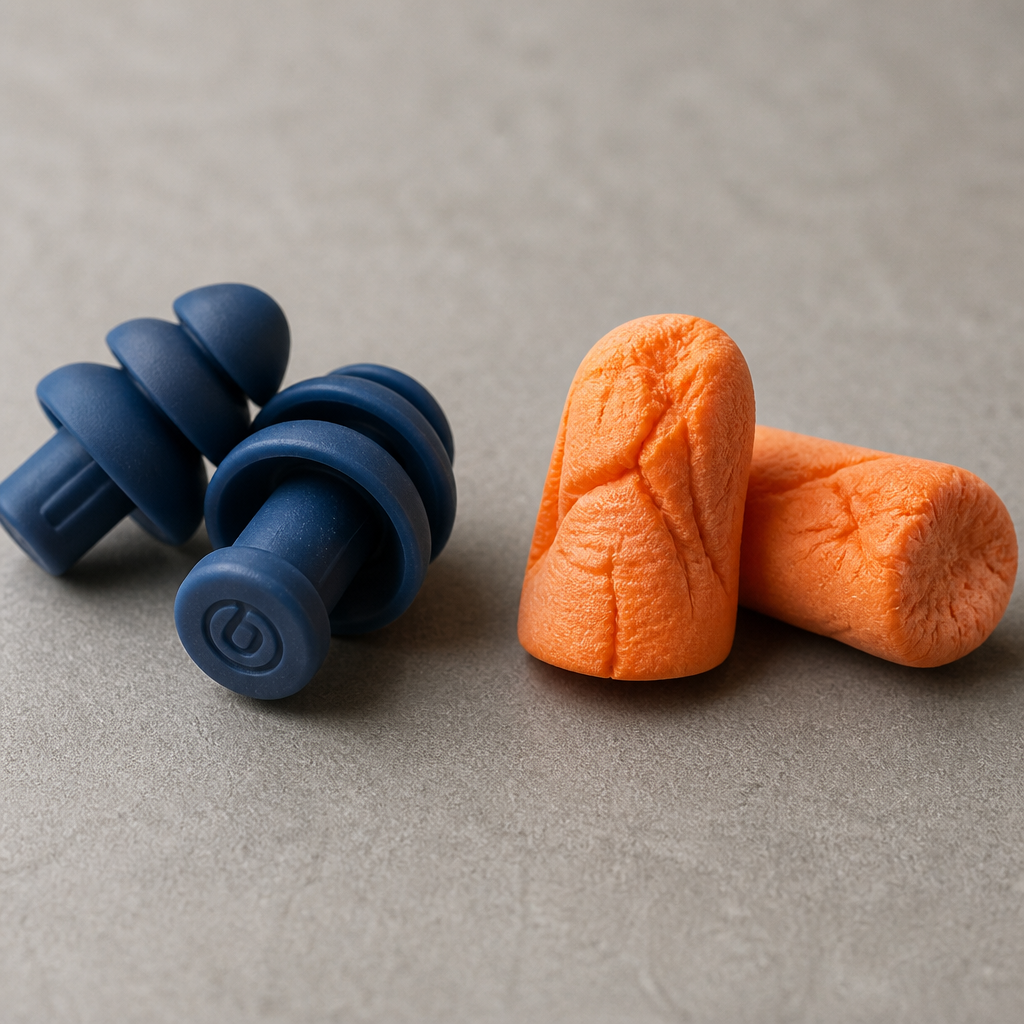
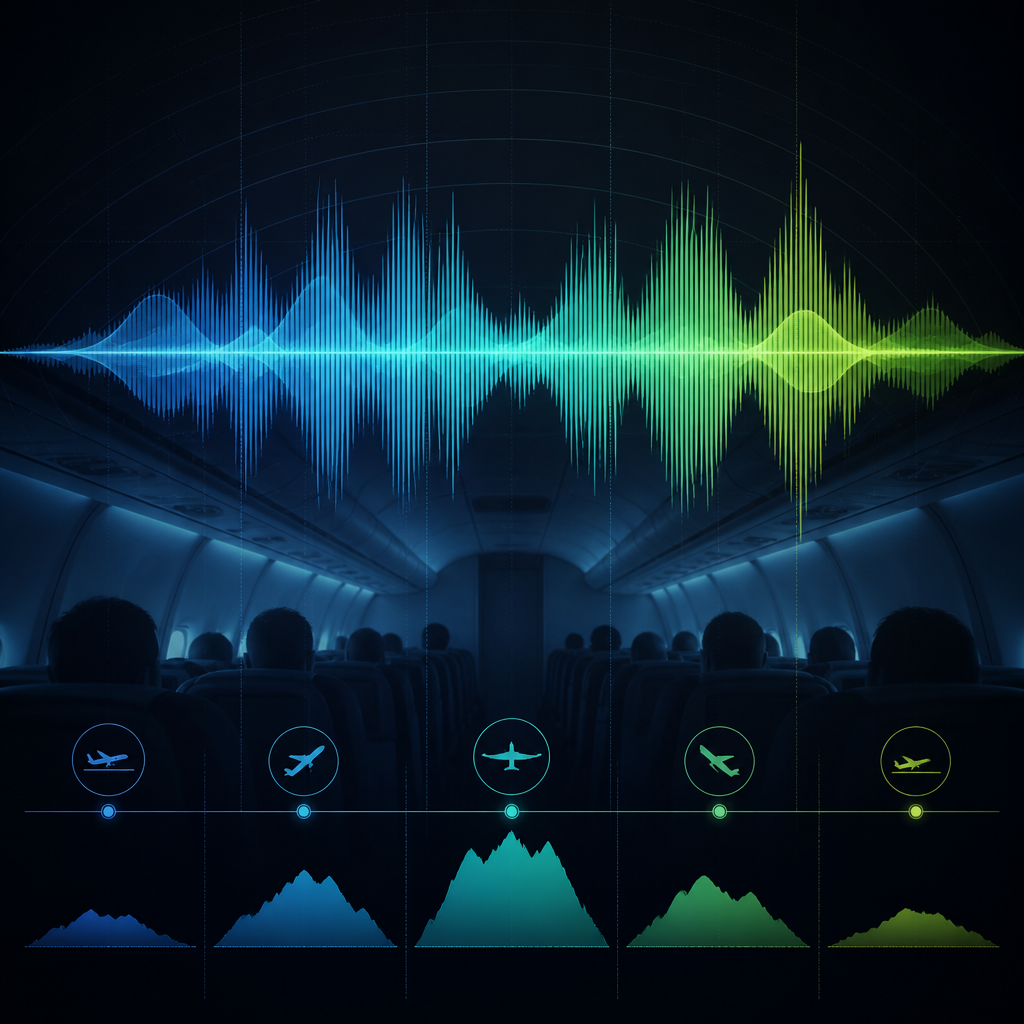
Not all ear plugs are designed with travel in mind. A pair optimized for a shooting range or a factory floor has very different engineering priorities from one designed to get you through a 14-hour flight. Here is what actually separates the useful from the mediocre when you are 35,000 feet in the air.
The NRR (Noise Reduction Rating) used in the United States and the SNR (Single Number Rating) used in Europe are both useful reference points, but treat them as relative comparisons rather than absolute guarantees. Real-world reduction is typically 50 to 75 percent of the rated value because lab conditions assume a perfect fit that most users never achieve. A pair rated at 32 dB NRR will realistically deliver 16 to 24 dB of effective reduction. That is still enough to bring peak cabin noise from 105 dB down to a manageable 80 to 90 dB range.
Foam earplugs typically achieve NRR ratings of 30 to 33 dB, while silicone alternatives usually fall in the 20 to 26 dB range. The key differentiator is not material alone but how well the design ensures a consistent seal in the specific geometry of your ear canal.
A common mistake is grabbing a one-size product and assuming it will work. Ear canals vary considerably between individuals, and an oversized tip creates discomfort while an undersized one creates leaks. Products that include multiple tip sizes, such as XS, S, and M soft memory foam options, allow you to match the fit to your anatomy rather than stretching or compressing the plug to compensate.
Pro tip: Always test your fit at home before a trip, not in your seat mid-boarding. Insert both plugs, snap your fingers next to each ear, and check that the sound is equally muffled on both sides. Uneven attenuation almost always means one plug is not seated correctly.
This is where travel-specific design separates itself from general-purpose hearing protection. Trying to sleep against a headrest or a window with a plug that protrudes several millimetres from your ear creates constant pressure on the outer ear, making sustained wear painful. A low-profile, concave body that sits flush with the ear canal opening eliminates that problem and makes overnight flights genuinely restful.
The market for ear plugs for flying broadly falls into three categories, each with a distinct set of trade-offs. The right choice depends on how often you fly, how long your typical routes are, and what you most need from the product.
| Type | Best For | Key Trade-offs |
|---|---|---|
| Disposable foam plugs (e.g., 3M, Flents) | Occasional travelers, short domestic routes, emergency backup | Cheapest upfront. NRR up to 33 dB. Single-use, environmentally wasteful, inconsistent fit, degrades with body heat and moisture during a long flight. Harder to use correctly, need to be rolled tight and held in place while expanding. |
| Filtered silicone plugs (e.g., Alpine FlyFit, Loop Quiet 2) | Travelers who need some ambient awareness, moderate noise reduction | Reusable. Typically 17 to 24 dB SNR. Pressure-regulating filter variants slow ear canal pressure change during altitude changes. Lower overall attenuation than foam. Silicone can cause irritation for some users on very long flights. |
| Premium metal-bodied plugs with memory foam tips (e.g., ATTENU8) | Frequent flyers, light sleepers, long-haul travelers, noise-sensitive individuals | Highest durability. Approximately 32 dB noise reduction with soft memory foam tips. Concave aluminium body sits flush for side-sleeping comfort. Multiple tip sizes (XS, S, M) for a precise seal. Only the foam tips need replacing every 6 to 8 weeks, not the entire device. |
The filtered silicone category is genuinely useful for travelers who need to hear announcements or conversations during a flight but want to take the edge off engine noise. The trade-off is a measurably lower noise reduction figure, which makes them a poor choice for anyone trying to sleep through a full overnight route.
For frequent flyers prioritising sleep quality and long-term hearing health, the premium reusable category offers the best overall value proposition once you account for the cost of replacing disposable plugs across dozens of trips per year.
The pair of ear plugs you bring on every trip should be chosen with the same care as your travel pillow or noise-cancelling headphones. Poor fit means poor protection, and poor protection accumulates into real hearing damage over years of regular flying.
Ear pain during flights is caused by the change in cabin pressure that occurs during takeoff and, more noticeably, during descent. As the aircraft descends and cabin pressure increases, a pressure difference builds between the air in your middle ear and the environment outside your eardrum. For most people, the Eustachian tube handles this automatically. For others, particularly those with any degree of congestion, the tube does not open fast enough and the result is sharp, throbbing pain.
Standard ear plugs help by slowing the rate at which pressure changes reach the ear canal, giving the Eustachian tube more time to equalize. Research published in The Laryngoscope found that travelers who used earplugs during flights experienced significantly less ear pain than those who did not. This is a secondary benefit that is rarely highlighted in marketing but matters enormously to anyone who has ever gripped their armrests during a rapid descent.
Pro tip: Insert your ear plugs before the cabin doors close, not just before landing. Pressure changes begin as soon as the aircraft climbs through the first few thousand feet, and starting with the plugs already seated means your Eustachian tube gets the full benefit of the slowed pressure gradient throughout the ascent.
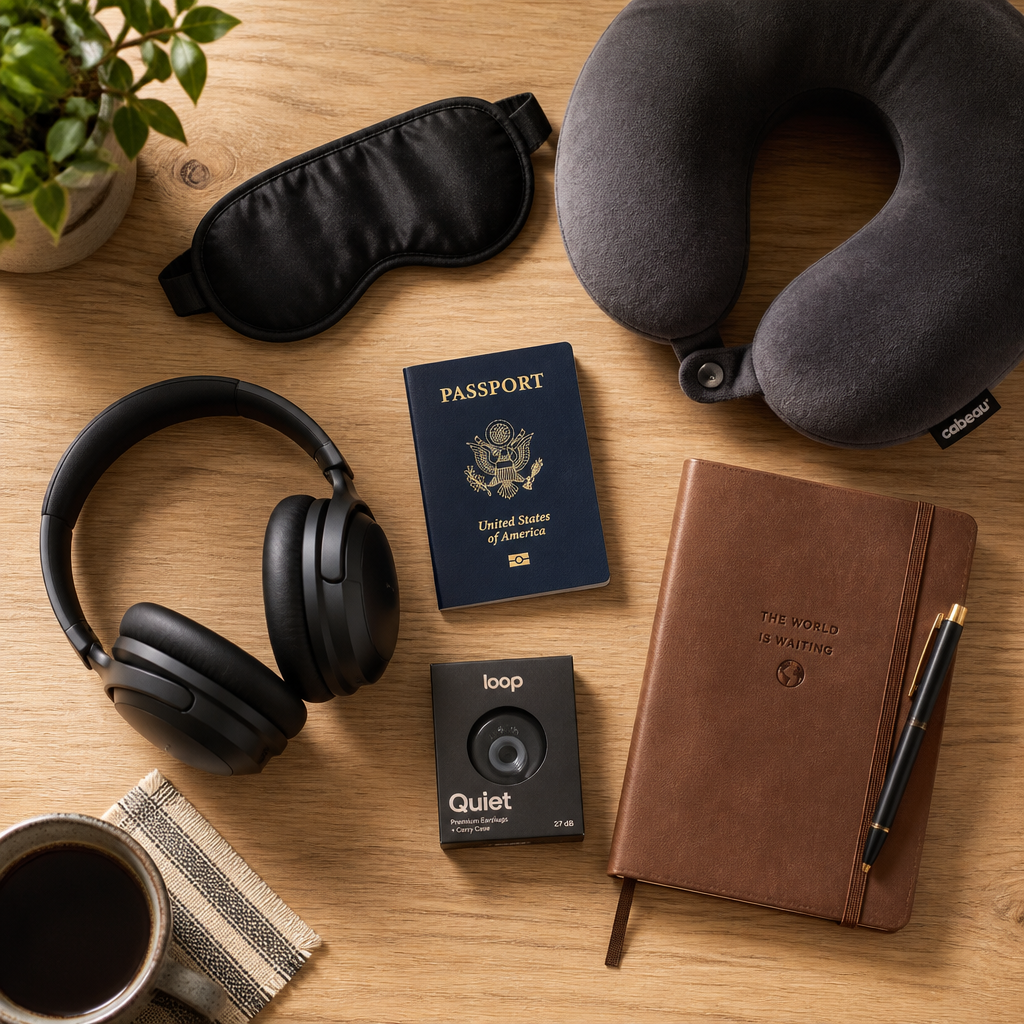
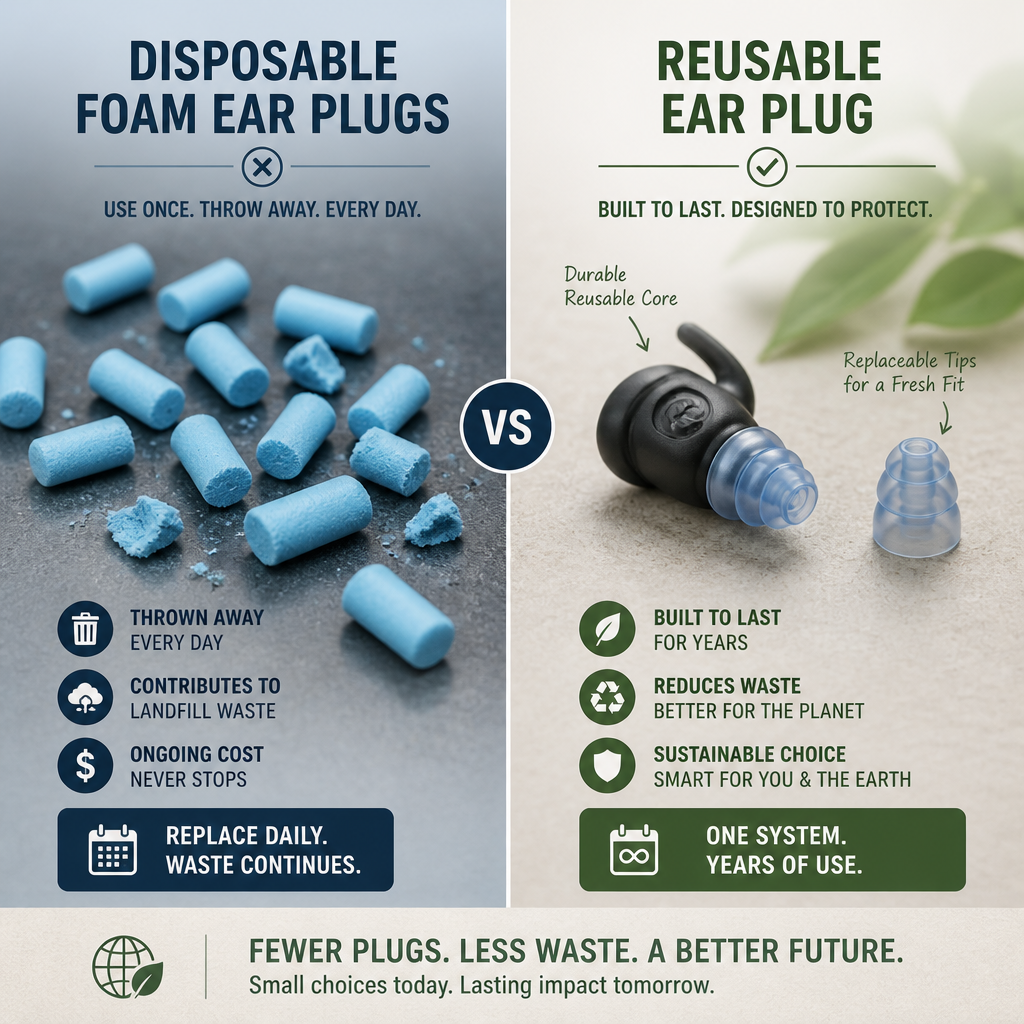
The argument for disposable foam plugs is simplicity: buy a bulk pack, use one per flight, throw it away. In practice, this approach has several problems that compound the more you travel. A foam plug that has been sitting in a carry-on pocket absorbs lint, moisture, and skin oils, which degrade its expansion speed and seal quality. Using a dirty or deformed plug effectively means wearing a product that performs well below its rated NRR.
Reusable metal-bodied ear plugs with replaceable foam tips address this directly. The aluminium body, being non-absorbent and wipeable, maintains its structural integrity indefinitely. Only the foam tips, which are the component that actually contacts the ear canal and forms the acoustic seal, are replaced on a regular schedule. Replacing tips every 6 to 8 weeks rather than discarding the entire device dramatically reduces per-use cost and environmental waste.
For anyone flying more than twice a month, the economics are clear. The upfront investment in a quality pair of reusable ear plugs returns its cost within a relatively short time compared to ongoing disposable purchases, and the consistency of performance over each flight is significantly higher. Consistent performance is the real metric: a premium plug that delivers 24 dB of real-world attenuation reliably on every flight is worth more than a theoretically higher-rated disposable that varies wildly based on insertion and degradation.
There is also the hygiene dimension, which frequent flyers rarely think about until they develop ear canal irritation. Memory foam tips that are replaced on schedule maintain a level of cleanliness that a reused, degraded foam plug from the bottom of a bag simply cannot match. For travelers with sensitive skin or any history of external ear issues, this is not a minor consideration.
Even the best ear plugs for flying deliver poor results if inserted incorrectly. Most people, including experienced travelers, do not roll and insert foam-tipped plugs correctly, which is why so many first-time users of quality ear plugs report being surprised by how much better they work when used properly.
With memory foam tip plugs, the process is straightforward but requires a moment of patience. Compress the foam tip gently between your fingers until it is narrow enough to enter the canal comfortably. With your other hand, reach over your head and gently pull the top of your ear upward and backward to straighten the canal. Insert the plug with a slow, gentle rotating motion and hold it in place with light finger pressure for 20 to 30 seconds while the foam expands to fill and seal the canal. Releasing too early before the foam has fully expanded is the most common reason for a poor seal.
If you need to press hard to insert the plug or if you feel discomfort after the foam has fully expanded, the tip is too large. Drop to the next smaller size. If the plug feels loose, shifts when you move your jaw, or falls out, the tip is too small. Getting this right on the first flight you use a new pair is worth the few minutes of experimentation because a correctly fitted plug will still be comfortable six hours later.
Ear plugs work best as part of a deliberate in-flight sleep setup rather than as a last-resort grab when noise becomes intolerable. Pair them with an eye mask, set your seat recline before insertion (so you are not fumbling with controls while wearing plugs), and avoid caffeine in the hours before your intended sleep window. The noise reduction ear plugs provide is most effective for sleep when the other environmental variables, light and physical comfort, are also managed. ATTENU8’s concave aluminium body design is particularly well suited to window seats with a pillow pressed against the side of the head, where protruding plugs would otherwise dig into the outer ear.
If you find yourself on a long-haul route where a window seat is not available, the low-profile body still performs better than conventional cylindrical or T-shaped plugs against an airline headrest. Aisle-seat travelers who cannot lean against the window particularly benefit from a plug that does not shift or dislodge when they tilt their head to rest on a travel pillow.
Yes, wearing well-fitted ear plugs for the duration of a long-haul flight is safe for most adults. The key is choosing plugs made from skin-safe materials and ensuring the foam tips are clean and replaced on a regular schedule. If you experience any pain, remove the plugs, check that the tip size is appropriate, and reinsert. Pain is almost always a sign of incorrect sizing or a hygiene issue with degraded tips, not a sign that ear plugs themselves are harmful.
Yes. Ear plugs slow the rate at which cabin pressure changes reach the ear canal, giving the Eustachian tube more time to equalize the pressure difference across the eardrum. Research published in The Laryngoscope found that travelers who used earplugs during flights reported significantly less ear pain than those who did not. This effect is most pronounced during descent, which is when the pressure change is fastest and most people experience discomfort.
For sleep on long-haul flights or for travelers who are sensitive to noise, aim for an NRR of at least 28 to 33 dB, or an SNR of around 25 to 32 dB. Remember that real-world attenuation is typically 50 to 75 percent of the rated figure, so a 32 dB NRR plug will realistically deliver 16 to 24 dB of effective reduction in-flight. That is enough to bring peak cabin noise from the 100 dB range down to levels that allow genuine sleep and substantially reduce hearing fatigue.
ATTENU8 uses a premium aluminium body with a concave profile designed specifically for low-profile wear, making them better suited for side-sleeping against a headrest or pillow. The memory foam tips deliver approximately 32 dB of noise reduction, which is higher than the 24 dB SNR offered by products like the Loop Quiet 2. Unlike competitors that use silicone tips throughout, ATTENU8 uses soft memory foam tips in three sizes (XS, S, M) that conform precisely to individual ear canal geometry for a more consistent seal. The tips are replaced every 6 to 8 weeks rather than replacing the entire device, which reduces long-term cost and waste.
Yes, and this is one of the practical advantages of investing in a quality reusable pair. A premium ear plug designed for noise reduction and comfort during travel, particularly one with a low-profile body for side-sleeping, performs equally well for blocking out street noise, a snoring partner, or early morning disturbances at home or in a hotel. Keeping a single high-quality pair for all noise-sensitive situations is more cost-effective and means you always have a broken-in, correctly sized pair available when you travel.
Every 6 to 8 weeks under regular use is the standard guidance, though this varies depending on usage frequency and how well you clean the tips between uses. Signs that tips need replacing sooner include a loss of elasticity (the foam no longer springs back fully after compression), visible discoloration, or a noticeable drop in the quality of the seal. Tip replacement is the only maintenance a metal-bodied plug requires, which is one of the core reasons premium reusable designs are more practical for frequent travelers than either disposable foam or full-silicone alternatives.
They serve different purposes. Noise-cancelling headphones are excellent for the mid-range frequencies where music and conversation sit, but they are bulkier, require battery power, and do not allow you to sleep comfortably against a headrest or pillow. Ear plugs deliver passive broadband noise reduction across all frequencies including low-frequency engine rumble, require no power, and are small enough to carry in any pocket. For sleep specifically, ear plugs outperform headphones because they allow natural head positioning and do not create a seal that breaks when a headphone slips. Many experienced long-haul travelers use both: headphones during waking hours for entertainment, ear plugs for sleep.
Have you found a specific tip size or insertion technique that works best for you on long flights? Share your experience in the comments, we read every one.
Noise-induced hearing loss does not announce itself with a dramatic event. It accumulates shift by shift, flight by flight, concert by concert, until one day the damage is done and no amount of money brings your hearing back. If you are still reaching for a fresh pair of disposable foam plugs every morning, you are solving a permanent problem with a temporary tool. Reusable ear plugs for work and daily life exist precisely because certain environments are loud enough, and frequent enough, to make single-use protection both wasteful and expensive. The eight environments below are not edge cases. They are the places where hearing protection stops being optional.
| Key Insight | Explanation |
|---|---|
| Reusable plugs cut long-term costs sharply | Replacing only foam tips every 6 to 8 weeks instead of buying new disposable plugs daily makes reusable ear plugs dramatically cheaper over a working year. |
| Metal bodies outlast foam bodies | A concave aluminium body like the one used in ATTENU8 plugs resists compression, crushing, and contamination in ways that all-foam or all-plastic plugs simply cannot match on active job sites. |
| Fit determines actual noise reduction | Rated NRR figures mean nothing if the plug does not seat properly. Memory foam tips in multiple sizes (XS, S, M) ensure a reliable seal regardless of ear canal shape. |
| Hearing damage is cumulative and permanent | Every unprotected hour in a loud environment adds to lifetime exposure. Professionals in construction, manufacturing, or the military face repeated daily exposure that compounds over careers. |
| Sleeping with ear plugs requires comfort above all else | Side sleepers in particular need a low-profile plug that does not create painful pressure points during hours of use. Hard-shell reusable plugs with soft memory foam tips solve this directly. |
| Disposable plugs create ongoing waste and cost | A construction worker using one pair of disposables per shift generates hundreds of discarded plugs per year. Reusable plugs with replaceable tips reduce that waste to near zero. |
| Around 32 dB of noise reduction covers most loud environments | A plug delivering approximately 32 dB of noise reduction handles construction machinery, concert stages, aircraft cabins, and urban transit noise without over-blocking to the point of communication failure. |
Construction is the environment most people picture when they think about hearing protection in loud environments. Jackhammers, pile drivers, angle grinders, and heavy plant equipment produce sustained noise levels that are genuinely dangerous over a full shift. The problem is not a single loud moment. It is eight or ten hours of cumulative exposure, day after day, for an entire working life.
Disposable foam plugs work in theory, but in practice they fall apart on a busy site. Dust and sawdust contaminate them within hours. Workers handle them with dirty gloves. They get crushed in pockets, lost in debris, and replaced improperly by people who have not been trained to roll and insert them correctly. A badly inserted disposable plug can deliver far less than its rated protection.
A durable ear plug with a metal body changes this dynamic. You clean it, you reuse it, and because it does not degrade visibly the way foam does, workers are more likely to actually wear it consistently. The ATTENU8 aluminium body paired with replaceable memory foam tips gives site workers the rated 32 dB noise reduction they need without generating a trail of discarded plugs behind every shift.
Pro tip: On construction sites, keep your reusable plugs on a lanyard or cord attachment. The single most common reason workers go unprotected is that they cannot find their plugs quickly when a loud machine starts up nearby.
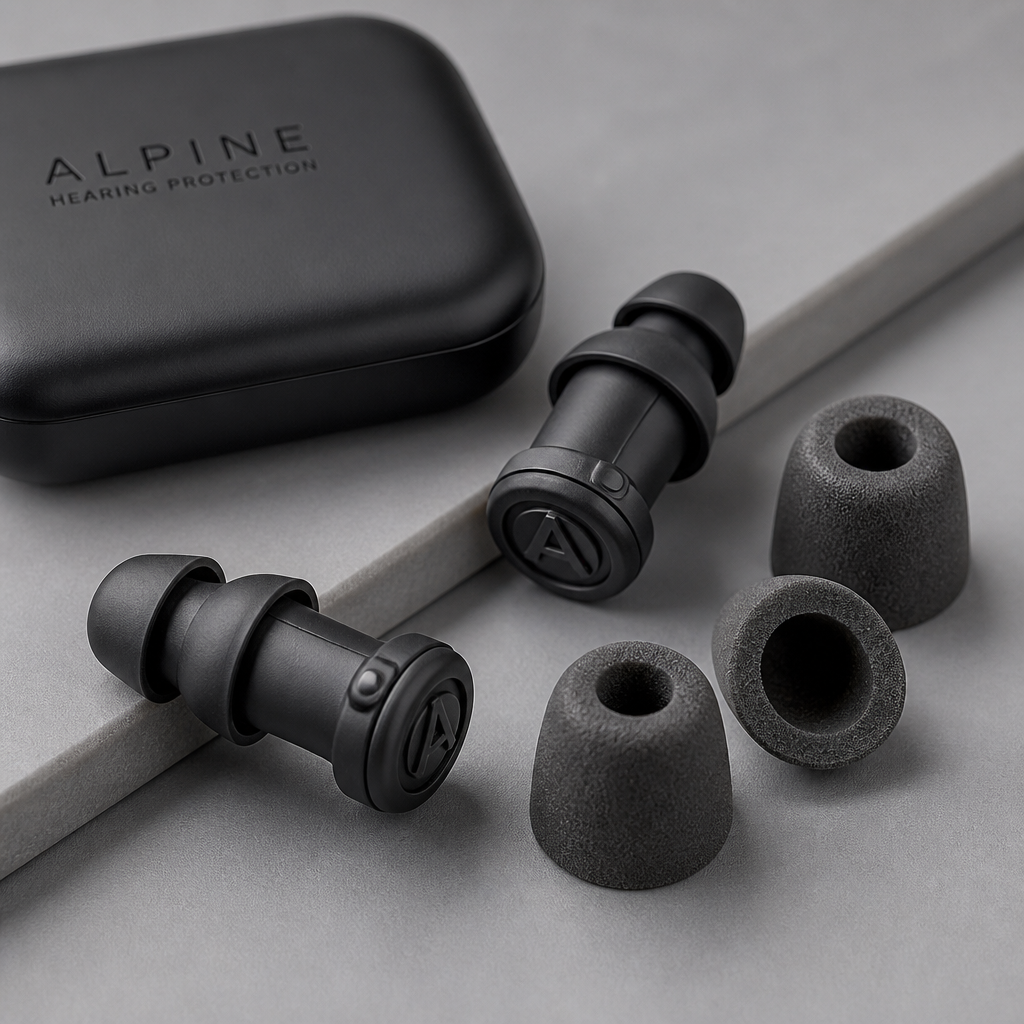
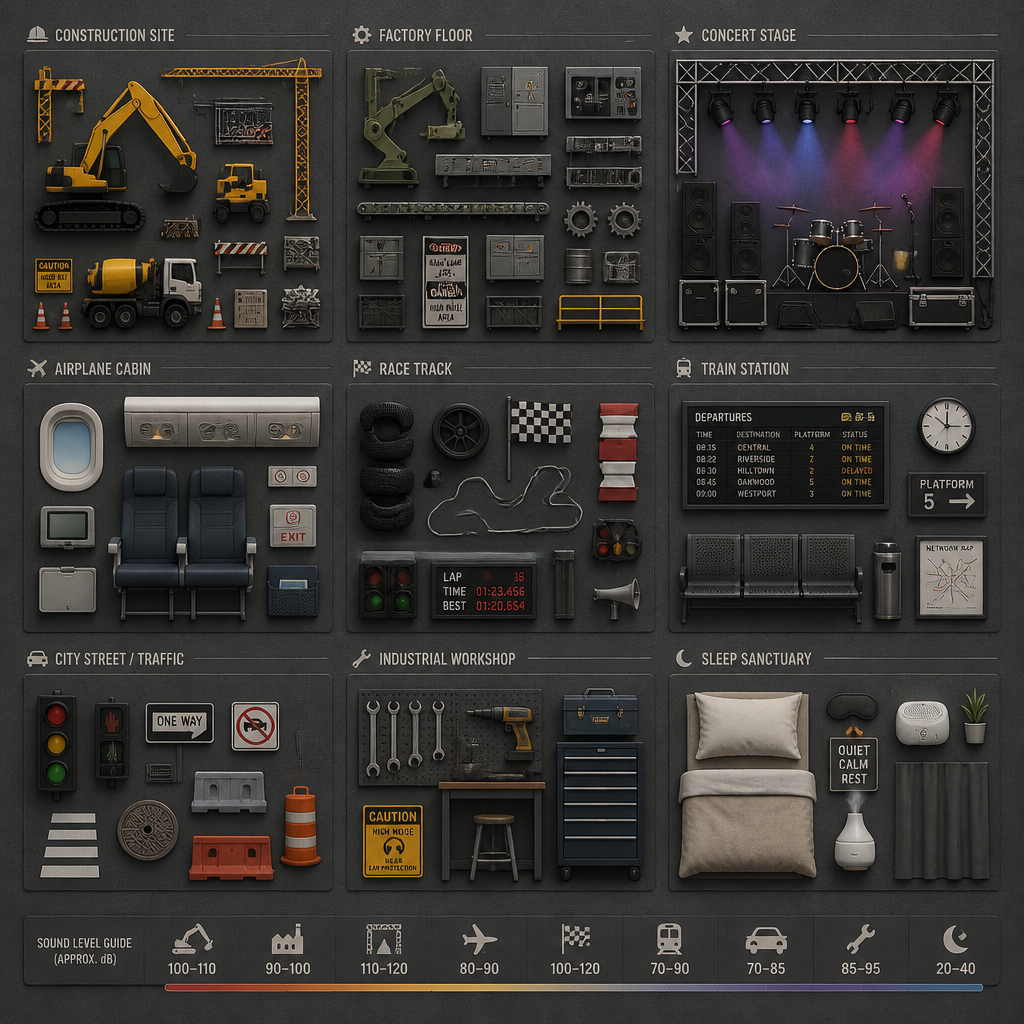
Most workplace safety regulators set an action level where hearing protection becomes mandatory. Reusable plugs rated at approximately 32 dB of noise reduction are well-suited to the range of noise sources found on typical sites, from power tools at closer range to general ambient machinery noise across a larger site. The key is consistent wear, and consistent wear depends on comfort and convenience, which is where reusable metal-bodied plugs earn their keep.
Factory workers face a different challenge from construction workers. The noise on a manufacturing floor is often more constant and less variable. Stamping presses, conveyor systems, CNC machines, and ventilation systems combine into a relentless background roar that rarely drops below dangerous levels during a shift.
In this context, ear plugs for work need to be comfortable enough to wear for an entire shift without causing fatigue or the urge to remove them. This is where most cheap reusable plugs fail. Rigid flanged plugs in a fixed size create pressure in ear canals that are not perfectly suited to that size, and workers quietly pull them out by mid-morning. Memory foam tips that conform to the specific shape of an individual ear canal are simply more comfortable over long periods.
Manufacturing environments also tend to be cleaner than construction sites, which makes the hygiene case for reusable plugs even stronger. You can wipe down a metal-bodied plug at the end of a shift in seconds. That is not something you can say about a foam plug that has absorbed eight hours of sweat.
In large manufacturing operations, the cost of supplying disposable ear plugs to an entire workforce adds up quickly. More importantly, compliance monitoring becomes harder when workers are constantly swapping plugs in and out due to discomfort. Workers who own a personal pair of reusable plugs tend to wear them more consistently, which is the actual goal of any hearing protection program.
Concert venues, festival stages, and nightclubs routinely operate at sound levels that can cause temporary hearing threshold shifts after a single event. For casual attendees, this is a one-off risk. For musicians, sound engineers, venue staff, and frequent concert-goers, it is a cumulative occupational hazard.
The classic objection to wearing ear plugs at concerts is sound quality. Standard disposable foam plugs muffle high frequencies disproportionately, turning a live performance into a muffled, bass-heavy experience. This is not a problem with good reusable plugs that use memory foam tips designed to attenuate evenly across the frequency range. You hear the music. You just hear it at a safer level.
The best ear plugs for concerts are the ones you actually wear. A plug that sits in your pocket because it sounds terrible or feels uncomfortable provides exactly zero protection.
Musicians who perform multiple nights per week have the strongest case for investing in high-quality reusable plugs. The ATTENU8 approach of a durable metal body with replaceable soft tips means the product stays in rotation for years, not weeks. Over a touring season, that economics argument becomes very clear very fast.
Aircraft cabin noise is a steady, low-frequency roar produced by engines, airframe vibration, and pressurization systems. It sits at levels that are not acutely dangerous in the way a construction site is, but they are fatiguing over a long-haul flight and they contribute meaningfully to cumulative exposure for frequent flyers.
Ear plugs for travel solve two distinct problems on a plane. First, they reduce the physiological fatigue that comes from prolonged exposure to cabin noise. Frequent travellers consistently report arriving less exhausted when they wear ear protection on long flights. Second, for travellers trying to sleep in economy class, they block the ambient noise that prevents sleep onset and disrupts sleep cycles.
Airports themselves are a second layer. Gate areas, particularly near runway-facing windows, produce significant ambient noise. Carry-on luggage that includes a pair of reusable plugs takes up almost no space and costs nothing extra once the initial purchase is made.
Pro tip: Keep your reusable ear plugs in your carry-on rather than your checked luggage. The environments where you need them most, aircraft cabins, airport gate areas, and transit hubs, are all airside, not at your destination.
Firearms, artillery, and military vehicles produce some of the most intense impulse noise that human ears are routinely exposed to. A single unprotected gunshot at close range exceeds safe exposure limits in an instant. For military personnel, the cumulative exposure across a career of training exercises, live fire events, and operational deployments is substantial.
The durability requirement in military and tactical contexts is extreme. Equipment gets wet, dirty, compressed, dropped, and subjected to temperature extremes that destroy consumer-grade products quickly. A metal-bodied reusable ear plug is simply better suited to this kind of abuse than an all-foam or all-plastic alternative. The aluminium body does not deform, does not absorb moisture, and does not degrade with the same predictable failure pattern that foam plugs exhibit.
For civilians in shooting sports, the same logic applies. Range days are loud. Cumulative range exposure over years of regular practice adds up to meaningful hearing damage if protection is inconsistent. A reusable plug that you own, maintain, and carry as standard kit is more likely to actually be used than a disposable plug you have to remember to stock.
Military personnel who wear helmets, headsets, or communication gear face a fit challenge that standard bulky ear muffs cannot solve. A low-profile in-ear plug that provides strong attenuation without interfering with other headgear is often the only practical option. The compact form factor of metal-bodied plugs with memory foam tips fits this requirement directly.
Motorsport venues are among the loudest recreational environments a person can enter voluntarily. Formula racing, motorcycle events, and drag strips produce sustained noise levels that can cause hearing damage to spectators, let alone pit crew members and marshals who work track-side for entire race days.
For pit crew and track workers, hearing protection is professional-grade necessity. For spectators attending multiple events per season, the cumulative argument applies with force. One race weekend without protection is one thing. Ten race weekends per year over a decade is a very different calculation.
The practical challenge at motorsport events is that you also need situational awareness. You need to hear commands, radio calls, or safety announcements. A plug delivering around 32 dB of noise reduction brings the roar of a race engine down to a manageable level without blocking human voice frequencies entirely, which is the practical balance that matters in this environment.
Underground rail systems, particularly older infrastructure, produce wheel squeal and acceleration noise that can be genuinely loud at platform level and inside carriages. Bus travel in dense urban environments adds engine noise, stop-start braking, and passenger noise to the mix. For daily commuters making this journey twice a day, five days a week, the exposure is not trivial.
Beyond the hearing protection argument, there is a practical productivity and wellbeing case. Commuters who use ear plugs during transit report lower stress levels on arrival at work and improved concentration during the commute itself when using it to read or decompress. The plugs do not need to be paired with any audio device to deliver this benefit. Silence, or near-silence, is the point.
Urban noise pollution also extends beyond transit. City apartments near arterial roads, flight paths, or entertainment districts expose residents to sustained outdoor noise that disrupts concentration and rest. Reusable ear plugs worn during focused work periods, or during afternoon rest, address this directly.
This is the environment where comfort matters most and where most ear plugs fail their users. A plug that is fine for two hours on a job site becomes intolerable at hour four of a sleep attempt, particularly for side sleepers who press one ear into a pillow.
Standard cylindrical foam plugs create pressure points when the pillow compresses against them. This wakes light sleepers repeatedly and causes enough discomfort that many people abandon ear plugs for sleep entirely, accepting the noise rather than the discomfort. This is a product design failure, not a user failure.
The concave aluminium body design of ATTENU8 plugs addresses this directly. The recessed profile sits within the ear without protruding, reducing the pressure point problem that makes most plugs unwearable for side sleepers. The soft memory foam tips conform to the ear canal and hold their position without requiring the user to shove the plug deeper to maintain a seal.
Light sleepers near busy roads, shift workers sleeping during daytime hours, travellers in hotels near street level, and partners of people who snore are the core audience for sleep-specific hearing protection. The snoring use case alone is significant. The noise generated by a partner’s snoring can be genuinely loud, and a plug delivering around 32 dB of noise reduction brings it to a level that no longer prevents sleep onset.
Visit the ATTENU8 product page to see how the three memory foam tip sizes (XS, S, and M) address the fit problem that causes most sleep ear plug failures.
Not all ear plugs are built the same, and the environment you are protecting against should drive your choice. The table below compares the three main categories directly on the factors that matter most across the eight environments covered above.
| Protection Type | Best For | Key Limitations |
|---|---|---|
| Disposable foam plugs (single-use) | One-off situations, shared use in visitor safety kits, environments with very high contamination risk | High ongoing cost, significant waste, inconsistent insertion quality, no size options, degrades quickly in dirty or humid conditions |
| Reusable silicone or flanged plugs (plastic body) | Occasional use, budget-conscious buyers, environments where comfort over long periods is less critical | Fixed flange size fits many ear canals poorly, pressure build-up during extended wear, less durable under heavy physical use |
| Reusable metal-bodied plugs with memory foam tips (ATTENU8) | Daily professional use, sleep, travel, concerts, any environment requiring consistent long-term wear and high durability | Higher upfront cost than disposables, foam tips need replacement every 6 to 8 weeks (though this is the only recurring cost) |
With a metal-bodied reusable plug like ATTENU8, you replace only the memory foam tips, not the entire plug. Tips typically need replacing every 6 to 8 weeks with daily use. The aluminium body itself lasts years under normal conditions. Compare this to disposable foam plugs, which need replacing after every use or every shift.
Yes, provided you clean them regularly. A metal body wipes down in seconds with a damp cloth. Memory foam tips should be replaced on the 6 to 8 week schedule rather than cleaned repeatedly, as foam absorbs moisture over time and loses its sealing properties. In practice, reusable plugs with replaceable tips are more hygienic than disposable plugs handled repeatedly with dirty hands on a job site.
Most cylindrical foam plugs are uncomfortable for side sleepers because they protrude from the ear and create pressure points when a pillow presses against them. A low-profile plug with a concave or recessed body design reduces this problem significantly. Soft memory foam tips that conform to your ear canal without requiring deep insertion also help maintain a seal without discomfort during several hours of side sleeping.
Construction sites with heavy machinery typically require plugs with an NRR of 25 dB or higher. Many construction-grade plugs are rated at 25 dB to 33 dB. A plug delivering approximately 32 dB of noise reduction covers the majority of construction noise sources effectively. The actual protection you get depends equally on correct insertion and consistent wear throughout the shift, which is why comfort and fit matter as much as the rated figure.
Frequent travellers benefit from reusable plugs in three ways. First, there is no need to carry or restock disposables across multiple trips. Second, a consistent pair of plugs that you have already fitted to your ear canals provides reliable protection without the insertion variability of disposables handled in cramped conditions. Third, the environmental footprint is dramatically lower, which matters to travellers who are already conscious of their per-trip impact.
A well-fitted plug delivering around 32 dB of noise reduction reduces dangerous background noise to safe levels while preserving enough hearing range for face-to-face communication at normal speaking distance. Human speech, especially in the mid-frequency range where most conversation occurs, remains intelligible at close range even with plugs inserted. The common complaint that ear plugs block all communication usually comes from plugs that fit poorly or are inserted too deeply, not from the protection level itself.
If you wear ear plugs in any of the environments above, we would genuinely like to hear which situations drive you to reach for them first and what has stopped you from switching to a reusable option so far.
We would love your feedback and any insights you would share with others. What perspective would you add?

