


 0

Open-plan offices promise collaboration and deliver interruptions. A colleague’s call, a keyboard clattering two desks over, and a printer that never stops can break a train of thought before it forms. For people who already struggle with focus, ear plugs for open plan office work have become one of the cheapest fixes that actually changes the day. The trick is not blocking everything. It is blocking the right sounds for a full shift, without losing the ability to hear your name or a fire alarm.
| Key Insight | Explanation |
|---|---|
| Aim for a comfortable level, not silence | An office vendor’s summary of workplace research puts the comfortable level near 50 dB. Total silence can feel unnatural and bring on boredom, so target the sharp peaks like calls and clatter. |
| Test for four hours, not four minutes | Pressure points and seal problems usually appear after a long sitting stretch. Judge a pair across a full morning of typing before you decide. |
| Choose by seal before rating | A tip that leaks loses more noise reduction than any rating on the packaging can make up for. |
| Remove plugs before any conversation you need | Plugs reduce speech but do not erase it. Take them out or reseat them before standups, calls, and anyone who needs to reach you. |
| Replace foam tips every 6 to 8 weeks | Replacing only the tips keeps the seal consistent and avoids throwing away a whole pair. Swap sooner if the tips feel stiff or lose shape. |
| Test your building’s alarms with plugs in | Confirm you can hear the fire alarm and evacuation signal before relying on plugs for a full workday. |
Most open-plan complaints are not about loud noise. They are about unpredictable noise, the kind that arrives every few minutes and forces your brain to decide whether it matters. A conversation two desks away is harder to ignore than a steady hum, because your attention keeps checking on it.
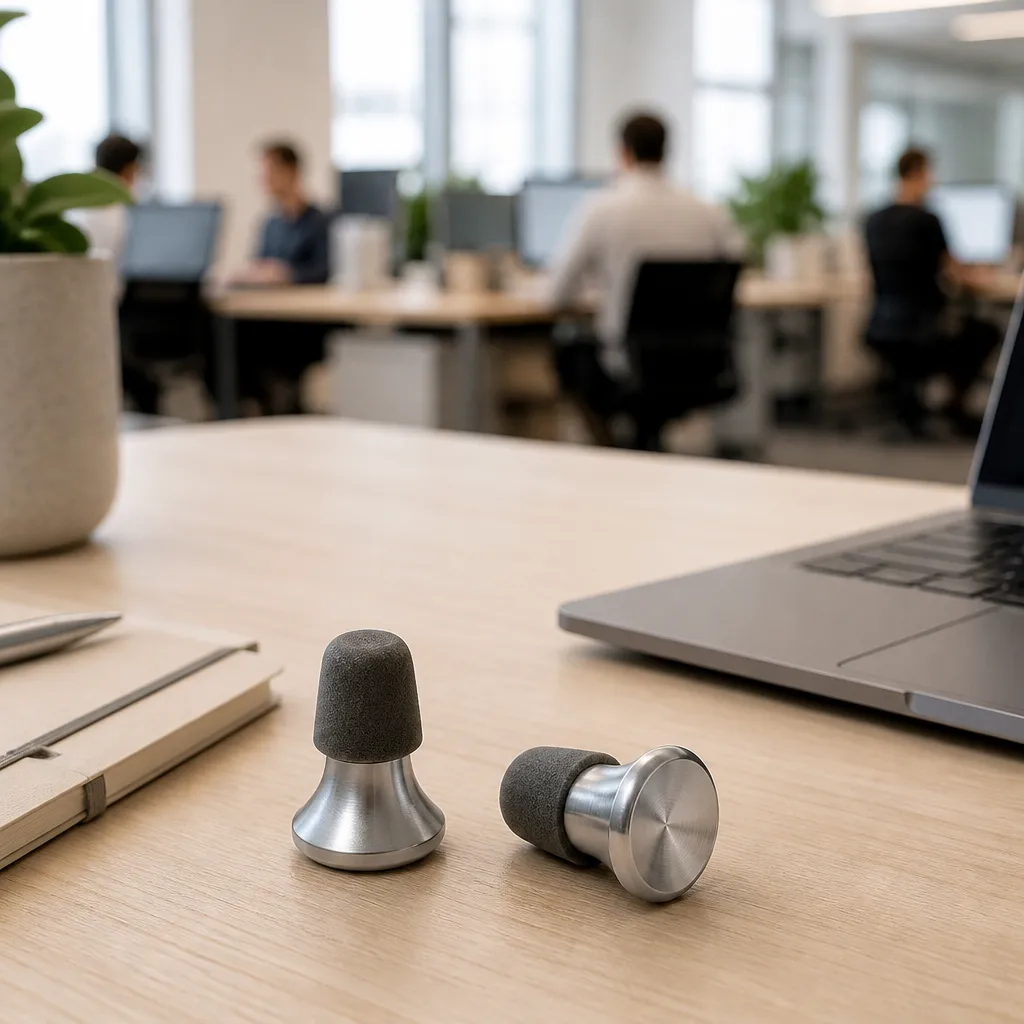
Framery’s office noise guidance makes a point that matches what many shared-floor workers describe: too much noise can make concentration harder, raise stress, and cause headaches, while too little can bring on boredom. The goal is not a silent room. You want the sharp, speech-heavy peaks gone while the floor still feels alive.
Speech carries meaning, which is why it pulls your attention so hard. Sound masking systems work by adding subtle ambient noise that makes nearby speech harder to understand, and that same logic explains why a soft background can feel calmer than a dead-quiet desk. Ear plugs take a different route: they lower the overall level at your ear, so the same conversation becomes less intrusive.
In practice, a well-fitting pair handles keyboards, phone calls across the room, and chair squeaks well. It does far less for a colleague standing beside your desk, because close-range speech is loud enough to get through a good seal. Expect plugs to solve the background problem, not the face-to-face one.
Before buying anything, spend a week noting when your focus breaks. A desk by the kitchen and a desk in the middle of a team pod can sound like two different buildings, so generic advice about open offices will only take you so far.
Write down the time, the source, and whether you lost more than a minute of work. Patterns show up quickly: a standup at 10:00, the coffee machine mid-afternoon, a sales team’s calls after lunch. Those are the windows where a pair of ear plugs earns its place, and they tell you whether you need a light reduction or a stronger one.
Noise reduction ratings are useful for comparing products, but they do not tell you how the result sounds. ATTENU8 ear plugs are rated at roughly 32dB. In an office, the more useful question is whether that reduction takes the edge off phone calls and keyboard noise without making colleagues sound muffled or your own voice sound boomy. A long-term tester of earplugs for noise sensitivity notes that very high reduction can isolate you from your surroundings and make conversation difficult, which is exactly the trade-off an open floor exposes.
Pro tip: Log your focus breaks for five working days before you buy. If most interruptions are speech, prioritize seal and clarity over maximum reduction. If they come from constant hum or equipment, you can accept a stronger reduction.
Sleep-focused plugs often fail at a desk. They are built for lying down, and pressure that feels fine on a pillow turns into an ache after three hours of sitting and typing. Noisy World’s testing used a minimum of four hours of wearing time as its bar, and that is the right standard for a workday.
A plug that does not seal the ear canal loses most of its value. Seal consistency is one of the criteria long-term testers weigh most heavily, because a gap lets through the mid-range frequencies that carry speech. Once a pair is in, talk for a few seconds. Your own voice will sound deeper because of the occlusion effect, which is normal with a sealed fit. If the room sounds unchanged, the seal is leaking and the tip size is probably wrong.
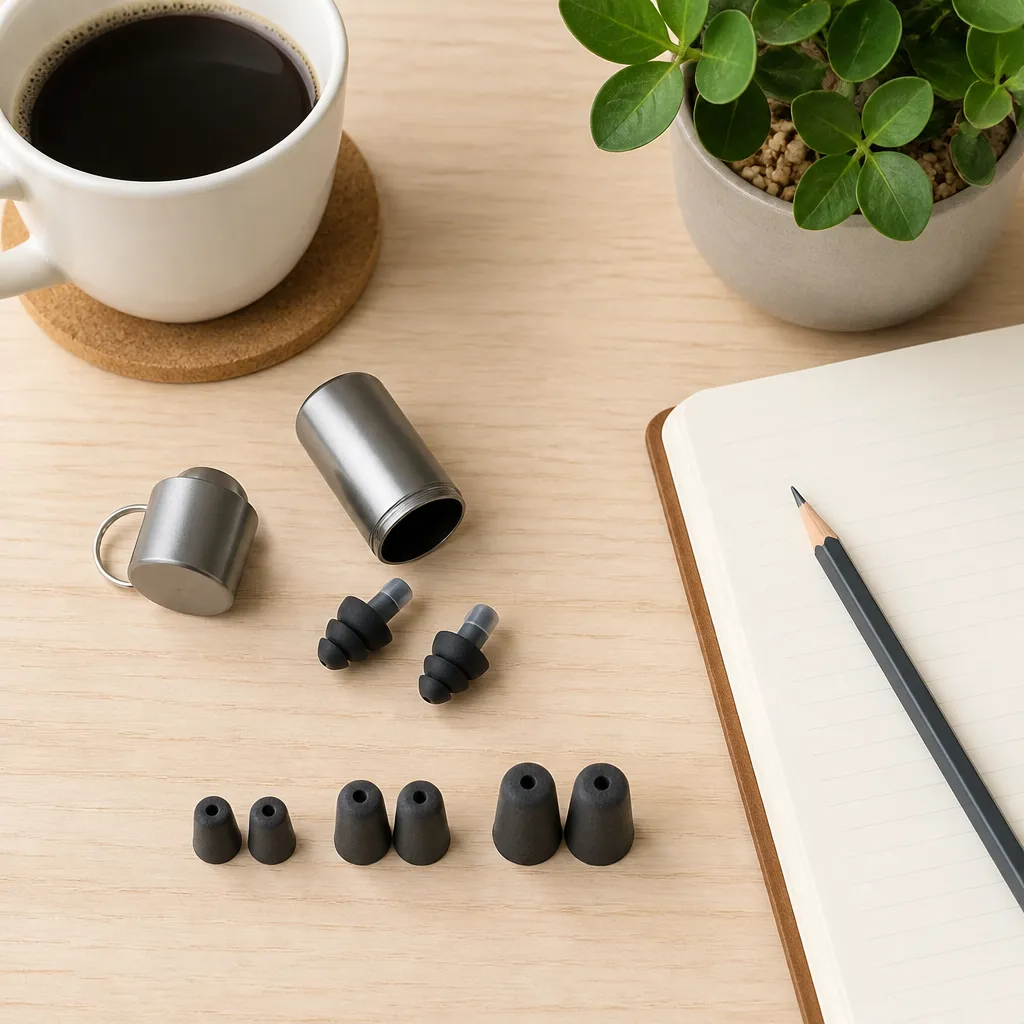
Switching from a tapered tip to a cylindrical or multi-flange design can relieve pressure within a single day. ATTENU8 ships three foam tip sizes, XS, S, and M, for this reason. Most people fit one size clearly better than the others, and the wrong size is often the first reason a pair feels painful by mid-morning.
The best ear plug for an open office is the one you forget you are wearing by mid-morning.
That is the test worth applying. If you are constantly adjusting, reseating, or noticing the ache, the pair is working against you no matter how good its rating looks.
The strongest objection to wearing ear plugs at work is a fair one: you still need to hear what matters. A good shared-floor setup does not mean being cut off. It means being deliberate about when you are plugged in and when you are not.
Most people who give up on plugs do so because they missed something they should have heard, not because the plugs were uncomfortable. Build the awareness routine first, then decide how long you can comfortably wear them each day.

Find out what your building’s fire alarm and evacuation signals sound like, then test whether you can hear them with plugs in. Remove plugs before you walk through a shared corridor or stairwell, and make that a habit rather than a decision you make under stress. It costs a few seconds and matters more than any product specification.
Plugs reduce speech but do not erase it. Colleagues who approach from behind or call across the floor can be harder to catch. Tell your team you wear them, agree on a shoulder tap or a chat message for urgent items, and reseat or remove a plug before any meeting you are expected to join.
No single tool covers every open-plan problem. Personal ear plugs solve your problem fast and cheaply, while building-level fixes solve it for everyone but take longer and need budget approval. The table below compares three common approaches for the typical shared-desk worker.
| Approach | Best For | Main Drawback |
|---|---|---|
| Reusable metal-bodied ear plugs with interchangeable foam tips | Immediate, personal relief from keyboard noise, calls, and nearby chatter | Comfort depends on finding the right tip size, and you lose some awareness of soft sounds while wearing them |
| Sound masking system installed by facilities | Reducing speech intelligibility across a whole floor at once | You cannot control it personally, and it needs careful setup so it does not become a new distraction |
| Acoustic ceiling baffles or panels | Cutting echo and reverberation across large open runs | Slow to install and costly, and it does little for a loud coworker sitting directly beside you |
In practice, most people should start with personal plugs this week and raise structural fixes with facilities in parallel. Plugs give you an immediate result you can test, while panels and masking are the changes that lift the whole floor once they are in.
Ear plugs are personal, but the noise problem is shared. Many open offices have no written quiet-hours policy, so a small agreement with your team often does more than a one-off purchase.
Ask for two hours a day where calls move to a booth or huddle room. Frame the request around output: teams that protect deep-work time tend to finish more of it. Parterre’s list of office noise fixes includes dedicated quiet spaces and sound-friendly furniture, and both are inexpensive to suggest in a team meeting.
Put a simple signal on your desk, such as a card or a headphone clip, that says you are in focus mode. Pair it with a team rule that urgent items go by chat or a quick tap on the shoulder rather than a call across the room. Signals only work when the whole team agrees to them.
Pro tip: Ask facilities to measure noise at your desk at two different times of day before you request panels. A single reading taken at 9:00 on a quiet Monday tells you almost nothing about the afternoon you actually struggle through.
Your desk position matters as much as your plugs. Sitting with your back to a high-traffic path or the printer reduces the number of sudden sounds you have to filter, and fewer sudden sounds mean you can wear a lighter, more comfortable pair for longer.
Face away from the walkway if you can. Desks at the edge of a bay usually pick up less echo than desks in the middle of a long open run, so ask for a move if your seat sits in the echo zone. A seat with a clear view of the room also reduces startle responses, because you see people coming rather than hearing them arrive.
Keep your plugs in a small case in your bag or drawer rather than loose on your desk. That way you can insert them before a loud task and remove them before a call. Replacing only the foam tips every six to eight weeks keeps the seal consistent and costs far less than replacing a whole pair, which is the practical reason to buy reusable plugs in the first place. You can find the tip replacement options on the ATTENU8 website.
Yes, for most people, provided the fit is right and you take short breaks. Plan to reseat or remove them around lunch and before any call that matters.
They reduce speech but do not eliminate it. Close-range conversation still gets through, so remove plugs for discussions you need to follow and set up a simple tap or message system for urgent contact.
Every six to eight weeks is the standard schedule for ATTENU8 tips. Replace them sooner if they stiffen, lose their shape, or the seal starts to feel weaker.
They can be, but only after you have confirmed you can hear your building’s alarm and evacuation signal with them in. Always remove plugs when moving through shared corridors and stairwells.
For speech and sudden sounds, plugs usually win because they sit in the ear without a battery and leave you free to take a call. Headphones suit steady, low background noise, but they are bulkier for all-day wear and get in the way when you need to talk.
Share your experience with ear plugs on a shared floor, including the fit problems you ran into and whatever finally made the workday bearable.

