


 0

If you lie awake listening to traffic, a snoring partner, or neighbourhood noise, you are not just unlucky. You are dealing with a documented physiological problem. Research into noise and sleep quality makes one thing very clear: your brain never fully switches off its response to sound, even during deep sleep. The noise that does not fully wake you is still doing damage, triggering stress hormones, shifting you into lighter sleep stages, and quietly eroding the recovery your body depends on. This article breaks down exactly what the science says and what you can practically do about it.
| Key Insight | Explanation |
|---|---|
| Your brain stays alert to noise all night | Even during deep sleep, auditory processing continues. Sounds trigger physiological reactions without necessarily causing full wakefulness. |
| Noise pushes you into lighter sleep stages | Environmental noise increases stage 1 (lightest) sleep and reduces slow-wave and REM sleep, the two most restorative stages. |
| Sounds as low as 30 dB can disturb rest | Even relatively quiet noise can affect sleep. A whispered conversation sits around 30 dB. Your bedroom does not need to be loud to be disruptive. |
| Noise activates your stress hormones at night | Nighttime noise triggers adrenaline and cortisol production, elevates heart rate, and raises blood pressure, even without waking you. |
| Sound machines are not a reliable fix | Recent research published in the journal Sleep found that pink noise reduced REM sleep by nearly 19 minutes and worsened outcomes when combined with traffic noise. |
| Earplugs outperform sound masking for deep sleep protection | The same study found that wearing earplugs was far more effective than pink noise at protecting deep, restorative sleep from traffic noise disruption. |
| Noise sensitivity is partly neurological | Research suggests brain rhythm patterns influence how vulnerable an individual is to noise-related awakenings, meaning light sleepers are not imagining it. |
Sleep is not a single state. It is a cycle of distinct stages, each with a different function and a different level of vulnerability to noise. Stage 1 is the lightest, barely distinguishable from wakefulness. Stage 2 is where most of us spend roughly half the night. Slow-wave sleep (stage 3) is the deepest, most physically restorative stage. REM sleep is where memory consolidation, emotional processing, and cognitive recovery happen.
Environmental noise, particularly from traffic and aircraft, has been shown to increase time spent in stage 1 sleep while reducing slow-wave and REM sleep. That trade-off matters enormously. You might technically sleep for eight hours, but if noise keeps pulling you out of slow-wave and REM and pushing you into stage 1, you will wake up feeling like you barely rested. Stage 2 is also where noise is most likely to cause a full awakening, since auditory awakening thresholds are generally lower there than in slow-wave sleep.
One important nuance: most noise-triggered arousals are not remembered. Your brain briefly surfaces, registers the sound, and partially settles again, all without you being consciously aware. This is why many people insist they slept through the noise when their sleep quality data tells a completely different story.
Pro tip: If you consistently feel unrefreshed despite getting enough hours in bed, noise-triggered micro-arousals are a credible cause. You do not need to remember waking up for the disruption to be real.
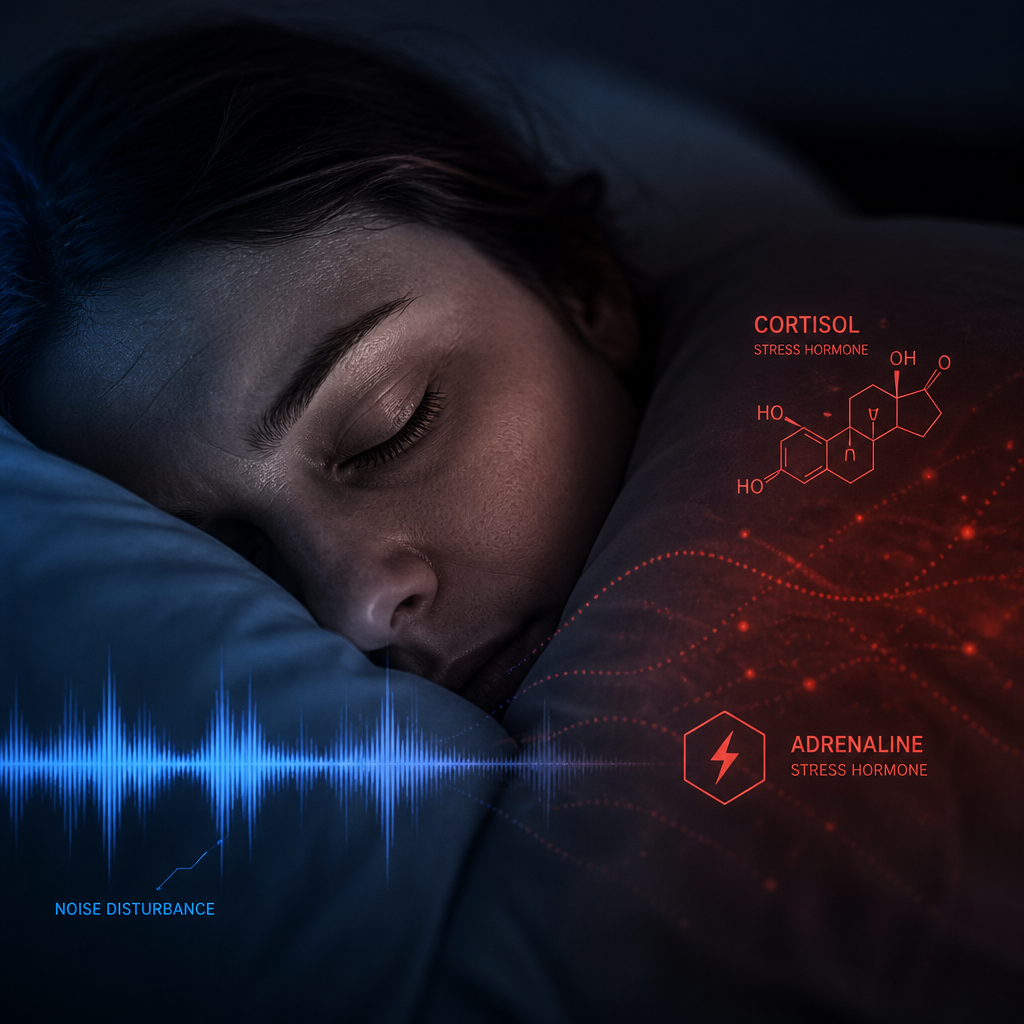
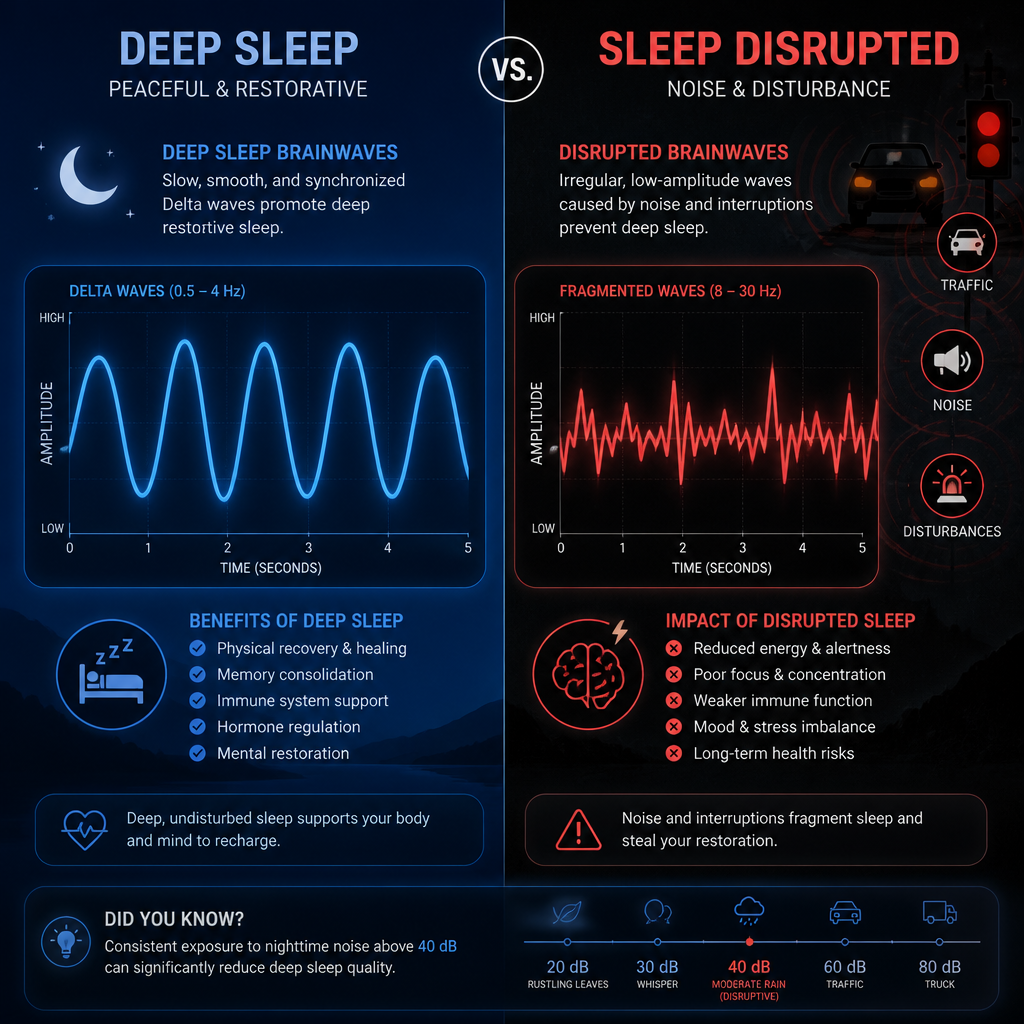
The effects of noise during sleep are not limited to wakefulness. Even sounds that do not cause a full awakening trigger measurable physiological responses. Research has found that a noise of around 48 dB, quieter than the hum of a refrigerator, was 3.4 times more likely to cause a change in pulse wave amplitude, a measure related to blood flow. Sounds above 40 dB produced detectable increases in heart rate.
Nighttime noise also stimulates the production of stress hormones including adrenaline and cortisol, and can elevate blood pressure. Researchers have suggested that these responses may be a primitive survival mechanism, the body preparing to respond to a potential threat. That is useful if a predator actually approaches. It is damaging if it happens every time a truck changes gear outside your window.
Chronic exposure compounds the problem. When noise-triggered cardiovascular responses occur repeatedly night after night, research indicates they may increase the risk of hypertension, heart disease, and other adverse health outcomes. This is not a fringe finding. Research has estimated that traffic-related noise alone causes the loss of over one million years of healthy life among Western Europeans annually.
Even when you sleep through the noise, your nervous system does not. Adrenaline, cortisol, elevated heart rate, disrupted blood flow: the body keeps score, even when the conscious mind does not.
Health guidance generally recommends keeping nighttime bedroom noise below 30 decibels to support uninterrupted sleep. For context, busy road traffic runs at roughly 70 to 85 dB, a subway at around 90 dB, and even a conversation in an adjacent room can exceed 30 dB when sound travels through walls. Reaching that 30 dB threshold in a typical urban or suburban bedroom is harder than it sounds.
If you have ever shared a room with someone who sleeps through a thunderstorm while you lie awake at the sound of a dripping tap, you already know that noise sensitivity is not uniform. Research confirms this is not just a personality trait. Brain rhythm patterns, specifically the activity of sleep spindles during stage 2 sleep, appear to play a role in how effectively a person’s brain filters out external sounds during sleep. People with more active sleep spindles show greater resilience to noise disruption.
Age is another significant factor. Studies show that children and older adults are the most vulnerable to sound-related sleep disruption. Emotional salience also matters: a sound with personal significance, such as your baby’s cry, your name, or an alarm, cuts through sleep far more effectively than a neutral sound at the same volume. The brain is not passively receiving noise. It is actively evaluating it.
For genuine light sleepers, this neurological sensitivity is not something that can be trained away easily. It calls for a practical, physical reduction in the noise reaching the ears, rather than an expectation that willpower or adaptation will solve the problem.
Pro tip: If you identify as a light sleeper and you have tried relaxation techniques without much success, focus on the environment first. Reducing the decibel level reaching your ears is a more reliable intervention than trying to change how your brain processes sound during sleep.
Understanding the scale of the problem helps calibrate the solution. Not all noise is equal, and what disrupts sleep is a combination of volume, frequency, unpredictability, and duration. A single loud event is disruptive; repeated unpredictable events across the night are far worse, because the brain cannot habituate to irregular patterns the way it can to constant background sound.
The most common sleep-disrupting noise sources include road traffic, aircraft, snoring partners, neighbours, and environmental sounds like air conditioning or plumbing. In urban settings, it is rare to have a bedroom that stays below 40 dB through the night without active intervention. Even a quiet suburban environment can see regular spikes from passing vehicles, animals, or wind.
Snoring deserves a specific mention because it is uniquely difficult to habituate to. Research on emotional noise shows that personally relevant sounds are harder to filter out, and few sounds are more personally relevant at 2 AM than a partner’s snoring directly beside you. Snoring typically registers between 50 and 70 dB, well above the threshold for disrupting sleep architecture.
There are broadly three categories of approach to managing sleep disruption noise: physical noise blocking, acoustic masking, and environmental modification. Each has a different evidence base and a different practical ceiling.
| Approach | How It Works | Evidence and Limitations |
|---|---|---|
| Ear protection (earplugs) | Physically reduces sound reaching the ear canal. High-quality options with memory foam tips can reduce noise by 25 to 32 dB across a wide frequency range. | Research from the University of Pennsylvania found earplugs outperformed pink noise machines at protecting both REM and deep slow-wave sleep from traffic noise disruption. Most direct evidence of benefit. |
| Sound masking (white, pink, or brown noise) | Adds continuous background sound to reduce the perceived contrast when disruptive noises occur. | A study published in the journal Sleep found pink noise at 50 dB reduced REM sleep by nearly 19 minutes on its own, and worsened sleep further when combined with traffic noise. Popular but overstated in effectiveness. |
| Environmental modification (windows, insulation, room positioning) | Structural changes to reduce external noise entering the room: double glazing, heavy curtains, door seals, changing which room you sleep in. | Double-pane windows can reduce noise by 10 to 20 dB. Effective but expensive and impractical for renters. Best used in combination with ear protection rather than as a standalone solution. |
The practical takeaway is that earplugs, particularly well-fitted ones that maintain a seal throughout the night, represent the most evidence-backed immediate intervention for noise-related sleep disruption. Sound masking is better suited to situations where earplugs are not practical, and even then the evidence for benefit is weaker than most sound machine marketing implies.
For light sleepers and anyone dealing with persistent sleep disruption noise, the goal is not to eliminate every sound from the universe. It is to reduce the spikes, the sudden changes in volume that pull you out of deeper sleep stages. That is where the right ear protection makes a significant difference.
Comfort across an entire night’s sleep is the non-negotiable factor that most people underestimate. A plug that works well for 30 minutes may become painful by hour three, particularly for side sleepers. Foam tips that conform to the ear canal are more comfortable for extended wear than rigid options. Having multiple tip sizes available matters too, because ear canal dimensions vary significantly between individuals, and a poor fit means both discomfort and reduced noise attenuation.
Durability is the second factor. Disposable foam earplugs need to be replaced constantly, accumulate in landfill, and often lose their expansion capacity after a single use. A well-constructed reusable option with replaceable foam tips addresses both the environmental cost and the long-term economics. The ATTENU8 aluminium-bodied earplug is built around exactly this principle: a precision-machined metal body with three sizes of soft memory foam tips (XS, S, and M), delivering around 32 dB of noise reduction with foam tips that only need replacing every six to eight weeks rather than after every use.
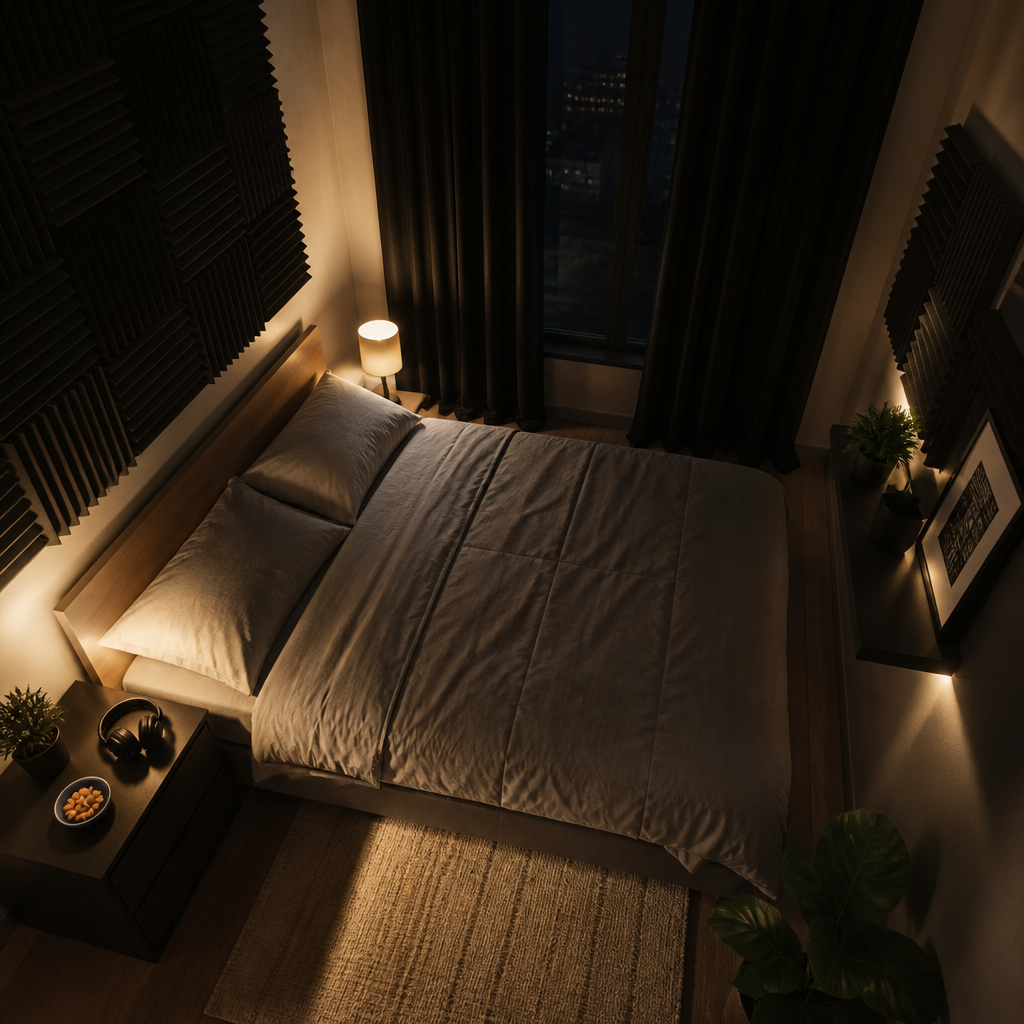
In practice, ear protection works best as the primary intervention, with environmental modifications as a supporting layer. Closing windows, using heavier curtains to absorb sound reflections, and positioning the bed away from the noisiest wall all reduce the baseline noise level before earplugs need to do their work. Start with the physical environment, then add ear protection, and you compound the benefit of both without needing to reach for a sound machine that the evidence suggests may be doing more harm than good.
For people in genuinely loud occupational environments, such as construction or manufacturing, the principle that protects hearing at work applies at home too: sustained noise exposure at levels that trigger physiological stress responses has cumulative consequences. The same discipline that goes into workplace hearing protection should extend to the sleep environment.
Pro tip: If you travel frequently for work and struggle with hotel noise, carrying your own earplugs is one of the highest-return sleep interventions available. Hotel rooms vary wildly in noise levels, and blackout curtains handle light but do nothing for sound from corridors, traffic, or thin walls.
Research suggests sounds as low as 30 decibels can affect rest, and noises above 40 dB produce measurable cardiovascular responses even without waking a sleeper. For context, a quiet conversation registers around 40 to 50 dB. You do not need to be startled awake for noise to be damaging your sleep quality.
Partially, but not fully. The brain can become less likely to fully wake in response to familiar, predictable sounds over time. However, the underlying physiological responses, including cortisol production and heart rate changes, persist even with adaptation. Chronic exposure to noise does not become harmless simply because it becomes familiar.
The evidence is more cautious than the marketing. A recent study published in the journal Sleep found that pink noise, one of the most popular formats, reduced REM sleep by nearly 19 minutes per night, and made sleep quality worse when combined with traffic noise. Sound masking can reduce the perceived contrast of disruptive noises, but it does so by adding more sound to the ear. Physical noise blocking through well-fitted earplugs is better supported by the research for protecting deep and REM sleep.
Stage 2 sleep is where most full awakenings triggered by noise occur, largely because auditory awakening thresholds are lower there than in slow-wave sleep. However, slow-wave sleep and REM sleep are both reduced by environmental noise exposure even when the noise does not cause a full waking event. All stages are affected; stage 2 is just where you are most likely to notice it consciously.
Yes. Chronic exposure to nighttime noise has been linked in research to elevated risk of hypertension, heart disease, and other cardiovascular conditions. The mechanism is the repeated activation of stress responses during sleep, including cortisol and adrenaline release and heart rate elevation, which accumulate as a physiological burden over time. This is why managing your sleep noise environment is a health priority, not just a comfort preference.
Memory foam tips that expand to form a seal within the ear canal are generally the most comfortable for extended wear and the most effective at reducing noise across a broad frequency range. The key variables are tip size, which must match your ear canal for both comfort and attenuation, and the body design, which should not create pressure points for side sleepers. Reusable earplugs with replaceable foam tips are more practical and economical for nightly use than single-use disposables.
Yes. Studies consistently show that children and older adults are the most vulnerable to noise-related sleep disruption. Children spend a higher proportion of sleep in REM, which is particularly sensitive to audio interference. Older adults tend to experience lighter sleep overall, which raises their vulnerability to being woken by noise events. Both groups benefit disproportionately from a quieter sleep environment.
Have you found a particular approach that helped you manage noise and get better sleep? Share your experience below, as it might help someone else dealing with the same problem.
Around 30% of adults report sleeping lightly enough that ordinary household sounds, a partner shifting position, or traffic noise outside pulls them fully awake, according to the American Sleep Association. If you wake up easily and struggle to fall back asleep, you are not simply a bad sleeper. Your sleep architecture, your environment, and possibly your ear canals are working against you. This article breaks down exactly why light sleepers wake so easily, what the research actually says about noise sensitivity sleep disruption, and which light sleeper solutions consistently produce measurable results versus which ones waste your time.

Light sleeping is not a personality trait. It is a measurable difference in how your brain processes sensory input during the non-REM stages of sleep. People who wake up easily tend to produce fewer sleep spindles, which are short bursts of brain activity that essentially act as a buffer between external stimuli and your conscious awareness.
Research published in the journal Current Biology found that individuals with higher sleep spindle activity slept through sounds that reliably woke low-spindle participants. This is a neurological difference, not a willpower issue. The data consistently shows that people cannot simply decide to sleep more deeply without changing the conditions around them.
Age also plays a significant role. As people move past 40, slow-wave sleep, the deepest and most restorative phase, shrinks. That compression pushes more of your sleep into lighter stages where noise, light, and temperature changes can reach your brain and trigger arousal.
Genetic predisposition and baseline anxiety levels both increase the likelihood of light sleeping. If your autonomic nervous system runs hot, meaning your fight-or-flight response is easily activated, sounds that are objectively quiet will register as threats during sleep. This is why some people wake up to a distant car alarm while a partner sleeps through a thunderstorm beside them.
Chronic stress compounds this. Elevated cortisol in the evening delays sleep onset and makes the sleep you do get shallower and more fragmented. Addressing the neurological and environmental causes together is far more effective than tackling either alone.
Sleep is not a uniform state. It cycles through light sleep (N1, N2), deep sleep (N3), and REM sleep roughly every 90 minutes. Each stage serves a different function. N3 drives physical recovery and immune function. REM handles emotional regulation and memory consolidation. Noise disrupts the architecture of these cycles even when it does not fully wake you.
Studies from the World Health Organization have established that noise above 40 decibels at night measurably increases cortisol, elevates heart rate, and pulls sleepers from N3 into N2, fragmenting the restorative portion of the cycle. You may not remember waking, but your body tracks the deficit.
Constant low-level noise is easier to adapt to than intermittent spikes. A steady hum of traffic is far less disruptive than a dog barking twice at 3am. The sudden onset of sound, rather than its volume alone, is what pulls the brain to alert status. This is why even moderate noise sensitivity sleep problems are often worse in urban environments with irregular noise patterns than in genuinely loud but consistent industrial settings.
Light sleepers are disproportionately affected because their already thin spindle buffer gives them almost no tolerance for sudden sound events. Each micro-awakening from an intermittent noise spike extends the time to cycle back into deep sleep, sometimes by 30 to 45 minutes.
| Key Insight | Explanation |
|---|---|
| Sleep spindles determine light sleeping tendency | Low sleep spindle activity means less protection from external sounds. This is neurological, not habitual. |
| Noise above 40dB disrupts sleep even without waking you | WHO research confirms that sub-waking noise events still elevate cortisol and fragment deep sleep cycles. |
| Intermittent noise is worse than consistent noise | Sudden sound spikes are harder to adapt to than steady background hum and cause more micro-arousals. |
| Ear plugs with 32dB NRR provide the most reliable passive protection | A high-NRR plug like those from ATTENU8 physically blocks sound at the ear canal before it reaches the brain. |
| White noise masks but does not eliminate | Sound masking raises your ambient floor but cannot stop high-decibel spikes from breaching that threshold. |
| Memory foam tips improve both seal and comfort for longer wear | A poor seal reduces effective NRR significantly. Properly fitted foam tips maintain seal throughout the night. |
| Sleep hygiene changes alone rarely solve noise sensitivity | Without physical sound attenuation, even perfect sleep hygiene cannot compensate for a disruptive acoustic environment. |
There is no shortage of advice on the internet about sleeping better, but most of it glosses over the single most important variable: if noise is the trigger, then removing noise is the solution. Every other intervention is secondary to that fact.
In practice, the most reliable light sleeper solutions cluster into three categories: physical sound blocking, acoustic environment design, and nervous system regulation before bed. All three matter, but their order of importance depends on your specific trigger profile.
High-NRR ear plugs are the single most effective intervention for noise-triggered waking. A plug rated at 32dB noise reduction does not require any technology to fail, any power source to run out, or any subscription to maintain. It works passively and immediately. The challenge for light sleepers has traditionally been comfort. Disposable foam plugs compress and expand through the night, creating pressure and discomfort that causes some people to remove them unconsciously.
This is where purpose-built designs matter. ATTENU8 ear plugs use a concave aluminium body that holds its shape and distributes pressure evenly, paired with soft memory foam tips in three sizes (XS, S, M). The aluminium shell does not degrade or lose structure, and the tips can be replaced every 6 to 8 weeks rather than discarding the entire device. For light sleepers who have given up on ear plugs due to discomfort, this is the architecture that changes the experience.
Beyond what you put in your ears, your room itself can be optimised. Heavy curtains, draught-proofed doors, and even a rolled towel at the base of a door reduce low-frequency noise bleed significantly. Hard floors and bare walls reflect and amplify sound. Rugs, upholstered furniture, and bookshelves absorb it. These changes compound with physical protection rather than replace it.
For light sleepers whose waking is partially driven by anxiety rather than raw decibels, a lower baseline cortisol level going into sleep means each noise event has less chance of triggering a full arousal. Consistent sleep and wake times, avoiding screens for 60 minutes before bed, and a cooling room temperature between 16 and 19 degrees Celsius all reduce arousal threshold and produce measurable improvements in sleep continuity.
Light sleepers are often told to try white noise machines, sleep masks, or both before reaching for ear plugs. The reasoning is usually that ear plugs are uncomfortable or disorienting. That reasoning is worth examining directly.
| Solution | Mechanism | Effectiveness for Noise-Triggered Waking |
|---|---|---|
| High-NRR ear plugs (e.g., ATTENU8 at 32dB) | Physical attenuation at the ear canal | High. Blocks sound before it reaches the auditory cortex. Works against all noise types including sudden spikes. |
| White noise machine | Acoustic masking by raising ambient floor | Moderate. Effective against low-level consistent noise. Less effective against sudden loud events that exceed the masking level. |
| Sleep mask | Light blocking | Low for noise issues. High for light-triggered waking. Often used in combination with ear plugs for dual-trigger sleepers. |
A common mistake is treating white noise as an equivalent substitute for ear plugs when the problem is noise. White noise raises your ambient floor, but if a car alarm registers at 90dB and your white noise machine plays at 55dB, the spike still clears the threshold. Ear plugs cut the car alarm down to approximately 58dB before it reaches your eardrum, which your brain can now rationalise as non-threatening.
“Noise is the most underestimated environmental factor in sleep quality. We treat it as background. The sleeping brain treats it as a potential threat.” — Matthew Walker, neuroscientist and author of Why We Sleep
Combining ear plugs with a white noise machine is not redundant. The ear plugs handle sudden spikes and the white noise handles the residual low-level bleed. For serious light sleepers, running both simultaneously produces better outcomes than either alone.
Pro tip: If you find white noise keeps you awake instead of helping, set it to brown noise instead. Brown noise has more low-frequency energy and most people find it less mentally stimulating than the higher-frequency hiss of classic white noise.
Noise sensitivity during sleep is not purely about volume. It is about unpredictability, frequency content, and personal relevance. A study from the journal Sleep Medicine found that sounds with personal significance, such as your own name spoken quietly, are more likely to trigger arousal than louder but meaningless sounds. This means noise sensitivity sleep issues are partly cognitive, not just acoustic.

Partners who snore are a particularly common culprit. Snoring typically registers between 50 and 70dB, places it well inside the range that disrupts sleep cycles, and it is highly irregular in its timing. It is also personally significant to the listener, which amplifies the arousal response. High-NRR ear plugs reduce snoring sound by enough to prevent full waking in most cases, while still allowing the wearer to hear a smoke alarm or a child calling out.
Urban light sleepers typically deal with traffic, neighbours, and irregular noise spikes. Rural light sleepers are sometimes caught off guard by animal sounds, wind, or the specific quiet that makes every small sound more prominent by contrast. The appropriate solution is the same in both cases: reduce the peak level of unexpected sounds reaching the ear. The mechanism to do that does not change based on geography.
Light sleepers who travel or work irregular shifts face an additional layer of difficulty: their sleep environment changes constantly. Hotel rooms, airplane cabins, and shared accommodation all introduce noise profiles the brain has not adapted to, which heightens arousal sensitivity further. Carrying a consistent physical solution, ear plugs that reliably perform in any environment, removes one major variable from an already disrupted sleep equation. ATTENU8 ear plugs are compact and reusable, making them a practical fit for frequent travellers who cannot afford to depend on whatever foam plugs are available at a pharmacy in an unfamiliar city.
Pro tip: When travelling across time zones, wear your ear plugs during daytime naps to prevent unfamiliar city noise from cutting short the recovery sleep your body needs to reset its circadian clock faster.
Not all ear plugs are built for sleeping. Some are built for concerts, where you want to hear music with balanced attenuation. Some are built for industrial use, where comfort matters less than maximum protection. Light sleepers need a specific combination: high NRR, comfort for 7 to 9 hours of continuous wear, and a secure fit that does not shift as you move through sleep positions.
The Noise Reduction Rating is the standardised measure of how many decibels an ear plug attenuates under controlled conditions. A rating of 32dB, as delivered by ATTENU8 ear plugs, means a 90dB noise event is reduced to approximately 58dB at the eardrum. That sits below the threshold at which even light sleepers reliably experience full arousal. Anything below 25dB NRR offers limited protection against the typical urban noise spikes that wake light sleepers.
The most technically impressive ear plug delivers zero of its rated NRR if the seal is broken. Fit is not optional. This is why ATTENU8 provides three memory foam tip sizes (XS, S, M) with every pair. In practice, most adults assume they need a medium or large tip and end up with an inadequate seal on a smaller ear canal. Testing all three sizes and choosing the one that expands to fill the canal without creating painful pressure is not pedantic. It is the difference between 32dB of protection and 15dB.
Disposable foam plugs degrade within a single night of wear. They lose their expansion force, flatten under pillow pressure, and can harbour bacteria after repeated use. A metal-bodied reusable ear plug with replaceable foam tips solves all three problems. The aluminium shell maintains its geometry indefinitely. The tips are replaced on a 6 to 8 week cycle, making the ongoing cost far lower than continuous disposable replacement while eliminating the hygiene concerns associated with single-use foam.
Competitors in the premium ear plug space, including Flare Audio and Loop Ear Plugs, have built products with specific design priorities. Flare focuses on titanium shells and broad frequency response. Loop targets lifestyle aesthetic and social use cases. ATTENU8 is specifically optimised for the high-NRR, long-wear comfort profile that light sleepers and hearing protection users need, rather than splitting its design across multiple use cases.
You can reduce the factors that make light sleeping worse, including chronic stress, inconsistent sleep schedules, and poor sleep hygiene, but you cannot meaningfully change your baseline sleep spindle activity. What you can change is how much disruptive stimulus reaches your brain during sleep. That is where environmental and physical interventions do the real work.
Yes, provided you maintain basic hygiene. Reusable ear plugs with replaceable memory foam tips are safe for nightly use. Replace the foam tips every 6 to 8 weeks to prevent bacterial buildup. Disposable foam plugs used repeatedly without replacement are the primary source of ear plug hygiene concerns, not reusable designs with a proper maintenance schedule.
High-quality ear plugs with a 32dB NRR attenuate sound rather than eliminate it. A smoke alarm at 85dB is reduced to approximately 53dB at your eardrum. That is still clearly audible for most people and well above the threshold of awareness during lighter sleep stages. If you are concerned, smoke alarms with strobe lights provide an additional visual alert channel that requires no auditory perception.
Noise sensitivity refers to a lower threshold for auditory arousal during sleep, which sits within the normal range of human variation. A sleep disorder like insomnia involves difficulty falling or staying asleep regardless of environmental conditions, and often includes anxiety about sleep itself as a compounding factor. Many people have both, but they require different primary treatments. If you fall asleep easily in a quiet environment but wake in response to noise, noise sensitivity is the primary target.
Memory foam tips expand slowly to conform to the shape of your ear canal, which produces a better acoustic seal and distributes pressure more evenly over time. Silicone tips create a surface contact seal rather than a volumetric one, which can feel more intrusive and is more sensitive to positional shifts during sleep. For overnight wear, memory foam consistently outperforms silicone in both seal integrity and comfort.
A 32dB NRR ear plug will reduce but not eliminate loud sounds. A crying infant at close range typically produces 80 to 85dB, which reduces to roughly 48 to 53dB with full attenuation. Most parents report that this level is still clearly audible and distinct enough to wake them. Combining ear plugs with a baby monitor that has a visual alert component gives you the best of both: reduced ambient noise disruption and reliable notification for genuine needs.
Have you found a combination of strategies that finally worked for your light sleeping? Share your experience in the comments below.

