


 0
0

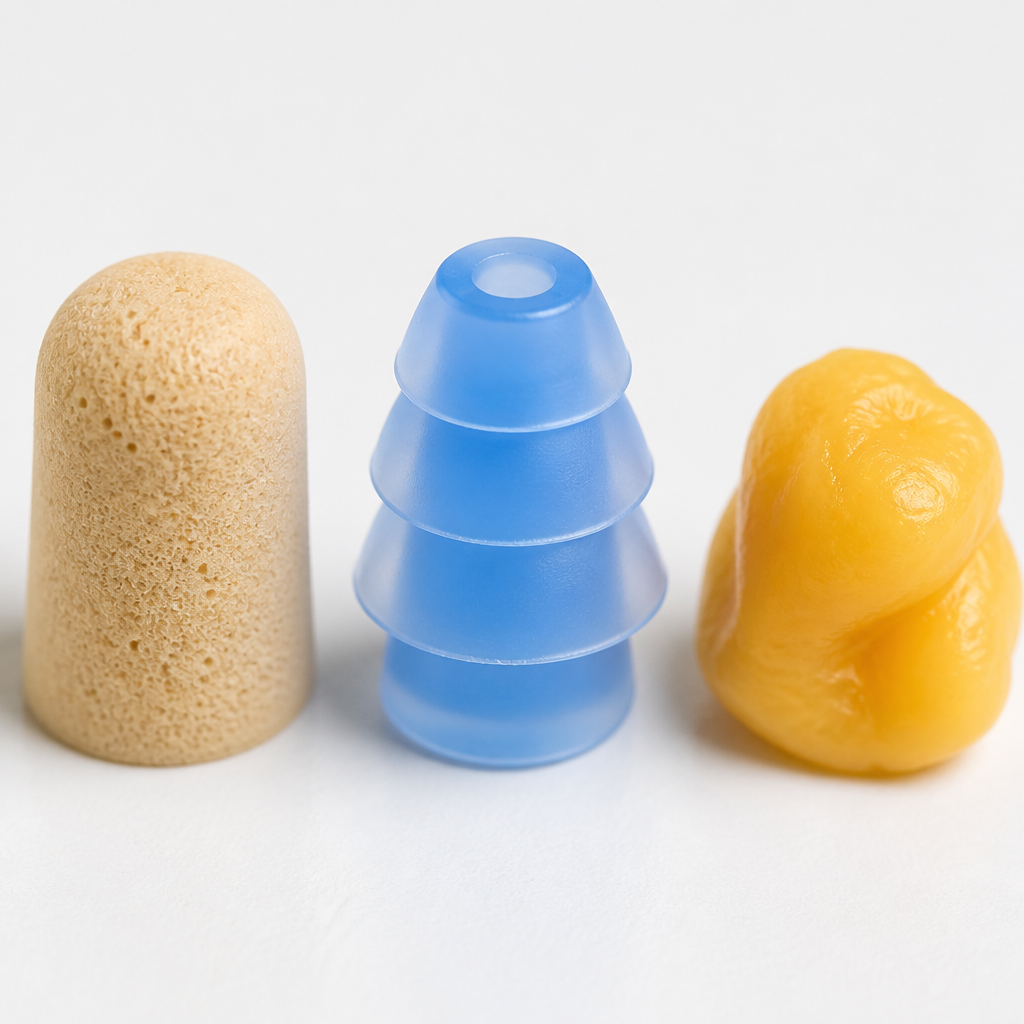
Most people reach for whatever ear plugs are cheapest at the pharmacy and wonder why they wake up at 3am to their neighbour’s music or a snoring partner. The material of the ear plug tip is almost never discussed on the packaging, yet it is the single factor that determines whether you get a real acoustic seal or an expensive placebo. Memory foam ear plug tips are not the default choice simply because they are traditional. They are the default choice because no other material reliably conforms to the irregular geometry of a human ear canal. Silicone flanges and wax putty both have real-world limitations that become obvious the moment you actually try to sleep on your side for eight hours or stand on a noisy construction site for an entire shift.
| Key Insight | Explanation |
|---|---|
| Memory foam expands to fill the ear canal | Unlike silicone flanges, memory foam conforms to the individual contours of each ear canal after insertion, producing a custom-like acoustic seal without custom-moulded tooling. |
| Silicone creates pressure points during side sleeping | Flanged silicone tips are rigid enough to transmit pillow pressure directly into the ear canal. Most side sleepers report discomfort after 3-4 hours, compared to 6-8 hours with memory foam. |
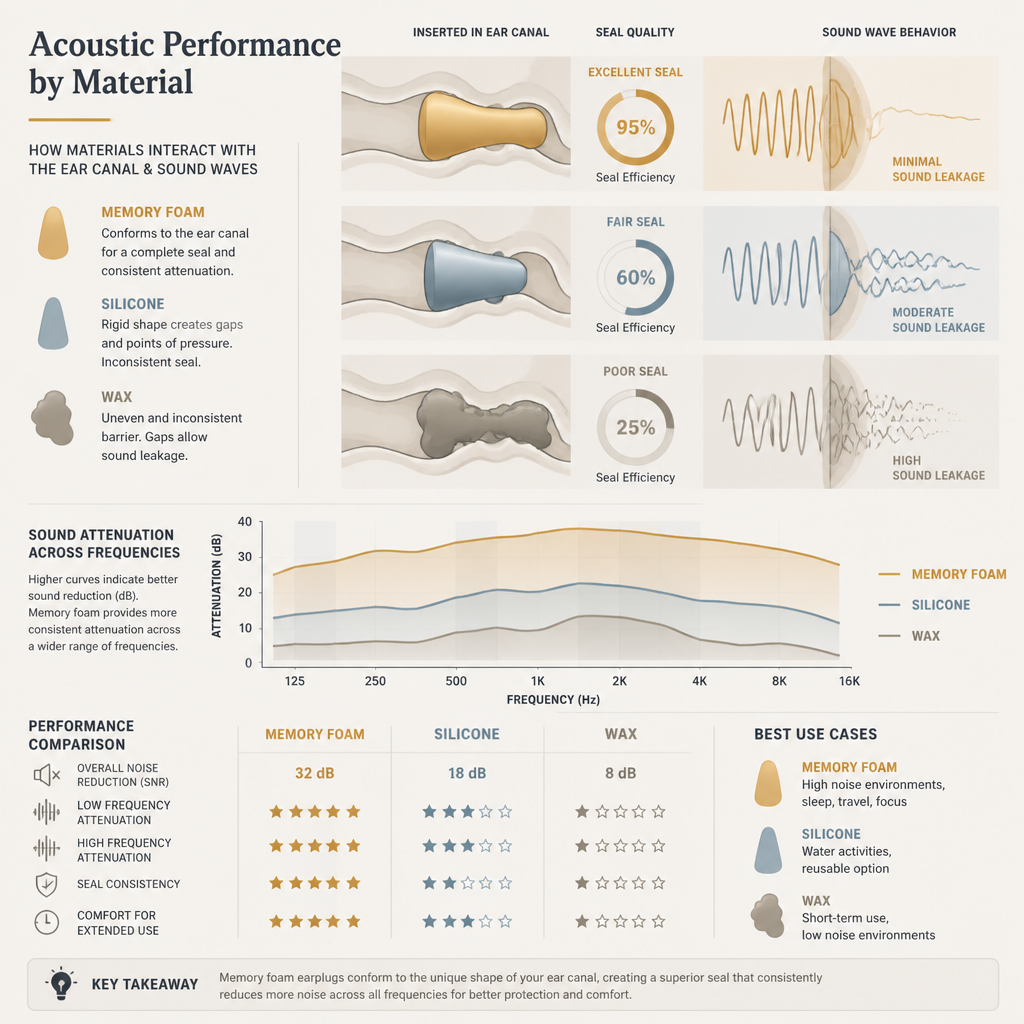
| Wax plugs have significantly lower noise reduction ratings | Wax and moldable silicone putty seal at the entrance of the ear canal rather than inside it, which produces lower NRR figures and leaves low-frequency noise like traffic and snoring poorly attenuated. |
| Foam tip size matters as much as material | A correct-size memory foam tip that fully expands inside the canal outperforms an oversized silicone flange that creates a partial seal at the wrong point. Multiple tip sizes are not a marketing add-on. They are an acoustic requirement. |
| Memory foam softness reduces cumulative ear fatigue | Memory foam is considerably softer than silicone, which matters over long wear periods such as overnight sleep or a full work shift. Harder materials build up pressure-related discomfort that foam does not. |
| Foam tips degrade and require replacement; the ear plug body does not | With a reusable metal-bodied design like ATTENU8, only the foam tips are replaced every 6-8 weeks. The aluminium body is permanent. This is more cost-effective and less wasteful than discarding entire ear plugs. |
| Real-world NRR is always lower than lab-rated NRR | Lab NRR figures assume perfect insertion. With memory foam and a correct insertion technique, real-world attenuation is closer to the rated value than with any other tip material because the seal is more consistent. |
The ear canal is not a uniform tube. It bends, narrows, and widens in ways that differ from person to person and even between your left and right ear. A rigid tip material that relies on a fixed shape, such as a flanged silicone tip, can only seal properly when its geometry happens to match the canal geometry closely enough. That match is inconsistent across a population of users.
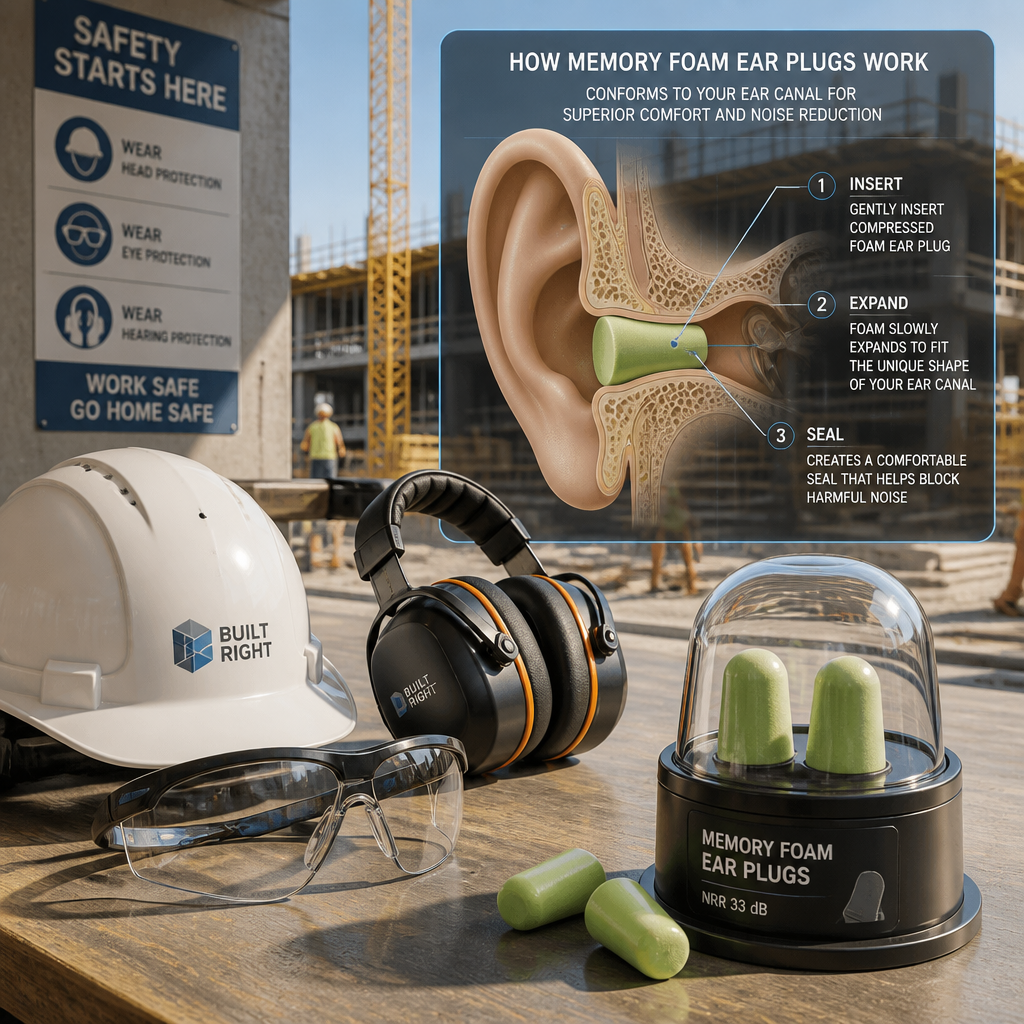
Memory foam works through a different mechanism entirely. You compress the tip between your fingers, insert it while compressed, and the foam then slowly expands against the canal walls. This expansion-based seal conforms to the precise contours of the individual ear canal, filling small gaps that any fixed-shape tip would leave open. Those gaps are where noise enters. Closing them is the entire job of an ear plug tip.
The expansion also creates a distributed, low-pressure contact across the full circumference of the canal rather than concentrated pressure at a few contact points. This is why memory foam tips are more comfortable during extended wear. The pressure is spread over a larger surface area at lower intensity per square millimetre, rather than a silicone flange pressing firmly at two or three discrete points.
Pro tip: After inserting a memory foam tip, press gently on your tragus (the small flap of cartilage at the front of your ear opening) and speak aloud. If your voice sounds hollow and enclosed rather than open and external, the foam has fully expanded and the seal is complete. If you still hear your voice externally, the tip needs to be reinserted deeper.
The slow expansion rate of quality memory foam also gives you time to position the plug correctly before the foam locks in place. Cheaper foam tips expand too fast, locking in before you can adjust the depth. This is why foam formulation quality varies considerably between products, and why the tip material specification matters even within the category of foam.
Silicone ear plug tips are durable and easy to clean. Those are real advantages. The problem is that a clean, durable tip that does not seal properly provides no meaningful hearing protection. Durability is only a virtue if the underlying performance justifies repeated use.
Flanged silicone tips can provide a seal, but the fit is less consistent depending on ear shape and tip size. Because silicone does not expand to match the shape of the ear, tips that feel secure at first insertion can loosen as you move, talk, or shift position during sleep. Memory foam maintains its expanded seal even as the ear canal shifts slightly with jaw movement or head rotation.
This inconsistency has a direct acoustic consequence. Every time a silicone tip loses partial contact with the canal wall, low-frequency noise bleeds through the gap. Low-frequency sounds, specifically traffic rumble, bass from music, and snoring, are exactly the noise profile that most light sleepers and noise-sensitive individuals are trying to block.
Silicone’s firmness becomes a genuine problem during side sleeping. When your ear presses against a pillow, the ear plug body transmits pressure directly into the ear canal through the rigid silicone tip. Most side sleepers report discomfort after 3-4 hours with flanged silicone, compared to 6-8 hours with memory foam. For anyone trying to get a full night of sleep, that difference is decisive.
This is not a minor comfort issue. Discomfort during sleep causes micro-arousals even when they do not fully wake you, reducing sleep quality even if you technically stayed asleep. An ear plug that causes you to remove it at 2am has not protected your sleep.
The goal of an ear plug tip is not to be close to the right shape. It is to become the right shape. Only expanding foam reliably achieves that in a population with varying ear canal geometry.
Wax ear plugs have one genuine advantage: they sit at the entrance of the ear canal rather than inside it, which means they create no inward pressure on the canal walls. For people who find any in-canal insertion uncomfortable, wax is more tolerable. That is where the list of advantages ends.
Wax and moldable silicone putty seal at the canal entrance rather than inside the canal, which produces lower NRR figures and leaves low-frequency noise poorly attenuated. This matters enormously when the noise you are trying to block is a snoring partner or low-frequency traffic rumble, both of which require substantial attenuation in the 125-500Hz frequency range. Surface seals at the canal entrance do not produce that attenuation.
Wax also deforms inconsistently. The material softens with body heat, which can cause it to lose its moulded shape over the course of a night. A tip that has shifted position at 4am is not providing the same protection it provided at 11pm. Memory foam maintains its expanded shape once set, and does not flow or deform under body heat.
Wax is a reasonable short-term option for light, occasional noise. It is not a serious solution for consistent high-attenuation hearing protection, whether for sleep, professional noise environments, or travel.
Pro tip: If you have been relying on wax ear plugs for sleep and they are not working well enough, the issue is almost certainly not the brand. It is the fundamental limitation of a surface seal. Switching to a well-fitted memory foam tip with proper insertion depth will produce a noticeably different result the first night you use it correctly.
The table below compares the three main ear plug tip materials across the factors that matter most to people using ear plugs for sleep, travel, or occupational hearing protection.
| Factor | Memory Foam | Flanged Silicone | Wax / Moldable Putty |
|---|---|---|---|
| Seal mechanism | Expands to fill full canal contour | Fixed flanges press against canal wall | Surface seal at canal entrance |
| Noise reduction consistency | High, consistent across ear shapes | Moderate, varies with ear canal geometry | Low to moderate, limited by depth of seal |
| Comfort for side sleeping | Excellent (6-8 hours) | Poor (pressure after 3-4 hours) | Good (no inward pressure) |
| Low-frequency attenuation | Strong | Moderate | Weak |
| Reusability | 6-8 weeks per tip (with metal body) | Long-term with cleaning | Short-term, degrades quickly |
| Cleanability | Limited (porous material) | Easy (non-porous, washable) | Single-use or very short-term |
| Fit adjustment | Self-adjusts via expansion | Requires correct size selection | Manually moldable at insertion |
Sleep is where material choice produces the most obvious real-world difference. The conditions of sleep, specifically lying still for 6-8 hours, changing position multiple times, pressing one ear against a pillow, and tolerating the plug at low consciousness levels, expose every weakness of silicone and wax that is less apparent during brief daytime use.
Selecting the right ear plug for sleep is not just about grabbing the highest NRR number. Comfort in a side-lying position, material softness, and whether the plug stays sealed as you move all matter more than raw decibel reduction numbers. A plug rated at a high NRR that causes you to pull it out at 2am provides zero protection for the rest of the night.
High-quality memory foam for ear plug tips is engineered to be noticeably softer than standard foam. It compresses with less force and expands slowly, so there is minimal rebound pushing against the ear canal wall when you are lying on your side. This slow, low-pressure expansion is what makes memory foam tolerable for hours rather than minutes.
In practice, a foam tip that expands too aggressively creates the same pressure problem as a firm silicone flange. Foam quality varies, and not all foam ear plugs use the same formulation. The tips on ATTENU8 ear plugs are specifically soft memory foam, designed to maintain a seal without creating the hard pressure points that wake side sleepers before their alarm does.
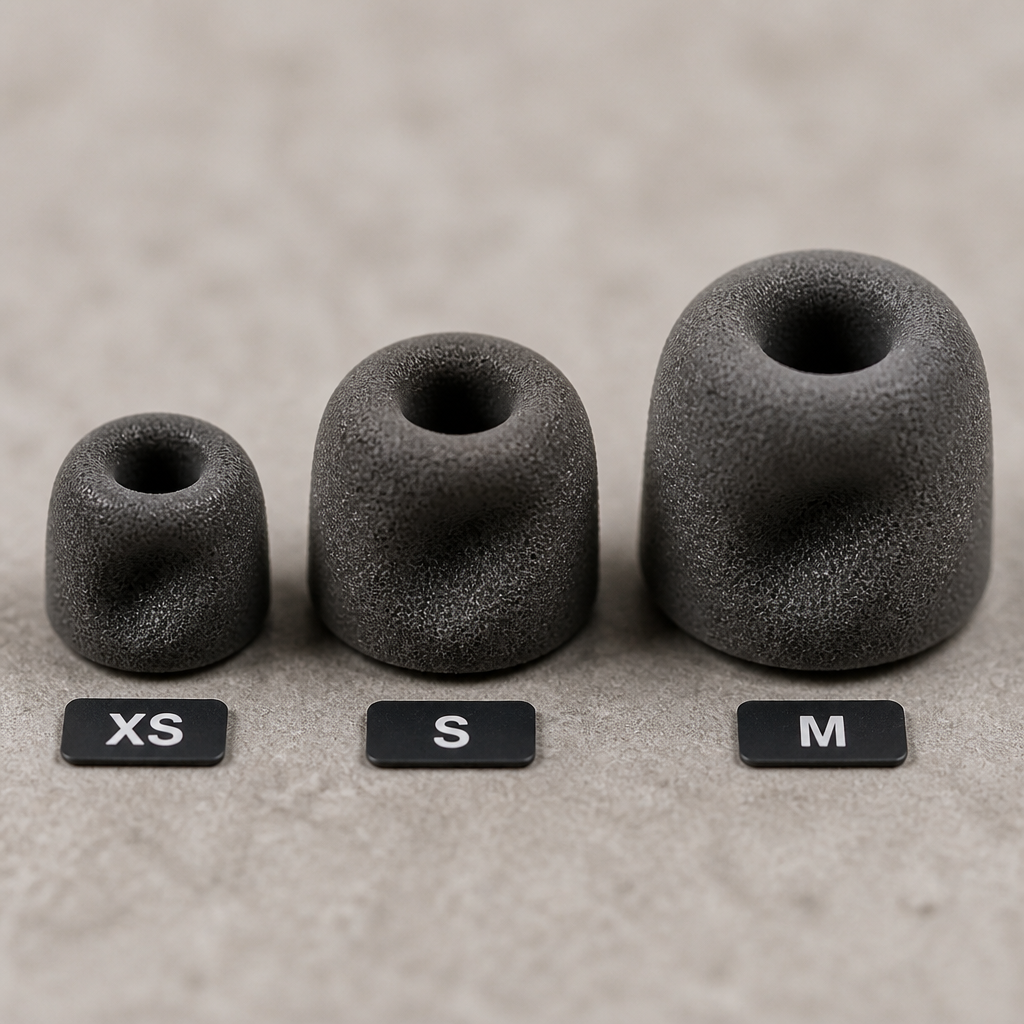
Ear canals are not standardised. Offering a single foam tip size and expecting it to work for every user is acoustically unrealistic. A tip that is too small will not expand to fill the canal. A tip that is too large will not insert deeply enough for a proper seal. ATTENU8 ships with three sizes of soft memory foam tips (XS, S, and M) precisely because the correct size is an acoustic requirement, not a preference. Finding the right size on the first night eliminates the guesswork that causes most new users to abandon ear plugs prematurely.
Construction workers, manufacturing personnel, and military operators face a different set of requirements than light sleepers. Hearing protection must remain effective over long shifts, withstand physical activity, and maintain its seal even when the wearer is sweating or moving frequently. Memory foam handles all of these conditions better than the alternatives.
For professionals who wear ear protection for hours at a stretch, the memory foam tip material reduces the cumulative pressure discomfort that builds over a shift with harder silicone or rigid stem designs. An ear plug that feels fine at 8am and becomes painful by noon is a liability, not protection. Workers will remove it, defeating its purpose entirely.
The ATTENU8 design addresses the professional context specifically. The aluminium body serves as an insertion handle and anchoring structure, while the replaceable memory foam tip creates the acoustic seal. A disposable foam plug in a tool belt pocket degrades before it is even inserted. An aluminium-bodied plug in a carry case does not. The combination of a durable body with a high-performance foam tip produces hearing protection that holds up to the demands of an actual work environment rather than just a lab test.
For noise environments requiring approximately 32dB reduction, which covers most construction and manufacturing settings, this design is genuinely viable. The foam tip provides the seal; the metal body provides the consistency of insertion and the longevity that disposables cannot offer.
One legitimate criticism of memory foam ear plug tips is that they degrade over time. Foam compresses and expands repeatedly with use, gradually losing elasticity and its ability to form a complete seal. This is a real limitation, and dismissing it would be dishonest.
The ATTENU8 approach addresses this limitation directly rather than ignoring it. The aluminium body is permanent and does not wear out. Only the memory foam tips are replaced, at a recommended interval of every 6-8 weeks. This means you replace the component that actually degrades while keeping the component that does not. The alternative, buying new disposable foam ear plugs every few weeks, replaces the entire product including the parts that were still functional.
This also has a comparison advantage over the memory foam vs silicone debate. Silicone tips last longer without requiring replacement, which is a genuine advantage. But the relevant question is not which tip lasts longer in isolation. It is which tip provides better acoustic performance per dollar and per unit of user effort. Memory foam tips that are replaced on schedule maintain their performance. Silicone tips that last longer but provide a less consistent seal may technically outlast the foam, but they also underperform on every night that the fit is not right.
A common mistake is to assume that because silicone is more durable, it is the better long-term investment. Durability only has value when the product is performing its function. An ear plug tip that lasts two years but provides inconsistent noise reduction is not a better investment than one replaced every 6-8 weeks that seals correctly every time.
Yes, for most users and most use cases. Memory foam expands to conform to the individual shape of each ear canal, creating a more consistent acoustic seal than fixed-shape silicone flanges. Silicone can provide a good seal when the tip size happens to match the canal geometry closely, but this consistency is lower across a general population. For sleep, construction noise, and traffic, memory foam’s expanding seal outperforms silicone flanges in practice.
Memory foam ear plug tips maintain their expansion properties for approximately 6-8 weeks of regular use before the foam begins to lose elasticity and the seal becomes less consistent. On a reusable design like ATTENU8, only the tips are replaced at this interval. The metal body is permanent. You can tell a tip needs replacing when it no longer feels like it fully expands against the canal wall, or when noise that was previously blocked starts to come through at familiar volume levels.
Wax ear plugs sit at the entrance of the ear canal rather than inside it, which means there is no inward pressure on the canal walls. This makes them more comfortable for people sensitive to in-canal insertion. The trade-off is that a surface seal at the canal entrance cannot achieve the same attenuation as a deep in-canal seal. Low-frequency noise in particular, including snoring and traffic, requires substantial attenuation in frequency ranges that a surface seal does not reliably cover.
Memory foam is the best ear plug tip material for side sleepers. Silicone flanges are firm enough to create pressure points when your ear presses against a pillow, and most side sleepers report discomfort after a few hours. Memory foam compresses under pillow pressure without creating hard pressure points, which is why memory foam ear plug users can comfortably wear them for a full night. Wax sits outside the canal and avoids in-canal pressure, but provides significantly less noise reduction than in-canal foam.
It matters more with disposables, not less. Disposable foam ear plugs use a basic open-cell foam that degrades quickly and loses its seal after a single use. Silicone disposables are rare. The comparison becomes most relevant when you move to reusable ear plugs, where you are choosing a tip material that will be your daily noise protection for weeks at a time. With a reusable system using replaceable memory foam tips, you get the acoustic advantages of foam combined with the economic and environmental advantages of a durable body.
Yes. Ear canal geometry varies considerably between individuals, and even between a person’s left and right ear. A tip that is too small will not expand to fully contact the canal walls. A tip that is too large will not insert to the correct depth. Both produce a partial seal rather than a full one, reducing real-world noise attenuation substantially. ATTENU8 includes XS, S, and M tip sizes specifically because correct sizing is an acoustic requirement. Try all three sizes and confirm the seal using the tragus-press check described earlier in this article.
Have you switched from silicone or wax to memory foam ear plug tips, and noticed a difference in how much noise actually gets through? Share what you experienced below, because real-world comparisons from different environments are useful to others making the same decision.
Most ear plugs fail not because they are low quality, but because they are the wrong size. You can spend good money on a pair rated at 32dB noise reduction and still wake up to every car alarm, snoring partner, or early-morning construction clatter, simply because the foam tip never formed a proper seal. This ear plug size guide exists to fix that. Whether you are working through ATTENU8’s three included tip sizes for the first time or troubleshooting a fit that has never felt quite right, what follows is a specific, no-nonsense walkthrough of how ear canal anatomy, tip size, insertion technique, and seal quality all interact to determine the noise reduction you actually get, not just the number printed on the box.
The Noise Reduction Rating stamped on every pack of ear plugs is measured in a controlled laboratory under ideal conditions. In practice, the number you see on packaging is the theoretical ceiling, not the floor you can count on. Regulatory bodies including NIOSH recommend applying a significant real-world derating factor to any labeled NRR, precisely because insertion technique and fit vary so much person to person.
A correctly fitted ear plug at a moderate rating will outperform a higher-rated plug that does not seal properly. The seal is the mechanism. Without it, sound bypasses the attenuating material entirely, traveling through the gap between the foam tip and your ear canal wall. No amount of rating points compensates for an air gap.
This is the core problem with one-size disposable foam plugs. They assume a canal geometry that many people, particularly women and smaller-framed adults, simply do not have. ATTENU8’s approach of including three tip sizes, XS, S, and M, with every pair acknowledges what the disposable foam industry largely ignores: ear canals vary significantly enough that a single size is a coin flip for a large portion of the population.
A plug that fits correctly does less work because it does more work. The foam does not need to compensate for gaps it cannot fill if it is already flush against the canal wall.
Before you can choose the right tip size, it helps to understand what you are fitting. The ear canal is not a straight tube. It has a slight curve, and its internal dimensions vary between the outer cartilaginous section, which is more flexible, and the inner bony section, which is not. Most reusable ear plug tips sit in the outer section, which is why material compliance matters so much.
Research into ear canal anthropometry consistently shows that men’s canals are on average longer, wider, and deeper than women’s. The difference between the height and width of the ear canal opening alone can vary by roughly 40% across a population. This is not a minor variation. It means a medium tip that seals perfectly for one person may be loose in a narrower canal and uncomfortable in a wider one.
Beyond biological sex, canal shape also varies by ethnicity, age, and individual anatomy. Two people of identical height and build can have measurably different canal geometries. This is why self-testing with the included sizes, rather than assuming a size based on general body size, is the only reliable method.
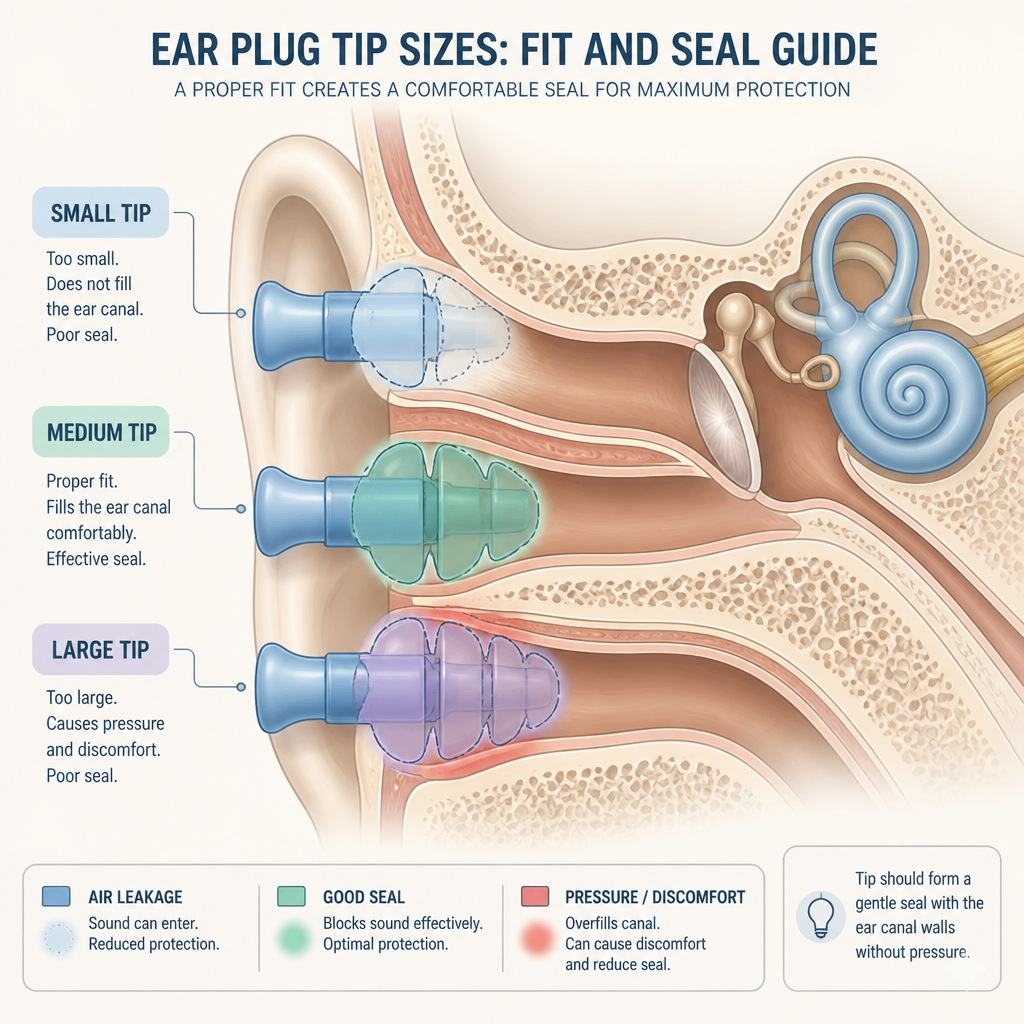
The slight curve of the canal is why pulling the outer ear upward and backward during insertion matters so much. That gentle tug straightens the canal temporarily, allowing the tip to travel further in without meeting the curve as resistance. Skip this step and the tip sits at an angle, pressing on one wall while leaving a gap on the other.
Memory foam is uniquely suited to this anatomy because it compresses for insertion, then expands slowly to conform to whatever shape it encounters. A silicone or rigid flanged tip cannot do this. It either fits or it does not. Memory foam bridges the gap between sizing categories, which is why even a tip that is slightly smaller than ideal can still form an adequate seal if it expands fully before you release it.
ATTENU8 includes all three sizes in every pack precisely so you can test, not guess. The instinct to reach for medium is understandable, but it is wrong as often as it is right. Here is how to work through the selection properly.
Medium is the industry default, but the population skews smaller than most manufacturers assume, especially among women and adults from East Asian backgrounds. Starting with S gives you a reference point. If an S tip feels loose or you can feel slight pressure relief when you press the plug further in, move to M. If S feels snug and slightly difficult to remove after expansion, stay there.
The correct size should require gentle effort to remove, not a firm tug and not a pinch. If a tip slides out without resistance after full expansion, it is too small. If removal causes discomfort, it is probably too large, or you have pushed it too deep.
These are the clearest indicators to act on. A tip that is too small will feel loose, allow you to hear ambient noise clearly even after full expansion, and may gradually work its way out during sleep as you move. A tip that is too large will be difficult to insert correctly, may cause a pressure sensation rather than a seal sensation, and can cause soreness with extended wear.
The correct fit produces a specific sensation: a slight muffling of your own voice as you speak or hum, and a sense of even, distributed pressure around the canal opening rather than a point of pressure on one side. That muffled self-voice test is one of the most reliable quick checks available without specialist equipment.
Pro tip: Try each size in both ears separately. It is not uncommon for a person’s left and right ear canals to differ slightly in diameter. Some ATTENU8 users find they need an S in one ear and an M in the other, and using mismatched sizes is entirely appropriate if that is what seals correctly.
Choosing the right tip size is half the equation. The other half is insertion. A correctly sized tip inserted incorrectly will underperform a slightly smaller tip inserted well. The technique below applies to ATTENU8’s memory foam tips specifically, though the principles apply to any compressible foam tip.
Roll the memory foam tip between your thumb and index finger until it is compressed to roughly half its resting diameter. With standard disposable foam plugs, you would roll the entire plug into a thin cylinder. With ATTENU8’s design, you are compressing the tip only, not the aluminium body. Hold the compression for two to three seconds so the foam has time to settle before you insert it.
A common mistake is releasing compression too early. If the foam begins expanding while you are still positioning it at the canal opening, it will not travel far enough in to seal correctly.
Reach over your head with your free hand, grasp the top of your outer ear, and pull it gently upward and backward. This straightens the canal. While holding this position, slide the compressed tip into the canal with a gentle rotating motion, aiming slightly forward and downward. Do not shove it. Resistance that requires force means the tip is too large or the canal is not straightened enough.
This is the step most people skip. Keep the plug held in position with a light fingertip pressure for a full 20 to 40 seconds while the memory foam expands. Memory foam requires time to return to its resting shape after compression. Releasing before full expansion means the tip may settle short of the canal wall, leaving a gap.
The distinction between memory foam and standard PU foam matters here. Standard foam expands in roughly 10 seconds. Memory foam, which is denser and more heat-responsive, takes longer but conforms more precisely once it does expand. That conforming quality is what delivers the consistent seal across multiple wearings that disposable foam cannot replicate.
Pro tip: Insert your ear plugs while sitting, then gently lie down for sleep rather than inserting them while already lying on your side. Gravity assists the initial positioning, and you avoid the awkward angle that comes from trying to compress and insert while your ear is pressed against a pillow.
Never assume the seal is correct. Run a quick check every time, particularly in the first few uses with a new tip size. It takes under 30 seconds and tells you immediately whether you need to reinsert.
Hum or say a word aloud immediately after insertion. With a good seal, your own voice will sound noticeably louder and more resonant inside your head, as if you are speaking into a closed space. This is the occlusion effect, and it is your primary confirmation that the seal is working. If your voice sounds normal or you can easily hear ambient noise at conversational levels, the seal is incomplete.
Cup both hands firmly over your ears while the plugs are in. If the ambient noise level does not change significantly when you cup your hands, the plugs are doing the work. If cupping noticeably reduces ambient noise beyond what the plugs alone are doing, there is a gap in the seal. Remove the plugs, recompress, and reinsert, or try a larger tip size.
For workers in industrial or construction environments, a proper fit check is not optional. The gap between a correctly sealed 32dB plug and a poorly fitted one under the same conditions can mean the difference between protected hearing and cumulative damage across a long shift.
Understanding how ATTENU8’s memory foam tips compare to the main alternatives helps clarify why size selection and insertion technique have such different levels of importance across plug types.
| Tip Type | Size Adjustability | Seal Quality Dependence on Technique |
|---|---|---|
| Memory foam (ATTENU8 XS/S/M) | High. Three discrete sizes plus foam conforming to canal shape. Tolerates minor size mismatch through expansion. | Moderate. Compression and hold time matter, but the foam compensates for minor technique errors once expanded. |
| Standard disposable PU foam | Low. Single size per product. No size selection without buying a different product. | High. Correct rolling and insertion are critical because the foam expands fast and leaves no time to correct position. |
| Silicone flanged tips (Loop-style) | Moderate. Multiple sizes available, but flanged silicone does not conform, so correct size is non-negotiable. | Low to moderate. Insertion is simpler but relies entirely on the tip diameter matching the canal diameter precisely. |
The practical implication: memory foam rewards patience during insertion but is more forgiving on size. Silicone flanged tips are quicker to insert but punish a wrong size choice immediately. Disposable foam is the least forgiving on technique. ATTENU8’s combination of a rigid aluminium body (which gives you something to hold and position precisely) with slow-expanding memory foam tips threads the needle between the control of flanged designs and the conforming seal of disposable foam.
The performance of a memory foam tip degrades over time for two reasons: the foam loses its elasticity as it is compressed and re-expanded repeatedly, and it accumulates earwax and skin oils that stiffen the surface and reduce its ability to conform. Neither of these processes is immediately obvious, which is why scheduled replacement matters more than waiting for a visible sign of wear.
ATTENU8’s guidance places replacement at every 6 to 8 weeks for regular nightly use. At that point, the foam will typically have undergone enough compression cycles that it no longer expands fully. You may not notice a gradual degradation in seal quality, but it will be there. A simple check: compress the tip and time its return to full shape. Fresh memory foam should recover fully within 30 to 40 seconds. If a tip springs back quickly like standard foam or barely recovers at all, it is past its effective life.
This replacement model is a significant practical advantage over single-use foam plugs, which require complete replacement after every use, and over silicone-tip designs from competitors where you typically replace the entire assembly rather than just the consumable foam component. Replacing only the foam tip keeps long-term cost low and eliminates the waste of discarding functional metal hardware.
Wipe the aluminium body with a damp cloth after each use. Do not submerge the foam tips in water or use solvent-based cleaners on the foam itself. Water softens the foam structure and accelerates breakdown of the cell matrix that gives memory foam its slow-rebound property. A dry wipe after each use is sufficient maintenance for the tips between replacements.
Store the plugs in their case when not in use. Leaving memory foam exposed to sunlight or high heat (such as a car dashboard in summer) will accelerate the degradation of the foam. The aluminium body is indifferent to these conditions, but the tips are not.
Start with S. Medium is the assumed default across the industry but fits a smaller portion of the population than manufacturers imply. S gives you a calibration point. If the seal test fails or the tips feel loose after full expansion, move to M. If S causes discomfort or is difficult to insert, try XS. Most adults find either S or M works well, with XS being the right choice for smaller ear canals, including many women and younger adults.
Yes, and you should if that is what seals correctly. Left and right ear canals are not always the same diameter. If your seal test passes in one ear but not the other with the same size, switching to the next size up in the looser ear is the right call. Using matched sizes when they do not both seal correctly is a false economy.
The tip should sit with most of the foam inside the canal, with only the aluminium body visible or protruding slightly from the ear opening. If you can see or feel the foam tip protruding, it has not traveled far enough in. Re-pull your ear upward and backward, and reinsert with the tip more compressed. You should not feel pain during correct insertion. Discomfort that persists beyond the first few seconds usually means the tip is too large or you have pushed it against the canal wall at an angle.
The foam tips are likely past their effective life. Memory foam loses its slow-rebound characteristic after repeated compression cycles, which reduces how fully it expands against the canal wall. If your plugs worked well initially and have degraded over six or more weeks of nightly use, replacing the tips with fresh ones of the same size is the first step. Technique only explains failures that appear from the start, not gradual degradation over time.
It depends on the ambient noise level you are working in, but 32dB places ATTENU8 among the higher-rated options available. The practical protection you receive will be less than the rated figure under real-world conditions, which is why correct fit and seal are so important in occupational settings. If your workplace requires a specific real-ear attenuation figure for compliance, verify that the fitted plug meets it. For most construction and manufacturing environments, a well-fitted 32dB plug is sufficient protection for the duration of a standard shift.
Yes. Side sleepers put lateral pressure on the ear canal from pillow contact, which can push an oversized tip against the canal wall and cause soreness by morning. Side sleepers often find one size smaller than their seated fit works better, because the pillow compression adds effective diameter. ATTENU8 also includes flat base foam tips designed specifically for side sleeping, which reduce the protrusion that causes pressure points. If standard tip sizing causes ear soreness by morning, try the flat side-sleeper tips before assuming the product is not right for you.
Have you tried multiple tip sizes with your ATTENU8 ear plugs, and did you find your two ears needed the same size or different ones? Share what worked for you in the comments.

