


 0
0

You roll onto your side, finally drift off, and by 3 AM your ear plugs are somewhere in the bedding and your partner’s snoring is back at full volume. If this is a recurring event, you are not doing something wrong. The ear plugs are. Most ear plugs on the market are engineered for upright use or back sleeping, and they fail side sleepers in specific, predictable ways. Understanding the physics of what happens when your head presses a plug against a pillow for eight hours makes the solution obvious. The problem is not your ears. It is the plug’s body shape, material, and profile height.
| Key Insight | Explanation |
|---|---|
| Profile height is the single biggest retention factor | Any plug that protrudes beyond the ear opening gives pillow pressure a fulcrum point to push against, loosening it overnight. |
| Standard foam plugs are designed for upright use | They expand uniformly when you are sitting or standing. Side sleeping introduces lateral shear forces the design does not account for. |
| Pillow pressure acts as a slow lever arm | The longer a plug’s external body, the more mechanical force pillow contact generates. A shorter, concave external body dramatically reduces this effect. |
| Memory foam tips hold a seal better than open-cell foam | Open-cell foam rebounds quickly and can create pressure points. Slow-rebound memory foam conforms to the ear canal shape and maintains contact during positional shifts. |
| Multiple tip sizes are not a luxury, they are a retention requirement | A tip that is even slightly too small for your canal will not seat properly. An ill-fitting tip is the most common reason plugs that work for some people fail others. |
| Insertion depth matters more in side sleeping than in any other use case | Partial insertion is the leading cause of displacement. A plug seated fully at the correct depth has far less external material for pillow pressure to act on. |
| Rigid or high-profile plugs cause pain that forces you to remove them | Even plugs that do not fall out can fail side sleepers by waking them with soreness. Low-profile, soft-interface designs eliminate the pain problem before it starts. |
Side sleeping is the dominant sleep position. Research tracking actual in-bed movement found that people spend roughly 54% of their time in bed on their side, compared to about 37% on their back and 7% on their stomach. That means most people asking “why do my ear plugs fall out?” are side sleepers, and most of the ear plug industry is still not designing specifically for them.
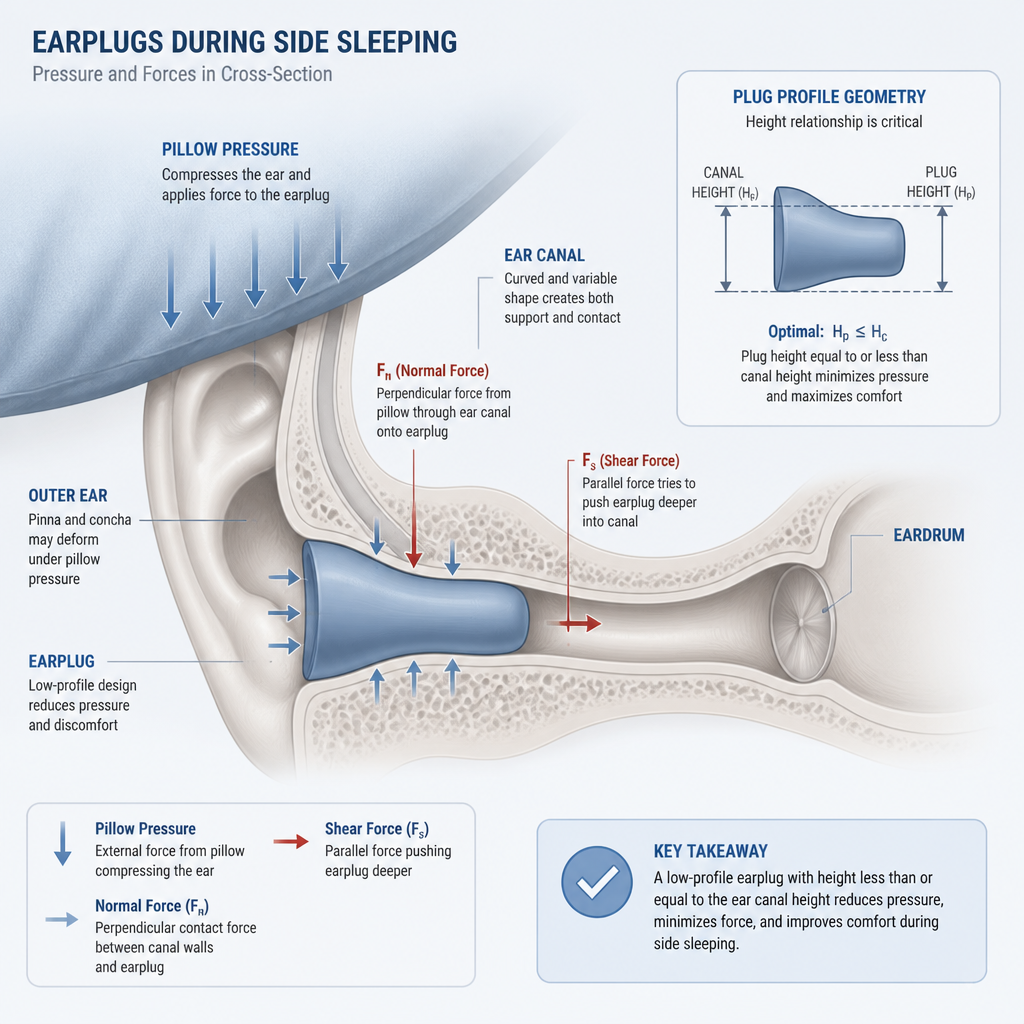
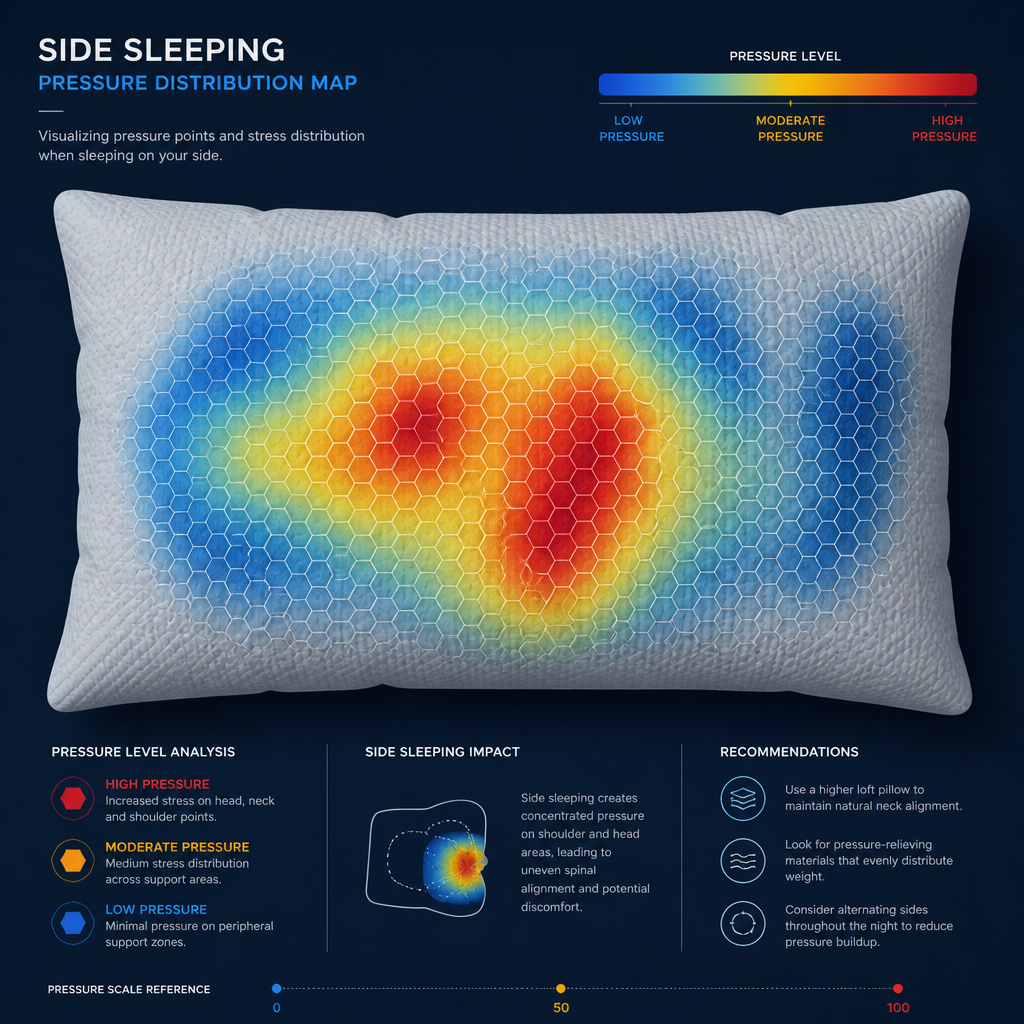
When you sleep on your back, an ear plug faces no lateral pressure. It sits inside the ear canal with gravity working neutrally. When you sleep on your side, the ear pressed into the pillow becomes a compression point. Any plug with external material protruding from the ear opening now acts as a bridge between your skull and the pillow surface. Every time you shift, roll, or press your head deeper into the pillow, that bridge transmits force directly inward, either driving the plug deeper than it should sit or levering it back out.
Back sleepers can often get away with almost any design. Side sleepers cannot. The physics are simply different, and a plug that works perfectly for one sleep position can be genuinely useless for the other. Recognising this is the starting point for finding ear plugs for side sleepers that actually perform through the night.
These are not vague, overlapping causes. Each one is distinct and has a specific fix. If you can identify which failure mode is happening to you, you can solve it.
The most common cause is also the simplest. Many people do not insert foam ear plugs deeply enough for them to stay in place. Foam ear plugs need to be rolled tightly, inserted while still compressed, and then held in place while they expand inside the ear canal. If they are only partially inserted, they are far more likely to pop out during the night. Side sleepers are particularly vulnerable to this because pillow pressure will gradually work a shallow-seated plug out of position even if it seemed secure when you lay down.
Pro tip: After inserting a compressed foam tip, hold your fingertip gently over it for 30 to 40 seconds while it expands. Do not remove your finger early. A tip that has fully expanded against the canal wall has dramatically better retention than one you let go of immediately.
Ear canals vary significantly in diameter and shape. A tip that is too small for your canal will not create the friction fit needed to stay put, and will not reduce sound adequately either. A tip that is too large will be uncomfortable enough that you consciously or unconsciously remove it in your sleep. Consumer Reports notes that an ear plug “that is too small would not reduce sound sufficiently and may fall out,” while one that is too large “will likely not seal the ear and would be uncomfortable.” Getting the size right is a retention requirement, not a comfort bonus.
This is why the availability of multiple tip sizes in XS, S, and M genuinely matters. It is not a marketing feature. It is the difference between a plug that seats correctly and one that will be on your pillow by morning.
This is the failure mode most specific to side sleepers, and it is the one the industry has been slowest to address. When a cylindrical foam plug or a high-profile premoulded plug sits in your ear with material extending past the ear opening, it creates a lever arm. Pillow pressure applies force to the exposed outer end of the plug. The longer that external body, the more torque is generated inside the ear canal, gradually working the plug loose over hours. Side sleepers report finding plugs in their pillow cases, not because they fell out instantly, but because this lever mechanism operated slowly through the night.
A low-profile or concave body design eliminates this mechanism by removing the lever arm. When the outer surface of the plug sits flush with or recessed from the ear opening, pillow pressure has nothing external to act on.
The ear canal is not a static tube. Jaw movement during sleep, including grinding, clenching, or normal relaxation, changes the canal’s shape slightly. This movement can loosen a plug that was initially well-seated. Combined with normal position shifts during the night, this means a plug that relies entirely on friction from tip expansion has a limited window before it migrates. Designs where the body itself anchors against the ear’s natural geometry, rather than relying solely on foam tip expansion, maintain retention through this movement.
Not every ear plug design is made equal for side sleeping. Here are the specific physical characteristics that separate ear plugs that stay in from ones that will be gone by morning.
This is the single most important design variable for side sleeper retention. A concave outer body means less external material extends beyond the ear opening compared to a standard cylindrical plug. A standard cylindrical foam plug creates a hard, unforgiving bridge between your head and the pillow. A low-profile or concave design reduces the lever arm that pillow pressure can exploit, which translates directly to better overnight retention. For a committed side sleeper, this single structural difference can be the deciding factor between sleeping through the night and waking at 3 AM searching for a plug in the sheets.
The concave aluminium body of ATTENU8’s design was developed with exactly this problem in mind. The metal body provides a rigid, dimensionally stable outer structure that does not deform under pillow pressure the way foam does, while the concave profile keeps external protrusion minimal. You can read more about the full design rationale in the ATTENU8 guide on why ear plugs fall out at night.
The contact surface between an ear plug and the ear canal matters as much as the body design. Open-cell foam rebounds quickly, which creates pressure against the canal wall rather than conforming to it. Slow-rebound memory foam adapts to the individual shape of your ear canal and maintains that contact through temperature changes and position shifts. It applies gentler, more consistent pressure, which is both more comfortable and creates a more stable seal. For comfortable ear plugs for side sleeping, the tip material is where the difference between eight hours of silence and a sore, disrupted night is made.
Pro tip: Replace memory foam tips every six to eight weeks, even if they still look intact. Foam loses its slow-rebound characteristics over time, and a tired tip that rebounds too quickly will both lose its seal and create more pressure. Replacement tips are a small cost compared to buying new plugs entirely.
A design that ships with multiple tip sizes acknowledges the reality that one size does not work for all ear canals. For side sleepers specifically, a marginally too-small tip will work itself out under pillow pressure. A marginally too-large tip will cause enough discomfort to disrupt sleep or prompt unconscious removal. Starting with the right size is the foundation everything else builds on.
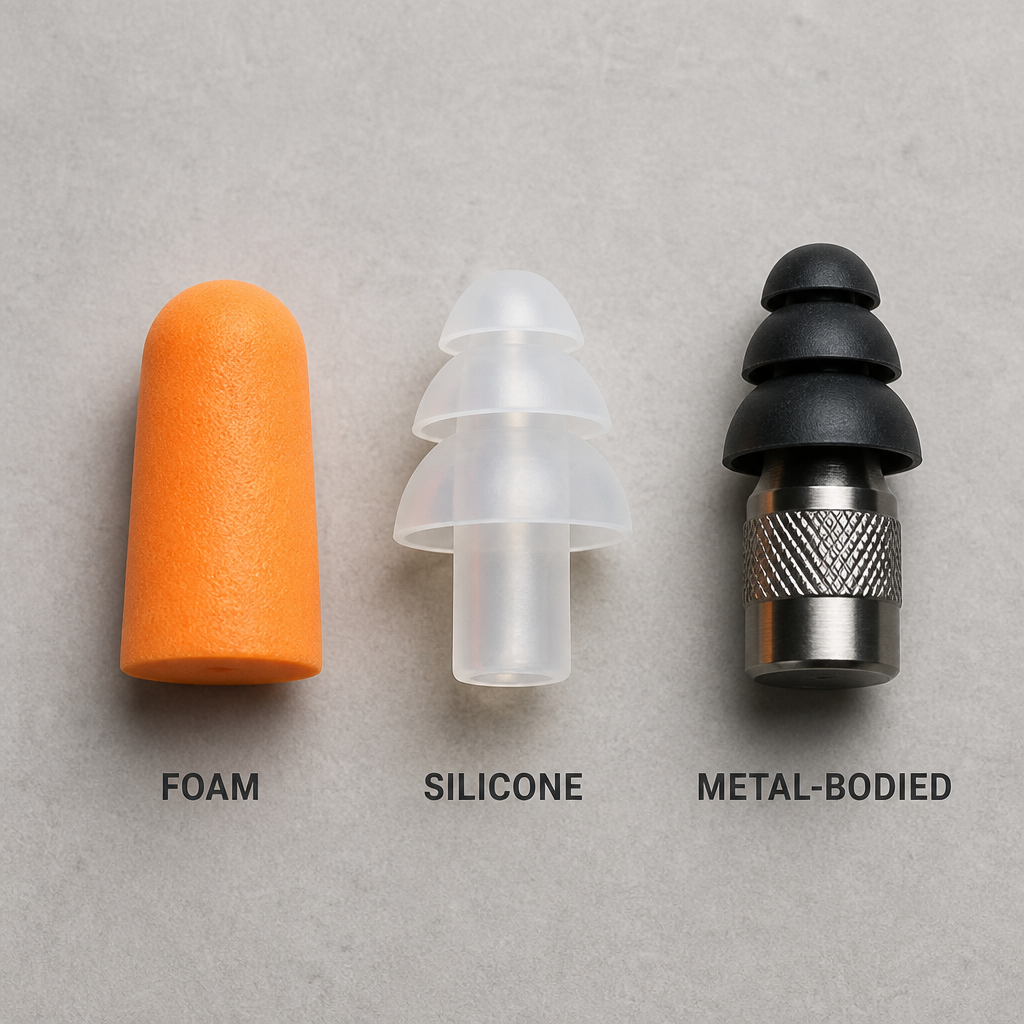
These three approaches represent the realistic options for a side sleeper looking for reliable overnight noise reduction. Each has a different profile height, material behaviour, and retention characteristic under pillow pressure.
| Ear Plug Type | Side Sleeper Retention | Comfort Under Pillow Pressure |
|---|---|---|
| Disposable cylindrical foam | Poor. High-profile cylindrical body creates a lever arm against the pillow. Plugs commonly found in pillow cases by morning. | Variable. Open-cell foam can rebound too aggressively, creating pressure points. Can cause soreness after several hours. |
| Silicone or wax moulded | Good. Flat profile sits flush against the outer ear, removing the lever arm problem. Less protrusion means less displacement. | Good for short periods. Wax and silicone putty designs can become sticky and pick up debris. Not practical for multi-night reuse. |
| Metal-bodied with memory foam tips (e.g. ATTENU8) | Best for side sleepers. Concave metal body minimises external protrusion. Rigid structure does not deform under pillow pressure. Foam tip seats and holds independently of body movement. | Excellent for extended overnight use. Memory foam tip conforms to canal shape without aggressive rebound. Metal body does not compress against cartilage the way rigid foam does. |
Silicone plugs perform better than standard cylindrical foam for side sleepers, but they have a hygiene and longevity problem. Wax plugs in particular pick up lint and dust and are generally single-use or very limited use. The metal-bodied approach solves the retention problem structurally while the replaceable foam tip system addresses both hygiene and comfort. For a detailed material breakdown, see the ATTENU8 comparison of metal vs. foam ear plugs for sleep.
Even the best-designed ear plug will fail if it is inserted incorrectly. Side sleepers need a slightly modified technique from the standard industrial insertion method, which tends to over-seat the plug for overnight use.
Start by rolling the memory foam tip between your thumb and forefinger for three to four seconds until it is compressed. Then, reach your opposite hand over your head and gently pull your ear upward and back to straighten the ear canal. Insert the compressed tip with a gentle rotating motion until the outer edge of the foam sits just at the entrance of the ear canal. Then hold your fingertip lightly over it for 30 to 40 seconds while the foam expands and seats itself against the canal walls.
The common mistake is inserting the plug and immediately laying down before the foam has expanded. When the foam expands against a canal that is already angled by the pillow position, it can seat asymmetrically and create a gap on one side. Insert the plug while sitting upright, let it fully expand, then lay down on your side. This simple sequence, consistently applied, dramatically reduces overnight displacement.
The best approach for side sleepers is to remove the variable of pillow pressure from the insertion equation entirely. Insert while upright, let the tip seal set, then adopt your sleep position. Do not let the pillow be part of the fitting process.
It is also worth testing any new ear plug design during a 30-minute side-lying rest before committing to overnight use. If pressure or discomfort develops within half an hour, it will only worsen over eight hours. That 30-minute test is a practical filter that saves a lot of disrupted nights. For a full breakdown of what else can cause overnight displacement, the ATTENU8 side sleeper’s guide to comfortable ear plugs covers insertion mechanics in detail.
Standard cylindrical foam ear plugs have a high external profile that protrudes from the ear opening. When you sleep on your side, the pillow presses against this protruding section, creating mechanical leverage that gradually works the plug loose over several hours. The foam’s open-cell structure also means it does not hold its shape as consistently as a rigid body under sustained lateral pressure. Low-profile designs with a concave or flush outer surface remove this lever arm and dramatically improve overnight retention.
Yes. The key features to look for are a low-profile or concave outer body that sits flush with the ear opening rather than protruding from it, a slow-rebound memory foam tip that conforms to the canal shape without aggressive expansion, and multiple tip sizes so you can find the correct fit for your specific ear canal. Metal-bodied designs with replaceable foam tips address all three requirements and maintain their shape under pillow pressure in a way all-foam designs cannot.
For most sleep applications, such as blocking a snoring partner, traffic noise, or HVAC sounds, around 30 to 32 dB of noise reduction is effective. Maximum industrial-grade attenuation is not necessary and can actually create a disorientating silence that some people find harder to sleep in. Around 32 dB is the practical sweet spot: it eliminates disruptive environmental noise while leaving some awareness of genuinely important sounds.
For most healthy adults, wearing ear plugs every night is safe when they are inserted correctly and kept clean. The main risks associated with regular use are ear canal irritation from materials that are too rigid or too large, and wax buildup if plugs are worn too deeply for extended periods. Using memory foam tips that sit at the correct depth rather than deep in the canal, and replacing foam tips on a regular schedule, addresses both of these concerns. If you experience soreness or discharge, stop use and consult a doctor.
Memory foam tips should be replaced every six to eight weeks with regular nightly use. Foam loses its slow-rebound characteristics over time even when it still looks intact. A tip that has degraded will rebound more quickly, apply more pressure to the ear canal, lose its seal more readily, and sit less securely under pillow pressure. For reusable metal-bodied ear plugs like ATTENU8, only the foam tips need replacing rather than the entire plug, which makes ongoing maintenance both straightforward and significantly cheaper than buying new disposable plugs continuously.
It is the foundation everything else builds on. A tip that is too small for your ear canal will not create the friction contact needed to stay seated, particularly under pillow pressure, and will also leak sound at the edges. A tip that is too large will create enough discomfort to cause unconscious removal during the night. Matching tip size to your canal is not a fine-tuning step. It is the baseline requirement for any ear plug to work for side sleeping at all.
Soreness during side sleeping is almost always caused by one of three things: a plug body that protrudes and creates a pressure point between your ear and the pillow, a tip that is too large and applying excessive radial pressure inside the canal, or a tip material that rebounds too aggressively. Rigid or high-profile designs create the most soreness because they act as a hard bridge between your skull and the pillow surface. Low-profile, concave-bodied plugs with soft memory foam tips eliminate all three causes simultaneously. If soreness is your primary complaint, profile height and tip material are the two variables to change first.
Have you found a specific design or technique that finally solved the ear plug retention problem for you as a side sleeper? Share what worked in the comments.

