


 0
0

Most people wearing ear plugs are getting less than half of their rated noise reduction. Not because the plugs are faulty, but because the insertion technique is wrong. A plug that sits at the canal entrance rather than inside it can deliver as little as 5 dB of real-world attenuation from a product rated at 32 dB. That gap is not a flaw in the rating system. It is entirely a technique problem. Learning how to insert ear plugs correctly takes about 30 seconds per ear, and it is the single most important thing you can do to get the sleep, focus, or hearing protection you are actually paying for.
| Key Insight | Explanation |
|---|---|
| Pull your ear upward and backward before inserting | This straightens the ear canal, allowing the plug to seat deeply instead of stopping at the outer curve. |
| Hold the plug in place for 20 to 40 seconds | Memory foam and disposable foam both need time to expand and fill the canal. Releasing too early causes the plug to back out and break the seal. |
| Your own voice should sound muffled and resonant | The occlusion effect is your primary signal that the seal is working. If your voice sounds normal, the plug is not seated correctly. |
| Tip size matters as much as technique | A correctly inserted wrong-size tip still leaks. For reusable plugs with multiple tip sizes (XS, S, M), test each size to find the one that seals without pressure. |
| Do not insert while lying on your side | Gravity and pillow angle work against you. Insert while sitting upright, then lie down gently after the foam has expanded. |
| The cupped-hands test catches a bad seal immediately | Cup both palms tightly over your ears after insertion. If the noise drops noticeably, the plug was not sealing and needs reinsertion. |
| Dirty or stiff foam tips will not expand properly | For reusable plugs, replace foam tips every 6 to 8 weeks. Compressed, soiled tips lose their expansion capacity and seal quality drops significantly. |
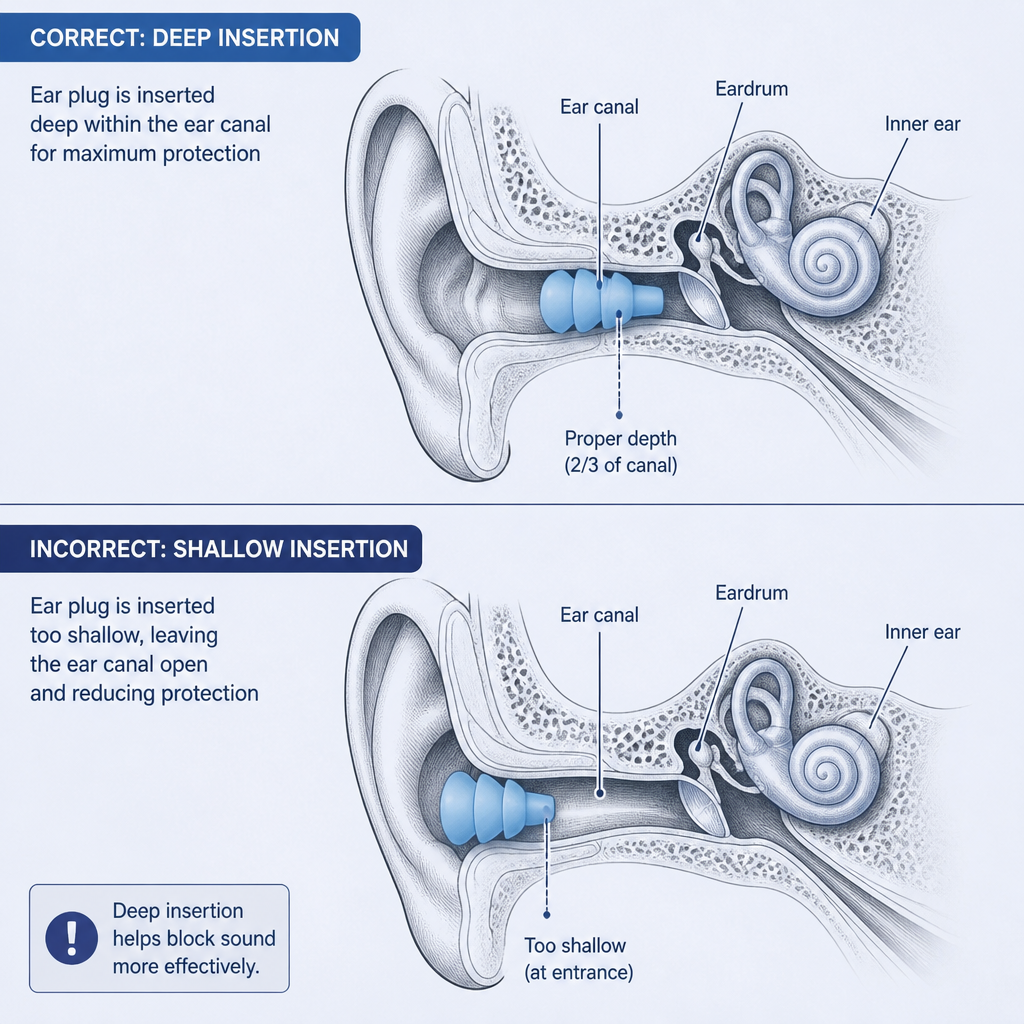
The ear canal is not a straight tube. It curves, and that curve is exactly why the standard push-it-in approach fails. When you insert a plug without first pulling your ear to straighten the canal, the plug bottoms out against the canal wall before it reaches the deeper, narrower section where a real seal forms. The result is a plug that feels like it is in, but leaves a gap that lets in low-frequency noise, which is precisely the range that disrupts sleep and threatens hearing.
The second common failure is releasing the plug too quickly. Foam, whether disposable or memory foam on a reusable plug, needs time to expand against the canal walls. Release it after five seconds and it will spring partially out, sitting high and loose. The rated noise reduction assumes the plug has fully expanded into contact with the entire canal wall, not just the entrance.
Shallow insertion is the single most documented cause of earplug underperformance. A plug that sticks out visibly beyond the ear canal opening is almost certainly not sealing. Properly inserted plugs should sit flush or just inside the canal, with little to nothing protruding.
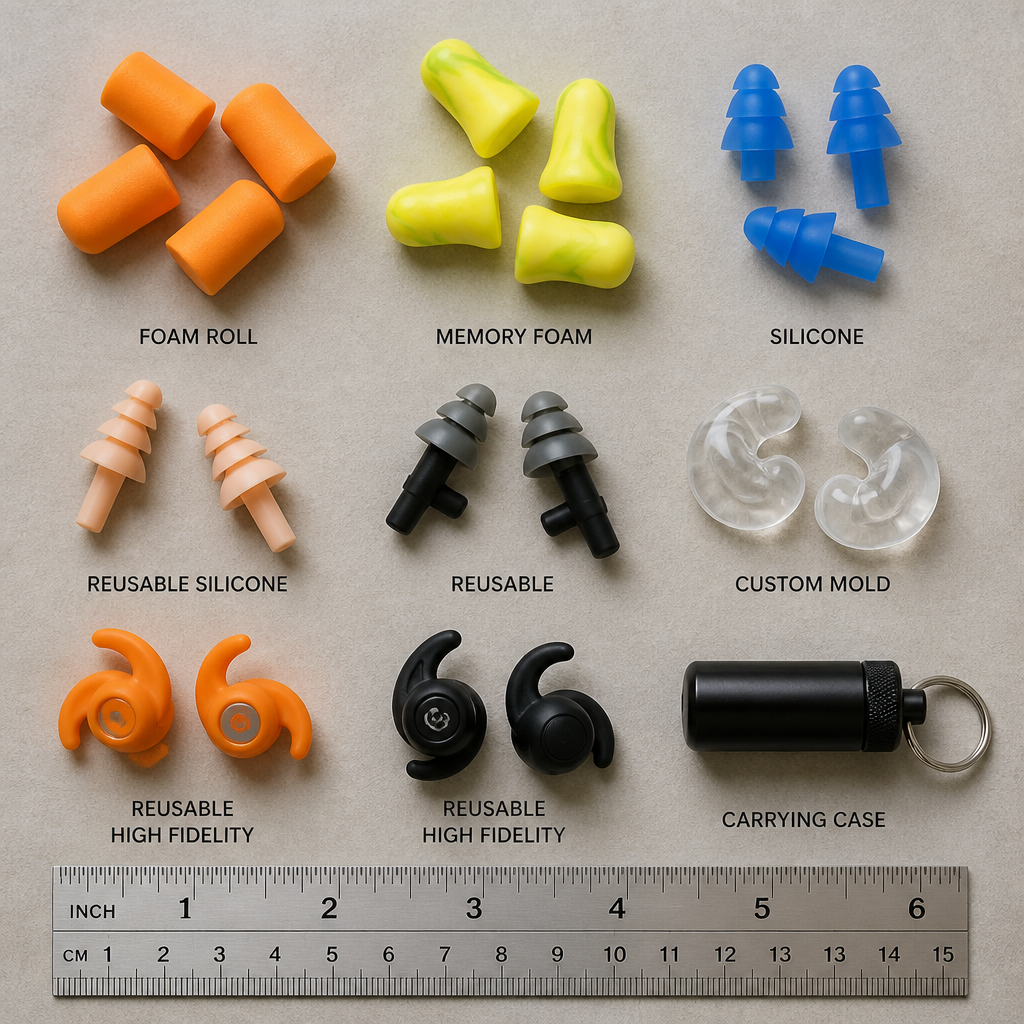
The third failure is sizing. If you are using a one-size plug in a canal that is significantly smaller or larger, technique alone cannot fix it. This is where reusable plugs with multiple tip sizes have a real practical advantage over disposable foam, which offers no size variation at all.
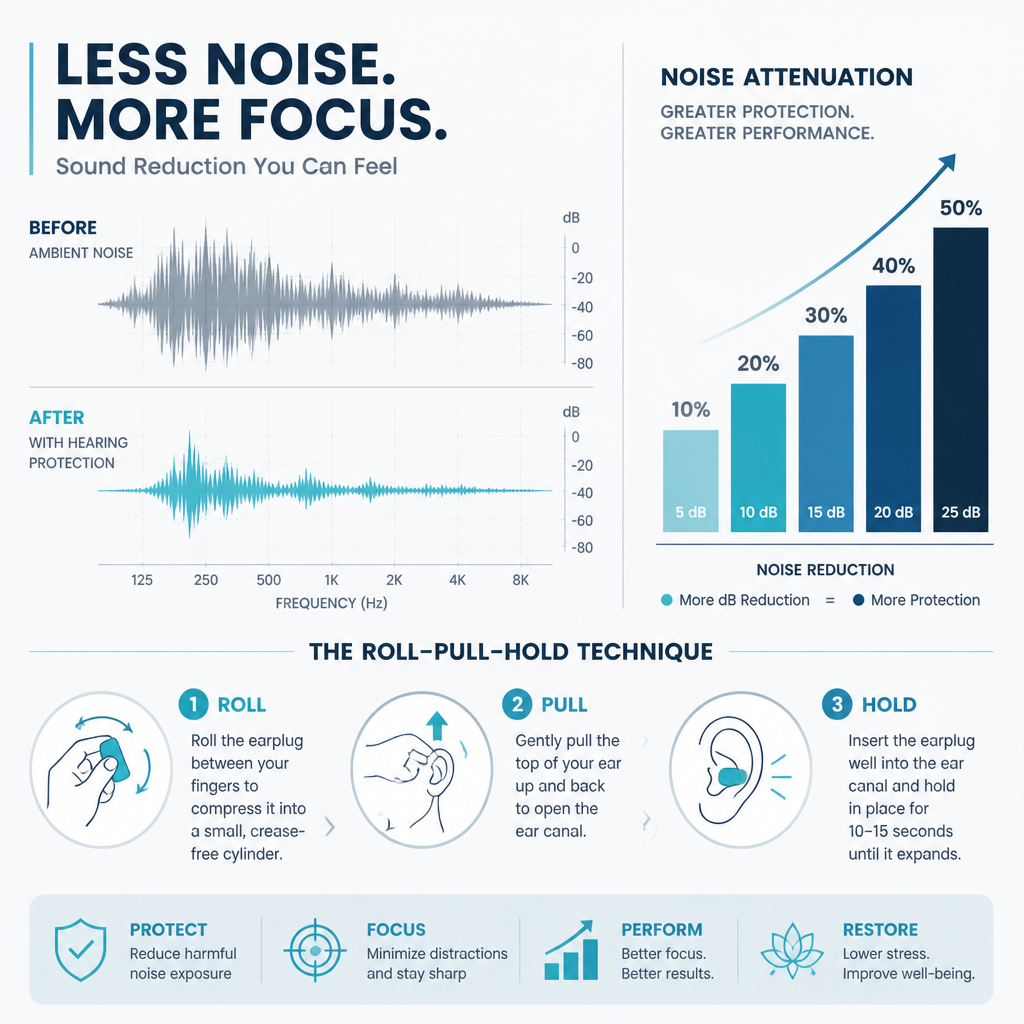
For disposable foam ear plugs and any memory foam tip that needs compression before insertion, the Roll-Pull-Hold method is the correct technique. It is not complicated, but each step has a specific purpose. Skipping any one of the three steps reduces effectiveness significantly.
Using your thumb and forefinger, compress the foam into the thinnest, smoothest cylinder you can manage. Aim for a torpedo shape with no creases or lumps. A creased plug creates channels along its surface that allow sound to bypass the foam entirely. The thinner the compressed cylinder, the deeper it can seat before expanding.
Pro tip: Roll with clean, dry hands. Oils from skin and any moisture change the surface friction of foam and make it harder to compress uniformly. This matters especially for memory foam tips, which are denser than standard disposable foam.
Reach over the top of your head with the opposite hand and grasp the top of your outer ear. Pull it gently upward and slightly backward. You will feel the ear canal open. This straightens the natural curve of the canal and is the step most people skip entirely because it feels unnecessary. It is not optional.
With the canal straightened, slide the compressed plug into the ear canal using a gentle rotating motion and hold it in place with your fingertip. Keep your other hand pulling the ear. Hold for a full 20 to 40 seconds. The foam is expanding against the canal walls during this time. Let go before it finishes expanding and the plug will partially eject itself, sitting too high and breaking the seal.
A properly inserted ear plug should be nearly invisible from the front. If you can see a cylinder of foam protruding from the ear, the plug has not seated correctly and is delivering a fraction of its rated noise reduction.
Reusable plugs like ATTENU8 with a rigid metal body and replaceable memory foam tips use the same fundamental technique, but with a few practical differences. The metal body does not compress, so you are only compressing the foam tip, not the entire plug. This makes the insertion marginally more precise.
Hold the aluminium body between your fingers and compress the memory foam tip with your thumb and forefinger. The tip should reduce to roughly half its resting diameter. Memory foam is denser than disposable foam, so it takes slightly more pressure to compress, but it also holds its shape during compression better, making the torpedo form easier to achieve cleanly.
Rather than pushing straight in, use a slow half-turn rotation as you insert the plug. This distributes the tip evenly against the canal wall and seats it more consistently than a direct push. The rotating motion also helps identify whether you have reached the correct depth, because you will feel the tip engage the canal walls with slight resistance when it is properly positioned.
Pull the ear upward and backward, insert with a gentle rotation, and hold for 20 to 30 seconds. Because the metal body provides a stable handle, you can hold the plug in position without pressing uncomfortably against the canal opening.
Pro tip: Insert your ear plugs while sitting upright, then lie down gently once the foam has expanded. Trying to insert while already lying on your side creates an awkward angle and makes it nearly impossible to pull your ear correctly. Gravity also assists with initial positioning when you are upright.
ATTENU8 ships with XS, S, and M tips for exactly this reason. Start with S and run a seal check. If the cupped-hands test shows leakage, try M. If M creates pressure or discomfort, go back to S or try XS. The goal is the smallest tip size that seals completely without causing pressure. A tip that is too large creates discomfort and can actually compromise the seal by distorting the canal shape. For detailed guidance on selecting the correct size, the ATTENU8 ear plug size guide covers the XS, S, and M fit criteria in detail.
Never assume the seal is correct. Two tests take under 30 seconds combined and will tell you definitively whether the plug is seated. Run them every time until correct insertion becomes automatic. After that, run them whenever you change tip sizes or try a new ear canal position.
With both plugs inserted, cup your palms tightly over your ears and release. If the ambient noise level barely changes when you add your hands, the plugs are sealing effectively. If covering your ears makes the room noticeably quieter, the plugs are not doing their job and need to be reinserted. The logic here is simple: if your hands are doing more work than the plugs, the plugs are not sealing.
Hum quietly or say a word aloud immediately after insertion. With a good seal, your own voice sounds noticeably louder and more resonant inside your head, as if you are speaking into a closed chamber. This is the occlusion effect, and it is a reliable physical confirmation that the seal is intact. If your voice sounds normal or only slightly different, remove and reinsert.
The occlusion effect can feel strange the first few times, especially for new ear plug users. It is not a sign that something is wrong. It is exactly the confirmation you want.
The technique is consistent across use cases, but the context changes some practical details. Sleep, travel, and occupational use each create conditions that affect how you approach insertion.
Sleep is the use case where technique failures hurt the most, because a plug that backs out at 2 AM while you are asleep cannot be reinserted consciously. The priority is achieving a deep, stable seal before you lie down. Insert in a seated position, confirm the seal with both tests, then move carefully to your sleeping position.
For side sleepers specifically, a plug that protrudes will be pushed against the pillow and forced out of position as you move during sleep. Low-profile reusable plugs with a concave aluminium body, like ATTENU8, sit recessed within the ear rather than protruding, which removes the pillow pressure problem entirely. For more on this specific challenge, sleeping on your side with ear plugs covers the design considerations in detail.
Aircraft cabins are noisy, pressurized environments where ear canal pressure changes can affect how a plug seats over time. Insert fresh tips before boarding rather than waiting until the noise becomes annoying, because a rushed insertion in a cramped seat is harder to execute correctly. Confirm your seal while seated at the gate.
Construction, manufacturing, and similar environments require consistent, repeatable insertion technique across an entire shift. Clean hands before insertion matter more in occupational contexts because repeated daily handling increases contamination risk. Workers who replace disposable foam daily are also more likely to have proper expansion capacity than those reusing degraded plugs. Switching to reusable metal-bodied plugs with replaceable tips removes the daily degradation variable entirely, since the tip material stays fresh across multiple uses. The article on loud environments where reusable ear plugs pay off breaks down which occupational settings benefit most.
| Plug Type | Insertion Technique | Common Failure Point |
|---|---|---|
| Disposable foam (e.g. standard single-use plugs) | Roll entire plug into thin cylinder, pull ear up and back, insert two-thirds of the way in, hold 20 to 40 seconds | Not rolling thin enough; releasing too soon before full expansion; reusing a stiff, compressed plug that no longer expands |
| Reusable memory foam tipped (e.g. ATTENU8) | Compress only the foam tip, pull ear up and back, insert with gentle rotation, hold 20 to 30 seconds; confirm seal with cupped-hands and occlusion tests; choose from XS, S, M tip sizes | Skipping tip size selection; pushing in without rotating; not replacing worn tips at the 6 to 8 week mark when foam loses expansion capacity |
| Pre-moulded flanged reusable (e.g. triple-flange silicone) | No rolling required; pull ear up and back, insert with a rocking motion until the outermost flange is flush with the canal entrance | Not pulling the ear during insertion; using the wrong size flange; forcing in too deep and causing pressure pain |
The plug should sit deep enough that it is flush with or just inside the ear canal opening, with little to nothing protruding visibly. If you can see a cylinder of foam sticking out beyond the outer ear, the plug is too shallow and is almost certainly not sealing. Deep insertion is the standard for maximum noise reduction, not shallow or partial insertion.
The most likely causes are not holding the plug long enough during insertion (the foam backs out before fully expanding), using the wrong tip size for your canal, or inserting while already lying down which prevents you from correctly pulling the ear to straighten the canal. Try inserting while sitting, holding for a full 30 seconds, and confirming the seal before lying down. If the problem persists with a particular tip size, try moving up one size.
The occlusion effect is the experience of your own voice sounding louder, more resonant, and slightly bass-heavy when your ear canal is sealed. It happens because bone-conducted sound from your own speech is trapped inside the sealed canal. It is normal, expected, and actually desirable. A sealed ear plug produces a clear occlusion effect. If your voice sounds unchanged after insertion, the plug is not sealing.
Yes. A plug that is inserted without pulling the ear typically sits at an angle against the curved canal wall, creating uneven pressure on one side. This causes the soreness or pressure sensation people often blame on the plug design itself. Correct insertion, with the canal straightened by pulling the ear, allows the foam to expand concentrically against the canal wall with even pressure, which is significantly more comfortable during extended wear.
Every 6 to 8 weeks for regular daily use. Memory foam tips compress and decompress hundreds of times, and the cell structure gradually degrades, reducing the tip’s ability to expand fully against the canal wall. A tip that no longer expands to its original volume cannot form a complete seal, regardless of how well the insertion technique is executed. For ATTENU8 specifically, replacement tips are available in the same XS, S, and M sizes as the original set.
You need to pull your ear for all plug types. The ear canal curves regardless of what type of plug you are inserting. Pre-moulded flanged plugs need the canal straightened so that each flange seats evenly rather than one side pressing against the canal wall at an angle. The pull is a universal step, not specific to foam plugs.
The aluminium body does not compress, so you are compressing only the memory foam tip rather than the whole plug. Memory foam is also denser than standard disposable foam, so it requires slightly more finger pressure to compress, and it expands more slowly and precisely. The advantage is a more consistent, stable seal across repeated insertions. Use the gentle rotating motion during insertion to distribute the tip evenly, and hold for a full 20 to 30 seconds to allow complete expansion.
If you have been wearing ear plugs for years and are now realizing the insertion was never quite right, you are not alone. Share what changed for you after fixing your technique, or ask a question below.
We would love your feedback and any insights you would share with others. What perspective would you add?

