


 0
0

If you have ever stood in a hardware store comparing a pair of foam ear plugs to a set of bulky earmuffs and felt completely lost, you are not alone. The ear plugs vs earmuffs debate matters more than most people realise, because choosing the wrong type means either tolerating needless noise or wearing something so uncomfortable you simply stop using it. Whether you are a light sleeper fighting your partner’s snoring, a construction worker running a jackhammer all day, or someone flying long-haul every few weeks, the right hearing protection is the one you will actually keep wearing.
| Key Insight | Explanation |
|---|---|
| NRR numbers are not face value | NIOSH recommends derating foam earplug NRR values by 50% to reflect real-world fit. A plug rated 33 dB may deliver closer to 16.5 dB for most users in practice. |
| Ear plugs win for sleep | Earmuffs are impractical for most sleep positions, especially side sleeping. Low-profile ear plugs with soft memory foam tips are the only realistic option for overnight use. |
| Earmuffs are easier to use correctly | Correct insertion technique is critical for ear plugs to hit their rated NRR. Earmuffs sit over the ear and are harder to misfit, making them more consistent for casual or supervised workplace use. |
| Glasses reduce earmuff effectiveness significantly | Thick-framed glasses can reduce earmuff NRR by 9 to 11 dB by breaking the seal around the ear cup. Ear plugs are unaffected by eyewear. |
| Dual protection is recommended above 100 dB | OSHA and NIOSH recommend wearing both ear plugs and earmuffs simultaneously when noise exposure exceeds 100 dBA TWA or when a single protector cannot reduce exposure adequately. |
| Reusable ear plugs cut long-term cost and waste | Premium reusable ear plugs with replaceable foam tips cost more upfront but generate far less waste and expense for daily users compared to bulk disposable foam plugs. |
| Fit determines performance more than NRR rating | Multiple studies show that fit quality, not the printed NRR number, is the strongest predictor of actual noise reduction achieved. Multiple tip sizes (XS, S, M) are essential for a proper seal. |
Before comparing ear plugs to earmuffs, it helps to understand what the numbers actually mean. Every hearing protector sold in the United States carries a Noise Reduction Rating (NRR), measured in decibels. A higher NRR indicates greater potential noise reduction. The key word is “potential.”
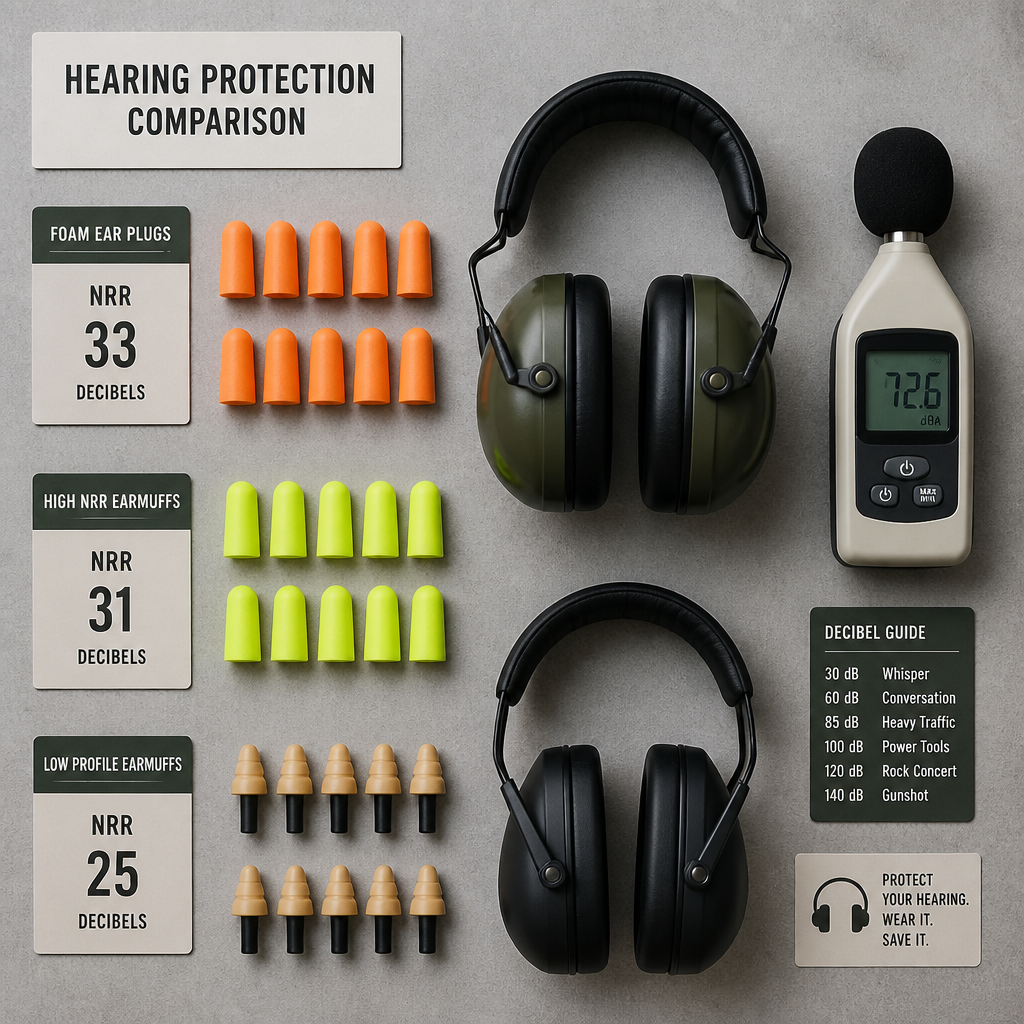
The NRR is derived under laboratory conditions where a trained experimenter fits the hearing protector, not the person who will actually be wearing it. Real-world performance is consistently lower. NIOSH recommends applying a derating factor: 25% for earmuffs, 50% for formable foam ear plugs, and 70% for all other ear plug types. That means a foam ear plug with an NRR of 33 dB is expected to deliver roughly 16.5 dB of real-world protection for the average user. The best-rated earmuffs, with NRR values around 30 to 31 dB, derate to approximately 22 to 23 dB.
On paper, the highest-rated foam ear plugs beat the best earmuffs. In practice, once derating is applied, well-fitted earmuffs often deliver more consistent noise reduction for most users because the fit is harder to get wrong.
OSHA uses its own more conservative formula: (NRR minus 7) divided by 2. So a protector rated 33 dB delivers an estimated 13 dB of effective protection by OSHA’s calculation. Neither formula is perfect, but both point to the same truth: fit and consistency matter more than the number on the box.
Pro tip: If you are evaluating hearing protection for a workplace, use the NIOSH derating formula to estimate real-world protection levels rather than relying on the printed NRR. It gives a more honest picture of what workers will actually experience.
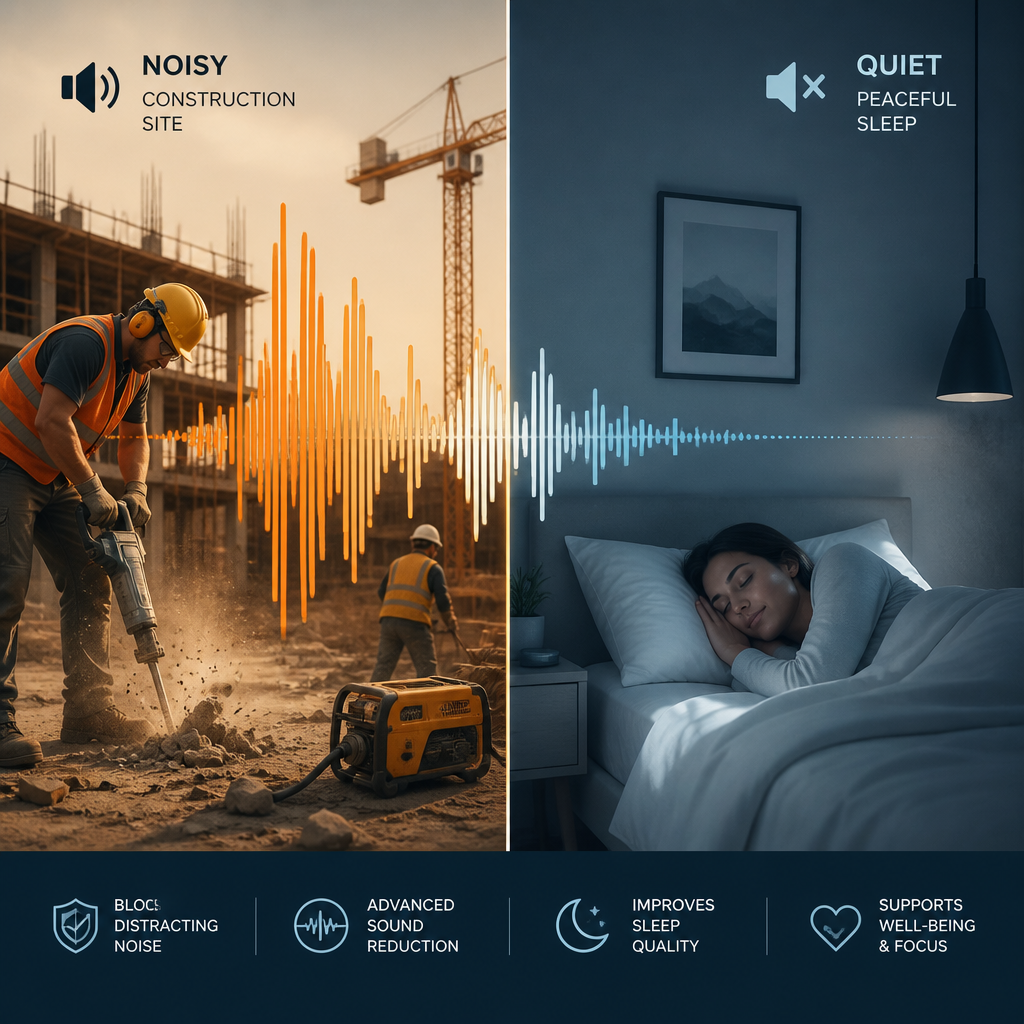
Ear plugs fit inside the ear canal itself, which gives them several structural advantages that earmuffs simply cannot match. They are compact, lightweight, unaffected by heat, and compatible with virtually every other piece of personal protective equipment including hard hats, safety glasses, face shields, and respiratory masks.
When fitted correctly, ear plugs provide strong attenuation across a wide frequency range. They are particularly effective at blocking low-frequency noise when seated optimally in the canal. They keep ears cool, which matters significantly for anyone working outdoors in summer or in high-heat industrial environments. They travel well in a pocket, a case, or a kit bag.
For sleeping specifically, ear plugs are the only type of hearing protection that works in any sleep position, including on your side. No earmuff design is genuinely comfortable with a standard pillow pressing against the ear cup through the night.
The weakest point of any ear plug is the insertion step. Foam ear plugs require rolling, compressing, and holding in place while they expand into the canal. Get this wrong and the NRR drops sharply. Workers with dirty or greasy hands face a real hygiene risk: inserting plugs with contaminated hands can push dirt and bacteria into the ear canal. Single-use disposable foam plugs are most vulnerable here.
This is where the choice of ear plug type matters. Premium reusable ear plugs with a rigid metal or hard polymer body, like those made by ATTENU8, sidestep the dirty-hands insertion problem because the handle sits outside the ear rather than requiring deep finger contact. The memory foam tips do the sealing work without requiring the user to touch the part that enters the canal directly.
Earmuffs cover the entire outer ear with padded cups sealed against the head by an adjustable headband. Their biggest advantage is consistency: they are harder to wear incorrectly than ear plugs, which makes them a sensible default for workplaces where supervisors need to confirm hearing protection compliance at a glance.
Earmuffs are quick to put on and take off, which is useful when workers move frequently between loud and quiet areas. They provide visible confirmation that hearing protection is being worn, which matters for site supervisors managing large teams. For workers who have ear canal irregularities or find any in-canal device uncomfortable, earmuffs are a practical alternative.
The clamping pressure of the headband is a genuine comfort problem for all-day wear. Earmuffs trap heat around the ear, which becomes a real issue in warm environments. They are also susceptible to seal-breaking. Safety glasses with thick temples have been shown to reduce earmuff NRR by 9 to 11 dB by breaking the cup seal. Even a baseball cap worn underneath the headband can cost around 5 dB of protection.
Earmuffs are entirely impractical for sleeping, travel in confined spaces like aircraft seats, or any context where the user needs to lie down. Their bulk also makes them incompatible with many helmets used in construction, military, and motorsports settings.
Pro tip: If your team wears safety glasses with thick frames alongside earmuffs, test the combined NRR with the actual glasses in place. The sealed laboratory NRR figure on the box may be significantly optimistic for your real working conditions.
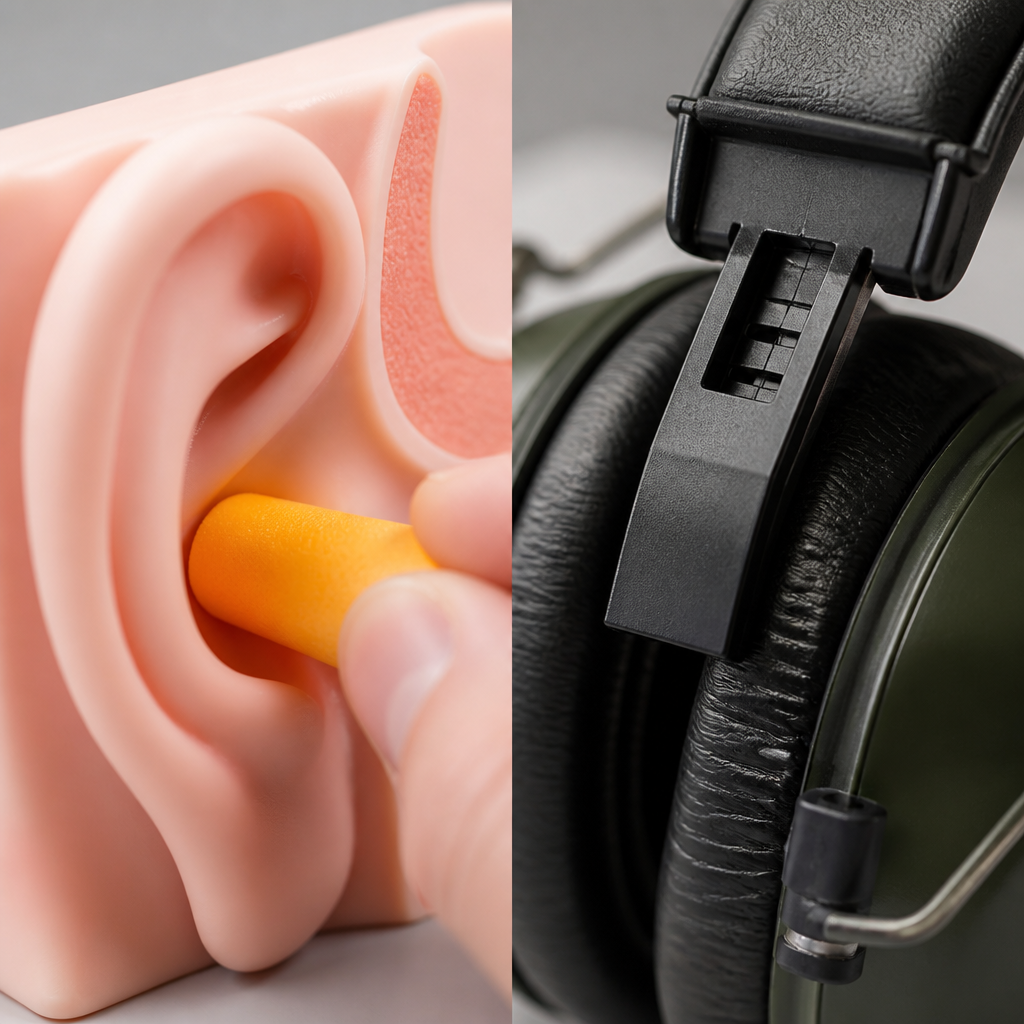
The answer for sleeping is unambiguous: ear plugs. No earmuff is comfortable to sleep in unless you use a specially shaped travel pillow with a cutout for the ear cup, which is a workaround that most people abandon quickly. For side sleepers especially, earmuffs are a non-starter with any standard pillow.
For sleeping, the goal is not maximum industrial-grade noise reduction. Snoring from a partner typically registers between 55 and 65 dB, well within the range that quality ear plugs handle comfortably. Most sleep-focused hearing experts suggest an effective NRR in the range of 24 to 27 dB is sufficient for blocking disruptive bedroom noise, while still leaving the user able to hear critical alerts like alarms.
The more important variable for sleep is physical comfort. Soft memory foam tips that conform to the specific shape of the ear canal are far better than firm pre-moulded silicone plugs for overnight use. A plug that creates pressure points will wake a light sleeper even if the noise does not. Multiple tip sizes, covering at least XS, S, and M, are essential because ear canal diameter varies significantly between adults.
ATTENU8’s metal-bodied reusable ear plugs are designed with exactly this use case in mind. The concave aluminium body keeps the contact point minimal, and the three included memory foam tip sizes allow users to match the tip to their canal rather than forcing a one-size-fits-none compromise. The result is a seal that blocks approximately 32 dB without the discomfort that makes people give up on ear plugs by 3 a.m. You can see the full fit guide at ATTENU8’s fit page.
For occupational settings, the choice between ear plugs and earmuffs depends heavily on the noise level, the other PPE required, and how frequently the protector needs to be removed.
OSHA’s permissible exposure limit (PEL) is 90 dBA over an 8-hour work shift. For every 5 dBA increase above that level, the safe exposure time is halved. A hearing conservation program is required when workers face 85 dBA or above. These thresholds set the floor for protection requirements, not the ceiling for smart practice.
In environments where workers move in and out of noisy areas frequently, where supervision needs visual confirmation of compliance, or where workers lack the training to insert ear plugs correctly and consistently, earmuffs are a pragmatic choice. Construction site supervisors often prefer earmuffs for exactly this reason.
When workers are in continuous loud environments, wearing hard hats, respirators, or welding masks, ear plugs are the only compatible option. Military personnel in particular favour in-canal protection because it works under helmets and does not interfere with headsets. Ear plugs also keep ears cooler in hot industrial environments, which directly affects compliance throughout a shift.
OSHA and NIOSH recommend using ear plugs and earmuffs together when noise exposure exceeds 100 dBA or when a single protector alone cannot bring exposure to a safe level. The combined NRR is not simply additive. The general rule is to add approximately 5 dB to the higher-rated of the two protectors when both are worn simultaneously.
The table below compares the three main hearing protection approaches across the key decision factors most users actually care about.
| Factor | Ear Plugs (Reusable, Memory Foam) | Earmuffs | Ear Plugs + Earmuffs Combined |
|---|---|---|---|
| Rated NRR (best available) | Up to 33 dB | Up to 30-31 dB | Highest-rated + approx. 5 dB |
| Real-world NRR (NIOSH derating) | Approx. 16.5 dB (foam, 50% derate) | Approx. 22-23 dB (25% derate) | Highest real-world + 5 dB |
| Suitable for sleeping | Yes, ideal | No, impractical | No |
| Compatible with glasses | Yes, no interference | Reduced by 2-11 dB with glasses | Reduced by glasses on muff side |
| Compatible with hard hats and helmets | Yes | Limited, helmet-mounted versions only | Yes (ear plugs component) |
| Comfort for all-day wear | High with correct fit and soft tips | Moderate, heat and pressure issues | Low, not designed for extended wear |
| Ease of correct use | Requires technique and right tip size | Easier, harder to misfit | Requires both techniques correctly |
| Best use case | Sleep, travel, all-day industrial use | Intermittent work exposure, supervised teams | Extreme noise above 100 dBA |
Most of the ear plugs vs earmuffs conversation assumes you are choosing between disposable foam plugs and over-ear muffs. There is a third option that changes the calculation significantly: premium reusable ear plugs with replaceable tips.
Disposable foam ear plugs cost very little per pair and are widely available. For occasional use, they make sense. For daily users, the economics shift quickly. The environmental cost is also real: disposable plugs used every night create substantial ongoing plastic and foam waste compared to a reusable design.
Reusable ear plugs with a durable metal or hard polymer body and replaceable soft tips address the main weaknesses of both disposable plugs and earmuffs. You get the comfort and portability of in-canal protection without the hygiene risk of reusing foam plugs that have been rolled and compressed repeatedly with bare fingers. The body stays clean; only the foam tips are replaced, typically every six to eight weeks for a daily user.
ATTENU8 builds this model around a concave aluminium body that is designed to last, paired with memory foam tips that users swap out on a regular schedule. This sits in a different category from budget disposables and from fashion-focused ear plug brands: it is engineering-first hearing protection that happens to be comfortable enough to sleep in. You can read detailed product specs at the ATTENU8 product page or check answers to common fit and hygiene questions on the ATTENU8 FAQ page.
Pro tip: When comparing the long-term cost of reusable ear plugs with replaceable tips against bulk disposables, factor in the time spent inserting foam plugs correctly each time. A poor insertion from a rushed or incorrect technique effectively drops the NRR to near zero, making even cheap protection expensive if it is not working.
On paper, the highest-rated foam ear plugs have a slightly higher NRR than the best earmuffs. In practice, once NIOSH derating is applied, well-fitted earmuffs typically deliver more consistent real-world noise reduction because users are more likely to fit them correctly. Ear plugs beat earmuffs when insertion technique is mastered and tip size is correctly matched to the user’s ear.
Yes, reusable ear plugs with clean, regularly replaced tips are safe for nightly use. The main risks with disposable foam plugs used nightly are hygiene-related: repeated reuse of foam plugs that are not cleaned introduces bacteria into the ear canal. With a reusable metal-bodied design where tips are replaced on a regular schedule, this risk is effectively managed.
Yes, and this is the correct approach when noise exposure exceeds 100 dBA. Wearing both together provides greater protection than either alone. The combined benefit is not simply the sum of both NRR values: OSHA and NIOSH calculate it as the higher-rated protector’s value plus approximately 5 dB.
Almost always, this is an insertion problem. Foam plugs need to be rolled tightly, inserted deep into the canal, and held in place for several seconds while they expand. If the tip is not the right size for your canal, even correct insertion will not create a proper seal. Trying a smaller or larger tip size and slowing down the insertion process resolves this in most cases.
It depends on what other PPE you are wearing. If the job requires a hard hat, safety glasses, and a respirator, ear plugs are more compatible. If the team moves in and out of noisy zones frequently and supervision needs to confirm protection is being worn, earmuffs are practical. For noise above 100 dBA, both together is the correct answer regardless of workflow.
Ear plugs are significantly better for air travel than earmuffs. They are compact, fit under a travel pillow without discomfort, and do not interfere with headrests or neck pillows. Soft memory foam tips provide effective attenuation of the consistent drone of aircraft cabin noise without the bulk or heat of over-ear muffs.
For daily users, every six to eight weeks is a reasonable replacement interval for memory foam tips. The foam compresses and loses its ability to fully expand and seal over time. A tip that no longer springs back to shape after being rolled is no longer delivering its rated noise reduction, regardless of how it looks.
Have you tried both ear plugs and earmuffs in your own noise situation? Share what worked (or did not) in the comments below.

