


 0

Most people buying earplugs focus on the noise reduction rating and stop there. That is a mistake. The number printed on the packaging only tells you what the earplug achieved in a controlled lab setting with trained insertion. What determines whether you actually get close to that rating every single night is the material the earplug tip is made from, and specifically how well it conforms to the unique geometry of your ear canal. Memory foam earplugs outperform alternatives not because of a marketing claim, but because of a specific physical property: they respond to body heat and pressure to fill the canal from the inside out, forming a seal that other materials simply cannot replicate.
| Key Insight | Explanation |
|---|---|
| Memory foam is viscoelastic polyurethane | It responds to both body heat and pressure, softening and conforming to the exact shape of your ear canal rather than holding a fixed shape. |
| Foam NRR consistently outperforms silicone | High-quality memory foam earplugs reach NRR ratings of 28-33 dB. Silicone alternatives typically range from 20-26 dB, a meaningful gap in genuinely noisy environments. |
| The seal is the whole game | A rating means nothing if the plug does not seal properly. Memory foam expands after insertion to fill the canal’s irregular cross-section, while silicone holds a rigid shape it arrived with. |
| Soft earplugs reduce pressure pain for side sleepers | Memory foam compresses under pillow pressure and slowly re-expands. Flanged silicone stays rigid, transmitting that pressure directly into the canal wall, which wakes most people within hours. |
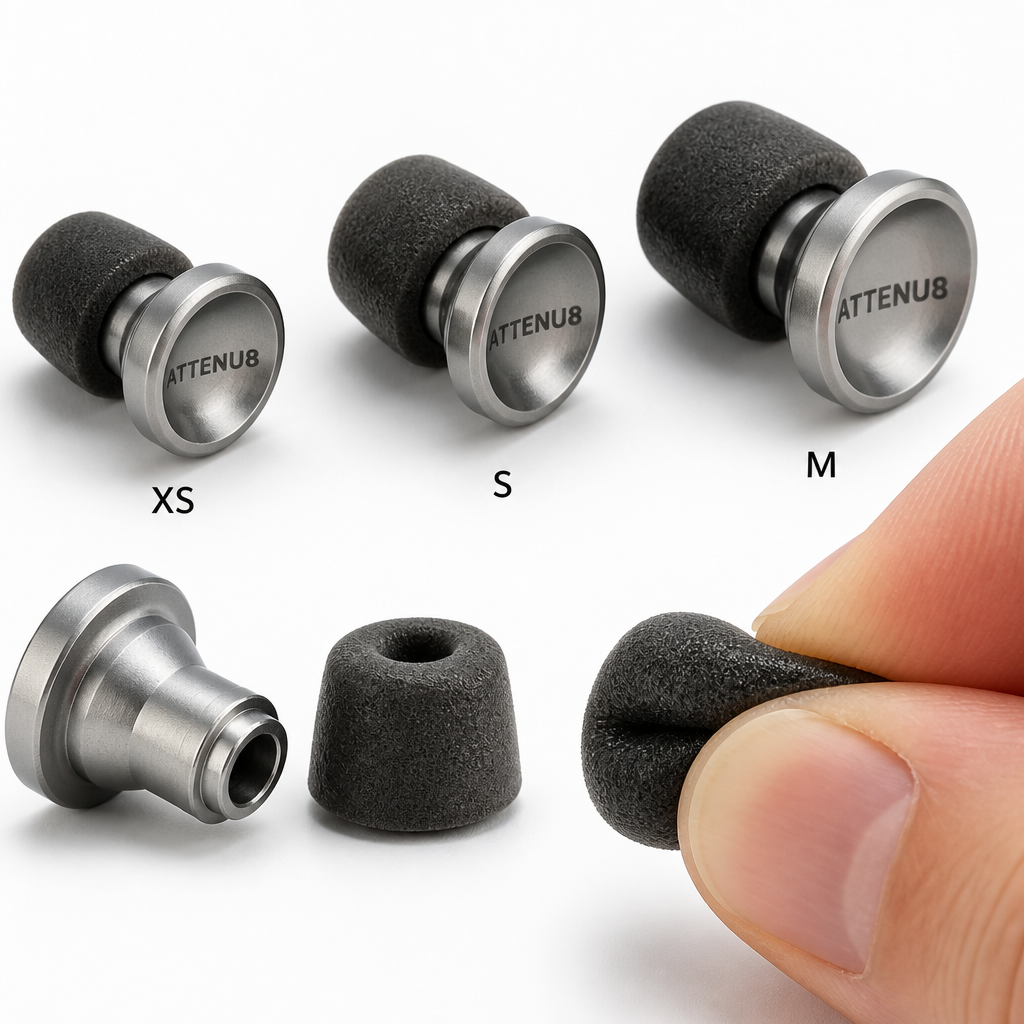
| Tip size selection is non-negotiable | An oversized foam tip causes abrasion; an undersized one breaks the seal. Having three tip sizes available, such as XS, S, and M, is the difference between a tool that works and one that doesn’t. |
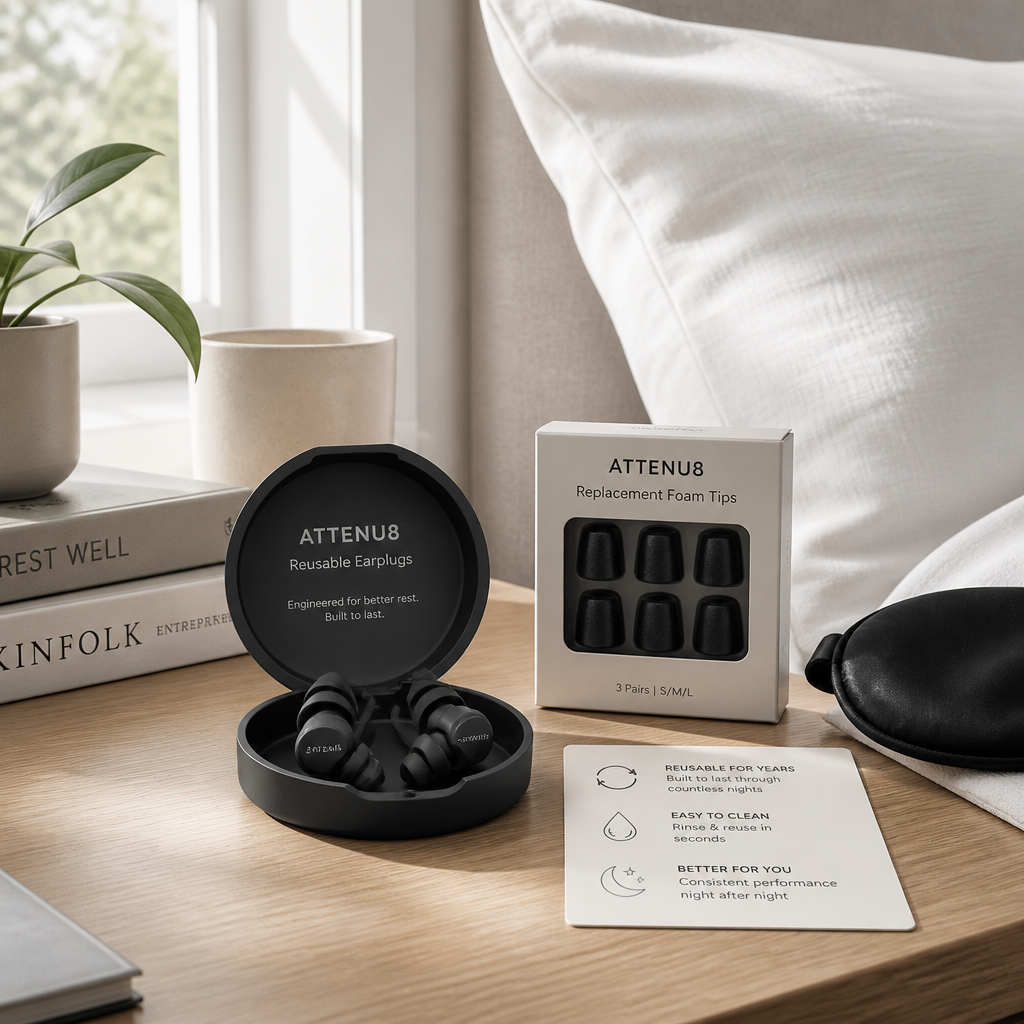
| Reusable foam tips need replacing, not the whole earplug | Memory foam tips degrade over time as they absorb skin oils and ear secretions. Replacing only the tip every 6-8 weeks preserves performance without discarding the entire earplug. |
| Real-world reduction is lower than the lab rating | In practice, most users achieve 13-20 dB of real-world reduction from a 32 dB rated earplug. That is still enough to reduce a loud urban bedroom to comfortable sleeping levels. |
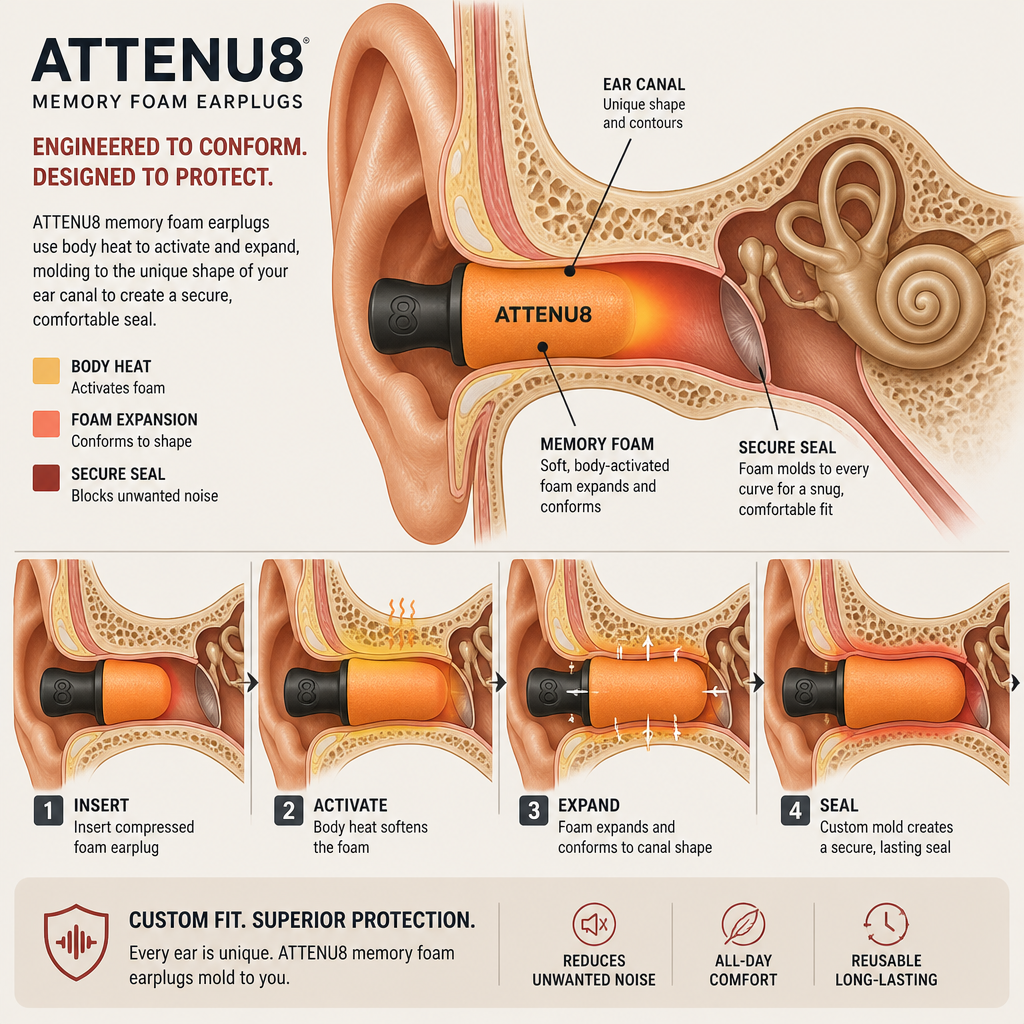
Memory foam is a type of polyurethane foam that responds to body heat and pressure. When exposed to warmth, the open-cell structure softens and slowly conforms to whatever shape is pressing against it. When pressure is removed, it returns to its original form. This combination of properties is described as viscoelastic, meaning the material exhibits both viscous (flow-like) and elastic (spring-back) behavior at the same time.
The material was originally developed for aerospace applications, and its transition into consumer products happened because those properties turned out to be extremely useful anywhere the goal is even pressure distribution and custom fit. Manufacturers eventually applied it to mattresses, pillows, orthotic braces, and, critically for this discussion, earplug tips.
What separates memory foam from standard polyurethane foam is not just density but the responsiveness to temperature. A standard foam earplug expands mechanically after you release the compression. A memory foam tip softens as it warms to body temperature inside the canal, which means it continues to adapt for the first thirty seconds after insertion rather than simply springing open immediately.
The open-cell structure and what it does for noise
The internal structure of memory foam is an interconnected network of open cells. When compressed for insertion, the cells collapse. Once inside the canal and warmed by body heat, those cells slowly re-inflate and the foam presses outward in every direction equally. That outward pressure creates contact with the canal walls across the full circumference, which is what closes the acoustic pathway that sound travels through.
Standard foam achieves a similar effect mechanically, but without the temperature response, the expansion is faster and less controlled. The result is often a plug that seals well in some spots and less well in others, depending on the individual canal geometry. Memory foam’s slower, heat-driven expansion fills in those irregular spots.
Pro tip: When inserting memory foam earplugs, compress the tip fully, insert it, then hold it gently in place for 20-30 seconds while it warms and expands. Releasing too early before the seal has formed is the single most common reason people underperform the rated NRR.
No two ear canals are shaped the same. They vary in diameter, length, curvature, and cross-sectional shape. A rigid material, whether silicone or plastic, can only contact the canal at its outermost point unless it happens to match that canal’s exact geometry by chance. Memory foam sidesteps this problem entirely by conforming to whatever shape it encounters.
The acoustic seal is what blocks sound. Sound travels as pressure waves through air. Interrupting the air column inside the ear canal, from the canal entrance to the eardrum, is what reduces the sound reaching the auditory system. The better the seal, the more complete that interruption. Any gap, even a small one, allows sound to bypass the earplug entirely.
The choice of hearing protection should be based on fit, comfort, and correct noise reduction rating for the environment. A plug that fits correctly and is worn consistently outperforms a higher-rated plug that is worn incorrectly or removed during sleep.
Memory foam’s conforming expansion is particularly effective at low frequencies, which are the hardest to block. Traffic rumble, snoring, HVAC noise, and machinery hum all sit in the lower frequency ranges. A material that fills the canal completely and presses against the walls uniformly provides better low-frequency attenuation than one that seats only at the canal entrance.
Shallow insertion is the most common earplug error. When a foam tip sits at the entrance of the canal rather than inside it, the effective noise reduction drops significantly, particularly for low frequencies. The roll-pull-hold method recommended by occupational safety researchers exists because it gets the tip seated deeply enough for the foam to seal the full canal cross-section rather than just the opening.
This is one reason a well-designed memory foam tip on a structured body performs more consistently than a bare foam cylinder. The body provides a reference point for insertion depth and gives you something to grip and hold steady while the foam expands. Without that structure, users often push the tip in too shallow, feel the expansion at the entrance, and assume the job is done.
Silicone earplugs are the most common alternative to foam, and they are genuinely good at some things. They are washable, reusable, and comfortable for shorter wear periods. But on the measures that matter most for sleep and hearing protection in loud environments, the comparison is not close.
Foam earplugs, including memory foam, frequently achieve NRR ratings of 30-33 dB. Silicone earplugs typically range from 20-26 dB. That gap of roughly 7-10 dB is not a rounding error. On a logarithmic scale, 10 dB represents a tenfold change in sound intensity. The practical difference between a 22 dB and a 32 dB earplug is the difference between muffling a snoring partner and actually sleeping through the night.
| Property | Memory Foam Tips | Silicone Earplugs |
|---|---|---|
| Typical NRR / SNR rating | 28-33 dB | 20-26 dB |
| Seal mechanism | Expands to fill canal from inside | Seats at canal entrance or flanges at discrete points |
| Low-frequency attenuation | Strong, especially with deep insertion | Moderate, weaker at low frequencies |
| Comfort for side sleeping | Compresses under pressure, re-expands slowly | Remains rigid, transmits pillow pressure into canal |
| Adaptation to canal shape | Full conforming expansion to canal geometry | Depends on flanged fit at predetermined points |
| Longevity per tip/plug | Tips replaced every 6-8 weeks | Washable, longer tip life but lower performance throughout |
Silicone does hold one genuine advantage: it maintains its noise reduction more consistently over repeated use without material degradation. Foam, including memory foam, can permanently compress with extended use, which is why tip replacement on a defined schedule is not optional, it is the maintenance requirement built into the format. A silicone plug that delivers 22 dB reliably for months may outperform a foam tip that degraded to 15 dB effective performance because nobody replaced it.
The correct answer to “memory foam vs silicone earplugs” is therefore: memory foam for maximum noise reduction and sleep comfort, silicone for occasional use where convenience matters more than peak attenuation.
Pro tip: If you share a sleeping environment with a partner who snores, silicone earplugs will reduce noise but are unlikely to block low-frequency snoring sounds effectively enough to stop sleep disruption. Snoring peaks between 50 Hz and 500 Hz, which is exactly the frequency range where silicone underperforms foam most sharply.
The word “soft” in the context of soft earplugs is doing more work than it looks like. Softness is not just a comfort preference. It is a functional requirement for overnight use, particularly for anyone who sleeps on their side.
When you lie on a pillow, pressure transfers from the pillow surface through your outer ear and into the ear canal. A rigid earplug sitting in that canal becomes a pressure point. Most side sleepers using flanged silicone or harder earplug formats report discomfort within three to four hours. Memory foam, because of its viscoelastic properties, compresses slowly under pillow pressure and re-expands just as slowly. The ear does not experience a sharp pressure spike. It experiences a gradual, manageable compression that the material itself absorbs.
The shape of the earplug body also matters. A concave, low-profile design that sits flush with or slightly below the outer ear creates far less leverage when the pillow pushes inward compared to a protruding cylindrical earplug. The geometry of the housing is what makes a high-NRR foam tip wearable for a full eight-hour night rather than just the first few hours of it.
Light sleepers and noise-sensitive individuals face a compounding problem. They wake more easily from noise, which is why they reach for earplugs in the first place. But they also tend to be more sensitive to physical discomfort, which means an earplug that causes canal pressure or skin irritation will wake them just as reliably as the noise it was meant to block.
Memory foam distributes pressure evenly across the entire contact surface with the canal wall rather than concentrating it at a few points. This is the same property that makes memory foam mattresses useful for pressure relief. Applied at earplug scale, it means the canal wall is never experiencing a sharp localized force, it is experiencing gentle distributed contact that most people stop noticing within minutes of insertion.
Standard disposable foam earplugs are made from the same polyurethane foam family, but they are engineered for single use. They are not built to maintain their acoustic properties after contact with skin oils, ear secretions, and repeated compression cycles. In practice, a disposable foam earplug left in a pocket or toolbox degrades before it is even inserted, losing the cellular structure that allows it to expand correctly.
Reusable memory foam tips, paired with a durable body, solve this problem by separating two functions. The body, whether metal or hard plastic, provides the structure, grip, and insertion mechanics. The foam tip provides the seal. When the foam tip begins to degrade, typically after six to eight weeks of regular use, only the tip is replaced. The body remains. This is a fundamentally different cost and waste model than disposable earplugs.
The ATTENU8 design applies this principle using a concave aluminium body. The density contrast between the metal body and the memory foam tip creates an additional acoustic benefit: different materials attenuate sound differently, and the combination provides better low-frequency attenuation than a uniform foam material alone. Three tip sizes, XS, S, and M, allow genuine fit customization rather than forcing every ear canal into one diameter.
Memory foam tips accumulate skin oils and ear secretions with each use. These substances gradually fill the open-cell structure, reducing the foam’s ability to compress for insertion and expand to form a seal. A tip that no longer expands reliably is a tip that no longer seals reliably, regardless of what the original NRR rating was.
Replacing tips on schedule, rather than waiting until they visibly deteriorate, is the correct approach. The external appearance of a memory foam tip often looks acceptable well past the point where its acoustic performance has meaningfully declined. Set a calendar reminder every six to eight weeks. Do not rely on the tip looking dirty as your trigger for replacement.
Memory foam tips perform best when the insertion technique is correct and the tip size actually matches the canal. These two factors account for most of the gap between a rated 32 dB NRR and the 13-20 dB real-world reduction most users experience. Closing that gap is entirely within the user’s control.
Start with tip size selection. Insert a medium tip and note whether you feel pressure or whether there is no resistance at all. Pressure suggests the tip is too large for your canal diameter; no resistance suggests it is too small and the seal will be incomplete. The correct size sits snugly in the canal with light, even contact around the full circumference. Most people find their correct size on the first or second attempt when three options are available.
For insertion: compress the tip fully between your thumb and index finger, reach the opposite hand over your head to gently pull the outer ear upward and backward to straighten the canal, then insert the compressed tip and hold it in position for at least 20 to 30 seconds. The warmth from your finger contact begins the expansion process. Releasing before that process completes is where most people lose performance.
Pro tip: Test your seal by cupping both hands firmly over your ears immediately after insertion. If the earplug is sealed, the sound level should drop noticeably when you cup your hands compared to when you release them. If there is no change, the tip has not sealed and you need to re-insert or size down.
For professionals using earplugs in occupational settings, the same insertion principles apply, but consistency matters more. An earplug inserted correctly on Monday and carelessly on Tuesday means your protection level varies daily. Build the insertion routine until it is automatic, not something you rush through before walking onto a loud work floor.
Memory foam is a type of polyurethane foam manufactured with additives that make it viscoelastic. The “viscoelastic” description means it is both viscous, responding to pressure with a slow flow-like deformation, and elastic, returning to its original shape once pressure is removed. The open-cell structure within the foam is what allows it to compress for insertion and then expand again as it warms to body temperature.
For most sleep applications, yes. Memory foam earplugs consistently achieve higher noise reduction ratings than silicone alternatives, with foam typically rated at 28-33 dB compared to silicone’s usual range of 20-26 dB. More importantly for sleep, memory foam compresses under pillow pressure and slowly re-expands rather than remaining rigid, which makes it significantly more comfortable for side sleepers over a full night.
With regular nightly use, memory foam tips typically maintain good acoustic performance for around six to eight weeks. The degradation is driven by the accumulation of skin oils and ear secretions in the open-cell structure rather than visible wear. The tip may still look acceptable past this point, but its ability to compress cleanly and expand to a full seal has usually diminished. Replacing on a schedule rather than waiting for visible deterioration is the correct approach.
The right size sits snugly in the canal with even contact around the full circumference, with no feeling of painful pressure and no slipping or loose fit. With three tip sizes available, such as XS, S, and M, most people identify their correct size within one or two trial insertions. If you feel significant pressure or ear canal pain, size down. If the plug falls out or provides noticeably less noise reduction on one side, size up. Note that your two ear canals may not be the same size.
Yes, provided the rated noise reduction is appropriate for your specific noise environment and the earplug meets any relevant regional occupational safety standards. Memory foam earplugs rated at approximately 32 dB cover most construction, manufacturing, and industrial settings. The key variable is consistent, correct insertion. An earplug worn incorrectly provides a fraction of its rated protection. Building a reliable insertion routine is as important as the rating itself.
The pressure sensation felt immediately after insertion is the foam expanding against the canal walls. This is the seal forming, not a sign of poor fit. For most people the sensation fades within one to two minutes as the ear adjusts to the contact. If pressure persists or intensifies rather than fading, the tip size is likely too large. Persistent canal pain after removal is a signal to size down or consult a hearing health professional.
Yes, and they are genuinely well-suited to both. For sleep, the softness and conforming seal provide comfort and noise reduction through the night. For travel, the same properties block aircraft cabin noise and the lower-frequency rumble of engines that silicone earplugs handle less effectively. A reusable design with a carrying case is practical for both contexts without requiring you to carry a separate earplug for each use case.
Have you made the switch from disposable foam or silicone earplugs to memory foam tips, and if so, what difference did you actually notice in your sleep quality or hearing protection? Share your experience in the comments below.

