


 0
0

Noise-induced hearing loss is one of the most common occupational injuries in manufacturing, and it is entirely preventable. According to the CDC, around 46 percent of manufacturing workers have been exposed to hazardous noise, with roughly 14 percent already carrying measurable hearing loss before most of them ever file a single workers’ comp claim. The bitter irony is that the standard answer to this problem, cheap disposable foam ear plugs for manufacturing workers, is also one of the biggest reasons compliance breaks down on the factory floor. Workers pull them out halfway through a shift because they ache, lose their shape, or simply stop sealing properly. This article cuts through the noise, literally, on what industrial hearing safety standards actually demand, where conventional protection falls short, and what a durable, well-fitted earplug can actually do for an eight-hour shift.
| Key Insight | Explanation |
|---|---|
| OSHA’s action level is 85 dBA over 8 hours | Any worker consistently exposed at or above 85 dBA must be enrolled in a formal hearing conservation program, including audiometric testing and access to hearing protection at no cost. |
| Real-world protection is lower than the label NRR | NIOSH recommends derating manufacturer NRR values by 50% for typical users to estimate real-world attenuation. A plug rated NRR 32 delivers roughly 13 to 16 dB of actual protection in field conditions for most workers. |
| Comfort determines compliance | Workers who find earplugs uncomfortable remove them early. Even 30 minutes of unprotected exposure in a loud environment can significantly reduce the effective protection for that shift. |
| Plug degradation is a real safety risk | Disposable foam plugs lose shape and acoustic integrity with repeated use. Using them a second or third time without replacement means the NRR rating no longer applies. |
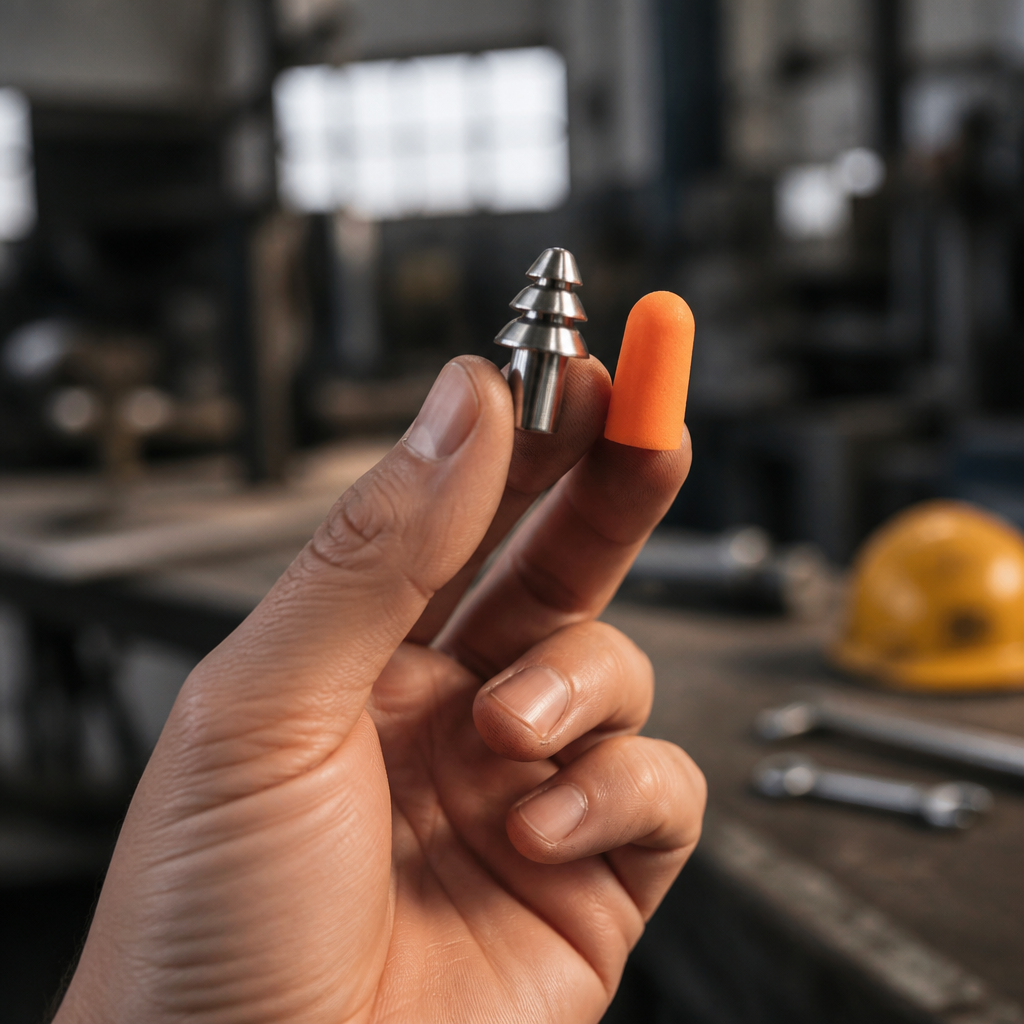
| A rigid body maintains consistent acoustic geometry | Metal-bodied earplugs like those from ATTENU8 hold their shape session after session. Only the memory foam tips need periodic replacement, preserving the rated attenuation long-term. |
| Fit sizing matters more than most workers realize | A plug that is too small for the ear canal will not seal properly, reducing effective attenuation regardless of the NRR rating. Multiple tip sizes, such as XS, S, and M, are essential for a workforce with varied ear canal geometries. |
| Reusable earplugs reduce per-worker cost over time | Replacing only foam tips every 6 to 8 weeks, rather than buying new disposable plugs daily, substantially lowers procurement cost per worker while maintaining protection integrity. |
Occupational noise-induced hearing loss does not happen dramatically. There is no incident report, no visible injury, and no moment where a worker feels the damage occurring. The loss accumulates across thousands of shifts, in stamping plants, assembly lines, pneumatic tool stations, and packaging halls, until the frequencies that carry speech clarity are simply gone.
The scale of the problem in manufacturing specifically is staggering. CDC data show that approximately 18 percent of manufacturing workers have measurable hearing difficulty, and 11 percent live with tinnitus, the persistent ringing that no amount of quiet can stop. These are not corner-case numbers. They represent a workforce-wide exposure failure that has been ongoing for decades.
The reason this keeps happening is not ignorance of the risk. Most manufacturers have hearing protection programs on paper. The failure point is almost always the earplug itself: plugs that are genuinely painful after two hours, that fall out during physical movement, or that workers quietly pocket because nobody is watching. Solving the factory hearing protection problem is not primarily a regulatory problem. It is an equipment-comfort problem.
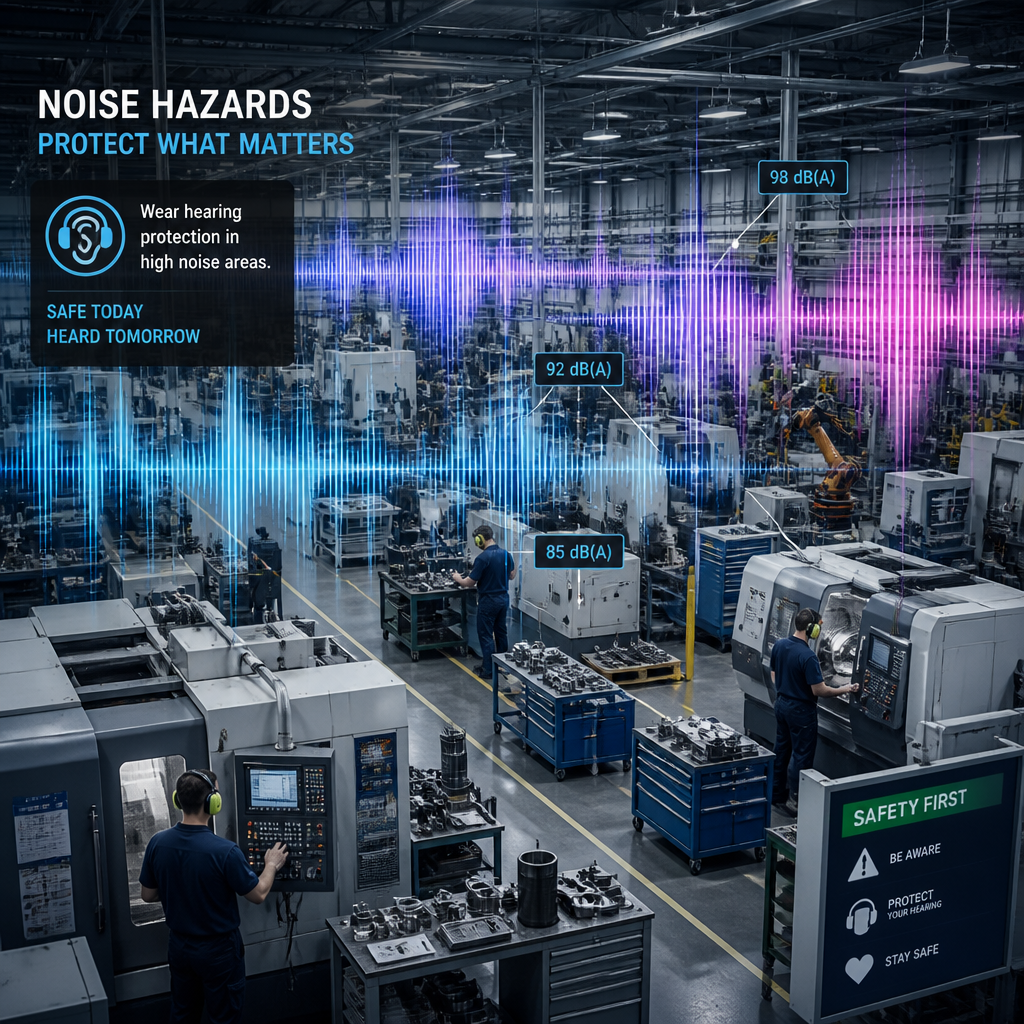
If you are responsible for a manufacturing floor in the United States, the governing standard is OSHA 29 CFR 1910.95. It sets a permissible exposure limit (PEL) of 90 dBA as an 8-hour time-weighted average (TWA), using a 5 dB exchange rate. A separate action level of 85 dBA over 8 hours triggers a full hearing conservation program, which means audiometric testing, mandatory access to hearing protection at no cost to the employee, worker training, and recordkeeping.
Engineering controls, reducing machine noise at the source, are required when exposure exceeds 90 dBA. But engineering controls are expensive, slow to implement, and often impractical for legacy equipment. Hearing protection devices fill the gap, and the earplug selection must be adequate to bring a worker’s actual exposure below the relevant threshold.
The standard does not simply require you to hand a worker any earplug with an NRR printed on the box. The attenuation achieved must be sufficient to reduce that worker’s personal noise exposure to a TWA of 85 dBA. This is where many compliance programs quietly fail: they procure high-NRR plugs, distribute them, and consider the obligation met. The actual fitting, the actual seal, and the actual hours worn are rarely audited.
OSHA’s standard also specifies that when a worker’s audiogram shows significant hearing damage, that worker must be refitted with hearing protectors and retrained in their use. In other words, a damaged audiogram is a signal that the current protection is not working, not just that the worker has bad luck.
The right hearing protection device is the one a worker will actually wear correctly for the full duration of exposure. A theoretically superior plug removed after two hours is worse than a comfortable plug worn all day.
Most factory noise discussions focus on continuous TWA levels, but OSHA 1910.95 also caps impulsive or impact noise at 140 dB peak sound pressure level. Workers on press lines, in stamping operations, or near pneumatic tools face these high-peak transient events in addition to sustained background noise. Earplugs for these environments need to seal consistently under dynamic jaw and head movement, because a plug that shifts during a loud impact event is not providing the protection it appears to offer.
The Noise Reduction Rating (NRR) printed on every earplug package is a laboratory number. It is measured under controlled conditions with trained fit technicians, using a standardized method that optimizes insertion technique. Real workers on a factory floor do not insert earplugs the way audiological technicians do in a quiet lab.
NIOSH recommends applying a 50 percent derating to the manufacturer’s NRR for typical workplace users to estimate the actual protection achieved in field conditions. This means a plug rated NRR 33 delivers roughly 16 dB of real-world attenuation for the average user. A plug rated NRR 25 may deliver only around 12 dB under the same derating. For a worker standing near 100 dB machinery for eight hours, that gap determines whether they stay under the 85 dBA action level or not.
There is an additional variable that the NRR system does not capture: degradation over time. Standard foam earplugs lose compression recovery with repeated use. A plug used three days in a row may visually appear intact while its acoustic seal has deteriorated significantly. This is one of the strongest structural arguments for reusable earplugs with replaceable tips rather than disposables reused informally.
ATTENU8’s metal-bodied reusable earplugs are rated at approximately 32 dB noise reduction and are manufactured to CE certification standard BS EN 352-2:2002. The concave aluminium body maintains the acoustic geometry that produces the rated attenuation, session after session. The aluminium does not compress, deform, or take a set the way foam does. What changes over time is only the memory foam tip, which ATTENU8 recommends replacing every 6 to 8 weeks, at which point the tip loses compression recovery and seal-forming ability.
The practical result is that a worker using ATTENU8 earplugs is getting a consistent, predictable level of attenuation across a full replacement cycle, not a sliding scale of degrading protection across a week of disposable reuse. For employers building a documented industrial hearing safety program, consistency is not just convenient, it is legally defensible.
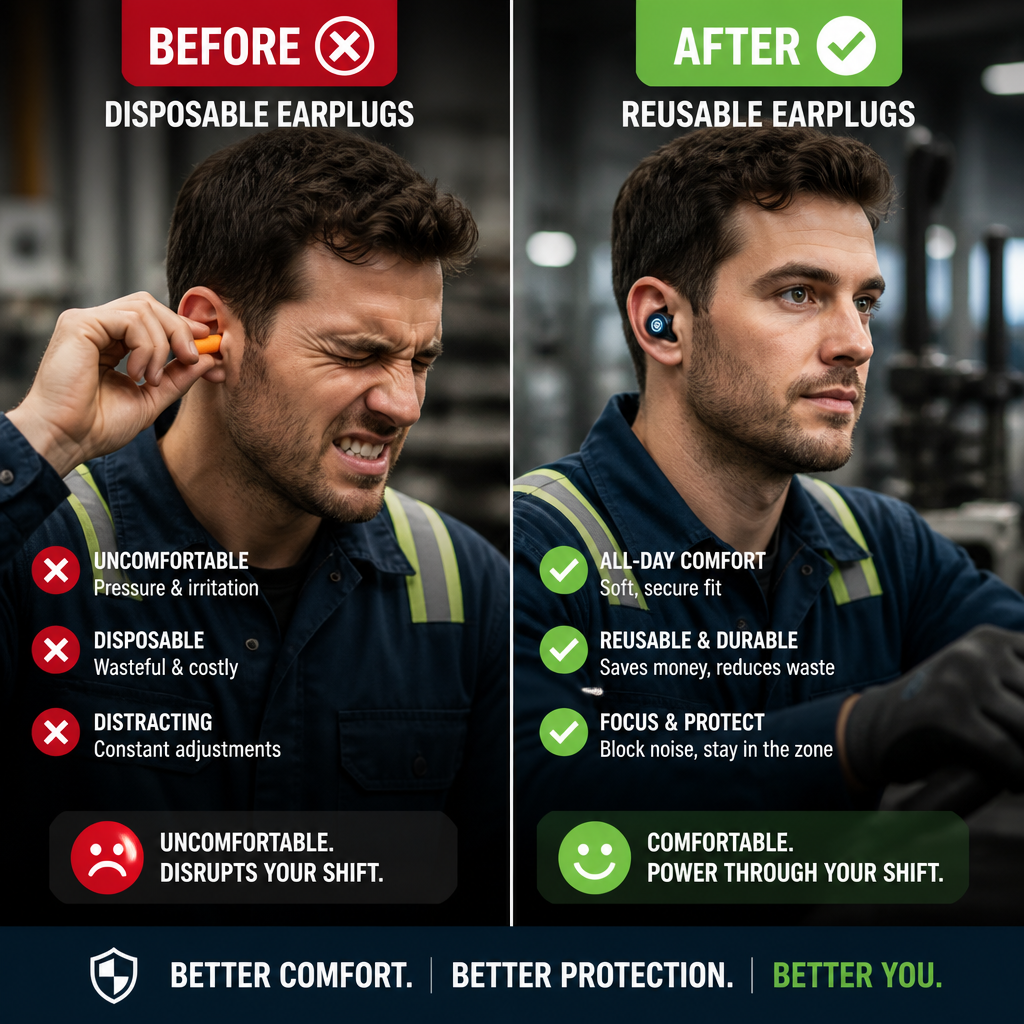
The choice between disposable and reusable earplugs for factory environments comes down to three factors: protection consistency, cost over time, and worker compliance. Here is how the main categories compare directly.
| Factor | Disposable Foam Earplugs | ATTENU8 Reusable Metal-Body Earplugs |
|---|---|---|
| NRR / Noise Reduction | Typically NRR 29-33; peaks at NRR 33 but degrades with every reuse | Approximately 32 dB, consistent across the full 6-8 week tip cycle |
| Comfort for All-Day Wear | Adequate for first use; foam pressure builds over hours, causing discomfort on long shifts | Memory foam tips with minimal pressure; concave aluminium grip reduces insertion force needed |
| Cost Over 12 Months | Low per-pair cost, but daily replacement volumes add up significantly across a large workforce | Higher upfront cost per unit; only foam tips replaced every 6-8 weeks, reducing long-run spend |
| Fit Variability | One or two sizes; fit quality depends heavily on correct rolling and insertion technique | Three memory foam tip sizes (XS, S, M); rigid body guides correct positioning in the canal |
| Environmental Waste | High; daily disposal from every worker on every shift | Low; only foam tips discarded on a 6-8 week cycle |
| Compliance Tracking | Difficult; workers often reuse without reporting | Easier; fixed replacement schedule per worker creates a trackable maintenance cadence |
Pro tip: If workers on your floor are visibly reusing disposable foam plugs, treat it as a compliance failure, not a cost-saving measure. A degraded disposable plug may deliver half or less of its rated attenuation, which could put workers above the OSHA action level even if they appear to be wearing protection.
Comfort in a manufacturing environment is not a luxury specification. It is the single most important variable in determining whether a worker actually wears the earplug for the full shift. A plug with NRR 33 that comes out at lunchtime and stays in a pocket for the afternoon has an effective NRR of zero for those hours.
The primary complaint workers have with foam earplugs is sustained canal pressure. Traditional rolldown foam plugs work by expanding inside the ear canal. That expansion is the mechanism of attenuation, but it is also the source of the aching, full feeling that drives workers to remove them. Higher-NRR plugs tend to apply more lateral pressure to achieve a better seal, creating a direct tradeoff between attenuation and comfort with traditional foam designs.
A rigid body with a memory foam tip changes that equation. The memory foam tip conforms to the canal shape rather than pushing uniformly outward. The aluminium body provides the acoustic mass and the insertion depth guide, so the foam does not need to be rolled, compressed, and shoved as deeply. The result is a seal that does not depend on the expansion force of a compressed foam cylinder pressing against canal walls for hours at a time.
Factory work involves bending, turning, lifting, and working with vibrating machinery. An earplug that shifts during these movements breaks its acoustic seal intermittently throughout the shift, and the worker usually does not notice until it falls out entirely. A concave aluminium body with a correctly sized memory foam tip creates a stable, grip-assisted seal that stays seated through normal physical work movement, which is something rolldown foam cylindrical plugs, by design, cannot replicate.
A manufacturing workforce is not uniform. Ear canal diameters vary significantly across individuals, and a plug that seals correctly on one worker may be too loose or too narrow for another. This is why ATTENU8 includes three memory foam tip sizes, XS, S, and M, with each unit. Workers can self-select the tip that seals without pressure, which immediately improves both comfort and attenuation accuracy compared to single-size disposable programs.
Pro tip: Run a simple fit check station at the start of new earplug programs. Have each worker try all three tip sizes in a quiet area and identify the one that seals without requiring hard insertion force. Five minutes of setup prevents months of poor compliance.
Not all manufacturing noise environments are equal. A packaging line running at 82 dBA presents a very different risk profile from a stamping press operating at 105 dBA. Choosing the best ear plugs for factory use means matching the protection level to the measured exposure, not defaulting to the highest available NRR for every application.
At this range, which covers assembly lines, light machining, and most packaging environments, a plug delivering 12 to 16 dB of real-world attenuation is generally sufficient to bring exposure below the 85 dBA action level. A reusable earplug with approximately 32 dB NRR, derated to real-world conditions, fits this range well and provides meaningful headroom. The priority at this level should be comfort and all-day wearability, since workers in moderate-noise environments often spend entire shifts at their stations without a noise break.
Heavy manufacturing, stamping, forging, and power tool environments typically measure in this range. Here, the derating math becomes critical. A plug with NRR 32 to 33, derated by 50 percent, provides roughly 13 to 16 dB of actual protection. For a worker at 105 dBA, this brings effective exposure to approximately 89 to 92 dBA, still above the PEL. At these levels, double protection combining earplugs with earmuffs is often warranted. OSHA guidance notes that 5 dB can be added to the NRR of the more protective device when combining earplugs and earmuffs, giving additional attenuation without requiring workers to rely on a single device to do all the work.
Press rooms, nail guns, and pneumatic tools produce sharp transient peaks that standard TWA calculations underestimate in terms of cochlear damage risk. In these settings, a plug that maintains its seal under dynamic jaw movement and head rotation is non-negotiable. Plugs that depend on compression-based expansion may shift during the recoil of impact operations, breaking the seal at exactly the moment of highest peak sound pressure. A memory foam tip anchored by a rigid metal body is far more mechanically stable in these applications.
OSHA does not mandate a specific NRR number. Instead, it requires that hearing protection be adequate to reduce a worker’s noise exposure to a TWA of 85 dBA. The appropriate NRR depends on the measured noise level at the worker’s specific position. NIOSH recommends derating label NRR values by 50 percent for typical users to estimate real-world attenuation, so a plug rated NRR 32 should be counted on to deliver roughly 13 to 16 dB of practical protection when selecting the right device for a given exposure level.
Yes, and in many practical situations they are more effective. Disposable foam plugs are rated on first use, but workers frequently reuse them across multiple shifts. Each reuse reduces the foam’s compression recovery and acoustic seal, meaning the effective attenuation drops well below the labeled NRR. A reusable metal-bodied plug with replaceable memory foam tips, like ATTENU8, maintains consistent acoustic geometry throughout the tip replacement cycle, giving a more predictable level of protection over time.
In a manufacturing setting where earplugs are worn for full 8-hour shifts, memory foam tips should be replaced when they no longer fully recover their shape after compression, or on a scheduled basis. ATTENU8 recommends tip replacement every 6 to 8 weeks under normal use. In environments with high levels of particulate, oil mist, or chemical exposure, inspect tips more frequently, as surface contamination can degrade foam faster and affect the acoustic seal.
Yes, and this is specifically recommended for environments where noise levels exceed approximately 100 dBA TWA. OSHA notes that combining earplugs with earmuffs adds approximately 5 dB to the attenuation of the more protective of the two devices. The earplug provides the primary deep-canal seal while the earmuff adds a secondary outer ear barrier. In practice, using a compact metal-bodied earplug under earmuffs is more comfortable than bulky rolldown foam plugs, which can be difficult to seat correctly with earmuff cups pressing against the outer ear.
NRR (Noise Reduction Rating) is the standard used in the United States, governed by the EPA. SNR (Single Number Rating) is the European equivalent, governed by EN ISO 4869-2. They are calculated using different methodologies and are not directly interchangeable, though both aim to represent the attenuation achieved in laboratory testing. ATTENU8 products carry an SNR 32 rating under CE certification to BS EN 352-2:2002, which is the applicable standard for the Australian and European markets. Workers and employers in the US should compare NRR values when selecting against OSHA compliance thresholds.
A properly fitted earplug will produce a noticeable reduction in ambient noise immediately upon insertion. A common field test is to cup your hands over your ears after inserting the plugs. If you hear a significant additional reduction in noise, the earplugs are not sealing correctly and need to be reinserted or replaced with a better-fitting size. In formal hearing conservation programs, fit testing using a personal attenuation rating (PAR) device provides objective measurement of each worker’s actual achieved attenuation with a specific plug and size.
Have you found a specific earplug type or fit approach that keeps your workers protected and comfortable through a full manufacturing shift? Share your experience in the comments below.

