


 0

Most people who wear earplugs for concerts do it wrong. They grab a pair of disposable foam plugs from the venue merch desk, jam them in, and spend the next two hours listening to music that sounds like it is coming through a mattress. So they pull them out. By the time they leave, their ears are ringing, and they have added another small, cumulative dose of permanent damage to their hearing. There is a better way, and it does not require sacrificing the music to save your ears.
| Key Insight | Explanation |
|---|---|
| Rock concert volumes can hit 110-120 dB | At those levels, safe daily exposure limits can be reached in under one minute without protection. |
| Standard foam earplugs destroy sound quality | They remove the ear canal’s natural resonance peak, making music sound muffled and indistinct. Musicians wearing them tend to compensate by playing louder. |
| High-fidelity designs reduce volume, not clarity | A flat-response filter lowers sound evenly across frequencies, preserving the timbre and balance of music while still protecting your ears. |
| Fit determines how much protection you actually get | A loose earplug with a 32 dB rating gives you far less than that in practice. The seal matters as much as the specification. |
| Reusable metal-bodied plugs outperform disposables long-term | A durable housing paired with replaceable foam tips gives you consistent protection without the cost and waste of single-use alternatives. |
| Musicians and audience members have different protection needs | A performer on stage needs to hear themselves and their band clearly. Audience members need to protect against sustained high-volume exposure from the PA system. |
| Tip size is not a minor detail | An XS or S tip inserted correctly into a smaller ear canal creates a better seal than a medium tip forced in poorly. Multiple sizes are essential, not a luxury. |
Live music is loud by design. A rock or electronic concert regularly pushes sound levels to 110 decibels or above, and at those levels, the maximum safe daily noise exposure limit can be reached in less than one minute. This is not theoretical. Repeated exposure to sound above 85 dB causes measurable, cumulative damage to the hair cells in the cochlea, and those cells do not regenerate.
The World Health Organization has estimated that 1.1 billion young people globally face risk from recreational sound exposure, including concerts, nightclubs, and music festivals. Regular concert-goers and musicians are among the most consistently exposed groups. Tinnitus, that persistent ringing or buzzing after a loud show, is often the first signal that damage has already occurred.
The fundamental problem with concert hearing damage is that it accumulates invisibly over years. Each individual show might feel harmless. The pattern across a decade of regular attendance is not.
The good news is that hearing protection at concerts is not a compromise between safety and experience. It is a question of choosing the right tool for the situation. Earplugs designed for music behave very differently from the foam cylinders you find at hardware stores, and the difference is immediately noticeable the first time you wear them at a show.
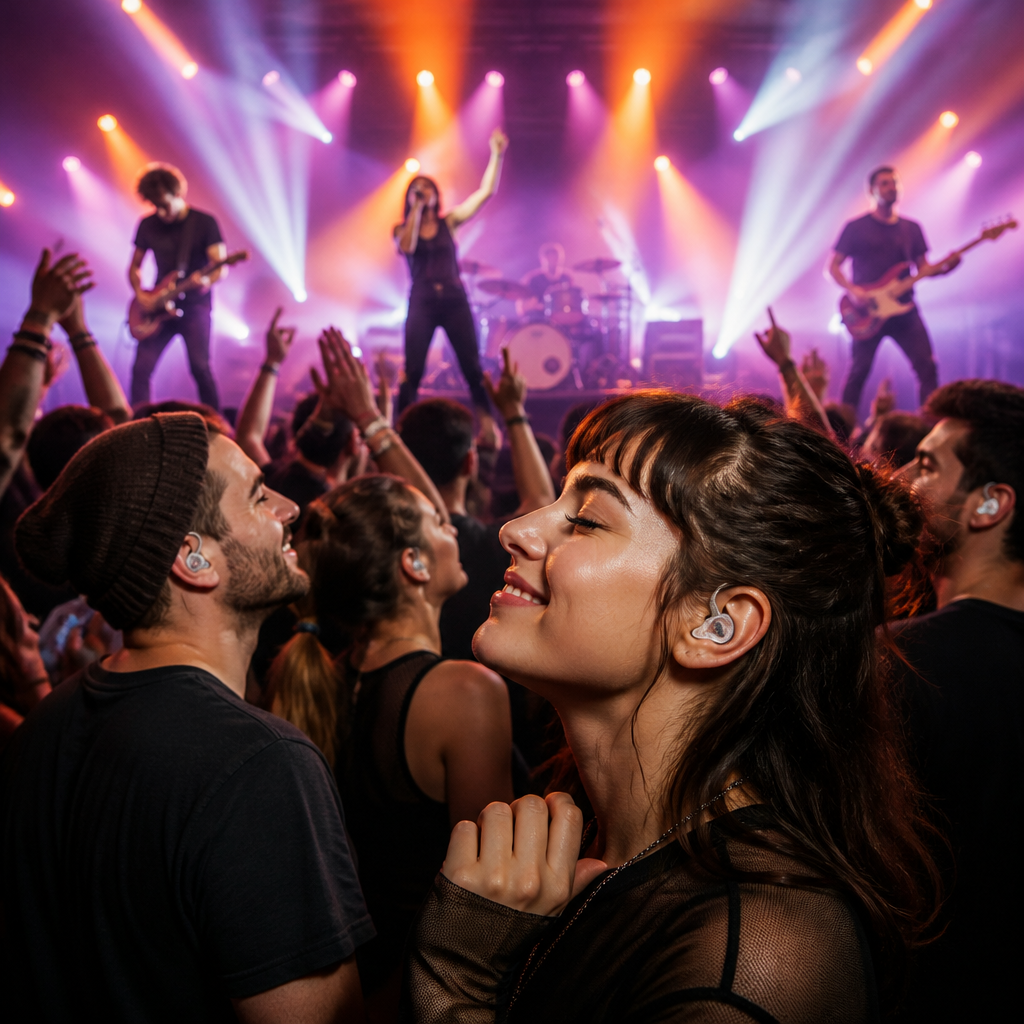
The average open ear canal has a natural acoustic resonant peak of approximately 17 dB at around 2,700 Hz. When you insert a standard foam earplug, you block the ear canal and remove that natural resonance entirely. The result is unbalanced attenuation: high frequencies are cut far more aggressively than low frequencies, which is why everything sounds muffled, bass-heavy, and indistinct.
This is not just an aesthetic annoyance. Research comparing foam earplugs and musician-grade hearing protection found that pianists wearing foam earplugs played significantly louder than when wearing earplugs with a flat frequency response. The musicians were unconsciously compensating for the loss of sound clarity by pushing harder. The foam plugs were actively making the performers’ situation worse, not better.
For concert-goers, the same dynamic plays out differently. You pull the plugs out because the music sounds terrible, which means you are unprotected. Or you leave them in and spend the evening frustrated. Neither outcome is acceptable when well-engineered alternatives exist.
Pro tip: If you have ever left a foam earplug in only one ear to “test” sound quality and found the muffled ear sounded worse, you experienced the resonance removal problem firsthand. That muffled sound is what your brain is trying to correct for. A flat-response earplug eliminates that problem.
A high-fidelity earplug is built around one core principle: attenuation should be as even as possible across the full frequency spectrum. Instead of blocking the ear canal completely, these designs use an acoustic filter or resistor that controls how much sound passes through. The goal is to reproduce the listening experience of the open ear, but at a lower overall volume.
The filter in a high-fidelity earplug is tuned to add back something close to the ear canal’s natural resonance peak, which standard foam removes. The result is that music retains its tonal balance. The kick drum still sounds like a kick drum. The vocalist’s midrange still carries. The cymbal wash is present but not painful. Volume drops; clarity does not.
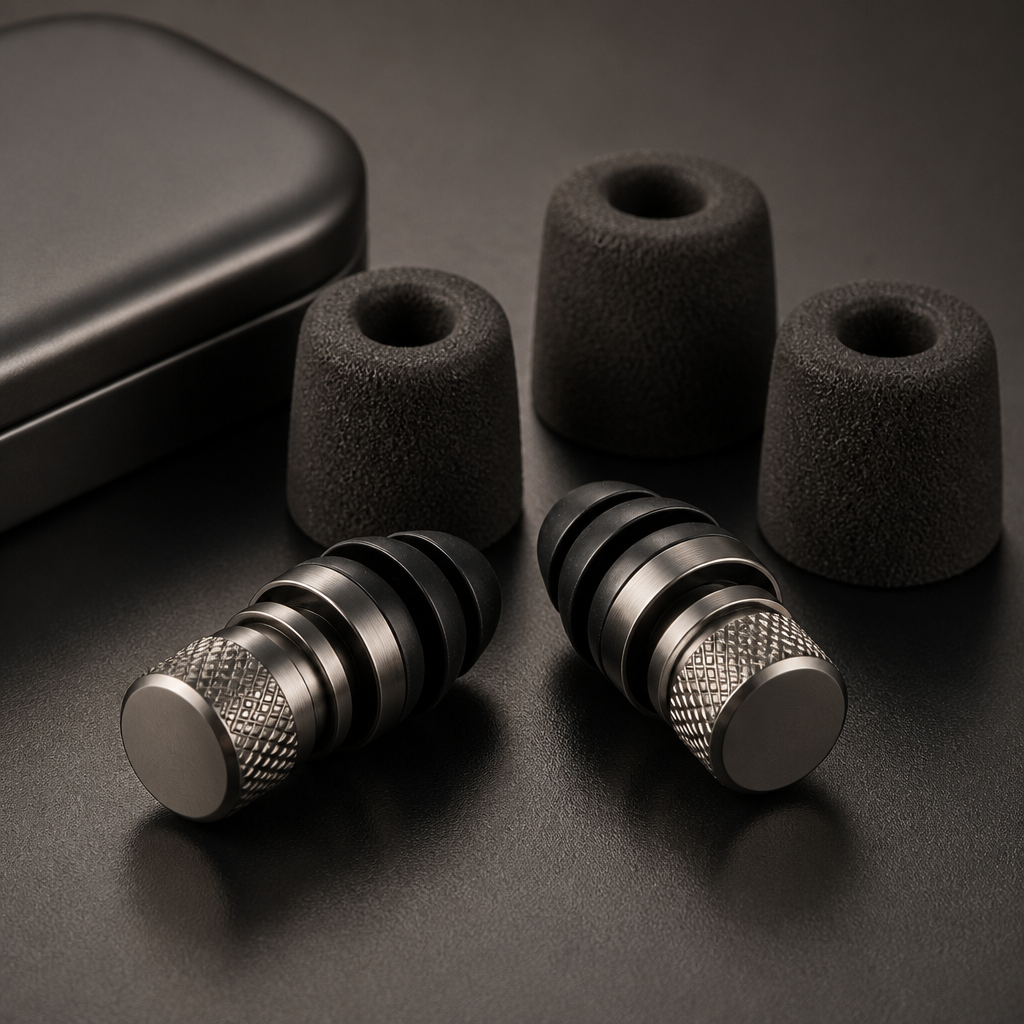
The housing of an earplug affects how the filter performs and how consistently it seals. A rigid, dimensionally stable body, such as one machined from aluminium, holds its geometry precisely over time. It does not deform under body heat or repeated use. This matters because the fit between the earplug body and the ear tip determines the quality of the acoustic seal, and the seal determines whether you are getting the protection the rating promises.
ATTENU8’s concave aluminium body is designed around this principle. The metal body creates a meaningful density differential with the memory foam tip, which is part of what drives the approximately 32 dB SNR performance. The concave shape also helps guide the foam tip to a consistent depth, reducing the variability that undermines protection with cheaper designs. You can read more about why the aluminium body matters for both noise reduction and long-term durability in ATTENU8’s guide to the aluminium advantage.
Pro tip: When inserting any earplug before a show, pull the top of your outer ear upward and back slightly to straighten the ear canal. Insert the tip, then hold it in place for a few seconds while the foam expands. This step alone significantly improves the acoustic seal and the actual protection you receive.
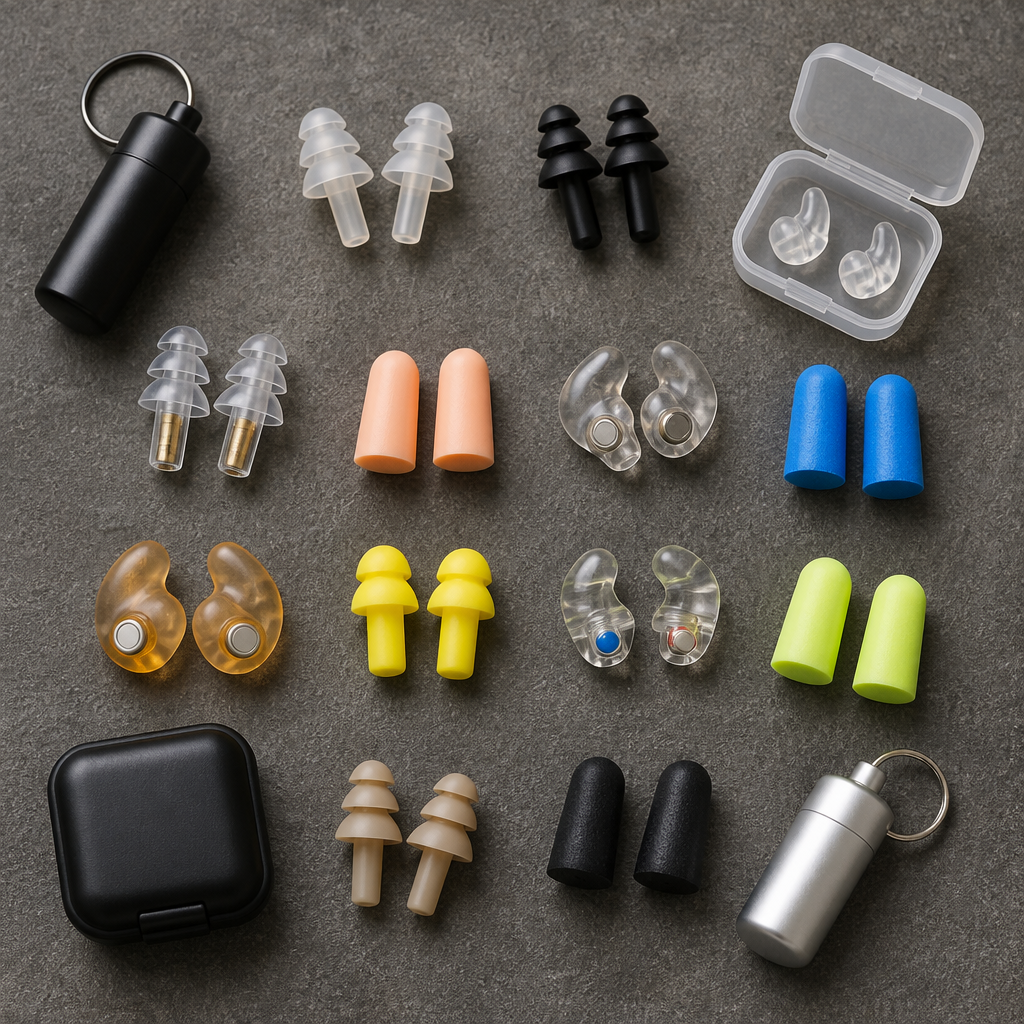
Not every earplug works the same way at a concert. The table below compares the three main categories you will encounter, based on what actually matters for live music use.
| Earplug Type | Sound Quality at Concerts | Best For |
|---|---|---|
| Standard disposable foam | Poor. Heavy muffling, bass-dominant, unnatural. Uneven attenuation removes natural ear canal resonance and makes music sound distorted. | Industrial noise, construction, situations where music quality is irrelevant. Not suited for concerts or musical performance. |
| High-fidelity filtered earplugs (non-custom) | Good to excellent. Flat-response filter preserves tonal balance. Music sounds like music at lower volume. Suitable for most concert environments. | Regular concert-goers, festival attendees, musicians who need to hear themselves and their bandmates clearly during performance. |
| Custom-moulded musician earplugs | Excellent. Professionally fitted to individual ear canal shape, providing the most accurate and consistent attenuation. Highest sound quality available. | Professional touring musicians, audio engineers, anyone who attends multiple live music events per week and can justify the cost of a professional fitting. |
For most people, high-fidelity non-custom earplugs represent the best balance of performance, cost, and practicality. Custom-moulded options offer the highest accuracy but require an audiologist appointment and considerably higher upfront investment. The key upgrade from disposable foam is not the price. It is the filter design.
A guitarist standing in front of a 4×12 cabinet and a fan in the crowd are both at risk, but from different acoustic sources. The musician faces direct, close-range instrument noise from multiple sources simultaneously: their own instrument, their monitor wedge, the backline from other players, and, at many venues, the house PA as well. Their exposure is prolonged and often higher in peak level than what the audience experiences.
In-ear monitors have changed the situation for many working musicians, allowing them to control their personal mix at a safe level while blocking ambient stage noise. But many smaller venues and rehearsal situations still rely on floor wedge monitors, and musicians in those environments often have no attenuation at all. A well-fitted pair of hearing protection earplugs worn during rehearsal, not just live shows, is where most of the cumulative risk actually accumulates for regular players.
This is the practical challenge that stops most musicians from wearing protection consistently. With standard foam earplugs, a singer cannot hear their own pitch accurately. A drummer cannot hear the nuance of their cymbal work. A guitarist loses the harmonic detail that informs their playing. High-fidelity earplugs with even attenuation solve this by preserving frequency balance. The musician hears themselves and their bandmates at a safer volume, not through a sonic fog.
Studies of professional pop, rock, and jazz musicians have confirmed that greater musical experience correlates with higher hearing thresholds, particularly in the 3-6 kHz frequency range. Weekly playing hours show a stronger link to measurable hearing loss than years of playing. The math on consistent use of hearing protection during practice and performance is straightforward: less cumulative exposure means slower progression of damage.
Noise reduction ratings (NRR in the US, SNR in European CE-certified products) describe how much sound attenuation an earplug provides under standardised test conditions. A higher number means more attenuation. For concert use, the right figure depends on the environment and the role you are in.
An earplug rated at approximately 32 dB SNR, such as the ATTENU8, will bring a 110 dB concert environment down to roughly 78 dB for a well-fitted user. That puts you comfortably within safe listening territory for an extended show. The same protection level meets occupational hearing protection thresholds for construction and manufacturing environments. For concerts, it is more than adequate. The critical variable is fit: a poorly inserted earplug rated at 32 dB may only deliver 15-20 dB of actual attenuation.
Some music earplugs are rated in the 15-25 dB range, which still provides meaningful protection at moderate concert volumes. The argument for lower attenuation is typically that it feels more natural and less isolating. In practice, if you are attending shows where the PA is running at 105 dB or above, a 20 dB earplug leaves you at 85 dB, which is the threshold at which sustained exposure begins to cause damage. For loud venues, higher attenuation paired with good sound quality is the correct choice, not lower attenuation with marginally better music fidelity.
The ATTENU8 earplug is designed to sit at the upper end of this range, delivering approximately 32 dB SNR while using memory foam tips that conform to the individual ear canal shape. The combination of a rigid aluminium body and soft foam tip is what makes that rating achievable across a range of ear sizes and canal geometries.
The most common reason good earplugs underperform is that people use the wrong tip size for their ear canal. A tip that is too large creates discomfort and is inserted too shallowly. A tip that is too small does not seal properly and allows sound to leak around the edges. Both failures reduce the effective attenuation you receive, regardless of what the product specification says.
If you experience discomfort within a few minutes, the tip is likely too large. If you can hear external sounds clearly at a level that suggests the earplug is barely attenuating, the tip is likely too small or not inserted deeply enough. Starting with a small tip and working up is usually more reliable than guessing based on how your ear looks from the outside. Ear canals vary significantly in diameter and angle.
ATTENU8 includes three tip sizes, XS, S, and M, plus a set of flat bottom tips for side sleepers. For concert use, the standard tip sizes are the relevant ones. Taking five minutes before your first show to test each size correctly is worth it. You are looking for a seal that reduces ambient noise noticeably when the tip is seated properly, without causing pressure pain.
Memory foam tips pick up skin oils, earwax, and debris with regular use. A contaminated tip does not expand as cleanly and may provide a less consistent seal over time. Replacing tips every 6-8 weeks with regular use keeps your protection performing to specification. This is substantially cheaper than replacing the entire earplug, which is the only option with single-use disposables. The aluminium body, properly maintained, does not need replacing.
Pro tip: Between concerts, store your earplugs in a hard case rather than a fabric pouch. The aluminium body is robust, but foam tips that are crushed or deformed before use will not expand correctly in the ear canal. A small rigid case keeps the foam tips in their natural shape and prevents contamination.
Standard foam earplugs do cause noticeable muffling because they attenuate high frequencies far more than low frequencies, removing the natural resonance of your ear canal. High-fidelity earplugs are specifically designed to avoid this. They use an acoustic filter that reduces volume evenly across frequencies, so the music retains its tonal balance. The experience is closer to turning down the volume on a speaker than to covering your ears with your hands.
SNR (Single Number Rating) is used on CE-certified products sold in Europe and the UK, while NRR (Noise Reduction Rating) is the American standard. They are calculated differently, so the numbers are not directly interchangeable, but both describe the attenuation a product provides under standardised test conditions. When comparing earplugs, make sure you are comparing ratings from the same system. ATTENU8 is CE-certified with a rating of approximately 32 dB SNR, following the BS EN352-2:2002 standard.
Yes, and if you perform regularly in loud environments, it is important that you do. The key is choosing hearing protection that maintains sound clarity through a flat frequency response, rather than standard foam that muffles high frequencies and forces you to compensate by playing louder or harder. High-fidelity earplugs allow musicians to hear pitch, dynamics, and tone accurately, just at a safer overall volume.
With regular use, memory foam tips should be replaced approximately every 6-8 weeks. Tips that have been used frequently collect skin oils and earwax that reduce their ability to expand fully and seal consistently. When you notice the foam is slower to expand after compression, or the fit feels looser than it used to, it is time for a new set of tips. The metal body of the earplug does not require replacement under normal use.
Comfort depends almost entirely on fit. An earplug that is the wrong size or inserted incorrectly creates pressure and discomfort within minutes. With the correct tip size inserted properly, quality earplugs should be forgettable after the first few minutes of a show. Memory foam tips that conform to the shape of the individual ear canal are considerably more comfortable over extended wear than rigid silicone or flanged tips, particularly during two or three hour concerts.
The priorities differ. A musician on stage needs consistent, accurate sound reproduction so they can perform well, in addition to protection from peak sound levels. An audience member primarily needs reliable attenuation of sustained high-volume PA output. In practice, a well-designed high-fidelity earplug with approximately 32 dB attenuation works well for both roles. Where musicians benefit from additional precision, custom-moulded options fitted by an audiologist offer the most accurate individual calibration.
It is not too late to prevent further damage, even if some has already occurred. Noise-induced hearing loss is cumulative, meaning every loud event without protection adds to the total. Starting now reduces the rate at which damage accumulates going forward. If you already notice persistent ringing or difficulty distinguishing speech in noisy environments, it is worth having a hearing assessment, but that is not a reason to delay starting protection.
Have you found a specific earplug setup that works for you at concerts or during performances? Share your experience in the comments. It helps other music lovers and musicians find what actually works.

