


 0

You grab a pair of ear plugs off a shelf, squint at the packaging, and see “32dB noise reduction” printed next to a European CE mark. Impressive, you think. But impressive compared to what? Most people have no practical frame of reference for that number, and that gap in understanding is exactly why so many ear plugs end up abandoned in a bedside drawer after a week. Whether your problem is a partner who snores at 65dB or a street outside that never fully quiets down, knowing what 32dB noise reduction actually delivers in practice, not just in a testing lab, is the difference between a product that transforms your sleep and one that disappoints.
| Key Insight | Explanation |
|---|---|
| 32dB is a logarithmic cut, not a linear one | A 32dB reduction drops perceived loudness to roughly one-eighth of the original intensity, which is far more dramatic than the arithmetic gap suggests. |
| SNR and NRR are not the same number | SNR is the European standard; NRR is the US standard. For the same ear plug, SNR typically reads 2-3dB higher. They are not directly interchangeable. |
| Lab ratings overstate real-world performance | Ratings are measured under perfect insertion conditions. A loose or incorrectly inserted plug can cut real-world attenuation to roughly half the rated value. |
| The WHO recommends below 30dB in bedrooms at night | Most urban bedrooms exceed that threshold. A 32dB SNR ear plug can bring ambient noise down into the WHO recommended range for most common sources. |
| Snoring sits between 60-70dB for most people | A 32dB rated ear plug, properly fitted, can reduce snoring to somewhere between 30-38dB, well inside the range for uninterrupted sleep. |
| Fit and seal matter more than the rating number | An ear plug with a 32dB rating and a poor seal will underperform one with a 24dB rating and a tight, consistent seal every night. |
| Tip size is the single biggest lever for seal quality | Using the wrong foam tip size is the most common reason rated performance fails to translate into quieter sleep. Three sizes exist for a reason. |
The most common mistake people make when reading an ear plug rating is treating it like a straightforward subtraction problem. If a noise source is 70dB and the ear plug is rated at 32dB, surely the result is 38dB, right? Arithmetically, yes. Practically, that framing misses everything important about how decibels actually work.
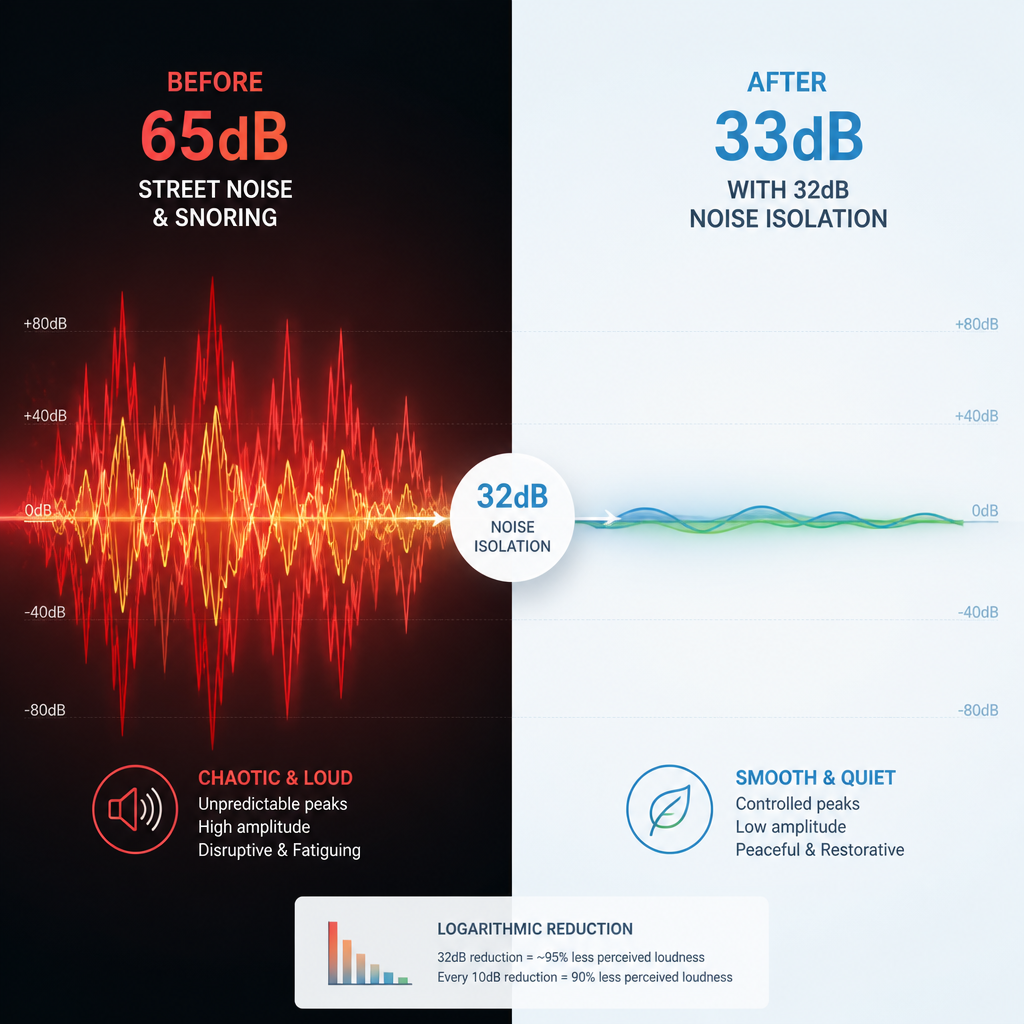
The decibel scale is logarithmic. A reduction of 10dB does not cut loudness by 10 percent, it cuts the perceived loudness roughly in half. A 20dB reduction cuts it to about one-quarter. A 32dB reduction therefore brings perceived volume down to somewhere around one-eighth of its original intensity. The subjective experience of that reduction is far larger than the gap between two numbers on a page can convey.
A 3dB increase in noise represents a doubling of sound intensity. That means the difference between 85dB and 88dB is not a small step, it is a 200% jump in energy reaching your ears.
This matters for sleep in a very direct way. When your partner’s snoring registers at 65dB and your ear plug brings that down by 32dB to approximately 33dB, you are not experiencing a modest improvement. You are experiencing a shift from “loud conversation level” to “a quiet whisper in a library.” That is the kind of difference that separates lying awake at 2am from sleeping through to your alarm.
Pro tip: When comparing ear plug ratings, do not ask “how many dB less is this one?” Ask “how many times quieter will this make the sound?” A 32dB SNR rating makes a source sound roughly eight times quieter than it would without protection. That reframe is far more useful than treating the number as a simple volume dial.
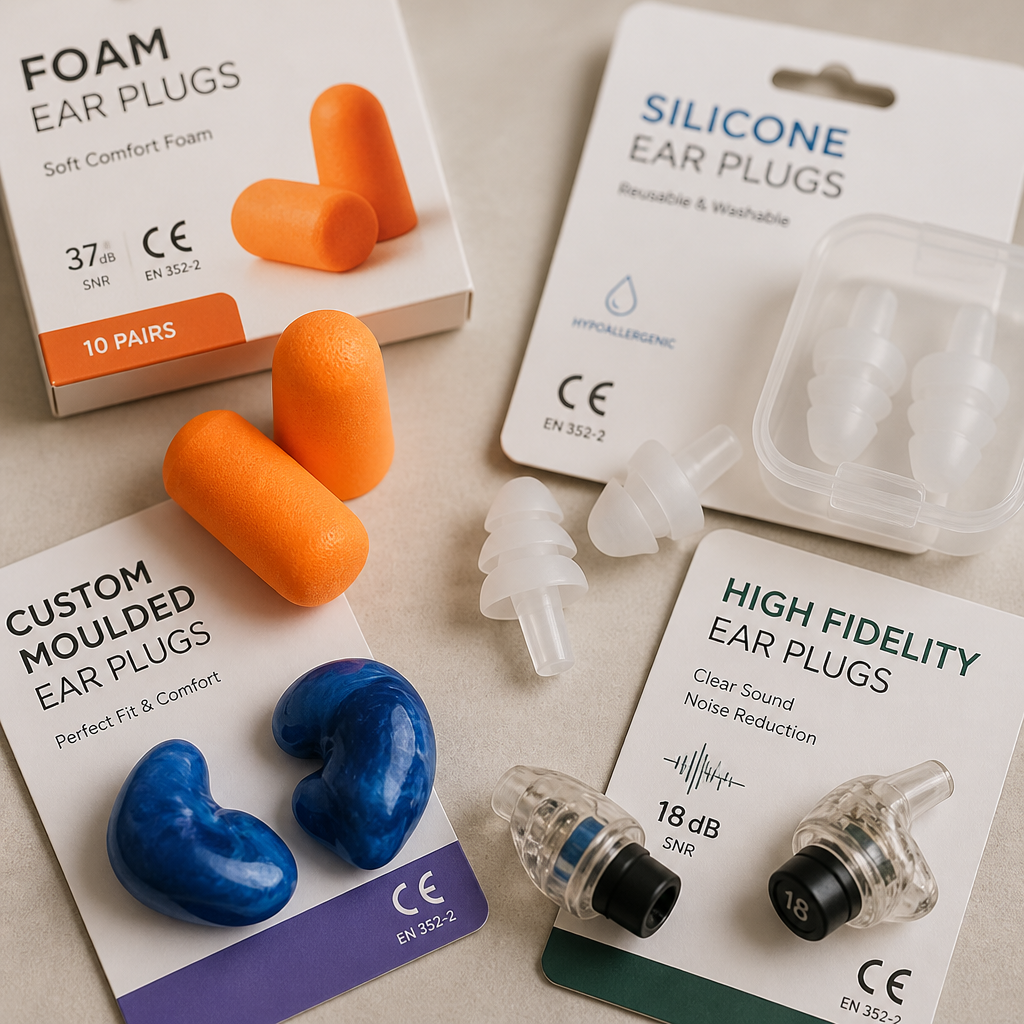
When you are shopping for ear plugs and comparing specifications across different brands, you will encounter two rating systems. Understanding which one you are looking at, and why you cannot simply stack the numbers against each other, is essential before any purchasing decision.
SNR stands for Single Number Rating, and it is the European standard for measuring how much noise an ear plug attenuates. It appears on products manufactured or sold under EU or CE certification, including those certified to the BS EN 352-2 standard. ATTENU8 ear plugs carry an SNR 32 rating, measured under this framework. The SNR represents the average noise reduction across test frequencies, expressed as a single figure in decibels.
The Noise Reduction Rating is the US equivalent, regulated by the Environmental Protection Agency and tested under the ANSI S3.19 standard. The NRR is derived from laboratory tests where subjects insert ear plugs following written instructions only, without hands-on fitting guidance. For the same physical ear plug, the SNR figure typically reads about 2 to 3dB higher than the NRR. A product with an NRR of 33 and a product with an SNR of 32 are not delivering equivalent real-world performance.
Both ratings are generated under ideal laboratory conditions with perfect insertion technique. In practice, even a well-intentioned user can insert a foam tip too loosely, choose the wrong tip size for their ear canal, or position the plug at a depth that breaks the acoustic seal. Any of these errors meaningfully reduces actual attenuation. A plug rated at 32dB can realistically deliver somewhere between 16dB and 32dB depending entirely on how well it fits and seals.
That is not a reason to dismiss the rating. It is a reason to treat the rating as a ceiling, not a guarantee, and to prioritize fit, tip selection, and seal quality when choosing an ear plug for sleep.
To understand what 32dB buys you in practice, you need a reference point for the noises you are actually trying to block. Most of them are louder than people assume.
The World Health Organization recommends that indoor bedroom noise levels stay below 30dB during the night for undisturbed sleep. The WHO also recommends that average noise outside bedrooms stay below 40dB at night to prevent adverse health effects. Most urban bedrooms do not come close to meeting either of those thresholds without intervention.
Snoring typically ranges from 60 to 70dB, roughly comparable to a normal conversation at close range. Road traffic noise for people living near busy streets frequently falls between 70 and 85dB. Air conditioning units typically hum around 50dB. Even sounds well below those levels, a refrigerator, a fan, an HVAC system, can sit in the 40-50dB range that is sufficient to disrupt deep sleep stages over the course of a night.
Pro tip: If you are uncertain how loud your bedroom actually is, most modern smartphones have a free decibel meter app that gives a reasonably accurate reading. Measure the noise that disturbs you most (partner snoring, traffic, HVAC) and compare it against the 30dB WHO threshold for sleep. That gap tells you exactly how much attenuation you need.
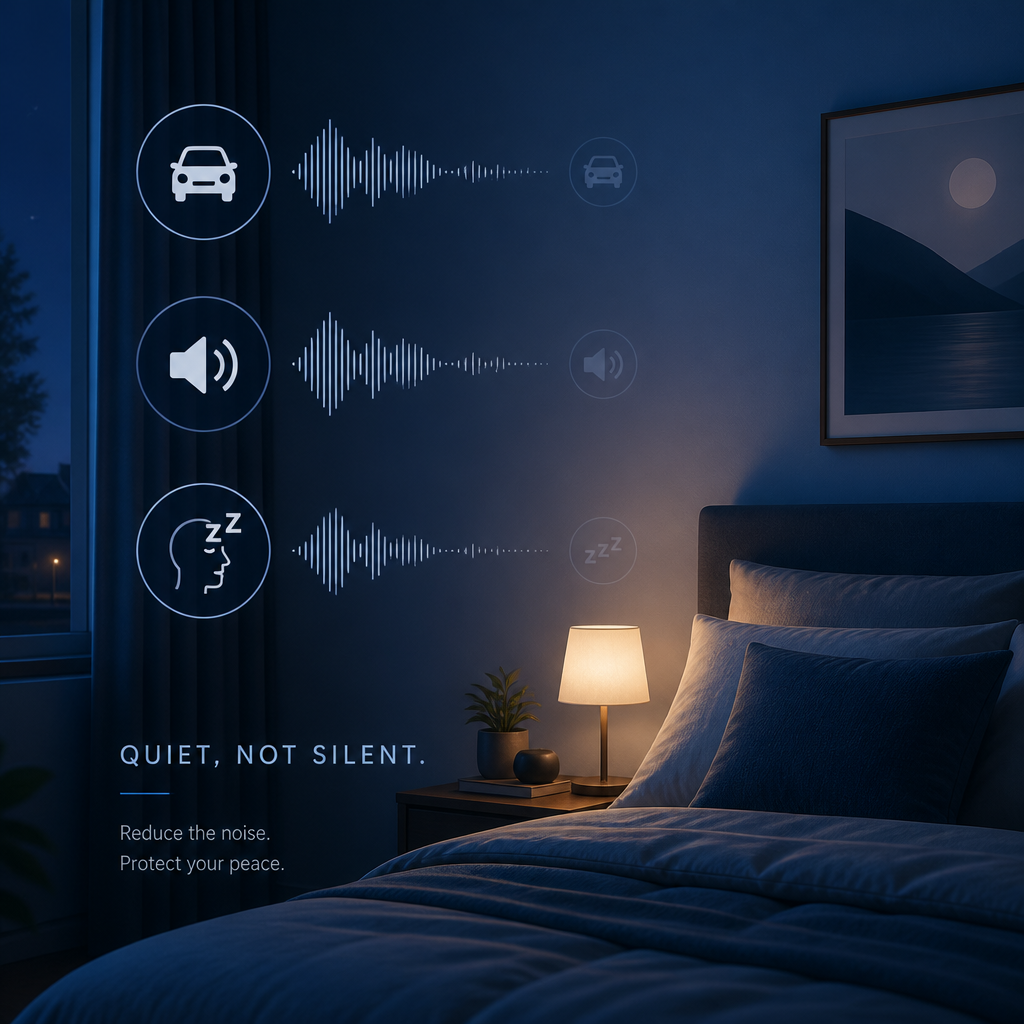
With real noise levels as a reference, the practical value of a 32dB SNR rating becomes concrete rather than abstract.
A partner snoring at a moderate 65dB, properly attenuated by a 32dB rated ear plug with a good seal, would reach your ears at roughly 33dB. That is below the WHO’s 35dB classroom recommendation and within the quiet library range. You would still perceive that something is there, sounds never disappear entirely, but it would register as a distant murmur rather than a disruptive presence.
Urban traffic noise at 75dB, reduced by 32dB, arrives at approximately 43dB. That is still audible but equivalent to a quiet office environment rather than a busy street. For light sleepers who currently lie awake listening to traffic, this shift is often enough to allow sleep onset and maintenance through the night.
The harder case is extreme snoring, which can reach above 80dB in severe cases. Even with 32dB of attenuation, the residual sound sits above 50dB, which remains potentially disruptive for highly sensitive sleepers. In those cases, maximizing the seal becomes critical, because every decibel of real-world attenuation beyond the baseline matters significantly on a logarithmic scale.
The Importance of Matching the Rating to Your Specific Problem
A 32dB SNR rating is among the highest available for consumer ear plugs. Most products on the market sit between 20dB and 35dB SNR. At the 32dB level, you are at the top of what you can reasonably achieve without industrial hearing protection equipment that is impractical for sleeping. If 32dB with a good seal is not solving your problem, the issue is almost certainly not the ear plug rating. It is fit, insertion technique, or a noise source that sits genuinely above what any consumer ear plug can fully address.
The rating on the packaging assumes something that almost nobody achieves without deliberate attention: a perfect acoustic seal with the ear canal, achieved every single time the plug is inserted. In the real world, fit varies significantly, and the consequences for noise reduction performance are severe.
An ill-fitting ear plug can substantially reduce the actual attenuation delivered compared to its rated value. The seal is the entire mechanism. Sound does not care about the material an ear plug is made from if there is a gap between that material and the ear canal wall through which sound waves can travel.
Ear canals vary considerably in size between individuals, and even between a person’s left and right ear. Using a tip that is too small creates a loose seal that fails under movement during sleep. Using a tip that is too large causes pressure and discomfort that makes wearing the plug through the night impractical. Neither scenario delivers rated performance.
This is precisely why ATTENU8 includes three sizes of memory foam tips (XS, S, and M) with every pair. The rated 32dB SNR performance is achievable, but it requires the right tip for your canal geometry. A common mistake is selecting the medium tip by default without testing the others. In practice, many people find they need XS in one ear and S in the other, or that the size they assumed was correct created just enough gap to reduce effective attenuation by 8-10dB.
Traditional foam ear plugs require you to roll them down, insert them quickly, and hold them in place while they expand. If you remove your hand too early, the plug expands before it has fully seated and the seal is compromised. Each insertion is slightly different, which means performance varies from night to night.
A metal-bodied design with foam tips separates two functions that foam plugs combine into one. The aluminium body holds a fixed position in the ear canal. The memory foam tip conforms to the canal wall and creates the seal. This separation makes consistent insertion more reliable, which means the gap between rated performance and real-world performance narrows compared to a traditional rolled foam plug.
Understanding how different ear plug designs approach noise reduction, comfort, and durability helps explain why the specification on the box does not tell the full story. Below is a direct comparison of the three main categories available to sleep-focused buyers.
| Feature | Traditional Disposable Foam | Silicone / Shaped Plug (e.g., Loop, Flare) | Metal-Bodied with Memory Foam Tips (ATTENU8) |
|---|---|---|---|
| Typical SNR / NRR Rating | NRR 29-33 / SNR 30-35 | SNR 18-27 (varies by model) | SNR 32 |
| Real-world attenuation consistency | Variable. Insertion technique heavily affects result each time. | More consistent insertion but lower peak attenuation. | High consistency due to fixed body position and conforming foam tip. |
| Side sleeper comfort | Poor. Foam protrudes and creates pillow pressure. | Moderate. Shaped plugs vary in profile. | Designed with side sleepers in mind; optional flat foam bottom cap reduces profile pressure. |
| Durability and ongoing cost | Single-use. Cost accumulates significantly over months. | Reusable body, but may require cleaning and eventual replacement. | Reusable aluminium body. Only foam tips replaced every 6-8 weeks. |
| Fit customisation | One size expands to fit. No sizing options. | Limited size options depending on brand. | XS, S, and M foam tips included. Mix and match per ear. |
| Best for | Occasional use where convenience outweighs performance. | Moderate noise environments, concerts, travel. | Daily sleep use, high-noise environments, noise-sensitive individuals seeking long-term solution. |
The table makes one pattern clear: high SNR rating and long-term wearability rarely coexist in a single product category, except in a metal-bodied design with replaceable foam tips. Disposable foam can match or exceed the SNR number, but the inconsistency of insertion and the discomfort for side sleepers means that the rated number is rarely what you actually experience night after night.
For most snoring levels, yes. Snoring typically sits between 60 and 70dB. A properly fitted 32dB SNR ear plug reduces that to approximately 30-38dB, which is within the range the World Health Organization recommends for undisturbed bedroom sleep. Extreme cases above 80dB may still leave a perceptible residual sound, but the reduction in intensity is significant enough that most people sleep through it. Fit quality is the critical variable: a well-seated plug with the correct tip size will always outperform a loosely inserted higher-rated alternative.
SNR (Single Number Rating) is the European measurement standard. NRR (Noise Reduction Rating) is the US equivalent regulated by the Environmental Protection Agency. Both measure attenuation in decibels, but they use different testing methodologies. For the same physical ear plug, the SNR figure typically reads about 2 to 3dB higher than the NRR. You cannot directly compare an SNR 32 product to an NRR 32 product and assume they perform the same. ATTENU8 ear plugs carry an SNR 32 rating under CE certification to the BS EN 352-2 standard.
Because the rated value is measured under ideal laboratory conditions with perfect insertion technique. In real-world use, the most common causes of underperformance are using the wrong tip size for your ear canal, inserting the plug too shallowly, or not achieving a complete acoustic seal. Start by testing all three tip sizes and check that the foam tip fully contacts the ear canal wall around its entire circumference. A tight, consistent seal is the only route to approaching the rated attenuation in practice.
Yes, for the vast majority of people. Ear plugs rated at 32dB SNR are designed for consumer use and reduce noise rather than eliminating it entirely. You will still hear loud sounds like alarms through them. The practical consideration for nightly use is hygiene and comfort: with a reusable metal-bodied design, the aluminium body remains clean and the foam tips should be replaced every 6-8 weeks to maintain both performance and ear canal hygiene. Avoid wearing any ear plug that causes pain, persistent pressure, or irritation.
Yes, and this is one area where a 32dB SNR rating genuinely matters beyond the bedroom. Industrial environments regularly exceed 85dB, which is the threshold at which sustained exposure causes hearing damage. A well-fitted 32dB SNR ear plug brings an 85dB environment down to approximately 53dB at the eardrum, well within safe exposure limits. The same product that helps you sleep through urban traffic is providing meaningful hearing protection during a shift in a noisy workplace, which is a meaningful advantage of choosing a premium ear plug over a sleep-specific low-attenuation product.
For extreme industrial settings above 100-110dB (heavy machinery, certain manufacturing processes), double protection combining ear plugs and ear muffs is sometimes warranted, and 32dB alone may not fully address the exposure level. For sleep and everyday high-noise environments, 32dB SNR sits at the upper end of what consumer ear plugs deliver, and finding a plug with a higher real-world seal is more effective than chasing a higher rating number with a product that fits poorly.
Memory foam tips degrade over time as the foam loses its ability to fully expand and conform to the ear canal wall. When that happens, the seal quality drops and real-world attenuation falls well below the rated value, even if the plug feels similar to wear. For daily sleep use, replacing foam tips every 6-8 weeks maintains the seal quality needed to consistently approach the rated 32dB SNR performance. This is considerably more economical than replacing disposable foam ear plugs every day or two.
If you use ear plugs for sleep, we would love to hear which noise source disrupts you most and how much of a difference the right ear plug has made for you, share your experience in the comments.
If you wake up at the sound of a car door closing three streets away, you already know that light sleeping is not a personality quirk. It is a physiological reality that leaves you exhausted, irritable, and hunting for solutions that actually hold up through a full night. The problem with most advice on ear plugs for light sleepers is that it treats every plug as roughly equal. It is not. The gap between a cheap foam roll-and-insert and a precision-fit, high-attenuation plug is the difference between waking up rested and waking up at 3am because someone flushed a toilet two rooms away.
Light sleepers spend more time in the lighter stages of the sleep cycle, which means their brain is closer to full wakefulness for a greater portion of the night. A noise that a deep sleeper processes and ignores is enough to pull a light sleeper fully conscious. This is not a weakness. In many contexts, it is a useful sensitivity. But in a modern noise-polluted environment, it becomes a chronic problem.
The sounds that trigger waking are rarely the loud, obvious ones. It is the intermittent drip, the distant traffic surge, the partner shifting and breathing. Intermittent noise is consistently harder for the brain to habituate to than steady background sound, because the brain keeps flagging each new instance as a potential threat requiring attention.
This means the solution is not simply “block all sound.” It means reducing ambient noise to a level low and consistent enough that the brain stops flagging it. That is exactly what a well-fitted, high-attenuation ear plug does.
| Key Insight | Explanation |
|---|---|
| Intermittent noise is worse than steady noise | The brain cannot habituate to sounds that keep changing. Cutting the peaks of intermittent noise is the priority for light sleepers. |
| Fit determines attenuation more than material | A poorly fitted ear plug with a 33dB rating will underperform a well-fitted plug rated at 28dB. Seal is everything. |
| Memory foam tips outperform rigid silicone for sleep | Memory foam conforms to the unique shape of your ear canal and maintains a seal when you roll over in your sleep, which rigid tips cannot reliably do. |
| Reusable metal-bodied plugs hold their shape indefinitely | Unlike disposable foam plugs, a metal-bodied plug does not degrade. Only the foam tips need replacing, roughly every 6 to 8 weeks. |
| Around 32dB noise reduction is the target for sleep use | This level reduces most ambient noise to a tolerable background hum without creating the disorienting total silence that some sleepers find uncomfortable. |
| Sizing matters more than most brands admit | Ear canals vary significantly between people. A plug supplied with multiple tip sizes (XS, S, M) gives you a genuine chance of finding the right fit. |
| Pressure on the ear canal kills compliance | If your plugs hurt after an hour, you will take them out at 2am without realising it. Comfort is not a luxury feature; it is what determines whether the plug actually works all night. |
Noise disrupts sleep at the architectural level. Before you fully wake up, noise triggers micro-arousals, brief shifts from deeper sleep stages to lighter ones that you may not consciously register but that accumulate into a night of fragmented, unrestorative sleep. You wake up feeling like you barely slept even though the clock says eight hours.
The sounds that cause the most damage are not necessarily the loudest. Research on sleep and noise consistently points to two factors: unpredictability and relevance. A sound that changes volume suddenly, or one that carries meaning (a name, a siren, a child crying) is far more disruptive than a steady loud hum. This is why traffic noise from a busy road is often more damaging to sleep than living near a motorway where the sound is constant.
The goal for a light sleeper is not silence. It is acoustic consistency. Remove the peaks and spikes, and the brain can finally stop standing guard.
For light sleepers, even low-level noise spikes (a partner snoring, a neighbour’s TV, an air conditioning unit cycling on) are enough to cause arousals multiple times per hour. Over weeks and months, this compounds into genuine sleep deprivation and its downstream effects: poor concentration, mood instability, impaired immune function.
Pro tip: If you wake up feeling unrested despite sleeping a full eight hours, noise-triggered micro-arousals are one of the first things to rule out. Wearing well-fitted ear plugs for a week is a simple, low-cost diagnostic as much as it is a solution.
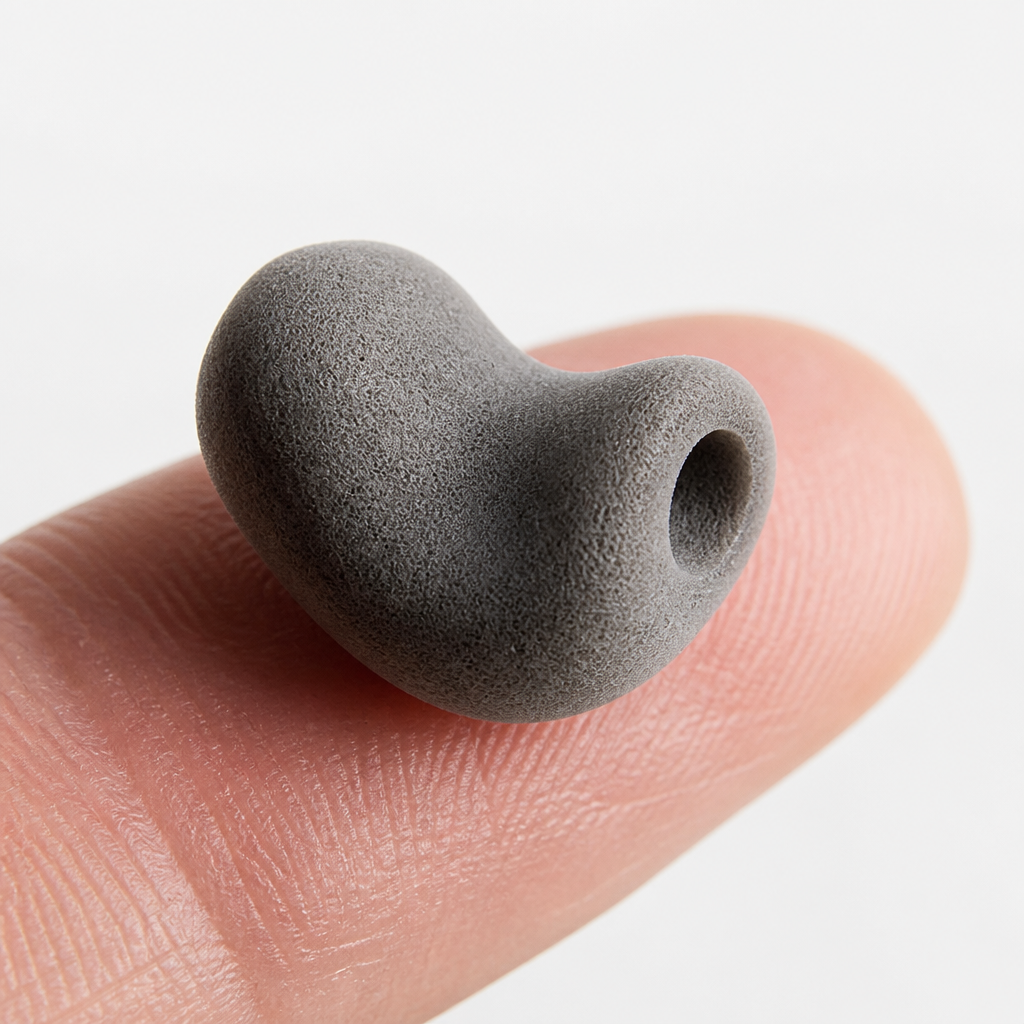

The Noise Reduction Rating (NRR) printed on ear plug packaging is a laboratory figure. It describes the maximum attenuation measured under controlled conditions with a correct fit. In real-world use, actual attenuation is lower, because most people do not insert plugs with the same precision as a lab technician.
A rating of around 32dB, like that delivered by ATTENU8’s metal-bodied plugs, represents a strong real-world reduction that brings most bedroom noise environments into the range where sleep disruption drops sharply. You are not eliminating sound entirely. You are taking a room at, say, 55 to 65 decibels of intermittent noise and reducing what your ear canal receives to a quiet background murmur.
Why the Correct Fit Closes the Gap Between Lab and Real Life
The single biggest reason people do not get the rated attenuation from their ear plugs is poor fit. With foam roll-and-insert plugs, users frequently do not compress the foam enough, do not pull the ear up and back to straighten the canal, or do not hold the plug in place long enough for the foam to expand fully. The result is a partial seal that delivers perhaps half the rated attenuation.
A plug with a rigid or semi-rigid body and replaceable memory foam tips removes much of this variability. The body positions the tip accurately in the canal, and the memory foam conforms to the specific geometry of your ear rather than relying on you to insert it at exactly the right angle every single night.
Pro tip: When testing a new ear plug for the first time, insert it in a noisy room rather than a quiet one. You will immediately feel the difference in seal quality when you rotate the plug slightly to find the optimal position, which is impossible to assess in silence.
Disposable foam ear plugs are the default choice for most people because they are cheap and widely available. For occasional use in a construction environment or a noisy flight, they are fine. For nightly sleep use, they have significant practical problems.
Disposable foam plugs are designed to expand to fill the canal, which means they generate outward pressure against the canal wall. That pressure is tolerable for an hour. Across eight hours, especially for side sleepers where the plug is also being compressed by a pillow, it becomes genuinely uncomfortable. Most people remove their plugs at some point in the night without realising it, which means the protection disappears exactly when they need it most, during the lighter sleep stages in the early morning hours.
Disposable foam plugs are supposed to be discarded after each use but rarely are. Reused foam plugs accumulate ear wax and skin oils, become stiffer, and lose their expansion ability, reducing their attenuation progressively. Most people are using plugs that are performing well below their rated NRR because the foam has been used past its effective lifespan.
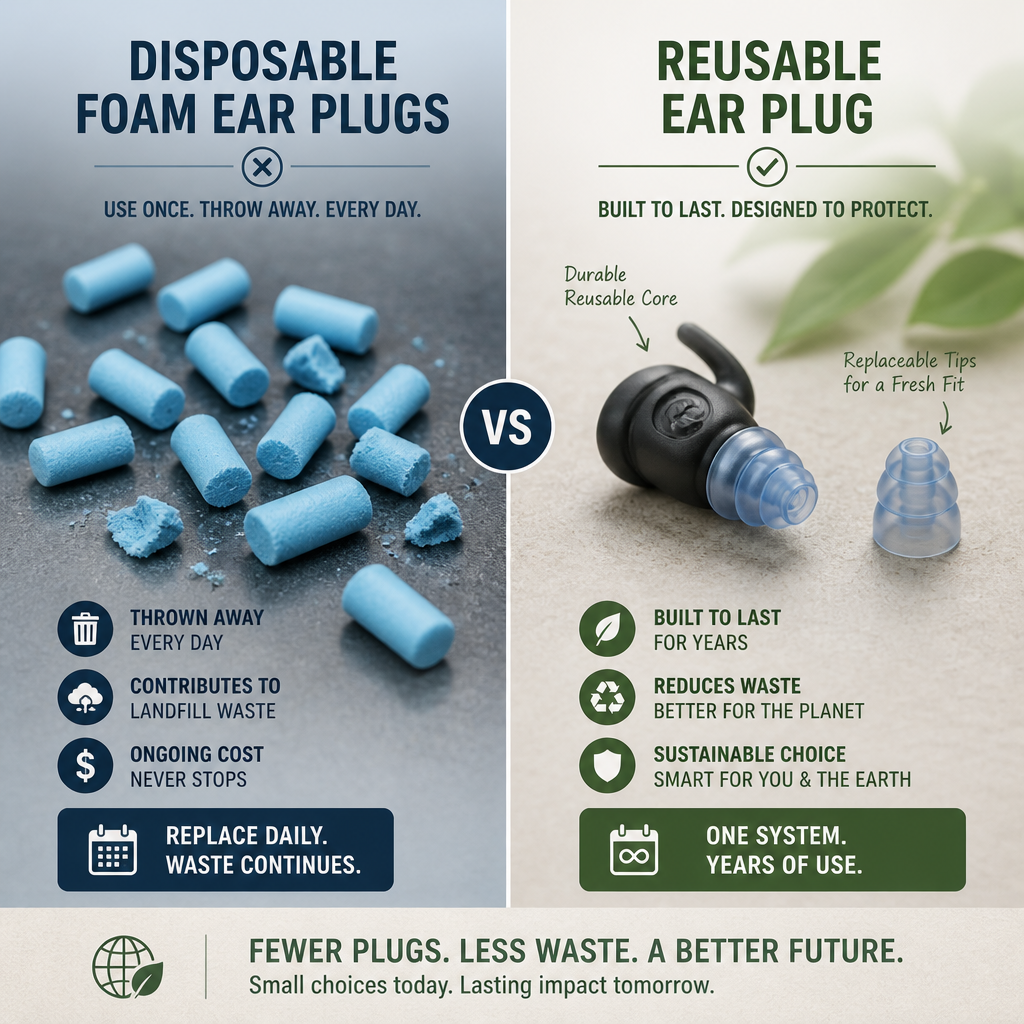
A reusable metal-bodied plug solves both problems. The body does not generate expanding pressure. The foam tips are replaced on a clear schedule (every 6 to 8 weeks) so you always have fresh, properly performing foam. And because you are replacing tips rather than entire plugs, the ongoing cost is a fraction of continually buying disposable packs.
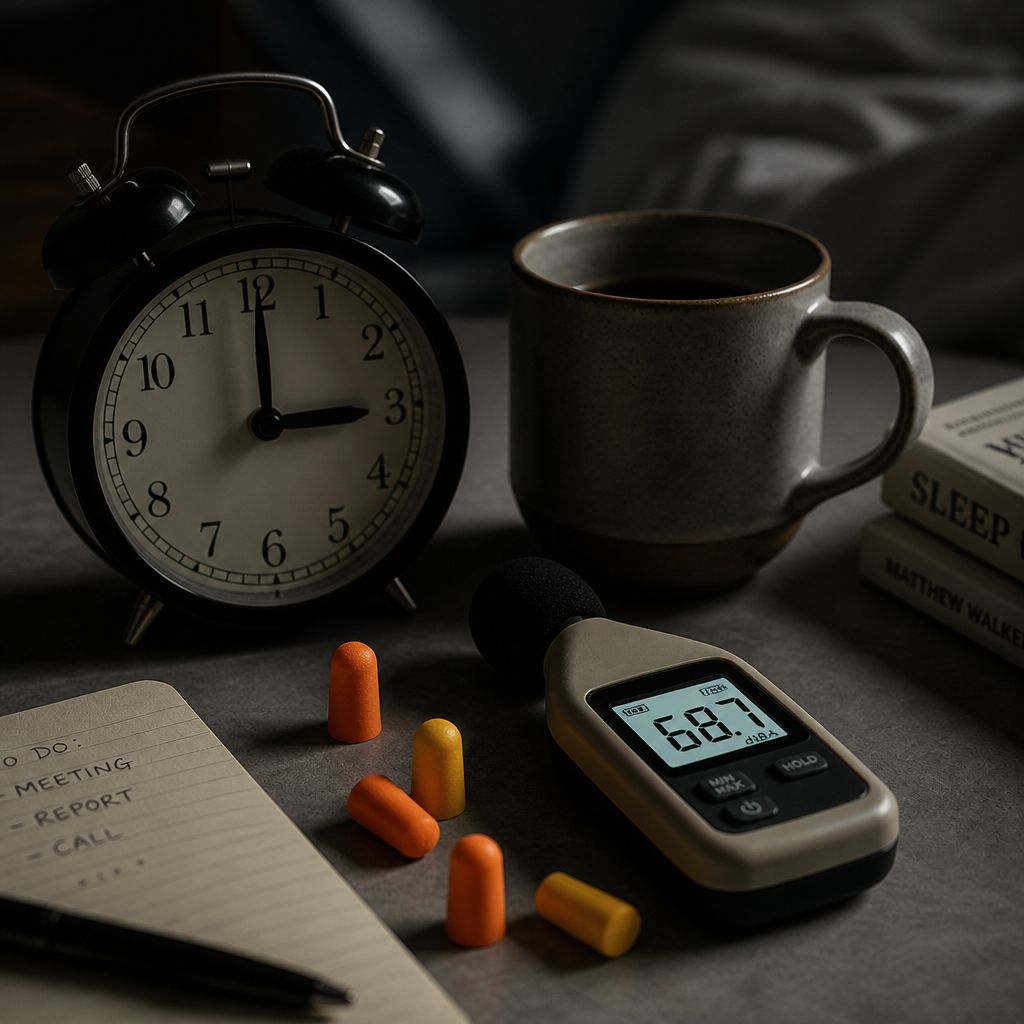
There are three realistic categories of ear plug available for regular sleep use. Each has a clear use case, and understanding the trade-offs makes the decision straightforward rather than overwhelming.
| Type | Best For | Main Limitation |
|---|---|---|
| Disposable foam plugs (e.g., standard polyurethane roll-and-insert) | Occasional use, travel, first-time users. High NRR ratings available. Low upfront cost. | Pressure discomfort over long wear; hygiene degrades quickly when reused; inconsistent fit without technique; significant ongoing waste and cost for nightly users. |
| Reusable metal-bodied plugs with memory foam tips (e.g., ATTENU8) | Nightly sleep use, travel, noise-sensitive individuals who need consistent, comfortable attenuation every night. Durable. Multiple tip sizes for fit. | Higher upfront cost than disposables. Foam tips need replacing every 6 to 8 weeks, though this cost is minimal compared to ongoing disposable purchase. |
| Electronic sleep earbuds (e.g., advanced earbud-style devices with passive noise cancellation and audio playback) | Users who want to pair noise blocking with ambient sound or sleep audio. Battery-powered options with companion apps. | High cost (some options priced above $250). Battery dependency. Bulkier profile uncomfortable for side sleepers. Overkill for users who simply need reliable noise attenuation without audio features. |
For someone who struggles with noise every night, the reusable metal-bodied plug sits in the practical sweet spot. It delivers consistent, high attenuation without the pressure problem of disposable foam, without the cost and complexity of electronic options, and without the hygiene issues that accumulate when you reuse foam you were supposed to throw away.
Fit is the variable most guides skip past. Even a well-designed plug will underperform if it is inserted incorrectly, and for light sleepers there is no margin for error. A partial seal that lets in 40% of ambient noise can be the difference between sleeping through the night and lying awake at 4am.
First, reach over the top of your head with the opposite hand and gently pull your ear up and back. This straightens the ear canal, which curves slightly in most people. Second, insert the plug with a slow, gentle rotating motion rather than pushing it straight in. Rotation helps the tip seat properly against the canal wall. Third, hold the plug in place for a few seconds to allow the memory foam to begin conforming to the canal shape.
If you can still hear conversation clearly with both plugs in, the seal is not right. Reinsert and try pulling the ear further back before inserting. Sizing is the other variable. A foam tip that is too large creates excessive pressure; one that is too small cannot form a seal. This is why having three tip sizes available (XS, S, and M) is not a marketing feature. It is a functional requirement for achieving real attenuation across the range of adult ear canal sizes.
Side sleepers face an additional challenge: pillow pressure on the outer ear can partially dislodge or compress a plug, breaking the seal. A plug with a low-profile, concave body sits closer to the ear, reducing the leverage a pillow has on it. Flat, protruding plug designs are particularly bad for side sleepers because the pillow acts as a lever against the body of the plug, slowly working it loose during the night.
When evaluating the best ear plugs for sleeping, the criteria that matter most for light sleepers are different from what matters for occasional industrial use. Here is what actually determines whether a plug works through the night, every night.
For sleep, you are looking for roughly 28 to 33dB of noise reduction. Below 28dB, intermittent noise spikes (snoring peaks, traffic surges) can still clear the threshold for micro-arousal. Above 33dB starts to feel disorienting and can make you miss sounds you actually need to hear, like an alarm. The 32dB sweet spot that ATTENU8’s plugs deliver sits right in the effective range for sleep-specific noise reduction for sleep.
Memory foam tips win for overnight wear. They conform and hold their position without generating sustained outward pressure. Silicone tips are more durable but create a harder seal that many people find uncomfortable after several hours. The body material determines the overall profile: a lightweight aluminium body keeps the total weight and bulk low, which matters when your ear is pressed against a pillow for eight hours.
A disposable foam plug used every night costs more per year than most people realise when they do the arithmetic on a pack-by-pack basis. A reusable metal-bodied plug with replaceable foam tips front-loads the cost and then drops it to the minimal recurring expense of replacement tips every six to eight weeks. Over 12 months of nightly use, the reusable option is consistently cheaper and generates significantly less waste.
Pro tip: Keep a second pair of tips accessible on your nightstand. If you remove your plugs in the night and the tips feel compressed or uncomfortable, swapping to a fresh pair takes seconds and means you are not lying awake trying to reinsert a fatigued foam tip at 3am.
Wearing well-fitted ear plugs for sleep does not damage hearing. The risk associated with ear plugs is primarily related to incorrect insertion or excessive force, not routine nightly use. If you experience pain or discomfort, it is a sign the fit is wrong or the tip size is too large, both of which are easy to correct. Regular gentle cleaning of the outer ear remains good practice regardless of ear plug use.
At around 32dB of noise reduction, a standard smartphone alarm set to a moderate to high volume will still be audible. The attenuation reduces ambient noise significantly but does not create total sound isolation. If you are concerned, test your alarm volume with plugs in before relying on it, and use a phone alarm rather than a distant clock across the room.
Start with a medium tip. Insert it and assess two things: whether the seal feels complete (ambient noise drops noticeably) and whether the pressure is comfortable. If the medium tip creates significant discomfort or feels like it is stretching the canal, move to a small. If you can hear clearly around the seal with minimal outside noise reduction, try medium before moving to large. Most adults find medium fits one ear and small fits the other, which is completely normal.
Yes, provided the foam tips are replaced on schedule (every 6 to 8 weeks) and the metal body is wiped down periodically. This is actually more hygienic than the common practice of reusing disposable foam plugs well beyond a single use, which is how most people use them despite manufacturer guidance. Fresh foam tips on a clean metal body beat degraded, ear-wax-saturated disposable foam that has been used twenty times.
Snoring is one of the most common reasons people seek sleep ear plugs, and a well-fitted, high-attenuation plug is an effective first-line solution. Snoring typically peaks at 50 to 60 decibels at close range. A plug delivering 32dB of attenuation reduces that to the low-20-decibel range, which for most light sleepers sits below the threshold for sleep disruption. It does not fix the snoring, but it removes it as a barrier to your sleep.
Most people adapt within three to five nights. The first night often feels slightly unusual, particularly if you are not accustomed to the sensation of something in your ear canal. By the third or fourth night, the sensation becomes background and most people report they stop noticing the plugs entirely. The key is starting with a correctly sized, comfortable tip rather than pushing through discomfort from a poor fit, which will make the adaptation period longer and more unpleasant.
Have you found a particular ear plug style or technique that finally solved your sleep noise problem? Share your experience below so other light sleepers can benefit from what actually worked for you.
Noise-induced hearing loss does not announce itself with a dramatic event. It accumulates shift by shift, flight by flight, concert by concert, until one day the damage is done and no amount of money brings your hearing back. If you are still reaching for a fresh pair of disposable foam plugs every morning, you are solving a permanent problem with a temporary tool. Reusable ear plugs for work and daily life exist precisely because certain environments are loud enough, and frequent enough, to make single-use protection both wasteful and expensive. The eight environments below are not edge cases. They are the places where hearing protection stops being optional.
| Key Insight | Explanation |
|---|---|
| Reusable plugs cut long-term costs sharply | Replacing only foam tips every 6 to 8 weeks instead of buying new disposable plugs daily makes reusable ear plugs dramatically cheaper over a working year. |
| Metal bodies outlast foam bodies | A concave aluminium body like the one used in ATTENU8 plugs resists compression, crushing, and contamination in ways that all-foam or all-plastic plugs simply cannot match on active job sites. |
| Fit determines actual noise reduction | Rated NRR figures mean nothing if the plug does not seat properly. Memory foam tips in multiple sizes (XS, S, M) ensure a reliable seal regardless of ear canal shape. |
| Hearing damage is cumulative and permanent | Every unprotected hour in a loud environment adds to lifetime exposure. Professionals in construction, manufacturing, or the military face repeated daily exposure that compounds over careers. |
| Sleeping with ear plugs requires comfort above all else | Side sleepers in particular need a low-profile plug that does not create painful pressure points during hours of use. Hard-shell reusable plugs with soft memory foam tips solve this directly. |
| Disposable plugs create ongoing waste and cost | A construction worker using one pair of disposables per shift generates hundreds of discarded plugs per year. Reusable plugs with replaceable tips reduce that waste to near zero. |
| Around 32 dB of noise reduction covers most loud environments | A plug delivering approximately 32 dB of noise reduction handles construction machinery, concert stages, aircraft cabins, and urban transit noise without over-blocking to the point of communication failure. |
Construction is the environment most people picture when they think about hearing protection in loud environments. Jackhammers, pile drivers, angle grinders, and heavy plant equipment produce sustained noise levels that are genuinely dangerous over a full shift. The problem is not a single loud moment. It is eight or ten hours of cumulative exposure, day after day, for an entire working life.
Disposable foam plugs work in theory, but in practice they fall apart on a busy site. Dust and sawdust contaminate them within hours. Workers handle them with dirty gloves. They get crushed in pockets, lost in debris, and replaced improperly by people who have not been trained to roll and insert them correctly. A badly inserted disposable plug can deliver far less than its rated protection.
A durable ear plug with a metal body changes this dynamic. You clean it, you reuse it, and because it does not degrade visibly the way foam does, workers are more likely to actually wear it consistently. The ATTENU8 aluminium body paired with replaceable memory foam tips gives site workers the rated 32 dB noise reduction they need without generating a trail of discarded plugs behind every shift.
Pro tip: On construction sites, keep your reusable plugs on a lanyard or cord attachment. The single most common reason workers go unprotected is that they cannot find their plugs quickly when a loud machine starts up nearby.
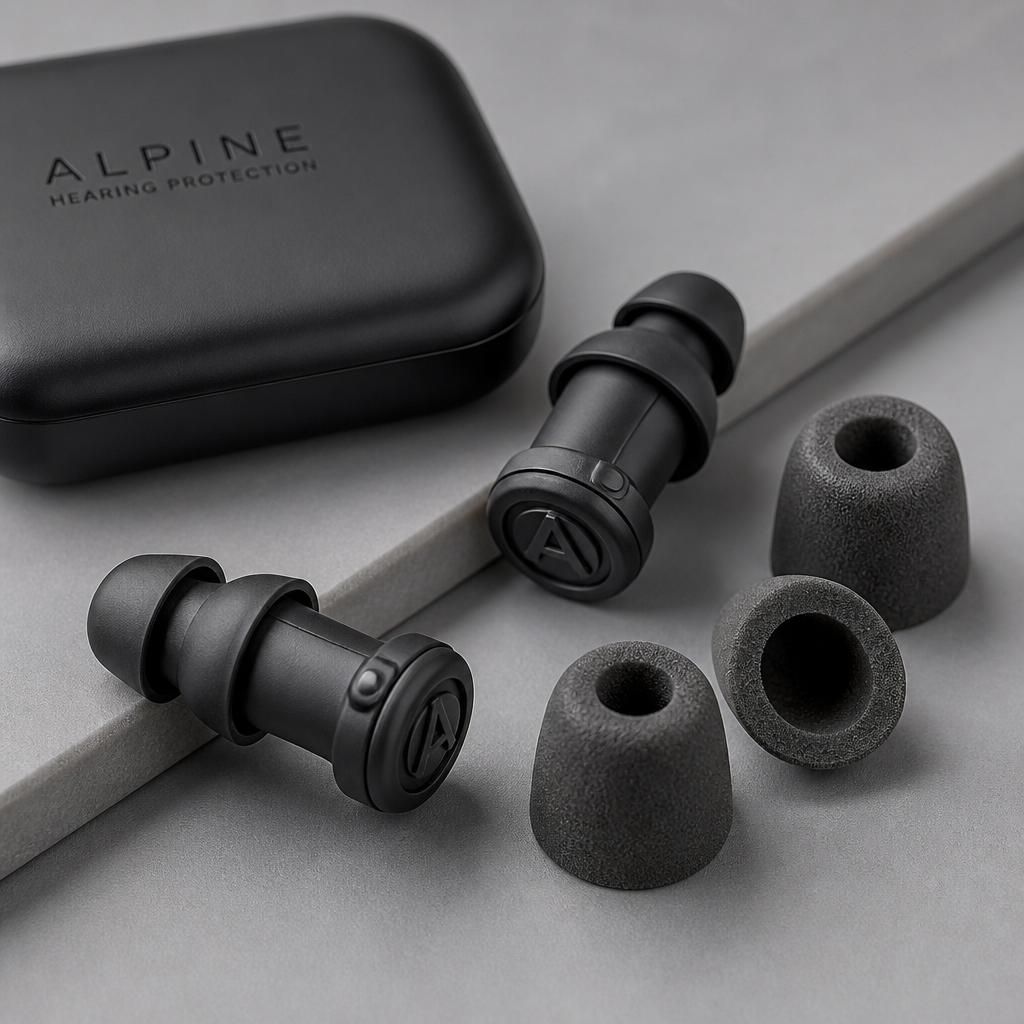
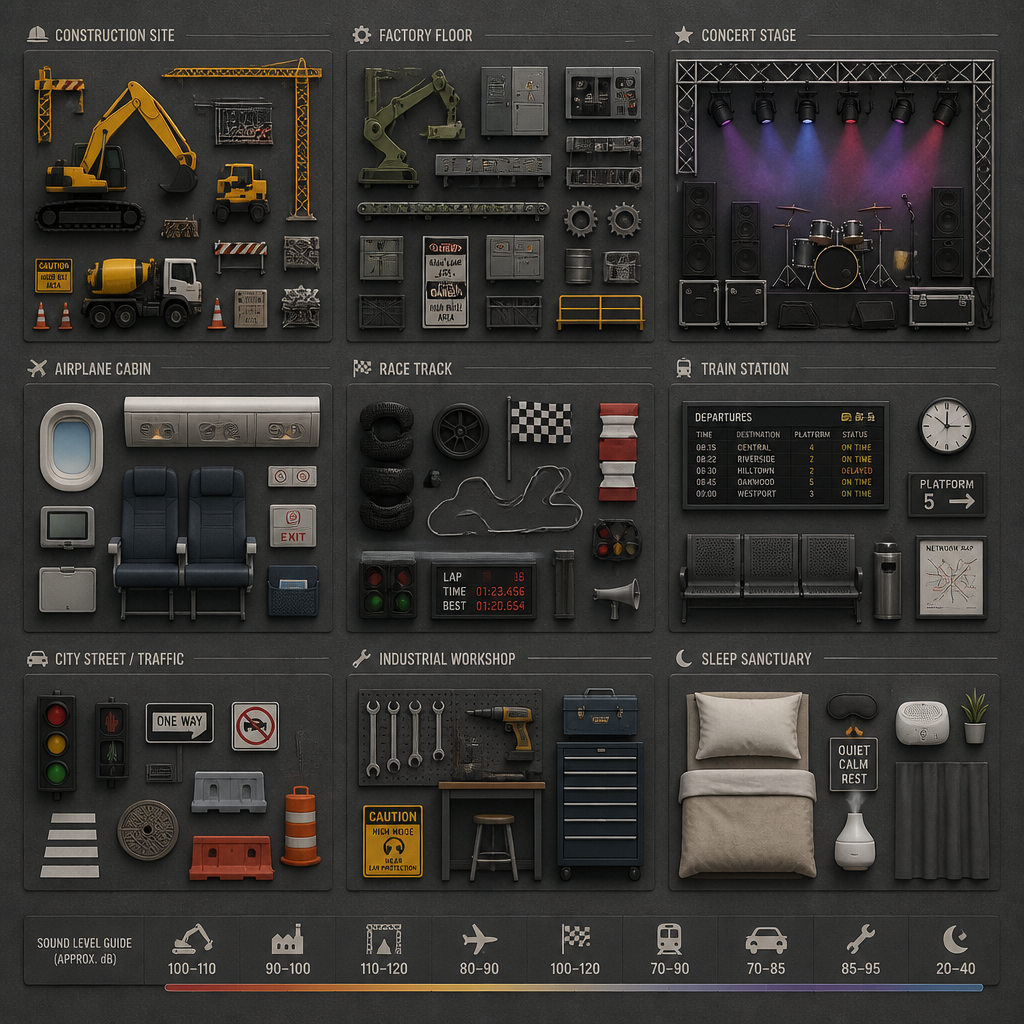
Most workplace safety regulators set an action level where hearing protection becomes mandatory. Reusable plugs rated at approximately 32 dB of noise reduction are well-suited to the range of noise sources found on typical sites, from power tools at closer range to general ambient machinery noise across a larger site. The key is consistent wear, and consistent wear depends on comfort and convenience, which is where reusable metal-bodied plugs earn their keep.
Factory workers face a different challenge from construction workers. The noise on a manufacturing floor is often more constant and less variable. Stamping presses, conveyor systems, CNC machines, and ventilation systems combine into a relentless background roar that rarely drops below dangerous levels during a shift.
In this context, ear plugs for work need to be comfortable enough to wear for an entire shift without causing fatigue or the urge to remove them. This is where most cheap reusable plugs fail. Rigid flanged plugs in a fixed size create pressure in ear canals that are not perfectly suited to that size, and workers quietly pull them out by mid-morning. Memory foam tips that conform to the specific shape of an individual ear canal are simply more comfortable over long periods.
Manufacturing environments also tend to be cleaner than construction sites, which makes the hygiene case for reusable plugs even stronger. You can wipe down a metal-bodied plug at the end of a shift in seconds. That is not something you can say about a foam plug that has absorbed eight hours of sweat.
In large manufacturing operations, the cost of supplying disposable ear plugs to an entire workforce adds up quickly. More importantly, compliance monitoring becomes harder when workers are constantly swapping plugs in and out due to discomfort. Workers who own a personal pair of reusable plugs tend to wear them more consistently, which is the actual goal of any hearing protection program.
Concert venues, festival stages, and nightclubs routinely operate at sound levels that can cause temporary hearing threshold shifts after a single event. For casual attendees, this is a one-off risk. For musicians, sound engineers, venue staff, and frequent concert-goers, it is a cumulative occupational hazard.
The classic objection to wearing ear plugs at concerts is sound quality. Standard disposable foam plugs muffle high frequencies disproportionately, turning a live performance into a muffled, bass-heavy experience. This is not a problem with good reusable plugs that use memory foam tips designed to attenuate evenly across the frequency range. You hear the music. You just hear it at a safer level.
The best ear plugs for concerts are the ones you actually wear. A plug that sits in your pocket because it sounds terrible or feels uncomfortable provides exactly zero protection.
Musicians who perform multiple nights per week have the strongest case for investing in high-quality reusable plugs. The ATTENU8 approach of a durable metal body with replaceable soft tips means the product stays in rotation for years, not weeks. Over a touring season, that economics argument becomes very clear very fast.
Aircraft cabin noise is a steady, low-frequency roar produced by engines, airframe vibration, and pressurization systems. It sits at levels that are not acutely dangerous in the way a construction site is, but they are fatiguing over a long-haul flight and they contribute meaningfully to cumulative exposure for frequent flyers.
Ear plugs for travel solve two distinct problems on a plane. First, they reduce the physiological fatigue that comes from prolonged exposure to cabin noise. Frequent travellers consistently report arriving less exhausted when they wear ear protection on long flights. Second, for travellers trying to sleep in economy class, they block the ambient noise that prevents sleep onset and disrupts sleep cycles.
Airports themselves are a second layer. Gate areas, particularly near runway-facing windows, produce significant ambient noise. Carry-on luggage that includes a pair of reusable plugs takes up almost no space and costs nothing extra once the initial purchase is made.
Pro tip: Keep your reusable ear plugs in your carry-on rather than your checked luggage. The environments where you need them most, aircraft cabins, airport gate areas, and transit hubs, are all airside, not at your destination.
Firearms, artillery, and military vehicles produce some of the most intense impulse noise that human ears are routinely exposed to. A single unprotected gunshot at close range exceeds safe exposure limits in an instant. For military personnel, the cumulative exposure across a career of training exercises, live fire events, and operational deployments is substantial.
The durability requirement in military and tactical contexts is extreme. Equipment gets wet, dirty, compressed, dropped, and subjected to temperature extremes that destroy consumer-grade products quickly. A metal-bodied reusable ear plug is simply better suited to this kind of abuse than an all-foam or all-plastic alternative. The aluminium body does not deform, does not absorb moisture, and does not degrade with the same predictable failure pattern that foam plugs exhibit.
For civilians in shooting sports, the same logic applies. Range days are loud. Cumulative range exposure over years of regular practice adds up to meaningful hearing damage if protection is inconsistent. A reusable plug that you own, maintain, and carry as standard kit is more likely to actually be used than a disposable plug you have to remember to stock.
Military personnel who wear helmets, headsets, or communication gear face a fit challenge that standard bulky ear muffs cannot solve. A low-profile in-ear plug that provides strong attenuation without interfering with other headgear is often the only practical option. The compact form factor of metal-bodied plugs with memory foam tips fits this requirement directly.
Motorsport venues are among the loudest recreational environments a person can enter voluntarily. Formula racing, motorcycle events, and drag strips produce sustained noise levels that can cause hearing damage to spectators, let alone pit crew members and marshals who work track-side for entire race days.
For pit crew and track workers, hearing protection is professional-grade necessity. For spectators attending multiple events per season, the cumulative argument applies with force. One race weekend without protection is one thing. Ten race weekends per year over a decade is a very different calculation.
The practical challenge at motorsport events is that you also need situational awareness. You need to hear commands, radio calls, or safety announcements. A plug delivering around 32 dB of noise reduction brings the roar of a race engine down to a manageable level without blocking human voice frequencies entirely, which is the practical balance that matters in this environment.
Underground rail systems, particularly older infrastructure, produce wheel squeal and acceleration noise that can be genuinely loud at platform level and inside carriages. Bus travel in dense urban environments adds engine noise, stop-start braking, and passenger noise to the mix. For daily commuters making this journey twice a day, five days a week, the exposure is not trivial.
Beyond the hearing protection argument, there is a practical productivity and wellbeing case. Commuters who use ear plugs during transit report lower stress levels on arrival at work and improved concentration during the commute itself when using it to read or decompress. The plugs do not need to be paired with any audio device to deliver this benefit. Silence, or near-silence, is the point.
Urban noise pollution also extends beyond transit. City apartments near arterial roads, flight paths, or entertainment districts expose residents to sustained outdoor noise that disrupts concentration and rest. Reusable ear plugs worn during focused work periods, or during afternoon rest, address this directly.
This is the environment where comfort matters most and where most ear plugs fail their users. A plug that is fine for two hours on a job site becomes intolerable at hour four of a sleep attempt, particularly for side sleepers who press one ear into a pillow.
Standard cylindrical foam plugs create pressure points when the pillow compresses against them. This wakes light sleepers repeatedly and causes enough discomfort that many people abandon ear plugs for sleep entirely, accepting the noise rather than the discomfort. This is a product design failure, not a user failure.
The concave aluminium body design of ATTENU8 plugs addresses this directly. The recessed profile sits within the ear without protruding, reducing the pressure point problem that makes most plugs unwearable for side sleepers. The soft memory foam tips conform to the ear canal and hold their position without requiring the user to shove the plug deeper to maintain a seal.
Light sleepers near busy roads, shift workers sleeping during daytime hours, travellers in hotels near street level, and partners of people who snore are the core audience for sleep-specific hearing protection. The snoring use case alone is significant. The noise generated by a partner’s snoring can be genuinely loud, and a plug delivering around 32 dB of noise reduction brings it to a level that no longer prevents sleep onset.
Visit the ATTENU8 product page to see how the three memory foam tip sizes (XS, S, and M) address the fit problem that causes most sleep ear plug failures.
Not all ear plugs are built the same, and the environment you are protecting against should drive your choice. The table below compares the three main categories directly on the factors that matter most across the eight environments covered above.
| Protection Type | Best For | Key Limitations |
|---|---|---|
| Disposable foam plugs (single-use) | One-off situations, shared use in visitor safety kits, environments with very high contamination risk | High ongoing cost, significant waste, inconsistent insertion quality, no size options, degrades quickly in dirty or humid conditions |
| Reusable silicone or flanged plugs (plastic body) | Occasional use, budget-conscious buyers, environments where comfort over long periods is less critical | Fixed flange size fits many ear canals poorly, pressure build-up during extended wear, less durable under heavy physical use |
| Reusable metal-bodied plugs with memory foam tips (ATTENU8) | Daily professional use, sleep, travel, concerts, any environment requiring consistent long-term wear and high durability | Higher upfront cost than disposables, foam tips need replacement every 6 to 8 weeks (though this is the only recurring cost) |
With a metal-bodied reusable plug like ATTENU8, you replace only the memory foam tips, not the entire plug. Tips typically need replacing every 6 to 8 weeks with daily use. The aluminium body itself lasts years under normal conditions. Compare this to disposable foam plugs, which need replacing after every use or every shift.
Yes, provided you clean them regularly. A metal body wipes down in seconds with a damp cloth. Memory foam tips should be replaced on the 6 to 8 week schedule rather than cleaned repeatedly, as foam absorbs moisture over time and loses its sealing properties. In practice, reusable plugs with replaceable tips are more hygienic than disposable plugs handled repeatedly with dirty hands on a job site.
Most cylindrical foam plugs are uncomfortable for side sleepers because they protrude from the ear and create pressure points when a pillow presses against them. A low-profile plug with a concave or recessed body design reduces this problem significantly. Soft memory foam tips that conform to your ear canal without requiring deep insertion also help maintain a seal without discomfort during several hours of side sleeping.
Construction sites with heavy machinery typically require plugs with an NRR of 25 dB or higher. Many construction-grade plugs are rated at 25 dB to 33 dB. A plug delivering approximately 32 dB of noise reduction covers the majority of construction noise sources effectively. The actual protection you get depends equally on correct insertion and consistent wear throughout the shift, which is why comfort and fit matter as much as the rated figure.
Frequent travellers benefit from reusable plugs in three ways. First, there is no need to carry or restock disposables across multiple trips. Second, a consistent pair of plugs that you have already fitted to your ear canals provides reliable protection without the insertion variability of disposables handled in cramped conditions. Third, the environmental footprint is dramatically lower, which matters to travellers who are already conscious of their per-trip impact.
A well-fitted plug delivering around 32 dB of noise reduction reduces dangerous background noise to safe levels while preserving enough hearing range for face-to-face communication at normal speaking distance. Human speech, especially in the mid-frequency range where most conversation occurs, remains intelligible at close range even with plugs inserted. The common complaint that ear plugs block all communication usually comes from plugs that fit poorly or are inserted too deeply, not from the protection level itself.
If you wear ear plugs in any of the environments above, we would genuinely like to hear which situations drive you to reach for them first and what has stopped you from switching to a reusable option so far.
We would love your feedback and any insights you would share with others. What perspective would you add?
Most ear plugs fail not because they are low quality, but because they are the wrong size. You can spend good money on a pair rated at 32dB noise reduction and still wake up to every car alarm, snoring partner, or early-morning construction clatter, simply because the foam tip never formed a proper seal. This ear plug size guide exists to fix that. Whether you are working through ATTENU8’s three included tip sizes for the first time or troubleshooting a fit that has never felt quite right, what follows is a specific, no-nonsense walkthrough of how ear canal anatomy, tip size, insertion technique, and seal quality all interact to determine the noise reduction you actually get, not just the number printed on the box.
The Noise Reduction Rating stamped on every pack of ear plugs is measured in a controlled laboratory under ideal conditions. In practice, the number you see on packaging is the theoretical ceiling, not the floor you can count on. Regulatory bodies including NIOSH recommend applying a significant real-world derating factor to any labeled NRR, precisely because insertion technique and fit vary so much person to person.
A correctly fitted ear plug at a moderate rating will outperform a higher-rated plug that does not seal properly. The seal is the mechanism. Without it, sound bypasses the attenuating material entirely, traveling through the gap between the foam tip and your ear canal wall. No amount of rating points compensates for an air gap.
This is the core problem with one-size disposable foam plugs. They assume a canal geometry that many people, particularly women and smaller-framed adults, simply do not have. ATTENU8’s approach of including three tip sizes, XS, S, and M, with every pair acknowledges what the disposable foam industry largely ignores: ear canals vary significantly enough that a single size is a coin flip for a large portion of the population.
A plug that fits correctly does less work because it does more work. The foam does not need to compensate for gaps it cannot fill if it is already flush against the canal wall.
Before you can choose the right tip size, it helps to understand what you are fitting. The ear canal is not a straight tube. It has a slight curve, and its internal dimensions vary between the outer cartilaginous section, which is more flexible, and the inner bony section, which is not. Most reusable ear plug tips sit in the outer section, which is why material compliance matters so much.
Research into ear canal anthropometry consistently shows that men’s canals are on average longer, wider, and deeper than women’s. The difference between the height and width of the ear canal opening alone can vary by roughly 40% across a population. This is not a minor variation. It means a medium tip that seals perfectly for one person may be loose in a narrower canal and uncomfortable in a wider one.
Beyond biological sex, canal shape also varies by ethnicity, age, and individual anatomy. Two people of identical height and build can have measurably different canal geometries. This is why self-testing with the included sizes, rather than assuming a size based on general body size, is the only reliable method.
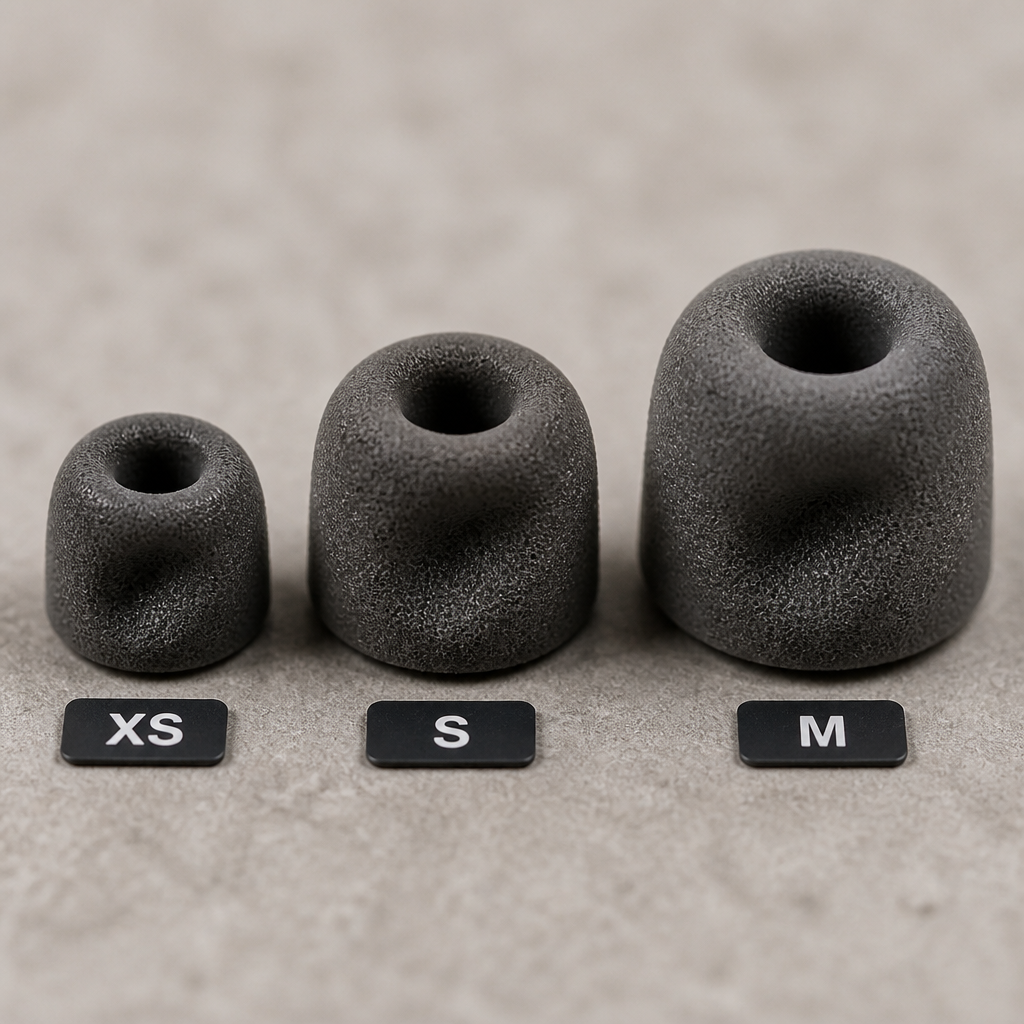
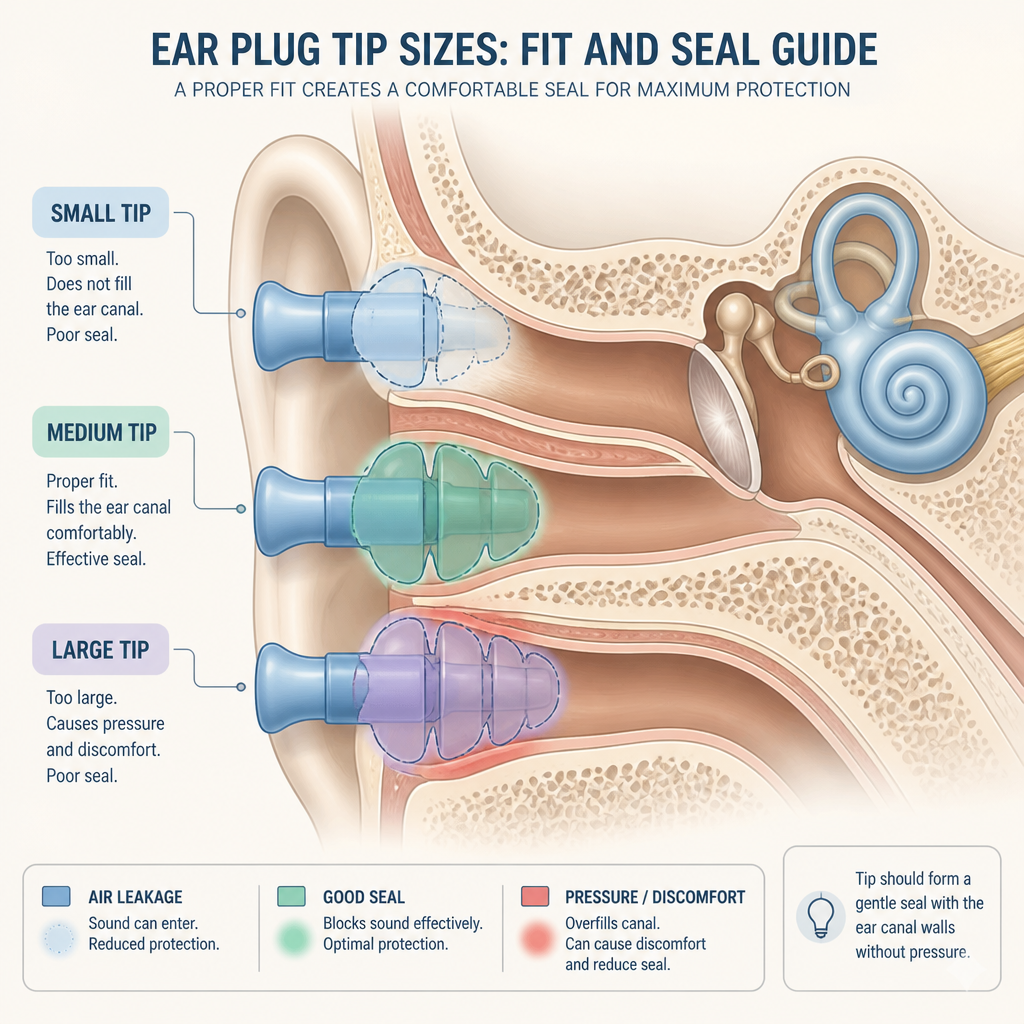
The slight curve of the canal is why pulling the outer ear upward and backward during insertion matters so much. That gentle tug straightens the canal temporarily, allowing the tip to travel further in without meeting the curve as resistance. Skip this step and the tip sits at an angle, pressing on one wall while leaving a gap on the other.
Memory foam is uniquely suited to this anatomy because it compresses for insertion, then expands slowly to conform to whatever shape it encounters. A silicone or rigid flanged tip cannot do this. It either fits or it does not. Memory foam bridges the gap between sizing categories, which is why even a tip that is slightly smaller than ideal can still form an adequate seal if it expands fully before you release it.
ATTENU8 includes all three sizes in every pack precisely so you can test, not guess. The instinct to reach for medium is understandable, but it is wrong as often as it is right. Here is how to work through the selection properly.
Medium is the industry default, but the population skews smaller than most manufacturers assume, especially among women and adults from East Asian backgrounds. Starting with S gives you a reference point. If an S tip feels loose or you can feel slight pressure relief when you press the plug further in, move to M. If S feels snug and slightly difficult to remove after expansion, stay there.
The correct size should require gentle effort to remove, not a firm tug and not a pinch. If a tip slides out without resistance after full expansion, it is too small. If removal causes discomfort, it is probably too large, or you have pushed it too deep.
These are the clearest indicators to act on. A tip that is too small will feel loose, allow you to hear ambient noise clearly even after full expansion, and may gradually work its way out during sleep as you move. A tip that is too large will be difficult to insert correctly, may cause a pressure sensation rather than a seal sensation, and can cause soreness with extended wear.
The correct fit produces a specific sensation: a slight muffling of your own voice as you speak or hum, and a sense of even, distributed pressure around the canal opening rather than a point of pressure on one side. That muffled self-voice test is one of the most reliable quick checks available without specialist equipment.
Pro tip: Try each size in both ears separately. It is not uncommon for a person’s left and right ear canals to differ slightly in diameter. Some ATTENU8 users find they need an S in one ear and an M in the other, and using mismatched sizes is entirely appropriate if that is what seals correctly.
Choosing the right tip size is half the equation. The other half is insertion. A correctly sized tip inserted incorrectly will underperform a slightly smaller tip inserted well. The technique below applies to ATTENU8’s memory foam tips specifically, though the principles apply to any compressible foam tip.
Roll the memory foam tip between your thumb and index finger until it is compressed to roughly half its resting diameter. With standard disposable foam plugs, you would roll the entire plug into a thin cylinder. With ATTENU8’s design, you are compressing the tip only, not the aluminium body. Hold the compression for two to three seconds so the foam has time to settle before you insert it.
A common mistake is releasing compression too early. If the foam begins expanding while you are still positioning it at the canal opening, it will not travel far enough in to seal correctly.
Reach over your head with your free hand, grasp the top of your outer ear, and pull it gently upward and backward. This straightens the canal. While holding this position, slide the compressed tip into the canal with a gentle rotating motion, aiming slightly forward and downward. Do not shove it. Resistance that requires force means the tip is too large or the canal is not straightened enough.
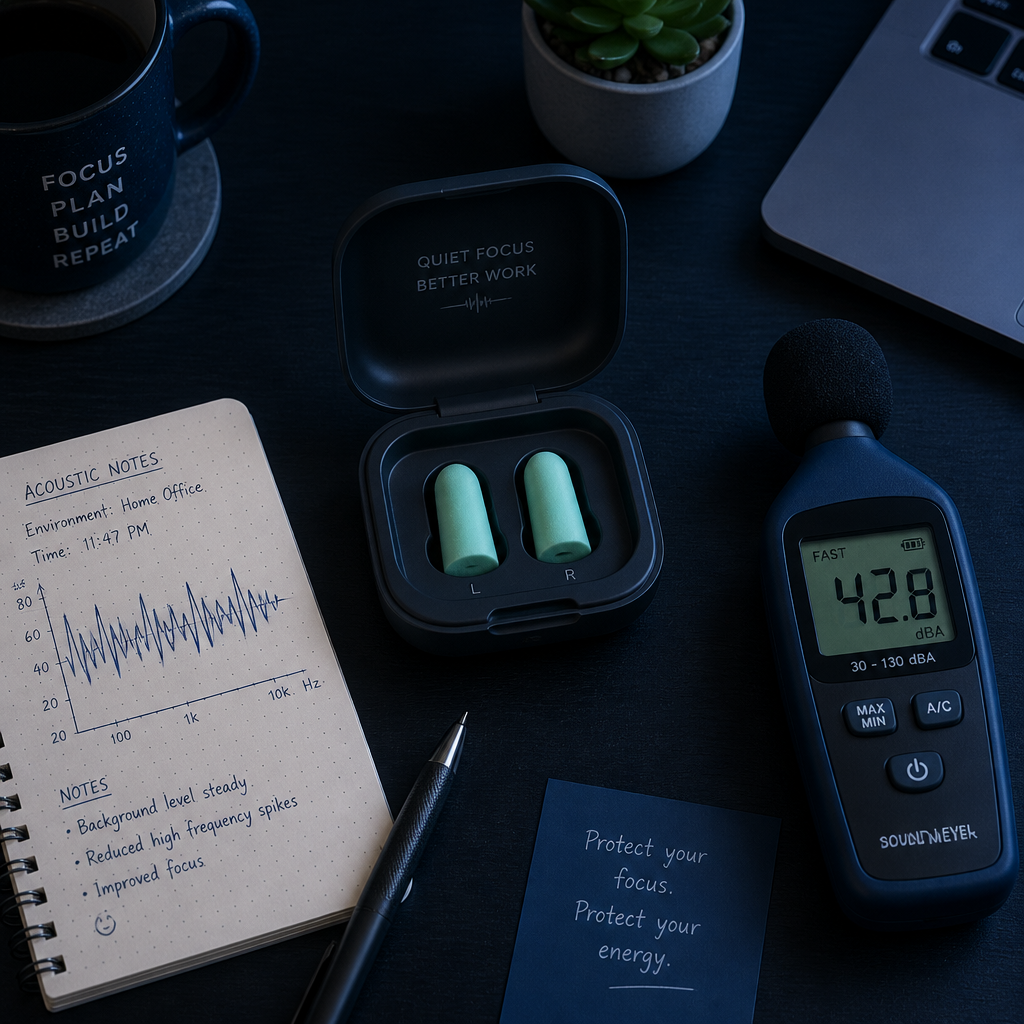
This is the step most people skip. Keep the plug held in position with a light fingertip pressure for a full 20 to 40 seconds while the memory foam expands. Memory foam requires time to return to its resting shape after compression. Releasing before full expansion means the tip may settle short of the canal wall, leaving a gap.
The distinction between memory foam and standard PU foam matters here. Standard foam expands in roughly 10 seconds. Memory foam, which is denser and more heat-responsive, takes longer but conforms more precisely once it does expand. That conforming quality is what delivers the consistent seal across multiple wearings that disposable foam cannot replicate.
Pro tip: Insert your ear plugs while sitting, then gently lie down for sleep rather than inserting them while already lying on your side. Gravity assists the initial positioning, and you avoid the awkward angle that comes from trying to compress and insert while your ear is pressed against a pillow.
Never assume the seal is correct. Run a quick check every time, particularly in the first few uses with a new tip size. It takes under 30 seconds and tells you immediately whether you need to reinsert.
Hum or say a word aloud immediately after insertion. With a good seal, your own voice will sound noticeably louder and more resonant inside your head, as if you are speaking into a closed space. This is the occlusion effect, and it is your primary confirmation that the seal is working. If your voice sounds normal or you can easily hear ambient noise at conversational levels, the seal is incomplete.
Cup both hands firmly over your ears while the plugs are in. If the ambient noise level does not change significantly when you cup your hands, the plugs are doing the work. If cupping noticeably reduces ambient noise beyond what the plugs alone are doing, there is a gap in the seal. Remove the plugs, recompress, and reinsert, or try a larger tip size.
For workers in industrial or construction environments, a proper fit check is not optional. The gap between a correctly sealed 32dB plug and a poorly fitted one under the same conditions can mean the difference between protected hearing and cumulative damage across a long shift.
Understanding how ATTENU8’s memory foam tips compare to the main alternatives helps clarify why size selection and insertion technique have such different levels of importance across plug types.
| Tip Type | Size Adjustability | Seal Quality Dependence on Technique |
|---|---|---|
| Memory foam (ATTENU8 XS/S/M) | High. Three discrete sizes plus foam conforming to canal shape. Tolerates minor size mismatch through expansion. | Moderate. Compression and hold time matter, but the foam compensates for minor technique errors once expanded. |
| Standard disposable PU foam | Low. Single size per product. No size selection without buying a different product. | High. Correct rolling and insertion are critical because the foam expands fast and leaves no time to correct position. |
| Silicone flanged tips (Loop-style) | Moderate. Multiple sizes available, but flanged silicone does not conform, so correct size is non-negotiable. | Low to moderate. Insertion is simpler but relies entirely on the tip diameter matching the canal diameter precisely. |
The practical implication: memory foam rewards patience during insertion but is more forgiving on size. Silicone flanged tips are quicker to insert but punish a wrong size choice immediately. Disposable foam is the least forgiving on technique. ATTENU8’s combination of a rigid aluminium body (which gives you something to hold and position precisely) with slow-expanding memory foam tips threads the needle between the control of flanged designs and the conforming seal of disposable foam.
The performance of a memory foam tip degrades over time for two reasons: the foam loses its elasticity as it is compressed and re-expanded repeatedly, and it accumulates earwax and skin oils that stiffen the surface and reduce its ability to conform. Neither of these processes is immediately obvious, which is why scheduled replacement matters more than waiting for a visible sign of wear.
ATTENU8’s guidance places replacement at every 6 to 8 weeks for regular nightly use. At that point, the foam will typically have undergone enough compression cycles that it no longer expands fully. You may not notice a gradual degradation in seal quality, but it will be there. A simple check: compress the tip and time its return to full shape. Fresh memory foam should recover fully within 30 to 40 seconds. If a tip springs back quickly like standard foam or barely recovers at all, it is past its effective life.
This replacement model is a significant practical advantage over single-use foam plugs, which require complete replacement after every use, and over silicone-tip designs from competitors where you typically replace the entire assembly rather than just the consumable foam component. Replacing only the foam tip keeps long-term cost low and eliminates the waste of discarding functional metal hardware.
Wipe the aluminium body with a damp cloth after each use. Do not submerge the foam tips in water or use solvent-based cleaners on the foam itself. Water softens the foam structure and accelerates breakdown of the cell matrix that gives memory foam its slow-rebound property. A dry wipe after each use is sufficient maintenance for the tips between replacements.
Store the plugs in their case when not in use. Leaving memory foam exposed to sunlight or high heat (such as a car dashboard in summer) will accelerate the degradation of the foam. The aluminium body is indifferent to these conditions, but the tips are not.
Start with S. Medium is the assumed default across the industry but fits a smaller portion of the population than manufacturers imply. S gives you a calibration point. If the seal test fails or the tips feel loose after full expansion, move to M. If S causes discomfort or is difficult to insert, try XS. Most adults find either S or M works well, with XS being the right choice for smaller ear canals, including many women and younger adults.
Yes, and you should if that is what seals correctly. Left and right ear canals are not always the same diameter. If your seal test passes in one ear but not the other with the same size, switching to the next size up in the looser ear is the right call. Using matched sizes when they do not both seal correctly is a false economy.
The tip should sit with most of the foam inside the canal, with only the aluminium body visible or protruding slightly from the ear opening. If you can see or feel the foam tip protruding, it has not traveled far enough in. Re-pull your ear upward and backward, and reinsert with the tip more compressed. You should not feel pain during correct insertion. Discomfort that persists beyond the first few seconds usually means the tip is too large or you have pushed it against the canal wall at an angle.
The foam tips are likely past their effective life. Memory foam loses its slow-rebound characteristic after repeated compression cycles, which reduces how fully it expands against the canal wall. If your plugs worked well initially and have degraded over six or more weeks of nightly use, replacing the tips with fresh ones of the same size is the first step. Technique only explains failures that appear from the start, not gradual degradation over time.
It depends on the ambient noise level you are working in, but 32dB places ATTENU8 among the higher-rated options available. The practical protection you receive will be less than the rated figure under real-world conditions, which is why correct fit and seal are so important in occupational settings. If your workplace requires a specific real-ear attenuation figure for compliance, verify that the fitted plug meets it. For most construction and manufacturing environments, a well-fitted 32dB plug is sufficient protection for the duration of a standard shift.
Yes. Side sleepers put lateral pressure on the ear canal from pillow contact, which can push an oversized tip against the canal wall and cause soreness by morning. Side sleepers often find one size smaller than their seated fit works better, because the pillow compression adds effective diameter. ATTENU8 also includes flat base foam tips designed specifically for side sleeping, which reduce the protrusion that causes pressure points. If standard tip sizing causes ear soreness by morning, try the flat side-sleeper tips before assuming the product is not right for you.
Have you tried multiple tip sizes with your ATTENU8 ear plugs, and did you find your two ears needed the same size or different ones? Share what worked for you in the comments.
Most people buying ear plugs focus on the number on the box, the Noise Reduction Rating, and assume a higher number means better sleep or safer hearing. The reality is messier than that. A foam plug rated at 32dB may deliver as little as 10dB of real-world attenuation if it is inserted poorly, while a metal-bodied plug with the same rating delivers that protection consistently, night after night, because the insertion technique is repeatable. When you are comparing metal ear plugs vs foam, or weighing those against wax options, the rated number is only the starting point. What matters is what each type actually blocks when you are using it at 2am next to a snoring partner, on a long-haul flight, or in a loud manufacturing environment.
| Key Insight | Explanation |
|---|---|
| Rated NRR is a lab result, not a field guarantee | Foam plugs rated at 28-33dB can deliver as little as 10-15dB of actual attenuation in real-world use due to improper insertion technique. |
| Wax plugs top out around 22-23dB NRR | Wax and silicone options sit well below foam and metal-bodied alternatives at peak lab performance, making them unsuitable for high-noise environments. |
| Metal-bodied plugs deliver repeatable protection | A rigid aluminium housing guides consistent insertion depth every use, reducing performance variation caused by technique errors. |
| Memory foam tips outperform standard polyurethane foam on seal quality | Slower recovery rate means memory foam expands fully against the ear canal walls before rebounding, creating a more complete acoustic seal. |
| Foam plug hygiene degrades quickly | Disposable foam plugs accumulate earwax, skin oils, and debris within days. They are not designed for daily reuse, which undermines both hygiene and performance. |
| Wax plugs are impractical for industrial use | Wax moulds to the outer ear rather than sealing the canal, making them poorly suited for environments exceeding 85dB where a consistent deep seal is essential. |
| ATTENU8 metal-bodied plugs require only tip replacements every 6-8 weeks | The aluminium body lasts indefinitely. Only the memory foam tips wear out, making this the lowest long-term cost option for daily users. |
The Noise Reduction Rating printed on every ear plug package is measured under controlled laboratory conditions with trained subjects who achieve maximum insertion depth. That number represents the best-case scenario for that plug design, not the typical result for an average user inserting it before bed in a dark room.
Research from NIOSH suggests that average field attenuation from disposable foam ear plugs runs at roughly 10-15dB, compared to the labeled NRR of 28-33dB. That gap is not a conspiracy by manufacturers. It is the predictable consequence of insertion technique variation, ear canal geometry differences, and the fact that most people do not follow the roll-compress-hold-and-wait procedure correctly every single time.
Understanding this gap reframes the entire comparison. The best ear plug is not the one with the highest number on the box. It is the one that delivers the most protection consistently, across real-world insertions, for your specific use case.
A rated NRR tells you what a plug can do under perfect conditions. Field performance tells you what it actually does when you are half-asleep, skipping steps, and hoping for the best. These two numbers are rarely the same.
Pro tip: When comparing ear plug types, mentally divide the rated NRR by 2 to get a conservative but realistic estimate of the protection you will actually experience. A 32dB-rated plug realistically delivers around 16dB of attenuation in everyday use, which is still meaningful but changes which product wins for your situation.
Standard disposable foam ear plugs made from polyurethane are the most widely used form of hearing protection in the world. They are cheap, universally available, and when inserted correctly, capable of blocking a significant amount of noise. The roll-compress-insert-and-hold method, when executed well, creates a tight canal seal that explains their dominance in industrial safety settings.
The problem is that “when executed well” carries a lot of weight. You compress the plug by rolling it tightly between your fingers, insert it while holding your outer ear back and upward to straighten the canal, and hold it in place for 20-30 seconds while it expands. Miss any step and effectiveness drops sharply. For someone using them once at a concert, the technique gap is a minor inconvenience. For someone relying on them every night for sleep, or a construction worker wearing them for an eight-hour shift, inconsistent insertion translates directly into inconsistent protection.
Disposable foam plugs are not designed for daily reuse. Within a few uses, they accumulate earwax, skin oils, and debris that degrades both the foam material and its ability to expand properly. Most manufacturers recommend disposing of them after one to three uses, which makes them expensive and wasteful for anyone using ear protection daily.
Side sleepers face a separate problem. Standard cylindrical foam plugs protrude from the ear canal and press painfully against a pillow, breaking the seal and causing discomfort that interrupts sleep. The very situation foam plugs are meant to help with, getting to sleep, is made harder by the plug’s physical design.
Pro tip: If you are using disposable foam plugs for sleep and waking up with one on your pillow, the plug was never seated deeply enough to hold. This is extremely common and is a symptom of the technique problem rather than your ear anatomy. Switching to a metal-bodied plug with a low-profile concave housing eliminates this entirely.
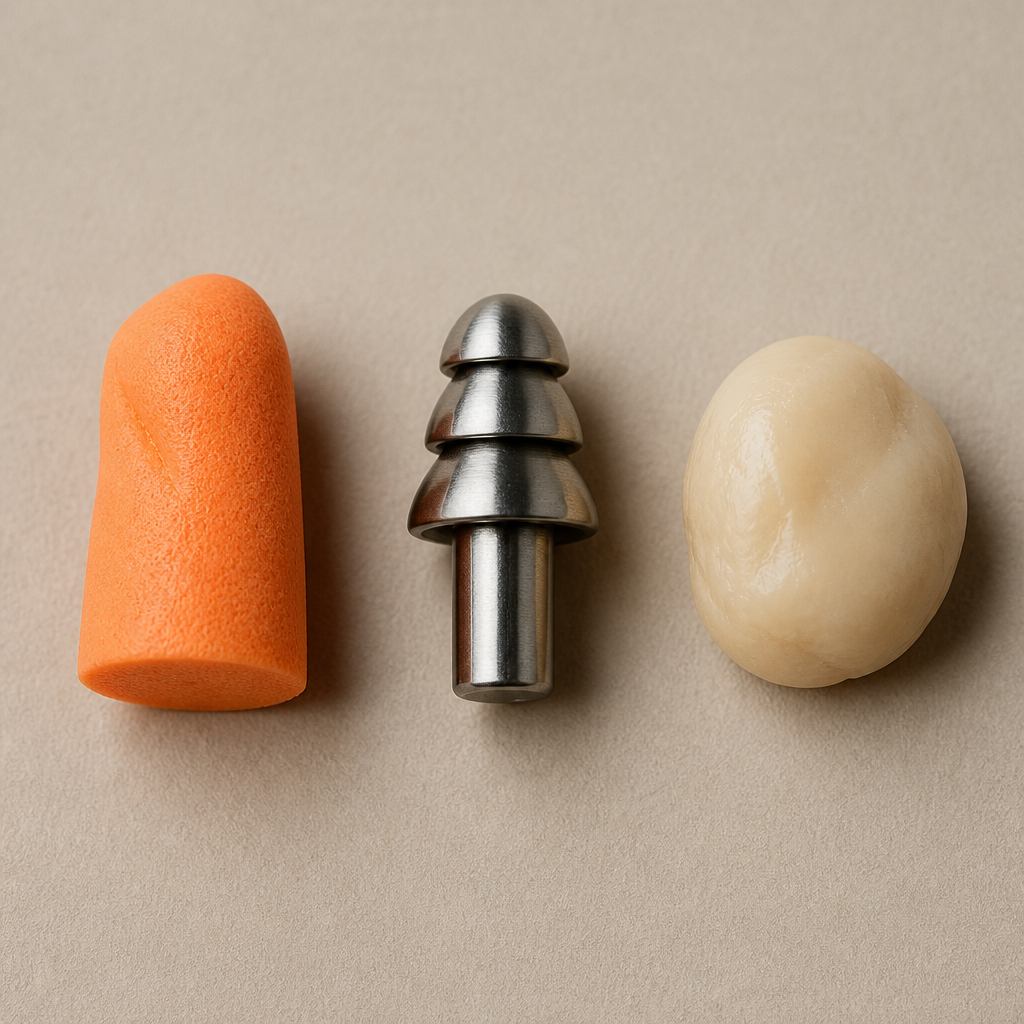
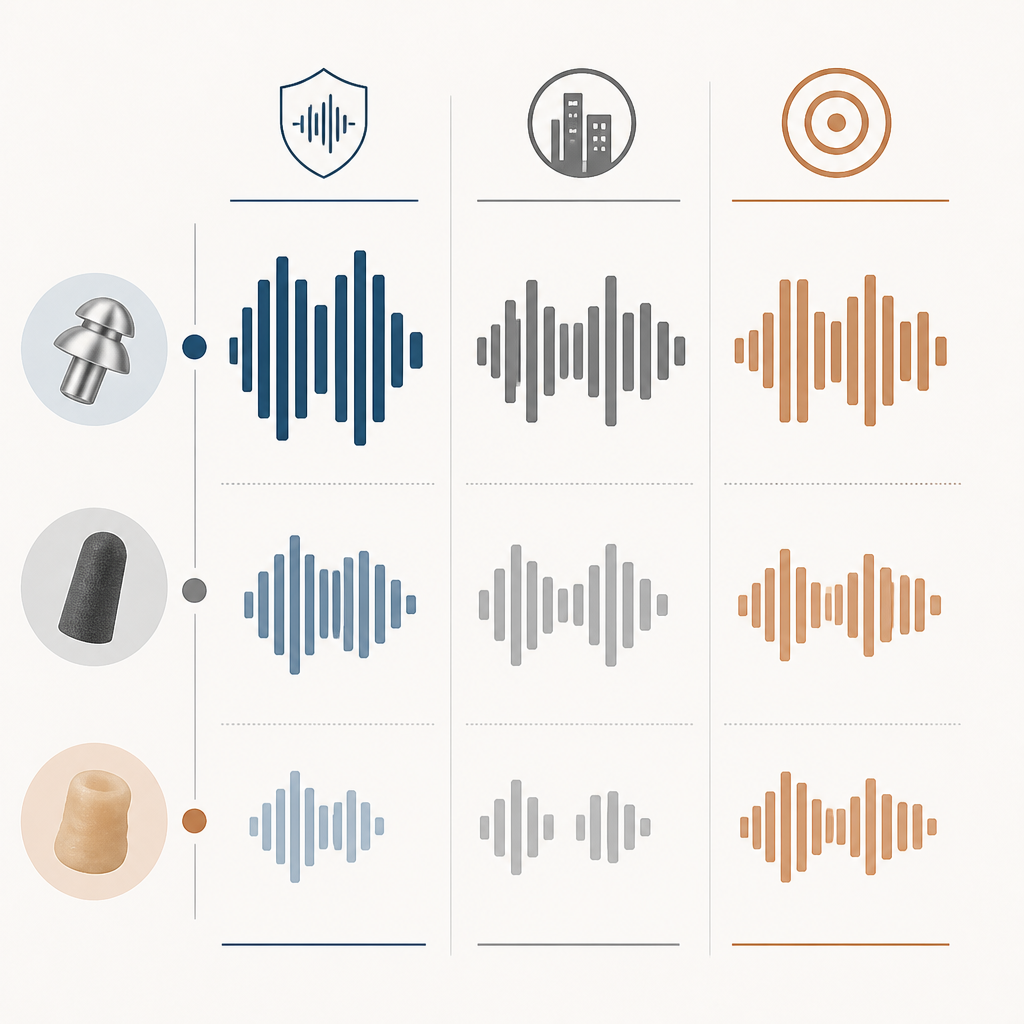
Wax ear plugs occupy a specific and limited niche. They are designed to be moulded and pressed against the outer opening of the ear canal rather than inserted deeply into it. This makes them genuinely comfortable for people who cannot tolerate anything inside the canal, and they are popular for swimming because they create a watertight surface seal.
Their noise reduction ceiling is substantially lower than foam or metal-bodied alternatives. Wax and silicone options commonly carry NRR ratings in the 22-23dB range. That is enough to take the edge off moderate background noise or light street sound, but it is nowhere near adequate for environments above 85dB, and it is marginal for blocking a partner who snores at 60-90dB at close range.
Wax plugs are not a bad product. They are a misapplied product when people buy them expecting industrial-grade protection. For someone who needs to muffle light ambient noise in a quiet bedroom, or who has very sensitive ear canals that react to foam, wax provides a gentle, comfortable option. For light sleepers dealing with significant noise sources, street traffic, loud neighbours, or a snoring partner, wax will consistently underperform.
Hygiene is also a genuine concern. Wax plugs are single-use by design. Reusing them accumulates bacteria and debris, and the material loses its moulding capability quickly. Daily replacement makes them one of the more expensive options per use for regular sleepers.
Metal-bodied ear plugs like those made by ATTENU8 approach the problem from a different angle. Rather than relying on the user to achieve perfect foam compression and insertion technique every time, the aluminium housing does that work for you. The rigid body guides the plug to a consistent depth with consistent orientation on every insertion. You feel the resistance of proper seating through the stem. There is no guesswork.
The memory foam tips fitted to a metal-bodied plug behave differently from standard polyurethane foam. Memory foam’s slower recovery rate means it expands gradually against the canal walls, conforming to the irregular geometry of your specific ear canal rather than springing back before the seal is complete. This creates a more complete acoustic seal at a consistent depth each time.
The single biggest advantage of a metal-bodied design over disposable foam is repeatability. A 32dB-rated metal-bodied plug delivers close to that protection every insertion because the technique is always the same. You hold the stem, align it, and seat it. The rigid body prevents over-insertion or under-insertion. For a light sleeper who puts ear plugs in at midnight every night, this consistency is worth more than a marginally higher rated NRR on a foam plug they will never achieve reliably.
ATTENU8’s concave aluminium body also sits flush rather than protruding, which directly addresses the side sleeper pillow problem that foam plugs cause. The low-profile design maintains the seal even under pillow pressure, which is not something a standard cylindrical foam plug can claim.
The aluminium body of an ATTENU8 plug is a one-time purchase. The only component that wears out is the memory foam tip, which needs replacing every 6-8 weeks with regular daily use. Three or four tip replacements per year represent the entire ongoing cost. Compare that to buying fresh foam disposables every few days if you are a daily user, and the economics shift decisively in favour of the metal-bodied option within the first few months.
Three tip sizes, XS, S, and M, address the reality that ear canal geometry varies significantly across individuals. A single-size-fits-all foam plug creates variable performance precisely because it cannot account for this variation. Matching tip size to your canal diameter is one of the most effective things you can do to improve the actual protection you receive.
The table below compares all three types across the dimensions that matter most for real-world daily use. Rated NRR is included but it is not the primary judge, since field performance depends heavily on the factors discussed above.
| Feature | Metal-Bodied (e.g. ATTENU8) | Disposable Foam | Wax |
|---|---|---|---|
| Typical Rated NRR | ~32dB | 25-33dB | 22-23dB |
| Realistic Field Attenuation | High (consistent insertion) | Variable (10-15dB average in field studies) | Low-moderate (surface seal only) |
| Insertion Technique Required | Minimal. Stem guides depth. | High. Roll, compress, hold required. | Low. Press against outer ear. |
| Comfort for Side Sleepers | Excellent (low-profile concave body) | Poor (protrudes, breaks seal on pillow) | Good (surface seal, no protrusion) |
| Reusability | Body: indefinite. Tips: 6-8 weeks. | 1-3 uses maximum | Single use |
| Hygiene | High (washable body, replaceable tips) | Low (absorbs oils and debris rapidly) | Low (single use or degrades quickly) |
| Suitable for Industrial Use | Yes (consistent high attenuation) | Yes, if inserted correctly | No (insufficient NRR for loud environments) |
| Long-Term Cost | Low (tips only after initial purchase) | High (constant repurchase) | High (single use, daily replacement) |
This is not a case where every option is equally valid depending on preference. Each type has clear strengths and clear failure modes. Matching the plug type to the actual use case is the difference between genuinely protected hearing and a false sense of security.
Metal-bodied plugs with memory foam tips win for daily sleep use. The combination of consistent insertion, low-profile design, and adequate NRR covers the most common sleep noise problems, snoring partners, street traffic, and thin apartment walls, reliably. Wax is an acceptable fallback for people with unusually sensitive canals who find any in-canal product uncomfortable. Disposable foam is the worst choice for nightly use because of hygiene degradation, protrusion discomfort, and technique dependency.
Aircraft cabin noise typically sits around 85dB during cruise. Both foam and metal-bodied plugs rated at 30dB+ can handle this, but the reusable nature of the metal-bodied option makes it more practical for frequent travellers. Disposable foam is commonly available in airports, making it a reasonable emergency backup. Wax provides insufficient attenuation for sustained aircraft noise and is not the right tool for this environment.
Environments above 85dB demand the highest possible consistent attenuation. Properly inserted foam is the traditional standard and remains effective when used correctly. Metal-bodied plugs with high-NRR memory foam tips offer an equally rated alternative with better consistency across a workday where inserting and removing plugs dozens of times is normal. Wax plugs should not be used as primary hearing protection in any environment classified as hazardous under occupational safety standards.
Pro tip: If you work in a loud environment and find yourself removing your ear plugs frequently because they are uncomfortable, the plug type is wrong for you, not your ears. Comfort directly affects compliance, and a 32dB plug you remove is providing 0dB of protection. A comfortable plug worn consistently beats a highly rated plug used inconsistently every time.
The rated NRR can be equivalent, around 32dB for both, but metal-bodied plugs typically deliver that rating more consistently in real-world use. The rigid housing ensures repeatable insertion depth, removing the technique variation that causes foam plugs to underperform their rating. NIOSH field studies suggest disposable foam averages 10-15dB of actual attenuation in practice, while a metal-bodied plug’s consistent insertion delivers performance much closer to its rated figure.
For most people, no. Snoring ranges from around 60dB up to 90dB at close range. Wax ear plugs with an NRR of 22-23dB provide only modest attenuation, and their surface seal rather than canal seal means real-world performance is at the lower end of that range. You would need at least 20dB of genuine field attenuation to meaningfully reduce snoring to sleep-friendly levels, and wax plugs rarely deliver that reliably for a partner sleeping beside the source.
For daily users, memory foam tips on metal-bodied plugs like ATTENU8 need replacing approximately every 6-8 weeks. The foam gradually loses its expansion properties with repeated compression, earwax absorption, and cleaning. The aluminium body itself does not wear out and does not need replacing. This makes the total cost of ownership over a year substantially lower than either daily disposable foam or single-use wax alternatives.
Yes, and this is one of their clearest advantages over standard foam plugs. ATTENU8’s concave aluminium body is designed to sit flush with the ear rather than protrude, which means pillow pressure does not break the seal or cause the discomfort that wakes side sleepers. Standard cylindrical foam plugs protrude significantly and press into the pillow surface, which both breaks the acoustic seal and creates pain that interrupts sleep.
Standard polyurethane foam rebounds quickly after compression, which can cause it to spring back before it fully seats against the canal walls. Memory foam, the type used in ATTENU8 tips, has a slower recovery rate that allows it to expand gradually into the unique contours of an individual ear canal, creating a more complete acoustic seal. Memory foam also tends to apply lower pressure against the canal walls, reducing the soreness that regular foam plugs cause during extended wear.
When maintained properly, yes. Disposable foam plugs absorb oils and earwax rapidly and should be discarded after one to three uses. Most people reuse them far longer than recommended, which introduces hygiene risks and degrades performance. Metal-bodied plugs like ATTENU8 have a washable aluminium body, and the foam tips are replaced on a scheduled basis every 6-8 weeks rather than when they visibly fail. This is a more controlled and hygienic approach than recycling disposable foam beyond its intended lifespan.
Have you switched from disposable foam to a reusable option for sleep or work? Share what difference you noticed with the seal, comfort, or noise reduction in the comments below.
If you wake at the slightest sound, whether it is a partner snoring, a car door slamming outside, or the low hum of a neighbour’s television, you already know that ordinary sleep advice does not cut it. What you actually need is a precise level of noise reduction that blocks the sounds that jolt you awake without making you feel entombed. 32dB noise reduction sits in a specific, practical range that addresses the most disruptive sleep noises without the discomfort of over-isolation. This article breaks down why that number matters, what it means for your sleep, and how to choose ear plugs that actually deliver it.
| Key Insight | Explanation |
|---|---|
| 32dB targets the most disruptive sleep sounds | Snoring peaks between 60 and 90dB. A 32dB reduction brings those peaks down to a range where most light sleepers can stay asleep. |
| The decibel scale is logarithmic, not linear | A 10dB reduction is perceived as roughly halving the loudness. 32dB is a very significant perceptual reduction, not a minor tweak. |
| Over-isolation is a real problem | Very high attenuation can amplify internal sounds like your own heartbeat and breathing, causing discomfort that disrupts sleep differently. |
| Fit determines whether rated NRR is achieved | A 32dB-rated plug worn loosely may deliver far less. Memory foam tips that conform to your ear canal are the most reliable route to consistent attenuation. |
| Reusable metal-bodied ear plugs outlast disposable foam | ATTENU8’s aluminium-bodied design requires only tip replacement every 6 to 8 weeks, meaning the attenuation performance stays consistent without buying new plugs constantly. |
| Tip size matters as much as plug design | Using the wrong size tip (too small or too large) changes the seal and undermines the noise reduction rating entirely. |
| Bedroom noise above 40dB meaningfully disrupts sleep | Rooms measuring above 40dB at night carry a greater likelihood of sleep interruption, making 32dB reduction sufficient to bring most environments into a comfortable range. |
A noise reduction rating of 32dB is not an abstract specification. It is the difference between a snoring partner waking you up four times a night and sleeping through until your alarm. To understand why, you need to understand how decibels work, specifically that they are measured on a logarithmic scale. A difference of 10dB is perceived by the human ear as roughly a doubling or halving of loudness. That means 32dB of reduction is a very large perceptual shift, not a small one.
In practical bedroom terms, typical snoring falls somewhere in the range of 60 to 90dB at the ear of the person trying to sleep beside it. Street traffic at night commonly sits between 50 and 70dB depending on proximity. A 32dB reduction applied consistently brings both of those sources down to a range where most people, including light sleepers, can remain asleep without interruption.
Pro tip: Do not compare ear plug ratings by looking at the single NRR number alone. Check whether the product specifies performance across different frequency ranges, since low-frequency rumble (traffic, bass from a neighbour’s music) is harder to attenuate than mid-range sounds like voices.
The noise reduction rating on ATTENU8 ear plugs is approximately 32dB, which places them squarely in the range designed for environments that are genuinely loud at night, not just slightly noisy. This is not the rating you see on the cheap foam cylinders you buy at a petrol station, many of which deliver far less in real-world use because they are poorly fitted by the wearer.

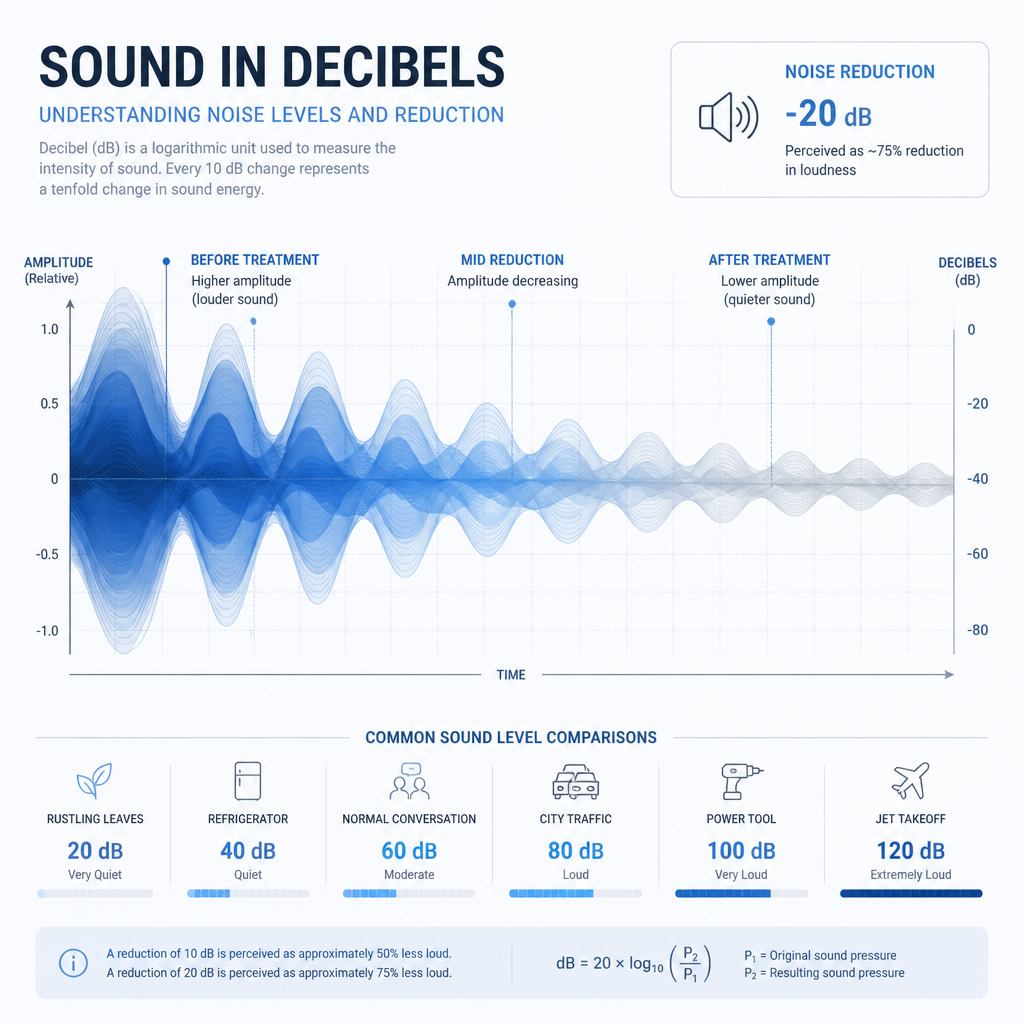
Light sleepers do not simply have a lower noise threshold. The architecture of their sleep is different. They spend more time in lighter sleep stages where auditory arousal thresholds are lower, meaning smaller sounds are more likely to trigger a full awakening. This is not a character flaw or anxiety issue. It is a physiological pattern, and it means general advice like “use white noise” or “get thicker curtains” often does not go far enough.
What light sleepers need is a reliable reduction in peak sound events, the sudden, sharp sounds that trigger cortical arousal. These are the sounds that interrupt deep sleep: a door closing, a passing vehicle with a loud exhaust, or a partner rolling over and snoring suddenly. Ear plugs for light sleepers need to perform at the moment of those peaks, not just provide average attenuation across a quiet room.
Sleep researchers have documented that the brain continues processing sound during sleep. Certain sounds, particularly those with sudden onset or vocal characteristics, are processed differently to steady background noise, even when a person is asleep. This is why a steady air conditioner hum rarely wakes people while a single cough from the next room will. The 32dB reduction from well-fitted ear plugs reduces the amplitude of those peak events enough to fall below the arousal threshold for most light sleepers.
This is also why sleep noise reduction is not well served by partial solutions. A 10 to 15dB reduction from a loosely fitting foam plug may do little for someone who wakes at sounds above 40 to 45dB. You need the full rated attenuation to reach the sounds that are actually causing the problem.
A moderate noise reduction of around 30 to 35dB sits in a comfortable range for sleeping because it addresses the sounds most likely to cause disruption while still allowing wearers to hear their alarms at close range.
Let us run through a concrete scenario. A bedroom in a city apartment with traffic noise outside registers approximately 55dB. Your partner snores at around 65dB at your ear. Without ear plugs, you are being hit with sound events up to 65dB throughout the night. Sleep researchers note that bedroom environments above 40dB carry a meaningfully greater risk of sleep interruption.
With 32dB of attenuation, that 65dB snoring event arrives at your ear at roughly 33dB, well within the range that most people, including many light sleepers, can sleep through. The 55dB traffic noise drops to approximately 23dB, which is quieter than a whisper in a library. That is not a marginal improvement. That is a fundamentally different sleep environment.
The most common objection light sleepers raise about wearing ear plugs is the fear of sleeping through their alarm. This concern is understandable but often overstated. A modern smartphone alarm at maximum volume typically reaches 80 to 90dB at arm’s length on a bedside table. Even with 32dB of attenuation, you are still hearing 50 to 58dB at your ear, which is louder than a normal conversation. In practice, almost no one sleeps through a full-volume alarm while wearing 32dB-rated ear plugs.
Pro tip: If alarm anxiety is stopping you from wearing ear plugs, place your phone alarm directly on your bedside surface rather than propped in a case. The vibration transmits through the surface and adds a tactile cue alongside the attenuated sound, giving you two independent signals.
The 32dB window is also why ATTENU8 ear plugs are designed for sleep and travel specifically, rather than industrial hearing protection. Industrial environments require higher ratings because the hazard noise levels are dangerously high. Sleep noise is disruptive, not hazardous, and the solution requires precision rather than maximum blockage.
Not all ear plugs deliver equivalent results even when they advertise similar ratings. The material, the body design, and the tip fit all interact to determine whether you actually receive the rated 32dB attenuation or something significantly lower. The table below compares the three main categories of best ear plugs for sleeping against the criteria that matter most for consistent nighttime use.
| Ear Plug Type | Typical Real-World NRR | Sleep Suitability |
|---|---|---|
| Disposable foam cylinders (e.g., standard drugstore foam) | Often 15 to 25dB in practice due to poor insertion technique and irregular fit | Low. Uncomfortable for side sleepers, degrades quickly with reuse, inconsistent seal |
| Silicone or resin acoustic filter plugs (e.g., Loop Sleep) | Typically 20 to 27dB depending on model and fit | Moderate. Comfortable for some users but the rigid body can cause pressure pain when side sleeping for extended periods |
| Metal-bodied plugs with memory foam tips (e.g., ATTENU8) | Approximately 32dB with correct tip size, consistent across uses | High. The concave aluminium body sits low in the concha, memory foam seals the canal, and tip replacement every 6 to 8 weeks maintains consistent attenuation |
The critical difference in the third category is that the aluminium body does not compress or degrade. The only part that changes performance over time is the memory foam tip, which ATTENU8 replaces on a simple 6 to 8 week schedule. Disposable foam plugs, by contrast, lose their expansion and sealing properties after only a handful of uses, meaning your NRR drops progressively even if you cannot feel the difference.
There is a tempting logic to seeking the highest possible noise reduction rating. If 32dB is good, then 40dB must be better. In practice, this breaks down quickly for sleep applications. Very high attenuation creates what researchers describe as occlusion, where the sensation of your own body sounds (breathing, heartbeat, jaw movement) becomes amplified and intrusive because external sound has been reduced to near silence.
For light sleepers, this can mean trading one type of sleep disruption for another. Instead of being woken by external noise, you are kept awake by the amplified internal sounds of your own body. Many people who try very high-attenuation industrial ear plugs for sleep report this experience within the first night.
Sleep-specific noise reduction sits most comfortably in the 28 to 35dB range for most adults. This range attenuates the common disruptive sounds (snoring at 65 to 90dB, urban traffic at 50 to 70dB, occasional loud voices) without producing the occlusion effect that makes higher-rated industrial plugs unsuitable for bed. The 32dB specification on ATTENU8 ear plugs is positioned deliberately within this effective window, not at the maximum end of what is technically achievable.
This is a genuine design decision, not a manufacturing limitation. Plugs that deliver 37 to 40dB typically require a deeper canal insertion and a harder body material, both of which reduce comfort over an 8-hour sleep period significantly.
A 32dB noise reduction rating is a laboratory measurement taken under controlled conditions with correct insertion technique. The gap between the rated figure and what you actually experience in bed is determined almost entirely by fit. A loosely inserted foam plug that does not seal the ear canal fully can deliver 10 to 15dB of attenuation or less, regardless of what the packaging claims.
Memory foam tips address this problem more reliably than solid silicone or foam cylinders because they conform to the specific geometry of each individual ear canal. No two ear canals are the same shape or size, which is why ATTENU8 provides three tip sizes (XS, S, and M) with each pair. Using the correct tip size is not a minor convenience detail. It is the single most important factor in whether you receive the full 32dB of rated attenuation.
A common mistake is defaulting to the medium tip because it sounds like the most average option. In practice, many adults, particularly women, find the small tip provides a better seal with less pressure. The correct fit is one where the tip, once compressed and inserted, expands to fill the canal without protruding significantly outside the ear and without requiring force to maintain position. If you can feel the plug working loose within a few minutes of lying down, you need a larger size or a deeper insertion.
The aluminium body of ATTENU8 ear plugs contributes to fit consistency in a way that plastic or silicone bodies do not. Metal does not flex or compress during insertion, meaning the tip receives consistent pressure to roll and seat properly each time. Plastic bodies can deform slightly during handling, which changes the insertion geometry in subtle but performance-relevant ways.
Pro tip: When inserting memory foam ear plugs, reach the opposite hand over your head to gently pull the top of your ear upward and outward before inserting the compressed tip. This straightens the ear canal and allows the foam to seat deeper and seal more completely, significantly improving your real-world attenuation result.
It means the ear plugs are rated to reduce the sound reaching your ear canal by approximately 32 decibels under proper insertion conditions. Because decibels are logarithmic, this represents a very substantial reduction in perceived loudness, roughly equivalent to cutting the perceived volume of a sound to well under a quarter of its original intensity at the ear.
For most people sharing a bed with a snoring partner, 32dB of attenuation will reduce the snoring to a level that no longer causes full arousal from sleep. Extremely loud snoring (above 85dB) may still be audible as a low, muffled sound, but the peak events that trigger waking are typically reduced below the arousal threshold. Complete silence is not the goal and not realistic. Sufficient reduction to stay asleep is, and 32dB reliably achieves that for the majority of light sleepers.
The most important difference is consistency of performance. Disposable foam plugs degrade quickly with repeated use, losing their expansion properties and their ability to seal the ear canal. ATTENU8 uses a durable aluminium body that never degrades, paired with replaceable memory foam tips that are changed every 6 to 8 weeks to maintain a consistent seal. This means the 32dB attenuation is repeatable every night, not just on the first use.
Yes. Wearing ear plugs at 32dB noise reduction for sleep does not damage hearing. Hearing damage from ear plugs is not a real risk under normal sleeping conditions. The only hygiene-related concern is ear canal cleanliness, which is managed by replacing the foam tips on schedule and keeping the aluminium body clean. You should not use ear plugs if you have an active ear infection or a condition affecting the ear canal without consulting a medical professional first.
NRR (Noise Reduction Rating) is the standard used in the United States, while SNR (Single Number Rating) is used in Europe and Australia. The two systems use different test methodologies, so the numbers are not directly comparable. An NRR of 32dB and an SNR of 32dB do not represent identical real-world performance. When comparing ear plugs, check which standard the manufacturer is using and compare only within the same standard to avoid misleading comparisons.
Not necessarily, provided the ear plugs are comfortable for extended wear and deliver sufficient attenuation for both environments. Aircraft cabin noise typically sits around 75 to 85dB, which is louder than most bedroom environments. A 32dB-rated ear plug handles both contexts effectively. The main practical difference is portability and hygiene management on the go, which is where a metal-bodied reusable design has a clear advantage over single-use foam plugs that compress in luggage and lose performance before you even use them.
Have you tried switching to a higher-rated ear plug for sleep and found it caused more problems than it solved? Share your experience in the comments below.
Most Kickstarter campaigns spend months building buzz before launch day. ATTENU8 hit 127% of its funding goal within 24 hours, which tells you something specific: backers did not need convincing. They had already been let down by cheap foam plugs that crumble, silicone tips that slip, and flimsy plastic bodies that crack in a bag. The ATTENU8 ear plugs review conversation online is not about whether the product works. It is about why it took this long for someone to build a reusable ear plug worth keeping. This article unpacks what drove that Kickstarter result, what the product actually delivers, and how it compares to the premium reusable ear plug market it now competes in directly.
| Key Insight | Explanation |
|---|---|
| 127% funded in 24 hours | ATTENU8 exceeded its Kickstarter goal within a single day, signalling a highly primed, frustrated audience ready to switch from disposable foam options. |
| Metal body is the differentiator | The concave aluminium shell is not cosmetic. It survives daily carry, resists compression, and does not absorb odour the way plastic and foam do over time. |
| 32dB noise reduction rating | Approximately 32dB attenuation puts ATTENU8 in the same bracket as industrial hearing protection, covering sleep, travel, construction, and manufacturing environments. |
| Three tip sizes in the box | XS, S, and M memory foam tips ship with every pair. A correct fit is what separates adequate noise reduction from effective noise reduction. |
| Tip replacement, not full replacement | Foam tips are replaced every 6 to 8 weeks. The metal body does not wear out. That is a fundamentally different ownership model to disposable or semi-durable competitors. |
| Sleep and travel are the primary use cases | Light sleepers and frequent flyers drove early Kickstarter backing. These users tolerate no margin for error on fit and comfort, which is exactly where cheap foam fails. |
| Kickstarter success as a proof-of-market signal | Crowdfunding at this speed confirms genuine unmet demand, not just novelty interest. Backers were solving a real, recurring problem they had not solved with existing products. |
Crowdfunding speed is a reliable indicator of pre-existing frustration. When a product funds this fast, it means the audience already knew their problem, had already tried alternatives, and had already decided those alternatives were not good enough. The ATTENU8 Kickstarter result did not happen because of clever marketing copy. It happened because light sleepers, frequent travellers, and noise-sensitive professionals are a large, underserved group who had been making do with inferior products for years.
Disposable foam ear plugs dominate the market by volume but fail on almost every qualitative measure. They compress unevenly, lose their shape overnight, collect debris, and generate waste that adds up fast for daily users. The alternative until recently was either custom-moulded plugs at significant cost or consumer-grade silicone options that compromise on attenuation to prioritise style. ATTENU8 entered Kickstarter with a product that did not ask backers to compromise.
Backers on Kickstarter are experienced enough to be sceptical of products that look good in renders but feel cheap in hand. The aluminium body in ATTENU8 is a credibility signal before the product is even inserted. Metal communicates permanence. It tells a sceptical buyer that this was engineered, not assembled from generic components.
The concave form factor also serves a function. It creates a natural grip point for insertion and removal, which matters more than it sounds for users who remove ear plugs half-asleep in the middle of the night or in turbulent cabin conditions.
The fastest-funded products on Kickstarter are rarely the most novel. They are the ones that solve a problem the backer has personally experienced, in a way that feels obviously better than what they have been settling for.
Remote work and open-plan offices expanded the population of people actively searching for noise management solutions. More people sleeping next to partners with different schedules, more people on long-haul flights working or resting, more shift workers trying to sleep during daylight hours. ATTENU8 launched into a market that had grown considerably from its pre-pandemic baseline.
Pro tip: If you are evaluating whether ATTENU8 is worth the switch from disposables, calculate what you spend on foam plugs monthly. Daily users of disposables spend more in a year than the cost of a single ATTENU8 pair plus several tip replacement cycles.
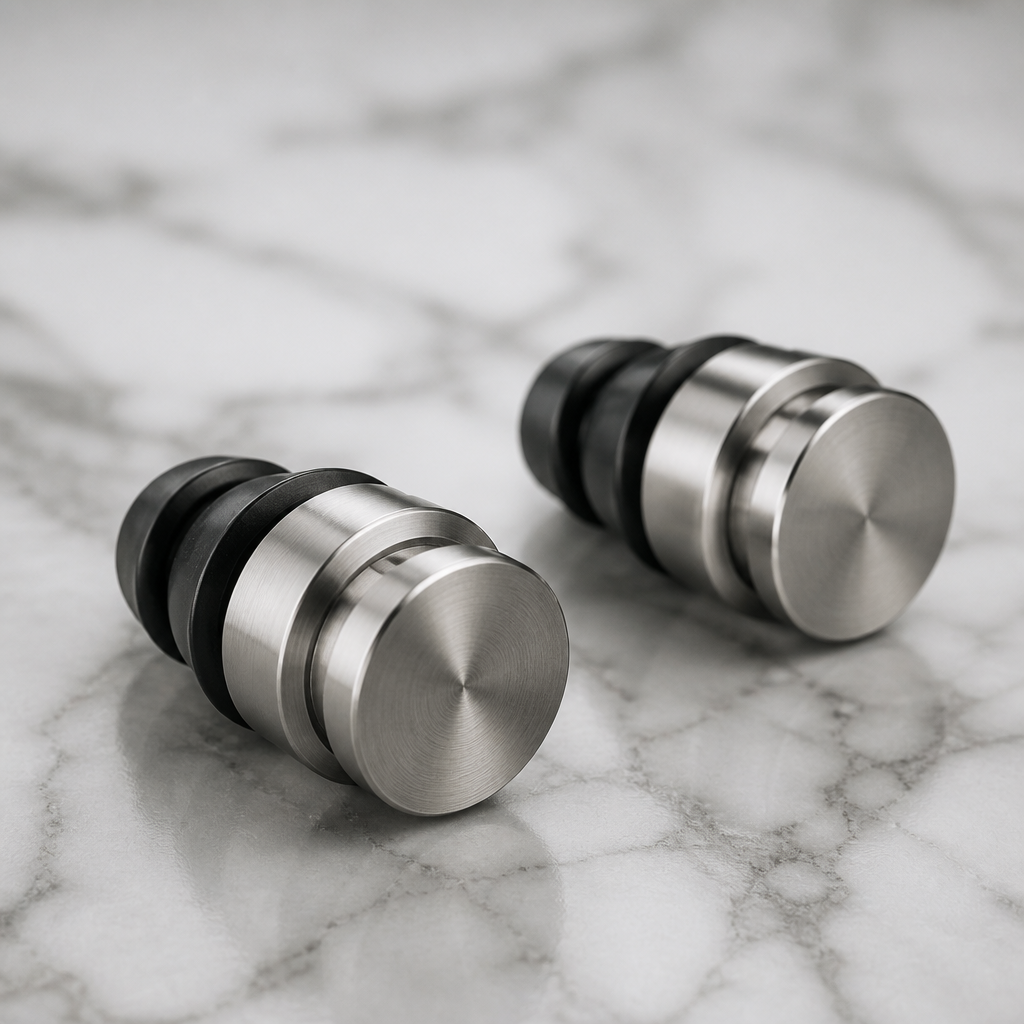
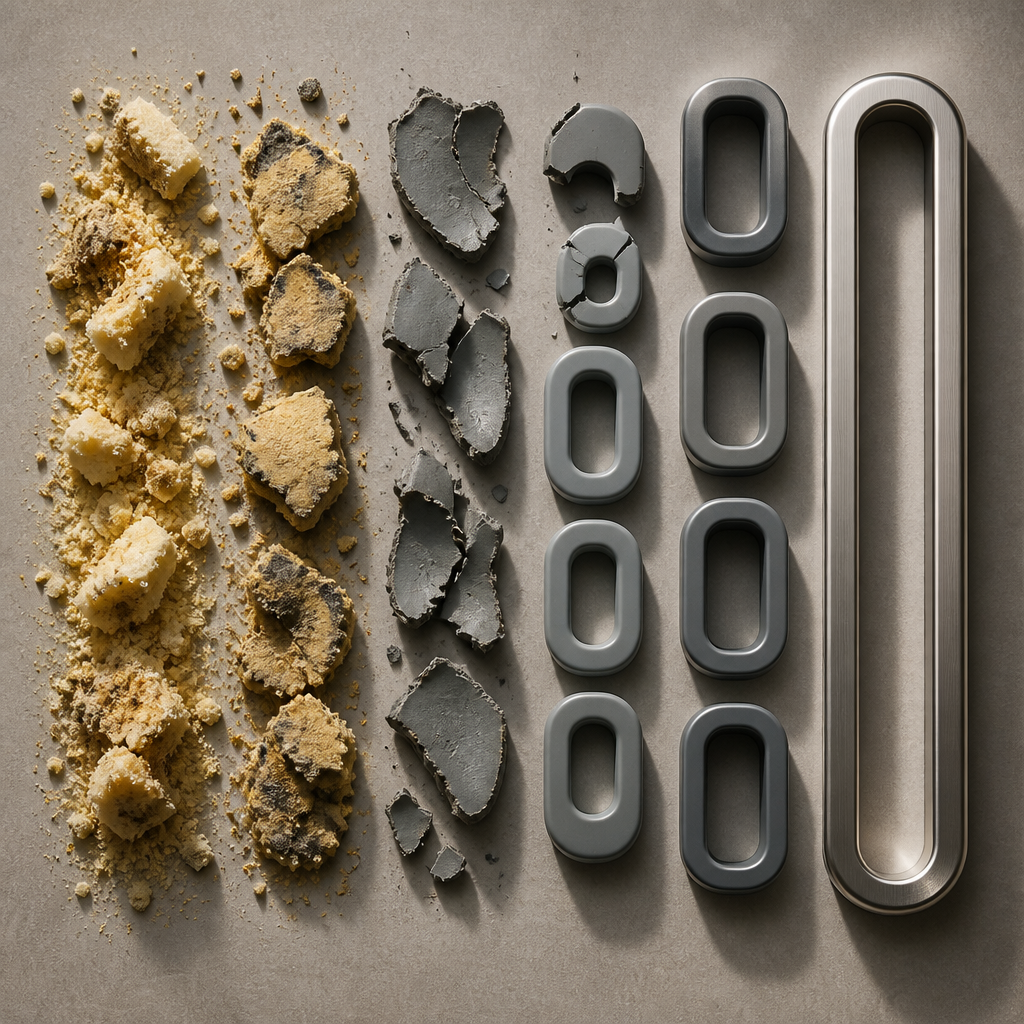
The core specification is approximately 32dB of noise reduction. That number sits at the high end of what most sleep-focused ear plugs claim and is comparable to what professional hearing protection products deliver in industrial settings. The difference is that ATTENU8 achieves this while remaining comfortable enough for side sleepers, which is the use case most ear plug designs fail at spectacularly.
Side sleeping compresses whatever is in your ear against a pillow. Rigid plugs create pressure points. Plugs that protrude too far create an awkward pivot point. The ATTENU8 aluminium body sits close to the ear canal entrance, meaning the profile is low enough to avoid the pillow-pressure problem that causes most side sleepers to remove their ear plugs before they have finished working.
The three included tip sizes, XS, S, and M, matter because ear canal diameter varies significantly between individuals and even between a person’s left and right ear. A tip that is too small defeats the entire noise reduction rating by leaving a gap. A tip that is too large causes pain and pressure before the foam has time to expand properly.
Memory foam is the right material here. It conforms slowly, which means it seals progressively rather than creating sudden pressure on insertion. For users who have found silicone tips uncomfortable, the foam contact feel is meaningfully different, softer on initial contact and more adaptive over the first few minutes of wear.
The 6 to 8 week replacement cycle for tips is a practical maintenance rhythm. At that frequency, tips are replaced often enough to stay hygienic and retain their expansion properties, but not so often that the cost or effort becomes a friction point. The metal body, which does not degrade under normal use, means the per-use cost of the product trends toward negligible over its lifespan.
Pro tip: When fitting ATTENU8 for the first time, try all three tip sizes before settling on one. Insert, allow the foam to expand fully for 60 seconds, then assess the seal by rubbing your fingers near your ears. A proper seal will muffle that sound noticeably. If it does not, move to the next size up.
The Kickstarter backer profile tells you more about the target user than any marketing brief. The early adopters were not audiophiles or extreme sports participants. They were light sleepers, shift workers, frequent flyers, and professionals in consistently loud environments who had developed strong opinions about what the existing market was getting wrong.
This is the largest user group and the most demanding. A light sleeper is not looking for moderate noise reduction. They need a product that reliably blocks enough ambient sound to prevent arousals, fits securely enough to stay in place for eight hours, and is comfortable enough that they forget it is there. Those three requirements simultaneously rule out most of what is sold in pharmacies and most of what is sold as a premium lifestyle product.
ATTENU8’s low-profile metal body and conforming foam tips address all three requirements more directly than either traditional foam cylinders or silicone-bodied competitors. Traditional foam plugs are excellent at attenuation but poor at stability and consistency. Silicone-bodied lifestyle plugs are comfortable but frequently sacrifice attenuation for aesthetics.
Construction, manufacturing, and military environments have specific hearing protection requirements. A product claiming approximately 32dB reduction is viable in these contexts. The durability advantage of the aluminium body is particularly relevant here. A foam disposable in a tool belt pocket is degraded before it is even inserted. An aluminium-bodied plug in a carry case is not.
For professionals who wear ear protection for hours at a stretch, the memory foam tip material also reduces the cumulative pressure discomfort that builds over a shift with harder silicone or rigid stem designs. This is the practical reason reusable, foam-tipped, metal-bodied plugs have a real market in professional environments and not just consumer sleep and travel contexts.
The premium reusable ear plug market currently has three meaningful players worth comparing directly: ATTENU8, Flare Audio, and Loop. Each takes a different position on the comfort-versus-attenuation spectrum, and each makes specific trade-offs that suit different user profiles.
Flare Audio approaches ear plugs with an acoustic engineering focus, targeting musicians and audiophiles who want noise reduction without significant frequency distortion. Loop has built a strong consumer brand around aesthetics and social acceptability, with a plug design that is intentionally visible and stylish. ATTENU8 sits in a different position: maximum attenuation, durable construction, and a maintenance model that reduces long-term cost.
| Feature | ATTENU8 | Loop Ear Plugs | Flare Audio |
|---|---|---|---|
| Body Material | Concave aluminium (metal) | Plastic and silicone | Titanium or aluminium (model-dependent) |
| Noise Reduction | Approximately 32dB | Varies by model (some prioritise frequency balance over raw dB) | Varies; some models tuned for acoustic clarity over maximum attenuation |
| Tip System | Memory foam, 3 sizes (XS, S, M), replaceable every 6 to 8 weeks | Silicone tips, multiple sizes | Foam or silicone tips depending on model |
| Primary Use Case | Sleep, travel, professional noise environments | Social settings, concerts, everyday urban wear | Music listening, concerts, studio environments |
| Ownership Model | Replace tips only; metal body is permanent | Full replacement when worn | Full replacement when worn |
| Side Sleeper Suitability | High, due to low-profile body design | Moderate, loop stem can create pillow pressure | Varies; some stem designs create pressure on side sleeping |
The critical difference that gets underreported in most ATTENU8 ear plugs review comparisons is the ownership model. Loop and Flare Audio sell you a complete product that you eventually replace. ATTENU8 sells you a permanent body and a consumable tip. Over a two-year period, that distinction matters significantly on both cost and environmental impact.
The economics of daily ear plug use are straightforward once you run them out. Disposable foam plugs used nightly generate waste and recurring cost that accumulates faster than most users track. A daily user goes through roughly 30 pairs per month. Over a year, that is 360 pairs discarded. The material cost alone is meaningful, and the environmental weight of that volume of single-use foam is significant.
ATTENU8’s model breaks this cycle. The aluminium body is a one-time purchase. The memory foam tips, replaced every 6 to 8 weeks, represent the ongoing cost. At that replacement frequency, a year of use requires roughly seven to eight tip changes. The per-use economics shift dramatically in favour of the reusable model when extended beyond the first few months.
There is a cost that does not appear on any receipt: the cost of using ear plugs that do not work well enough. A light sleeper who wakes at 3am because a cheap foam plug shifted loses sleep, suffers the downstream effects of that interrupted rest, and often gives up on ear plugs entirely rather than switching to a better product. That abandonment represents both a personal health cost and a market opportunity.
The best reusable ear plugs for sleep are not the ones with the most impressive marketing. They are the ones that stay in place, maintain their seal, and remain comfortable long enough to complete a full sleep cycle. ATTENU8’s combination of memory foam tips and a stable metal body addresses this directly. The aluminium shell does not compress, shift, or distort under pillow pressure the way an all-foam or flexible plastic plug does.
A reusable ear plug that actually stays in and works is worth significantly more than a cheap disposable that comes out at 2am. The real metric is not price per unit. It is cost per night of uninterrupted sleep.
For professionals in noise environments, the calculation is similar but includes the compliance angle. Hearing loss in manufacturing, construction, and military contexts is cumulative and irreversible. A hearing protection product that workers are willing to actually wear, because it is comfortable and fits correctly, delivers safety outcomes that an uncomfortable product shoved in a pocket cannot.
The metal ear plugs Kickstarter success of ATTENU8 is ultimately a story about a market that was underserved not for lack of awareness but for lack of a product that cleared the bar on every relevant dimension simultaneously: attenuation, comfort, durability, and long-term cost.
Standard foam ear plugs are single-use, degrade quickly, and compress unpredictably. ATTENU8 uses a permanent aluminium body with replaceable memory foam tips. The metal body does not wear out, the tips are replaced every 6 to 8 weeks, and the overall noise reduction of approximately 32dB is consistent across uses rather than degrading as the foam ages.
Yes. The concave aluminium body is designed with a low profile that reduces pressure when sleeping on your side. Many competitor designs, particularly those with a loop or stem that extends outside the ear, create a pivot point against the pillow that either causes discomfort or pushes the plug out during the night. ATTENU8’s design specifically avoids this failure mode.
ATTENU8 recommends replacing the memory foam tips every 6 to 8 weeks with regular use. Tips replaced at this frequency retain their expansion properties and hygiene. The aluminium body itself does not require replacement under normal use conditions.
Start with the medium size and test the seal by inserting the tip, allowing the foam to fully expand for around 60 seconds, then lightly rubbing your fingertips near the ear canal. A properly sealed tip will muffle this sound clearly. If the seal feels incomplete, move to the large size. If insertion feels uncomfortable or forced, try the small size. ATTENU8 includes XS, S, and M with every pair so you can trial all sizes before committing.
Loop is primarily positioned for social and everyday urban use, with designs that prioritise aesthetics and some frequency transparency over maximum attenuation. Flare Audio targets acoustic environments like concerts and studios where sound quality matters as much as volume reduction. ATTENU8 is the better fit for professional noise environments such as construction, manufacturing, and military settings, where maximum attenuation, physical durability, and all-day comfort under a helmet or earmuff are the relevant requirements.
A daily user of disposable foam ear plugs discards roughly 360 pairs per year. ATTENU8 generates only the discarded foam tips at replacement intervals, roughly 7 to 8 tip changes per year. The aluminium body itself is not disposed of. Over a two-year period, the reduction in single-use waste is substantial. For users motivated by both personal hearing protection and waste reduction, the reusable model is the only option that addresses both.
Kickstarter allowed ATTENU8 to validate genuine market demand before committing to full production scale. The 127% funding result within 24 hours confirmed that the target audience, light sleepers, travellers, and noise-environment professionals, were actively looking for a product like this and were not satisfied with existing options. Crowdfunding also created a community of early adopters who were invested in the product’s success before it shipped.
Have you made the switch from disposable foam ear plugs to a reusable option, and what was the deciding factor for you? Share your experience in the comments below.
Noise-induced hearing loss is one of the most common occupational injuries in manufacturing, and it is entirely preventable. According to the CDC, around 46 percent of manufacturing workers have been exposed to hazardous noise, with roughly 14 percent already carrying measurable hearing loss before most of them ever file a single workers’ comp claim. The bitter irony is that the standard answer to this problem, cheap disposable foam ear plugs for manufacturing workers, is also one of the biggest reasons compliance breaks down on the factory floor. Workers pull them out halfway through a shift because they ache, lose their shape, or simply stop sealing properly. This article cuts through the noise, literally, on what industrial hearing safety standards actually demand, where conventional protection falls short, and what a durable, well-fitted earplug can actually do for an eight-hour shift.
| Key Insight | Explanation |
|---|---|
| OSHA’s action level is 85 dBA over 8 hours | Any worker consistently exposed at or above 85 dBA must be enrolled in a formal hearing conservation program, including audiometric testing and access to hearing protection at no cost. |
| Real-world protection is lower than the label NRR | NIOSH recommends derating manufacturer NRR values by 50% for typical users to estimate real-world attenuation. A plug rated NRR 32 delivers roughly 13 to 16 dB of actual protection in field conditions for most workers. |
| Comfort determines compliance | Workers who find earplugs uncomfortable remove them early. Even 30 minutes of unprotected exposure in a loud environment can significantly reduce the effective protection for that shift. |
| Plug degradation is a real safety risk | Disposable foam plugs lose shape and acoustic integrity with repeated use. Using them a second or third time without replacement means the NRR rating no longer applies. |
| A rigid body maintains consistent acoustic geometry | Metal-bodied earplugs like those from ATTENU8 hold their shape session after session. Only the memory foam tips need periodic replacement, preserving the rated attenuation long-term. |
| Fit sizing matters more than most workers realize | A plug that is too small for the ear canal will not seal properly, reducing effective attenuation regardless of the NRR rating. Multiple tip sizes, such as XS, S, and M, are essential for a workforce with varied ear canal geometries. |
| Reusable earplugs reduce per-worker cost over time | Replacing only foam tips every 6 to 8 weeks, rather than buying new disposable plugs daily, substantially lowers procurement cost per worker while maintaining protection integrity. |
Occupational noise-induced hearing loss does not happen dramatically. There is no incident report, no visible injury, and no moment where a worker feels the damage occurring. The loss accumulates across thousands of shifts, in stamping plants, assembly lines, pneumatic tool stations, and packaging halls, until the frequencies that carry speech clarity are simply gone.
The scale of the problem in manufacturing specifically is staggering. CDC data show that approximately 18 percent of manufacturing workers have measurable hearing difficulty, and 11 percent live with tinnitus, the persistent ringing that no amount of quiet can stop. These are not corner-case numbers. They represent a workforce-wide exposure failure that has been ongoing for decades.
The reason this keeps happening is not ignorance of the risk. Most manufacturers have hearing protection programs on paper. The failure point is almost always the earplug itself: plugs that are genuinely painful after two hours, that fall out during physical movement, or that workers quietly pocket because nobody is watching. Solving the factory hearing protection problem is not primarily a regulatory problem. It is an equipment-comfort problem.
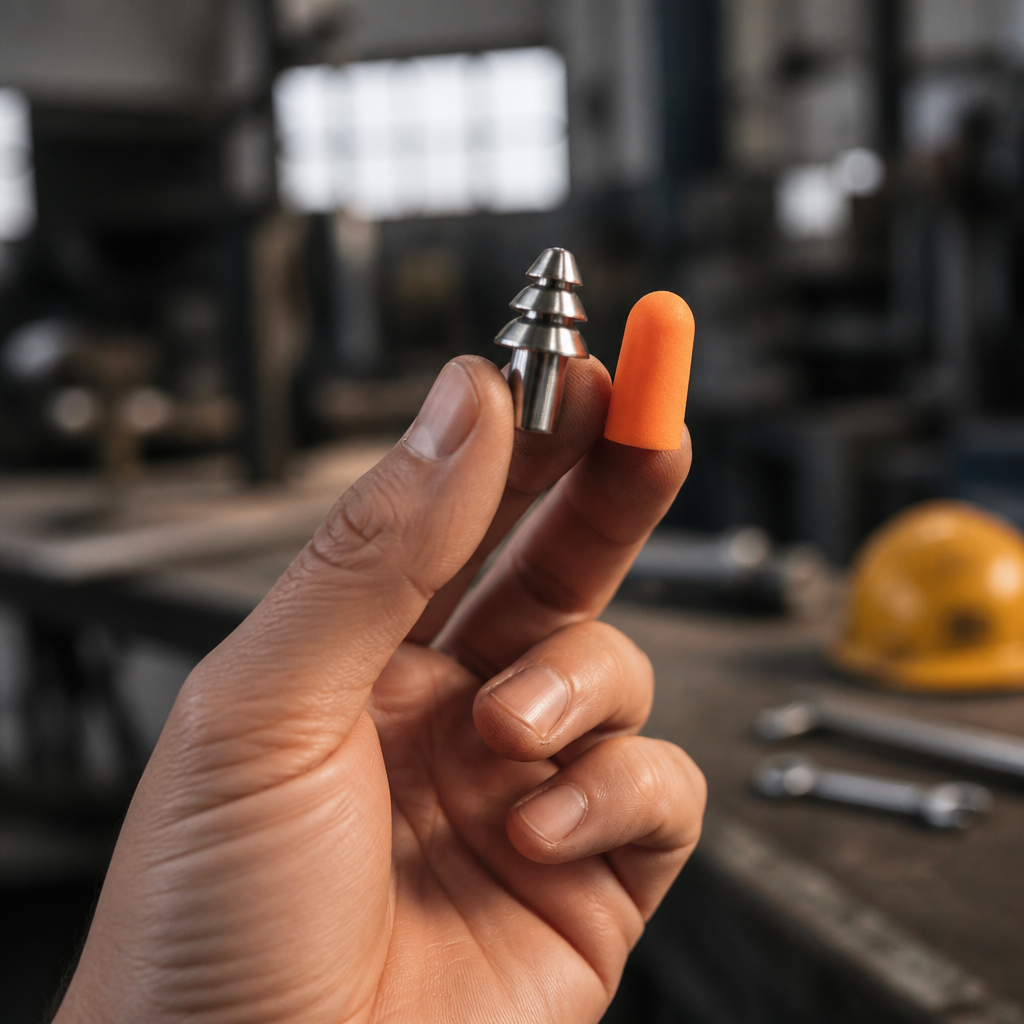
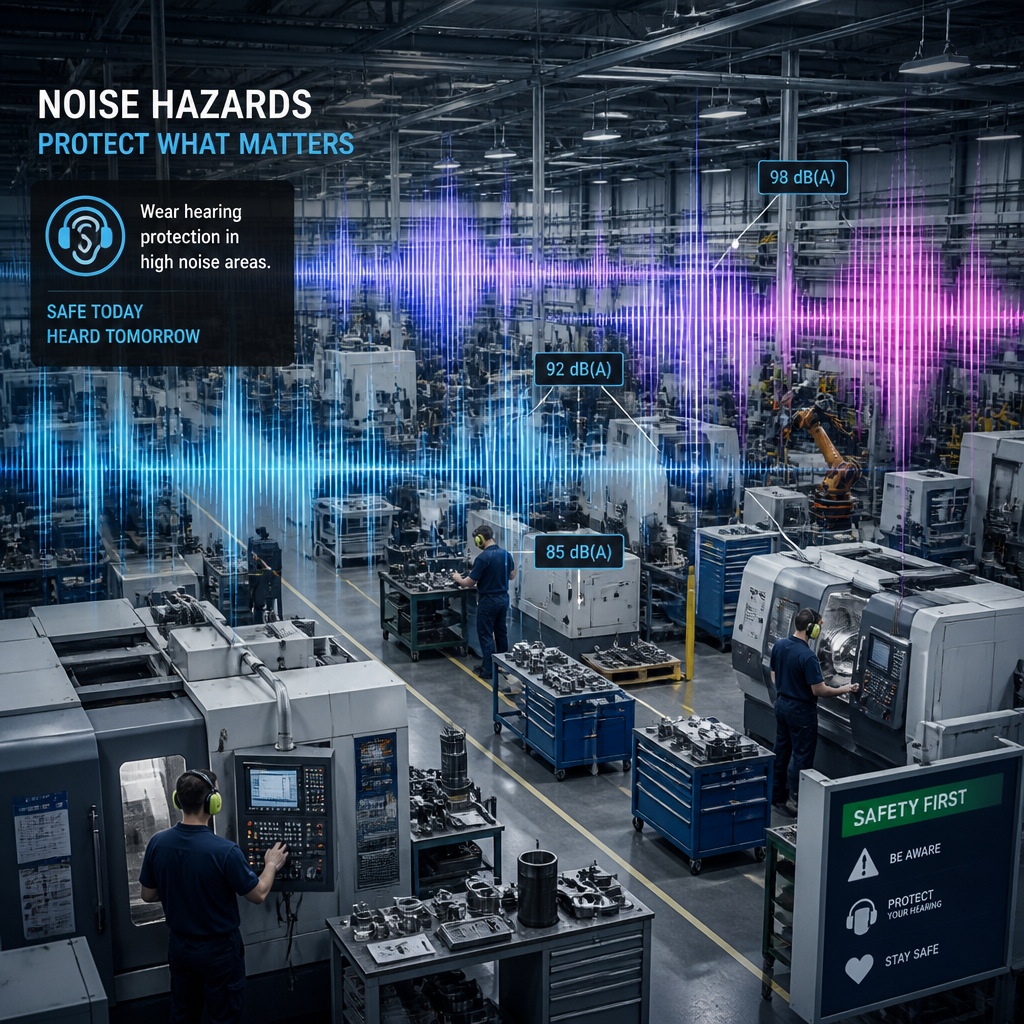
If you are responsible for a manufacturing floor in the United States, the governing standard is OSHA 29 CFR 1910.95. It sets a permissible exposure limit (PEL) of 90 dBA as an 8-hour time-weighted average (TWA), using a 5 dB exchange rate. A separate action level of 85 dBA over 8 hours triggers a full hearing conservation program, which means audiometric testing, mandatory access to hearing protection at no cost to the employee, worker training, and recordkeeping.
Engineering controls, reducing machine noise at the source, are required when exposure exceeds 90 dBA. But engineering controls are expensive, slow to implement, and often impractical for legacy equipment. Hearing protection devices fill the gap, and the earplug selection must be adequate to bring a worker’s actual exposure below the relevant threshold.
The standard does not simply require you to hand a worker any earplug with an NRR printed on the box. The attenuation achieved must be sufficient to reduce that worker’s personal noise exposure to a TWA of 85 dBA. This is where many compliance programs quietly fail: they procure high-NRR plugs, distribute them, and consider the obligation met. The actual fitting, the actual seal, and the actual hours worn are rarely audited.
OSHA’s standard also specifies that when a worker’s audiogram shows significant hearing damage, that worker must be refitted with hearing protectors and retrained in their use. In other words, a damaged audiogram is a signal that the current protection is not working, not just that the worker has bad luck.
The right hearing protection device is the one a worker will actually wear correctly for the full duration of exposure. A theoretically superior plug removed after two hours is worse than a comfortable plug worn all day.
Most factory noise discussions focus on continuous TWA levels, but OSHA 1910.95 also caps impulsive or impact noise at 140 dB peak sound pressure level. Workers on press lines, in stamping operations, or near pneumatic tools face these high-peak transient events in addition to sustained background noise. Earplugs for these environments need to seal consistently under dynamic jaw and head movement, because a plug that shifts during a loud impact event is not providing the protection it appears to offer.
The Noise Reduction Rating (NRR) printed on every earplug package is a laboratory number. It is measured under controlled conditions with trained fit technicians, using a standardized method that optimizes insertion technique. Real workers on a factory floor do not insert earplugs the way audiological technicians do in a quiet lab.
NIOSH recommends applying a 50 percent derating to the manufacturer’s NRR for typical workplace users to estimate the actual protection achieved in field conditions. This means a plug rated NRR 33 delivers roughly 16 dB of real-world attenuation for the average user. A plug rated NRR 25 may deliver only around 12 dB under the same derating. For a worker standing near 100 dB machinery for eight hours, that gap determines whether they stay under the 85 dBA action level or not.
There is an additional variable that the NRR system does not capture: degradation over time. Standard foam earplugs lose compression recovery with repeated use. A plug used three days in a row may visually appear intact while its acoustic seal has deteriorated significantly. This is one of the strongest structural arguments for reusable earplugs with replaceable tips rather than disposables reused informally.
ATTENU8’s metal-bodied reusable earplugs are rated at approximately 32 dB noise reduction and are manufactured to CE certification standard BS EN 352-2:2002. The concave aluminium body maintains the acoustic geometry that produces the rated attenuation, session after session. The aluminium does not compress, deform, or take a set the way foam does. What changes over time is only the memory foam tip, which ATTENU8 recommends replacing every 6 to 8 weeks, at which point the tip loses compression recovery and seal-forming ability.
The practical result is that a worker using ATTENU8 earplugs is getting a consistent, predictable level of attenuation across a full replacement cycle, not a sliding scale of degrading protection across a week of disposable reuse. For employers building a documented industrial hearing safety program, consistency is not just convenient, it is legally defensible.
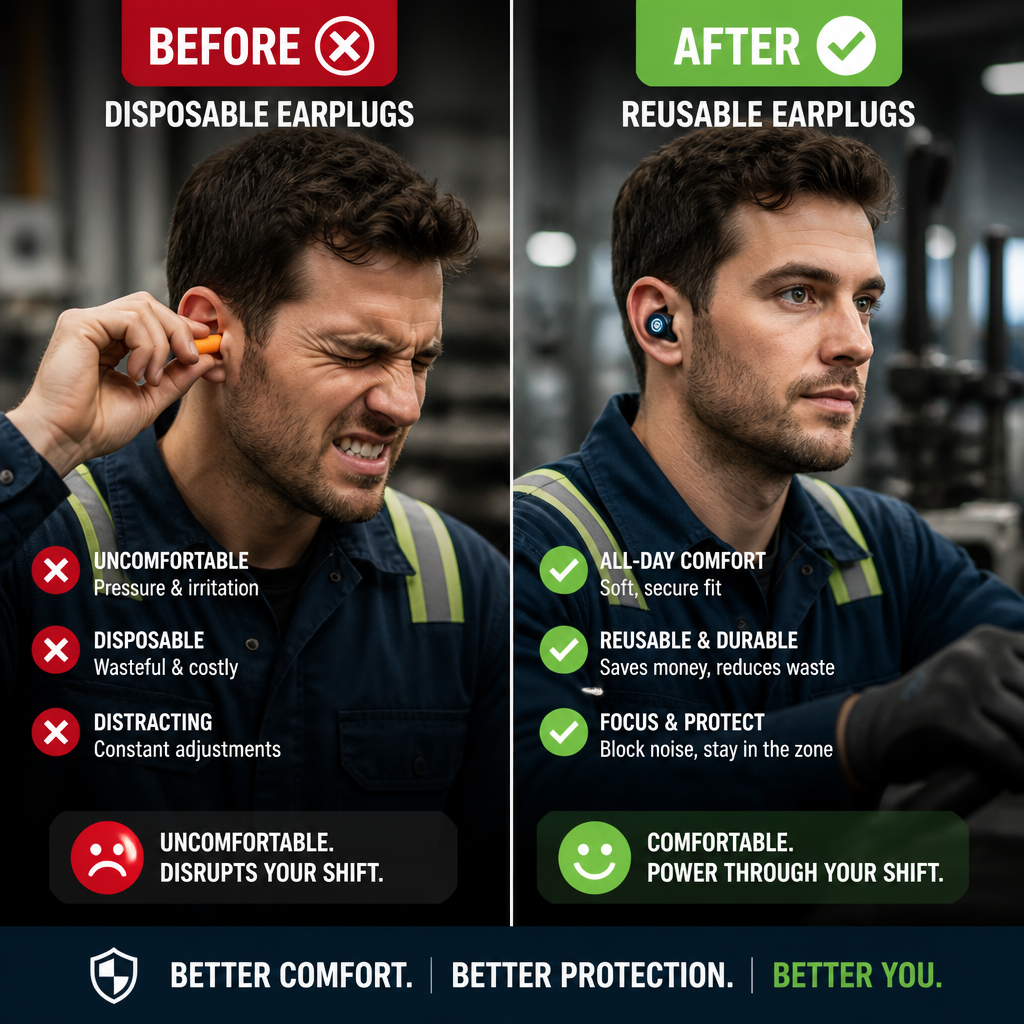
The choice between disposable and reusable earplugs for factory environments comes down to three factors: protection consistency, cost over time, and worker compliance. Here is how the main categories compare directly.
| Factor | Disposable Foam Earplugs | ATTENU8 Reusable Metal-Body Earplugs |
|---|---|---|
| NRR / Noise Reduction | Typically NRR 29-33; peaks at NRR 33 but degrades with every reuse | Approximately 32 dB, consistent across the full 6-8 week tip cycle |
| Comfort for All-Day Wear | Adequate for first use; foam pressure builds over hours, causing discomfort on long shifts | Memory foam tips with minimal pressure; concave aluminium grip reduces insertion force needed |
| Cost Over 12 Months | Low per-pair cost, but daily replacement volumes add up significantly across a large workforce | Higher upfront cost per unit; only foam tips replaced every 6-8 weeks, reducing long-run spend |
| Fit Variability | One or two sizes; fit quality depends heavily on correct rolling and insertion technique | Three memory foam tip sizes (XS, S, M); rigid body guides correct positioning in the canal |
| Environmental Waste | High; daily disposal from every worker on every shift | Low; only foam tips discarded on a 6-8 week cycle |
| Compliance Tracking | Difficult; workers often reuse without reporting | Easier; fixed replacement schedule per worker creates a trackable maintenance cadence |
Pro tip: If workers on your floor are visibly reusing disposable foam plugs, treat it as a compliance failure, not a cost-saving measure. A degraded disposable plug may deliver half or less of its rated attenuation, which could put workers above the OSHA action level even if they appear to be wearing protection.
Comfort in a manufacturing environment is not a luxury specification. It is the single most important variable in determining whether a worker actually wears the earplug for the full shift. A plug with NRR 33 that comes out at lunchtime and stays in a pocket for the afternoon has an effective NRR of zero for those hours.
The primary complaint workers have with foam earplugs is sustained canal pressure. Traditional rolldown foam plugs work by expanding inside the ear canal. That expansion is the mechanism of attenuation, but it is also the source of the aching, full feeling that drives workers to remove them. Higher-NRR plugs tend to apply more lateral pressure to achieve a better seal, creating a direct tradeoff between attenuation and comfort with traditional foam designs.
A rigid body with a memory foam tip changes that equation. The memory foam tip conforms to the canal shape rather than pushing uniformly outward. The aluminium body provides the acoustic mass and the insertion depth guide, so the foam does not need to be rolled, compressed, and shoved as deeply. The result is a seal that does not depend on the expansion force of a compressed foam cylinder pressing against canal walls for hours at a time.
Factory work involves bending, turning, lifting, and working with vibrating machinery. An earplug that shifts during these movements breaks its acoustic seal intermittently throughout the shift, and the worker usually does not notice until it falls out entirely. A concave aluminium body with a correctly sized memory foam tip creates a stable, grip-assisted seal that stays seated through normal physical work movement, which is something rolldown foam cylindrical plugs, by design, cannot replicate.
A manufacturing workforce is not uniform. Ear canal diameters vary significantly across individuals, and a plug that seals correctly on one worker may be too loose or too narrow for another. This is why ATTENU8 includes three memory foam tip sizes, XS, S, and M, with each unit. Workers can self-select the tip that seals without pressure, which immediately improves both comfort and attenuation accuracy compared to single-size disposable programs.
Pro tip: Run a simple fit check station at the start of new earplug programs. Have each worker try all three tip sizes in a quiet area and identify the one that seals without requiring hard insertion force. Five minutes of setup prevents months of poor compliance.
Not all manufacturing noise environments are equal. A packaging line running at 82 dBA presents a very different risk profile from a stamping press operating at 105 dBA. Choosing the best ear plugs for factory use means matching the protection level to the measured exposure, not defaulting to the highest available NRR for every application.
At this range, which covers assembly lines, light machining, and most packaging environments, a plug delivering 12 to 16 dB of real-world attenuation is generally sufficient to bring exposure below the 85 dBA action level. A reusable earplug with approximately 32 dB NRR, derated to real-world conditions, fits this range well and provides meaningful headroom. The priority at this level should be comfort and all-day wearability, since workers in moderate-noise environments often spend entire shifts at their stations without a noise break.
Heavy manufacturing, stamping, forging, and power tool environments typically measure in this range. Here, the derating math becomes critical. A plug with NRR 32 to 33, derated by 50 percent, provides roughly 13 to 16 dB of actual protection. For a worker at 105 dBA, this brings effective exposure to approximately 89 to 92 dBA, still above the PEL. At these levels, double protection combining earplugs with earmuffs is often warranted. OSHA guidance notes that 5 dB can be added to the NRR of the more protective device when combining earplugs and earmuffs, giving additional attenuation without requiring workers to rely on a single device to do all the work.
Press rooms, nail guns, and pneumatic tools produce sharp transient peaks that standard TWA calculations underestimate in terms of cochlear damage risk. In these settings, a plug that maintains its seal under dynamic jaw movement and head rotation is non-negotiable. Plugs that depend on compression-based expansion may shift during the recoil of impact operations, breaking the seal at exactly the moment of highest peak sound pressure. A memory foam tip anchored by a rigid metal body is far more mechanically stable in these applications.
OSHA does not mandate a specific NRR number. Instead, it requires that hearing protection be adequate to reduce a worker’s noise exposure to a TWA of 85 dBA. The appropriate NRR depends on the measured noise level at the worker’s specific position. NIOSH recommends derating label NRR values by 50 percent for typical users to estimate real-world attenuation, so a plug rated NRR 32 should be counted on to deliver roughly 13 to 16 dB of practical protection when selecting the right device for a given exposure level.
Yes, and in many practical situations they are more effective. Disposable foam plugs are rated on first use, but workers frequently reuse them across multiple shifts. Each reuse reduces the foam’s compression recovery and acoustic seal, meaning the effective attenuation drops well below the labeled NRR. A reusable metal-bodied plug with replaceable memory foam tips, like ATTENU8, maintains consistent acoustic geometry throughout the tip replacement cycle, giving a more predictable level of protection over time.
In a manufacturing setting where earplugs are worn for full 8-hour shifts, memory foam tips should be replaced when they no longer fully recover their shape after compression, or on a scheduled basis. ATTENU8 recommends tip replacement every 6 to 8 weeks under normal use. In environments with high levels of particulate, oil mist, or chemical exposure, inspect tips more frequently, as surface contamination can degrade foam faster and affect the acoustic seal.
Yes, and this is specifically recommended for environments where noise levels exceed approximately 100 dBA TWA. OSHA notes that combining earplugs with earmuffs adds approximately 5 dB to the attenuation of the more protective of the two devices. The earplug provides the primary deep-canal seal while the earmuff adds a secondary outer ear barrier. In practice, using a compact metal-bodied earplug under earmuffs is more comfortable than bulky rolldown foam plugs, which can be difficult to seat correctly with earmuff cups pressing against the outer ear.
NRR (Noise Reduction Rating) is the standard used in the United States, governed by the EPA. SNR (Single Number Rating) is the European equivalent, governed by EN ISO 4869-2. They are calculated using different methodologies and are not directly interchangeable, though both aim to represent the attenuation achieved in laboratory testing. ATTENU8 products carry an SNR 32 rating under CE certification to BS EN 352-2:2002, which is the applicable standard for the Australian and European markets. Workers and employers in the US should compare NRR values when selecting against OSHA compliance thresholds.
A properly fitted earplug will produce a noticeable reduction in ambient noise immediately upon insertion. A common field test is to cup your hands over your ears after inserting the plugs. If you hear a significant additional reduction in noise, the earplugs are not sealing correctly and need to be reinserted or replaced with a better-fitting size. In formal hearing conservation programs, fit testing using a personal attenuation rating (PAR) device provides objective measurement of each worker’s actual achieved attenuation with a specific plug and size.
Have you found a specific earplug type or fit approach that keeps your workers protected and comfortable through a full manufacturing shift? Share your experience in the comments below.
Most people who struggle to sleep blame their mattress, their stress levels, or their phone. The real culprit is usually noise. Research suggests that sounds as low as 30 decibels can disrupt rest, and nocturnal noise exposure has been linked to serious long-term health effects including cardiovascular stress, even when it does not fully wake you. If you care about sleep environment noise reduction, patching one weak spot in your bedroom is not enough. Sound finds every gap, every hard surface, and every room in the house that bleeds into your sleeping space. This room-by-room checklist covers everything from windows and doors to floors and hallways, so you can build a genuinely quiet bedroom rather than just masking the problem.
The brain does not switch off its auditory processing during sleep. It continues monitoring the acoustic environment throughout the night, and sudden or unpredictable sounds trigger arousal responses, whether or not those arousals reach full consciousness. The problem is not just being jolted awake by a passing truck. It is the dozens of micro-arousals per night that fragment your sleep architecture, prevent you from reaching deep slow-wave sleep, and leave you feeling unrested despite eight hours in bed.
Research published in the Noise and Health journal found that noise events induce arousals at relatively low exposure levels, independent of the noise source, whether that source is road traffic, neighbors, or other environmental sounds. Separate research cited by the WHO suggests that traffic-related noise alone causes significant loss of healthy life years across entire populations. These are not edge-case outcomes for people living next to airports. They apply to anyone sleeping in a normally noisy urban or suburban home.
The practical implication is clear: your bedroom noise level matters more than most sleep advice acknowledges. Fixing it is not a luxury project. It is a foundational health measure.
| Key Insight | Explanation |
|---|---|
| Sounds from 30 dB upward can disrupt sleep architecture | You do not need to fully wake for noise to damage sleep quality. Micro-arousals accumulate through the night and reduce restorative deep sleep stages. |
| Windows and doors are the primary noise entry points | Even well-insulated walls lose their effectiveness if window frames have gaps or if hollow-core doors allow sound to pass freely. Address these first. |
| Hard surfaces amplify and reflect sound inside the room | Bare floors, bare walls, and minimal soft furnishings allow sound to bounce and build. Rugs, heavy curtains, and upholstered furniture absorb these reflections. |
| White and pink noise machines work best at 50-60 dB | Background noise at this level masks disruptive sound spikes without introducing its own volume-related harm. Going above 85 dB creates new risks. |
| Noise masking and noise blocking serve different problems | Blocking reduces sound entering the room. Masking reduces your perception of sounds that remain. Most effective sleep environments use both strategies together. |
| Reusable ear plugs with high NRR ratings provide portable, personal noise reduction | Quality ear plugs rated around 32 dB NRR offer consistent protection regardless of what is happening in the room, making them effective for travel and unpredictable environments. |
| Noise from adjacent rooms matters as much as noise from outside | HVAC units, kitchen appliances, televisions in living areas, and bathroom pipes all transmit noise into bedrooms through walls, floors, and ceilings. |
Start with the room itself before moving outward. The bedroom has six surfaces, and treating all six matters if you want genuine quiet bedroom results rather than marginal improvements.
Hard flooring transmits impact noise directly. Footsteps from upstairs, vibration from appliances, and even street-level impacts travel up through structural elements and radiate into the room. A thick area rug with dense underlayment under the bed reduces floor-borne noise absorption and breaks the transmission path. If you have downstairs neighbors or a timber floor, this single addition makes a noticeable difference.
Ceilings are often overlooked. If a neighbor, flatmate, or family member occupies the room above yours, sound travels through the ceiling plane at surprising volume. A false ceiling with insulation, or even heavy wall art and acoustic panels mounted overhead, can interrupt that path. Most renters cannot modify the ceiling structure, but adding mass elsewhere in the room still helps.
Shared walls with adjacent rooms or neighboring units are a common noise path. The fastest low-cost approach is placing heavy, dense furniture directly against the shared wall. A full bookcase packed with books provides genuine acoustic mass. Upholstered headboards, thick fabric wall hangings, and acoustic panels all absorb reflected sound inside the room and reduce transmission through the wall surface.
A common mistake is treating soundproofing as a single wall problem. In practice, sound enters a room from every surface simultaneously. Treating only the wall that faces the street while leaving bare floors and no curtains leaves you with a room that still reflects and amplifies whatever does enter.
Pro tip: Before spending money on acoustic panels, walk around your bedroom barefoot and listen to where sound feels loudest. Hard corners where two walls meet a bare floor are echo focal points. Placing rugs and soft furniture near those corners gives you the highest acoustic return for the lowest cost.
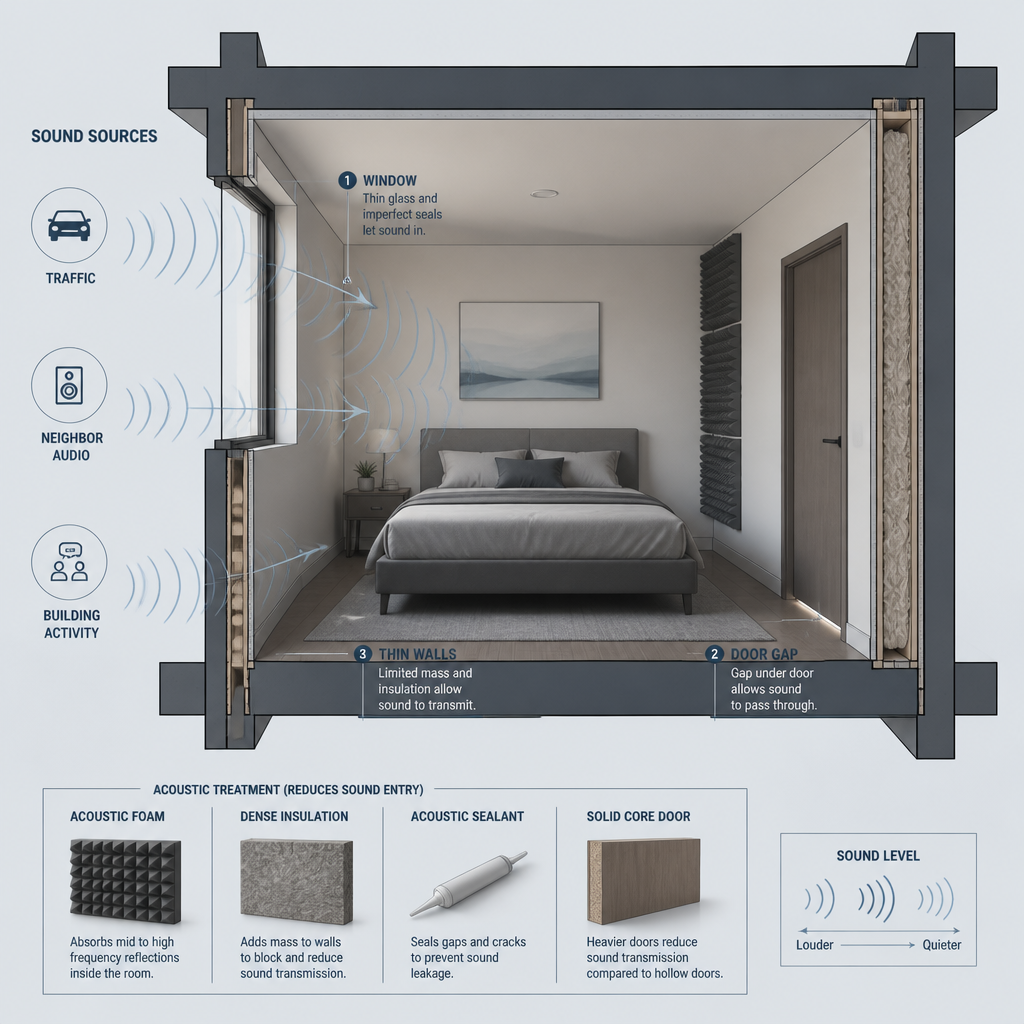
If you want to know how to reduce bedroom noise at its source, windows and doors are almost always the answer. A thick concrete wall might have a Sound Transmission Class (STC) rating above 50. A single-pane window sits around STC 26-28. A hollow-core door rarely exceeds STC 20. Every hour you spend treating walls without addressing windows and doors produces diminishing returns.
The fastest improvement is acoustic caulk around the window frame. Gaps between the frame and the surrounding wall, even small ones, allow disproportionate sound transmission. Sealing them costs very little and takes under an hour.
Heavy, dense curtains hung from ceiling to floor provide meaningful noise reduction at modest cost. Pleated curtains offer more acoustic mass than flat-hung versions. Dedicated soundproofing curtains with an STC rating of 20 or higher add a further layer. These do not match the performance of sealed window inserts, but they work without any structural modification.
For serious treatment, window inserts sit inside the existing frame and create an air gap that dramatically increases the STC rating. These are particularly effective for double-glazing a single-pane window without replacing the entire unit.
Bedroom doors are almost universally the weakest acoustic barrier in the room. Hollow-core doors, which are standard in most homes, offer almost no sound resistance. Upgrading to a solid-core door is the single highest-impact structural change you can make to a bedroom’s acoustic performance.
Where a solid-core door is not possible, the gap between the door bottom and the floor is the priority fix. A door sweep eliminates the gap that allows sound to pass freely beneath the door. Weather stripping around the door perimeter seals the remaining edges. These two additions alone transform a standard door from acoustically transparent to meaningfully resistant.
Pro tip: Check your door gap with a torch at night. If you can see light under the door from the hallway, noise is moving through that gap just as freely. A door sweep costs very little and takes minutes to install.

A significant portion of the noise disrupting your sleep does not come from outside the building. It comes from inside it. The television in the living room, the refrigerator compressor, the bathroom exhaust fan, a partner moving around the kitchen late at night: all of these transmit through walls, floors, and open doorways into the bedroom.
The most effective approach is removing the noise before it travels. Scheduling appliance use, switching off ice makers at night if the kitchen is adjacent to the bedroom, and placing anti-vibration pads under washing machines and dryers eliminates sound before it becomes a bedroom problem.
In hallways, a dense rug runner on hard floors absorbs the impact sound of footsteps that would otherwise travel into adjacent rooms. This is one of the least expensive and most consistently effective changes in a shared household.
HVAC systems are a frequently underestimated source of sleep disruption. Forced-air systems can transmit duct-borne sound directly into bedrooms through vent openings. Duct insulation and acoustic baffles at the vent opening reduce this without affecting air circulation. Pipe noise from plumbing is harder to treat but relocating the bed away from the wall shared with bathrooms or utility rooms solves most practical cases without renovation.
The bedroom door and the adjacent living space noise level together determine your baseline sleep environment more than any single acoustic product. Fix the noise at its source and at the boundary before reaching for masking solutions.
These two strategies are complementary, not interchangeable. Noise blocking physically reduces the amount of sound that reaches your ears. Noise masking adds a consistent background sound that reduces your brain’s sensitivity to the remaining noise spikes. Both have a role in a complete sleep environment, and understanding which problem each solves prevents wasted effort.
If your room has identifiable structural gaps, single-pane windows, hollow-core doors, or bare hard surfaces, blocking is the priority. Adding a white noise machine to a room with a 1cm gap under the door is like running a dehumidifier in a room with an open window. The machine will work to some degree, but the underlying problem remains unaddressed.
Once you have treated the main structural noise paths, a white or pink noise machine set at roughly 50 to 60 decibels provides a consistent acoustic baseline that reduces the perceptual contrast of any remaining sounds. Research on white and pink noise for sleep suggests this approach reduces how disruptive residual noise feels. Pink noise, which has more energy in the lower frequencies than white noise, suits people who find white noise too harsh or hiss-heavy.
Fans, air purifiers, and dedicated sound machines all serve this purpose. The specific sound source matters less than consistency. Avoid tracks that loop or vary, since changing sounds draw the brain’s attention rather than masking it.
| Approach | Best For | Practical Limitations |
|---|---|---|
| Structural soundproofing (solid-core doors, window inserts, acoustic caulk, wall mass) | Permanently reducing the amount of external noise entering the room. High return on investment in owned properties. | Requires time, investment, and sometimes permission from landlords. Does not eliminate all noise. |
| Soft furnishing absorption (heavy curtains, thick rugs, upholstered furniture, acoustic panels) | Reducing internal reverberation and absorbing noise that has already entered the room. Renter-friendly and low cost. | Reduces reflection rather than transmission. Will not block substantial external noise on its own. |
| Noise masking (white noise machines, pink noise, fan) | Reducing the perceptual impact of sounds that cannot be eliminated. Good for unpredictable noise patterns like traffic, snoring partners, and building sounds. | Does not reduce actual decibel levels. Requires correct volume setting to be safe and effective. Some people find sustained background sound disruptive rather than helpful. |
| Personal ear protection (reusable premium ear plugs with memory foam tips) | Individual noise reduction regardless of room treatment status. Essential for travel, shared accommodation, and situations where room treatment is not possible. | Requires correct fit for effective seal. Disposable foam ear plugs require constant replacement. Reusable options with replaceable tips offer much better long-term value. |
Even a well-treated bedroom has limits. Shared accommodation, hotel rooms, partner snoring, shift work with daytime sleeping, and travel all create noise environments you cannot structurally modify. This is where personal ear protection becomes essential rather than a last resort.
The problem with standard disposable foam ear plugs is not their noise reduction performance. It is the experience of wearing them. Cheap foam compresses unevenly, creating pressure points that wake light sleepers. They fall out during sleep. They require daily replacement, adding cost and waste. And they do nothing to address fit variations between individuals.
This is exactly what ATTENU8 was designed to address. The metal-bodied construction and concave aluminium shell hold their shape against the ear without creating the pressure problems typical of solid foam plugs. Three included sizes of soft memory foam tips (XS, S, and M) allow a proper acoustic seal regardless of ear canal variation, which is the single most important factor in actual noise reduction performance. An NRR of approximately 32 dB means meaningful attenuation of the sound sources most likely to disrupt sleep: traffic, voices, construction, and snoring.
The foam tips require replacement every six to eight weeks rather than after every use. In practice, this means a pair of ATTENU8 ear plugs costs a fraction of a year’s supply of disposable foam alternatives while delivering consistent, reliable fit every night. For side sleepers, the low-profile design and soft memory foam tips mean the plugs do not create discomfort against a pillow, which is the common failure point for harder ear plug designs.
If you are also addressing noise in professional environments, the same 32 dB NRR that makes ATTENU8 effective for sleep makes them suitable for use on construction sites, in manufacturing settings, and during air travel, where standard disposables are often worn incorrectly and deliver far less protection than their rated NRR would suggest.
Research and health guidance consistently point to below 30 decibels as the target for a sleeping environment. Urban residential areas typically measure 45 to 55 dB at night, which means most city dwellers are sleeping in rooms well above the recommended threshold without active noise reduction measures in place.
Yes, but within realistic limits. Dense, heavy curtains hung from ceiling to floor can reduce incoming noise by a few decibels and reduce internal reverberation meaningfully. They are not a substitute for sealed window frames or double-glazed glass, but as a renter-friendly first step, they deliver real improvement, particularly for mid-to-high frequency sounds like voices and traffic.
White noise used consistently at 50 to 60 decibels is considered safe for most adults. The risk arises when sound machines are set too loud. Levels above 85 decibels sustained through the night can cause auditory stress. Set your machine to the lowest volume that effectively masks the noise you are trying to block, not to the highest volume you can tolerate.
Reusable ear plugs with properly fitting memory foam tips typically outperform disposable foam plugs in practice because they allow a more precise fit. Disposable foam requires correct insertion technique to achieve its rated NRR, and most people do not insert them fully enough. A well-designed reusable plug with size-matched tips creates a reliable seal every night without the technique variability. They are also significantly cheaper over any period longer than a few weeks.
Treat it at the source first wherever possible. Turning off appliances, reducing household noise after a certain hour, and sealing internal door gaps all reduce the sound load on your bedroom before it reaches the boundary. Then treat the bedroom boundary itself with doors, windows, and curtains. Masking and personal ear protection address whatever remains. This order of operations produces the best results for the least cost.
Yes, significantly. A full bookcase against a shared wall adds acoustic mass that reduces transmission through that surface. A bed positioned away from the wall shared with a noisy bathroom or hallway reduces the perceived volume of pipe and footstep noise. Heavy furniture on hard floors also reduces the transmission of impact noise through the floor plane. These are not marginal effects. In rooms without soft furnishings, sound bounces and builds. Adding mass and soft surfaces changes the acoustic character of the room noticeably.
Substantially, yes. Thick area rugs, floor-to-ceiling curtains, furniture placement against shared walls, door sweeps (removable), acoustic panels mounted with adhesive strips, and personal ear protection all provide meaningful noise reduction without any structural modification. A renter who addresses all of these simultaneously will experience a very different acoustic environment from one who treats the bedroom as fixed. The combination of soft furnishings plus personal ear protection covers most practical scenarios without requiring landlord permission.
Have you already made changes to your sleep environment for better noise reduction? Share what worked (or what did not) in the comments below.
A 2023 study from University College London found that ambient noise above 65 decibels reduces reading comprehension scores by up to 30%. If you study in a dorm, café, or shared apartment, you are almost certainly working above that threshold without realising it. Using ear plugs for studying is not a workaround for people who cannot concentrate. It is a evidence-backed method to protect your cognitive performance during the hours that matter most. This article explains exactly why noise wrecks focus, which ear plug options genuinely work for students, and how to make the habit stick.
| Key Insight | Explanation |
|---|---|
| 32dB reduction is the practical target for serious study sessions | At 32dB attenuation, common dorm or café noise is reduced to a whisper-level background, preventing the attention splits that drain working memory. |
| Fit determines performance more than brand | An ear plug rated 32dB that sits loosely in your canal delivers far less real-world protection. Multiple tip sizes are not a luxury, they are essential for accurate fit. |
| Foam tips wear out every 6-8 weeks under regular use | Compressed or dirty foam loses its seal and drops your effective NRR significantly. Replacing tips rather than the whole ear plug saves money and maintains performance. |
| Disposable foam plugs are a false economy for students | Students who study 4-5 hours daily go through hundreds of disposable pairs per semester. A reusable metal-bodied pair with replaceable tips is dramatically cheaper over a term. |
| Ear plug comfort directly affects how long you study | Hard plastic or poorly shaped plugs cause pressure pain after 45-60 minutes. Memory foam tips on a shaped aluminium body distribute pressure evenly, making 3-4 hour sessions tolerable. |
| Consistency in ear plug use builds a focus trigger | When you pair ear plug insertion with the start of a study session every day, your brain begins to associate the act with deep focus. This is a conditioned cue, not just noise reduction. |
| Blocking noise is not the same as blocking all sound | You want attenuation, not total silence. At 32dB reduction, you remain aware of fire alarms and urgent calls while eliminating distracting conversation and traffic noise. |
The core problem is not volume. It is unpredictability. Research published by the Journal of the Acoustical Society of America shows that irregular, speech-like noise is far more cognitively disruptive than steady background hum because your brain cannot habituate to it. Every unexpected word fragment pulls your attention toward identifying whether it is relevant to you.
This phenomenon is called the irrelevant speech effect. Even when you think you are tuning out a conversation in the background, your phonological processing system is still partially engaged with it. The result is reduced capacity in working memory, which is precisely the cognitive resource you need for reading, problem-solving, and memorisation.
In practice, students often misattribute poor session quality to tiredness or motivation when the actual cause is a noisy environment chipping away at their working memory capacity for hours. Fixing the environment fixes the output. Ear plugs that genuinely block noise while studying address the root problem directly.
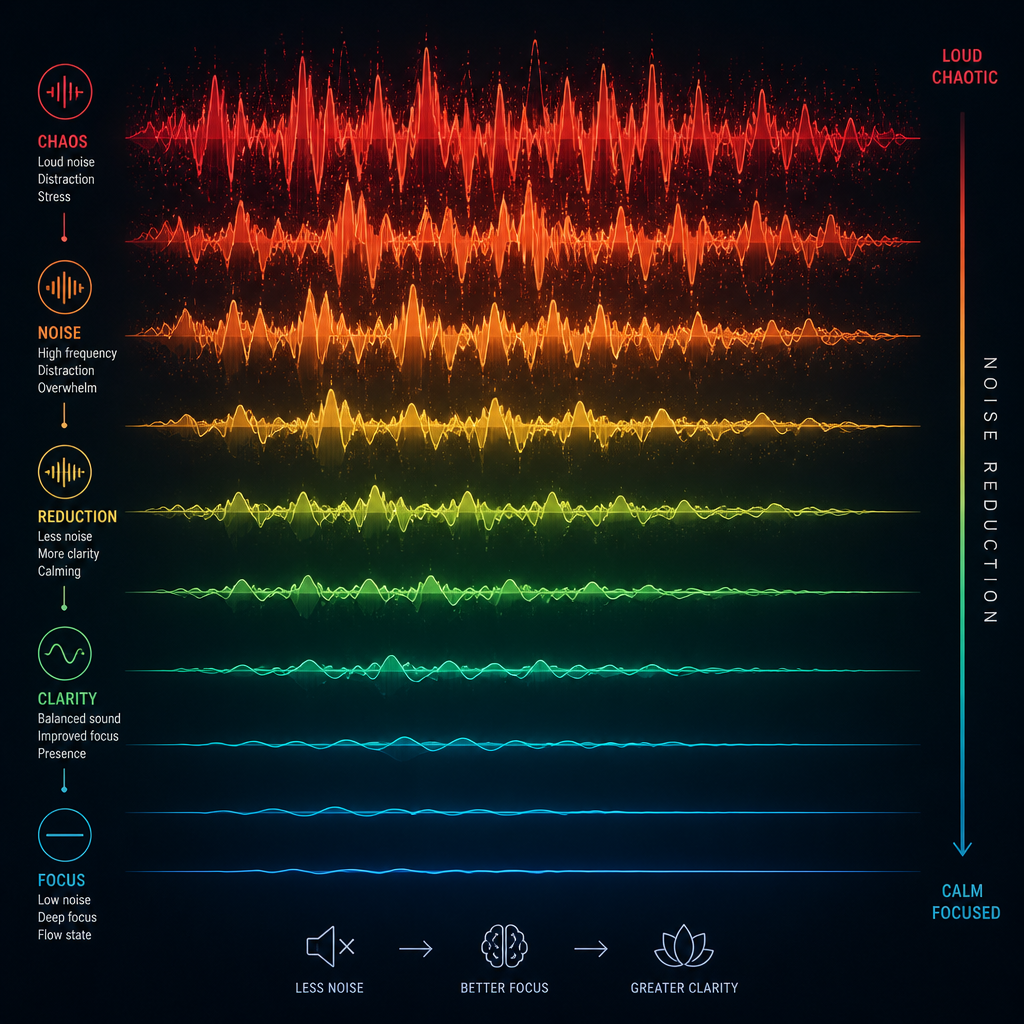
“Noise is the most underestimated study killer. Students spend money on apps, planners, and supplements but ignore the single environmental change that has the most immediate cognitive impact.” – Dr. Nick Perham, Cardiff Metropolitan University researcher on noise and cognition
The data consistently shows that even moderate noise levels around 55-65 decibels, which is a normal office or café environment, impair performance on tasks requiring reading comprehension and serial recall. Libraries are quieter than that, but shared student accommodation is almost never quieter than 60dB during waking hours.
The Noise Reduction Rating (NRR) printed on ear plug packaging is a laboratory measurement of attenuation in decibels. A product rated NRR 32 means it reduced test-booth noise by 32dB under controlled insertion by trained participants. Real-world performance is lower because most people do not insert ear plugs as precisely as a lab technician does.
A common mistake is assuming that a higher NRR automatically means better studying. Beyond roughly 30-35dB of attenuation, you start to feel uncomfortably isolated, and the pressure sensation in the canal becomes distracting in itself. The sweet spot for study sessions is 28-32dB reduction, which eliminates conversational and traffic noise without making you feel sealed in a vacuum.
ATTENU8 ear plugs are rated at approximately 32dB NRR. That sits at the top of the productive study range. The concave aluminium body also helps by acting as a stable outer shell that keeps the memory foam tip positioned correctly in the canal, so the real-world attenuation stays close to the rated figure rather than dropping off due to poor seal.
Memory foam tips must fully expand against the canal wall to create the acoustic seal that delivers rated performance. A tip that is too small leaves gaps. A tip that is too large creates pressure that causes pain and makes you remove the plug early, defeating the entire exercise.
ATTENU8 includes three tip sizes per pair, XS, S, and M, specifically because canal size varies significantly between individuals and even between a person’s left and right ear. Taking two minutes to test which size gives you a snug, painless fit is the single most effective thing you can do to maximise your real-world noise reduction.
Pro tip: Insert the tip, reach your hand over your head to gently pull your ear upward and backward, then press the tip in slightly and release. This straightens the ear canal and allows the foam to expand into a full seal. Most students skip this step and wonder why their ear plugs feel ineffective.
Students have three realistic categories to choose from: disposable foam plugs, reusable silicone or rubber plugs, and premium metal-bodied reusable plugs with replaceable foam tips. Each has a distinct profile of performance, cost, and practicality over an academic term.
The cheapest entry point. Soft polyurethane foam, rolled down and inserted to expand in the canal. NRR ratings typically fall between 29-33dB on paper. The problem is that these plugs degrade fast. After 2-3 uses, compressed foam loses significant recovery speed, and the tip picks up enough skin oil and debris to compromise the seal. Students who study daily burn through these quickly and generate significant waste.
They also lack any structural body to keep them correctly positioned. If you fall asleep at your desk studying, a disposable foam plug often migrates further into the canal than intended, which is both uncomfortable and sometimes difficult to remove without tweezers.
Better durability, washable, and available in multiple sizes. Brands like Loop and Flare Audio sit in this category and market themselves heavily toward lifestyle users. The NRR ratings are typically lower, often in the 18-27dB range, which is sufficient for mild café noise but noticeably insufficient in louder dorm environments or open-plan study spaces with multiple conversations happening.
These plugs work well for commuting or light focus work. For serious multi-hour study sessions where you need reliable, consistent attenuation, the lower NRR is a real limitation rather than an acceptable trade-off.
This is where ATTENU8 sits. The aluminium body serves a structural purpose: it maintains the correct depth and angle of the tip without requiring you to constantly re-insert. The memory foam tip does the acoustic sealing work, and when it wears out every 6-8 weeks, you replace only the tips rather than the entire plug. At 32dB NRR, performance is consistent across the life of the product because the aluminium body never degrades.
The durability case is straightforward. A student who studies four hours daily for a 13-week semester goes through roughly 26 sets of disposable ear plugs at minimum. A single pair of ATTENU8 plugs with one or two tip replacements covers the same period at a fraction of the cost and with more consistent performance.

The table below compares the three main ear plug categories on the factors that matter most for students who use them regularly across an academic term.
| Feature | Disposable Foam (e.g., 3M Classic) | Reusable Silicone (e.g., Loop, Flare) | Premium Metal-Bodied (ATTENU8) |
|---|---|---|---|
| Typical NRR | 29-33dB (drops after 2-3 uses) | 18-27dB | 32dB (consistent over product life) |
| Comfort over 3+ hours | Low. Foam migrates and creates pressure. | Moderate. Silicone can cause canal fatigue. | High. Concave body distributes pressure evenly with memory foam tips. |
| Cost per semester | High. Constant repurchasing of packs. | Medium. One pair lasts but NRR compromises study performance. | Low. One pair plus tip replacements every 6-8 weeks. |
| Fit customisation | One size. Poor fit is common. | Some models offer S/M/L. | XS, S, M memory foam tips included per pair. |
| Hygiene | Not designed for reuse. Single use only. | Washable silicone body. | Replaceable foam tips. Aluminium body is wipe-clean. |
| Best for | Occasional one-off use. | Commuting, mild noise environments. | Daily study sessions, high-noise environments, sleep, travel. |
The comparison is not close for students who study daily in genuinely noisy environments. Lower-NRR lifestyle plugs serve a different use case. The question for best ear plugs for focus students is not which product looks the most stylish. It is which product delivers consistent 30dB-plus attenuation without causing discomfort that cuts sessions short.
Correct insertion technique is underrated. Most students who report that ear plugs do not work for them are inserting them incorrectly and getting 10-15dB of actual attenuation from a product rated at 32dB. That gap is the difference between usable quiet and mildly reduced noise.
Roll the memory foam tip between your thumb and forefinger to compress it down to roughly half its diameter. Reach over your head with the opposite hand and pull your ear upward and back to straighten the canal. Insert the compressed tip fully into the canal entrance, not just partway. Hold it in place with your fingertip for 20-30 seconds while the foam slowly expands against the canal wall. When the foam has fully expanded, you should notice an immediate muffling of ambient sound. If you do not, the tip size is likely too small for your canal and you should try the next size up.
For ATTENU8 plugs specifically, the aluminium body sits just outside the canal entrance once correctly inserted. Do not try to push the body itself into the canal. The body is designed to stay external while the foam tip creates the seal internally.
Even well-fitted ear plugs cause mild pressure fatigue after 90-120 minutes. A common mistake is powering through the discomfort until you need to remove them entirely. A better approach is to remove them for 5 minutes during natural study breaks, which ATTENU8 recommends as standard practice anyway. This also allows the foam tips to re-expand to full volume, maintaining seal quality when you reinsert.
Pro tip: Keep your ATTENU8 plugs in the carry case and place the case visibly on your desk as a physical cue. When the case is open and the plugs are in, your study session is active. When you close the case, the session is over. This simple ritual reinforces the conditioned focus response over time.
Ear plugs work best as part of a deliberate environmental design rather than a reactive measure you grab only when noise gets unbearable. Students who reduce distractions while studying most effectively treat noise control as a pre-session step, not an interruption response.
A practical routine looks like this: before you open a book or laptop, insert your ear plugs, position your study materials, and silence your phone. This sequence takes under two minutes and signals to your nervous system that focused work is beginning. The ear plug insertion step carries particular weight because it is physical and irreversible in the moment. Unlike silencing a phone, which you can undo in seconds, inserted ear plugs require a deliberate removal action. That small friction keeps you in the session.
Ear plugs handle the variable, unpredictable noise that your brain cannot habituate to. If you also face a low, steady background hum from HVAC systems or distant traffic, that type of noise actually becomes less disruptive once the irregular conversational sounds are blocked. You do not need to add white noise machines or extra equipment in most study environments. Blocking the irregular speech-like noise with 32dB ear plugs is usually sufficient to create a workable study environment.
The one exception is if you share a thin-walled room with someone who is gaming with speakers or watching content at high volume. In those cases, ear plugs reduce the noise substantially but may not eliminate it entirely. The solution there is a combination of ear plugs and a direct conversation about study hours, not more complex audio equipment.
Memory foam tip degradation is gradual, which means you rarely notice the drop in performance. The foam compresses and re-expands slightly less fully with each use. After 6-8 weeks of daily use, a tip that originally expanded to full volume is now expanding to perhaps 80-85% of that. The NRR drop is measurable but not obvious. Setting a calendar reminder to replace your ATTENU8 tips every six weeks ensures you are always operating at rated performance.
This is genuinely different from how competitors approach the product. With Loop or Flare silicone plugs, the body and sealing mechanism are the same component, so degradation of the seal means degradation of the product. With ATTENU8, the durable aluminium body remains fully functional indefinitely. Only the consumable foam tip component needs periodic replacement, which takes ten seconds and costs a fraction of replacing the full product.
The effect is real and measurable. Research from the Acoustical Society of America and studies at Loughborough University consistently show that ear plugs providing 28dB or more of attenuation in genuinely noisy environments improve performance on tasks requiring working memory and reading comprehension. The mechanism is straightforward: blocking the irregular speech-like noise that activates your phonological loop frees up cognitive capacity for the task at hand. It is not a placebo; it is environmental engineering.
No. A 32dB NRR ear plug reduces ambient sound but does not create a sealed chamber. Fire alarms are typically rated at 65-75dB at the source and are legally required to reach 75dB at the pillow level in residential buildings. At 32dB attenuation, a 75dB alarm still reaches you at 43dB, which is clearly audible. You will hear fire alarms, loud knocks on doors, and any sound above roughly 40-50dB in the room. Normal conversational noise at 55-65dB gets reduced to a quiet murmur, which is exactly the intended effect.
Start with the medium tip, which fits most adult ear canals. Insert it correctly using the roll-and-hold technique. If you feel significant pressure or discomfort within the first few minutes, try the small tip. If the plug feels loose or falls out easily, try the medium again with closer attention to insertion depth. A correctly sized and inserted tip creates a clear but painless muffling sensation immediately on insertion. The XS size is specifically useful for individuals with narrower canals, which is more common than most people realise, and having the option avoids the degraded performance that comes from using an oversized tip.
Every 6-8 weeks under daily use is the practical guideline for memory foam tips. Visible signs of degradation include yellowing or browning from skin contact, a flattened appearance where the foam no longer fully recovers its shape within 30 seconds of compression, and a noticeably reduced acoustic seal feeling on insertion. Do not wait for all three signs. If you have been using the same tips for more than eight weeks daily, replace them proactively. The cost is minimal compared to the performance drop from degraded foam.
Yes, and most students find note-taking with ear plugs in is no different from without them. The only scenario where ear plugs interfere with note-taking is if you are transcribing spoken audio from a lecturer or recording. In that case, you are introducing the irrelevant speech effect deliberately, so ear plugs are counterproductive. For silent reading, problem sets, memorisation, and written assignments, ear plugs have no downside and a measurable upside in noisy environments.
When maintained properly, yes. Disposable foam plugs accumulate ear canal debris and skin oil from the first use but are often reused several times anyway. A reusable aluminium-bodied plug with replaceable memory foam tips combines a wipe-clean body with consumable tip components that can be replaced before they accumulate enough contamination to become a hygiene concern. The key is adhering to the replacement schedule and wiping the aluminium body with a dry cloth periodically. This is objectively more hygienic than reusing week-old disposable foam plugs, which many students do to extend a pack.
If you use ear plugs regularly for studying, we would like to hear what has worked for you and what has not. Share your experience in the comments below.

