


 0

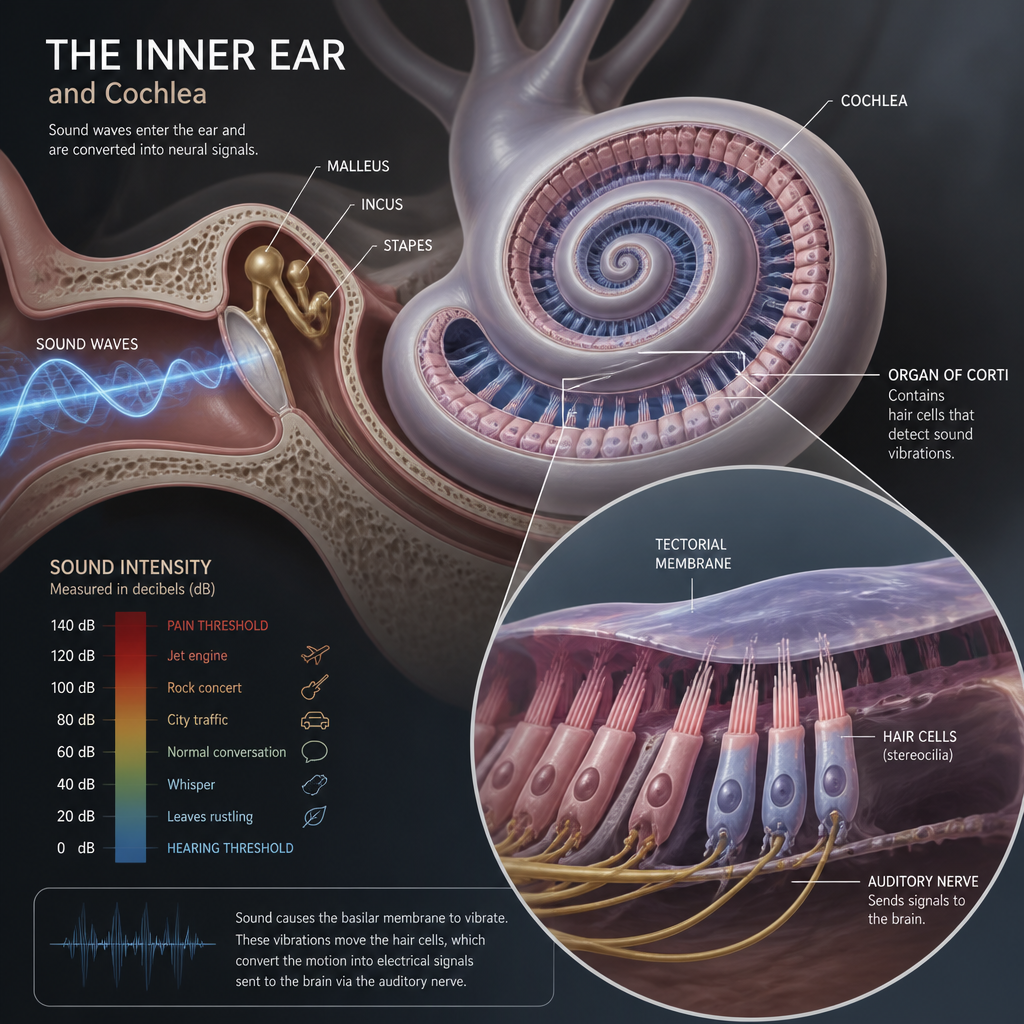
Most people associate hearing damage with dramatic, obvious events: a gunshot, a rock concert, an industrial accident. The reality is far less dramatic, and far more common. Noise-induced hearing damage builds silently, exposure by exposure, across the ordinary soundtrack of daily life. The lawnmower on Saturday morning, the subway commute on Monday, the earbuds you wear to get through the afternoon: each one is doing work on your inner ear that your body cannot undo. Approximately 40 million American adults may have hearing loss resulting from noise exposure, and the mechanism is the same every time: once the hair cells inside your cochlea are gone, they do not grow back.
| Key Insight | Explanation |
|---|---|
| 85dB is the damage threshold | Sounds at or above 85 decibels can start damaging your hearing over time. Heavy traffic from inside a car already sits at this level. |
| Damage is cumulative and irreversible | Each loud exposure adds to a running total. Inner ear hair cells do not regenerate once destroyed. |
| Earbuds are a major underrated risk | Listening at high volume through earbuds or headphones consistently puts users above safe thresholds, especially with noise-cancelling devices cranked up. |
| Time at volume matters as much as the volume itself | At 85dB, 8 hours of exposure is the working safety limit. Every 3dB increase roughly halves the safe exposure duration. |
| Over 1.5 billion people worldwide have hearing impairment | The WHO reports this figure, with noise exposure being the primary occupational cause in adults. The number is projected to grow. |
| Reusable ear plugs with high SNR ratings offer consistent daily protection | A product rated at SNR 32 (like ATTENU8) delivers meaningful attenuation across the noise types you meet every day, not just in extreme environments. |
| Protection must be comfortable to be used consistently | Foam tips that conform to the ear canal create a seal. Rigid or ill-fitting plugs are discarded when they become uncomfortable, leaving you exposed. |
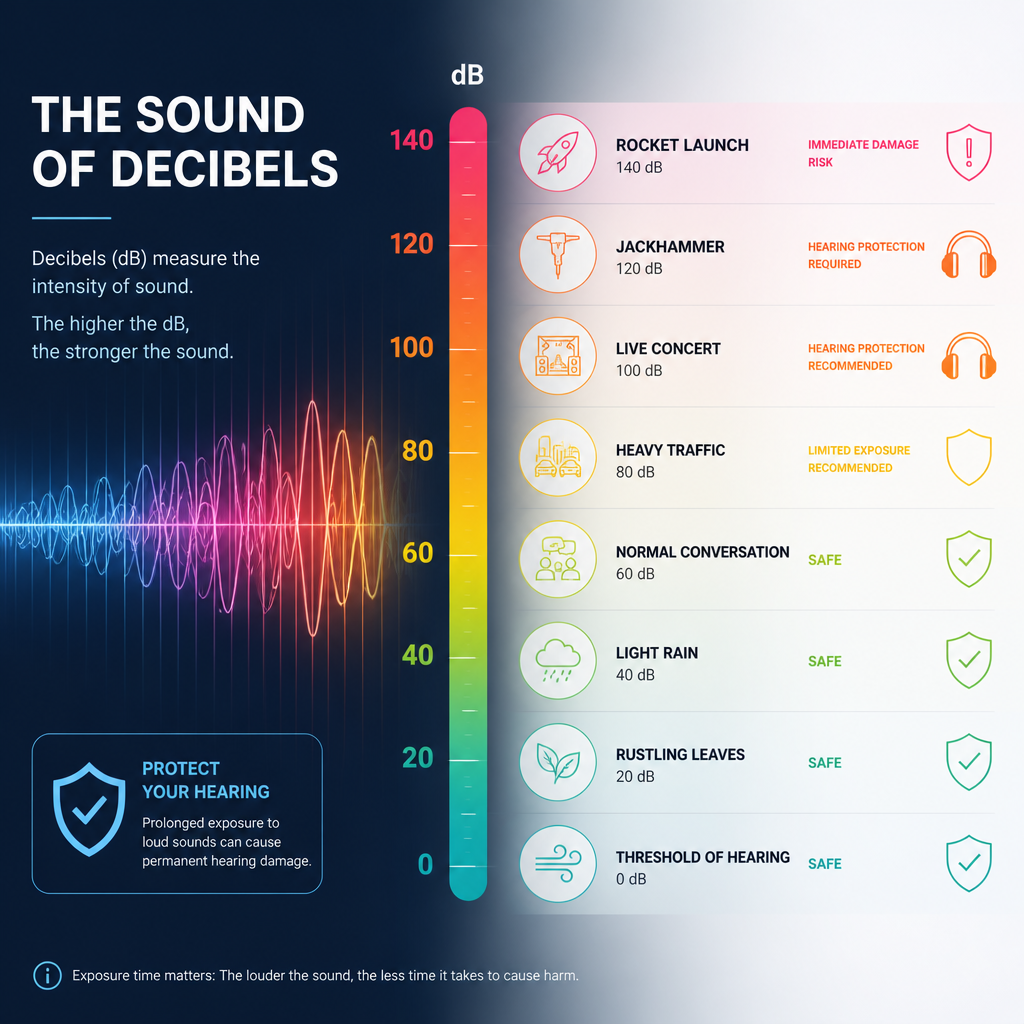
Decibels are not a linear scale. Every 3dB increase represents a doubling of sound intensity, which means the jump from 85dB to 100dB is not a modest step up but a dramatic one. Occupational safety standards in most countries set 85 decibels over eight hours as the maximum safe daily dose for workplace noise. Exceed that either in volume or in duration, and you are accumulating damage.
The physiology is straightforward and unforgiving. Your inner ear contains thousands of tiny hair cells in the cochlea. These cells convert sound vibrations into electrical signals your brain reads as sound. Loud noise physically bends and eventually destroys these cells. Unlike skin or bone, they do not regenerate. The loss is permanent, and it tends to start in the higher frequency ranges, which is why people with early noise-induced hearing damage often struggle to follow conversation in noisy rooms before they even notice anything is wrong.
Sounds at or below 70dB are generally considered safe for indefinite exposure. Normal conversation between two people sits at around 60dB. The problem is that almost everything else in a typical day edges closer to the danger zone than most people expect.
None of the following noise sources are exotic. Most people encounter several of them every single day without giving their hearing a second thought. That indifference is exactly the problem.

Sitting inside a car in heavy urban traffic already puts you at approximately 85dB, which is the occupational safety threshold. For daily commuters spending an hour or more in stop-and-go traffic with windows down or in a convertible, this exposure adds up across working weeks and years in a way that is genuinely consequential.
Subway noise regularly reaches 90dB or above, particularly when trains are accelerating or braking in enclosed stations. A 30-minute commute each way means an hour of near-constant 90dB exposure daily. Many commuters compound this by turning their earbuds up to overcome the background noise, pushing total exposure into a far more damaging range.
This is the most widespread source of noise-induced hearing damage in people under 35. Used at unsafe volumes, earbuds and headphones are contributing to an epidemic of hearing loss, particularly among young people. The World Health Organization has warned that over 1 billion young people aged 12 to 35 are at risk of permanent hearing damage from recreational noise exposure, with personal audio devices identified as a primary driver.
The problem is compounded by noisy environments. When you put earbuds in on a subway platform, you instinctively turn the volume up to hear your music over the train noise. You are now stacking two damaging sources on top of each other.
Yard work tools like power mowers and leaf blowers regularly register sounds over 90 decibels. A standard lawnmower session of 30 to 45 minutes without protection delivers a meaningful dose of noise-induced stress to your hearing. Most people operating this equipment are focused on the task and give no thought to their ears.
Hair dryers sit at around 90dB and are held close to the ear. A daily hair-drying routine of 10 to 15 minutes may seem trivial, but it is a daily, sustained exposure at a level above the safe threshold. The proximity to the ear matters: sound intensity drops with distance, so a dryer held close to the head delivers more energy than the same device at arm’s length.
Blenders, food processors, and garbage disposals all cluster around 85 to 90dB. Brief exposures from short appliance runs are less concerning than sustained ones, but households that run these appliances for extended periods daily, as in a commercial kitchen or a family preparing multiple meals, accumulate genuine noise exposure through this route.
DIY work is one of the most underappreciated sources of recreational hearing damage. Drills, circular saws, sanders, and nail guns operate well above 90dB, with some reaching 100 to 110dB. At 100dB, safe exposure time drops to roughly 15 minutes. Most home renovation sessions run for hours. The noise is not continuous, but the spikes are severe.
Busy restaurants and bars are noisier than most people realize. Background music, hard surfaces, and the collective noise of many conversations can push ambient levels to 85 to 95dB. A two-hour dinner in a loud venue is not a trivial exposure. This is a source that people tend to dismiss because it feels social rather than industrial, but the ears cannot distinguish context.
Live music venues are among the loudest environments most people voluntarily enter. Levels of 100dB or more are common, and at these intensities, safe exposure limits are measured in minutes rather than hours. A three-hour concert without protection is a significant acoustic event for your cochlea, and the ringing in your ears afterward is not a quirk: it is your auditory system signaling that damage has occurred.
Stadium crowds, air horns, and PA systems in enclosed arenas can reach 100dB or above. Like concerts, these are events people attend enthusiastically and repeatedly. The fact that the experience is enjoyable does not mitigate the physical effect on your inner ear hair cells.
Understanding noise-induced hearing damage requires thinking in terms of dose, not just peak volume. The relationship between loudness and safe exposure time is roughly this: at 85dB, you have about 8 hours. At 88dB, that drops to around 4 hours. At 91dB, roughly 2 hours. Every 3dB increase in sound level halves the duration you can safely tolerate.
This is why a commuter who spends 45 minutes on a loud subway, then works out with earbuds at high volume, then attends a loud restaurant lunch has potentially exceeded a safe daily noise dose before 2pm, without ever visiting a construction site or a concert.
The danger of everyday noise is not drama. It is repetition. The sounds that do the most cumulative damage are the ordinary ones you stop noticing precisely because they are ordinary.
Recreational noise is particularly problematic because it is not regulated or tracked the way occupational noise is. Workplace regulations set a cap of 85dB for eight hours, but this limit does not account for recreational noise exposure outside work, which can push total daily exposure well beyond a safe threshold.
Pro tip: If you need to raise your voice to be heard by someone standing an arm’s length away, the background noise is likely at or above 85dB. That is a reliable real-world signal to put hearing protection in.
Not all hearing protection is equivalent. The format, fit, attenuation rating, and practicality for real-life use vary considerably. Here is a direct comparison of the three main categories people use for everyday noise-induced hearing damage prevention.
| Protection Type | Typical Noise Reduction | Best For / Limitations |
|---|---|---|
| Disposable foam ear plugs | Up to ~33dB NRR (when correctly inserted) | Cheap and widely available, but inconsistent fit, single-use waste, and uncomfortable for extended wear. Correct insertion is harder than it looks, reducing real-world attenuation significantly. |
| Earmuffs / over-ear protection | 20-30dB NRR depending on model | Easy to put on correctly and suitable for construction or power tool use. Bulky, hot, and impractical for commuting, sleep, or wearing in social environments. |
| Premium reusable metal-bodied ear plugs (e.g. ATTENU8, SNR 32) | Approximately 32dB noise reduction | Consistent attenuation across noise types, with memory foam tips in multiple sizes (XS, S, M) that conform to the ear canal for a proper seal. Durable body requires only foam tip replacement every 6 to 8 weeks rather than full replacement. Practical for sleep, commuting, concerts, and occupational use. |
The practical gap between disposable foam plugs and a well-designed reusable option is significant. A disposable plug that is not inserted correctly delivers a fraction of its rated protection. A plug with a concave body that is easy to grip and memory foam tips that seal to the individual ear canal removes that variable. You either have a seal or you do not, and a proper fit tells you immediately.
Pro tip: If you are wearing ear plugs for sleep or travel, the body shape matters as much as the attenuation rating. A flat or cylindrical plug presses against the ear canal when you lie on your side. A concave design reduces that contact pressure, making sustained wear far more tolerable and far more likely to actually stay in through the night.
Generic advice about hearing protection tends to be useless because it treats protection as an occasional intervention for extreme situations. The sources of noise-induced hearing damage outlined above are not extreme. They are the ordinary pattern of daily life. Protection that only gets used at concerts will not prevent the damage being done on the subway every morning.
For sleep, the priorities are comfort during sustained wear and sufficient attenuation to block snoring partners, traffic outside, or urban ambient noise. For commuting, you need something that fits discreetly in an ear without falling out on a moving train. For construction or power tools, you need the highest practical attenuation you can achieve with a well-sealed fit. One product does not always serve all three contexts equally well, but a premium reusable plug with multiple tip sizes gives you a much better chance of finding a configuration that works across them.
A common mistake is treating hearing protection as equipment for specific jobs rather than a daily item. If your ear plugs are in your work locker or your tool bag, they are not with you when you need them at a restaurant, on a train, or at a weekend event. Carrying a compact reusable case in a pocket or everyday bag removes the friction point that causes people to go without protection in situations where they clearly need it.
Memory foam tips that have degraded do not seal as effectively even if they appear intact. With ATTENU8, the replacement schedule is every 6 to 8 weeks for regular users. Ignoring this means you are wearing protection that delivers less attenuation than the rated figure, which defeats the purpose, particularly at borderline noise levels around 85 to 90dB where a few extra decibels of reduction make a genuine difference.
Sounds at or below 70dB are considered safe for extended listening. That gives you a practical target: keep your personal audio at a volume where you could still hold a conversation with someone nearby without raising your voice significantly. If you cannot hear someone speaking normally over your music, you are almost certainly above safe levels. Noise-cancelling features in some headphones let you lower volume while maintaining clarity, which is one of the more practical ways to reduce total daily noise dose from personal audio.
For anyone whose work or lifestyle involves regular loud noise exposure, the most effective approach is layering protection: keep your personal audio at safe volumes, use ear plugs during high-noise activities, and treat protection as a non-negotiable part of the day rather than an inconvenience to consider at the last minute.
Sounds at or above 85 decibels can damage your hearing over time, depending on how long you are exposed. Brief exposure to very high levels, such as a gunshot or explosion, can cause immediate damage in a single event. For everyday sounds like traffic, appliances, and personal audio devices, it is the sustained duration at or above 85dB that accumulates into measurable hearing loss.
No. The inner ear hair cells in the cochlea that are destroyed by loud noise do not regenerate. Some very brief exposures may cause temporary threshold shifts, which is the muffled feeling and ringing you experience after a loud concert, and hearing may seem to recover. But repeated temporary damage leads to permanent loss, and the cells responsible for high-frequency hearing tend to go first.
At maximum volume, many consumer earbuds and headphones can reach 100 to 110dB or higher. Even at 60 to 70 percent volume, some devices deliver levels well above 85dB directly into the ear canal. The proximity of the speaker to the eardrum amplifies the effect compared to a distant sound source at the same decibel reading.
Daily ear plug use is safe for most people when plugs are kept clean and tips are replaced regularly. Using dirty or degraded tips can increase the risk of minor ear canal irritation. The bigger practical risk is wearing plugs that do not fit correctly, which reduces their protective value and can cause pressure discomfort during extended wear. Soft memory foam tips in multiple sizes address both issues by conforming to the individual ear canal rather than forcing a rigid fit.
Yes, if you do these things frequently. Lawn mowers and hair dryers both sit at approximately 90dB, and at that level, repeated exposures without protection add to cumulative hearing damage. A single session is not the issue. The problem is doing these things daily or weekly for years without any protection, which is exactly how noise-induced hearing damage progresses without anyone noticing until the loss is significant.
Both are standardized measures of how much noise a hearing protection device reduces, but they use different testing methods and are used in different markets. NRR (Noise Reduction Rating) is the standard used in the United States, while SNR (Single Number Rating) is used in Europe. An SNR of 32, as carried by ATTENU8 ear plugs, means the device is certified to reduce noise exposure by 32 decibels under the European standard, which represents strong attenuation for everyday and occupational noise sources.
Have you found a particular noise source in your daily routine that surprised you once you started paying attention to it? Share your experience in the comments below.
You buy a pair of earplugs, the label says 33 dB, and you expect 33 dB of silence. Then you wear them on a construction site or try sleeping next to a snoring partner and wonder why they feel barely adequate. The problem is not the earplugs. The problem is that the earplug decibel rating printed on the box is a lab number, not a real-world guarantee. Understanding what NRR and SNR actually measure, how they are calculated, and how much protection you realistically get from them is the difference between choosing hearing protection that works and buying false confidence.
| Key Insight | Explanation |
|---|---|
| NRR is a US lab standard | The Noise Reduction Rating is set by the EPA and tested under ANSI S12.6 standards in controlled lab conditions. Real-world protection is always lower. |
| SNR is the European equivalent | The Single Number Rating follows EN 352 standards and is typically 3 dB higher than the NRR for the same product. The two numbers are not directly interchangeable. |
| The OSHA real-world formula is (NRR – 7) / 2 | This gives you a more realistic estimate of actual decibel reduction. An earplug rated NRR 33 delivers roughly 13 dB of real protection under typical wearing conditions. |
| NIOSH recommends halving the NRR for foam earplugs | The National Institute for Occupational Safety and Health derates formable foam earplugs by 50% to reflect inconsistent insertion quality in actual use. |
| Fit is the biggest variable | A poorly inserted earplug with NRR 33 can drop to just 10 dB of effective attenuation. Rating means nothing without a proper seal. |
| 85 dB is the critical threshold | Sustained noise exposure at or above 85 dB over an 8-hour period can cause permanent hearing damage. Your earplug choice should keep you comfortably below this level. |
| Higher NRR is not always better for sleep or travel | For light sleepers or commuters, a moderate but consistently well-fitting earplug delivering 25-30 dB reliably outperforms a high-NRR earplug inserted badly. |
An earplug decibel rating is a single number expressed in decibels (dB) that tells you, in theory, how much ambient noise a hearing protection device can block. Two systems dominate the market: NRR (Noise Reduction Rating), used in the United States, and SNR (Single Number Rating), used across Europe and increasingly elsewhere. Both ratings measure the same fundamental thing – attenuation, meaning the reduction in sound intensity that reaches your ear canal – but they use different test protocols, different frequency ranges, and different statistical methods, which is why the same pair of earplugs can carry two different numbers depending on which side of the Atlantic it is being sold on.
Before diving into the mechanics, it helps to understand what decibels actually represent. The decibel scale is logarithmic, not linear. A sound at 90 dB is not twice as loud as one at 45 dB. A 3 dB increase in sound intensity actually represents a doubling of sound energy. This matters enormously when evaluating earplug ratings, because even a few decibels of difference in real attenuation translates to a meaningful change in noise exposure at the eardrum.
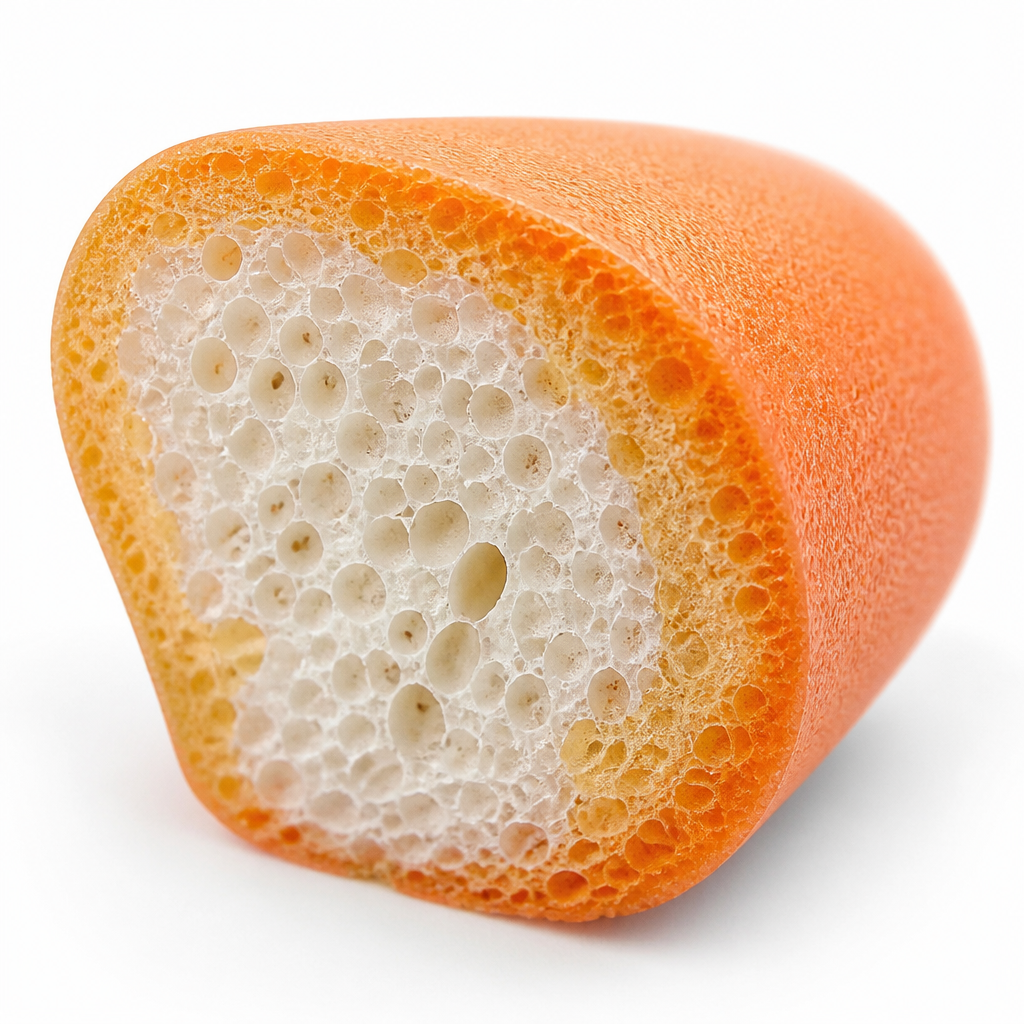
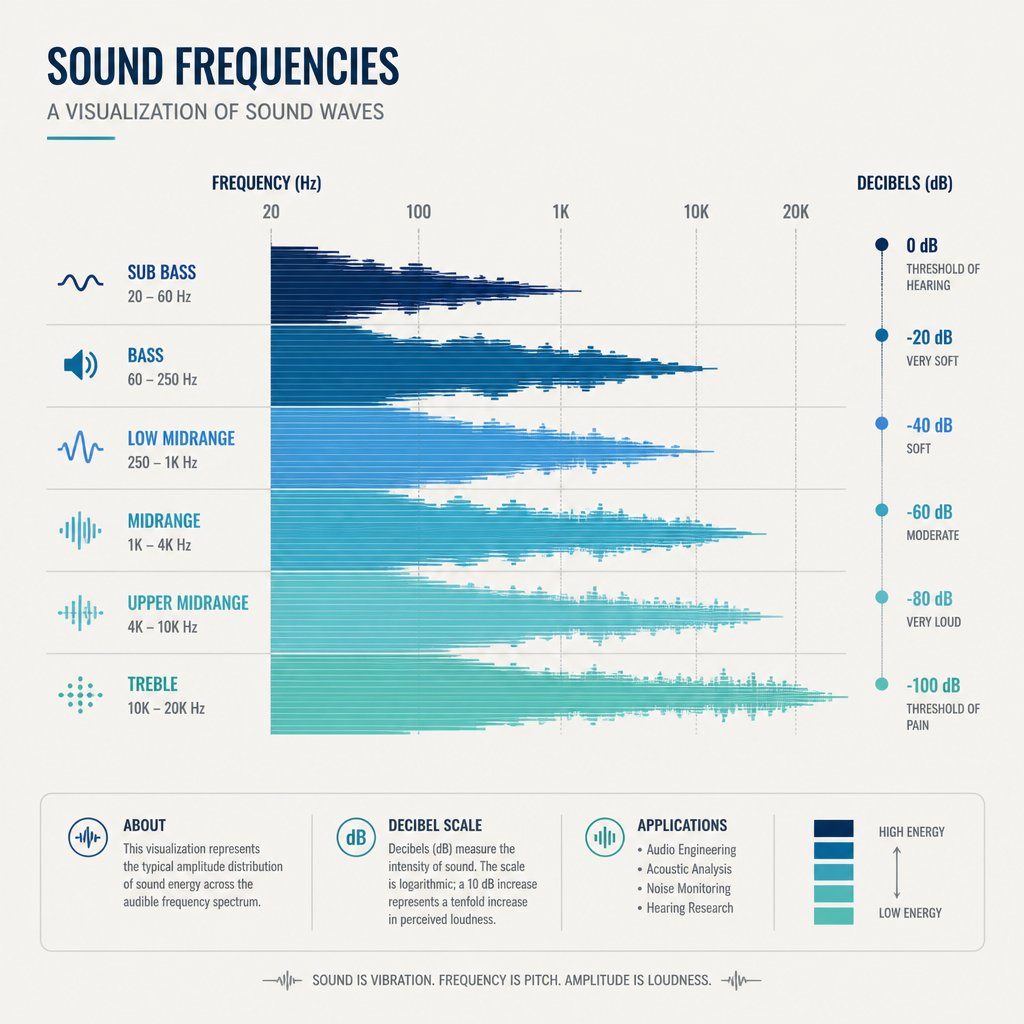
The Noise Reduction Rating is the standard measurement used in the United States to indicate how much noise a hearing protection device can reduce. It is expressed in decibels and is regulated by the US Environmental Protection Agency (EPA), which requires the NRR to be printed on the label of every hearing protector sold in the country. The testing process follows ANSI standards and involves exposing the hearing protection device to different frequencies of sound in a laboratory, then measuring the attenuation across those frequencies to produce an average.
The result is a single number: the NRR. A device with an NRR of 30 dB means it was measured, under ideal lab conditions with trained subjects inserting it perfectly, to reduce noise by 30 dB. The critical phrase is “under ideal lab conditions.” Real human ears, real insertion technique, and real environments introduce variation that the lab does not capture. This is why regulatory bodies and occupational health authorities consistently recommend applying a derating formula before treating the NRR as a practical guide.
The NRR is derived from a controlled test. Participants wear the hearing protection device, sounds at various frequencies are played, and the attenuation at each frequency is measured. An adjustment value is then applied to account for variability, and the final figure is divided by two. For earplugs, the adjustment value used is 7 dB. This means the rated NRR is already somewhat conservative compared to raw attenuation data, but it still reflects better-than-average insertion quality because laboratory subjects are trained in how to fit the device correctly.
Pro tip: When evaluating any earplug on the NRR alone, remember the number was generated by trained test subjects in a quiet lab. Your first-time insertion in a noisy environment will almost never match those conditions. Budget a real-world performance figure that is meaningfully lower than the label.
Because NRR overstates real-world protection, both OSHA and NIOSH apply derating methods. OSHA recommends derating all hearing protection by 50%. NIOSH goes further, recommending a 50% derating for formable foam earplugs and a 70% derating for all other earplugs, while applying only 25% derating to earmuffs. The most widely used practical formula for everyday estimates is the OSHA method: (NRR – 7) / 2. For an earplug with an NRR of 33, that calculation gives you (33 – 7) / 2 = 13 dB of realistic noise reduction. If ambient noise is 100 dB and you apply 13 dB of protection, your effective exposure is around 87 dB, still close to the 85 dB danger threshold.
This is not a flaw in the formula. It is an honest acknowledgment that rated performance and worn performance are not the same thing, and that hearing protection choices should be made with conservative estimates, not optimistic ones.
The Single Number Rating is the European equivalent of the NRR. It is the standard method used primarily in Europe under EN 352 standards to indicate the noise attenuation capability of a hearing protection device. The SNR provides a single-figure estimate of how many decibels a protector can reduce, averaged across a broad spectrum of sound frequencies from 63 Hz to 8,000 Hz. This wide frequency range is designed to account for both high-frequency sounds such as whistles and machinery whine, and low-frequency sounds such as engine rumble and bass noise.
For most earplugs and earmuffs, the SNR is roughly 3 dB higher than the NRR for the same product. This difference is not because European earplugs perform better. It reflects the different calculation methods and statistical approaches used by each standard. The two ratings are not directly interchangeable, and you should not compare an NRR from one product with an SNR from another and assume the higher number is superior protection.
To use the SNR, subtract it from the noise level you are exposed to. An SNR of 35 worn in an environment measuring 100 dB would give a theoretical exposure of 65 dB at the ear. As with NRR, this is a best-case figure. The EN 352 standard acknowledges that real-world attenuation depends heavily on the quality of fit, which varies from person to person and insertion to insertion.
The actual decibel reduction from wearing hearing protection may not match the rated number. Fit quality and insertion technique are the dominant variables that determine real-world performance, not the rating on the label.
If you are purchasing earplugs sold in both the US and EU markets, you will often see both ratings on the packaging. In that case, use the NRR and the OSHA formula if you are in the US, or the SNR if you are evaluating against European occupational exposure limits. Do not mix the two in the same calculation.
Understanding which standard applies to your context saves confusion when shopping for hearing protection. The table below compares the two systems across the dimensions that matter most to buyers and professionals.
| Feature | NRR (Noise Reduction Rating) | SNR (Single Number Rating) |
|---|---|---|
| Primary region of use | United States | Europe (and many international markets) |
| Regulatory body | US EPA (under ANSI S12.6) | European EN 352 standard |
| Frequency range tested | 125 Hz to 8,000 Hz | 63 Hz to 8,000 Hz (broader low-frequency coverage) |
| Typical value for same product | Lower number (e.g., NRR 29) | Higher number (e.g., SNR 32), typically ~3 dB more |
| Recommended derating | OSHA: 50% / NIOSH: 50-70% for earplugs | No universal mandatory derating formula, but real-world performance still falls below the label |
| Label requirement | Mandatory on all US hearing protectors | Mandatory for CE-marked products sold in Europe |
| Direct comparability | NRR and SNR are not directly comparable. Do not use one to evaluate a product rated only with the other. | |
This is where most earplug buying decisions go wrong. People see a high NRR rating and assume they are fully protected. In practice, the gap between the label and reality can be substantial. Laboratory NRR tests are performed by trained subjects who insert the earplugs correctly under controlled conditions. Real users, inserting earplugs quickly in noisy environments, often achieve significantly lower attenuation.
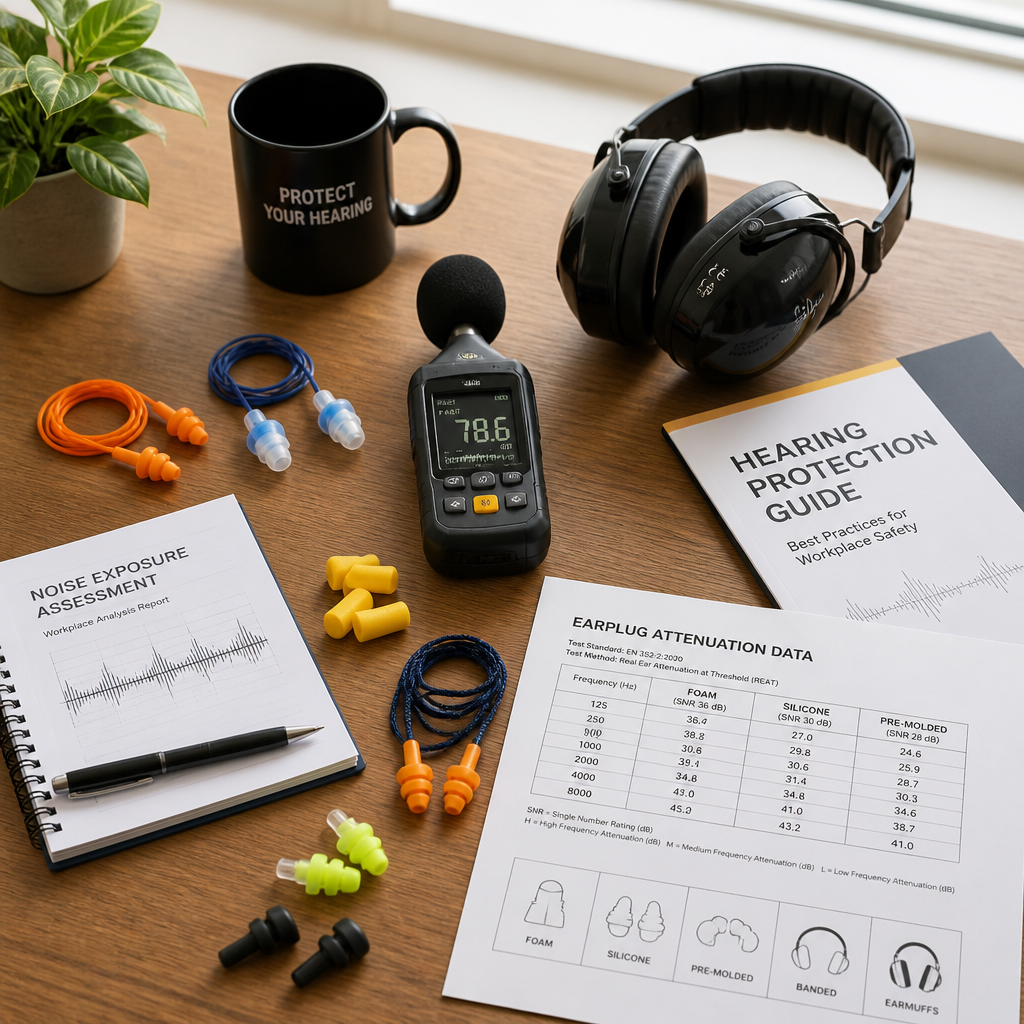
A commonly cited example from occupational health literature makes this concrete: an earplug rated NRR 33, inserted poorly, can drop to providing just 10 dB of effective noise reduction. That is not an edge case. That is what happens when people push foam earplugs into their ear canals without rolling them down first, or when an earplug body does not create a proper seal against the canal wall.
For practical planning, use the OSHA method: (NRR – 7) / 2 = estimated real dB reduction. Here is what that looks like across common NRR values:
Note that these estimates apply to conditions where fit is average. Earplugs that consistently deliver a reliable seal, because of their design, material, or adjustable tip system, will perform closer to their rated figure than earplugs that rely entirely on the user rolling and inserting a loose foam cylinder correctly every time.
If you are working in an extremely loud environment and need maximum attenuation, you can wear earplugs and earmuffs simultaneously. However, you cannot simply add the two NRR ratings together. When using two forms of hearing protection in combination, you add only 5 dB to the device with the higher NRR. This reflects the physical limits of sound blocking once you have created a basic seal around the ear canal.
Pro tip: For sleep and travel use, combining two protection devices is rarely practical or comfortable. Instead, focus on consistent fit quality from a single well-designed pair of earplugs with memory foam tips. A product that delivers a reliable seal every night is more valuable than a higher NRR that only materialises under perfect insertion conditions.
The answer depends entirely on what you are protecting against. There is no universal “right” NRR because the purpose matters. Noise reduction needs fall into two broad categories: occupational hearing protection, where you are preventing permanent hearing damage, and comfort and sleep use, where you are managing unwanted sound to preserve sleep quality or concentration.
For construction workers, manufacturing professionals, and anyone exposed to heavy machinery, the goal is keeping effective noise exposure below 85 dB. At or above this level for an 8-hour working day, the risk of permanent noise-induced hearing loss becomes significant. For an environment running at 100 dB, you need an earplug that delivers at least 15 dB of real-world reduction after applying the OSHA derating formula. That means an NRR of at least 29-33 on the label. Military personnel in particular may face impulse noise from firearms or explosions, which requires specialist hearing protection rated for both sustained and peak noise events.
For light sleepers, travellers, and people working in noisy open offices, the noise environment is typically much lower than an industrial site. Ambient traffic, a snoring partner, or aircraft cabin noise typically falls in the 60-80 dB range. In these cases, you do not need the maximum possible NRR. You need an earplug that fits comfortably enough to wear for hours, creates a reliable seal without causing ear canal irritation, and provides consistent attenuation night after night. A reusable earplug with memory foam tips such as those on the ATTENU8, which are designed in three tip sizes (XS, S, and M) to match individual ear canal geometry, solves the comfort-and-consistency problem that undermines many high-NRR disposable foam earplugs.
With approximately 32 dB of noise reduction, the ATTENU8 sits at the practical upper end of what a well-designed earplug can deliver for everyday use. Applied against the OSHA formula, that is roughly 12.5 dB of conservative real-world reduction, and likely more in practice for users who achieve a good seal with the correct foam tip size, because the concave aluminium body holds the memory foam tip securely in position throughout the night.
Of all the factors that determine how much noise protection you actually receive, fit is the most important and the most underestimated. A poorly fitting earplug creates gaps between the foam and the ear canal wall, and those gaps allow sound to bypass all the blocking material entirely. Even a small gap can reduce effective attenuation by 10 dB or more. This is why the same NRR 33 earplug can protect one person adequately and barely protect another at all.
The fit problem is particularly acute with standard disposable foam earplugs. They require a specific rolling and insertion technique. They need to be held in the canal while they expand. They work best in ear canals that fall within a narrow size range. When these conditions are not met consistently, the earplug decibel rating on the box becomes almost meaningless as a guide to actual protection.
Memory foam tip systems that come in multiple sizes address this problem directly. When you can select the tip size that matches your specific ear canal, the foam has less work to do in bridging gaps and more of its surface area is in contact with the canal wall from the moment of insertion. The result is a more reliable, more repeatable seal, which means the real-world attenuation you get is closer to the rated figure and stays there throughout the night or work shift rather than degrading as the earplug slowly works itself loose.
This is one of the key reasons that reusable metal-bodied earplugs with replaceable memory foam tips represent a meaningful step up from disposable foam cylinders for consistent users. The aluminium body maintains its position in the ear canal. The memory foam tip provides the seal. The combination reduces the insertion variability that is the primary cause of the gap between rated NRR and real-world performance.
Memory foam degrades over time, losing its ability to expand to a full seal. For regular users, this means the tips need periodic replacement, not the entire earplug. Replacing foam tips every 6 to 8 weeks maintains the consistent sealing performance that makes the rated noise reduction achievable in practice. This is both more economical and more environmentally sustainable than discarding the entire earplug every few uses.
An earplug’s decibel rating, expressed as NRR or SNR, represents the amount of noise reduction the earplug was measured to provide during standardised laboratory testing. It is not a guarantee of what you will experience in practice. Real-world reduction depends heavily on fit, insertion technique, and how well the earplug matches your ear canal size. Use the OSHA formula (NRR – 7) / 2 to estimate a more realistic figure for everyday conditions.
Not necessarily. A higher NRR rating is important when you are exposed to very loud noise, such as on construction sites, shooting ranges, or in manufacturing facilities. For sleep or travel, where the goal is comfort over extended periods, a slightly lower NRR in an earplug that fits reliably and stays in place all night will protect you more effectively than a higher-rated earplug that you remove at 3am because it is uncomfortable or has shifted out of position.
The NRR and SNR are calculated using different testing protocols. The NRR follows US ANSI standards while the SNR follows European EN 352 standards. The two use different frequency ranges and statistical methods, which is why the SNR for the same product is typically around 3 dB higher than the NRR. They measure the same physical property, but the numbers are not interchangeable. Always compare products using the same rating system.
Sustained exposure to noise at or above 85 dB over an 8-hour period poses a risk of permanent hearing damage. NIOSH and OSHA both identify 85 dB as the threshold at which a hearing conservation programme should begin. In practice, it is sensible to use hearing protection any time you are regularly exposed to persistent loud noise, even below this level, since cumulative lower-level exposure also contributes to long-term hearing decline.
The right tip size is the one that fills your ear canal without requiring excessive force to insert and without feeling like it is about to fall out. A well-fitted tip creates a gentle but complete seal around the canal wall. Most people discover they need a different size in each ear, which is normal. Starting with a medium tip and comparing it against small and extra-small options is a reliable way to find your correct size. The difference in effective noise reduction between a correctly fitted and an incorrectly sized tip is far larger than any difference between earplug models with similar NRR ratings.
Yes, and this is a common approach in very high-noise industrial environments. However, the combined NRR is not the sum of both ratings. When using dual protection, you add 5 dB to the device with the higher NRR to estimate total protection. For most everyday uses, including sleep and travel, wearing both simultaneously is impractical. Choosing a single well-fitting earplug with a strong NRR is the more workable solution.
Disposable foam earplugs should be replaced after each use, as they collect bacteria and lose their expanding ability quickly. Reusable earplugs with replaceable memory foam tips offer a more sustainable model: the earplug body itself lasts indefinitely, while the foam tips should be replaced approximately every 6 to 8 weeks of regular use to maintain sealing performance and hygiene. Replacing only the tips, rather than the entire device, also makes reusable earplugs more cost-effective over time.
Have you found a meaningful difference between the rated NRR and what you actually experience when wearing earplugs? Share your experience in the comments below.
Side sleepers have it harder than back sleepers when it comes to earplugs. The problem is not just noise, it is the pillow. Press any earplug against a firm surface for six to eight hours and comfort becomes the deciding factor long before noise reduction does. Most people grab whatever is cheapest at the pharmacy, slip them in, and wonder why they wake at 3 AM with a sore ear. The material choice matters enormously, and it affects noise reduction, durability, hygiene, and whether you can actually make it through the night without pulling the earplug out in frustration. This guide covers everything you need to know about memory foam earplugs, wax, and silicone so you can make the right call.
| Key Insight | Explanation |
|---|---|
| Memory foam compresses without pushing deeper | Unlike hard-tipped earplugs, memory foam deforms under pillow pressure and slowly re-expands, maintaining the acoustic seal without being driven further into the ear canal. |
| NRR on the box is not what you get in practice | Real-world noise reduction is typically 50-70% of the rated value. An NRR 32 earplug delivers roughly 16 dB of practical reduction for most wearers, which is still significant for blocking snoring and traffic noise. |
| Wax earplugs sit outside the canal, not inside | This is why they feel gentler, but it also means lower noise reduction, typically 22-25 dB rated, and they cannot be reused past a couple of nights before hygiene becomes an issue. |
| “Silicone” covers two completely different products | Moldable silicone putty sits over the ear opening and performs like wax. Flanged or pre-formed silicone sits inside the canal and can create painful pressure when you sleep on your side. |
| Pillow pressure is the silent killer of earplug comfort | Hard or protruding earplugs act as a lever when your ear hits the pillow, pushing the plug deeper. Low-profile designs with soft tips avoid this entirely. |
| Disposable foam is not the same as reusable memory foam | Standard disposable foam absorbs skin oils and degrades after one or two uses. High-quality reusable memory foam tips retain their expansion properties and can last 6-8 weeks with normal wear. |
| A metal or rigid body paired with soft tips solves the core trade-off | A firm outer body prevents total deformation under pressure, while soft foam tips still compress against the pillow. This combination protects the acoustic seal without creating hard pressure points. |
When you lie on your side, your ear is compressed against a pillow for hours at a time. Any earplug that protrudes from the ear canal or sits rigidly inside it will create pressure, and that pressure gets transmitted directly into your ear canal the longer you stay in that position.
Foam earplugs for side sleepers fail most often not because of noise reduction but because of geometry. The plug sticks out past the outer ear, the pillow pushes against it, and the whole thing acts as a lever. This is why some people using even the softest standard foam plugs report soreness after three to four hours. The plug did not get more painful, but it did get pushed slightly deeper over time.
The right material choice solves this before it becomes a problem. You need something that compresses under pressure without being rigid, stays in the ear canal without being driven further, and maintains its acoustic seal even after being repeatedly deformed throughout the night.
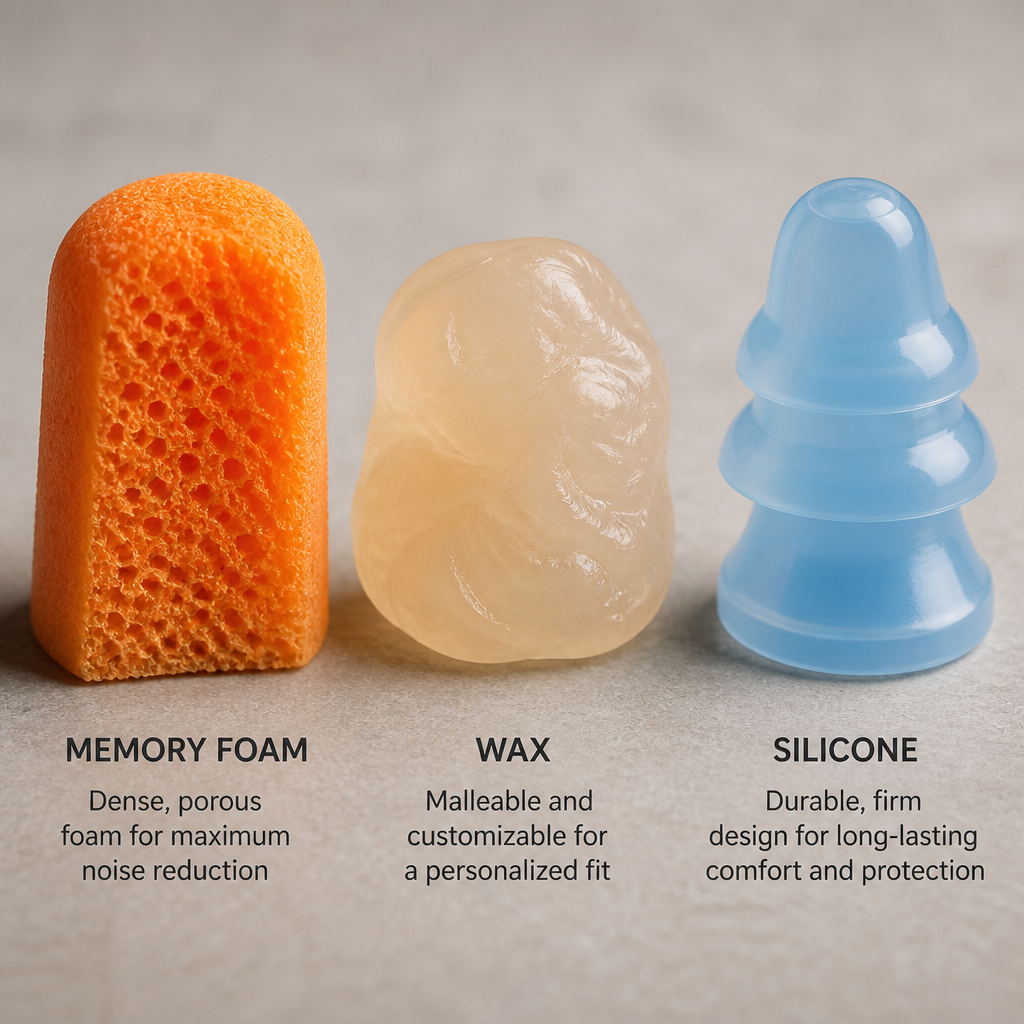
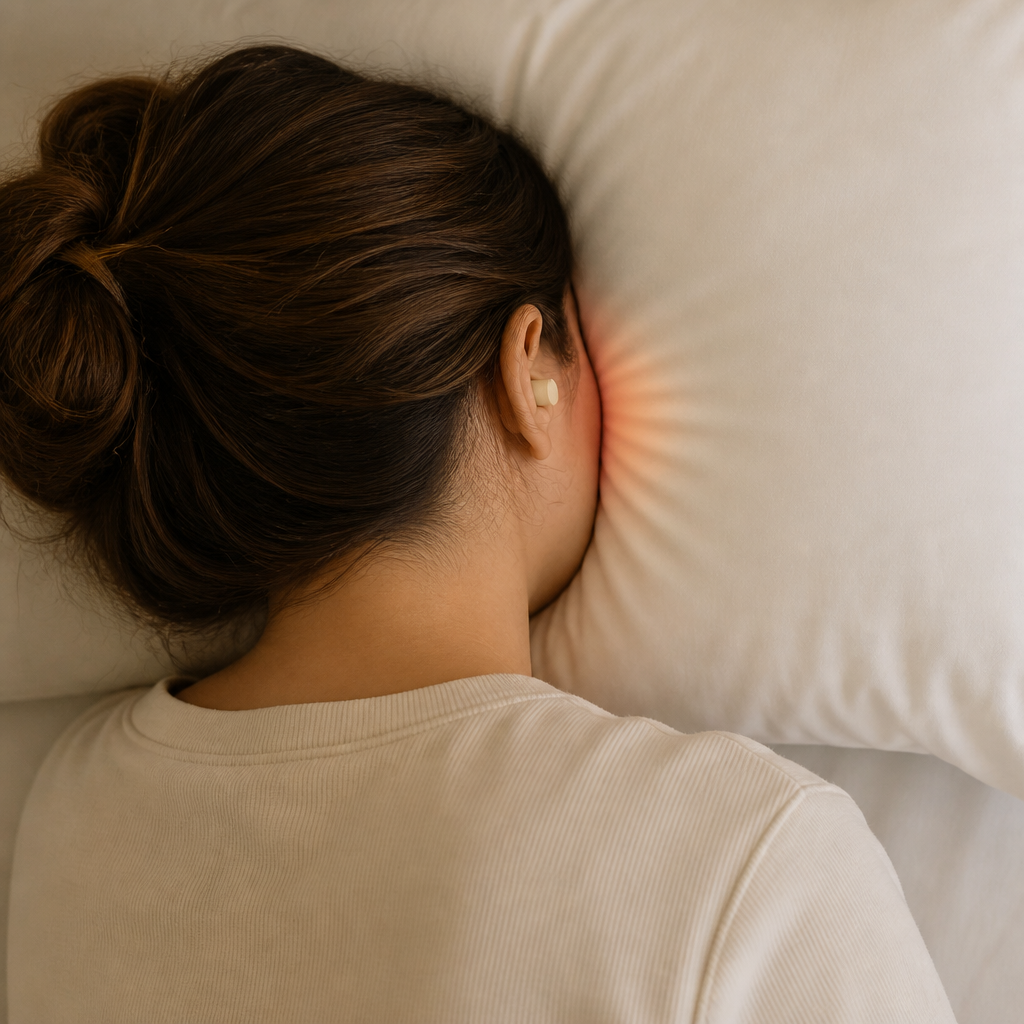
Memory foam is the benchmark material for sleeping earplugs, and the reason is the slow-rebound property. You compress it, insert it, and it gradually expands to fill the ear canal. When pillow pressure hits, it compresses again instead of being forced deeper, then re-expands to restore the seal. No other material does this as consistently.
High-quality memory foam earplugs reach NRR ratings of 28-33 dB, among the highest of any consumer earplug type. In practice, real-world reduction sits closer to 13-20 dB for most people, which is still enough to bring a 60 dB urban bedroom environment down to levels that allow uninterrupted sleep. The acoustic seal memory foam creates inside the canal is genuinely superior to external seals created by wax or moldable silicone putty.
The key variable is profile. Standard disposable foam cylinders protrude too far, causing the lever problem described above. Memory foam tips attached to a low-profile, concave body, like the design used in ATTENU8 earplugs, keep the outer surface flush with the ear. The aluminium body acts as a stable anchor while the foam tip handles the comfort and seal. This means the pillow contacts the body, not just the foam, distributing pressure rather than concentrating it.
Side sleepers consistently report 6-8 hours of comfort with well-designed memory foam earplugs compared to 3-4 hours with harder flanged silicone alternatives. That difference is the reason most serious side sleepers end up choosing foam tips regardless of what else they try.
This is where disposable foam and reusable memory foam diverge sharply. Standard foam disposables absorb skin oils and ear secretions after a single use and cannot be adequately cleaned. Reusable memory foam tips retain their expansion properties and remain hygienic when replaced on a regular schedule. ATTENU8 recommends replacing their memory foam tips every 6-8 weeks under regular use, which is a practical cycle that balances hygiene with cost over time.
Pro tip: When inserting memory foam earplugs, roll the tip into a tight cylinder, pull the outer ear back and upward to straighten the canal, then insert and hold for 20-30 seconds. Releasing early is the most common reason foam earplugs underperform.
Wax earplugs have been around since 1907 and the design has barely changed. You soften a ball of wax between your fingers, shape it over the ear canal entrance, and press it gently in place. Because it sits outside the canal rather than inside, there is no deep insertion, no pressure against the canal walls, and no protrusion for the pillow to push against.
For people who cannot tolerate anything inside the ear canal, wax is genuinely useful. The flat profile against the ear is comfortable for side sleepers, and the soft material deforms under pillow pressure without being pushed deeper. For occasional use, travel, or as a backup option, wax does the job reasonably well.
Noise reduction is the main limitation. Because wax seals only the canal entrance rather than sitting inside it, it typically achieves a noise reduction rating of 22-25 dB, noticeably lower than foam. For blocking heavy traffic, a snoring partner, or construction noise from nearby sites, this gap matters.
Hygiene is the other major problem. Wax is sticky by nature and traps dust, lint, and debris. Most wax earplugs are only good for one or two uses before they need to be replaced. For nightly use over weeks and months, this makes wax expensive and wasteful. If you are looking for a sustainable, reusable solution, wax is not the right material.
Pro tip: If you use wax earplugs, warm them between your palms for a full 30 seconds before shaping. Cold wax does not conform well and leaves gaps in the seal, which significantly reduces the noise attenuation you get.
“Silicone earplugs” is almost a useless category label because it covers two products that behave completely differently. Understanding the distinction is critical before making any purchase decision.
Moldable silicone putty works similarly to wax. You shape it, press it over the canal entrance, and it seals from the outside. It is waterproof, non-absorbent, and generally stays cleaner than wax. The noise reduction rating is similar to wax, typically in the 22-25 dB range, for the same reason: the seal is external, not internal. Moldable silicone putty is a practical option for people who want something reusable and gentle, but it will not compete with foam on raw noise reduction.
Pre-formed silicone earplugs with flanges or tips sit inside the canal like foam does, but they are made of a firmer material. This is where side sleepers run into serious problems. Silicone’s firmness becomes uncomfortable during side sleeping because the earplug body cannot compress under pillow pressure. Instead, that pressure is transmitted directly into the canal.
Most side sleepers report discomfort after three to four hours with flanged silicone, compared to six to eight hours with memory foam. The rated noise reduction of flanged silicone can be competitive with foam, sometimes reaching 24-27 dB SNR, but the comfort failure cuts the practical overnight use short before noise reduction even becomes relevant. Good noise reduction that wakes you up at 4 AM because of ear pain is not actually good noise reduction.
“If you sleep on your side, comfort tends to decide the issue faster than raw noise reduction. Side sleepers are dealing with two pressures at once: the room noise itself and the physical pressure of the pillow against the earplug.”
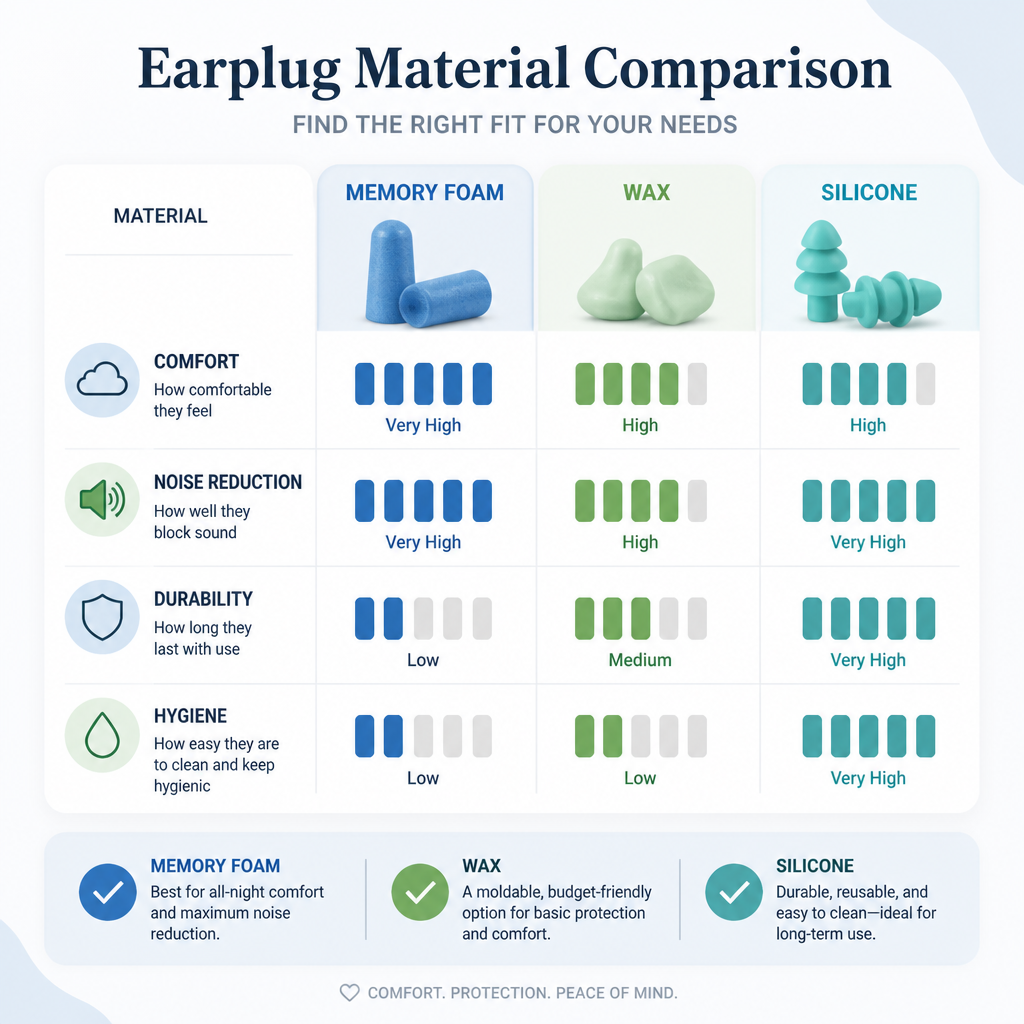
The table below summarizes how each material performs across the factors that actually matter for side sleepers sleeping through the night. Noise reduction figures refer to rated values, with the understanding that real-world performance is typically 50-70% of rated.
| Feature | Memory Foam (Reusable Tips) | Wax | Silicone (Flanged / Pre-Formed) |
|---|---|---|---|
| Noise Reduction (Rated) | 28-33 dB NRR | 22-25 dB NRR | 24-27 dB SNR |
| Side Sleeping Comfort | High. Compresses, re-expands | Moderate. Flat profile, lower seal | Low. Firm material creates pressure |
| Reusability | Yes. Tips replaced every 6-8 weeks | No. 1-2 uses maximum | Yes. Body lasts but tip hygiene varies |
| Hygiene | Good with tip replacement schedule | Poor. Traps dust and debris | Good. Non-absorbent material |
| Insertion Depth | Inside the canal | Over the canal entrance | Inside the canal |
| Pillow Pressure Impact | Low. Compresses without being driven deeper | Low. Deforms without deep insertion | High. Rigid material transmits pressure |
| Best For | Nightly use, high noise, side sleeping | Occasional use, sensitive ears, travel | Upright use, concert protection, daytime |
Once you have settled on memory foam as the material of choice for overnight side sleeping, the next step is evaluating specific design features. Not all memory foam earplugs are built the same way.
The outer body of the earplug should sit close to the ear, not protrude past the auricle. A concave or flush design eliminates the lever problem. When your ear presses into the pillow, the first point of contact should be the ear itself, not a protruding earplug tail. This is a feature ATTENU8 specifically engineered into its aluminium body: the concave shape nestles into the ear rather than sticking out from it.
Ear canals vary significantly in size, and a foam tip that is too large will cause pressure pain regardless of the material. A tip that is too small will not seal properly, destroying noise reduction. Look for products that include at least two or three tip sizes, such as XS, S, and M, so you can match the tip to your actual ear canal rather than forcing a compromise.
Standard disposable foam means buying a new pair every night or every few nights. Reusable earplugs with replaceable foam tips are significantly more economical and sustainable over time. The total cost of ownership is one of the most overlooked factors when people compare earplug types. An earplug with a durable metal body and foam tips you replace every six to eight weeks costs far less per night than nightly disposables over a year of consistent use.
For most side sleepers dealing with snoring, traffic, or urban apartment noise, a rated NRR of 28-33 dB, or roughly 14-20 dB in practice, is more than sufficient. For professionals in genuinely loud environments, such as construction or manufacturing, you want to be at the upper end of that range and should verify compliance with relevant occupational safety standards for your region. Sleep-oriented earplugs and industrial hearing protection sometimes look similar but are designed to very different specifications.
For most side sleepers, yes. Memory foam compresses under pillow pressure and slowly re-expands to maintain the acoustic seal, while flanged silicone remains rigid and transmits pressure directly into the ear canal. The difference in comfort over a full night is significant, with most side sleepers managing six to eight hours comfortably with memory foam compared to three to four hours with hard silicone tips.
It depends on the design. Standard disposable foam cylinders should not be reused past one or two nights because they absorb skin oils and cannot be cleaned effectively. Reusable memory foam tips on a durable body, like those used by ATTENU8, can be used nightly and replaced every six to eight weeks, which gives you proper hygiene without the cost of daily disposables.
Wax earplugs typically have a noise reduction rating of 22-25 dB, which is lower than memory foam because they seal over the canal entrance rather than inside it. In practice, this means they handle moderate noise like a quiet street or light snoring reasonably well but fall short against heavy traffic, loud partners, or industrial environments.
The most common cause is a combination of insertion depth and earplug rigidity. If the earplug protrudes from the ear or is made of firm material, pillow pressure is concentrated on a small, hard surface and transmitted into the canal. The solution is a low-profile earplug with soft, compressible tips that deform under pressure rather than being driven deeper. This is the specific problem that a concave aluminium body with memory foam tips is designed to solve.
Disposable foam should be replaced after every one to two uses. Reusable memory foam tips on a durable body should be replaced every six to eight weeks under regular nightly use. The signs that tips need replacing are visible compression that does not fully recover, visible soiling, or a noticeable reduction in perceived noise blocking. Trying to extend foam tips past their useful life is one of the main reasons people think their earplugs have stopped working.
The shape of the outer body matters more than most people realise. A cylindrical earplug that protrudes from the ear is a poor design choice for side sleeping regardless of the material. A concave, low-profile body that sits flush with the ear canal entrance distributes pillow pressure across the ear rather than concentrating it on the earplug. If you have tried multiple earplugs and found them all uncomfortable during side sleeping, the shape and outer body design is likely the issue, not the material alone.
Industrial hearing protection prioritises maximum attenuation and compliance with occupational safety standards, often at the expense of overnight comfort. Sleep-oriented earplugs balance noise reduction with comfort for extended wear in a lying position. The best earplugs for side sleepers during sleep achieve high noise reduction, around 30-33 dB rated, while maintaining a low enough profile and soft enough material to remain comfortable through a full night. For professionals who need protection in both contexts, a product that performs in both environments is worth investing in.
Have you tried switching earplug materials to solve a side-sleeping comfort problem? Share what worked for you in the comments below.
Most people shopping for earplugs to sleep in focus on the wrong number. They chase the highest NRR rating they can find, assuming more is always better. In practice, that logic produces earplugs you will pull out at 3am because they feel suffocating, or earplugs that block so much sound you sleep through your alarm or miss a smoke detector. 32dB noise reduction sits in a precise middle ground: enough attenuation to silence snoring, traffic, and hotel HVAC without cutting you off from the world entirely. This article explains exactly why that rating matters for sleep specifically, and why ATTENU8 built its metal-bodied reusable earplugs around it.
Environmental noise is not just an annoyance you adapt to. Research published in Sleep Science confirms that nocturnal noise provokes measurable biological stress responses and directly disrupts sleep architecture, meaning it alters the proportions of light, deep, and REM sleep you cycle through each night. These disruptions mirror those seen in clinical sleep disorders, even when the sleeper is not consciously aware of waking.
The downstream effects are documented and serious. Poor sleep from noise exposure is associated with daytime sleepiness, mood changes, reduced cognitive performance, and over time, adverse cardiometabolic outcomes. Nocturnal noise is considered the most health-significant form of noise pollution precisely because it acts both directly on biology and indirectly through the damage it does to sleep quality.
For light sleepers, even noise events well below conversation level (around 40 to 50 dB) can trigger cortical arousals, the micro-awakenings that fragment sleep without fully waking you. This is the problem a well-designed sleep earplug needs to solve: not silence, but a sufficient reduction to keep those spikes from crossing the arousal threshold.
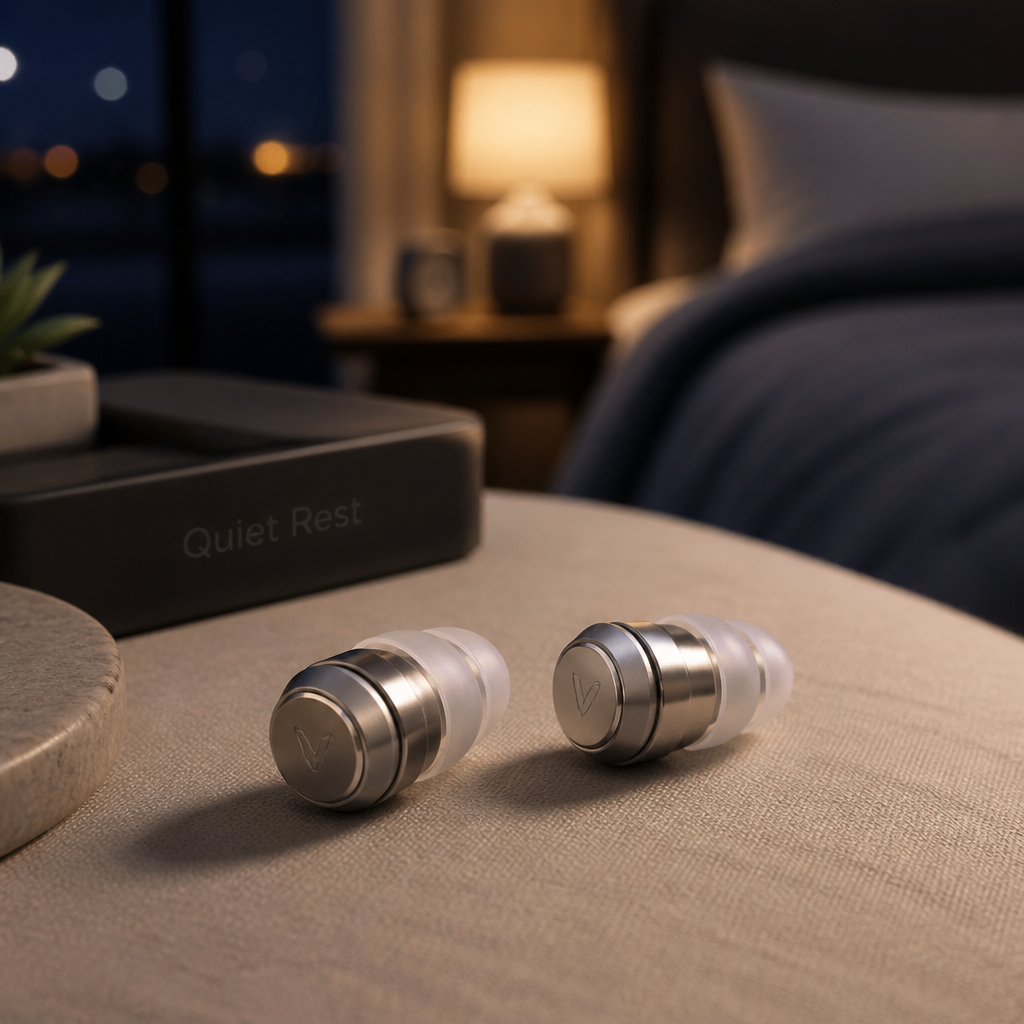
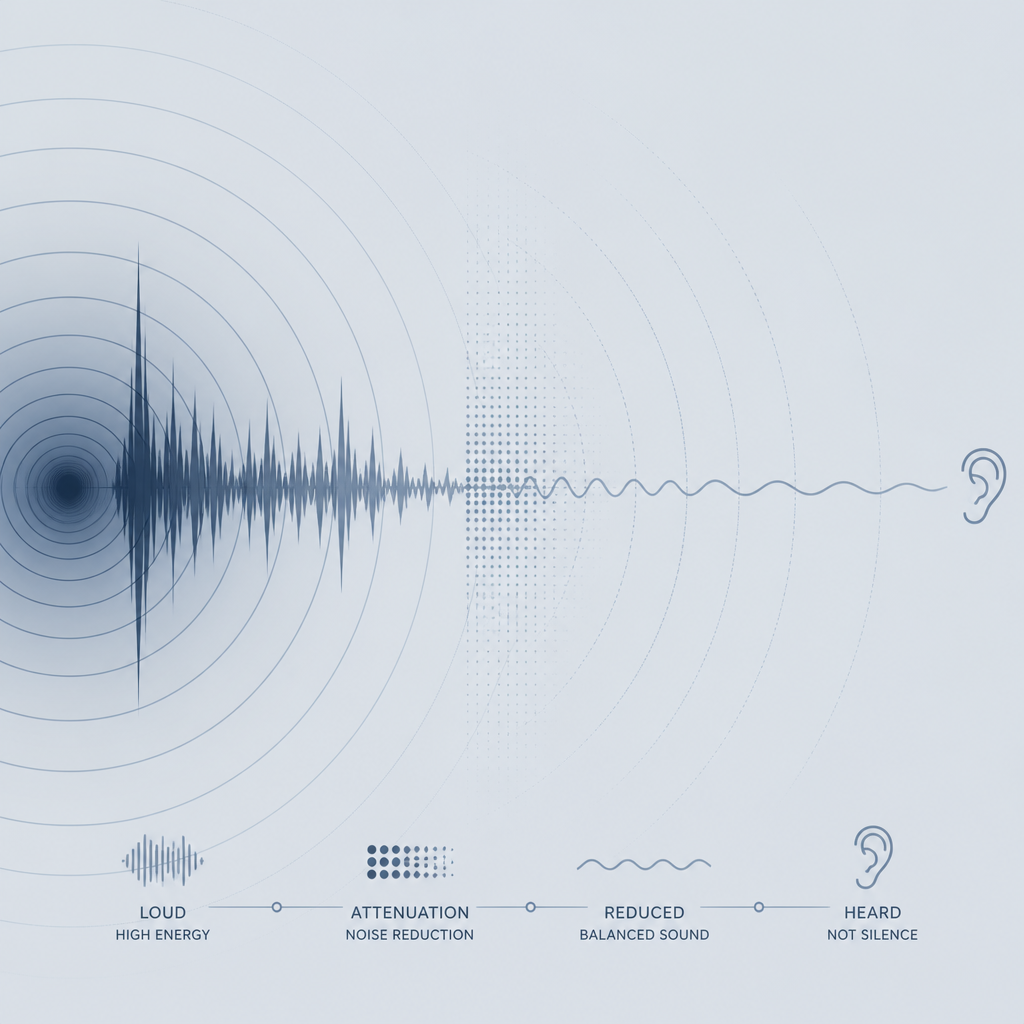
Decibels work on a logarithmic scale, which is not intuitive. A 10dB reduction is perceived as roughly halving the loudness of a sound. A 32dB reduction therefore represents a very substantial cut, not a marginal one.
We would love your feedback and any insights you would share with others. What perspective would you add?
A partner snoring typically registers somewhere between 50 and 70 dB at close range. With 32dB of attenuation, that lands closer to 20 to 38 dB, which is roughly the level of a quiet library or soft whisper. Urban traffic through a bedroom window, often in the 55 to 65 dB range, drops to the low 20s to mid-30s. Hotel air conditioning units and HVAC systems sit around 40 to 50 dB, and after a 32dB reduction they are effectively inaudible.
The key insight is that 32dB gets almost every common sleep noise into or below the threshold where sleep architecture is protected. You are not chasing silence. You are chasing a reduction deep enough that your brain stops treating noise as a threat during sleep cycles.
Sufficient noise reduction for sleep is not about eliminating all sound. It is about keeping sound levels low enough that the nervous system stays in a rest state rather than triggering arousal responses.
The NRR (Noise Reduction Rating) figure on earplug packaging is derived from laboratory testing under controlled, ideal conditions. Real-world attenuation is typically lower because most people do not insert earplugs with perfect technique. A common correction used in occupational health contexts is to halve the NRR to estimate real-world protection. At 32dB NRR, that still represents 16dB of dependable real-world attenuation, which is meaningful. At a rated 40dB NRR, you might get 20dB in practice, but the comfort trade-offs (discussed below) often make those earplugs unwearable for a full night.
Pro tip: If you find yourself removing earplugs during the night without remembering doing it, the fit is wrong rather than the noise reduction rating being too low. Start with the smallest foam tip size and work up before assuming you need higher attenuation.
Earplugs rated above 33 to 35dB typically achieve that rating through one of two compromises: extremely dense foam that generates significant pressure over hours, or a fit so deep and occlusive that it produces an uncomfortable sensation of total ear blockage called the occlusion effect. Both problems cause sleepers to remove their earplugs before getting the full night’s benefit.
Disposable foam earplugs at the high end of the NRR spectrum are dense enough to maintain a tight seal, but that density creates outward pressure against the ear canal wall. Lying on your side, which is the most common sleep position, presses that earplug further into the canal. After an hour, this stops being background comfort and becomes a specific pain that wakes you. The irony is that a 40dB rated earplug you remove at 1am provides zero protection for the remaining five hours of your sleep window.
Complete acoustic isolation is not desirable for most home sleepers. You need to hear a smoke alarm, a child calling out, or a front door. A 32dB reduction leaves enough of the environmental soundscape intact that genuine emergency sounds, which by design are very loud (smoke alarms typically exceed 85 dB), remain audible. At 32dB of attenuation, an 85 dB alarm still reaches you at approximately 53 dB, well above the threshold of conscious hearing even from sleep.
Earplugs pushed toward 40dB or beyond start making emergency sound detection a real concern for home sleepers, something worth considering seriously before prioritising maximum attenuation.
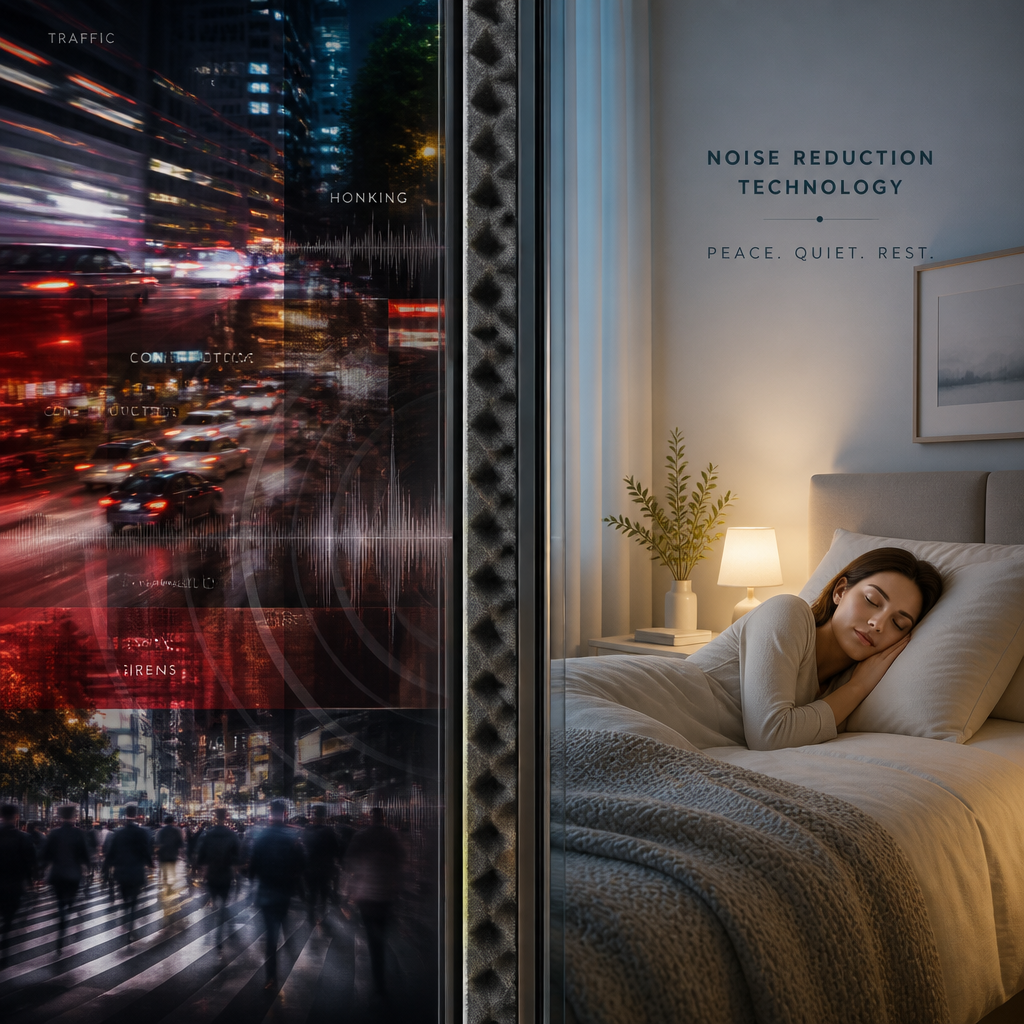
Achieving 32dB consistently through the night depends as much on the earplug body as it does on the tip material. This is where the design of reusable metal-bodied earplugs like ATTENU8 diverges meaningfully from disposable foam.
A standard disposable foam earplug is compressed and inserted, then expands in the canal. It works, but the expansion force is what creates pressure, and that pressure only grows if you adjust your sleeping position. The foam also degrades with each use, meaning the first and the tenth use of the same earplug deliver different levels of attenuation and comfort. By the end of a typical week, a “reused” disposable has lost meaningful sealing ability.
ATTENU8’s aluminium body holds a concave shape that positions the memory foam tip precisely at the canal entrance rather than deep inside it. That positioning achieves the seal needed for 32dB attenuation without the deep-insertion pressure that causes discomfort over a full night. The rigid body also means the earplug does not compress unpredictably when you roll onto your side.
Standard polyurethane foam is stiff when compressed and expands aggressively. Memory foam responds to body temperature and softens as it warms, which means the sealing pressure reduces over time rather than maintaining a rigid expansion force. For sleeping, that temperature-responsive softening is a significant comfort advantage. ATTENU8 includes three tip sizes (XS, S, and M) so the fit is anatomically matched rather than a single-size-fits-all compromise, which is how consistent 32dB attenuation is achieved across different ear canal geometries without needing an aggressively tight fit.
Pro tip: Replace memory foam tips every 6 to 8 weeks rather than when they look dirty. Foam that has lost its memory from repeated compression will not seal correctly, and you will lose meaningful attenuation without realising it, since the earplug will still feel like it is in place.
Not all earplugs marketed for sleep are solving the same problem. The table below compares three distinct approaches by the criteria that actually matter for overnight use.
| Earplug Type | Noise Reduction | Sleep Comfort | Longevity and Cost Over Time |
|---|---|---|---|
| Disposable foam (single-use) | Rated 29 to 33dB, but drops quickly with reuse. Insertion technique varies result significantly. | Expansion pressure causes discomfort after 1 to 2 hours, especially for side sleepers. No size options. | Low unit cost but ongoing expense. Environmental waste adds up rapidly. |
| Silicone or wax moulded plugs (e.g. Loop, Flare style) | Typically 20 to 27dB, tuned for situational awareness rather than maximum sleep noise reduction. | Better for short wear; hard silicone body can create pressure during extended side sleeping. | Body is durable but attenuation is a deliberate design compromise, meaning they serve a different use case. |
| Metal-bodied reusable with memory foam tips (ATTENU8) | Consistent 32dB across tip life when tips are replaced on schedule. Three tip sizes maintain seal integrity. | Concave body keeps foam at canal entrance rather than deep inside. Memory foam reduces overnight pressure. | Only foam tips require periodic replacement (every 6 to 8 weeks). Metal body is indefinitely reusable. |
Even the best earplug design underperforms when used incorrectly. A common mistake is assuming any insertion that feels snug is delivering the rated attenuation. The seal is what matters, not the sensation of fullness.
Start with the smallest tip (XS) and test it by cupping your hands over your ears while the earplug is in. If there is a significant difference in perceived noise between the cupped and uncupped position, the seal is incomplete and you need to move up a tip size. With a correct seal, cupping your ears should produce almost no perceptible change, because the earplug is already doing the work of blocking the canal.
Side sleepers should ensure the earplug sits flush with or just inside the ear canal opening rather than proud of it. An earplug protruding from the ear catches the pillow, creates lateral pressure, and often works its way out during the night. A low-profile metal body designed for this purpose sits flat enough against the ear that pillow contact does not dislodge it or create a fulcrum point pressing the tip deeper into the canal.
The combination of correct tip size and proper depth is what separates consistent 32dB performance from the variable, frustrating results most people associate with sleeping with earplugs. It is a skill that takes two or three nights to develop, not a product failure when the first night is imperfect.
For most snoring situations, yes. Snoring at close range typically falls between 50 and 70 dB. A 32dB reduction brings the loudest snoring into a range comparable to a quiet room, which is below the threshold that triggers sleep disruption for most people. In extreme cases of very loud snoring (above 75 dB consistently), a combination of earplugs and a white noise machine producing a masking sound is more effective than chasing higher earplug ratings alone.
Earplugs do not damage hearing. The concern with prolonged earplug use is earwax impaction if earplugs are pushing wax deeper into the canal, which is more relevant to deep-insertion foam plugs than to shallow-seating designs. Maintaining basic ear hygiene and switching to a correctly sized tip that seals at the canal entrance rather than deep within it eliminates this concern for the vast majority of users.
NRR (Noise Reduction Rating) is measured under laboratory conditions with trained testers inserting earplugs optimally. Real-world attenuation is consistently lower. For a 32dB NRR earplug, a conservative estimate of real-world protection is around 16dB using the standard halving correction. Even at that adjusted figure, 16dB of consistent nightly attenuation is the difference between sleep disruption and protected sleep for most noise environments.
The metal body of an earplug like ATTENU8 provides the structure and positioning that makes correct seal geometry repeatable night after night. The foam tip provides the actual acoustic seal. Memory foam degrades with compression cycles, body oils, and cleaning over time, losing the ability to conform and seal correctly. Replacing only the tip every 6 to 8 weeks costs a fraction of buying new earplugs and restores full attenuation performance without discarding the precision-engineered aluminium body.
Different contexts have different requirements. Occupational hearing protection in genuinely hazardous noise environments (construction sites, manufacturing floors) is governed by workplace safety regulations and typically requires higher sustained attenuation and specific compliance ratings. Sleep earplugs are optimised for comfort over 6 to 8 hours and for a level of attenuation appropriate to residential and travel noise rather than industrial noise. Using a 32dB sleep earplug in a workplace that requires industrial-rated PPE is not an appropriate substitution. Using an industrial foam earplug as a sleep aid is theoretically sufficient on attenuation but often fails on overnight comfort.
The best earplugs for sleeping are designed around three requirements that disposable or occupational earplugs do not prioritise: comfort across a full 7 to 8 hour wear period, a consistent seal that survives position changes during sleep, and a noise reduction level calibrated to sleep environments rather than industrial ones. A low-profile body, soft tip material that responds to body temperature, and multiple tip sizes to match different anatomy are the features that separate purpose-built sleep earplugs from everything else on the market.
If you have been struggling to find earplugs that actually stay comfortable through the whole night, we would love to hear what has and has not worked for you in the comments below.
Most people buy ear plugs the same way they buy batteries: they grab whatever is cheapest and closest, use them until discomfort forces them to stop, and then wonder why their sleep or hearing still suffers. That approach wastes money and often delivers none of the protection you actually need. This ear plug buying guide for 2026 cuts through the marketing noise (literally) so you can match the right plug to your specific situation, understand what noise reduction ratings actually mean in the real world, and avoid the most common fit and comfort mistakes that cause people to give up on ear plugs altogether.
| Key Insight | Explanation |
|---|---|
| Real-world NRR is much lower than the label | NIOSH and OSHA derate NRR values because most users do not insert foam plugs correctly. A rated 33 dB plug may deliver only 10-15 dB of actual protection for an untrained user. |
| Seal quality beats material every time | A well-sealed reusable plug with a structured body consistently outperforms a poorly inserted disposable foam plug, regardless of which has the higher rated NRR. |
| Three tip sizes matter more than you think | Ear canals vary significantly between people. Plugs that come with XS, S, and M memory foam tips (like ATTENU8) allow you to find a genuine seal rather than settling for a one-size approximation. |
| Foam tips, not full plugs, need replacing | Premium reusable designs require only foam tip replacement every 6-8 weeks. You replace the part that degrades, not the entire product, which dramatically lowers the long-run cost. |
| SNR (Europe) and NRR (USA) are not interchangeable | SNR is the European standard, NRR is the US standard. An SNR of 32 dB and an NRR of 32 dB describe similar real-world protection but are measured under different protocols. |
| Side sleepers need low-profile, pressure-free designs | Bulky plugs create pressure pain against the pillow within 20-30 minutes. A concave metal body or a flat, low-profile design is the practical requirement for all-night wear. |
| Matching plug to environment prevents over- and under-protection | For sleep and travel, 27-32 dB is the target range. For construction or heavy industrial work, you want at minimum NRR 25-30 on a well-fitted plug, or double protection for exposures above 100 dB. |
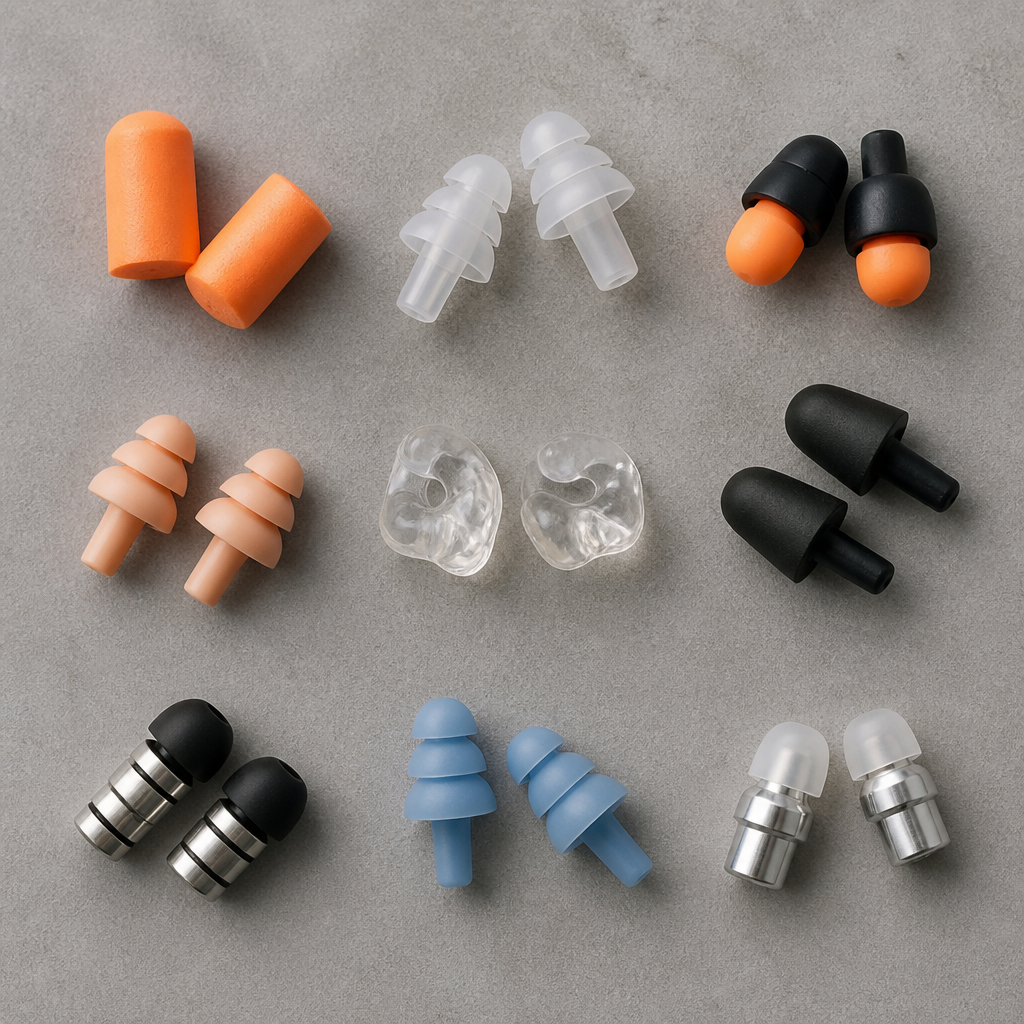
Walking into this purchase without knowing the categories is how people end up with the wrong product entirely. There are four distinct ear plug types, and each makes a different set of trade-offs between protection level, comfort, reusability, and price per use.
The classic roll-down cylindrical foam plug is the most common and the cheapest per-unit purchase. It reaches the highest NRR ratings, typically NRR 29 to 33, when inserted correctly. The catch is that phrase “when inserted correctly.” Disposable foam requires you to compress the plug tightly, insert it deep into the canal, and hold it in place while it expands. Most people skip steps, which is why independent field studies consistently show real-world attenuation far below the lab rating.
Disposable foam is genuinely ideal for high-turnover industrial environments, single-use hygiene requirements, and anyone who needs maximum noise blocking for a short, one-off exposure. It is the wrong tool for nightly sleep use because the replacement cost accumulates quickly and the insertion inconsistency means you never quite know how much protection you are getting on a given night.
Pro tip: If you use disposable foam plugs for sleeping, you should be replacing each pair every single night. Reusing them compresses the foam so it no longer seals properly, and compressed foam also collects earwax that pushes back into the canal on the next use.
Flanged plugs push into the canal without rolling and can be washed clean and reused for weeks. They typically rate NRR 25 to 27, which is sufficient for most industrial environments and more than enough for sleep and travel. The lower ceiling compared to foam is the main drawback. The benefit is consistency: the flanged structure gives you the same insertion depth every time, which means your protection is predictable.
This is the category ATTENU8 occupies, and it solves the two biggest shortcomings of the other designs simultaneously. The structured aluminium body guides correct insertion every time, addressing the consistency problem of foam. The replaceable memory foam tips address the hygiene and degradation problem of flanged plugs. ATTENU8’s concave body with three interchangeable tip sizes (XS, S, M) delivers approximately 32 dB of noise reduction with the seal reliability that most people never achieve with disposable foam.
Electronic plugs use active noise cancellation or compression circuitry. Filtered plugs attenuate specific frequency ranges while allowing others through, which is useful for musicians who want to protect hearing while maintaining audio clarity. These are specialty products with a specific audience and a significantly higher price point. They are not the right starting point for sleep, travel, or general industrial hearing protection.
The single most misunderstood aspect of any ear plug buying guide is the noise reduction rating. People see a number on the box and assume it represents the decibels subtracted from their environment. It does not work that way in practice.
NRR (Noise Reduction Rating) is the US standard, governed by EPA regulations and referenced by OSHA and NIOSH. SNR (Single Number Rating) is the European equivalent under ISO/EN standards. Both are measured under laboratory conditions with trained subjects inserting plugs correctly. The SNR and NRR numbers describe similar real-world protection but come from different measurement protocols, so they are not directly interchangeable despite often producing similar numerical values.
OSHA recommends halving the NRR to estimate real-world protection. NIOSH goes further, applying a 50 to 70 percent derating factor because field studies consistently show that most users do not achieve lab conditions. A plug rated NRR 33 may realistically deliver only 10 to 15 dB of protection for an average user who has not been trained in proper insertion technique.
The derating issue is not a product flaw. It is a human behaviour pattern. A structured plug body that guides correct placement every time closes most of the gap between rated and real-world protection without requiring the user to learn a technique.
This is why the design of the plug body matters as much as the NRR number on the label. An NRR 32 plug that consistently seals correctly protects your hearing better than an NRR 33 plug that most users insert 50 percent depth.
For sleep and domestic noise (snoring, street traffic, neighbours), a real-world reduction of 25 to 32 dB is the useful target range. You do not want complete silence. You want the edge taken off disruptive noise while retaining enough awareness to hear an alarm. For construction and manufacturing environments with sustained noise above 90 dB, you need a minimum of NRR 25 on a correctly fitted plug, and exposures above 100 dB warrant double protection (plug plus earmuff).
Pro tip: When comparing products with different ratings, use the OSHA derating formula as your benchmark: subtract 7 from the NRR, then divide by 2. This gives you a conservative estimate of real-world dB reduction. An NRR 32 plug becomes approximately 12.5 dB of estimated field protection under this formula, which is still meaningful protection against moderate sleep noise.
The most practical section of any how to buy ear plugs guide is this one: matching the product to the actual problem you are solving. Different environments demand different priorities.
Sleep use has the most demanding physical requirements of any ear plug application. You wear them for 6 to 8 hours, often on your side, and comfort degradation over time is the primary reason most people abandon ear plugs within weeks of buying them. The key requirements for sleep ear plugs are low profile (to avoid pillow pressure), soft material at the canal contact point (memory foam wins here), and a design that stays in place without pressure building up as the foam expands.
Disposable foam plugs swell as they expand, creating increasing pressure over time that wakes many side sleepers. A memory foam tip on a metal-bodied plug like ATTENU8 expands gently against the canal wall without the same outward swelling force, which is why users report all-night comfort that disposable foam rarely achieves.
Travel use is about two distinct problems: cabin pressure changes and sustained ambient noise (engine hum, passenger noise). For pressure changes during takeoff and landing, a slow-release memory foam tip or a filtered plug is preferable to a hard flanged plug, as the gradual seal adjustment is more comfortable during pressure transitions. For sustained ambient noise reduction on long flights or trains, a 27 to 32 dB plug in a durable carry case is the practical requirement. A metal-bodied plug with a case holds up to bag handling in a way that a loose pair of foam plugs simply does not.
Occupational hearing protection operates under regulatory frameworks (OSHA 29 CFR 1910.95 in the US) that set mandatory exposure limits. The basic requirement is that your plug brings noise exposure below 85 dBA as an 8-hour time-weighted average. For a 95 dB environment, an NRR 25 or higher correctly fitted plug meets that threshold. For louder environments at 105 dB or above, double protection (plug plus earmuff) is the practical standard.
In industrial settings, the insertion consistency problem is most acute because workers are inserting plugs repeatedly across shifts, often with gloved hands or in poor lighting. A push-to-fit design with a structured body removes the technique variable and delivers more predictable protection across a team than roll-down foam.
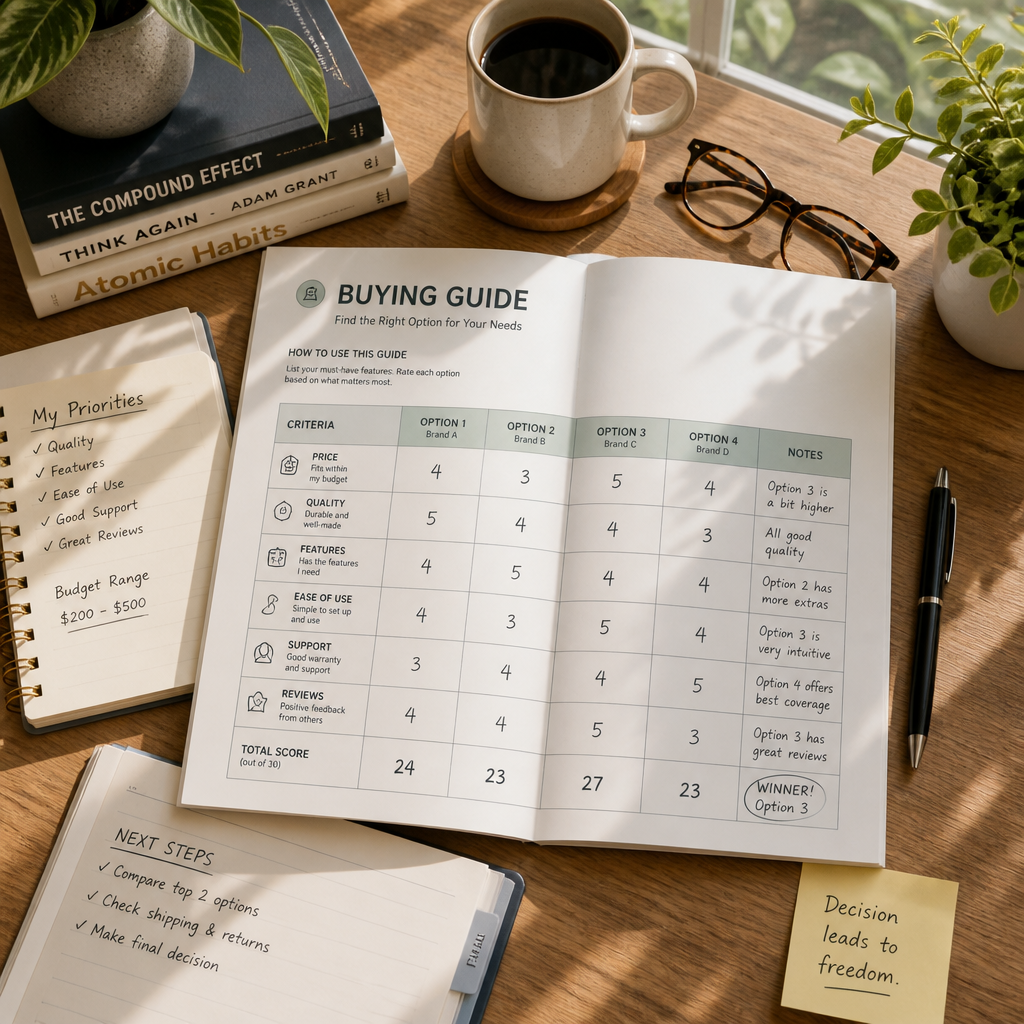
Fit is the variable that renders all other specifications secondary. A perfectly engineered ear plug with an excellent NRR delivers zero protection if the user removes it after 45 minutes because it is uncomfortable. This is not a minor concern. It is the primary reason most ear plug purchases fail.
Human ear canals vary considerably in diameter and length. A one-size foam plug compresses to fill the space but does not account for whether that space is actually being sealed. Products that offer multiple tip sizes (XS, S, and M) allow users to match the seal contact area to their actual canal geometry, which produces both better noise reduction and more comfortable long-term wear. This is not a minor upgrade; it is the structural difference between a plug that works and one that the user tolerates for a week before giving up.
Memory foam conforms slowly to the exact shape of the canal, distributing pressure across a larger surface area. Silicone flanges contact the canal at specific flange edges, creating higher local pressure points. For short-duration wear (30 minutes to 2 hours), silicone is comfortable and effective. For all-night sleep use, memory foam is the more comfortable material at the canal contact point for most users. The combination of a structured body (for consistent insertion and acoustic engineering) and a memory foam tip (for comfort and seal) is why metal-bodied designs with replaceable foam tips perform well across both sleep and industrial use cases.
This deserves its own paragraph because it eliminates a large portion of available products immediately. Standard cylindrical foam plugs protrude from the ear canal by 10 to 15 mm. When a side sleeper presses their ear into a pillow, that protrusion creates a lever that pushes the plug sideways against the canal wall. The result is discomfort within 20 to 40 minutes that either wakes the user or causes them to remove the plug in their sleep. A low-profile, concave-bodied design that sits flush with the outer ear solves this mechanically, and it is a non-negotiable feature for side sleepers.
| Feature | Disposable Foam | Reusable Silicone Flanged | Reusable Metal-Bodied with Memory Foam Tips (e.g. ATTENU8) |
|---|---|---|---|
| Noise Reduction Rating | NRR 29-33 (rated); 10-15 dB typical real-world | NRR 25-27; more consistent real-world delivery | Approximately 32 dB SNR; consistent seal due to structured body |
| Comfort for Sleep | Poor for side sleepers; pressure builds over hours | Moderate; flanges can create pressure points overnight | High; memory foam distributes pressure, low-profile body suits side sleepers |
| Insertion Consistency | Technique-dependent; widely variable between users | Better than foam; push-to-fit reduces variation | Best; structured body guides correct canal placement every use |
| Lifespan and Replacement | Single use; replace every wear | Weeks; replace full plug when flanges degrade | Body lasts indefinitely; replace foam tips only every 6-8 weeks |
| Long-Run Cost | Lowest per unit, highest cumulative cost for daily use | Low per-use cost over weeks | Lowest per-use cost for daily or nightly users; tip replacements are the only ongoing expense |
| Best Use Case | High-turnover industrial, single-use hygiene needs, occasional use | Daily industrial wear, occasional travel | Sleep, travel, noise-sensitive daily use, professionals wanting consistent protection |
| Environmental Impact | High waste; daily disposal | Moderate; periodic full replacement | Low; only tips replaced, aluminium body is durable and reusable |
The best ear plugs to buy are always the ones that match your primary use case, fit your ear canal, and that you will actually keep wearing. Here is the decision process that removes guesswork from the purchase.
Be specific. “Noisy” is not an environment. “Snoring partner in a quiet bedroom” is a different problem from “operating a pneumatic drill at 105 dB for 8 hours.” The first needs 25-32 dB of comfortable long-wear protection. The second needs regulatory-compliant double protection. Write down the actual situation and its approximate decibel level before you look at any product page.
If you need ear plugs every night or every working day, a reusable design is the rational choice from any economic or environmental angle. If you need them once a month for a specific event, a box of quality disposable foam makes sense. The break-even point between disposable and reusable typically arrives within the first few weeks of daily use.
Do not buy a one-size product without first checking whether you have a small, medium, or large ear canal. Most people have never tried a smaller tip and assume their current discomfort is just “how ear plugs feel.” Often, it is simply the wrong size. Look for products that include at least two tip size options, and ideally three (XS, S, M) so you can trial-fit before committing to a single size.
Apply the OSHA derating formula (subtract 7 from NRR, divide by 2) to get your working estimate of real-world protection. Compare that number to the noise level you are trying to manage. If your environment is 90 dB and you need to get below 85 dB, a derated 12.5 dB from an NRR 32 plug still closes that gap. If your environment is 105 dB, you need a higher-rated plug or double protection.
If any portion of your use involves lying down or sleeping, reject any product that protrudes more than a few millimetres from the ear canal opening. Check the product dimensions or user reviews specifically from side sleepers before purchasing.
Pro tip: Read one-star reviews specifically for comfort complaints from side sleepers, not from people who disliked the noise reduction level. Those reviews will tell you more about whether a plug is genuinely usable overnight than any manufacturer claim will.
The maintenance question separates thoughtful buyers from people who end up disappointed. Every ear plug type has a different maintenance requirement, and ignoring it reduces both performance and hygiene significantly.
Disposable foam plugs should be used once and discarded. Reusing them flattens the cellular foam structure so it no longer expands to a full seal. Beyond the performance issue, compressed used foam accumulates earwax that reintroduces contamination into the canal on the next insertion. The rule is simple: one use, then gone.
Reusable silicone plugs need washing with mild soap and water after each use. Inspect the flanges every two to three weeks. When flanges soften, crack, or lose their shape, the plug no longer seals correctly and should be replaced in full. A common mistake is continuing to use a flanged plug well past its effective life because it “still looks okay.”
The maintenance advantage of a metal-bodied design like ATTENU8 is that the component that degrades (the memory foam tip) is the component that gets replaced, on a schedule of approximately every 6 to 8 weeks. The aluminium body itself requires only occasional cleaning with a damp cloth and does not degrade. This modular approach means you are never discarding a functional acoustic component; you are only replacing the comfort and seal element that wears out through use.
In practice, this maintenance schedule is easy to keep: replace tips at the same time you replace your toothbrush. The cost and effort are minimal, and you always have a fresh seal without having to replace the entire product.
NRR (Noise Reduction Rating) is the US standard regulated by the EPA and referenced by OSHA and NIOSH. SNR (Single Number Rating) is the European standard under ISO/EN protocols. Both reflect the decibels of noise reduction measured in a laboratory setting, but they use different test methodologies, so the numbers are not directly interchangeable. When comparing products, make sure you are comparing NRR to NRR or SNR to SNR, not mixing the two.
Disposable foam plugs should be replaced after every single use. Reusable silicone flanged plugs typically last several weeks before the flanges degrade and should be inspected regularly. Reusable metal-bodied plugs with memory foam tips require only tip replacement every 6 to 8 weeks; the body itself lasts indefinitely with basic cleaning. The right answer depends entirely on which type you own.
Wearing ear plugs does not damage hearing by itself. Incorrect insertion that pushes earwax deeper into the canal over time is the concern most audiologists raise about regular foam plug use. A plug that does not require deep canal insertion, and that is cleaned properly between uses, eliminates most of this risk. If you notice earwax buildup, tinnitus, or changes in hearing after regular plug use, consult an audiologist.
Price alone is not a reliable quality indicator. What matters is whether the design delivers consistent seal quality for your ear canal size, fits your specific use case (sleep, industrial, travel), and is comfortable enough for the duration you need to wear it. A well-designed premium reusable plug that you actually wear all night is objectively better than a high-NRR disposable plug you pull out at 2 AM because it hurts. Match the product to the requirement, then evaluate whether the price reflects the value for your specific situation.
Side sleepers need a low-profile design that does not protrude significantly from the ear opening. Standard cylindrical foam plugs are among the worst options for side sleepers because they protrude and create pillow pressure that either causes pain or pushes the plug out during sleep. A concave or flush-profile body with a soft memory foam tip provides comfort through the night without the lever-pressure problem. ATTENU8’s concave aluminium body was specifically designed with this geometry in mind, making it a practical option for consistent overnight wear.
Start with the medium (M) tip if the product offers multiple sizes, as it fits the majority of adult ear canals. If the M tip feels loose or you can remove it easily without any resistance, size down to S. If it causes immediate pressure or pain before the foam has time to seat, size up. The correct size should feel snug but not painful within the first 30 seconds of insertion. A proper seal also produces a subtle muffling of ambient sound immediately upon insertion; if you hear no change after inserting the plug, the seal is incomplete.
Ear plugs do reduce snoring noise meaningfully when they achieve a proper seal. Snoring typically registers between 60 and 80 dB at close range. A plug delivering a real-world reduction of 25 to 32 dB brings that range down to 30 to 55 dB, which is below the threshold that triggers most light sleepers’ arousal responses. The result is not silence, but it is often the difference between waking repeatedly and sleeping through the night. The caveat is that seal quality is everything: a poorly fitted plug that delivers only 10 to 12 dB of real-world reduction may not move the needle enough for a very light sleeper.
Have you switched from disposable foam to a reusable ear plug design? Share what made the biggest difference to your comfort or protection in the comments below.
Most Kickstarter campaigns spend weeks or months building momentum before they see meaningful traction. The ATTENU8 Kickstarter campaign hit 127% of its funding goal within the first 24 hours of going live. That speed is not a marketing achievement. It is a signal that the audience already knew their problem, had already tried cheaper alternatives, and had already decided those alternatives were not good enough. This is the story of how a Singapore-based startup, SoundBlock Asia, identified a real gap in the ear plug market, built a product that addressed it properly, and validated that product through crowdfunding before scaling to retail.
| Key Insight | Explanation |
|---|---|
| 127% funded in 24 hours | ATTENU8 exceeded its Kickstarter goal within the first day, confirming strong pre-existing demand rather than manufactured hype. |
| 333 backers, S$18,024 pledged | The campaign raised over three and a half times its S$5,000 target, with a community of early adopters invested in the product’s success from day one. |
| Founded by Marissa Tang of SoundBlock Asia | The brand was built by a Singapore-based startup that identified a specific fit problem with traditional foam ear plugs and built a solution from the ground up. |
| Metal body is the core differentiator | The solid aluminium construction provides durability and noise reduction that plastic and foam bodies cannot match, and it acts as a credibility signal on the Kickstarter page before the product is even tested. |
| Tip replacement every 6 to 8 weeks, not daily | Users replace only the memory foam tips at intervals, not the entire unit, making ATTENU8 dramatically less wasteful than disposable foam ear plugs discarded after a single use. |
| 32dB noise reduction from a passive design | No batteries, no electronics, no charging. The attenuation comes entirely from the density change between the aluminium body and the memory foam tip, making the product genuinely maintenance-free. |
| Crowdfunding validated the market before full production | The Kickstarter result confirmed that light sleepers, travellers, and professionals in noisy environments were actively searching for a better option and were not satisfied with what existed. |
The ear plug category has a fit problem that manufacturers of disposable foam plugs have never had to solve. When you sell a product that is used once and thrown away, you are not rewarded for making it work well every time. You are rewarded for making it cheap enough to buy in bulk. The result is a product that compresses unevenly, fails to seal properly in many ear canals, and degrades within hours of insertion.
Marissa Tang, founder and CEO of SoundBlock Asia, observed this directly during the COVID-19 pandemic. As more people shifted to working from home, demand for ear plugs increased sharply. People who had never needed hearing protection in an office environment were suddenly trying to block out household noise, neighbour sounds, and shared-space distractions. Most of them reached for cheap foam plugs and found them unsatisfying.
“Typically, the default option for ear plugs are the foam ones as it is a cheaper alternative. However, many struggle to attain the right fit as it’s too soft and malleable, adversely affecting sound reduction.” Marissa Tang, founder of SoundBlock Asia, via EIN Presswire.
The product development process involved prototyping and one-on-one interviews with potential users, specifically to identify how fit could be improved. The answer was not a better foam formula. It was a structural one: pair a rigid metal body with sized memory foam tips so that the fit is consistent, repeatable, and not dependent on how well the user can roll and compress a soft plug under time pressure in a dark room.
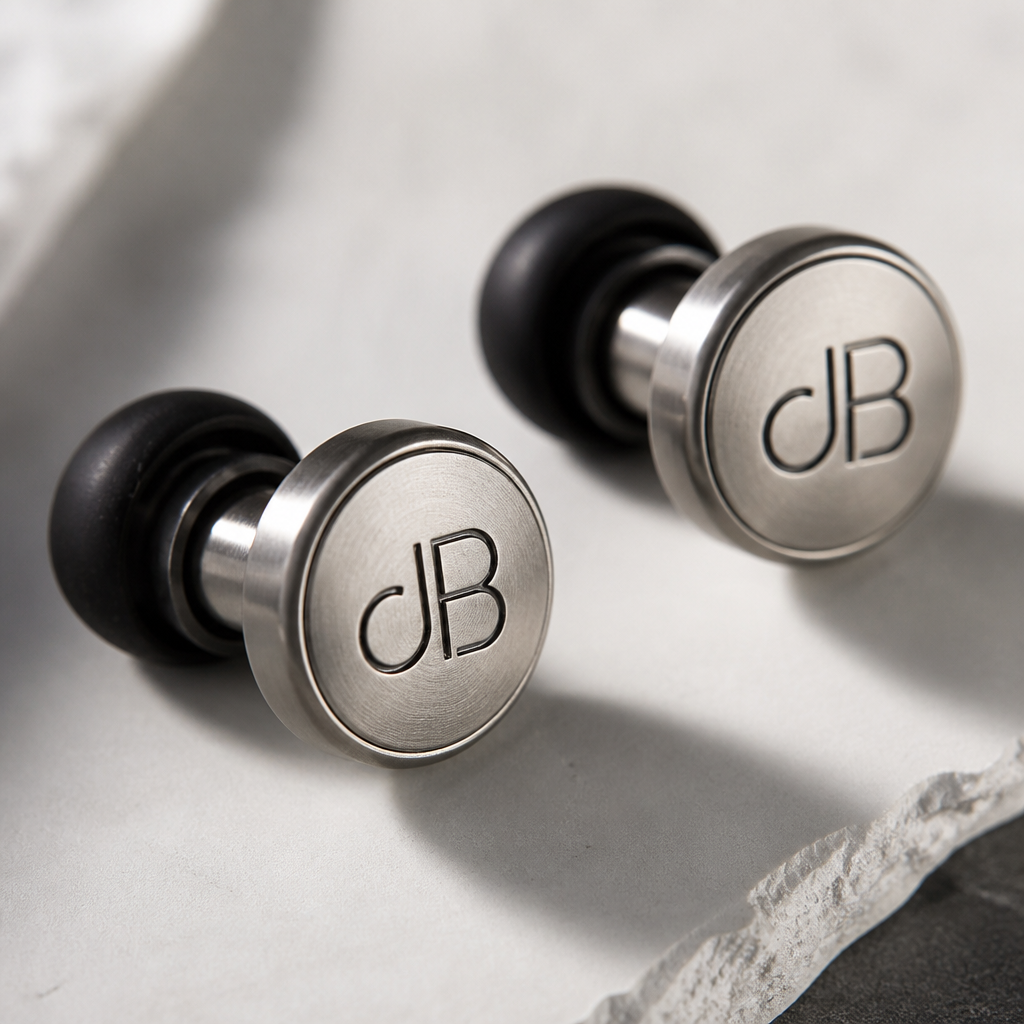

The ATTENU8 Kickstarter campaign launched with a S$5,000 funding goal. It closed with 333 backers having pledged S$18,024. That is a final tally of over 360% of the original target, and it started with the goal being crossed within the first 24 hours of the campaign going live.
The Kickstarter price was set at S$23 per pair. Retail pricing from November of that year was set at S$28. That pricing structure is deliberate: it rewards early adopters with a meaningful discount for taking the early-stage risk, and it sets a retail price that positions the product as premium without being inaccessible.
Why the S$5,000 Goal Was Set Where It Was
A low initial goal on Kickstarter is sometimes a cynical move designed to generate “funded” headlines cheaply. In ATTENU8’s case, the goal reflected a genuine minimum viable production run rather than a performance target. The speed at which it was exceeded revealed actual market size, not just headline-ready optics. When a product triples or quadruples its goal, that data is useful for production planning, supplier negotiations, and investor conversations in ways that hitting a large goal at the wire simply is not.
The campaign closed on 8 September 2021. The timeline between the June 2021 pre-launch announcement and the September close gave SoundBlock Asia a window to build awareness through press coverage, early community engagement, and word-of-mouth from people who had already been using prototypes.
Pro tip: If you backed ATTENU8 on Kickstarter and are now using your pair daily, the foam tips are due for replacement every 6 to 8 weeks. Check the ATTENU8 website for replacement tip availability so your noise reduction performance stays consistent rather than degrading gradually without you noticing.
Backers on Kickstarter are not passive consumers. They are people who have already tried the mainstream options, found them lacking, and are willing to pre-fund a product that promises something better. For ear plugs specifically, the mainstream option is a disposable foam cylinder that has not meaningfully changed in decades.
ATTENU8 appealed to three distinct groups. Light sleepers and people sensitive to noise who had tried every foam plug on the market and found that either the fit was uncomfortable for side sleeping or the plugs fell out by morning. Travellers who needed reliable noise reduction on planes and in hotels without carrying fragile or bulky equipment. And professionals in loud environments, including construction workers, musicians, and manufacturing staff, who needed hearing protection they could trust to perform consistently shift after shift rather than having to buy and discard plugs daily.
The concave aluminium body does more than house the foam tip. It gives users a grip point for insertion and removal that matters enormously in practice: removing ear plugs half-asleep in the middle of the night, or during turbulence in a cabin with a seatbelt on, is a genuinely different experience with a rigid metal body versus a soft foam cylinder. The design communicates that this product was engineered for repeated use by someone who had actually thought about the use case.
ATTENU8 also includes an optional foam cap that fits over the base of the metal body. This is specifically for side sleepers, who experience pressure from the hard end of a standard ear plug pressing against the pillow. It is a small detail, but it is exactly the kind of detail that makes a Kickstarter backer trust that the creator understands their problem rather than just solving the obvious version of it.
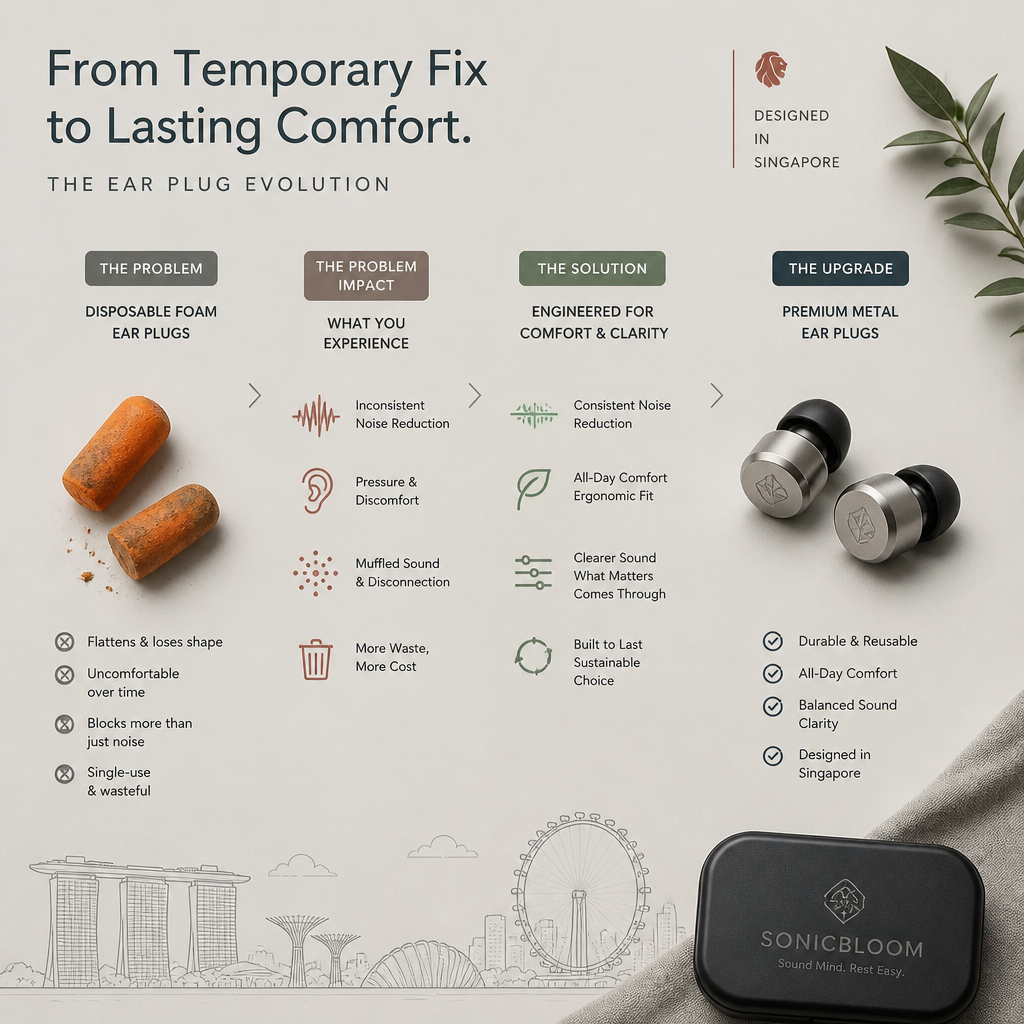
Most ear plugs on the market, including premium options, use plastic for any rigid components. Plastic is light, cheap, and easy to mould. It is also a material that communicates disposability. When you hold a plastic ear plug, you are already in the mental category of “use and discard.” A solid aluminium body changes that mental framing entirely.
Metal communicates permanence. It tells a sceptical buyer that this product was engineered, not assembled from generic components. More importantly, it performs differently. The density difference between aluminium and the surrounding air, combined with the sealed memory foam tip, is what generates the approximately 32dB of noise reduction. There are no batteries, no active electronics, and no charging. The physics of the material does the work.
A disposable foam ear plug is used, at best, a handful of times before it loses its shape and its ability to expand properly in the ear canal. In practice, many users discard them after a single use. A daily foam plug user discards a significant number of pairs per year. The ATTENU8 aluminium body is designed to last for years. The only consumable part is the memory foam tip, replaced every 6 to 8 weeks, at a pace of roughly 7 or 8 tip changes per year.
The metal body can be cleaned with soapy water. The foam tips can be wiped with a damp cloth between replacements. This maintenance cycle is achievable, not aspirational. It does not require special equipment or careful ritual. It is the kind of maintenance that fits into the same routine as cleaning glasses or charging a phone.
Pro tip: Store your ATTENU8 ear plugs in the included case rather than loose in a bag or pocket. The custom foam cut-out protects the memory foam tips from compression damage between uses, which extends tip life closer to the full 8-week cycle rather than forcing earlier replacement from preventable wear.
The reusable ear plug market ATTENU8 entered through Kickstarter has since become competitive. Loop and Flare Audio are two of the most visible alternatives. Understanding how the crowdfunded origin of ATTENU8 shaped its product priorities makes the comparison meaningful rather than just a spec sheet exercise.
| Brand | Body Material | Key Differentiator |
|---|---|---|
| ATTENU8 | Solid aluminium with memory foam tips (XS, S, M) | Maximum passive noise reduction (approx. 32dB), side-sleeper foam cap, tip replacement model reduces long-term waste and cost |
| Loop (au.loopearplugs.com) | Hard plastic with silicone ear tips | Range of models targeting different noise reduction levels and daily use scenarios; strong lifestyle branding and broad retail availability |
| Flare Audio (flareaudio.com) | Metal (titanium or aluminium options) with foam or silicone tips | Audiophile-focused frequency response; strong following among musicians and concert-goers specifically |
The practical difference between ATTENU8 and its main competitors comes down to use case priority. Loop’s product range is designed for broad accessibility, from children to office workers, with models targeting different noise reduction levels. Flare Audio is built around music fidelity, with a following among musicians who want to wear ear protection at concerts without losing sound quality. ATTENU8’s priority is maximum passive attenuation for sleep, travel, and occupational noise, with a build quality that reflects repeated, long-term use rather than occasional wear.
For anyone whose primary use case is sleeping in a loud environment, whether that is a partner who snores, a flat on a busy street, or a shared bunkroom while travelling, ATTENU8’s combination of high attenuation and the side-sleeper foam cap puts it ahead of alternatives that treat sleep as one use case among many rather than the central design constraint.
The journey from a Kickstarter campaign to a product sitting on someone’s bedside table every night is not automatic. Plenty of well-funded campaigns deliver products that work once and then end up in a drawer. ATTENU8’s ongoing retail presence, including availability through stores like Swee Lee in Singapore, indicates that the product converted initial backers into genuine long-term users rather than one-time purchasers.
The tip replacement model is partly responsible for that retention. A product with no ongoing relationship with its user is easy to forget about and replace. A product where the user returns periodically for replacement tips has a built-in reason for continued engagement with the brand. For ATTENU8, the 6 to 8 week tip replacement cycle creates a natural rhythm of reordering that keeps the product active in the user’s routine.
What the ATTENU8 Brand Story Means for New Buyers
Buying ATTENU8 now means buying a product whose design decisions were pressure-tested by 333 paying backers before it went into full production. The side-sleeper foam cap exists because someone asked for it. The three tip sizes exist because one-size ear plugs demonstrably fail a significant portion of users. The concave grip geometry exists because the creator thought about how the product is actually handled in real use conditions, not just how it looks in a render.
That is what a 127% funded Kickstarter launch actually signals: not that the marketing was good, but that the product addressed a real, specific problem for a real, specific audience that had been waiting for it.
The ATTENU8 Kickstarter campaign closed with 333 backers having pledged S$18,024 against an original S$5,000 goal, reaching 127% of the target within the first 24 hours and ending the campaign well above three times the initial funding target.
ATTENU8 was created by Marissa Tang, founder and CEO of SoundBlock Asia, a Singapore-based startup. SoundBlock Asia developed ATTENU8 as Singapore’s first locally designed metal-bodied ear plug, initially targeting musicians, engineers, and noise-sensitive individuals before expanding to a broader audience of sleepers and travellers.
The key difference is the aluminium body, which lasts for years, combined with memory foam tips that are replaced every 6 to 8 weeks rather than after each use. Disposable foam plugs degrade quickly, often fail to seal properly due to their soft, malleable structure, and generate significant ongoing waste. ATTENU8’s rigid body creates a consistent fit anchor that the memory foam tip seals around, delivering approximately 32dB of noise reduction reliably across repeated uses.
Yes. ATTENU8 includes an optional memory foam cap that fits over the base of the metal body, which cushions the contact point between the ear plug and the pillow. This is a specific design feature for side sleepers and distinguishes it from many other reusable ear plug options that do not account for the additional pressure created when sleeping on your side.
Loop offers a range of models across different noise reduction levels with broad lifestyle appeal and retail availability. Flare Audio targets musicians and audiophiles with a focus on sound fidelity during ear plug use. ATTENU8’s focus is maximum passive attenuation for sleep, travel, and occupational noise environments, with a metal body, a side-sleeper-specific accessory, and a tip replacement model that makes it a long-term purchase rather than a seasonal one.
Yes. ATTENU8 is available for purchase through the ATTENU8 website at attenu8.co and through select retailers. The retail price is higher than the Kickstarter early-bird price, but the product is the same one validated by the original campaign backers.
The main ongoing cost is replacement memory foam tips, which are replaced every 6 to 8 weeks. The aluminium body itself does not need replacing. This compares favourably to the cumulative cost of disposable foam plugs used daily, where the per-use cost is low but the annual total adds up considerably alongside the waste generated.
If you have used ATTENU8 since the Kickstarter days or picked it up more recently, we would like to hear how the product has held up in your specific sleep or noise environment.
Most people buy a bulk bag of foam ear plugs once, lose half of them, roll the rest incorrectly, and wonder why they still wake up at 3am to a snoring partner or a passing truck. The answer usually isn’t their light sleeping – it’s their ear plugs. If you’ve ever asked whether premium ear plugs are worth it versus the cheap disposable ones, the short answer is yes, but the reasons matter more than the price tag. This article breaks down exactly what you’re paying for, where budget options fall short, and how to calculate the real cost of what goes in your ears every night.
| Key Insight | Explanation |
|---|---|
| Real-world NRR is often half the label figure for foam plugs | Improper rolling and insertion dramatically reduces the actual protection foam plugs deliver, regardless of what the packaging claims. |
| Cost per use favors reusables after a few weeks | Bulk foam plugs cost roughly $0.17 to $0.50 per pair. Reusable premium plugs used nightly can cost a fraction of that per use within the first month. |
| Fit determines effectiveness more than material | A well-fitted premium plug with a lower stated NRR will outperform a loosely-worn foam plug with a higher stated NRR every time. |
| Metal-bodied reusable plugs solve the hygiene problem | Disposable foam picks up bacteria from unwashed fingers during insertion. A cleanable metal body with replaceable foam tips removes that risk entirely. |
| Comfort is not a luxury feature for sleep users | If ear plugs cause pressure or soreness during the night, you remove them. A plug that stays comfortable all night delivers 100% more protection than one pulled out at 2am. |
| Industrial users waste hundreds annually on disposables | Workers going through multiple pairs per day can spend $300 to $500 per year on foam ear plugs. Reusables with replaceable tips eliminate most of that cost. |
| Premium plugs with replaceable tips are not single-purchase products | ATTENU8-style designs only require foam tip replacement every 6 to 8 weeks, not a full new pair, which dramatically lowers ongoing cost. |
Budget foam ear plugs are not bad products. They are just optimized for the wrong things. They are designed to be cheap to manufacture, easy to stock in bulk, and effective under ideal laboratory test conditions – conditions that do not describe a real person’s ear canal at midnight.
The core problem is insertion. Foam plugs require you to compress the plug tightly, hold it in the ear canal while it expands, and maintain a consistent seal. Most people do not do this correctly, especially when half-asleep or when handling plugs with hands that have touched a phone, a steering wheel, or food. Studies suggest real-world foam plug performance can fall as much as 50% below the rated NRR due to improper insertion. That means a plug rated at 33dB might actually be delivering closer to 16 to 17dB in practice.
There is also the durability and hygiene issue. Disposable foam plugs are single-use by design, but many people reuse them for days or weeks. Once the foam compresses and loses its expansion memory, the seal degrades and protection drops further. And every time you re-insert a foam plug with unwashed hands, you’re pushing bacteria directly against your ear canal.
Pro tip: If your cheap foam plugs still feel like they’re “working” after a week of daily use, test them by doing a quick clap near your head while wearing them. If you hear it clearly, the foam has lost its structure and your protection has gone with it.
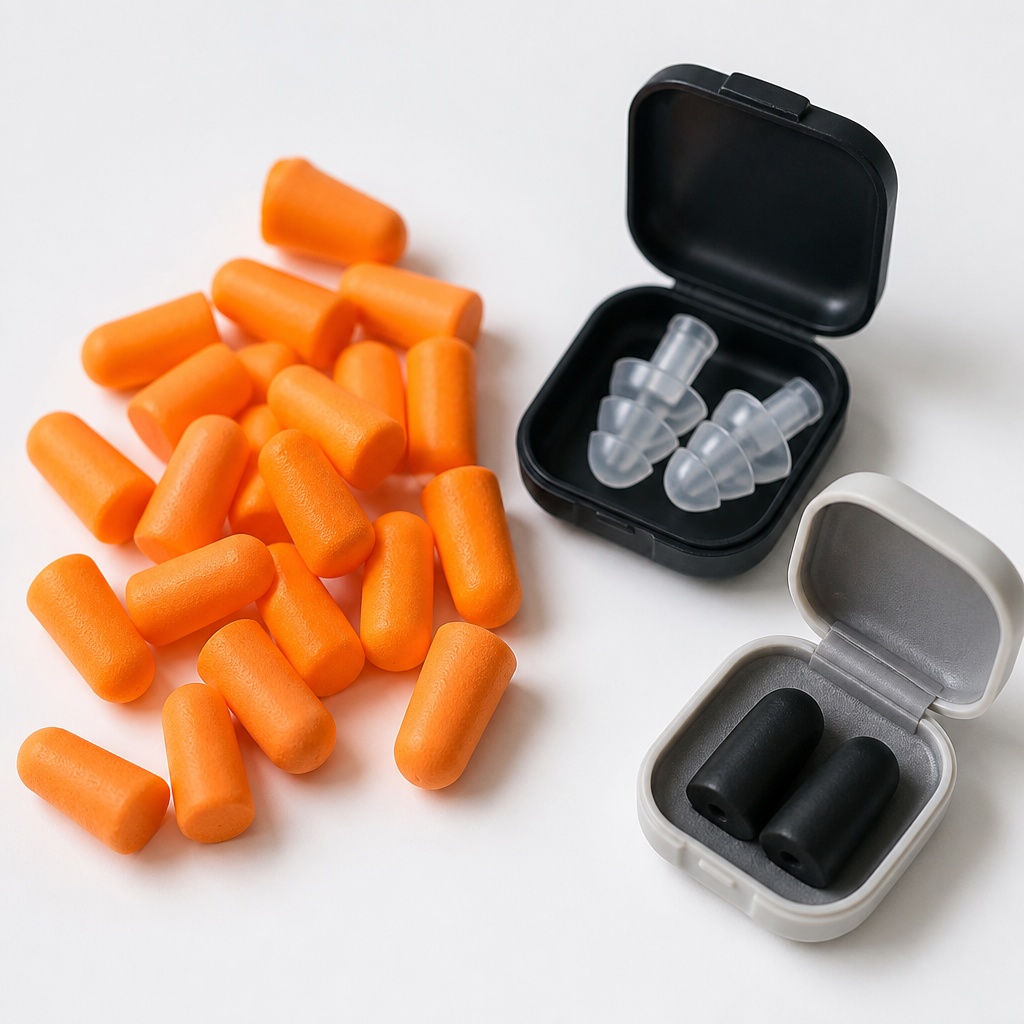

Premium ear plugs are not simply more expensive versions of the same product. They solve different problems. The key differences show up in three areas: construction, fit, and long-term usability.
A metal-bodied ear plug like those made by ATTENU8 is built around a rigid, durable aluminium shell with a concave form designed to sit comfortably in the outer ear. The shell does not compress, degrade, or lose its shape. What does get replaced periodically are the soft memory foam tips that seal against the ear canal – and those replacements happen on your schedule (every 6 to 8 weeks) rather than every single use.
This structure means the product maintains consistent performance use after use. You are not gambling on whether last night’s plug is still sealed properly. The body is the same. The tip is fresh when it needs to be.
One of the most overlooked differences between budget and premium ear plugs is size selection. A single-size foam cylinder is designed for an “average” ear canal – a size that fits perhaps half the population well and the rest poorly. Premium options like ATTENU8 include XS, S, and M memory foam tip sizes, meaning the plug actually fits your anatomy rather than the other way around. Correct fit is the single biggest determinant of how much noise a plug actually blocks, which makes tip sizing a functional feature, not a cosmetic one.
Cheap foam plugs exert continuous outward pressure as they expand in the canal. That pressure is tolerable for 20 minutes on a flight. It becomes genuinely uncomfortable over a full 7 to 8 hours of sleep, and many people remove the plugs in the middle of the night without even fully waking up. Memory foam tips on a structured body conform to your canal shape without pushing. The result is a plug you can actually wear all night without waking up with it on your pillow.
The most effective ear plug is the one that stays in your ear. A 32dB plug worn all night beats a 33dB plug pulled out at 2am by every measure that matters.
NRR (Noise Reduction Rating) is a standardized laboratory measure of how many decibels a plug reduces sound exposure. It is measured under controlled conditions with trained technicians inserting plugs correctly. It is a useful benchmark but not a guarantee of real-world performance.
Most disposable foam ear plugs carry NRR ratings between 25 and 33dB. Reusable flanged plugs typically rate between NRR 25 and 27dB. Premium options like ATTENU8 deliver approximately 32dB, which puts them at the top end of the reusable category and competitive with the best disposable foam ratings.
The practical difference is consistency. A foam plug rated NRR 33 worn incorrectly delivers less protection than a premium plug rated NRR 32 worn correctly every time. When evaluating any ear plug on NRR alone, you are looking at the best-case ceiling – not the everyday floor.
There is also the SNR (Single Number Rating) system used in Europe, which tends to produce slightly higher numbers than NRR for the same product. Be cautious when comparing plugs across regions – a 30dB SNR rating and a 30dB NRR rating are not the same thing.
Pro tip: When reading any ear plug specification, check whether the noise reduction figure is NRR or SNR. If the listing does not specify, ask the manufacturer. The difference can be significant when comparing products across brands.
The sticker price of premium ear plugs is the first number most people look at and the least useful one for making a decision. The number that actually matters is cost per use.
Bulk disposable foam plugs run roughly $0.10 to $0.50 per pair depending on quantity and brand. If you use them nightly, that is $36 to $180 per year just for sleep. If you reuse them beyond their effective life, you are also accepting degraded protection without realising it. One estimate puts the annual foam earplug cost for a regular sleep user at around $220 when using reasonable-quality single-use pairs nightly.
A quality reusable pair requires only foam tip replacements, not a full product replacement. With ATTENU8, tips are replaced every 6 to 8 weeks. That means roughly 6 to 8 tip replacements per year replace the entire annual cost of disposables. The metal body itself is a one-time purchase that does not degrade in the way foam does.
For professionals in loud environments, the math is even more decisive. Workers who go through multiple pairs of foam plugs per day can spend $300 to $500 or more annually. A reusable system with a replaceable tip design eliminates the bulk of that cost while also reducing waste.
Not every situation calls for the same ear plug, and the right answer does depend on context. Here is a direct comparison across the three most common use cases.
| Use Case | Budget Disposable Foam | Premium Reusable (e.g., ATTENU8) |
|---|---|---|
| Nightly sleep | High pressure causes discomfort over 7-8 hours. Many users remove them mid-sleep. Cost adds up nightly. | Memory foam tips conform to canal shape. Comfortable all night. Cost per use drops significantly over weeks of use. |
| Travel (flights, public transport) | Acceptable for short durations. Risk of losing single-use pairs is high. Hygiene concerns with reuse. | Metal body is durable and easy to carry in a case. Tips stay fresh. Consistent protection across trips without restocking. |
| Occupational noise (construction, manufacturing) | High NRR possible but insertion errors common. Daily cost compounds fast. Waste and hygiene issues at scale. | Consistent fit with correct tip size. Cleanable body. Tip replacements far cheaper than daily foam pairs. Better long-term compliance. |
Budget foam plugs win on upfront cost and on situations where you need a large supply for a one-off event, visitor use, or genuinely single-use scenarios. For anyone using ear plugs regularly – nightly, on daily commutes, or across a working week in a noisy environment – the economics and the performance both tilt toward premium reusables.
Honesty about this matters. There are situations where premium ear plugs are the wrong choice, and pushing them into every scenario would be bad advice.
If you need ear plugs for a single event – a concert, a noisy commute once a month, or a guest staying over – the cost-per-use advantage of premium plugs disappears. A handful of disposable foam plugs from a pharmacy is the correct call for genuinely infrequent, low-commitment use.
If you are in an extreme-noise industrial environment requiring the absolute highest NRR possible, some disposable foam plugs rated NRR 33 will technically offer a higher ceiling than most reusable options. However, the gap closes quickly when you factor in consistent correct insertion – something reusable plugs with pre-formed tips make easier.
And if you are new to ear plugs and are not sure whether you will use them consistently, starting with a cheap option to test your tolerance for the sensation is completely reasonable. The premium investment makes sense once you know you will use the product regularly. What premium ear plugs are not is a cure for someone who simply cannot tolerate anything in their ear canal – no amount of tip quality changes that underlying sensitivity.
The bottom line on best value ear plugs is that value is use-dependent. For the majority of people asking this question – light sleepers, regular commuters, people in persistent noise environments – the numbers and the comfort data both favour premium reusables within weeks of consistent use. Cheap is not always cheaper.
The durable body of a metal reusable ear plug like ATTENU8 is built to last indefinitely with basic care. The component that wears out is the foam tip, which should be replaced every 6 to 8 weeks depending on frequency of use. This is far more economical than replacing the entire product, and it means your performance stays consistent because you are always working with a fresh sealing surface.
In laboratory NRR ratings, high-end disposable foam plugs can match or slightly exceed premium reusable options on paper. But in real-world use, premium ear plugs with a proper fit system consistently deliver better protection because they are worn correctly more often. Real-world foam plug performance has been estimated to fall as much as 50% below its rated NRR due to insertion errors. Premium plugs with multiple tip sizes and a structured body largely remove that variable.
NRR (Noise Reduction Rating) is the US standard for measuring ear plug noise reduction, while SNR (Single Number Rating) is the European equivalent. They use different testing methodologies, and SNR values tend to run slightly higher than NRR for the same product. When comparing ear plugs from different brands or regions, always check which rating system is being quoted. Comparing an SNR figure to an NRR figure as if they are equal will often make one product look better than a direct comparison would support.
Yes, and this is one of the genuine advantages of a quality reusable design. A pair delivering around 32dB of noise reduction is appropriate for sleep (where ambient noise rarely exceeds 70 to 80dB), travel, and general occupational noise environments. For extremely loud industrial settings above 100dB, you may need supplementary hearing protection such as earmuffs on top of plugs. But for the vast majority of everyday noise environments, one good pair of premium reusable plugs covers all your needs.
Loop and Flare Audio offer stylish, well-marketed reusable options, with Loop’s quiet model designed primarily for sleep and focus. However, Loop earplugs are typically priced in the $30 to $50 range and their NRR varies significantly by model. ATTENU8 offers a metal-bodied design with consistent 32dB noise reduction and the practical advantage of replaceable foam tips – meaning you maintain fresh, hygienic sealing surfaces without buying a new product. The aluminium body also provides durability that polymer or resin bodies used by some competitors cannot match.
Reusing disposable foam ear plugs beyond their effective lifespan is both unhygienic and ineffective – the foam absorbs oils, bacteria, and debris from your ear canal and from your hands during insertion. Premium reusable ear plugs with a metal body solve the hygiene problem because the body can be wiped clean and the foam tips are replaced on a schedule. This makes them a significantly cleaner option for daily use compared to repeatedly handling and re-inserting a used foam plug.
Have you made the switch from disposable foam to reusable premium ear plugs? Share what made the difference for you – or what’s still holding you back.
Most people who struggle to sleep are not missing a pill or a gadget. They are missing a consistent set of habits. Research consistently shows that sleep hygiene, the collection of behavioral and environmental practices that promote regular, restorative sleep, is one of the most accessible interventions available for poor sleep quality. Yet most sleep hygiene checklists online are vague, generic, and fail to distinguish between habits with strong evidence and those that are largely overhyped. This guide does not hedge. It covers 12 science-backed items from a real sleep hygiene checklist, ranks them honestly, and explains the one product that addresses what habits alone cannot fix: environmental noise.
| Key Insight | Explanation |
|---|---|
| Consistent sleep timing is the highest-impact habit | Going to bed and waking at the same time every day, including weekends, reinforces your circadian rhythm more than almost any other single change. |
| Caffeine after midday is a silent sleep killer | Caffeine has a half-life of approximately 5 to 7 hours. An afternoon coffee is still significantly active in your system at midnight. |
| Bedroom temperature of 65 to 68°F supports sleep onset | Your core body temperature needs to drop to initiate sleep. A room that stays warm blocks this natural thermoregulatory process. |
| Noise above 65 dB worsens sleep quality measurably | Research using the Pittsburgh Sleep Quality Index found higher noise exposure consistently correlated with poorer sleep scores and increased neurological symptoms. |
| Earplugs outperform white noise machines for traffic noise | A University of Pennsylvania study published in the journal Sleep found earplugs were significantly more effective at protecting sleep from traffic noise than pink or broadband noise playback. |
| Morning exercise benefits sleep more than evening exercise | Population-based research on 2,050 adults found morning exercise showed a protective effect on sleep quality, latency, and nighttime awakenings. |
| Reusable earplugs reduce ongoing cost and waste | Single-use foam earplugs add up quickly. A product like ATTENU8 with replaceable memory foam tips every 6 to 8 weeks delivers the same protection at a fraction of the ongoing cost. |
Sleep hygiene is an array of behavioral and environmental practices that promote regular, sound, and sufficient sleep. It is not a single tip. It is a system. The reason most people fail to improve their sleep is that they pick one habit, stick with it for a week, see modest improvement, and quit. The compounding value of sleep hygiene only shows up when multiple habits reinforce each other consistently.
Poor sleep is not just inconvenient. Research links it to impaired immune function, reduced cognitive performance, elevated cardiovascular risk, disrupted thermoregulation, and increased susceptibility to mood disorders. For light sleepers, shift workers, and anyone in a loud or unpredictable sleep environment, the stakes are higher than average. A structured checklist cuts through the noise, literally and figuratively.
“Sleep hygiene is helpful, but the evidence is clearest when multiple behaviors are addressed together rather than in isolation. No single habit is a cure.”
This is the honest framing that most sleep content ignores. The habits below are ranked roughly by evidence strength, not alphabetically. Work through the list in order and you will feel the difference within two weeks.
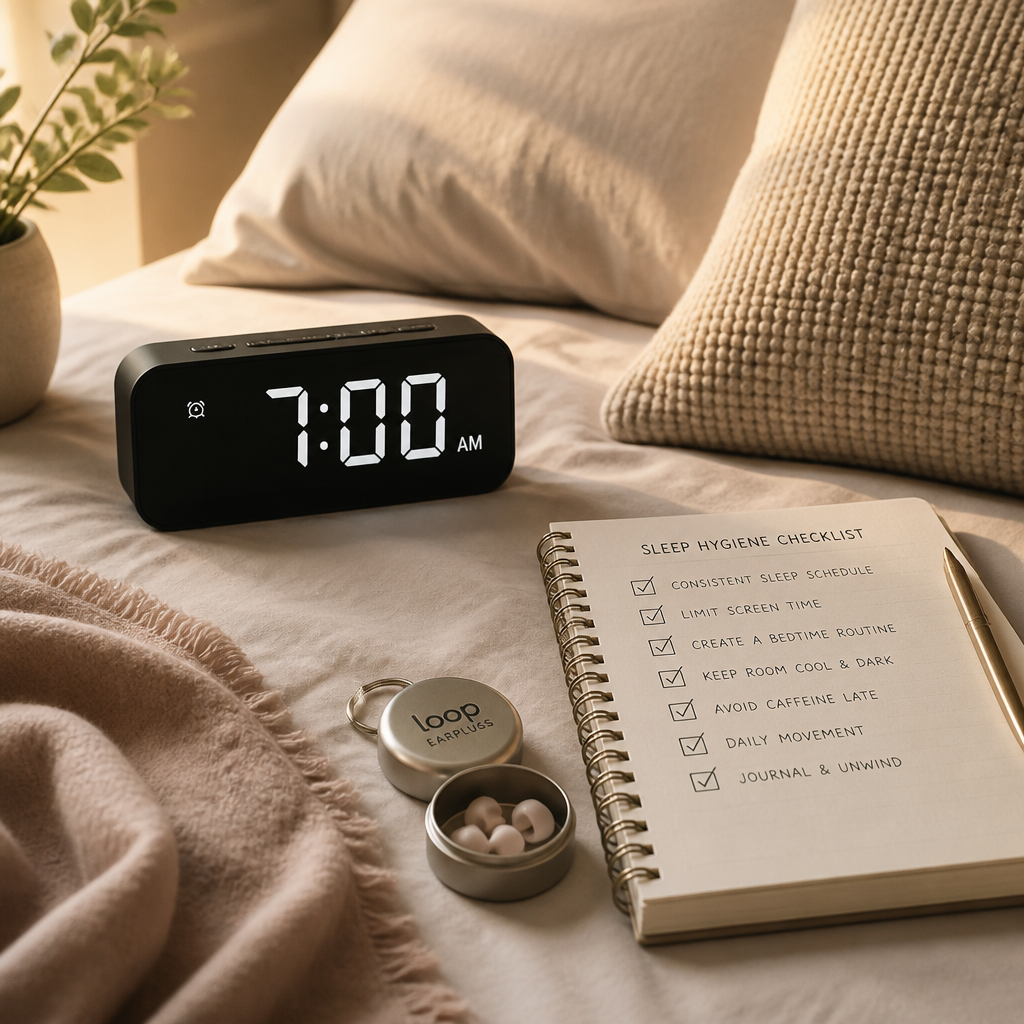

This is the single most evidence-supported habit on the list. Sleeping on a regular schedule strengthens circadian rhythms and improves sleep efficiency. Research indicates that inconsistent sleep schedules contribute to depression and lower sleep quality across age groups, including college students and working-age adults. The target is the same wake time every day, including weekends, even after a poor night.
Pro tip: Set your alarm for the same time regardless of when you fell asleep. The temporary discomfort of getting up early after a bad night resets your sleep drive faster than any supplement.
Caffeine has a half-life of approximately 5 to 7 hours. A cup of coffee at 2 pm still has a meaningful concentration in your bloodstream at 9 pm. Evening caffeine consumption is associated with shorter sleep duration and longer sleep latency. This is one of the clearest dose-response relationships in sleep research. The fix is simple but requires discipline: move your caffeine cutoff to 12 or 1 pm and hold it there for at least two weeks before judging the result.
Your body needs to drop its core temperature to initiate and sustain sleep. A bedroom kept at 65 to 68°F facilitates this thermoregulatory shift. A 2020 study published in the Oxford Academic Sleep journal, combining data from over 3.75 million nights, found that bedroom temperatures outside the 65 to 70°F range were associated with poorer sleep and higher rates of wakefulness. Sleeping hot is one of the most underestimated causes of frequent night waking.
Evening use of electronic devices with illuminated screens shows a negative effect on multiple sleep parameters including duration, latency, and nighttime awakenings. Blue light suppresses melatonin production. The practical rule: dim screens significantly two hours before bed, and shift to warm-toned lighting at or below 2700K in the bedroom. That said, research suggests the stimulating content on those screens, not just the light wavelength, is also a major factor. Turning off news and social media before bed matters independently of screen brightness.
Exposure to bright natural light early in the day anchors your circadian rhythm to the correct phase. This makes it easier to feel sleepy at the right time at night. Morning light and evening darkness are two sides of the same biological mechanism. If you cannot get outside within an hour of waking, a bright indoor light source pointed toward you while you eat breakfast is a reasonable substitute.
Population-based research on 2,050 adults found that morning exercise showed a protective effect on sleep quality, latency, and nighttime awakenings. Evening exercise close to bedtime raises core body temperature and can delay sleep onset for some people. Regular physical activity of any kind improves sleep, but if you have a choice, schedule harder sessions before noon.
Alcohol is widely misunderstood as a sleep aid. It reduces the time it takes to fall asleep but significantly disrupts sleep architecture, particularly REM sleep, in the second half of the night. For anyone waking between 2 and 4 am with racing thoughts, alcohol consumed within three to four hours of bedtime is frequently the culprit. The data on this is consistent. If you drink, move it to earlier in the evening and limit intake to one drink if sleep quality is a priority.
Research found that reporting dinner as the largest meal of the day was associated with shorter sleep duration and longer sleep latency. A full stomach diverts physiological resources toward digestion at exactly the time your body should be downregulating. Aim to finish eating at least two to three hours before bedtime.
Even small amounts of light during the night can interfere with melatonin production and sleep depth. Blackout curtains or a sleep mask are not luxury items for this reason. They are functional tools. Light leaking around curtain edges is a common overlooked problem. Mount blackout solutions outside window frames and add coverage to the sides to eliminate the light halo effect that standard curtains miss.
Pro tip: Cover any LED indicators on chargers, monitors, or smart speakers in your bedroom. These small light sources are often dismissed but can affect sleep quality over time, especially for light sleepers.
Your nervous system does not switch from full activation to sleep-ready in minutes. A consistent pre-bed routine of 20 to 40 minutes signals to your brain that sleep is approaching. This can include reading physical books, light stretching, journaling, or a warm shower. The specific activity matters less than the consistency and the absence of stimulating inputs like work email, social media, or stressful conversations.
Mental activation from worry and rumination is among the most common causes of insomnia. Stress and anxiety elevate cortisol at night, directly opposing the melatonin-driven sleep signal. Techniques such as writing down tomorrow’s tasks before bed, progressive muscle relaxation, or structured breathing exercises all have practical utility here. If chronic anxiety is driving your sleep problems, cognitive behavioral therapy for insomnia (CBT-I) has demonstrated effectiveness in improving sleep quality beyond what hygiene alone can achieve.
Working, watching entertainment, and scrolling on your phone in bed teaches your brain to associate the bed with wakefulness. The sleep environment association matters. When your body enters the bedroom and nothing else happens there except sleep, the physiological cue to wind down becomes automatic. This habit takes time to build but works gradually and persistently once established.
Most sleep hygiene checklists address light, temperature, caffeine, and screens. Very few give environmental noise the serious attention it deserves. This is a significant gap. Environmental noise pollution is a major public health issue. The World Health Organization sets nighttime noise thresholds for traffic at 45 dB, yet an estimated 72 million people in Europe alone are regularly exposed to nighttime noise levels above 50 dB. Sleep disruption is the primary mechanism of harm.
Research on 125 urban residents assessed using the Pittsburgh Sleep Quality Index found that higher noise exposure consistently correlated with poorer sleep quality and increased reports of headaches, dizziness, and irritability. Individuals exposed to noise levels above 65 dB showed significantly greater symptom burden. For light sleepers, a single noise event at the wrong moment in a sleep cycle can fragment sleep in a way that is disproportionate to its duration. This is because arousal from sleep during lighter sleep stages takes very little stimulus.
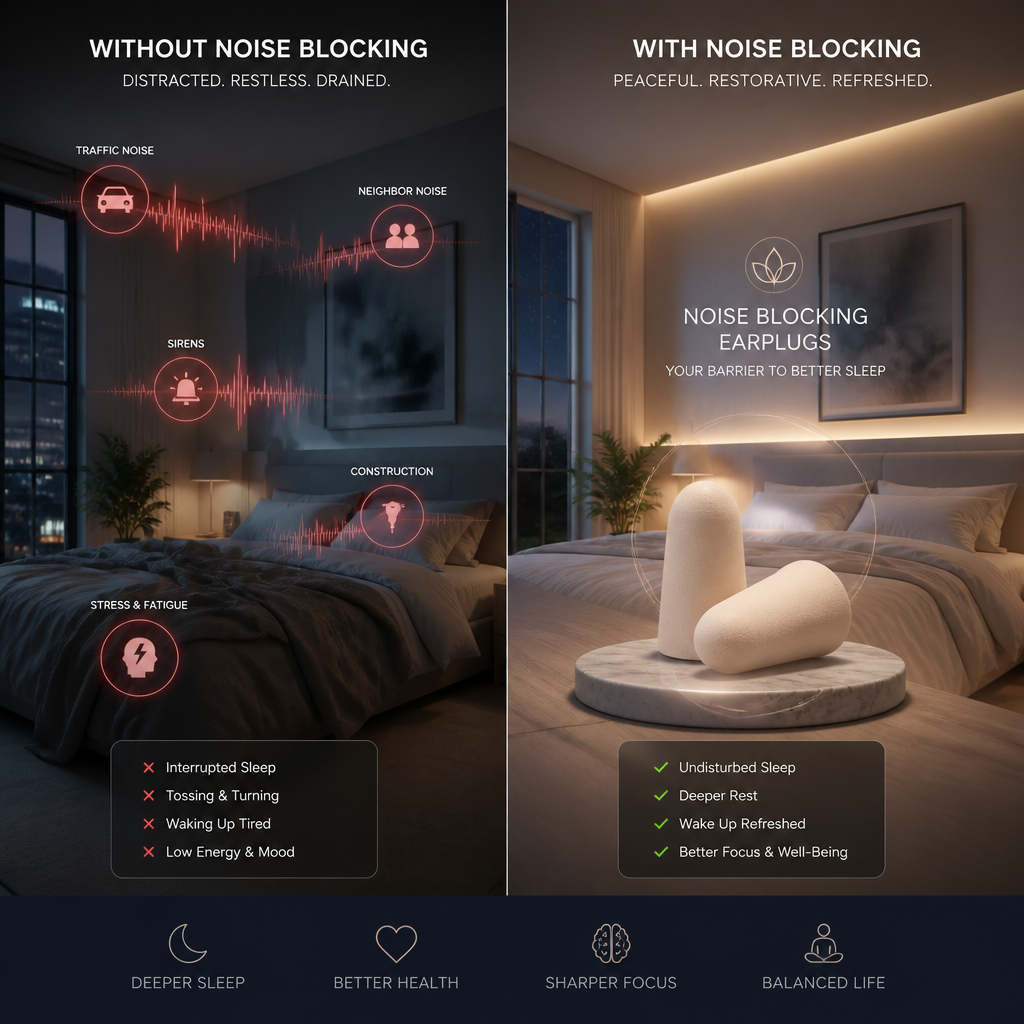
A study from the University of Pennsylvania Perelman School of Medicine, published in the journal Sleep, found that pink noise reduced REM sleep and that earplugs were significantly more effective at protecting sleep from traffic noise than broadband sound playback. This finding directly contradicts the growing market for white noise and pink noise machines, which millions of people now use under the assumption that masking noise with more noise is protective. It is not, at least not reliably, and in some cases it is actively harmful to sleep architecture.
The practical implication is clear: if you live in a city, near a road, near a snoring partner, or in any environment with unpredictable noise, earplugs are the most evidence-supported environmental intervention available. The question then becomes which type of earplug to use.
Single-use disposable foam earplugs are cheap, but they are also inconsistent, uncomfortable for extended wear, and wasteful if used nightly. ATTENU8 takes a fundamentally different approach. The earplugs feature a precision-machined aluminium body with three sizes of soft memory foam tips (XS, S, and M), delivering approximately 32dB of noise reduction. The metal body maintains its shape and hygiene in ways that disposable foam cannot.
For light sleepers using earplugs every night, the economics also work differently. Instead of replacing the entire product, you replace only the memory foam tips every 6 to 8 weeks. The aluminium body lasts indefinitely. Compared to Flare Audio and Loop Earplugs, which offer polymer or silicone-bodied options, ATTENU8’s metal construction provides a more durable and more hygienic long-term solution. For someone who needs reliable noise reduction every single night, durability is not a secondary concern. It is the point.
If you want to explore the full product range, ATTENU8’s site covers the sizing guide and foam tip replacement schedule in detail.
| Approach | Noise Reduction Method | Evidence Quality and Practical Verdict |
|---|---|---|
| Single-use disposable foam earplugs | Physical attenuation, typically 28 to 33 dB NRR | Effective for noise reduction but inconsistent fit, uncomfortable for prolonged wear, and expensive when used nightly. Generates significant waste. |
| White or pink noise machines / apps | Sound masking by adding broadband noise | Research shows pink noise reduces REM sleep. A University of Pennsylvania study found earplugs outperformed broadband noise for traffic protection. Weak overall evidence for sleep benefit. |
| ATTENU8 reusable metal earplugs | Physical attenuation, approximately 32 dB reduction with memory foam tips | Consistent fit due to three memory foam tip sizes. Durable aluminium body is hygienic and long-lasting. Replace tips every 6 to 8 weeks rather than the entire product. Best for nightly use. |
Not every sleeper has the same problem. A light sleeper kept awake by a partner’s movement has different needs than a shift worker whose schedule rotates weekly, or a construction professional who arrives home with residual auditory stress. The same checklist applies to all of them, but the priority order shifts.
Prioritize noise control first, then darkness, then temperature. A single noise event during light sleep can trigger a full arousal and reset the sleep cycle. Physical noise attenuation is more reliable than any behavioral habit for this group because the source of the problem is environmental, not behavioral. Add ATTENU8 earplugs to the routine before focusing on wind-down rituals, because even the most consistent routine cannot stop a garbage truck at 3 am.
Workers in construction, manufacturing, or the military face a different challenge: auditory system fatigue and elevated stress hormones from sustained noise exposure during the day. For these individuals, the wind-down period before bed needs to be longer and more deliberate. Cortisol elevated from a loud, high-stakes work environment does not fall quickly. A structured 45-minute wind-down, combined with physical noise attenuation at night, addresses both the physiological and environmental sides of the problem. ATTENU8’s aluminium body is also built for people who use hearing protection as standard equipment and understand the difference between a product that holds up and one that does not.
Hotels, shared accommodation, aircraft, and unfamiliar rooms disrupt sleep partly through noise and partly through the absence of familiar sleep cues. The most portable elements of a sleep hygiene checklist are the behavioral ones. You can maintain a consistent wake time, cut caffeine after midday, and dim your phone screen regardless of location. What you cannot control is the environment. A pair of reusable earplugs in your carry-on solves the environmental variable across every context.
Pro tip: When traveling across time zones, keep your wake time anchored to your destination’s local time from day one rather than trying to split the difference. Pair this with morning light exposure and ATTENU8 earplugs for the first two to three nights to protect sleep while your rhythm adjusts.
A sleep hygiene checklist is a structured list of behavioral and environmental practices that collectively support consistent, restorative sleep. Anyone who regularly takes more than 20 minutes to fall asleep, wakes during the night, or feels unrefreshed in the morning can benefit from systematically working through one. It is not reserved for people with diagnosed sleep disorders. It is a practical tool for anyone who treats sleep as a priority.
Most people notice meaningful improvement within one to two weeks of consistently applying the highest-impact habits, particularly a fixed wake time and caffeine cutoff. Full benefits, especially from temperature and noise control, are often felt within the first few nights because these are environmental changes rather than behavioral ones that require practice. Do not judge results after a single night. Judge after 10 to 14 consistent nights.
For the vast majority of adults, wearing well-fitted earplugs every night is safe. The main practical risk with disposable foam earplugs is hygiene, since foam accumulates earwax and bacteria when reused or poorly maintained. ATTENU8 addresses this directly with replaceable memory foam tips every 6 to 8 weeks and a durable, cleanable metal body. If you have recurring ear infections or significant earwax buildup, consult a doctor before using any in-ear product nightly.
The evidence is weaker than the market suggests. A study from the University of Pennsylvania Perelman School of Medicine found that pink noise actually reduced REM sleep, while earplugs proved significantly more effective at protecting sleep from traffic noise. While some research shows broadband noise can help certain people fall asleep, the overall quality of evidence is low, and there are potential downsides to continuous sound exposure during sleep. Physical attenuation via earplugs has a clearer evidence base.
Loop and Flare Audio both produce earplugs with polymer or silicone bodies, often marketed toward music, focus, and lifestyle use with varying noise reduction levels. ATTENU8 is specifically engineered for maximum comfort during extended sleep and noise-sensitive use, with a machined aluminium body, three sizes of memory foam tips for a reliable seal, and approximately 32dB of noise reduction. The replaceable tip model means you are investing in a durable product rather than repeatedly replacing cheap disposables or buying premium single units.
ATTENU8 includes XS, S, and M memory foam tips with each pair. A correctly sized tip should seal the ear canal comfortably without requiring force, and the earplug should stay in place without pressure when you lie on your side. Most adults find the S tip works well as a starting point. If you feel the plug shifting during sleep or feel no meaningful sound reduction, try a size up. Ear canals vary significantly between people, which is why having three sizes in the kit matters for consistent seal and attenuation.
Have you tried building a sleep hygiene routine before? Share which habit made the biggest difference for you, or what you are still struggling with, in the comments below.
Most people go to concerts to hear music, not a muddy, bass-heavy blur of noise coming through a pair of cheap foam plugs. Yet that is exactly what standard disposable earplugs deliver. The real question is not whether to wear ear plugs for concerts, it is how to choose a pair that protects your hearing without turning a live show into something unrecognizable. Get this right and you will actually enjoy concerts more, not less.
| Key Insight | Explanation |
|---|---|
| Concerts typically reach 100-120 dB | That level can cause hearing damage in as little as 15 minutes without protection. |
| Flat attenuation is everything | High-fidelity plugs reduce all frequencies equally so music sounds like itself, just quieter. |
| Target NRR/SNR of 15-25 dB for concerts | This range protects your hearing without isolating you from the crowd and the full musical experience. |
| Foam plugs cut high frequencies far more than lows | The result is muffled, distorted sound where you lose vocal clarity, cymbal detail, and guitar character. |
| Fit determines protection level as much as rating does | A poorly seated earplug, regardless of its stated NRR, leaks sound and underperforms significantly. |
| Reusable plugs with replaceable tips beat disposables on cost and reliability | A durable body means consistent performance every show; only the tips need refreshing over time. |
| Multiple tip sizes are not optional, they are essential | An earplug that does not seal your canal is not providing the protection or sound quality its specs promise. |
Live music is one of the loudest environments most people voluntarily spend time in. Sound levels at most concerts range between 100 and 120 dB, which is high enough to cause hearing damage in as little as 15 minutes without any protection. The OSHA guideline for safe noise exposure sits at 85 dB for extended periods. At a typical concert, you are exposed to levels well over double that threshold.
The damage is not always dramatic or immediate. You might leave with ringing ears, a condition called tinnitus, and write it off as part of the experience. But repeated exposure builds into permanent, irreversible hearing loss. The ringing after a show is not atmosphere. It is a symptom.
This is why hearing protection at concerts is not a preference, it is a practical necessity for anyone who values their long-term ability to enjoy music. The good news is that protecting your hearing does not mean sacrificing the experience.
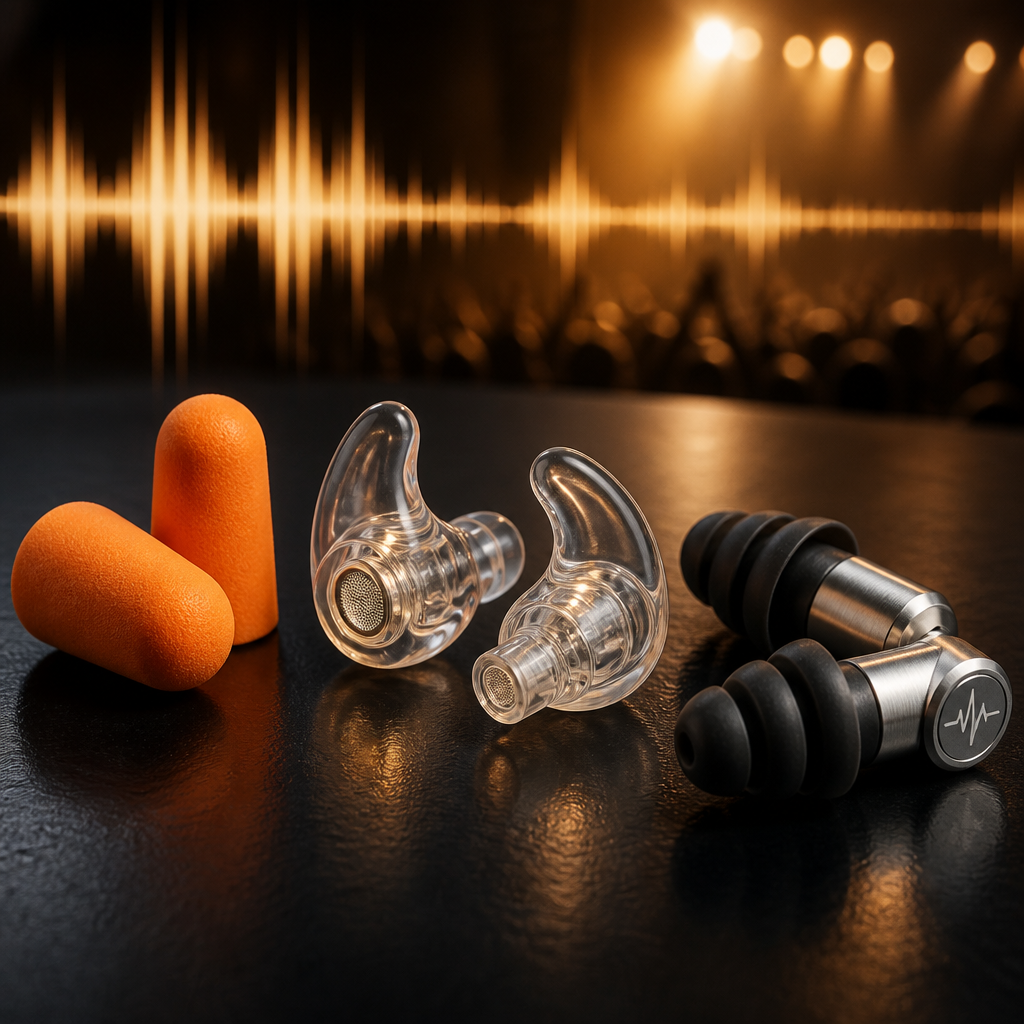
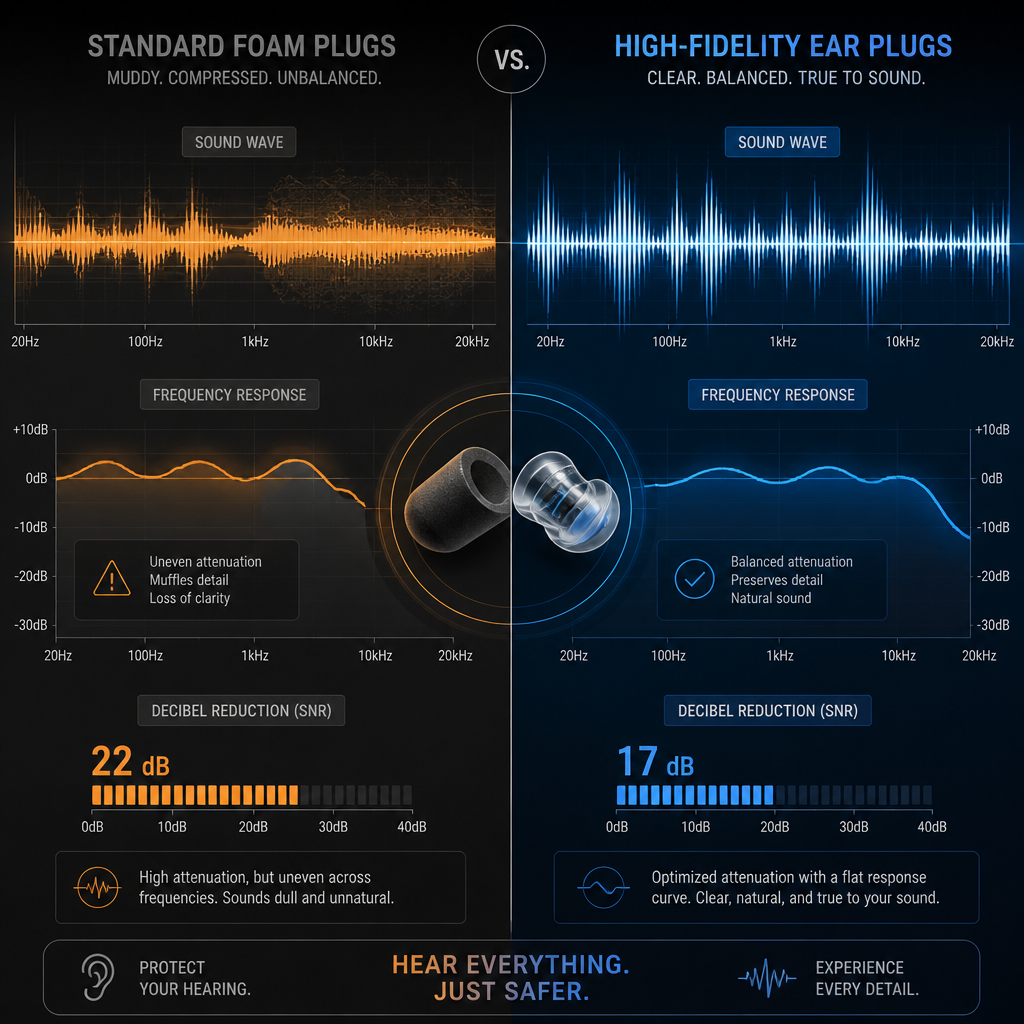
The foam earplugs you find in a convenience store or handed out at the venue door have one job: block noise. They do that job indiscriminately. Standard foam plugs attenuate high frequencies far more than low frequencies. In practice, this means a 110 dB concert becomes a 110 dB concert where the kick drum still pounds through but the vocals sound distant and underwater, the guitars lose their character, and the hi-hats almost disappear entirely.
This is not a minor audio inconvenience. It changes the fundamental character of the music. Many concertgoers who try foam plugs once never go back to them. They tolerate the noise damage instead, which is exactly the wrong outcome.
A disposable foam plug might reduce high frequencies by 30-35 dB while only cutting low frequencies by around 15 dB. The gap between those two numbers is what makes music sound wrong. You are not hearing a quieter version of the performance. You are hearing a tonally distorted version of it. The mix the sound engineer worked to create is completely undermined by an uneven attenuation curve.
Pro tip: If the only earplugs available are standard foam ones and you have no alternative, wear just one in the ear closest to the speakers, and position yourself away from the main PA stacks rather than directly in front of them. It is an imperfect workaround, but better than nothing.
High-fidelity earplugs solve the frequency imbalance problem through acoustic engineering. Instead of a dense foam mass that physically blocks sound, they use a small acoustic resistor, sometimes described as a tuned bore, membrane, or filter, that attenuates sound evenly across the full audible spectrum. The result is a quieter version of the concert, not a distorted one.
When the attenuation is equal across all frequencies, the music retains its tonal balance. Vocals stay clear. Cymbals stay present. Bass does not overpower everything else. The sound engineer’s mix remains largely intact. You are simply hearing it at a safer volume.
The difference between hearing protection and high-fidelity hearing protection is flat frequency response. One protects your ears. The other protects your ears and the music.
Flat attenuation means the plug reduces sound by approximately the same number of decibels at every frequency point, from the deep bass registers to the highest treble. A filter rated at 20 dB should reduce both 100 Hz and 8,000 Hz by roughly 20 dB each. In practice, no earplug achieves perfect flatness, but high-fidelity designs come significantly closer than foam equivalents.
This is the core specification to look for when shopping for the best ear plugs for music events. The marketing language to seek out includes “flat attenuation,” “linear response,” and “open-air membrane filter.” Ignore any earplug that does not describe its attenuation curve at all.
Choosing the right concert ear plugs comes down to five factors. Each one matters, and none of them are interchangeable.
For concerts, an NRR (or SNR in European ratings) of roughly 15-25 dB is the target zone. Below 15 dB and you are not providing adequate protection at a loud show. Above 25 dB and you risk over-damping the experience, leaving you isolated from the crowd energy and missing quiet musical passages entirely. Most high-fidelity concert earplugs sit in the 15-25 dB range deliberately, because that sweet spot brings a 110-115 dB venue down to a safe listening level without making you feel like you are watching the show through soundproofing glass.
As covered above, this is the single most important technical specification. Without flat attenuation, the number on the box is largely irrelevant to sound quality. Prioritize this over everything else.
A perfectly engineered earplug that does not seal your ear canal is not performing to its rated specification. The acoustic seal is what activates the filter. Without it, sound leaks around the plug and the attenuation is inconsistent. Always choose plugs that come with multiple tip sizes. Ear canals vary significantly between people, and the size that seals one person’s ear completely may leave a gap in another’s.
Memory foam tips are particularly effective here because they conform to the unique shape of your canal rather than imposing a fixed geometry on it. This is why ATTENU8’s metal-body plugs pair their rigid aluminium body with three sizes of soft memory foam tips (XS, S, M). The body maintains the acoustic performance; the tips ensure the seal.
If you attend concerts regularly, a durable reusable plug will outlast hundreds of disposable pairs and maintain more consistent acoustic performance across its lifetime. A metal or hard-shell body resists compression and deformation, meaning the filter geometry stays intact show after show. ATTENU8’s aluminium-bodied design is built on exactly this principle. Only the memory foam tips need replacing, roughly every 6-8 weeks depending on use, rather than the entire unit.
A common practical concern is visibility. Many concertgoers, particularly at smaller venues or when attending with unfamiliar groups, prefer plugs that do not visually announce themselves. Low-profile designs that sit flush with the outer ear are worth considering. A plug you actually wear consistently is worth far more than a technically superior one you leave in your pocket because it looks bulky.
Pro tip: Before a big show, test your earplugs at home with music you know well. If the sound still feels balanced, with clear highs and defined mids, the attenuation curve is working correctly. If everything sounds thick and muddy, you have not found a high-fidelity design yet.
| Feature | Disposable Foam Plugs | Plastic High-Fidelity Plugs (e.g., Loop, Flare) | Reusable Metal-Body Plugs (e.g., ATTENU8) |
|---|---|---|---|
| Sound quality at concerts | Poor. Heavy high-frequency roll-off creates muffled, distorted sound. | Good. Flat attenuation filters preserve tonal balance. | Excellent. Aluminium body preserves filter geometry for consistent flat attenuation. |
| Noise reduction range | High raw NRR (often 30+ dB) but uneven across frequencies. | Typically 15-25 dB with more even frequency response. | Approximately 32 dB with even attenuation across frequencies, suitable for very loud venues. |
| Fit and seal consistency | Variable. Soft foam can degrade quickly; single size fits poorly for many users. | Moderate. Plastic bodies offer limited conformity to canal shape. | Strong. Multiple tip sizes (XS, S, M) in memory foam ensure a reliable acoustic seal. |
| Durability | Single use. Inconsistent from pair to pair. | Moderate. Plastic shells can crack; tips wear over time. | High. Metal body does not deform. Only foam tips require periodic replacement (every 6-8 weeks). |
| Long-term cost | Low per pair but high over time if used regularly at shows. | Mid-range upfront; full replacement needed when worn out. | Higher upfront but low ongoing cost. Only replacement tips needed. |
| Best suited for | One-off industrial or construction use. Not ideal for music. | Casual concertgoers who attend a few shows per year. | Regular attendees, frequent travellers, and anyone who needs consistent performance across different noise environments including concerts, transport, and sleep. |
Not all concert environments are equal. A stadium rock show and an intimate jazz club present very different exposure profiles, and the right earplug choice reflects that.
These are the loudest environments. Stacked line arrays, subwoofers, and the sheer physical scale of the PA systems push levels to the upper end of the 100-120 dB range. A higher-attenuation plug in the 20-25 dB range is appropriate here. The acoustic pressure is intense enough that even a high-fidelity plug at this rating will still feel engaging.
Smaller rooms with reflective walls can actually be more damaging in some frequency ranges because the sound has nowhere to dissipate. A 15-20 dB flat-attenuation plug works well here. The mix in a smaller room is often clearer to begin with, so the high-fidelity advantage is especially noticeable.
These tend to be quieter by comparison, with peak levels around 90-100 dB. The dynamic range is wider, which means the plug you choose needs to handle both very quiet passages and sudden loud ones. A lower-attenuation, extremely flat-response plug preserves the most musical detail in this context. Fit and seal quality are critical here because any leakage will disrupt the listening experience at lower volumes.
Even the technically best earplug fails if it is uncomfortable enough that you remove it halfway through a show. Comfort over a three-hour set is a real-world specification, not a secondary concern.
The two main comfort factors are tip material and body weight. Memory foam tips conform to the canal and create a seal without the rigid pressure that harder silicone tips can produce over long periods. A lightweight body, whether metal or plastic, matters because even a few grams of additional weight becomes noticeable when you are moving and turning your head throughout a performance.
A common mistake is assuming the medium tip is right for most ears. In practice, ear canals vary considerably, and an oversized tip that creates a pressure seal is just as problematic as an undersized one that does not seal at all. Both fail in different ways. The oversized tip causes discomfort that leads to early removal. The undersized tip leaks sound and underperforms on attenuation.
This is why ATTENU8 includes XS, S, and M memory foam tips with every pair. Trying all three at home before a show to identify the correct fit is the single most impactful thing you can do to ensure both comfort and full rated noise reduction.
Reusable plugs need basic maintenance. Wipe the body down after each use to remove oils and debris. Replace memory foam tips when they lose their elasticity, roughly every 6-8 weeks under regular use. Keep them in a case rather than loose in a pocket or bag where they accumulate grit. A plug that fits and seals correctly at the start of the night should feel the same at the end of it.
Not if you choose the right attenuation level. A plug in the 15-20 dB NRR range will bring a typical concert from a damaging 110-115 dB down to a safer 90-95 dB level. That is still loud. The show still feels energetic and immersive. The goal is not silence, it is a safer volume that preserves the full musical experience rather than cutting it off.
NRR (Noise Reduction Rating) is the standard used in the United States, while SNR (Single Number Rating) is used in Europe and Australia. They are calculated slightly differently, so the numbers are not directly interchangeable. A product rated SNR 20 dB is broadly similar in performance to one rated NRR 18-20 dB, but always check which standard a product is using before comparing numbers across brands.
For regular concert use, yes. A metal body resists the deformation and compression that gradually changes the geometry of plastic shells over time. That means the acoustic filter inside maintains its designed performance for much longer. The ATTENU8 aluminium-body design specifically addresses this by keeping the structural integrity of the plug stable across years of use, with only the foam tips needing replacement.
Yes, and a reusable plug with memory foam tips is one of the best dual-purpose options available. The same properties that make ATTENU8 plugs effective at a concert, a firm body with conforming foam tips that seal the canal, also make them effective for blocking noise during sleep or travel. The key is having the right tip size for a comfortable overnight seal. Many users find that the same size that works at a concert is also ideal for sleep.
A correct seal produces a clear, immediate change in the volume of the environment when the plug is fully seated. If you insert an earplug and the change in sound level is gradual or incomplete, the tip is too small or not seated deeply enough. At a concert, cup your hands lightly over your ears with the plugs in. If the volume drops further significantly, you have a seal problem. A good seal means your cupped hands add very little additional reduction.
Every 6-8 weeks under regular use is a reasonable benchmark. The signal that tips need replacing is loss of elasticity. Memory foam should spring back to shape after compression. When it no longer does that reliably, the seal consistency drops. For someone attending one to two concerts per month and also using the plugs for travel or sleep, that 6-8 week window is a practical guideline rather than a strict deadline. Replace them when the foam no longer recovers its original shape.
Have you found a concert earplug setup that works well for you, or are you still searching for the right fit and attenuation level? Share your experience in the comments.
Pick up a pair of standard foam ear plugs and compress them between your fingers. In seconds, the material starts recovering, begins its push outward, and you hope for the best. Now consider that the entire structure doing the acoustic work, the housing guiding placement, depth, and seal, is made from a soft cylinder with no rigid reference point at all. That is the fundamental design limitation that a metal ear plug body solves. ATTENU8 built its ear plugs around a concave aluminium body precisely because the material choice is not cosmetic. It is structural, hygienic, and directly tied to consistent noise reduction performance every single time you insert them.
| Key Insight | Explanation |
|---|---|
| Aluminium holds its geometry permanently | Unlike plastic, aluminium does not creep, warp, or deform from body heat or compression over time, keeping the ear plug body dimensionally stable for years. |
| The concave shape guides foam tip placement | ATTENU8’s concave aluminium body positions the memory foam tip consistently at the right depth, removing the guesswork that causes variable sealing with straight foam cylinders. |
| Aluminium is non-porous, plastic is not | A non-porous surface does not harbour earwax, oils, or bacteria between uses. Plastic surfaces develop micro-scratches that trap contaminants over time. |
| Only the foam tips need replacing, not the body | ATTENU8 foam tips are replaced every 6-8 weeks. The aluminium body lasts years, making this far cheaper than discarding complete plastic or foam ear plugs repeatedly. |
| The density change between aluminium and foam drives noise reduction | The acoustic mass difference between the aluminium body and the memory foam tip contributes to ATTENU8’s approximately 32dB SNR rating, exceeding what foam-only designs typically achieve. |
| Anodised aluminium resists corrosion in a moisture-rich environment | The ear canal produces moisture, heat, and oils. Anodised aluminium forms a protective oxide layer that makes it resistant to this environment where plastic coatings peel and degrade. |
| Three foam tip sizes ship with every pair | XS, S, and M memory foam tips let wearers dial in the fit without buying accessories separately, a key practical advantage over one-size competitors. |
Most people shopping for ear plugs focus entirely on the noise reduction rating. That number matters, but it is only achievable if the ear plug maintains its structural integrity and seals correctly on every insertion. The housing material determines whether that happens reliably or only sometimes.
Disposable foam ear plugs work well when new. Their design asks the user to compress the foam, insert it, and wait for it to expand. The problem is that the foam is doing three jobs at once: it is the structure, the seal, and the attenuator. When foam degrades from repeated handling, body oils, and moisture, all three functions degrade together. There is no rigid component to maintain geometry.
A metal ear plug body separates those functions. The aluminium housing provides stable geometry and guides placement. The foam tip provides the seal. Because each component does only its own job, the system remains reliable even as tips wear and get replaced. This is the engineering logic behind ATTENU8’s design, and it is why material selection is not a marketing decision but a functional one.
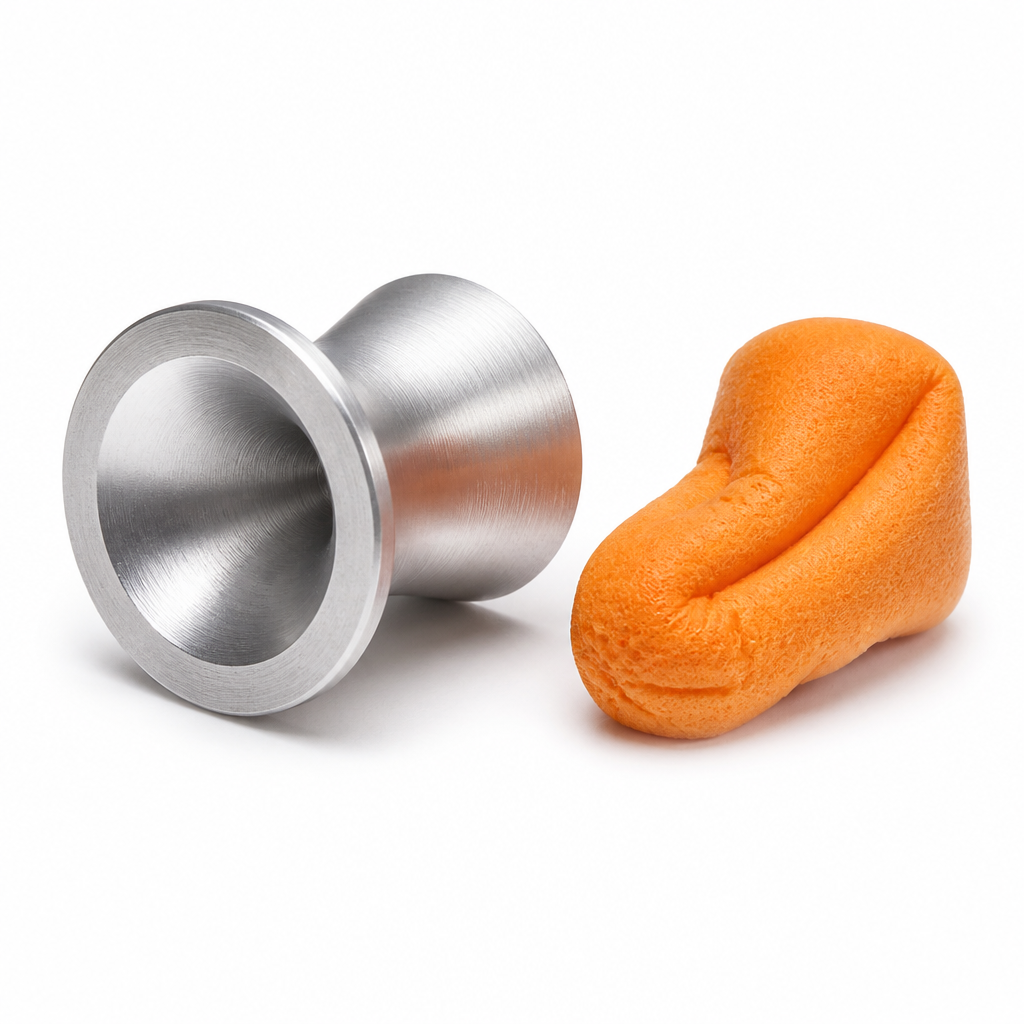
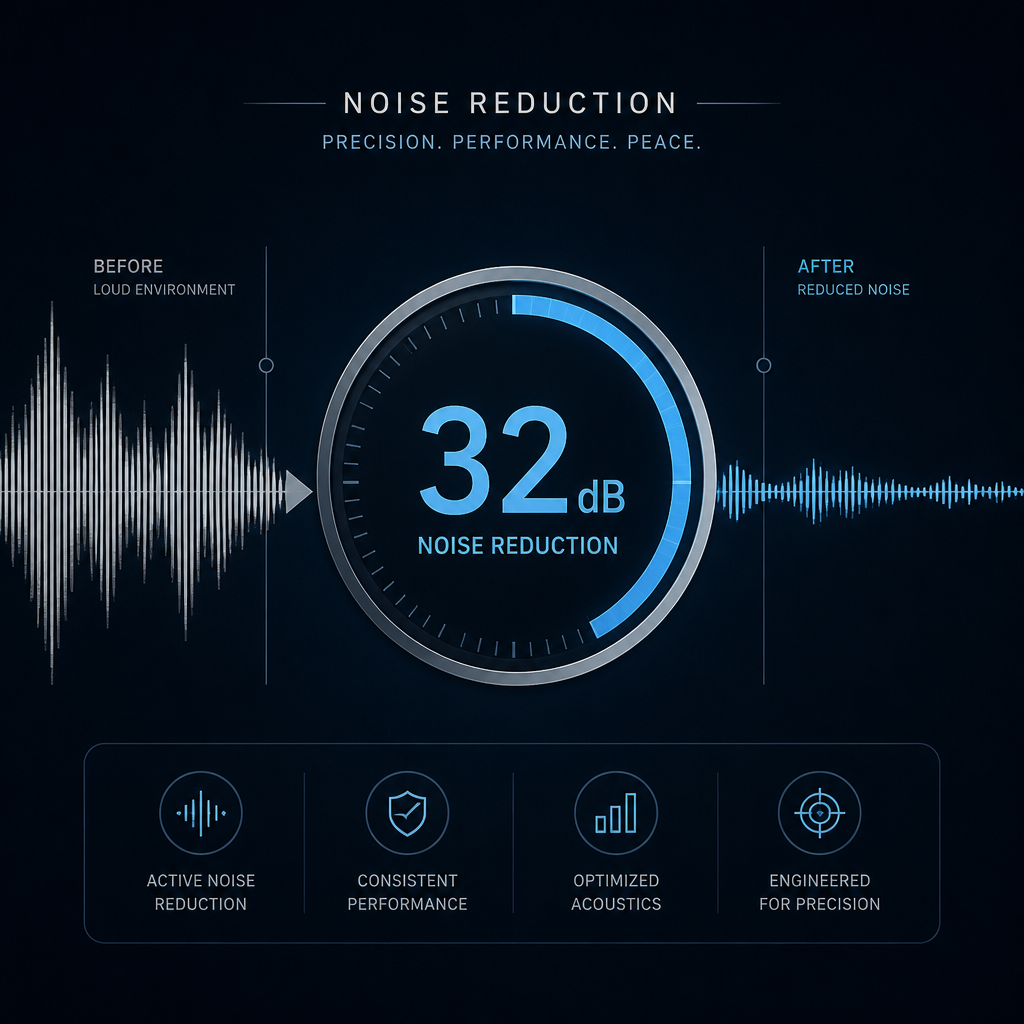
Aluminium is not chosen arbitrarily for precision applications. Its combination of properties makes it genuinely superior for a wearable hearing protection device that needs to survive years of daily handling in a warm, moist environment.
Aluminium has a density of approximately 2.7 g/cm³, which means the ATTENU8 body contributes negligible weight to the ear plug. For a product worn during sleep, weight matters. Heavy ear plugs create pressure against the pillow and the ear canal walls, interrupting sleep rather than enabling it. The aluminium body is rigid enough to hold its shape under any realistic handling force while remaining light enough that side sleepers do not feel it pressing against the pillow throughout the night.
Aluminium alloys also offer high strength-to-weight ratios compared with most plastics, meaning the body resists the micro-fractures and stress cracking that can affect plastic housings at stress concentration points, particularly around the tip-insertion area where repeated flexing occurs.
When aluminium is exposed to air, a layer of aluminium oxide forms almost instantaneously on its surface. This oxide layer provides excellent resistance to the warm, humid, earwax-rich environment of the ear canal. ATTENU8’s anodised finish reinforces this protection further, creating a harder surface that resists the daily abrasion of insertion and removal. Plastic housings have no equivalent natural protection mechanism. Their resistance depends entirely on coatings and formulation quality, both of which degrade with UV exposure, heat cycling, and chemical contact.
Pro tip: Wipe the aluminium body with a damp cloth weekly. Because the surface is non-porous and anodised, this 30-second routine keeps the body clean without any risk of damage to the material or surface finish.
The density change between the aluminium body and the soft memory foam tip is not incidental. It is acoustically significant. Sound energy transmits efficiently through materials of similar acoustic impedance and loses energy at boundaries between materials of very different impedance. The aluminium-to-foam interface creates exactly that kind of impedance mismatch, which contributes to the sound attenuation before the acoustic energy even reaches the ear canal. This is part of why ATTENU8 achieves an approximately 32dB SNR rating rather than the lower figures typical of foam-only designs.
Plastic-bodied ear plugs occupy a middle ground in the market: more structured than raw foam, less durable than metal. In practice, plastic housings fail in ways that are gradual enough to be invisible until the product simply stops performing reliably.
The ear canal sits at body temperature, and ear plugs worn during sleep are held against warm skin for six to eight hours at a time. Many consumer plastics have relatively low heat deflection temperatures. Over months of nightly use, repeated thermal cycling causes dimensional change in the housing. A housing that no longer holds its original geometry no longer positions the foam tip at the designed depth and angle. The seal quality becomes inconsistent, and users notice that the same ear plugs seem to provide less noise reduction than they once did.
Aluminium’s thermal properties are fundamentally different. It conducts heat away from contact points quickly and has a melting point far beyond any temperature the ear canal will reach. The geometry of an aluminium body remains stable after years of use in the same way it was stable on day one.
Plastic surfaces develop micro-scratches from routine handling. Every insertion and removal, every time the ear plug is dropped on a nightstand, every contact with keys and coins in a travel bag adds surface damage. Those micro-scratches create a texture that traps earwax, skin oils, and moisture. Over time, a plastic housing that started smooth develops a microscopically rough surface that is both harder to clean and more hospitable to bacterial growth.
Porous surfaces, including raw foam bodies and some silicone compounds, absorb earwax, oils, and moisture. Over time, this absorption creates an environment that supports bacterial growth. A non-porous metal surface with an anodised finish does not share this vulnerability.
Anodised aluminium, by contrast, resists scratch formation due to the hardness of the oxide layer. The surface that ships with the product is largely the surface you will be cleaning two years later.
Plastic housings are sensitive to prolonged UV exposure, which degrades polymer chains and causes brittleness, discolouration, and surface cracking. Travel ear plugs spend time in bags left in cars, on windowsills, and in direct sunlight. An aluminium body is unaffected by UV radiation. It does not bleach, does not become brittle, and does not develop surface crazing. For a product meant to be genuinely reusable over years, this resistance to environmental degradation is not a minor benefit. It is the difference between a product that lives up to its “reusable” claim and one that quietly becomes unreliable within 12-18 months.
Pro tip: When travelling, store ATTENU8 in its case rather than loose in a bag. Not because the aluminium body needs protection from impact, but because keeping the foam tips clean before insertion matters more than protecting the body itself.
The shape of the ATTENU8 body is as important as the material. A concave aluminium profile is not an aesthetic choice. It is an ergonomic and acoustic one.
Standard cylindrical foam ear plugs rely entirely on the user’s technique for insertion depth and angle. Get it slightly wrong and the seal is compromised. Get it very wrong and the noise reduction rating the lab measured becomes irrelevant to what you actually experience. The concave shape of the ATTENU8 body creates a natural resting depth, guiding the foam tip to a consistent position in the ear canal on every insertion.
This is especially important for first-time users and for people with irregular sleep positions who reinsert ear plugs during the night without the benefit of a mirror or full concentration. The body acts as a depth stop, making correct placement the path of least resistance rather than a technique that requires practice.
For side sleepers in particular, a low-profile housing that sits flush with the ear rather than protruding is important for comfort. ATTENU8 includes specific bottom foam tips designed for side sleepers, addressing directly the pressure point that causes most people to abandon ear plugs after one uncomfortable night.
Ear plugs for sleep are worn for six to eight hours in a warm, enclosed environment with direct skin contact. The hygiene requirements for this use case are more demanding than for short-duration industrial use. Material choice has direct hygiene consequences.
Raw foam bodies and many silicone compounds are porous or semi-porous at a microscopic level. They absorb earwax, skin oils, and moisture. A foam plug that looks clean visually may have absorbed contaminants that cleaning cannot remove because the material holds them beneath the surface. This is why disposable foam plugs are disposable. The cleaning problem is solved by replacement.
The anodised aluminium body of ATTENU8 is non-porous. Contaminants sit on the surface rather than being absorbed into it. A wipe with a damp cloth removes them. This is also why the maintenance model makes sense: the foam tips, which do the sealing and do come into sustained contact with ear canal skin, are replaced every 6-8 weeks. The aluminium body, which does not absorb contaminants, is simply cleaned. The two components have different maintenance schedules because they have different hygiene properties.
Competitors with plastic bodies occupy an awkward middle ground: they are presented as reusable, but their surfaces develop the micro-scratch texture that traps contaminants over time. The choice to use aluminium with an anodised finish at ATTENU8 is a choice to make the reusable promise a genuine one rather than a compromise.
Understanding how these three housing approaches compare across the dimensions that actually matter to daily users cuts through a lot of marketing noise. The table below addresses the specific performance categories relevant to sleep, travel, and noise-sensitive use.
| Performance Category | Aluminium Body (ATTENU8) | Plastic Body (Lifestyle Competitors) | Raw Foam (Disposable) |
|---|---|---|---|
| Structural longevity | Decades. Aluminium does not warp, crack, or deform from heat or handling. | 12-24 months typical before thermal cycling and micro-cracking affect geometry. | Single use. Degrades from first handling. |
| Noise reduction consistency | Consistent. Concave body guides foam tip to correct depth every insertion. | Variable. Housing geometry may shift over time, affecting tip positioning. | Highly variable. Entirely technique-dependent. No rigid reference point. |
| Hygiene maintenance | Non-porous anodised surface. Wipe clean. Replace foam tips every 6-8 weeks. | Surface develops micro-scratches that trap contaminants. Harder to clean reliably. | Not cleaned. Discarded after use. |
| Weight and sleep comfort | Very low weight. Low-profile concave shape. Specific side-sleeper tips included. | Light, but protrusion profile varies. Side-sleeper comfort is a common complaint. | Very light but unstable. Moves during sleep. Often found on the pillow by morning. |
| Environmental and cost impact | Body lasts years. Only tips replaced every 6-8 weeks. Minimal waste. | Full product replaced when housing degrades. More waste than metal alternative. | Disposed of after every use. Highest ongoing cost and waste generation. |
| SNR rating | Approximately 32dB. CE certified to BS EN352-2:2002. | Typically 17-24dB SNR for lifestyle-positioned plugs. | High when new, but field performance typically much lower due to inconsistent insertion. |
The upfront price of aluminium ear plugs is higher than disposable foam. This is a real fact, not a disadvantage when examined over any meaningful time horizon, but it is the number that stops some buyers at the first decision point.
Consider the actual cost model. A pair of disposable foam ear plugs used nightly means 365 pairs consumed per year. Even at low per-pair cost, the annual spend adds up consistently, and the waste is substantial. A box of 200 pairs looks economical until you calculate how quickly it disappears for a person using them every night.
With ATTENU8, the aluminium body is a one-time purchase. Replacement foam tips are the only ongoing cost, at a replacement interval of every 6-8 weeks. Over a two-year period, the total cost of the durable reusable ear plugs model, including all tip replacements, is substantially lower than the equivalent in disposable foam. One internal analysis referenced by ATTENU8 describes metal designs as 70-80% cheaper than disposable foam over multi-year periods, despite higher initial cost.
The environmental case is equally clear. A single aluminium body replacing hundreds of disposable foam units over its lifetime represents a material reduction in plastic and foam waste. For buyers motivated by sustainability, this is not a secondary consideration. It is a core reason to choose the metal option from the start.
For professionals in construction, manufacturing, or other high-noise environments who require hearing protection for repeated daily use across years, the economics are even more straightforward. The aluminium body does not degrade with industrial-environment exposure in the way that plastic-bodied alternatives do. The maintenance overhead is predictable: clean the body, replace foam tips on schedule, and the product performs consistently.
No. Aluminium has a density of approximately 2.7 g/cm³, which means the ATTENU8 body adds negligible weight compared with any realistic alternative. The concave shape also sits lower in the ear than most cylindrical or bulbous plastic designs, which reduces the feeling of protrusion, particularly relevant for side sleepers.
The aluminium body contributes in two ways. First, it guides the memory foam tip to the correct insertion depth consistently, which is where most noise reduction is lost in foam-only designs. Second, the acoustic impedance mismatch at the aluminium-to-foam boundary adds an additional attenuation layer before sound reaches the ear canal. Together, these effects support ATTENU8’s approximately 32dB SNR rating.
Aluminium naturally forms a protective oxide layer when exposed to air, giving it inherent corrosion resistance. ATTENU8’s anodised finish reinforces this further. The combination of the natural oxide layer and the anodised surface means the body is well-suited to the warm, moist environment of the ear canal and does not corrode, stain, or discolour with regular use and proper cleaning.
Loop and Flare Audio products use plastic or silicone housings and tend to target lifestyle or concert-going use cases with lower SNR ratings, typically in the 17-24dB range. ATTENU8’s aluminium body achieves approximately 32dB SNR, which positions it at the higher end of hearing protection for sleep and professional environments. The structural longevity and hygiene properties of the aluminium housing are also distinct from what plastic or silicone-bodied alternatives offer.
ATTENU8 foam tips are designed to be replaced every 6-8 weeks of regular use. The tips are the sealing component that contacts the ear canal and that absorbs the most wear and contamination. The aluminium body does not require replacement, only regular cleaning with a damp cloth. This maintenance model means the ongoing cost is low and the aluminium body itself is genuinely a long-term investment.
The anodised aluminium surface of ATTENU8 does not come into direct contact with ear canal skin. The memory foam tips form the interface between the product and the skin. Aluminium itself has a strong biocompatibility profile and is used widely in medical and food-contact applications. The combination of an anodised outer body and foam tips means metal sensitivity is not a practical concern for the vast majority of users.
If you have switched from disposable foam or a plastic-bodied ear plug to a metal body design, we would like to hear what difference you noticed in fit, comfort, or noise reduction quality.

